Summary
- The economic unit is a colocation cabinet and power reservation. The customer is not only buying metal space in a rack; it is reserving 208V power, A+B delivery, cooling density, access controls, web-visible monitoring, network ports, remote-hands support and a contractual path for credits when service levels fail (https://acedatacenter.com/colocation.php, https://acedatacenter.com/sla.php).
- Ace's own facility material gives unusually concrete unit detail for a small public operator: 8,500 square feet of raised floor, 394 total 52U high-density cabinets, 30A 208V zero-U PDUs per cabinet, redundant A+B cabinet power, six 750 kW UPS units, three 2 MW N+1 generators, 3,500 gallons of fuel storage per generator, N+2+ cooling, 750 tons of cooling capacity and an average annual PUE claim below 1.2 (https://acedatacenter.com/facility-details.php).
- Public network and registry records support the existence of an active network-resource surface for Ace Data Centers II, LLC, including ARIN organization records and AS401152. Those records are useful evidence of public network operation, but they do not prove customer workloads, internal architecture, revenue, uptime history or data-residency outcomes (https://rdap.arin.net/registry/entity/ADCIL, https://rdap.arin.net/registry/autnum/401152, https://bgp.tools/as/401152).
- The disciplined thesis is narrow. Official documents support a technically specific Orem colocation offer, operating evidence suggests a facility designed around cabinet-level power reservations, and market context makes Utah power and locality more valuable. Missing metrics leave the thesis unproven at the economics, reliability and retention levels (https://lf-public.deq.utah.gov/WebLink/DocView.aspx?dbid=0&id=556627&repo=Public, https://d36oiwf74r1rap.cloudfront.net/wp-content/uploads/2026/04/Data-Center-Growth-FS-Apr2026.pdf).
The customer reserves power before space
Start at the cabinet door, not at the company logo.
A buyer who signs for a quarter rack, half rack or full cabinet at Ace is not mainly buying a rectangle of metal. The buyer is making a claim on a chain of physical and operational inputs that have to be in place before the first server becomes useful. The server needs a secure cabinet. The cabinet needs power. The power needs redundancy. Redundancy needs UPS capacity, generator fuel, switchgear, monitoring, maintenance windows and a service contract that tells the customer what happens when both feeds fail. The rack needs cool air.
Cooling needs raised floor, contained hot and cold aisles, chillers, CRAC capacity, sensor alarms and staff who can move tiles, change set points or guide a customer through a thermal incident. The customer needs access. Access needs identity checks, cameras, doors, mantraps, badge systems, logged entry, escorted work and remote hands when the customer cannot be present. The network needs ports, cross-connects, transit, routing and a way to measure bandwidth.
That is the paid unit behind this article: a colocation cabinet and power reservation. It is a reservation because the customer wants capacity to be waiting before its hardware arrives. It is power-led because an empty cabinet has almost no value unless the operator can energize and cool it. It is an infrastructure decision because the customer is deciding not to build a small server room, not to rely entirely on public cloud, and not to send every workload to a very large carrier hotel or hyperscale campus.
Ace's public material makes that unit unusually visible. The facility specification page describes 8,500 square feet of raised floor and 394 total 52U high-density cabinets. The cabinet section says the customer can choose quarter rack, half rack or full cabinet, with 52U 19-inch high-density cabinets, front and rear locking options, private or semi-private pods of 20 cabinets and 30A 208V zero-U PDUs installed to each cabinet. The power section describes redundant A+B power to each cabinet, three sets of dual segregated transformers, redundant critical power paths, full bypass capability, six 750 kW UPS units and three 2 MW N+1 generators wired in parallel with 3,500 gallons of fuel storage each and priority refueling contracts. The same page says power is delivered at 208V and that remote monitoring and reboot are supported through a web portal (https://acedatacenter.com/facility-details.php).
Those figures matter because they translate a sales claim into the unit a customer actually reserves. A full cabinet does not only mean 52U of vertical room. It implies a specified voltage, a cabinet PDU, cooling expectations, power-path resilience, security controls, network access and operational support. A buyer comparing Ace with cloud instances, a small office server closet, an enterprise data center or another colocation site is really asking whether that chain is worth paying for before utilization is known.
The evidence supports that question. It does not answer every part of it. Public materials show technical design claims, service terms, security measures, IP-transit price bands, uptime and power availability language, and current network-resource records. They do not show contracted power, actual cabinet utilization, recurring revenue, measured PUE by month, outage history, customer concentration or retention. The thesis must therefore remain bounded: Ace has public evidence of a specific cabinet-and-power product; public evidence does not prove how profitable, reliable or sticky that product is today.
Identity and facility proof have to be separated
The public identity trail has two strands. The directory entity is Ace Data Centers II, LLC. ARIN's organization record for ADCIL lists Ace Data Centers II, L.L.C. at 727 North 1550 East, Suite 400, Orem, Utah, with a 2020 registration and a May 2026 update; ARIN's AS401152 record ties ACEDATACENTERS-DCH to the same registrant and shows a 2024 registration with the same May 2026 update. Those records are strong evidence for the current network-resource holder, not a full statement of facility ownership (https://rdap.arin.net/registry/entity/ADCIL, https://rdap.arin.net/registry/autnum/401152).
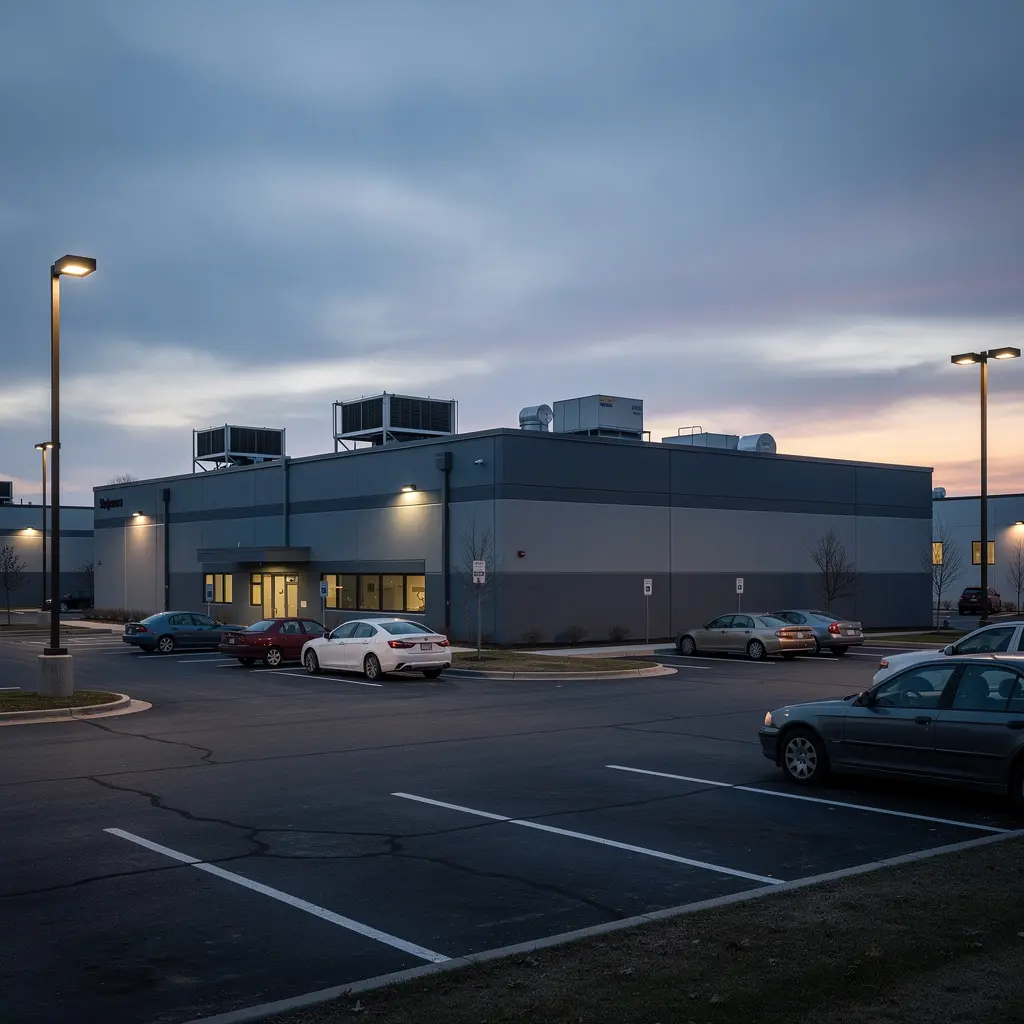
The facility trail is more complicated. Ace-branded pages describe an Orem-area cabinet colocation product with raised floor, cabinet, power, cooling, security and support detail. A 2024 Utah Division of Air Quality approval order, however, identifies "Bluehost Holdings - Data Center" at 1958 South 950 East, Provo, says Bluehost Holdings operates a data center in Utah County, lists three diesel-fueled emergency generators rated 2 MW each, and says the earlier Ace Data Center source was purchased by Bluehost Holdings. That government record is live facility evidence, but it points to Bluehost Holdings as the owner/operator of that permitted emissions source rather than to Ace Data Centers II as sole owner of the physical plant (https://lf-public.deq.utah.gov/WebLink/DocView.aspx?dbid=0&id=556627&repo=Public).
A contractor project page adds useful but secondary facility context: it describes an Ace Data Center project in the Provo area with 17,000 square feet total, including an 8,500-square-foot server rack room and 8,500 square feet of support and access space, plus redundant diesel generation. That aligns with the scale of Ace's own raised-floor claim, but the contractor page uses a different generator count than the Utah air record and should not be treated as a current operating certificate (https://www.gslelectric.com/ace-data-center).
The conservative reconciliation is to distinguish brand, resource and plant evidence. Ace Data Centers II has current public network-resource records. Ace-branded pages preserve a detailed customer-facing colocation offer. Public air-permit evidence shows that at least the historic Provo generator source moved to Bluehost Holdings. Therefore this article treats Ace pages as product and design evidence, ARIN and BGP records as live network-resource evidence, and Utah air records as facility/ownership boundary evidence.
A current operator statement, utility interconnection record, lease record or ownership filing tying today's cabinet service directly to the LLC would raise confidence.
The rack is the accounting unit, but not the cost center
The visible product is easy to count. Ace says the facility has 394 total high-density cabinets. The accounting unit may be a quarter rack, half rack or full cabinet. The customer may ask how many rack units are available, whether front and rear doors lock, whether the cabinet sits in a pod, how many amps are included, how bandwidth is billed, how remote hands are handled, whether the customer can enter at 2 a.m., and whether power failures produce credits.
The cost center is harder. A cabinet reservation consumes shared infrastructure before it earns full revenue. UPS systems have to be installed and maintained whether the cabinet is fully occupied or waiting for a customer. Generators must be tested and refueled. Cooling systems must support the room, not only one customer's server. Security staff, cameras, card readers, remote-hands personnel, network operations and support tools have fixed-cost characteristics. Spare capacity is not free, but a customer will not sign if the operator has no spare power, no spare cooling and no rapid deployment path.
Ace's own colocation page makes that tradeoff explicit in marketing language. It argues that a customer can avoid the cost of building its own data center while still owning and maintaining its own servers. It also says Ace offers both fixed and usage-based pricing and additional monitoring, services and security. That is the classic colocation value proposition: the customer keeps control of hardware and software while outsourcing the building, power, cooling, physical security and some operational labor (https://acedatacenter.com/colocation.php).
The economic question is whether Ace can price that bundle well enough to recover the fixed cost of the facility and support team. Small and midsize colocation is not just rent per rack. It is a pooled-capacity business. Customers arrive with different power densities, hardware ages, cabling practices, support demands and outage sensitivity. Some use a fraction of the included power; others push density and require careful cooling. Some need remote hands rarely; others need crisis work, migration help and cabling support.
A good operator converts those differences into margins through standard cabinets, standard power feeds, disciplined remote-hands policies and contract language. A weak operator gives away too much operational labor, underprices power or fills the room with customers whose support burden exceeds their monthly charges.
The official pages do not publish current cabinet pricing. The old colocation pricing page says the site was close to 100 percent leased and expected additional colocation space toward 2013 Q2. That is a historical utilization signal, not current proof. It shows that at one point the company presented scarcity as real enough to pause public colocation pricing. It does not show current occupancy, current expansion capacity or current sales velocity. The IP-transit pricing page is more specific: it lists month-to-month contracts, no surcharge for bursting, and price bands from $25 per Mbps at 10 Mbps to $3.50 per Mbps at 1,000 Mbps, with larger commits requiring a call. Those bandwidth figures give a proxy for the pricing culture around flexible commits, but they are not a cabinet price sheet (https://acedatacenter.com/pricing.php, https://acedatacenter.com/ip-pricing.php).
For the buyer, the absence of current published cabinet price is normal but important. It means procurement becomes negotiated. The buyer has to ask how much power is included, how overages are measured, how bandwidth is metered, whether remote hands are free or billable, what cross-connects cost, how long a reservation holds, what happens if hardware delivery is delayed, and whether credits are meaningful relative to downtime risk. The public record proves the existence of the product architecture. It does not prove the current unit economics.
Power availability is the product behind the cabinet
Ace's strongest public evidence is in its power language. The facility specification page says each cabinet receives redundant A+B power. It names three sets of dual segregated transformers, redundant critical power paths, full bypass capability, six 750 kW UPS units, 120 minutes of UPS battery time at peak load, three 2 MW N+1 generators and 3,500 gallons of fuel storage for each generator. It also says additional UPS or generator capacity can be added as needed and that there is allocated space for more generator installation (https://acedatacenter.com/facility-details.php).
This is the core reservation. A customer can buy servers anywhere. It can rent virtual machines with a credit card. It can use managed hosting or cloud. It can keep a small on-premises server closet alive with a single UPS. The reason to reserve a colocation cabinet is that the customer wants industrialized power availability without owning the building. Ace's power evidence speaks directly to that buyer.
The service level agreement sharpens the point. It says AC power is to be available to the customer's data center colocation cabinet 100 percent of the time. It also requires the customer to use equipment capable of dual power sources and to plug directly into both the A and B power strips. That caveat is not legal decoration. It is the boundary between a facility failure and a customer-equipment failure. If a customer installs single-corded equipment, overloads a power rating or ignores electrical standards, the facility cannot turn that into a redundant service just by contract language (https://acedatacenter.com/sla.php).
The SLA defines power unavailability around AC power not being available to the cabinet's primary outlet or redundant outlet at the same time, subject to ticket and exclusion conditions. The remedy is a service credit for each cumulative hour or fraction of power unavailability affecting both A and B circuits, capped by the relevant monthly recurring charges. That structure is familiar in colocation. It makes the guarantee commercially real, but it does not make the customer whole for business interruption.
The credit protects the service contract; it does not pay for lost application revenue, lost trading activity, failed backups, reputation damage or emergency migration work.
That distinction changes how a rational customer evaluates Ace. The buyer should not ask only whether the site advertises 100 percent power availability. It should ask whether the power design, maintenance discipline, testing history, customer equipment profile and escalation path make simultaneous A+B failure unlikely. Public evidence supports a technical design claim. It does not supply the incident record needed to prove realized power reliability.
Power also drives the capacity value. A cabinet with 30A 208V PDUs is not equivalent to every other cabinet. At 208V, a 30A circuit can support substantially more power than a 120V office circuit, but actual usable load depends on derating, feed design, cabinet policy and the service order. High-density customers care about whether the facility can support the planned hardware, not only whether the cabinet exists. Ace's public facility language points toward high-density service, but procurement would still need the service order, load allowance and power pricing.
This is why the article's thesis begins with the power chain. The customer reserves the right to place equipment into a room where energized capacity has been engineered in advance. If that right is scarce, the cabinet is valuable. If it is abundant, poorly priced or unreliable, the cabinet is just a shell.
Cooling converts amperage into usable capacity
Power is useless when heat cannot be removed. Ace's cooling claims are therefore not secondary. They are part of the same reservation.
The facility page says the colocation room uses fully segregated hot and cold aisles, N+1 redundant chillers, N+2+ cooling redundancy, 750 tons of total cooling capacity, twelve 60-ton Liebert CRAC units and one additional 30-ton unit, a 36-inch raised floor and outside air for much of the year. It also says the system has automated controls, alerting, fault detection and backup units. The facility tour describes contained and segregated aisles and says each cold aisle in a private suite or pod contains 20 high-density cabinets offering A+B power. It also says average annual PUE is below 1.2 (https://acedatacenter.com/facility-details.php, https://acedatacenter.com/facility.php).
Those claims are commercially meaningful. A buyer reserving cabinet power is also reserving the facility's ability to keep inlet temperatures inside policy. If the operator cannot cool the load, the customer does not really own usable capacity. Hot aisles, cold aisles, raised floors, CRAC units and outside-air economization all matter because they determine whether the customer can run the equipment it planned to install.
The SLA again gives a useful boundary. The temperature and humidity section says Ace will maintain specified environmental conditions within the data center as measured at the return air intake of CRAC units, and that customer equipment must be designed to operate within those ranges. It says Ace will respond to CRAC temperature alarms within two hours, and it will work with customers reporting temperature server alerts. The documented remedies include changing perforated tiles, changing CRAC set points or advising customer modifications to equipment configuration, with possible additional charges (https://acedatacenter.com/sla.php).
That language is practical. Cooling is a shared system, but cabinet-level outcomes depend on customer behavior. Bad blanking, poor cable management, too much rear exhaust recirculation, blocked airflow, single dense cabinets inside a lightly loaded pod and aging hardware can all undermine thermal performance. Ace is saying, in effect, that it controls the room and will adjust its systems, but customer configuration still matters. That is how colocation actually works.
The key missing evidence is measured performance. A PUE below 1.2 would be strong for the age and size of a small colocation facility, especially in a market where cooling economics are a major driver. But a PUE claim is not the same as a time series. Public sources do not show monthly PUE, load factor, seasonal variation, curtailment, cooling incidents or customer thermal complaints. They also do not show how much of the 394-cabinet fleet can operate at the highest advertised densities at the same time.
The disciplined reading is favorable but cautious. Ace's public design evidence suggests a facility built around power and cooling efficiency, not merely a generic office server room. It supports the idea that a customer can reserve a cooled cabinet. It does not prove realized energy efficiency or thermal reliability across the current customer base.
Access, remote hands and the labor layer
The next part of the reservation is human access. A cabinet becomes valuable only if the customer can install, maintain and repair hardware without turning every incident into a travel problem.
Ace's facility materials emphasize controlled access. The home page advertises 24/7 secure access, multiple layers of security checkpoints and real-time usage reports. The facility specification page says the site has strict visitor surveillance, limited data center access, more than 100 full-motion video cameras, 24/7 CCTV monitoring of exterior and interior areas, card-key access controls, mantraps, biometric hand scanners, photo-badge requirements and 24/7 manned on-site security. The facility tour describes multiple security layers before a person reaches a cabinet, including biometric and key-card validation, a staffed security desk, further key-card checkpoints, suite-level controls and lockable cabinets (https://acedatacenter.com/, https://acedatacenter.com/facility-details.php, https://acedatacenter.com/facility.php).
For a buyer, this is not just physical-security theater. It shapes operational cost. If the site allows reliable after-hours entry, the buyer can dispatch staff during outages, maintenance windows and migrations. If remote hands are competent, the buyer can avoid sending staff for every power cycle, cable replacement, keyboard connection or drive swap. If security is too loose, customers face audit and theft risk. If security is too rigid or slow, recovery time increases.
Ace's public service list includes no-charge extras such as visual checks with phone support, server lift equipment, reset cables, power cycles, portable monitors and keyboards, tech benches and tools, and expert staff. The managed services list includes equipment installation, cabling, wiring, cross-connects, equipment monitoring, first-line equipment and network maintenance, diagnostics and repair, monitoring, IP bandwidth, backup and other data management services. The colocation page adds remote reboot through a web portal, real-time power and bandwidth monitoring, DDoS protection, remote hardware hands for installation, emergency issues, crisis resolution, hardware replacement and cabling assistance, plus migration and temporary-infrastructure help (https://acedatacenter.com/facility-details.php, https://acedatacenter.com/colocation.php).
That support layer matters most for smaller and midsize customers. A hyperscale buyer may have dedicated staff, its own runbooks and multiple facilities. A regional hosting company, enterprise IT team or application provider may rely heavily on the data center's staff. In that case, the cabinet reservation includes an implied labor option: the customer can call for eyes, hands and troubleshooting when the equipment is physically far away.
Labor options can be valuable, but they can also erode margins. If the provider includes too many tasks at no charge, high-maintenance customers consume staff time without corresponding revenue. If the provider charges too aggressively for routine work, customers may see the facility as expensive and inflexible. The public pages show that Ace positioned service as a differentiator. They do not disclose remote-hands rates, average response time, staffing levels or customer satisfaction. That keeps the labor economics unproven.
Still, this is a real part of the product. The customer is reserving more than amperage. It is reserving the ability to keep hardware alive when no employee is standing in the room.
Network capacity turns the rack into a service platform
Power and cooling keep the cabinet alive. Network access makes it useful.
Ace's facility specification page says the facility has more than 120G of fiber transport connectivity to the internet backbone, expandable to more than 1 Tbps. It lists a 10 Gigabit Ethernet network backbone, redundant fiber connections on diverse physical paths, redundant telecom and fiber providers, and dedicated 100 Mbps, 1 Gbps or 10 Gbps switch ports. The home page describes a multi-carrier, multi-homed bandwidth blend with flexible commits, month-to-month terms, guaranteed prices, multiple Tier 1 and Tier 2 carriers, redundant backbone, low-latency optimized routes, reasonable monthly commits, no surcharge for bursting, a nationwide IP backbone and 95/5 usage calculations (https://acedatacenter.com/facility-details.php, https://acedatacenter.com/, https://acedatacenter.com/ip-transit.php).
The IP-transit pricing page makes that commercial model more concrete. It lists optional colocation bandwidth pricing by commit: 10 Mbps at $25 per Mbps, 20 Mbps at $15, 50 Mbps at $10, 100 Mbps at $5, 1,000 Mbps at $3.50, and a call requirement above 10,000 Mbps. It also lists month-to-month contracts, no surcharge for bursting and a national POP network. Those numbers may be old and should not be treated as current quotes without confirmation, but they expose the product structure. Ace was selling bandwidth as a flexible add-on to colocation rather than only as a bundled black box (https://acedatacenter.com/ip-pricing.php, https://acedatacenter.com/ip-transit.php).
That matters for the customer decision. A cabinet reservation with no credible network is only a remote machine room. A cabinet reservation with transit options, monitoring and burst policy becomes a small infrastructure platform. Customers can host web properties, backup systems, dedicated servers, managed appliances, private cloud nodes or network services while keeping enough flexibility to change traffic patterns.
Public network-resource records support the existence of a live Ace Data Centers II network surface, but they must be handled carefully. ARIN records list Ace Data Centers II, L.L.C. as the registrant for organization handle ADCIL, registered in 2020 and updated in May 2026. ARIN records for AS401152 name ACEDATACENTERS-DCH, registered in 2024 and updated in May 2026, with Ace Data Centers II, L.L.C. as registrant. BGP and IP intelligence pages show advertised prefixes and upstream or peer context, and IPinfo reports hosted-domain and geolocation summaries. RIPE records show Ace Data Centers II, LLC as a U.S. local internet registry with a Utah registration number and Orem address. Ace also publishes a geofeed file with many prefix-location entries (https://rdap.arin.net/registry/entity/ADCIL, https://rdap.arin.net/registry/autnum/401152, https://bgp.tools/as/401152, https://ipinfo.io/AS401152, https://whois.ipip.net/AS401152/2.26.40.0/22, https://acedatacenter.com/geofeed.csv).
Those records are useful evidence that the company is not only a brochure. They are current public artifacts of a network operator. But they do not reveal the private economics of the facility. Hosted-domain counts do not prove revenue. Prefix advertisements do not prove colocation occupancy. Geofeed entries do not prove where customer workloads physically run. Ping results do not prove uptime. Abuse or hosting-provider classifications do not prove customer quality.
The correct use is bounded: public network records are consistent with Ace operating an active hosting, colocation or transit network surface; they are not proof of internal architecture or customer workload.
This distinction is especially important for a company like Ace, where the public service site is old-fashioned and some pages carry 2012 revision or copyright language while network-resource records remain current. The website tells us what the facility and service offer claim. ARIN and RIPE records tell us the current resource-holder identity and network surface. Neither gives a complete financial or operational report.
Service credits allocate risk; they do not eliminate it
The contract language is as revealing as the specifications. It shows how risk is allocated when the facility fails or when the customer's equipment does not match the service design.
The SLA contains power, network, latency, packet-loss, jitter, bandwidth availability, outage-reporting and environmental provisions. It says the IP network is guaranteed to forward IP packets 98.00 percent of the time as averaged over a calendar month. That is lower than the 100 percent uptime phrase used elsewhere in the marketing copy, and the distinction matters. Marketing language compresses several ideas into one promise; the SLA defines narrower metrics, exclusions and credit mechanics. A buyer should read the contract, not only the headline (https://acedatacenter.com/sla.php).
The latency guarantee is 80 milliseconds or less across the Ace IP backbone on average over a calendar month, measured from 15-minute samples. The packet-loss guarantee is less than 1 percent average over a calendar month. Network jitter is guaranteed not to exceed 1 millisecond on average during any calendar month. The data center internet bandwidth availability section is part of the same structure. Remedies are typically credits against monthly recurring charges and are capped at the affected service charges.
This is normal, but it is not the same as business-continuity insurance. If a customer loses a revenue day because both power feeds fail, the contract may grant a service credit, not the customer's lost margin. If packet loss affects application quality, the remedy is bounded. If a temperature issue requires a customer to change its configuration, the customer may bear part of the remedy. The data center sells a more reliable environment than a customer's own office closet, but it does not absorb all consequences of failure.
The Master Service Agreement similarly shows that Ace keeps the right to access cabinet space for maintenance, repairs, inspection and service performance. It lists broad force-majeure concepts, including blackouts, brownouts, utility failures and customer equipment failures. It also limits liability and places some risk on the customer. Again, that is not unusual. It is the contractual version of the same power-reservation logic: Ace provides a facility with redundancy and services, while the customer must use dual-cord equipment, follow ratings, maintain its own systems and accept that service credits are capped (https://acedatacenter.com/msa.php).
For customers, this turns procurement into a risk-management exercise. The buying question is not "does Ace promise uptime?" The buying question is "does the facility, staff, contract, network and maintenance record reduce our risk enough for the workloads we plan to place there?" Public evidence supports a serious offer. It does not provide enough performance history to answer that question without diligence.
Utah makes the reservation more valuable and more contested
Ace's public Orem-area footprint sits inside a Utah data center market that has become more strategically relevant. The state is no longer only a secondary low-cost market with a few regional providers. It is part of a much larger U.S. data center buildout driven by cloud, artificial intelligence, enterprise outsourcing and power availability.
The April 2026 Kem C. Gardner Policy Institute summary says Utah hosts 48 operational data centers with more than 920 MW of capacity, and that projects under construction will add about 2,600 MW. It says Utah's operational and planned data centers are clustered in Salt Lake City, West Jordan, Bluffdale, Eagle Mountain and Delta, with the 10 largest operational sites accounting for nearly 80 percent of operating capacity. It also says seven under-construction sites will add 2,600 MW, with 1,700 MW behind the meter or off grid. The same report says new U.S. data center power capacity rose from an average of 15 MW per facility in 2010-2015 to more than 65 MW by 2025, and that Utah's new data center capacity averaged 50 MW between 2020 and 2025 (https://d36oiwf74r1rap.cloudfront.net/wp-content/uploads/2026/04/Data-Center-Growth-FS-Apr2026.pdf).
That context matters because a 394-cabinet Orem-area colocation offer is no longer evaluated in a sleepy market. It sits near a state-level debate about grid capacity, water, tax incentives, behind-the-meter generation and very large AI campuses. The same report notes that many planned data centers will be in water- and grid-stressed areas, that concentrated non-interruptible data center load adds to peak demand, and that Utah faces elevated grid-risk concerns later in the decade under extreme conditions. It also records recent state legislation around qualifying data centers, water reporting and incentives for large-load sites.
Ace is not one of the hyperscale campus projects in that report, and the article should not pretend otherwise. Its public facility scale is much smaller than the 100 MW and larger projects now driving policy fights. That difference can be an advantage. A smaller established colocation facility may serve customers whose workloads are too important for an office closet but too small or bespoke for a hyperscale campus. It can provide locality, physical access, remote hands, smaller cabinet increments and operational familiarity. The customer is not always trying to reserve 100 MW. Sometimes it wants a half rack that works.
The same difference can be a disadvantage. Large campuses can attract hyperscale customers, secure power deals, invest in newer cooling systems, and spread staff and security costs across far more capacity. A smaller facility has to compete on service, local access, flexible terms, network quality and density that matches its customers. It may not have the same procurement leverage for power, equipment or insurance.
Utah's market therefore raises the value of Ace's existing powered footprint while increasing the proof burden. If power, permitting and grid constraints intensify, an already operational Orem-area cabinet reservation becomes more valuable for some customers. If the market floods with new capacity, or if power policy changes raise costs for older facilities, Ace has to defend its niche through reliability and service. Rocky Mountain Power's large-service-request materials underscore the scale difference by separating 25-49 MW, 50-99 MW and 100 MW-plus load requests, which are far larger than the unit a small colocation buyer usually reserves (https://www.rockymountainpower.net/working-with-us/large-service-requests.html).
The old website is evidence, not a full operating report
One unusual feature of the public record is that Ace's service website preserves a lot of granular facility detail but also shows its age. Pages carry 2012 copyright or revision signals, the colocation pricing page mentions 2013 Q2, and the Master Service Agreement is written for Ace Data Centers, Inc. as a Utah corporation. Current ARIN and RIPE records identify Ace Data Centers II, LLC as the relevant network-resource holder. The clean approach is not to ignore the old pages and not to overstate them. They are public Ace service evidence. They are not a current audited operating report (https://acedatacenter.com/pricing.php, https://acedatacenter.com/msa.php, https://rdap.arin.net/registry/entity/ADCIL).
That source boundary affects the article's confidence. The facility specifications are useful because they contain physical and service details: cabinet count, raised floor, power architecture, generator capacity, cooling equipment, security controls and support features. The old pricing and legal pages are useful because they show commercial structures: fixed and usage-based pricing, IP-transit commit bands, month-to-month language, service credits, maintenance windows, dual-power requirements and customer obligations.
But none of these pages shows whether the current facility has expanded, changed equipment, reached or lost occupancy, updated pricing, retired older gear, changed operating policy or shifted customer mix.
The network records are current, which partially offsets the age of the site. ARIN updates in 2026, RIPE local-internet-registry records updated in 2026 and a live geofeed all show an active public network surface. But current network-resource evidence is not a substitute for current facility disclosure. It can show that Ace Data Centers II remains present in public internet-resource records. It cannot show how many cabinets are occupied or how much power is contracted (https://rdap.arin.net/registry/entity/ADCIL, https://rdap.arin.net/registry/autnum/401152, https://whois.ipip.net/AS401152/2.26.40.0/22, https://acedatacenter.com/geofeed.csv).
This is why the conclusion should not be phrased as "Ace proves the model." The better conclusion is that the public evidence supports a technically specific, service-rich colocation offer whose value depends on a customer's need to reserve a small or midsize block of powered, cooled, physically accessible capacity in Utah. The evidence is strong enough for an economics article. It is not strong enough for an underwriting memo.
The buyer's decision
A customer's alternatives are straightforward. It can build its own small server room. It can use public cloud. It can rent dedicated servers from a managed hosting provider. It can place equipment in a larger colocation site in Salt Lake City, Denver, Phoenix, Las Vegas, Silicon Valley or another market. It can split workloads across cloud and colocation. It can delay the hardware purchase entirely.
Ace's public pitch is strongest for customers that still want to own equipment but no longer want to own the facility problem. These customers may include hosting providers, regional enterprises, application operators, backup users, network service providers or businesses that need direct hardware control. They value remote hands because hardware incidents happen outside business hours. They value power reports because overuse or drift can become a billing and reliability issue. They value secure 24/7 access because migrations and maintenance windows do not wait for office schedules.
They value blended transit because network connectivity is part of the service. They value local presence because someone can reach the Orem/Provo area when physical intervention is needed.
Cloud competes with that logic. Public cloud removes the cabinet and converts capacity into API-accessed resources. For many workloads, that is simpler. But cloud does not eliminate the need for physical infrastructure; it moves the reservation to a larger provider. Some customers still prefer or require owned hardware for licensing, performance, security, predictable spend, legacy systems, compliance, data movement, specialized appliances or support workflows. For those buyers, the question is not cloud versus no cloud. It is which workloads deserve owned equipment, and where that equipment should sit.
Ace's service model appears designed for that middle ground. It is not only a wholesale megacampus. It is not only a virtual-server reseller. The public specifications speak to customers reserving physical cabinets, power feeds, monitoring, bandwidth and assistance. The old pricing page's near-full-leasing note and the current network records suggest the company has had real market presence, but they do not prove today's sales momentum (https://acedatacenter.com/facility-details.php, https://acedatacenter.com/pricing.php, https://rdap.arin.net/registry/autnum/401152).
The customer should therefore ask for the missing proof directly. What cabinet power is available today? Which feeds are included? What is the current overage policy? What are current remote-hands rates and response targets? What is the measured uptime history by power and network metric? How many maintenance windows affected both feeds? What is the current PUE series? What is the average and peak load by room? What is the oldest critical equipment? What generator tests have failed? How much fuel is on site today? How fast can refueling be guaranteed during a regional disruption? Which carriers are live now?
What is the current cross-connect process? How many cabinets are open, and for how long can a customer reserve them before installation?
Those are not hostile questions. They are the practical questions a power-reservation buyer has to ask. The public record gets the customer to the diligence stage. It does not close the diligence.
The network surface suggests activity, not workload identity
Ace Data Centers II's technical records are useful but easy to misuse. BGP pages show prefixes, upstreams and RPKI status. ARIN and RIPE-rendered records show resource-holder context. The company-published geofeed shows prefix-location assertions. Hosting-intelligence pages classify parts of the network as data center, hosting or transit. IPinfo and similar pages estimate hosted domains or geolocation distribution (https://bgp.tools/as/401152, https://rdap.arin.net/registry/entity/ADCIL, https://whois.ipip.net/AS401152/2.26.40.0/22, https://acedatacenter.com/geofeed.csv, https://ipinfo.io/AS401152).
Those facts are evidence of public network activity. They do not identify what customers are doing inside cabinets. A prefix geolocated to Orem does not prove a specific server is physically in a specific rack. A prefix geolocated outside Utah may reflect geofeed policy, address leasing, customer use, routing practice or third-party database treatment; it should not be converted into facility-location proof without more evidence. A hosted-domain count says something about observed internet use, but not about revenue, customer quality, server count or load.
Abuse databases can identify reports against IPs, but they do not measure the whole customer base.
The correct technical conclusion is modest: Ace Data Centers II has current public internet-resource records, including AS401152 and organization records tied to Orem. Those records are consistent with a provider that offers colocation, hosting and transit services. They strengthen the evidence that the cabinet reservation has a network layer behind it. They do not let us infer internal architecture, customer workloads, uptime outcomes or data-residency performance.
This matters for the economics. A colocation operator with many public prefixes can earn revenue through cabinet power, IP transit, dedicated servers, customer networks, address services and support. But public routing data does not split those revenue streams. If the business earns more from bandwidth than cabinets, the power-reservation economics differ. If the business earns more from small hosting customers than enterprise colocation, support costs differ. If a small number of customers consume most traffic, concentration risk differs. None of those questions is answered by the public network surface.
The technical records therefore support presence and reach, not profitability.
Why the reservation may be valuable
The case for value has four parts.
First, Ace's public facility design is specific. Many small providers advertise "secure data center" without disclosing much. Ace discloses cabinet count, raised-floor space, power architecture, UPS size, generator count, fuel storage, cooling tonnage, CRAC units, cabinet PDU model family, network capacity and access controls. Specificity does not guarantee truth, but it gives customers testable claims (https://acedatacenter.com/facility-details.php).
Second, the reservation is granular. A customer can think in quarter racks, half racks and full cabinets rather than only megawatts. In a market increasingly dominated by hyperscale power blocks, granular colocation still matters for enterprises and smaller infrastructure operators. Not every buyer needs a campus. Some need a reliable cabinet with hands, power and bandwidth.
Third, Utah's market context has improved the strategic value of powered infrastructure. Large data center growth has made power, water, permits and grid risk more visible. A smaller operational facility with known access, support and network features can be valuable even if it is not in the same league as the state's largest campuses. Scarcity at the top of the market can push attention toward practical smaller sites for workloads that do not need hyperscale procurement (https://d36oiwf74r1rap.cloudfront.net/wp-content/uploads/2026/04/Data-Center-Growth-FS-Apr2026.pdf, https://www.rockymountainpower.net/about/newsroom/news-releases/utah-operation-gigawatt.html).
Fourth, the contract and service pages show a service bundle rather than bare space. Remote reboot, power and bandwidth reports, remote hands, migration help, DDoS protection, cross-connects, monitoring and support turn the cabinet into an operating platform. Customers that lack large facilities teams may value that more than the physical square footage (https://acedatacenter.com/colocation.php, https://acedatacenter.com/facility-details.php, https://acedatacenter.com/msa.php).
The countercase is also clear.
The public website is old and does not provide a current operating report. Current cabinet pricing is not public. Current cabinet availability is not public. Current power availability by service order is not public. Measured PUE is not public. Uptime history is not public. Customer concentration and churn are not public. The facility is much smaller than the new hyperscale projects reshaping Utah. The network surface is real, but routing data cannot prove revenue or workload quality. Contract credits are capped and do not replace business-continuity planning.
That combination produces a disciplined conclusion. Ace's public evidence supports a meaningful cabinet-and-power reservation product. It does not prove that the reservation commands durable pricing power.
Compact evidence register
| Evidence | Public URL | Use in this article | Boundary |
|---|---|---|---|
| Ace facility specifications | https://acedatacenter.com/facility-details.php | Cabinet count, raised-floor space, A+B power, UPS, generator, cooling, security, support and connectivity claims. | Public product/specification page, not a current engineering audit. |
| Ace colocation service page | https://acedatacenter.com/colocation.php | Fixed/usage pricing language, customer profile, monitoring, remote reboot, remote hands, DDoS and migration support. | No current cabinet price sheet or response-time data. |
| Ace SLA | https://acedatacenter.com/sla.php | AC power availability, customer dual-power obligation, network metrics, temperature/humidity response and credit limits. | Contract remedy language, not incident history. |
| Ace MSA | https://acedatacenter.com/msa.php | License structure, no real-property interest, fees, power-cost pass-through, access rights and liability allocation. | Older Ace Data Centers, Inc. template language; not proof of current LLC contracts. |
| Ace IP pricing | https://acedatacenter.com/ip-pricing.php | Bandwidth commit price bands and month-to-month/no-burst-surcharge framing. | Stale-pricing risk; proxy only. |
| Ace colocation pricing note | https://acedatacenter.com/pricing.php | Historical near-full-leasing claim and 2013 expansion expectation. | Historical signal only, not current utilization. |
| ARIN organization record | https://rdap.arin.net/registry/entity/ADCIL | Current Ace Data Centers II identity and Orem address. | Resource-holder identity, not facility ownership or revenue. |
| ARIN AS401152 record | https://rdap.arin.net/registry/autnum/401152 | Current AS registration for ACEDATACENTERS-DCH. | Network-resource evidence only. |
| BGP.tools AS401152 | https://bgp.tools/as/401152 | Prefix, upstream and RPKI context. | Routing evidence, not customer/workload proof. |
| PeeringDB organization | https://www.peeringdb.com/org/3037 | Ace organization/network family context. | Self-maintained industry directory; use as network context. |
| Utah air approval order | https://lf-public.deq.utah.gov/WebLink/DocView.aspx?dbid=0&id=556627&repo=Public | Bluehost/Ace facility ownership boundary and three 2 MW emergency-generator permit context. | Applies to the permitted Provo emissions source; not a cabinet revenue report. |
| Utah data-center market report | https://d36oiwf74r1rap.cloudfront.net/wp-content/uploads/2026/04/Data-Center-Growth-FS-Apr2026.pdf | State data-center capacity, under-construction capacity, power/water/grid context. | Market context only, not Ace-specific utilization. |
Missing proof: economics, reliability and retention
The missing proof should be grouped, because not all gaps mean the same thing.
The economics gap is about money and utilization. Public evidence does not show current contracted cabinets, current occupied cabinets, average power sold per cabinet, realized price per kW, bandwidth margin, remote-hands revenue, cross-connect revenue, current electricity cost, insurance cost or capital-maintenance burden. It does not show whether the 394-cabinet count remains the same, whether additional space came online after the old pricing note, or whether the near-full-leasing language still describes the facility. Without those metrics, the article cannot prove that reserved cabinets generate attractive returns.
The reliability gap is about operating performance. Public evidence includes strong design claims, a power availability SLA, cooling specifications and network metrics. It does not include incident history, measured power unavailability, generator-test results, UPS replacement history, battery-test performance, CRAC failure history, annual PUE series, maintenance-window outcomes, packet-loss history or customer-reported outage rates. Without those metrics, the article can say the design supports reliability; it cannot say reliability has been achieved at a particular level.
The retention gap is about customer behavior. Public evidence includes a testimonial, old near-full-leasing language, hosted-domain estimates and network-resource records. It does not show renewal rates, average contract length, customer concentration, churn, expansion bookings, customer support satisfaction or reasons customers leave. Without those metrics, the article cannot prove that customers treat Ace's cabinet reservation as sticky (https://acedatacenter.com/about.php, https://acedatacenter.com/pricing.php, https://ipinfo.io/AS401152, https://rdap.arin.net/registry/entity/ADCIL).
These gaps are not unique to Ace. Private data center operators often disclose little. But the assignment is to judge the economics from public evidence, not to assume the best. On that standard, Ace clears the bar for a serious operating-evidence article and falls short of a proven profitability thesis.
The disciplined conclusion
Ace Data Centers II is most interesting when viewed from the customer's power chain. The rack is the endpoint. The paid unit starts with a decision to reserve capacity: a powered cabinet, cooled aisle, secure room, support staff, network port and contract path that exist before the customer's hardware earns money.
Official facility and service materials support the existence of a detailed Orem-area colocation offer. The published specifications describe 8,500 square feet of raised floor, 394 high-density 52U cabinets, 30A 208V cabinet PDUs, A+B power, UPS capacity, generator redundancy, fuel storage, cooling tonnage, security controls, remote-hands support, monitoring and bandwidth options. The SLA supports a power-and-network service model with explicit metrics, exclusions and capped credits. Current ARIN and RIPE records support Ace Data Centers II's active public network-resource presence. Utah air-permit evidence separately shows that the historic Provo data-center generator source is recorded under Bluehost Holdings, so ownership and facility attribution should not be collapsed into a simple one-company claim. Utah market research supports the broader idea that powered data center capacity in the state has become more strategically important (https://acedatacenter.com/facility-details.php, https://acedatacenter.com/sla.php, https://rdap.arin.net/registry/entity/ADCIL, https://whois.ipip.net/AS401152/2.26.40.0/22, https://lf-public.deq.utah.gov/WebLink/DocView.aspx?dbid=0&id=556627&repo=Public, https://d36oiwf74r1rap.cloudfront.net/wp-content/uploads/2026/04/Data-Center-Growth-FS-Apr2026.pdf).
Operating evidence therefore suggests a real cabinet-and-power reservation business. Technical records are consistent with active network operations. Market context makes locality and power more valuable. But missing metrics leave the thesis unproven. Economics are missing because current pricing, utilization and contracted power are not public. Reliability is missing because measured uptime, PUE and incident history are not public. Retention is missing because renewal behavior, customer concentration and churn are not public.
The strongest fair claim is not that Ace has proven a durable moat. It is that Ace's public record shows why a rack can become a power reservation: the customer pays because the operator has already assembled power, cooling, access, hands and network capacity into a usable cabinet. Whether that reservation is valuable enough to defend margins in the next Utah data center cycle remains a question the public record cannot yet answer.