Summary
- What it says: The divergence: access operator, hoster, reseller or resource identity?
- Main topic: Hosting economics; Cloud service dependency; Network-resource evidence
- Context: Cloud services / Company research / Asia-Pacific
Aayat Host: The Economics of a Hosting Name Attached to a Thin, Dormant ASN
The divergence: access operator, hoster, reseller or resource identity?
Aayat Host presents a clear divergence in its economic model. A first reading considers it as a local Bangladeshi access provider: an Internet Service Provider selling bandwidth or IP connectivity to households, small businesses, or local enterprises. A second reading sees it as a hosting operator: a small web hosting, VPS, colocation, or server rental brand with its own address resources. A third reading casts it as a reseller or white-label operator: commercially active under the name Aayat Host, but depending on another ISP, a hosting platform, or an upstream network for the actual delivery of services.
The fourth reading is that of a thin resource and ASN identity: an APNIC-registered entity with an AS number and IP resources, but little visible evidence of an independently operating network or customer-facing hosting activity.
The evidence favors the fourth reading, with nuanced versions of the second and third close behind. Aayat Host is indeed real at the Internet resource level. AS148978 is registered with APNIC under the name AAYAT-AS-AP, described as Aayat Host, associated with Bangladesh, and linked to the organization identifier ORG-AH10-AP; bgp.tools records the ASN as active and allocated by APNIC, with a registration dated 25 October 2021. But the same routing view indicates that AS148978 is "currently not present in the global routing table" and announces no IPv4 or IPv6 prefixes.
IPinfo also classifies AS148978 as inactive, with zero hosted domains, zero IPv4 addresses, zero IPv6 addresses, no peers, no upstreams, no downstreams, and no traceroute data. This combination does not match the appearance of a visible access ISP, nor that of a large-scale hosting network. It is the profile of a resource holder or an unannounced ASN, possibly with addresses routed via another entity.
The interpretation as a hoster retains importance because several non-primary data sources associate Aayat Host and the domain aayathost.com with the address space of the 103.175.56.0/23 range, and IP2Location classifies 103.175.57.0 as a data center, web hosting, or transit under AS148978. IPGeolocation similarly labels 103.175.57.103 as belonging to the company "Aayat Host", of type "HOSTING", domain aayathost.com, while displaying AS0 and no route for this IP in its current lookup.
These elements do not prove retail hosting sales; geolocation and IP-to-company mapping databases may lag reality, inherit labels from registries, or reflect older routing. But they explain why the brand should first be treated as a hosting/resource label, and not as a typical mass-market ISP.
The interpretation as an access provider is the weakest because the observable infrastructure does not show a retail network. A local ISP normally leaves traces: active announced prefixes, transit providers, participation in exchange points, router hostnames, residential IP reputation, BTRC license visibility, customer complaints, plan advertisements, on-the-ground installation language, or social media pages selling monthly broadband subscriptions.
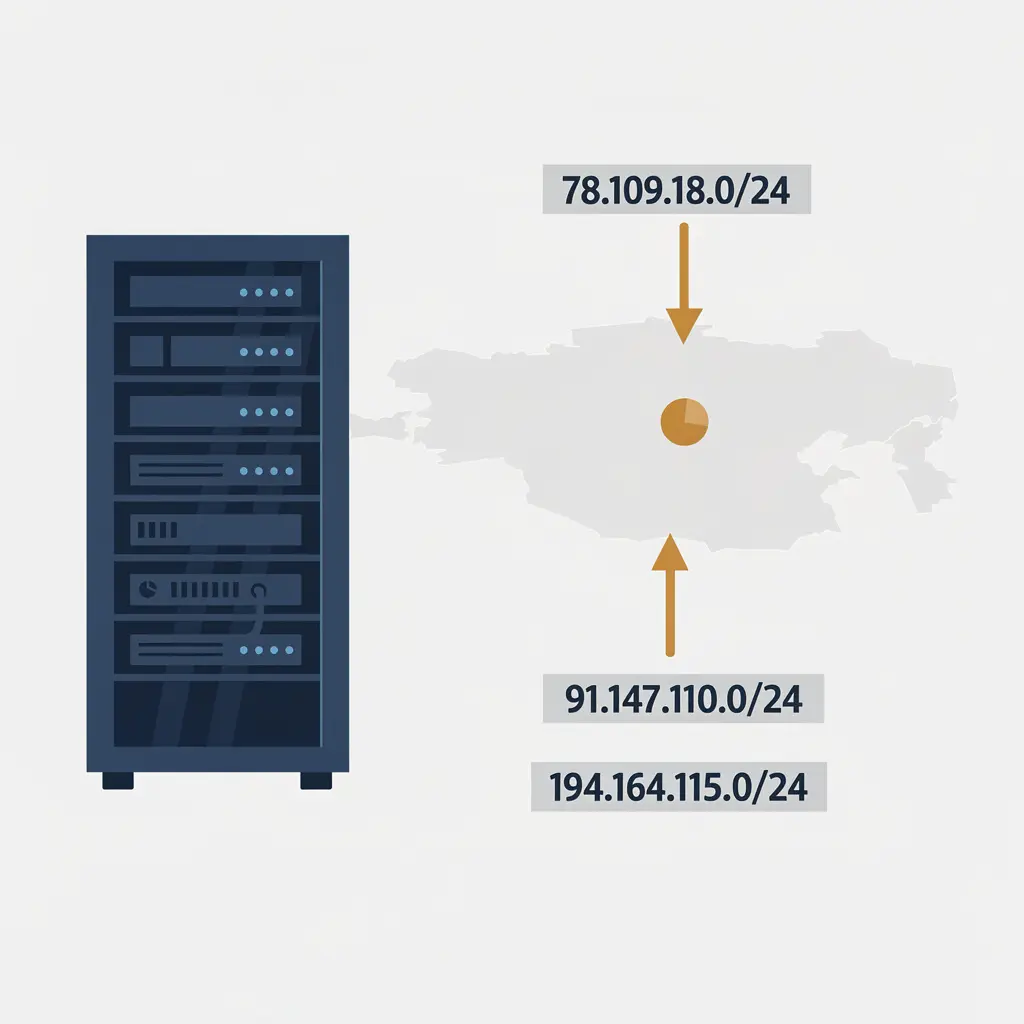
The public archives examined here instead show an APNIC organization, an inactive ASN, address resource certification, and a single /24 described as Aayat and reachable, announced by another Bangladeshi network, D-NET SERVICE, not by AS148978. BigDataCloud shows 103.175.56.0/24 as globally reachable and associated with Aayat Host, but its transit path goes through AS135615 D-NET SERVICE via AS58717 Summit Communications. The bgp.tools page for AS135615 lists 103.175.56.0/24 with the prefix description "Aayat Host" among the prefixes announced by D-NET.
The most economically useful conclusion is therefore not simply "Aayat Host is a hoster" or "Aayat Host is an ISP". It is this: Aayat Host is best understood as a small APNIC resource identity linked to Bangladesh, with hosting semantics and outsourced or delegated routing, whose commercial significance depends less on a visible customer base than on scarce IPv4 resources, a possible resale economy, and the option value of later becoming a routable network. This distinction changes the whole economic interpretation. A retail ISP makes its living through dense last-mile relationships and field interventions.
A hosting company makes its living through server utilization, IP reputation, availability, support, and customer churn management. A reseller makes its living through arbitrage, trust, and low acquisition costs. A thin resource identity earns, or may later earn, through address scarcity, credibility, delegated routing, and optionality.
Identity: the network record is stronger than the operational brand
The canonical identity visible in the primary network records is "Aayat Host". The APNIC WHOIS record on IPSHU shows AS148978 with network name AAYAT-AS-AP, country Bangladesh, description Aayat Host, and source APNIC. The same record links the entity identifier ORG-AH10-AP to Aayat Host as the holder, registered on 28 September 2021, last modified on 5 September 2023, with an address in Banani, Dhaka, a phone number, andinfo@aayathost.com. It also shows the administrative and technical contact AHA17-AP, "Aayat Host administrator", withabuse@aayathost.com.
This is a significant identity foundation. It shows that Aayat Host is not simply an SEO listing or a random geolocation tag. It has an APNIC organization entity, an ASN, maintainer references, an abuse contact structure, and associated messaging domains. In Internet infrastructure intelligence, these are not cosmetic details. They are the primitives by which addresses, ASNs, abuse handling responsibilities, and routing authority are assigned. A company may have no public marketing site and yet be operationally significant if it controls number resources, maintains route entities, and appears in routing data.
But this same identity record also introduces ambiguity. The abuse record exposed by APNIC-derived sources uses the group name IRT-AAYAT-BD, a Gmail mailbox for abuse, and an address written as "2080 One White Oak Ln Building 2 APT 2208", while the administrative contact points to Banani, Dhaka. The APNIC WHOIS output for the abuse role showsmamunict98@gmail.comas the abuse mailbox and indicates that the IRT email was validated on 15 December 2025. The coexistence of a domain-based contact, a Gmail abuse contact, and two address contexts is not fatal; small network operators often use personal or legacy emails at early registration. But it is a maturity signal. Larger ISPs and professional hosting companies tend to standardize contact addresses, publish NOC pages, operate ticketing systems, and maintain consistent business registries.
The domain aayathost.com is also present in resource data. IPinfo lists aayathost.com as the ASN domain and points to host.io for that domain, while IP2Location and IPGeolocation use the same domain in IP-to-company or AS metadata. However, the public operational footprint is thin. The document research examined did not uncover a full corporate website, a pricing grid, a WHMCS storefront, job postings, customer reviews, a service status page, a social channel, or support documentation comparable to a retail hosting operation or a mature ISP.
The IPinfo page for AS148978 reports zero domains hosted on the ASN, which is significant because hosting companies normally leave a DNS and hosted-domain footprint, even when their institutional site is small.
Name ambiguity is commercially important. "Aayat Host" is close to many unrelated uses of "Aayat" and "Ayat", including non-infrastructure entities and media results. In a market like Bangladesh, where many small ISPs, resellers, freelancers, and local IT shops use similar naming conventions, the exact spelling and domain matter. The target is not "Ayat Network", nor a call center company, nor a media brand, nor a generic hosting keyword. The defensible anchor of the target is AS148978, ORG-AH10-AP, AAYAT-AS-AP, and aayathost.com.
The routing contradiction: certified resources, inactive ASN, delegated reachability
The central infrastructure fact is only a contradiction if one assumes that an ASN must carry its own traffic. Aayat Host has an ASN and address resources, but AS148978 is not currently visible as a route origin in the global table. bgp.tools indicates that AS148978 is not currently in the global routing table and announces no IPv4 or IPv6 prefixes. IPinfo independently shows the ASN as inactive with zero IPv4 and IPv6 addresses, no peers, no upstreams, and no downstreams. These sources are consistent: as an autonomous routing entity, Aayat Host is dormant.
At the same time, Aayat Host appears to have a certified set of number resources. An RPKI certificate view for the relevant resource holder shows subordinate resources including AS148978, the IPv4 prefix 103.175.56.0/23, and the IPv6 prefix 2001:df7:ed80::/48, with the certificate valid from 15 December 2025 to 31 January 2027. This is stronger than a mere geolocation guess: it shows a resource certification context linking Aayat Host's ASN to a /23 IPv4 block and a /48 IPv6 block. It does not, by itself, prove that Aayat Host announces routes, has customers, or that any particular ROA authorizes a specific origin AS.
It proves that the resource set exists in the RPKI certification chain.
The visible routed part is more revealing. BigDataCloud shows 103.175.56.0/24 as Aayat Host and globally reachable, but carried by AS135615 D-NET SERVICE, with AS58717 Summit Communications in the transit path. bgp.tools for AS135615 lists 103.175.56.0/24 with the description "Aayat Host" among the prefixes announced by D-NET. BGP.he also lists 103.175.56.0/24 among the prefixes announced by AS135615, with D-NET's peers/upstreams including Summit Communications, Rego Communications, and EXABYTE. The address label points to Aayat Host, but the route origin points to D-NET.
This pattern has several possible explanations. Aayat Host may have delegated part of its address block to D-NET for transit or customer reachability. D-NET may be providing upstream, colocation, or operational BGP service on Aayat's behalf. Aayat may have acquired or applied for resources but never completed an independent multi-homing architecture. Or the public databases may reflect stale registry descriptions while D-NET is the actual access/hosting operator using the space. This is not about choosing a single private arrangement without evidence.
It is about recognizing that the commercial center of gravity is not AS148978 as an independent, active network. It is the relationship between Aayat's resource registration, D-NET's route announcement, and the Bangladesh wholesale connectivity stack.
This matters because routing independence is a form of bargaining power. A hosting or ISP operator that announces its own prefixes from its own ASN, maintains multiple upstreams, signs correct RPKI route origin authorizations, and participates in exchange points has greater ability to switch providers, handle outages, shape routes, and sell "network" credibility. An operator whose address space is carried by another local ISP has lower capital requirements but weaker control. It can buy simplicity at the price of dependence.
For a small hosting brand, this tradeoff may be rational: let a more established ISP handle BGP and upstreams while the brand focuses on customers, billing, and support. For an access ISP, the same dependence can be a constraint on margins and service quality.
The unannounced IPv6 resource is another maturity signal. The RPKI certificate view includes 2001:df7:ed80::/48, and yet the main ASN views show that AS148978 announces no IPv6 prefixes. In a mature hosting network, IPv6 announcement is not mandatory, but its absence reduces the evidence of a production network operation. In the local Bangladesh retail market, IPv4 demand and NAT realities may still dominate customer economics, so the lack of visible IPv6 is not disqualifying. But for a hosting company seeking technical differentiation, IPv6 deployment is a low-cost credibility marker.
Here, it is absent from the visible routing layer of AS148978.
Why "Host" is not enough: four economic readings
- The reading as an access provider
If Aayat Host were an access provider, its economy would be that of a local ISP: recurring monthly access revenue, installation fees, router and drop cable costs, field technicians, neighborhood density, local word-of-mouth, and churn management. The key assets would be customer relationships, last-mile coverage, wholesale bandwidth contracts, and operating licenses. Switching costs would be significant for residential and SME customers because changing access provider requires installation, downtime, router reconfiguration, and local support coordination.
The gross margin challenge would come from upstream bandwidth, NTTN lease costs, last-mile maintenance, backup power, technician utilization, and price competition.
Bangladesh's regulation makes this model visible when it is real. The BTRC ISP regulatory framework divides ISP licenses into Nationwide, Divisional, District, and Upazila/Thana categories. The directive text and screenshot also indicate that no person or entity may build, maintain, or operate ISP systems or services without a license, and that ISPs provide Internet/data and IP services to end users. The directive further shows a structural dependence on licensed transmission infrastructure: an ISP must lease or sub-lease transmission capacity from NTTN operators, with last-mile length rules and specific conditions for wireless links.
Within this regulatory context, the evidence of Aayat Host's public access provider activity is weak. The absence of visible routes for AS148978, AS148978 upstreams, AS148978 downstreams, consumer access plans, and the uncertain BTRC license trace in the examined evidence are all negative indicators. Searches in the BTRC 2024 divisional ISP license list PDF did not find "Aayat", "Aayat Host", or "Ayat". This is not conclusive because it is one list, one category family, and names may vary between the legal entity, trading name, and license class.
But it is still negative evidence for the hypothesis that Aayat Host is a visible divisional ISP under that exact name.
The reading as an access provider would become more plausible if a BTRC license appeared under Aayat Host or a legal name linked to the owner, if customer posts showed broadband installations, if Aayat began announcing residential-looking address pools, or if it appeared in BDIX/ISPAB-NIX with customer traffic. None of this is present in the public archives examined here. Commercially, therefore, the reading as an access operator should be treated as a low-probability interpretation, unless hidden under a different legal name.
- The reading as a hosting operator
The reading as a hoster is more plausible due to the name, domain, and IP classification. "Host" is not determinative, but Aayat Host's domain appears in ASN metadata, and IP2Location labels 103.175.57.0 as data center/web hosting/transit usage with ASN AS148978 and domain aayathost.com. IPGeolocation's company data for 103.175.57.103 shows Aayat Host, type HOSTING, domain aayathost.com, while its network layer currently shows no route and AS0 for that IP. The combined signal is that Aayat Host has been treated by IP intelligence providers as a hosting/data center identity, even though current routing is not clearly visible under AS148978.
If Aayat is a hosting operator, it is probably not a large one. A visible hosting company normally produces many external traces: name servers, reverse DNS, shared hosting domains, cPanel/WHM names, MX records, abuse tickets, uptime pages, reseller plans, SSL certificates, customer reviews, marketplace listings, Facebook ads, and pricing grids. IPinfo reports zero domains hosted on AS148978. This does not rule out hosting if Aayat's addresses are routed via D-NET, if customers use Cloudflare, if the company resells third-party infrastructure, or if the address block is dormant.
But it does rule out the simple claim that AS148978 visibly hosts domains at scale.
The economics of a small Bangladeshi hoster are very different from those of a global cloud. Revenue would likely come from shared hosting, small VPS instances, hosting reselling, domain and SSL add-ons, business email, backup, and occasional managed services. Customer acquisition would depend on trust, price, local payment convenience, quick Bengali-language support, and the ability to help small businesses navigate confusing global platforms. Customers would include freelancers, agencies, small retailers, educational projects, mosques, NGOs, and SMEs needing websites and email more than elastic computing.
The support burden would be high relative to revenue because small hosting customers often need help with migration, DNS fixes, WordPress repair, email deliverability improvement, and payment reminders.
The margin structure is ruthless. Upstream bandwidth and rented servers may be priced in dollars or tied to hard-currency equipment cycles, while customers pay in taka and are price-sensitive. Hardware depreciation, backup power, cooling, security, and colocation costs can eat into margin if the hoster owns its own servers. If the hoster resells another platform, the gross margin improves operationally but decreases commercially because the upstream provider captures the infrastructure economics. IP reputation is another constraint.
A small hoster with a /24 can quickly lose email deliverability or attract abuse risks; one bad spammer customer can damage the address pool's value. The APNIC/RPKI record gives Aayat Host infrastructure credibility, but the lack of a visible scale of hosted domains suggests that this credibility has not translated into a visible hosting estate.
- The reading as a reseller or white-label operator
The reading as a reseller explains the record more elegantly. Aayat Host could be a commercial storefront that depends on D-NET or another provider for routing, server hosting, or wholesale Internet access. In this model, Aayat does not need to operate a full network. It can sell hosting, IP services, or small-business IT packages while outsourcing the heavy components: upstream transit, colocation, BGP announcements, power, server inventory, and perhaps even the support tools. The visible announcement of 103.175.56.0/24 by D-NET is consistent with this type of arrangement.
This model reduces capital requirements but changes bargaining power. A reseller can start with very little money, avoid licensing complexity if it does not directly sell access, and focus on customer trust. It can survive with a thin public footprint if sales happen through personal networks, Facebook, local agencies, WhatsApp, or freelance channels. But bargaining power with the provider becomes the central economic risk. If D-NET or another upstream controls routing, service restoration, packet loss, port capacity, or abuse handling, Aayat's customer promise depends on someone else's operational discipline.
The reseller bears the unhappy customer, but not necessarily the router.
The reseller model also explains why Aayat might value an APNIC identity even with little visible traffic. Owning or being associated with an ASN and address space can increase credibility with technical customers, enable future migration, support dedicated IP offers, or provide protection from being seen as just a shared-hosting affiliate. In a crowded market, "we have our own ASN/IP block" can be a trust signal even if day-to-day routing is delegated. This claim is economically useful because customers cannot easily verify network depth; they see uptime, support speed, price, and whether emails work.
The downside is that resellers have weak price-setting power. Customers can compare with global cloud providers, cheap Indian or Singaporean VPS sellers, domain registrars, local cPanel resellers, Facebook hosting shops, and even free website builders. Switching costs exist but are narrow. A small business whose email, DNS, website files, and domain registration are bundled with one provider may hesitate to move. But a technically competent customer can migrate a WordPress site or VPS fairly quickly.
Therefore, unless Aayat controls either a local trust channel or a scarce technical asset like clean IPv4 addresses, reseller margins remain fragile.
- The reading as a thin resource/ASN identity
The reading as a thin resource identity is the most strongly supported. It says that the visible significance of Aayat Host lies in the registration of number resources rather than in observable commercial activity. AS148978 exists. Aayat Host exists as an APNIC organization. An IPv4 /23 resource and an IPv6 /48 resource appear in the RPKI certificate view. But the ASN is inactive in the global BGP, and the most visible /24 described as Aayat is announced by D-NET.
This does not mean "fake". Thin resource identities can be perfectly legitimate. A company may acquire resources before launching. It may suspend operations. It may use its addresses via an upstream ASN. It may maintain registry compliance while waiting for customer demand. It may have private customers that do not appear in hosted-domain databases. Or it could be a legal or administrative shell around resources that are used operationally elsewhere. Intelligence judgment must avoid legal overinterpretation and focus on economics: the asset is visible; the operational business is not.
IPv4 scarcity gives even a small /23 commercial significance. A /23 contains 512 IPv4 addresses. In hosting, clean IPv4 addresses can be monetized through dedicated IP add-ons, VPS allocations, VPN or remote access services, email infrastructure, and B2B leasing or delegation. In access networks, a /23 can support only a modest number of customers without carrier-grade NAT, but can still support premium public-IP offerings or business customers. In both cases, the address resource is economically more concrete than the marketing footprint.
Option value is the key. Aayat Host can become more operationally significant if it starts announcing AS148978, signs and maintains route origin authorizations, adds upstreams, announces IPv6, creates a PeeringDB profile, joins local IX fabrics, or publishes hosting packages. Until then, its commercial weight is latent. It is a call option on network operation, not proof of current scale.
The local Bangladesh market economics make thinness rational
The Bangladesh internet market encourages both fragmentation and supplier dependence. The BTRC and industry reports show a large, regulated, and crowded market in which many ISPs compete for local customers while relying on upstream infrastructure categories such as IIGs and NTTNs. The BTRC framework requires an ISP license and separates service categories; public reports have described BTRC actions to disconnect or cancel non-compliant ISPs and to manage license conversion under the 2020 guidelines.
The Financial Express reported that the BTRC rejected 301 ISP license applications to avoid overcrowding, more than half from Dhaka, and quoted ISPAB saying about 2,700 ISPs were active in the country, with some local areas having more than ten ISPs where only two might suffice. The same report noted license renewal and tariff approval obligations. This environment is important for Aayat Host because it reduces the appeal of becoming just another fully visible retail ISP without scale. The access market is crowded, regulated, operationally messy, and exposed to license enforcement.
Demand is substantial, but not uniformly accessible to small fixed-line operators. May 2026 figures from BTRC via AMTOB reported 134.07 million internet subscribers in Bangladesh, of which 119.12 million were mobile internet and 14.95 million were ISP plus PSTN. Thus, mobile dominates total internet access, while fixed ISP connections constitute a smaller but still substantial market. This creates a challenging strategic landscape for small providers: mobile broadband constrains retail prices and acts as a substitute, while fixed broadband customers demand reliability, low latency, and local support.
For a small operator, hosting can be more attractive than access because it avoids last-mile installation and regulatory exposure. But hosting also faces globalized competition. A Bangladeshi customer can buy from local hosters, Indian hosters, Singaporean VPS providers, global hyperscalers, domain registrars, and cheap shared hosting platforms. The local hoster's advantage is not raw infrastructure superiority; it is convenience, trust, local-language support, payment channels, and migration help.
That is why a thin resource identity can be rational: acquiring an ASN and address space gives infrastructure credibility without immediately committing to the full fixed-cost base of an ISP or data center.
D-NET's role also fits the market structure. D-NET SERVICE appears as an active Bangladeshi network, registered in 2016, with upstreams including Summit Communications, Rego Communications, and EXABYTE, and with 103.175.56.0/24 described as Aayat Host among its announced prefixes. For Aayat, using such a network could be cheaper and simpler than building independent BGP operations, contracting multiple upstreams, and maintaining exchange ports. For D-NET, carrying another labeled prefix can monetize existing upstream relationships and routing capacity.
This is not unusual in fragmented ISP markets. Small license holders, local cable operators, hosting resellers, and address holders often rely on upstream networks for transit, NTTN access, or BGP announcement. The economic logic is layered: the customer-facing brand owns trust and billing; the access or upstream network owns physical reach and routing; the number resource holder owns the registry identity; and the end user benefits from a combined service. The public evidence on Aayat Host fits a layered model better than a vertically integrated one.
Supplier dependence and margin pressure
If Aayat Host is commercially active, its dependency surface is larger than its visible brand suggests. At the routing level, the obvious dependency is D-NET for 103.175.56.0/24 reachability. D-NET in turn depends on upstreams including Summit Communications, Rego Communications, and EXABYTE, according to bgp.tools and BGP.he views. The BigDataCloud path for 103.175.56.0/24 identifies D-NET and Summit in the transit chain. This means that the economics of Aayat's reachable addresses, at least for this /24, is indirectly exposed to D-NET's upstream economics and operational quality.
For a hosting reseller, this dependency affects gross margin in three ways. First, the provider sets the price of wholesale bandwidth or server. If upstream costs rise, the reseller absorbs the shock or raises prices in a market where customers can compare. Second, the provider determines service quality. Packet loss, route instability, congestion, or abuse blacklisting hit the customer-facing brand even when the reseller cannot directly fix the network problem. Third, the provider controls the operational tempo. A reseller's support promise is only as fast as its escalation path.
For a direct hoster owning its own servers, dependence shifts from wholesale bandwidth to colocation, electricity, hardware, and repair. Bangladesh's power, cooling, and data center environment makes reliable hosting more capital-intensive than a domain reseller storefront. A small hoster must either pay for credible facilities or accept higher outage risk. If it rents VPS capacity abroad, it gains reliability but loses local latency and differentiation. If it hosts locally via a partner, it gains local latency but inherits that partner's operational constraints.
Payment frictions also affect margins. Local customers may prefer mobile financial services, bank transfer, cash-like settlement, or local invoicing, while many upstream costs, software licenses, control panels, domains, SSL products, and cloud resources are dollar-linked. This currency mismatch penalizes small hosters during exchange-rate pressure. It also increases administrative load: chasing small monthly invoices can consume support time that would otherwise go to technical operations.
The support burden is likely the most important hidden cost in any Aayat-type hosting model. Low-cost hosting attracts customers who need hand-holding assistance: domain pointing, email setup, WordPress malware cleanup, PHP version changes, backups, SSL renewals, and content migration. Large hosters automate this via dashboards, documentation, and scale. Small hosters compete on being reachable via chat and phone. This can win customers, but it caps scalability because support labor grows with customer count and service complexity.
Customer acquisition and switching costs
The apparent lack of broad public marketing by Aayat Host changes the approach to customer acquisition. A visible hosting company with search ads, social channels, and plan pages competes in open acquisition markets. A thin operator may instead rely on personal networks, agency referrals, local IT contractors, or existing ISP relationships. This model can be profitable at a small scale because acquisition costs are low and trust is pre-existing. It also makes public evidence sparse.
In hosting, switching costs are asymmetric. For a simple static website, changing provider is easy. For a small business whose domain registration, DNS, email, website files, database, backups, and payment integration are all managed by one local provider, switching is emotionally and operationally harder. The provider may have no formal lock-in, but it controls the knowledge. Customers do not know which registrar holds the domain, where name servers point, who has cPanel access, whether email is backed up, or how to migrate safely. Small hosters thus acquire 'soft switching costs' through service bundling and customer dependence.
In access provision, switching costs are more physical. A household or SME may need new cabling, a new ONU/router, an installation visit, and downtime. This creates stickier customer relationships if service quality is acceptable. But Aayat lacks the public access-provider signals that would make this model likely. Without evidence of last-mile network, the most plausible switching-cost mechanism is managed-services dependence rather than physical access lock-in.
If Aayat is primarily a resource holder, the 'customer' may not be an end user at all. It could be another network, a reseller, or an operational partner that needs addresses or registry association. In that case, switching costs are technical and administrative: renumbering servers, changing route entities, updating DNS, preserving IP reputation, and reconfiguring firewalls. These switching costs can be significant even when the end-user brand is invisible.
Competition and substitutes
The competitive set depends on the correct reading. As an access ISP, Aayat would face mobile broadband, national fixed-line operators, licensed local ISPs, neighborhood cable operators, and informal reseller networks. Mobile is the largest substitute by subscriber numbers in Bangladesh, with AMTOB data from BTRC showing mobile internet far larger than ISP plus PSTN subscribers in May 2026. This does not eliminate fixed broadband demand, but it caps pricing power for mass-market access and raises expectations for always-on connectivity.
As a hosting company, substitutes are broader and more global. A Bangladeshi small business can use a local cPanel hoster, a registrar package, a freelancer's reseller account, Google Workspace plus a website builder, Cloudflare in front of a cheap origin, a Singapore-based or Indian VPS, or hyperscale cloud. Local hosters win when customers want human support, Bengali communication, local payment, and someone to blame. They lose when customers demand enterprise-grade uptime, compliance certifications, elastic infrastructure, or global brand assurance.
As a reseller, Aayat competes on trust and convenience rather than infrastructure. The brand must persuade customers that it will answer calls, keep services renewed, and fix problems. The APNIC identity only helps with technically aware customers. For most SME customers, the differentiators are price, responsiveness, and relationship.
As a resource identity, Aayat competes in a different market: scarcity and credibility. IPv4 address resources, especially clean ones with low abuse history, have economic value independent of retail customers. They can support hosting, VPN, enterprise NAT pools, dedicated IPs, or future ISP growth. The threat is not customer churn but registry compliance, abuse reputation, route misconfiguration, hijack risk, and conflict with vendors.
Ownership, management, and trust signals
The public record confirms a registered network identity but does not provide a strong ownership narrative. The APNIC organization entity names Aayat Host and gives an address in Banani, Dhaka, a phone number, and a domain email. The administrative and technical roles are generic: "Aayat Host administrator". The abuse contact includes a Gmail address and an IRT validation date in December 2025. These are operational contacts, not proof of beneficial ownership, funding, management team, or legal registration.
This ambiguity is commercially important. In infrastructure markets, trust depends on knowing who can be held accountable. Customers ask: who owns the servers, who controls the domain, who answers abuse complaints, who pays the upstream bills, who renews the licenses, and who has the authority to change routes? A thin public profile raises counterparty risk for larger customers. An SME may accept a phone number and a local relationship; a professional buyer will want legal documents, tax registration, SLA terms, and escalation contacts.
The contact pattern suggests a small or lightly institutionalized operation. A mature network operator normally has role-based emails such as noc@, abuse@, billing@, and support@ on its own domain, a published NOC page, consistent registry addresses, routing policy registries, and visible customer communications. Aayat has some of these ingredients, notably domain-based abuse/admin contacts, but not the surrounding institutional evidence. This does not mean the operator is untrustworthy. It means the public evidence is to attribute enterprise-grade operational trust.
Funding evidence is absent. No press releases, funding announcements, M&A filings, major market notices, or data center build claims linked to Aayat Host were discovered. This absence reinforces the micro-operator or resource-identity interpretation. If a company with a dormant ASN were preparing a material network deployment, one would expect vendor announcements, hiring, license filings, customer marketing, or route activation. The record is instead silent.
What the evidence proves, suggests, and cannot resolve
The evidence proves that Aayat Host exists as an APNIC-linked network resource identity. It proves that AS148978 is associated with Bangladesh, AAYAT-AS-AP, and the organization ORG-AH10-AP. It proves that the ASN is currently inactive in the main routing views examined here and announces no IPv4 or IPv6 prefixes. It proves that resource certification data exists for AS148978, 103.175.56.0/23, and 2001:df7:ed80::/48. It proves that at least one prefix described as Aayat, 103.175.56.0/24, is visible via D-NET SERVICE rather than via AS148978.
The evidence suggests that Aayat Host is more hosting/resource-oriented than access-oriented. The name, domain, IP2Location usage classification, and IPGeolocation company classification all point toward hosting or data center semantics. The absence of access-provider traces, the inactive ASN, and the Bangladesh license context make a reading as a standalone access ISP less likely.
The evidence also suggests supplier dependence. The announcement of 103.175.56.0/24 by D-NET, combined with D-NET's upstream relationships, makes D-NET a key observed counterparty. Aayat may control or be associated with the address resource, but D-NET appears to provide the visible global route for at least one /24. Commercially, this makes D-NET's routing quality, upstream contracts, and abuse handling central to any Aayat service using that range.
The evidence cannot resolve whether Aayat Host has paying customers. It cannot resolve whether Aayat owns servers, rents servers, resells hosting, leases addresses, or is dormant. It cannot resolve beneficial ownership or legal registration beyond the network contacts. It cannot resolve whether the 103.175.57.0/24 half of the /23 is unused, used privately, stale in geolocation databases, or routed in a way not captured by the public sources examined. It cannot resolve whether Aayat has a BTRC license under a different legal name. These unknowns are not minor; each changes the business assessment.
If Aayat has paying hosting customers, the business has recurring revenue and support obligations. If it simply holds resources, the asset is primarily option value and IPv4 scarcity. If it resells via D-NET, gross margin and service quality are constrained by the supplier. If it is an access provider hidden under another license name, the customer base and license status would be the key due-diligence issues. The public record is not rich enough to choose among these private states with high confidence, but it is strong enough to reject the notion of Aayat Host as a visibly independent, large-scale network.
Commercial judgment
Aayat Host should be treated as a small Bangladeshi hosting/resource identity adjacent to infrastructure, not as a demonstrated large-scale ISP. Its strongest assets are registry legitimacy, an APNIC ASN, a certified IPv4 and IPv6 resource context, and a domain-linked identity. Its weakest assets are operational visibility, independent route announcement, public customer evidence, brand presence, and institutional trust signals.
The plausible revenue logic of the business, if active, is narrow recurring revenue from hosting, managed web services, address-backed services, or resale connectivity. Its pricing power is likely weak unless it serves relationship-based local customers or controls clean IP addresses with specific utility. Its gross margin is likely shaped by suppliers: D-NET or another upstream captures the network economics; data center or server providers capture the infrastructure economics; software vendors and registrars capture the platform economics. Aayat's margin, if any, comes from bundling, support, local trust, and customer inertia.
The most important economic fact is that Aayat's visible network independence is weaker than its resource identity. A resource holder can become more powerful by activating its own ASN, adding upstreams, and making its routing portable. Until that happens, the business is exposed to the operator that actually carries the traffic. This is why the hosting vs. access question needs reframing. Aayat Host is not best understood as choosing between hosting and access at the current scale. It is best understood as sitting between resource ownership and outsourced operation. The upside is optionality; the downside is opacity.
Evidence ledger