
Summary
- The paid unit around AARUTI Hospitality Inc should be treated as a room-night backed by booking-continuity capability, not as a bare lodging listing: the customer buys the right to arrive, pay, receive a clean room, and avoid being stranded by a broken reservation, unreachable front desk, payment failure, or local substitute that wins the booking first.
- The strongest company-specific public evidence is narrow: ARIN records identify AARUTI Hospitality Inc as the organization behind handle AH-1522 at 102 Market Center Dr, Tarboro, North Carolina, and show an active IPv4 /29 reassignment, while public evidence does not verify revenue, room count, ownership of a particular hotel brand, occupancy, software stack, staffing model, direct-booking share, OTA commission exposure, or guest retention.
- That evidence gap changes the investment and operating question. The useful test is not whether the company has an IP block; it is whether the booking, payment, property-system, labour and review surfaces attached to that local hospitality operation create enough reliability for guests to choose it over a chain hotel, an online travel agency listing, a short-term rental, another local property, direct booking elsewhere, or a delayed trip.
The Paid Unit Starts At The Moment The Stay Can Fail
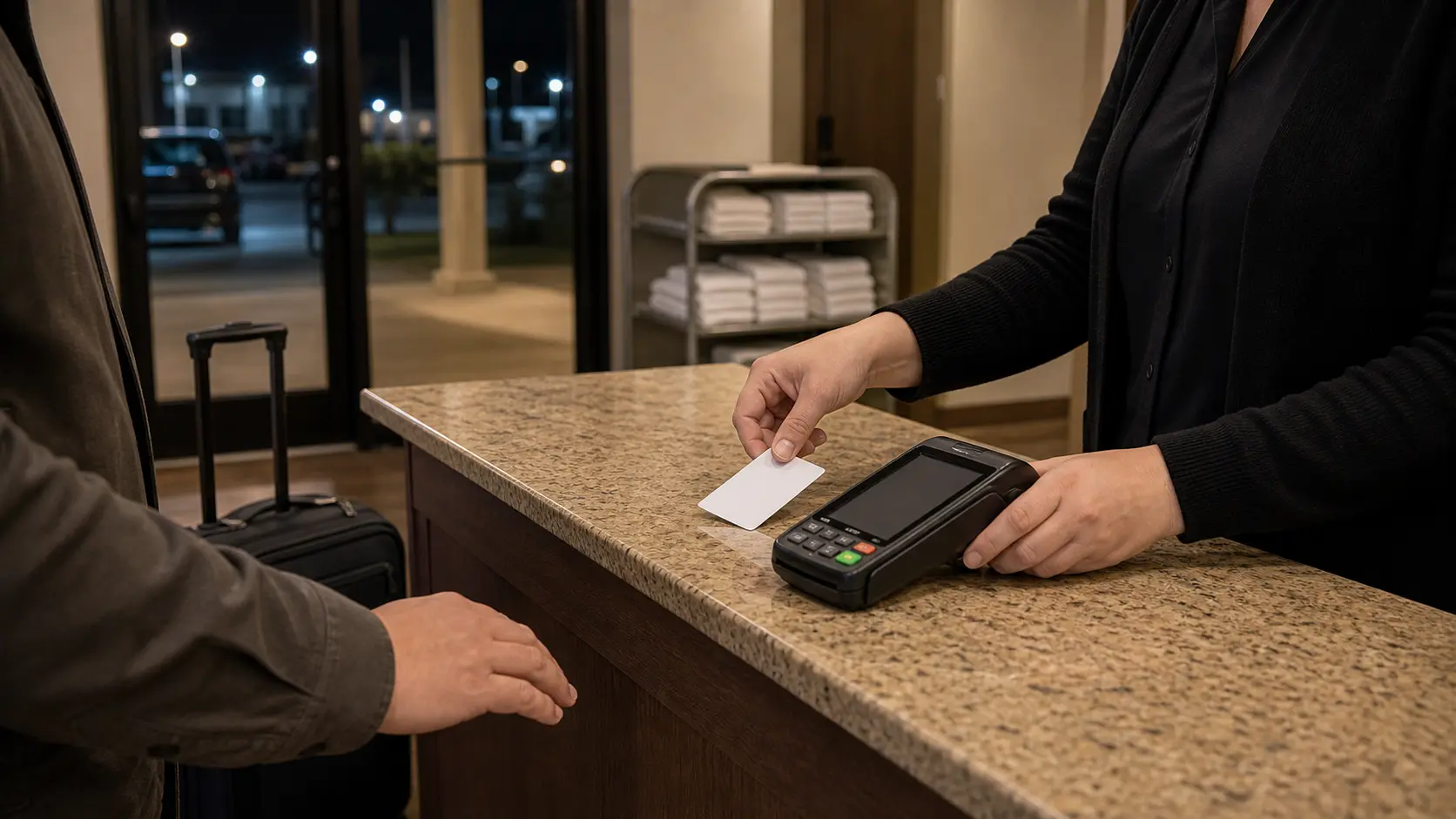
The most revealing moment for a small hospitality company is not the public listing page. It is the minute after a traveler believes a booking has been made and before anyone at the property has seen the guest. In that gap, the room-night becomes a bundle of fragile promises. The booking must have reached the property. The payment must be acceptable. The rate and date must be correct. The room type must not have been sold twice through another channel. Someone must be available to handle an after-hours arrival.
The guest's expectation, formed by search results, photos, reviews and cancellation terms, must still match what the property can actually deliver.
That is the right frame for AARUTI Hospitality Inc. ARIN's public organization record at https://whois.arin.net/rest/org/AH-1522 identifies AARUTI HOSPITALITY INC, not a chain marketing page, as the organization associated with a Tarboro, North Carolina address. The RDAP entity record at https://rdap.arin.net/registry/entity/AH-1522 repeats that organizational identity and shows a registration and last-change date in November 2019. The network record at https://rdap.arin.net/registry/ip/208.44.30.120 then ties the organization to a small IPv4 assignment, 208.44.30.120 through 208.44.30.127, with active status. Those facts do not prove that a specific reservation system was running on that address block. They do prove that AARUTI has been visible in a public internet resource registry as a hospitality-labeled organization with a small, place-specific network footprint.
For a room-night business, that is not trivia. A property can lose a sale before the guest sees the building. A booking engine can be unreachable, an online travel agency can show stale availability, a card can be declined because the front desk cannot complete pre-authorization, or a guest can abandon the booking because the local alternative looks less risky. The room-night is perishable: when tonight passes, the unsold or disputed room cannot be resold for yesterday. The operating value of digital continuity is therefore higher than the size of the technology footprint suggests.
The public record also warns against overstating the company. The ARIN organization record lists "canAllocate" as no, which means the record should be read as an end-user assignment context, not as evidence that AARUTI is a network provider. The separate ARIN Whois network XML at https://whois.arin.net/rest/net/NET-208-44-30-120-1 identifies the block as a reassignment and links it back to the AARUTI organization handle. It is evidence of a local network resource, not evidence of revenue, room count, brand affiliation or profitability.
That distinction matters because a guest pays for an outcome, while public registries show only part of the machinery behind that outcome. The customer buys a confirmed stay. The company incurs costs to keep that stay bookable, payable, staffed, clean, reviewed, and recoverable from errors. Public evidence can show whether a company has some registered infrastructure and whether market alternatives exist.
It usually cannot show whether each booked room-night produces attractive margin after software subscriptions, platform fees, card acceptance costs, labour hours, utilities, franchise or brand standards, maintenance, insurance, taxes and debt service.
The article therefore prices AARUTI through the booking-continuity account. The question is what a room-night is really worth when the margin depends on reachability before arrival, trust at the moment of choice, and the ability to survive small failures that larger hotel chains absorb through central reservations, loyalty programs, corporate contracts, and deeper technology teams.
What The Public Record Confirms And What It Does Not
The confirmed company-specific evidence is compact. AARUTI Hospitality Inc appears in ARIN as AH-1522. The organization address in the record is 102 Market Center Dr, first-floor room telco, Tarboro, NC 27886. The record date is 2019-11-23. The associated IPv4 network is a /29, a small block of eight addresses, registered under NET-208-44-30-120-1. The parent network is CENTURYLINK-LEGACY-QWEST-INET-3, visible in ARIN's parent RDAP record at https://rdap.arin.net/registry/ip/208.44.0.0/14. RIPEstat's public prefix overview at https://stat.ripe.net/data/prefix-overview/data.json?resource=208.44.30.120/29 says the specific /29 is not independently announced and aligns the result to the less-specific 208.44.0.0/14, announced by AS209, CenturyLink Communications. RIPEstat's routing-status endpoint at https://stat.ripe.net/data/routing-status/data.json?resource=208.44.30.120/29 likewise shows no origins for the /29 and a less-specific origin of 209. The network-info endpoint at https://stat.ripe.net/data/network-info/data.json?resource=208.44.30.120 resolves the address to prefix 208.44.0.0/14 and ASN 209.
That evidence supports a narrow interpretation. AARUTI had, and as of the queried public records still had, a registry-visible network assignment within a large Lumen/CenturyLink legacy range. It says something about fixed-location connectivity and accountability. It does not reveal whether the property relies on that address block for guest Wi-Fi, a point-of-sale terminal, an office network, a property-management workstation, a security system, voice service, a router handed off by an upstream carrier, or a legacy circuit whose importance has changed since 2019. The block could be essential, marginal, or dormant.
The public record does not say.
That is why the parent network language matters. Lumen's public acceptable-use page at https://www.lumen.com/en-us/about/legal/acceptable-use-policy.html and trust-and-safety page at https://www.lumen.com/en-us/about/legal/trust-center/trust-and-safety.html are linked from the parent RDAP remarks. Those links describe the upstream framework around the address space, not a contract with AARUTI. They still show why a small property's network evidence is best treated as dependency evidence. If connectivity, routing policy, abuse handling or account status fails upstream, the local hospitality operation may experience that as an inability to receive bookings, settle payments, support guest access or communicate with vendors.
There is also a point-of-contact caution. ARIN's RDAP record includes a notice that one public contact has not responded to ARIN validation since 2020. That is not proof that the company is unreachable, nonoperational or careless. It is a registry-maintenance signal. In a hospitality context, however, stale contact posture has analytical weight because booking recovery, abuse handling, vendor changeovers and broadband repair often depend on accurate administrative contacts. A room-night business does not need a large technology estate to suffer from an outdated contact trail.
The missing evidence is larger than the confirmed evidence. Public records reviewed for this article did not verify AARUTI's room count, property brand, franchise agreement, revenue, debt, occupancy, average daily rate, customer mix, manager, employee count, payment processor, channel manager, property-management software, booking engine, loyalty affiliation, insurance coverage, renovation history, online-ad budget, or direct-booking share. Public search also did not produce a reliable company website that could be tied to the ARIN organization without additional evidence. That absence does not weaken the company by itself.
Many small hotel owners operate through brand pages, online travel agency pages, phone calls, walk-in demand and local relationships rather than a richly indexed corporate site. But it does limit what can be concluded.
The public assessment should therefore separate three layers. First, confirmed identity and network records show an organization named AARUTI Hospitality Inc at a Tarboro address with a small internet-resource footprint. Second, lodging-market sources show how customers compare local properties and substitutes. Third, hotel-industry and payment sources explain the cost mechanics that likely matter to any small lodging operator. The article can test AARUTI against those mechanics; it cannot assign exact margins or operating health without private records.
The Room-Night Is A Perishable Right, Not A Commodity Bed
The customer buys one night of occupancy, but economically the product is broader. A room-night is the right to use a room at a particular location, on a particular date, under a particular cancellation and payment agreement, with a minimum level of cleanliness, safety, service and availability. The guest may compare a local hotel, a chain property, a short-term rental, a direct booking, or a decision to postpone travel. Once the date passes, the seller cannot recover the lost unit. That perishable structure makes booking friction unusually expensive.
For a small property, a confirmed stay has at least six cost layers. The first is fixed property cost: building, land, taxes, insurance, maintenance, utilities and debt or lease commitments. The second is variable room cost: cleaning labour, laundry, toiletries, breakfast or amenity inputs, card fees, commissions and occasional service recovery. The third is distribution cost: the money spent to appear where travelers search. The fourth is systems cost: property-management software, booking engine, channel manager, payment terminal, broadband, phone, website hosting, cybersecurity and backup procedures.
The fifth is reputation cost: each bad stay can reduce future conversion if reviews, ratings or local word-of-mouth deteriorate. The sixth is management attention: a small owner may be the person handling vendor calls, staff rosters, guest disputes, tax paperwork and late-night operational failures.
The ARIN evidence only touches the systems layer. It says there is or was a small registered network assignment. But the paid unit is viable only if that systems layer cooperates with the rest of the operation. A hotel can have a network block and still lose money if occupancy is weak, review risk is high, labour is unreliable, or acquisition costs absorb the rate. Conversely, a small property with little public technology evidence can produce durable returns if it has repeat local demand, disciplined staffing, low debt, strong maintenance control and a loyal base of direct bookers.
The customer buys confidence, not just square footage. When a traveler chooses a room through an online travel agency page such as https://www.booking.com/city/us/tarboro.html or a travel marketplace such as https://www.expedia.com/Tarboro-Hotels.d7126.Travel-Guide-Hotels, the guest is often buying the platform's comparison, cancellation and payment interface as much as the property. When the same traveler checks hotel review pages such as https://www.tripadvisor.com/Hotels-g49684-Tarboro_North_Carolina-Hotels.html, the guest is using public sentiment as a proxy for risk. When the traveler checks short-term rentals at https://www.airbnb.com/s/Tarboro--NC/homes, the guest is pricing a different kind of accommodation. None of those pages proves AARUTI's performance. They demonstrate the market in which a small room-night seller can be compared before it gets a chance to serve the guest.
The costly feature is synchronization. A room listed as available on one channel should not be sold on another. A rate should not be lower in a place that trains customers away from direct booking unless the owner intentionally pays for that demand. A deposit should flow into the correct merchant account. A no-show policy should be enforceable. A late cancellation should not produce a review dispute that costs more than the night's revenue. A property-management system should show the front desk which room is clean, which card was authorized, which guest needs a receipt, and which reservation came through a third party.
These are mundane facts, but in small lodging they are the difference between a room-night and a complaint.
The public record cannot verify AARUTI's synchronization quality. It can only show that the company appears in public network records and that the broader lodging market gives travelers substitutes. That is enough to shape the right diligence question: what private evidence would prove that a confirmed stay at this operation is not being eroded by booking friction?
Booking Reachability Is The First Price Of Trust
Booking reachability is the ability of a traveler to discover, price, reserve and confirm a stay without losing confidence. It includes search visibility, mobile usability, accurate availability, responsive phone handling, OTA listing health, brand reservation integration if the property has one, and the after-hours path for guests who arrive outside normal staffing patterns. The failure can be small. A booking button that times out, a phone number that rings too long, a stale rate in a third-party channel, or a calendar mismatch can move the guest to a substitute in seconds.
The ARIN block gives a limited but useful clue. A small static assignment can support property systems that prefer fixed addressing: routers, security appliances, remote support, voice equipment, payment terminals, camera systems, or vendor access. The public record does not prove which of those uses applies to AARUTI. It does show that the company is not merely a name in a listing; it has a registry-visible technical footprint at a physical address. For a hospitality business, that should be interpreted as operating context, not as a technology moat.
The reachability issue becomes sharper because Tarboro is not Manhattan or Las Vegas. A traveler looking around Tarboro may compare a local room against nearby chain inventory, a Rocky Mount alternative, a short-term rental, or a decision to continue driving. A brand-search page such as https://www.choicehotels.com/north-carolina/tarboro/hotels illustrates how chain systems organize demand around location, availability and loyalty, even when the page does not tell us anything about AARUTI's ownership. Chain reachability is not just advertising. It is a distribution infrastructure: central reservation systems, loyalty databases, mobile apps, call centers, standardized cancellation policies, negotiated corporate rates and bulk content syndication.
Small properties can win against that infrastructure when they have local fit. A guest may choose proximity, lower price, familiarity, parking convenience, an owner who answers the phone, or a specific room configuration. But the small property cannot afford hidden friction. If a guest is already taking a risk by choosing an independent or less-visible operator, the booking path must compensate with clarity. The property may not need national brand scale, but it does need enough continuity that the guest believes the reservation will exist at arrival.
This is why the paid unit should include a booking-continuity account. The room-night price is not the posted rate; it is the posted rate minus the cost of getting the booking, confirming it, servicing it, and repairing it if something goes wrong. If AARUTI receives meaningful demand through online travel agencies, the commission or merchant spread lowers the net rate but may buy reach. If it receives demand through direct phone or repeat local relationships, acquisition cost may be lower but staffing burden may be higher.
If it relies on brand distribution, franchise and system charges may convert demand into a more predictable but fee-heavy channel. Public evidence does not identify the mix.
The private facts that would change the judgment are direct. A channel report showing booking source by room-night would tell whether the property rents demand from intermediaries or owns repeat demand. A cancellation and no-show report would show how much booked revenue disappears. A call-log and abandoned-booking report would reveal reachability loss. A channel-manager error log would show whether inventory mismatch is rare or chronic. A guest-message response-time report would show whether uncertainty is being resolved before arrival.
Without those facts, the prudent conclusion is that reachability is likely a central economic variable but not yet measurable from public evidence.
OTA Dependence Can Buy Demand While Taxing The Net Rate
Online travel agencies can be a lifeline for a small property. They place the room in front of guests who may never search for the operator's name. They offer maps, filters, cancellation interfaces, loyalty rewards, payment flows and review context. They can also train the property to pay for demand it could have captured directly. That is why OTA dependence should be priced as a margin question, not merely a marketing question.
Large public intermediaries describe their own economics through SEC filings. Booking Holdings' filing index at https://www.sec.gov/cgi-bin/browse-edgar?action=getcompany&CIK=0001075531&type=10-K&owner=exclude&count=10 and Expedia Group's filing index at https://www.sec.gov/cgi-bin/browse-edgar?action=getcompany&CIK=0001324424&type=10-K&owner=exclude&count=10 are not evidence about AARUTI's contracts. They are evidence that travel intermediaries are large, sophisticated public companies whose revenue models depend on participating in travel transactions and advertising. A small hotel operator is usually a price taker against that distribution structure unless it has a strong direct channel or brand relationship.
The central OTA tradeoff is reach versus net revenue. A property can fill rooms that would otherwise sit empty. That matters because the room-night expires. A discounted or commissioned booking may still contribute to fixed costs if the variable cost of cleaning and servicing the room is lower than the net rate. But a property that becomes too dependent on paid intermediated demand may lose control of guest relationships, cancellation behavior, review mediation and rate integrity. The guest may remember the platform, not the property. The platform may own the email address and app relationship.
The property may carry the service burden while the intermediary owns the search and comparison moment.
The public evidence for AARUTI does not identify OTA share. That gap is important enough to name. If most bookings are direct, the company may have stronger local repeat demand than its public footprint implies. If most bookings arrive through OTAs, the gross rate may overstate economic health. If a brand reservation system supplies demand, the relevant cost may be franchise, reservation and loyalty charges rather than OTA commission alone. If local corporate, hospital, construction, college or family-visit demand repeats by phone, the property may be less exposed to intermediary fees but more exposed to staffing and relationship continuity.
The booking market also creates substitution pressure. A traveler who sees Tarboro hotel choices on Booking or Expedia can widen the map, sort by rating, compare refundable rates, or move to Rocky Mount. A traveler who sees short-term rentals can trade hotel service for kitchen space or whole-home privacy. A traveler who sees a chain site can choose loyalty points and standardized expectations. Each substitute prices a different risk. The chain sells reliability and rewards. The OTA sells comparison and convenience. The short-term rental sells space and local feel but can carry its own check-in and host risk.
The local direct booking sells immediacy and maybe price, but only if the guest trusts the confirmation.
The facts that would change the judgment are measurable. The first is net revenue by channel after commissions, payment cost and loyalty or franchise charges. The second is conversion rate by channel, because a commission-heavy channel can still be rational if direct conversion is weak. The third is repeat-stay rate by guest origin. The fourth is the volume of preventable disputes: overbookings, wrong dates, payment mismatches, refund confusion and negative reviews linked to booking expectations. Public listings and market chatter can highlight where travelers look; they cannot prove AARUTI's economics.
Payment Acceptance Is Part Of The Stay, Not Back-Office Plumbing
Payment acceptance sounds administrative until it fails at the front desk. Hotels commonly need to authorize a card before arrival, hold a deposit or incidental amount, reverse a hold after checkout, split charges, handle no-shows, and manage refunds through the same channel where the booking was made. The guest experiences this as convenience or frustration. The owner experiences it as cost, fraud risk, cash-flow timing and review exposure.
For a small property, card acceptance has three economic effects. First, it reduces lost bookings because many travelers expect to reserve with a card. Second, it creates direct fees and potential chargeback losses. Third, it creates compliance and data-security obligations. The Federal Reserve's Regulation II interchange page at https://www.federalreserve.gov/paymentsystems/regii-average-interchange-fee.htm explains debit-card interchange standards for covered issuers and shows why card acceptance is not free even where regulated caps apply to certain transactions. Credit-card acceptance, card-not-present risk and processor-specific pricing can be more complex than that public debit-card page. The point is not to compute AARUTI's exact fee. The point is that payment acceptance is a real cost line inside the room-night.
Payment security adds another layer. The PCI Security Standards Council's document library at https://www.pcisecuritystandards.org/document_library identifies the PCI DSS materials that merchants and service providers use for card-data security requirements. Public evidence does not show AARUTI's payment processor, PCI validation status, terminal provider, segmentation approach, or whether card data touches local systems. A small property may rely heavily on vendor-managed terminals and hosted booking flows, reducing local burden. It may also have legacy workflows, manual card handling, faxed authorization forms, or remote-access practices that increase operational risk. Without private evidence, those possibilities should not be converted into accusations. They should be treated as diligence items.
Payment continuity also depends on connectivity. If the local network or upstream circuit fails, a property may still check in a guest manually, but authorization, OTA reconciliation, digital receipts and card-present transactions can become difficult. The ARIN record does not prove payment traffic uses the assigned block. It does, however, show why a hotel with a small network footprint can still have meaningful payment exposure. A static address is small in internet terms but large in operational terms if it supports routers, terminals or back-office access.
The payment question also influences customer trust before arrival. A traveler may choose a property with clear cancellation and payment terms over a cheaper room with ambiguous card handling. A guest whose card is charged incorrectly may leave a review, dispute the transaction, call the OTA, or avoid the property in future. A room-night margin can be wiped out by one avoidable payment dispute if the staff time, fee and reputation cost are included.
The facts that would change the assessment are again private. Processor statements would show card fees, chargebacks, refund volume and settlement timing. Payment terminal inventory would show whether hardware is current and vendor supported. PCI self-assessment records would show compliance posture. Incident logs would show whether payment outages have affected check-ins. OTA extranet records would show whether virtual cards, prepaid bookings or pay-at-property reservations create operational friction. Public evidence can show why payment matters. It cannot prove AARUTI's payment resilience.
Property-System Continuity Decides Whether Inventory Is Real
The guest sees a room as available or unavailable. The property sees a sequence of systems: property-management software, channel manager, booking engine, housekeeping status, payment terminal, door locks, phone, email, guest messaging, accounting, maintenance and sometimes brand reservation systems. The smallest property does not need the most complex stack, but it still needs a single source of operational truth. If the room is dirty in the housekeeping log but available in the OTA channel, the confirmed stay is already at risk.
The American Hotel & Lodging Association points readers to hotel technology resources, including HTNG materials, at https://www.ahla.com/htng-technical-specifications. That is industry context, not a statement about AARUTI's software. It shows the breadth of integration problems hotel operators face: systems must exchange reservations, rates, guest profiles, payment status, room status and service requests. A small operator may simplify by using a cloud PMS or a brand-provided platform. It may also rely on manual processes. The economic test is not whether the stack is fashionable. It is whether the stack prevents revenue leakage and service failures.
The ARIN evidence is relevant because property-system continuity often sits on ordinary connectivity. A local circuit can support office access, guest Wi-Fi, remote vendor support, cameras, voice, card terminals or back-office systems. The RIPEstat result showing no independent /29 route announcement is not a negative business signal. Most small end-user assignments are not independently routed. It does suggest that the company likely depends on the upstream carrier path represented by the less-specific route, rather than controlling routing in the way a network operator would. For a hotel, that dependency is normal.
It also means resilience may come from backup broadband, mobile failover, local procedures and vendor support, not from BGP sophistication.
Property-system continuity has a labour dimension. A front-desk worker can recover from a system issue if the procedure is clear and the workload is manageable. The same failure becomes expensive when one person is handling arrivals, phone calls, laundry status, guest complaints and payment problems. A cloud system can reduce some local IT burden but create dependence on internet availability and vendor uptime. A local server can keep some functions close to the property but create maintenance and backup burdens. A hybrid setup can work well if responsibilities are clear. Public evidence does not reveal AARUTI's setup.
The room-night is costly because the property must carry these systems whether the room sells or not. Software subscriptions, broadband, phone, card processing minimums, vendor support and staff training are not perfectly variable. A low-occupancy month can make each occupied room carry more fixed systems cost. A high-occupancy period can make a small systems failure more expensive because there is less spare room inventory to recover from an error.
Private evidence that would change the judgment includes PMS vendor invoices, channel-manager configuration, outage logs, backup connection records, payment-fallback procedures, housekeeping-status audit trails and the number of reservations manually corrected after arrival. If those records show few failures and clean channel reconciliation, the public network footprint becomes a modest continuity signal. If they show recurring mismatches, the small IP assignment would be less important than the operational discipline around it.
Labour Scheduling Converts Demand Into Margin
The room-night is not fulfilled by software alone. Someone has to clean the room, inspect it, handle arrival, answer questions, deal with maintenance, process payment, replenish supplies and respond to complaints. Labour scheduling is therefore not an HR afterthought. It is a margin engine and a service-risk control.
AHLA's labour-issues page at https://www.ahla.com/issues/labor-issues is advocacy material, but it is useful context because it shows that hotel labour and workforce policy remain central industry concerns. For a small property, the schedule is even more sensitive. A large hotel can spread arrivals across teams. A small property may rely on a few people whose absence can create immediate service failure. A housekeeper shortage can delay check-in. A front-desk gap can make a confirmed guest wait. A maintenance delay can remove a room from inventory. A breakfast or laundry issue can become a review complaint. The guest may not know the staffing cause; the review will describe the stay.
Labour cost has a different shape from OTA cost. A commission moves with bookings. Labour is partly variable and partly fixed by coverage requirements. The property may need someone available even when occupancy is light. It may need extra cleaning hours after a busy night. It may need overtime or owner labour when demand arrives unevenly. A room sold cheaply through an intermediary can be profitable if it would otherwise sit empty, but it can be unprofitable if the room forces extra labour, laundry and service recovery beyond the net rate.
This is where the assignment's room-night emphasis matters. AARUTI's public records do not tell us how many rooms it operates or how many workers it schedules. The right economic question is whether each incremental booked night can be serviced without pushing the property into failure. If the room is already clean, the front desk is covered and payment is automatic, incremental margin can be attractive. If the booking arrives late through a channel that requires manual reconciliation, a room must be recleaned, a worker must stay late and a guest dispute follows, the same gross rate may be weak.
Labour scheduling also shapes review risk. Guests often review outcomes that are downstream of staffing: wait time, room readiness, cleanliness, responsiveness, breakfast availability and repair speed. Reviews should not be treated as verified facts about a company unless corroborated, but review patterns can indicate where labour and systems interact. A cluster of complaints about check-in, cleaning or billing would be a market signal worth investigating. A cluster of compliments about staff responsiveness would also be a signal, not proof of margin.
The private facts that would change the assessment are staff rosters, payroll hours by occupancy, room-cleaning minutes, overtime frequency, unready-room count at check-in time, guest-recovery credits and owner hours. A small property can look weak on public data and still be well run if it schedules tightly around predictable demand. It can also look fine on listings while quietly losing margin through labour mismatches. Public evidence cannot resolve that.
Reviews Are Demand Signals, Not Verified Operating Facts
Reviews matter because they sit near the purchase decision. A traveler comparing local hotels may treat a star rating, photo set or complaint thread as a shortcut for risk. But reviews are not audited operating records. They can be stale, emotional, fraudulent, platform-filtered, prompted by unusual events, or biased toward extremes. They should color the demand-risk analysis, not carry the business conclusion.
That caution is now regulatory as well as analytical. The FTC announced a final rule on fake reviews and testimonials at https://www.ftc.gov/news-events/news/press-releases/2024/08/ftc-announces-final-rule-banning-fake-reviews-testimonials. The official FTC page was not accessible through the automated fetch used for this research, but the public rule has been widely reported and can be checked directly by readers. The important point for AARUTI is not that any review about a Tarboro property is true or false. It is that review integrity itself is a business risk. A property that depends on review-mediated demand must care about both genuine service quality and the governance of review collection, response and display.
Review risk has several channels. A bad review can reduce conversion before the guest ever visits. A good review can make a higher rate acceptable. A management response can show recoverability. A pattern of silence can make a property look inattentive. A platform dispute can consume staff time. A fake positive or negative review can distort the market. A small property has less brand cushion than a national chain; a few visible complaints can matter more because the review count is usually smaller.
For AARUTI, public review material should be treated with extra care because the article did not verify a specific property brand or listing as definitively owned or operated by AARUTI. Market pages for Tarboro hotels show the comparison environment; they do not prove AARUTI's guest satisfaction. Any rating, comment or marketplace observation should therefore be phrased as a local demand signal unless a direct ownership link is established. The same caution applies to market chatter, forums and social posts. They can identify questions to ask. They cannot establish company facts by themselves.
The review economics tie back to the room-night. A guest who books through an OTA may leave a review on the OTA, a search platform, a travel forum or a brand site. The property may not control where the review appears, but it bears the conversion impact. A payment error, slow check-in, room-readiness issue or confusing cancellation policy can turn a small operational miss into a public demand penalty. Conversely, a staff member who resolves a late-arrival problem can create repeat demand that public records never show.
Private evidence that would change the judgment includes verified review-response records, complaint categories, service-recovery cost, rating movement after management changes, direct-repeat booking rates after reviewed stays, and records tying public listings to the company. Without those, the safest conclusion is that review risk is material to the room-night economics but unmeasured for AARUTI from public sources.
Local Demand And Substitutes Set The Ceiling
A local hospitality business does not create all of its own demand. It converts demand generated by the place: family visits, work crews, hospital visits, college activity, government and court business, sports, events, construction, logistics, highway travel, funeral and wedding travel, and travelers choosing a stop between larger markets. Tarboro's public profile matters because the room-night has to be sold against that local demand pool.
Tarboro is the county seat of Edgecombe County and sits in eastern North Carolina. Public secondary summaries of Census data, such as https://en.wikipedia.org/wiki/Tarboro%2C_North_Carolina and https://en.wikipedia.org/wiki/Edgecombe_County%2C_North_Carolina, describe a small-town and county context rather than a high-volume tourist hub. Wikipedia is not the strongest source for official demographics, and the official local and Census pages were not fully accessible through automated fetches during this research. The broad point is still conservative: the market should be assessed as local and regional demand, not as a destination market where brand scarcity alone creates pricing power.
That local structure changes substitution. A traveler who must be in Tarboro may value proximity over brand. A traveler with flexibility may stay in Rocky Mount, where chain inventory and transport links can be deeper. A family visitor may pick a short-term rental if space matters. A contractor may choose a lower-cost extended stay or a property with truck parking and early breakfast. A delayed trip may be the real substitute for discretionary travel. AARUTI's room-night therefore competes not only with named hotels but with trip timing, household spare rooms, rentals, chain loyalty and drive-time tradeoffs.
Local demand can be sticky in ways public data misses. A property may have relationships with employers, hospitals, colleges, churches, sports organizers or families that generate repeat stays. It may understand local event calendars better than a central system. It may know when to hold inventory for a recurring customer. It may have a location advantage that maps do not fully price. Those strengths are often private. They show up in repeat bookings, phone calls and local referrals, not necessarily in public filings.
The risks are equally local. A single new chain property nearby can reset expectations. A road project can redirect traffic. A major employer's slowdown can reduce weekday occupancy. A hospital or college schedule can affect peaks. A storm, flood or utility issue can create sudden demand or sudden closure. A small property with high fixed costs can be exposed to these shifts because it cannot diversify across many markets.
The facts that would change the judgment are a market segmentation report, local corporate account list, event calendar conversion history, negotiated-rate contracts, occupancy by day of week, average daily rate by segment, and competitor rate shop. Public travel pages show alternatives, but only internal booking data can show whether AARUTI wins because of price, proximity, relationship, brand, service, or lack of substitutes on specific dates.
Network Evidence Is A Continuity Signal, Not A Business Model
Network records are tempting because they are precise. They have handles, dates, prefixes, addresses and upstream relationships. Precision, however, is not the same as commercial completeness. AARUTI's ARIN and RIPEstat records can support a continuity analysis, but they cannot support a revenue model by themselves.
The confirmed network picture is modest. AARUTI has an ARIN organization handle and a /29 reassignment. The /29 is active in ARIN. The less-specific parent is visible as CenturyLink/Lumen legacy address space. RIPEstat sees the individual /29 as not independently announced and sees the less-specific prefix under AS209. There were no reverse-DNS names found for the eight addresses in a local lookup during this research, which is another nonproof: many end-user circuits do not publish meaningful reverse names. The absence of reverse names does not mean the block is unused; the presence of names would not have proved room-night economics.
What the network evidence can do is identify dependencies and questions. Is the circuit still active? Does it support guest Wi-Fi, back-office systems or payment acceptance? Is there a backup connection? Who can authorize carrier changes? Are contacts current? Are vendor remote-access methods controlled? Does the property separate guest Wi-Fi from payment and office networks? Are routers and firewalls supported? Are outages logged against lost bookings or check-in friction?
For a large technology company, a /29 would be negligible. For a small hotel, it can be enough to support a critical local edge. The economic value is not the IP addresses; it is the continuity of the services that may depend on them. A card terminal that cannot authorize, a desk computer that cannot reach the PMS, or a guest Wi-Fi network that fails during a long stay can all damage the paid unit.
Network evidence also speaks to data locality. The assignment topic includes data sovereignty and locality. Here the relevant issue is not cross-border cloud governance in the abstract. It is where guest, payment and booking data sit relative to the property, the vendor and the platform. A small property may use cloud systems operated by major vendors, OTA extranets, payment processors and local broadband. Guest data may move through several parties before the guest arrives. Public ARIN records show a local address resource in North Carolina; they do not show where reservation or payment data is stored.
That uncertainty should be stated rather than filled with assumption.
The facts that would change the judgment include a network diagram, vendor list, backup-internet contract, firewall logs, payment segmentation evidence, PMS hosting model, OTA account structure and data-retention practices. Until then, network evidence is best used as a disciplined floor: AARUTI has a public resource-holder footprint, but that footprint is only one component of the room-night reliability account.
Suppliers And Upstream Dependence Shape The Real Cost Base
A small hospitality operator depends on suppliers that guests rarely see. Broadband, payment processing, OTA contracts, property software, laundry, cleaning supplies, linens, maintenance vendors, insurance, utilities, franchise or brand services, security equipment, breakfast inputs and local labour all influence whether the room-night produces cash after variable and fixed costs. The supplier base can be more important than public company identity because supplier failures become guest-facing quickly.
Broadband and network dependence are the clearest supplier signals in the public record. The parent ARIN record points to CenturyLink Communications, now part of Lumen's business context, for the broader address block. The AARUTI assignment appears downstream from that. That does not tell us AARUTI's current service contract, price, service-level arrangement or support history. It does frame the network dependency: the property likely relies on a carrier path and carrier contact model rather than controlling public routing independently.
Payment suppliers are another dependency. Processor terms influence card fees, chargeback handling, settlement timing and terminal replacement. OTA suppliers influence cancellation rules, visibility, rate parity pressures and customer ownership. Software suppliers influence inventory accuracy and staff workflow. Linen and cleaning suppliers influence room readiness. Utility suppliers influence comfort and safety. Insurance suppliers influence resilience after damage or claims. A property can be disciplined internally and still suffer if a key supplier is slow, expensive or poorly integrated.
Supplier dependence creates switching costs. Changing a PMS can disrupt staff routines and historical data. Changing payment processors can require new terminals, new reconciliation, and sometimes new online booking integration. Changing broadband providers can affect IP assignments, remote access and guest Wi-Fi. Reducing OTA dependence can lower commission expense but may also lower occupancy until direct demand develops. Leaving a brand system can reduce fees but also remove reservation reach and standards. Joining a brand can increase reach but add obligations.
The room-night price must cover these switching and coordination costs even though the guest sees only a rate. If a property appears cheaper than a chain substitute, the buyer should ask which support layers are included and which are thin. If it appears more expensive, the buyer should ask whether proximity, service, local knowledge or scarcity justify the premium. Public evidence does not disclose AARUTI's supplier contracts, so the article cannot answer those questions definitively.
The private facts that would change the assessment include vendor contracts, monthly software and telecom spend, processor statements, OTA production reports, maintenance logs, utility bills, insurance renewals, brand or franchise agreements if any, and supplier incident history. A good small property can turn supplier discipline into margin. A weak one can have its margin consumed before any owner return appears.
Regulation And Operating Risk Enter Through Ordinary Doors
AARUTI's public record is not primarily a regulatory story. It is a hospitality operating story with regulatory touchpoints. Those touchpoints include business registration, lodging taxes, sales and occupancy tax compliance, employment law, payment-card security, consumer review practices, fire and health requirements, accessibility, privacy, insurance, and local permits. Public evidence reviewed here did not verify AARUTI's status across those categories. The absence of verification should not be treated as noncompliance. It should be treated as missing diligence.
The most visible regulatory-adjacent source in the company-specific record is ARIN. The organization record and network reassignment create a public accountability trail for internet resources. ARIN also provides an inaccuracy-reporting path at https://www.arin.net/resources/registry/whois/inaccuracy_reporting/. For a hotel, accurate resource records are not the same as licensing, but they matter for abuse handling, vendor support and continuity. A stale record can slow recovery when something goes wrong.
Payment regulation and standards create another layer. The Federal Reserve's debit-card interchange standards explain one part of card economics; PCI materials explain security expectations; processor and card-network rules add further obligations. The property may outsource much of this burden, but outsourcing does not remove operational responsibility. Staff still handle guest cards, refunds, pre-authorizations and disputes.
Review regulation now matters because public sentiment is a demand channel. A hotel that manipulates reviews, suppresses negative feedback, or allows misleading endorsements can face legal and reputational risk. A hotel that ignores false or unfair reviews can also face demand damage. The careful operator needs a review process that is honest, documented and fast enough to protect conversion without creating new compliance risk.
Labour regulation and workforce availability also enter through ordinary scheduling decisions. Overtime, wage rules, worker classification, safety, training and anti-trafficking practices can affect cost and risk. AHLA's pages are advocacy sources, not neutral regulators, but they show why hotel labour remains a policy issue. For AARUTI, the public article cannot verify labour practice. It can say that labour scheduling is one of the private facts needed to judge the room-night economics.
The facts that would change the judgment include business-registry records, tax account status, local inspection records, insurance certificates, payment-security validation, employee handbook, training logs, review policy, incident logs and litigation search results. Public network records start the accountability trail. They do not complete it.
Competitive Position Depends On Failure Cost, Not Only Rate
Travelers often compare rates, but the real competitive question is failure cost. What happens if the booking is wrong? What happens if arrival is late? What happens if the card is declined incorrectly? What happens if the room is not ready? What happens if the Wi-Fi fails for a guest who needs to work? What happens if the guest complains publicly? A small property can compete well when its failure cost is low and its recovery is personal. It competes poorly when small failures cascade into refunds, chargebacks and review damage.
A chain substitute offers institutional recovery: central reservations, loyalty support, standardized policies and brand escalation. A short-term rental offers space or price but can have host-specific uncertainty. Another local property offers proximity and maybe local reputation. Direct booking can reduce intermediary cost but requires trust. Delayed travel removes the lodging spend entirely. AARUTI's room-night must be priced against all of these substitutes, not just against the nearest posted hotel rate.
This is where public network evidence is useful but limited. A network record can suggest that the property has or had a fixed local connectivity arrangement. It cannot show whether the guest-facing failure cost is low. The property may have excellent manual procedures and local staff judgment. It may have weak backups. It may have a reliable OTA account but poor direct booking. It may have direct relationships that make public visibility less important. None of those can be proven from the ARIN record.
The company's advantage, if it exists, is likely operational rather than technological. A small hospitality company in a local market wins by knowing demand patterns, keeping rooms clean, answering the phone, preventing overbooking, processing payment cleanly, responding to complaints, maintaining the building, and protecting enough digital reachability that guests do not abandon the booking. Those are not glamorous advantages, but they are the advantages that convert room-nights into repeat demand.
The risk is that each advantage is fragile. A single staffing gap can damage check-in. A single bad system integration can double-sell a room. A single payment dispute can consume the profit from multiple nights. A single review cluster can reduce conversion. A single broadband failure can disrupt payment and guest service. A small company has fewer layers of redundancy than a large chain, so ordinary failures carry more weight.
The facts that would change the judgment include a failure-cost log: refunds, discounts, chargebacks, room moves, complaint credits, maintenance downtime, unready rooms, abandoned calls and negative review categories. If those numbers are low relative to room revenue, the small-company risk is manageable. If they are high, the public network footprint is not enough to offset the operating weakness.
What Would Change The Assessment
The current public assessment is cautious. AARUTI Hospitality Inc matters because it sits at the intersection of a local hospitality operation and a visible network-resource record. It should not be portrayed as a network company. It should not be valued from an IP block. It should be assessed as a room-night seller whose margin depends on booking reachability, payment acceptance, property-system continuity, labour scheduling, review risk and local substitutes.
The first evidence that would improve confidence is identity and property linkage. A current business-registry extract, ownership records, property deed or verified brand/franchise document would connect the ARIN organization to the operating lodging asset. Without that link, the public article can discuss AARUTI as the directory company entity and resource-holder, but it cannot attribute a specific public hotel listing, rating or brand to the company.
The second evidence is economics. Monthly room revenue, occupancy, average daily rate, RevPAR, gross operating profit, debt service, payroll, utilities, software cost, card fees, OTA commission, maintenance capex and insurance would show whether the room-night is worth selling. Group or industry data cannot substitute for that. A local property can beat industry averages because its cost basis is low or its demand is sticky. It can underperform despite strong market demand because debt, labour or maintenance absorbs the rate.
The third evidence is reliability. Booking-error logs, outage history, payment-failure counts, PMS/channel-manager reconciliation, guest-message response time, and backup-internet testing would show whether the booking-continuity account is healthy. The ARIN record raises the right questions; it does not answer them.
The fourth evidence is retention. Repeat-stay rate, direct-booking share, corporate/local account activity, review-response outcomes, complaint recurrence and referral volume would show whether guests trust the property after the first stay. A room-night business can survive high acquisition cost if guests repeat directly. It struggles when every night must be repurchased from an intermediary.
The fifth evidence is substitution pressure. A local competitor rate shop, availability scrape, event calendar, Rocky Mount comparison and short-term-rental review would show when AARUTI has pricing power and when it is only filling residual demand. That distinction is crucial. A property that wins because it is the only convenient option during peak local periods has a different risk profile from a property that wins only by discounting.
Until those facts are available, the judgment should remain bounded. The public evidence supports tracking AARUTI as a local hospitality company with confirmed ARIN identity and a small network-resource footprint. It supports a thesis that the paid unit is a room-night backed by booking continuity. It does not support claims about revenue scale, hotel brand, ownership of any specific online listing, guest satisfaction, profitability or system quality.
The right conclusion is that AARUTI's economic importance is not in the size of its public network record; it is in whether that modest continuity surface helps convert a local room into a trusted confirmed stay.
Bottom Line
AARUTI Hospitality Inc should be priced through the room-night that either holds together or breaks before the guest arrives. The confirmed public record is narrow but meaningful: ARIN identifies the company at a Tarboro address and ties it to a small active IPv4 reassignment. RIPEstat places the route context under a less-specific CenturyLink/Lumen-originated prefix. Those records show accountability and dependency. They do not show a business model by themselves.
The business model, if durable, is the conversion of local and regional lodging demand into confirmed stays with low failure cost. That means reachable booking, accurate inventory, accepted payment, enough labour to clean and check in rooms, stable property systems, honest review handling, and resilience against substitutes. A room-night is costly because every one of those pieces has to work before the property earns the net rate. Public evidence can identify the questions and the market context.
The decisive facts are private: channel mix, net rate after fees, staffing hours, outages, payment disputes, review patterns, repeat demand and property-level profitability.
The careful assessment is therefore neither promotional nor dismissive. AARUTI is not important because a /29 is large; it is important because a small hospitality company can lose margin through tiny points of friction that occur before the guest ever opens the room door. The paid unit is the confirmed stay. The risk is that booking reachability, OTA dependence, payment acceptance, property-system continuity, labour scheduling and review confidence each take a small cut until the room-night no longer produces enough return.
The upside is that if those cuts are controlled, a local property can turn modest infrastructure and local demand into reliable cash flow that public web evidence understates.