
Executive Summary
- 6WIND is the commercial brand of 6 WIND S.A., an active French société anonyme created on 24 July 2000 and headquartered in Montigny-le-Bretonneux, in the Paris region. It develops accelerated virtual routing and telecom-network functions rather than manufacturing physical routers or operating a cloud platform.
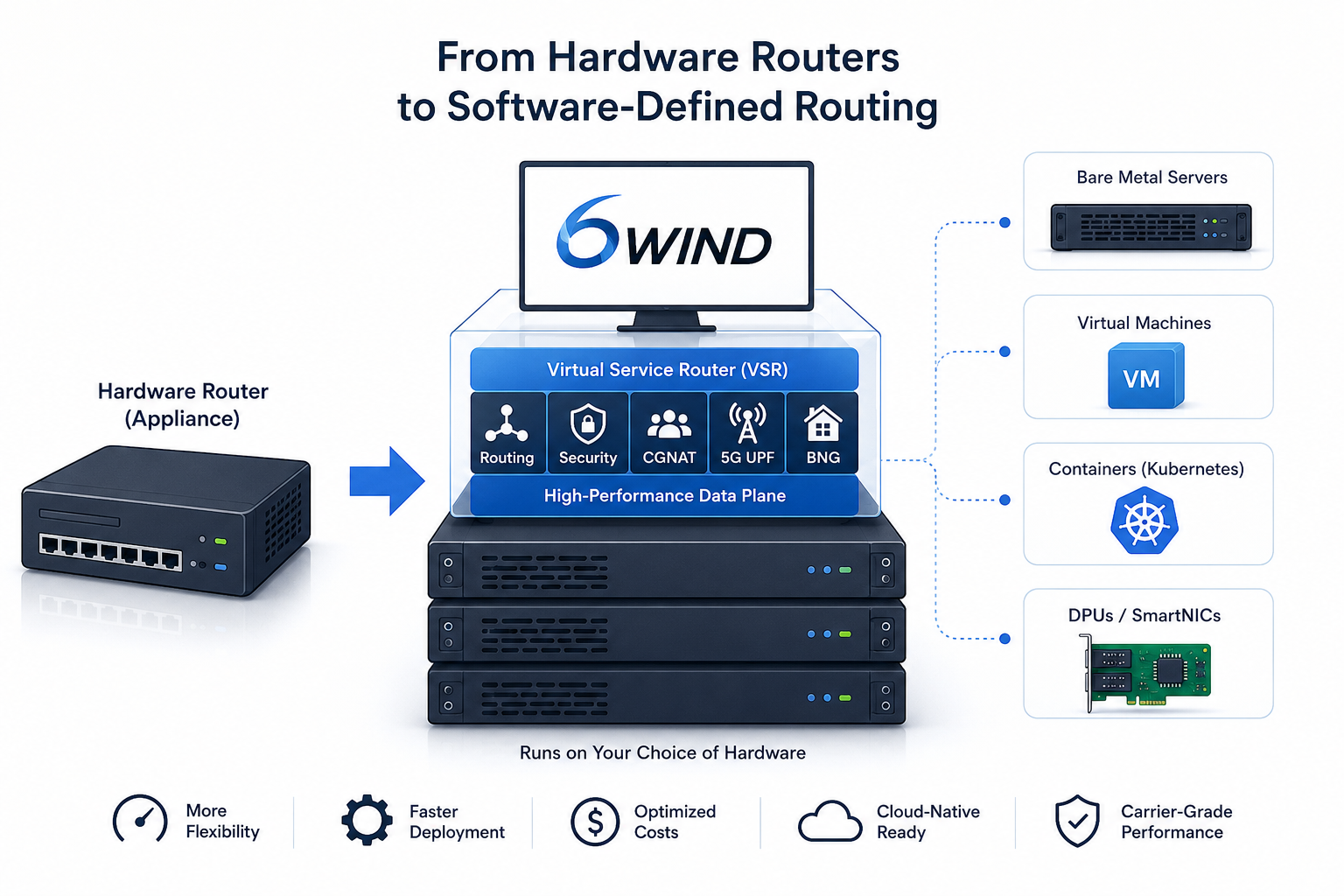
- Its Virtual Service Router portfolio includes provider-edge, cloud-service, border and customer-premises routing, as well as security gateways, firewalls, 5G user-plane functions, carrier-grade NAT and broadband network gateways. These products share a high-performance packet-processing foundation, but they differ substantially in routing scale, subscriber state, security obligations, high-availability requirements and platform design.
- The company’s core commercial proposition is disaggregation. Its routing and network-service software can run on selected commercial off-the-shelf servers, virtual machines, containers and supported data-processing units. This can give operators more freedom in procurement and deployment, but it does not remove the need for servers, network interfaces, optics, power, cooling, facilities, acceleration hardware or careful performance engineering.
- Public evidence is strongest for the company’s current product portfolio, leadership, board and investor relationships, and recent announcements involving Orange, Dell Technologies, NVIDIA, Equinix, Megaport and an unnamed tier-one European telecom operator. The public record does not provide audited revenue, profitability, valuation, ownership percentages, a current customer count or independent proof that announced performance and cost results apply across different workloads.
Replacing a hardware router begins with defining what is being replaced
The phrase “replacing hardware routers with software” sounds more radical than the engineering change it describes. A router has never been only a box. It combines protocol software, forwarding logic, interfaces, processors, memory, timing, power, cooling, management systems and a support contract. When an operator moves a network function from a proprietary appliance to 6WIND software, the physical system does not vanish. The control and service logic is separated from a single vendor’s chassis and placed on hardware selected from a validated range of servers, network cards, SmartNICs or data-processing units.
The economic unit changes before the physical requirements do. An operator may buy licences or subscriptions, deploy an image through a virtualisation platform or Kubernetes, and add capacity by assigning more processor cores or launching another instance. It may avoid a long appliance-procurement cycle and reuse a common computing estate across several services. Yet every packet still crosses a physical port, consumes memory bandwidth, competes for processor or accelerator cycles and depends on a real network path. Software changes the appliance boundary; it does not make the infrastructure immaterial.
The practical question is therefore narrower than the marketing slogan suggests: for which routing and telecom functions can portable software meet production requirements more effectively than a purpose-built system? A virtual border router at a cloud edge, a carrier-grade NAT cluster, a 5G user-plane function and a large core router face different demands for route scale, session state, latency, resilience and failure recovery. 6WIND matters because it has widened the range of functions for which software is a credible option. It has not shown that one server design should replace every router in every part of a network.
The legal company is specific even when the brand appears abstract
The commercial name is 6WIND, but the verified French legal entity is 6 WIND S.A., with a space. France’s national company directory records SIREN 432 424 356, a creation date of 24 July 2000 and an active headquarters at 3 avenue des Prés, 78180 Montigny-le-Bretonneux. Describing the business as Paris-based is convenient shorthand, but the more accurate formulation is that it is headquartered in Montigny-le-Bretonneux, in the Paris region.
That precise identity prevents several category errors. 6WIND is not a wind-energy company, a generic networking term, a manufacturer of router chassis, a hyperscale cloud provider or the DPDK open-source project. It is a private networking-software company whose products run inside telecom, cloud, enterprise and edge systems owned by other organisations. It controls how its software is designed, supported and validated, but it does not control a customer’s routing policy, the surrounding cloud, the physical network or the operating outcome of every deployment.
Its private status also places a limit on what can be established from public sources. The company publishes leadership information, product descriptions, board and investor relationships and partner announcements. It does not publish audited standalone accounts or a complete capitalisation table. The available evidence supports a detailed assessment of its technology and commercial model, but not reliable estimates of revenue, profit, valuation, customer concentration or ultimate ownership control.
The original problem lay in the packet path through a general-purpose operating system
Commercial servers became increasingly attractive for network functions as processors, memory and Ethernet interfaces improved and operators sought a common hardware base. Conventional operating-system networking, however, can impose overheads that are acceptable for ordinary applications but costly at high packet rates. Interrupt handling, context switches, scheduler activity, memory copies and cache misses can consume more computing time than the network function itself.
6WIND’s early advantage came from engineering around that path. User-space packet processing, polling, batching, core affinity and deliberate memory placement can reduce interrupts and improve cache locality. Packets can move through an optimised data plane instead of repeatedly crossing operating-system boundaries designed for flexibility rather than deterministic throughput. That work became the technical foundation for the later Virtual Service Router portfolio.
None of these techniques makes a standard server automatically fast. A system with poorly aligned network queues, memory attached to the wrong processor socket, insufficient huge pages or shared processor cores can perform far below its nominal capacity. Small packets place particular pressure on packets-per-second performance, encryption consumes a different mix of instructions and memory bandwidth, and large routing, access-control or session tables change cache behaviour. High-performance software routing is an engineering discipline, not a quality conferred simply by installing an image.
User-space acceleration expanded what commercial compute could do
The attraction of user-space acceleration is control over the packet-processing path. Poll-mode drivers can read network-interface queues continuously rather than waiting for an interrupt for each burst of traffic. Batch processing spreads lookup and function-call overhead across many packets. Reserved processor cores reduce interference from the operating-system scheduler, while huge pages and topology-aware memory allocation can reduce address-translation and remote-memory penalties.
Used together, these techniques can make a general-purpose processor behave more like a dedicated packet engine for selected workloads. They also create operational obligations. Reserved cores cannot be used by other applications, polling may consume power even when traffic is light, and memory placement must reflect the physical relationship among processor sockets, memory and network interfaces. Driver, firmware and network-card compatibility become part of the support matrix, while capacity planning must include enough headroom to survive failures rather than relying on a laboratory maximum.
6WIND’s commercial proposition is valuable because it packages those techniques with complete routing and service functions. Customers are not simply buying a faster packet-processing loop. They need routing protocols, configuration systems, telemetry, high availability, lifecycle tooling and vendor support around the data plane. The company’s move from acceleration technology to complete network functions reflects the difference between a benchmark component and an operable product.
DPDK is part of 6WIND’s history, not an asset it owns
6WIND’s historical material describes an important role in the development of high-performance packet-processing work associated with the Data Plane Development Kit, or DPDK. That relationship helps explain the company’s expertise in user-space networking and accelerated commercial compute. It does not mean that 6WIND owns DPDK or is its sole author.
DPDK is a broad, multi-contributor open-source framework whose governance, drivers and optimisations extend far beyond one company. 6WIND’s commercial value lies in a different layer: turning accelerated packet processing into supported routing, broadband, mobile and security products, then integrating those products with hardware and orchestration environments.
The distinction is important because open infrastructure often grows from contributions made by several companies and communities before becoming a shared substrate. A business can retain deep historical expertise while depending on an ecosystem it does not control. The more 6WIND promises portability across processors, network cards and data-processing units, the more important that dependency becomes.
The first commercial phase centred on embedded and original-equipment systems
During the 2000s, 6WIND developed accelerated networking software for embedded and original-equipment-manufacturer environments. The product was often a high-performance stack or toolkit that another vendor could integrate into a larger system. That work built expertise in multicore scaling, network-interface integration, memory management and predictable packet forwarding on standard processors.
This period matters because it created a long engineering continuity before network functions were widely sold as virtual appliances. The company learned that network performance depends on details beneath the routing protocol, including queue placement, memory locality, driver behaviour and how work is divided among processor cores. Those lessons later supported the development of software routers sold as complete products.
The public record is less detailed about the company’s early founders, individual financing rounds and every transition in its product line. The safest history is therefore functional rather than biographical. 6WIND began as a specialist in accelerated packet processing, contributed to the wider user-space networking movement and later moved higher in the stack by offering complete network functions.
Network-functions virtualisation changed the commercial product
Telecom network-functions virtualisation separated software functions from proprietary appliances. In principle, a provider could run a firewall, gateway, router or subscriber function as software on a shared computing platform. For 6WIND, this widened the addressable product from embedded acceleration technology to complete virtual network functions.
The transition required much more than repackaging. A provider-edge router needs routing protocols, virtual private-network services, management and redundancy. A carrier-grade NAT system must manage large amounts of session state, logging and regulatory obligations. A broadband network gateway binds subscriber sessions to policy and authentication systems, while a 5G user-plane function must fit into a mobile-core architecture. These functions can share an accelerated data plane, but their control, state and operational requirements differ.
Virtualisation also shifted more integration work to operators and systems integrators. A proprietary appliance vendor once delivered the hardware and software as one qualified system. In a disaggregated design, the customer may have to select servers, network cards, processor and memory layouts, accelerators, hypervisors, orchestration platforms, monitoring systems and high-availability patterns. 6WIND can supply portable software and support, but the customer still has to make the complete platform work.
The Virtual Service Router became a portfolio, not one appliance
6WIND’s current Virtual Service Router family covers a broad range of routing and telecom roles. Routing products include virtual provider-edge, cloud-service, border and customer-premises routers. Broadband and mobile functions include virtual broadband network gateway, user-plane function and carrier-grade NAT. Security products include a virtual security gateway and firewall. The software can be delivered on bare metal, in virtual machines, as containerised applications or on selected data-processing units.
The common brand should not obscure the different engineering problems involved. A border router primarily maintains routing and forwarding state. A security gateway may perform IPsec encryption at high throughput. A carrier-grade NAT system tracks address translations and sessions. A broadband gateway manages subscribers, policy, accounting and service integration, while a 5G user-plane function processes mobile traffic using interfaces defined by 3GPP. Shared acceleration can reduce duplicated engineering, but it cannot make these state models interchangeable.
For buyers, the portfolio may offer a useful degree of consistency across several functions, including shared management concepts, a common support relationship and a common packet-processing foundation. It also creates a verification burden. Every product and release must be assessed for protocol support, scale, state replication, telemetry and failure behaviour. A broad portfolio label does not prove that every function has the same maturity.
Julien Dahan’s appointment marked a phase of commercial expansion
Julien Dahan became chief executive in September 2020. The current leadership surface also includes Jean-Mickaël Guérin as chief technology officer and head of research and development, Guillaume Ducousso as chief financial officer, Barry Dahan in business development, Neelam Bahal in global marketing, Karim Mchirki in product, regional sales executives and a customer-success function. Guérin’s long tenure, beginning in 2000 and leading to the chief technology role in 2018, provides visible technical continuity alongside the newer commercial leadership.
The years after 2020 brought broader positioning across cloud connectivity, private 5G, broadband, security and managed services. Container delivery and Kubernetes integration became more prominent alongside virtual-machine deployments. Relationships with Orange, Dell, NVIDIA, Equinix and Megaport also became important parts of the company’s public go-to-market story.
Public leadership material does not reveal the exact size or location of every team. The company appears to retain a substantial research-and-development identity in France while using regional commercial executives and partners to reach North America and Asia-Pacific. A partner’s geographic reach should not be confused with a staffed 6WIND office in every market where its software can be deployed.
A virtual router still depends on a control plane and a data plane
Routing protocols decide which forwarding state should exist, while the data plane applies that state to packets. 6WIND separates these responsibilities so protocol and service logic can evolve while packet processing is optimised for the selected processor, network card or data-processing unit.
The separation allows the two parts of the system to scale differently. More forwarding cores can be assigned without rewriting routing policy, and parts of the packet-processing path can be moved to a data-processing unit while the control plane remains on the host. Different products can also share the same acceleration layer even when their service logic differs. This separation is a major source of the company’s claimed portability.
It also creates a consistency problem. Routes, policies, tunnels, encryption keys and session information decided by the control plane must reach every worker core or accelerator in the correct order. Stale or partially applied state can send traffic along the wrong path, interrupt sessions or create security failures. Dividing the work is useful only when the synchronisation between the two planes is reliable.
Routing protocols matter as much as raw forwarding speed
A software router must interoperate with existing networks, which requires correct implementation of BGP, OSPF, IS-IS, MPLS and product-specific functions. Route selection, policy, convergence and failure recovery determine whether the device participates safely in a larger routing system. A fast packet loop is of limited value if the control plane behaves unpredictably under route churn or failure.
Software delivery can make protocol upgrades faster than replacing a chassis or line card. It can also increase the frequency and complexity of releases. A new image may change forwarding behaviour, routing defaults, management models and hardware compatibility at the same time. Operators therefore need laboratory validation, staged deployment and a credible rollback path.
The least useful comparison places an optimised forwarding number beside an integrated appliance that has already been qualified for a particular role. A fair evaluation also includes routing-table scale, convergence, route churn, telemetry, high availability and support response. Forwarding performance is essential, but it is not a complete definition of a router.
Commercial hardware increases choice by increasing the number of choices
Commercial off-the-shelf servers can reduce dependence on a proprietary chassis and align network functions with a wider computing-procurement cycle. Operators may buy capacity from several server suppliers, reuse standard racks and automate provisioning through cloud tools. Software licensing can also be separated from a particular box.
That freedom produces a much larger design space. Processor generation, core count, clock speed, memory channels, non-uniform memory-access topology, network-card model, queue count, drivers, firmware and accelerator support can all affect performance. Results achieved on one validated Dell and Intel configuration cannot be assumed to apply to every server.
The practical meaning of “hardware independent” is therefore limited. The software may be portable across a class of validated platforms while production capacity remains specific to each configuration. Independence means that a customer can choose among supported options and move without rewriting the network function. It does not mean that hardware differences stop mattering.
Provider-edge and cloud-service routing sit where networks meet services
The virtual provider-edge and cloud-service-router products place routing and virtual private-network functions inside telecom or cloud platforms. They can connect tenant networks, exchange routes with peers, apply policy and support service-provider connectivity without requiring a dedicated appliance at every site.
This is particularly relevant in distributed environments. A cloud-connectivity provider may need routing near several interconnection locations, while a managed service may create customer instances on demand. A network operator may also prefer to add capacity in smaller software units rather than reserve an entire chassis for each edge.
The surrounding infrastructure remains important. Route scale, distributed-denial-of-service handling, upstream connectivity and high availability must still be designed. A virtual router can control paths and process packets, but it cannot guarantee that a cloud region, upstream transit provider or customer network will remain available.
Border routing is portable only when route scale and attack design travel with it
6WIND’s virtual border router targets internet and cloud-border roles. Moving that function into software can simplify deployment near a cloud edge or Network-as-a-Service platform, but a border router faces large routing tables, complex policy and hostile traffic. It may need many peers, full internet tables, fast convergence and an architecture designed for distributed-denial-of-service attacks.
The software image does not define the complete border system. Operators must decide whether malicious traffic is filtered before reaching the router, whether forwarding is offloaded, how route sessions are protected, how the control plane is policed and how capacity behaves during an attack. Redundancy across servers or availability zones must be designed rather than assumed.
Purpose-built hardware may retain a clear advantage at the highest densities. 6WIND’s opportunity is strongest where standard compute and supported acceleration meet the required performance envelope and where deployment flexibility carries enough value to justify the integration effort.
Carrier-grade NAT is a state and accountability problem
Carrier-grade NAT is often presented as a throughput function: translate many private addresses into a smaller public-address pool and keep packets moving. In production, it is also a large state machine. Every session requires a mapping, timers and resource allocation, and operators may need detailed logs that connect a public address and port to a subscriber at a particular time. Failover must preserve enough state to prevent widespread service interruption or gaps in forensic records.
A virtual carrier-grade NAT system may benefit from elastic computing capacity and automated deployment, but horizontal scaling is not as simple as launching additional stateless copies. Traffic steering must keep both directions of a session on a compatible instance, state may need replication, and draining an instance before an upgrade takes time. Logging can become a separate capacity, storage and compliance system.
6WIND’s accelerated data plane is relevant because translation and lookup occur for every packet. The complete proposition depends on how the product handles session state, logging, failure and regulatory requirements at the customer’s scale. Those characteristics have to be evaluated for the specific product, release and design rather than inferred from the portfolio as a whole.
A virtual broadband gateway carries subscribers, policy and history
A broadband network gateway terminates subscriber sessions and connects access networks to services. It may perform authentication, address assignment, policy enforcement, accounting, quality of service and service selection. That makes 6WIND’s virtual broadband network gateway one of the portfolio’s most operationally demanding products.
Virtualisation can allow a broadband provider to separate subscriber capacity from a fixed chassis and place processing closer to regional demand. It can also support automated service creation and use a common server estate. The challenge is preserving subscriber state and predictable behaviour during upgrades, server failures and traffic movements.
A process may restart quickly while subscriber recovery remains disruptive. Session resynchronisation, graceful draining, control-plane integration and traffic steering determine whether customers notice the event. Cloud-native packaging does not remove subscriber state; it makes the state lifecycle part of the cloud platform.
The 5G user plane extends the same disaggregation model into mobile networks
A 5G user-plane function processes subscriber traffic between the radio network, core network and external data networks. It applies forwarding, encapsulation, policy and accounting decisions supplied by other parts of the mobile system. Running the function as software fits the wider move towards cloud-native mobile cores and distributed edge computing.
Placement has direct consequences. A user-plane function close to users may reduce latency and backhaul demand, but it creates more sites to operate. A centralised deployment may simplify management while increasing path length and concentrating risk. Processor, network-card and accelerator choices affect packet rates, tunnelling and quality-of-service behaviour.
6WIND’s virtual user-plane function extends its common packet-processing strategy into mobile infrastructure. Public evidence of product availability does not establish identical 3GPP feature support, interoperability or production scale for every operator. Mobile deployments require integration with control-plane functions and platform-specific validation that a public portfolio description cannot fully demonstrate.
Security gateways and firewalls show the limits of acceleration
The virtual security gateway and firewall place security functions directly in the packet path. An IPsec gateway must encrypt and decrypt traffic, manage tunnels and keys and meet performance targets under the chosen algorithms. A Layer 3 or Layer 4 firewall applies rules to traffic and may maintain connection state.
User-space acceleration and data-processing units can improve throughput, particularly when cryptographic work would otherwise consume host-processor capacity. The security result still depends on policy quality, key management, patching, logging and the security of the applications behind the gateway. A fast firewall does not replace identity controls, application security or secure system design.
Responsibility remains divided. 6WIND owns the documented behaviour and support of its software, hardware vendors own firmware and acceleration components, and the operator defines policy, protects credentials and integrates telemetry. A marketplace or engineered solution may clarify the boundaries, but it does not make them disappear unless the contract explicitly assigns end-to-end responsibility to one party.
Virtual machines and containers solve different lifecycle problems
Virtual machines provide a familiar network-functions-virtualisation boundary. They package an operating system and application with strong isolation and established orchestration, but they can be relatively heavy and slow to start. Containers use smaller images and fit Kubernetes operations, although they share more of the host environment and depend closely on cluster networking, scheduling and security policy.
A containerised network function is not simply a virtual-network-function binary placed inside a container. It needs health checks, declarative configuration, graceful termination, metrics, resource limits, image provenance and a plan for persistent or replicated state. Kubernetes can restart a failed process quickly, but it cannot infer whether subscriber sessions, address translations or routing adjacencies survived correctly.
6WIND’s support for both virtual-network-function and cloud-native-network-function forms broadens customer choice. It also requires operators to distinguish packaging support from operational maturity. The decisive test is how the function behaves during rescheduling, rolling upgrades, node failure and control-plane interruption.
Host-based routing moves the network boundary into each worker
6WIND’s host-based-routing architecture brings routing and Ethernet VPN functions closer to Kubernetes worker nodes. Rather than sending all traffic through a central gateway or top-of-rack appliance, each host can participate more directly in the routed fabric. This may reduce bottlenecks, shorten paths and make the network more responsive to workload placement.
The change also multiplies the number of routing objects. A large cluster may contain thousands or tens of thousands of worker nodes, each with interfaces, routes, policies, health state and software versions. Control-plane scale, convergence and observability become part of the cluster platform rather than remaining confined to a separate network-appliance domain.
In February 2026, 6WIND announced that a tier-one European telecom operator had deployed the host-based-routing solution across tens of thousands of Kubernetes worker nodes. That is material first-party evidence of scale. The customer was not named, and the public record does not independently verify performance, savings or the complete architecture. The supportable conclusion is that 6WIND has announced a carrier-scale deployment in the cloud-host data path, not that every claimed benefit has been independently audited.
Ethernet VPN at the host removes one bottleneck and creates a larger control plane
BGP Ethernet VPN distributes endpoint, reachability and overlay information. Moving it onto hosts can allow the network to follow workloads more directly and avoid sending traffic through central gateways. It also creates many more BGP speakers and a much larger amount of distributed state.
The operating question shifts from the capacity of one appliance to the coordination of the whole system. Route reflectors, policy, failure detection and update processing must be sized for the host population. A configuration error can affect every workload on a worker, while a software upgrade must be coordinated with Kubernetes and the container-networking layer so network state is not lost during rescheduling.
This is a clear case of complexity being moved rather than removed. Central hardware may be reduced, but routing knowledge and responsibility are spread through the cluster. The approach is attractive when the platform team can automate and observe that distribution. It becomes risky when ownership is divided ambiguously among networking, Kubernetes and application teams.
Container-network integration determines whether host routing belongs to the platform
Kubernetes networking usually depends on a container network interface implementation, service routing and cluster-lifecycle tools. A host-routing system must coexist with those components and establish which layer owns addresses, routes, policy and tunnel state. It must also define the sequence of changes during node creation, upgrade and removal.
An automated integration can make deployment repeatable, but it also creates a shared failure domain. A change to the container-network interface, kernel, host-routing image or cluster manager can affect every workload on a node. Operators therefore need compatibility matrices, staged rollouts and rollback procedures that include network state rather than only container images.
The relationship with Spectro Cloud announced in 2026 is relevant because it connects 6WIND’s networking to Kubernetes lifecycle management. It indicates an ecosystem direction, but it does not establish that every combination of Kubernetes distribution, container-network interface and cloud platform has been validated.
Data-processing units show that software-defined networking remains hardware-accelerated
6WIND announced support for Virtual Service Router functions on NVIDIA BlueField-3 data-processing units in February 2026. A DPU can process networking independently of the host processor, preserve application computing capacity and create a stronger isolation boundary between infrastructure services and workloads. That can be attractive in AI, cloud and telecom systems with high packet-processing demand.
The announcement also corrects the idea that software and hardware sit on opposite sides of the market. As throughput, encryption and state requirements rise, specialised silicon returns in the form of SmartNICs and data-processing units. The service remains defined in software even when selected packet-processing work moves to another processor.
DPU adoption introduces another lifecycle. Firmware, software-development kits, drivers, security updates and vendor roadmaps become dependencies. Operators need to know which configuration and operating procedures remain common across CPU and DPU deployments. Portability should be judged by how much code, policy and tooling survive a platform change, not by whether specialised hardware is absent.
NVIDIA is both an investor relationship and a technology dependency
6WIND’s public governance material identifies NVIDIA as a strategic investor, while product announcements place NVIDIA hardware inside the deployment ecosystem. These are different relationships. An investment may align commercial interests or signal confidence, while support for BlueField creates a technical dependency. Neither establishes a particular ownership percentage or control right.
The same caution applies to Cisco, which is also named as a strategic investor but whose current operational relationship is less clearly described in the reviewed material. Investor labels should not be converted into assumptions about product integration, voting control or acquisition plans.
For customers, the practical question is whether 6WIND can preserve meaningful software choice while optimising deeply for selected accelerator platforms. A broad support matrix strengthens its claim to neutrality. A narrow dependency could move lock-in from a router chassis to a DPU software-development kit and firmware stack.
Dell’s engineered solution shows how disaggregated software is still sold as a system
6WIND and Dell Technologies have presented engineered solutions combining Virtual Service Router software with current server and Intel infrastructure. Such packaging can reduce the customer’s integration burden by validating hardware, interfaces and software together. It may also create a clearer procurement and support path than assembling each layer independently.
This does not reverse disaggregation. The network function remains software and may run on other supported platforms. The engineered solution provides one qualified reference architecture within that model, recognising that many operators still want an integrated bill of materials even when they do not want a proprietary routing appliance.
The commercial value depends heavily on support boundaries. Customers need to know which party owns first-line escalation, how firmware and software releases are matched and which performance configurations have been tested. A partner logo establishes that a relationship exists; the support contract determines what happens during an incident.
Orange provides named operator evidence without creating a universal template
In May 2025, Orange and 6WIND announced an expanded collaboration around cloud-connectivity and security services for business and wholesale customers. The relationship matters because it places the software in a named carrier-service context rather than only in a laboratory or product catalogue.
The announcement does not disclose every topology, capacity figure or commercial outcome. Orange may use selected 6WIND functions inside a wider platform that includes its own automation, infrastructure and operating procedures. The relationship demonstrates relevance, but it does not provide a deployment template that can be assumed to apply elsewhere.
Named operator evidence carries more weight than an abstract market claim because it shows that an experienced customer has integrated the technology. Attribution still matters. The deployment is described by the vendor and customer, while independent service-performance and financial results remain undisclosed.
Megaport makes virtual routing part of an on-demand connectivity service
On 23 July 2026, 6WIND expanded its relationship with Megaport so that the Virtual Service Router portfolio could be acquired and deployed through Megaport’s cloud-connectivity ecosystem. The development reflects a wider move away from appliance procurement and towards marketplace and Network-as-a-Service consumption.
A customer may be able to place routing near cloud connections, obtain it through an established commercial channel and align capacity with on-demand connectivity. That can reduce procurement friction and make virtual routing part of a broader cloud-network workflow instead of a separate hardware project.
Marketplace availability is not the same as a completed production deployment. Provisioning, billing, support, resilience and network reach depend on the partner arrangement and the customer’s design. Megaport controls its platform, 6WIND controls the routing software and the customer controls network architecture and policy. The partnership’s value lies in coordinating those layers rather than pretending they form one undivided system.
Equinix places virtual routing close to physical interconnection
6WIND also announced Virtual Service Router availability through Equinix-related marketplace and edge channels in 2026. Equinix facilities bring cloud providers, carriers and enterprises into physical proximity. Software routing available near those connections can support hybrid-cloud, multi-cloud and managed-connectivity designs without requiring a dedicated appliance at every site.
The relationship is evidence of distribution and a deployment environment. Equinix does not become the owner of 6WIND’s software, and 6WIND does not control the facility, cross-connect or customer network. Performance still depends on the chosen site, virtual or physical interfaces, upstream networks and customer topology.
Commercially, the layers may appear to converge into a single transaction. Operationally, an incident may still cross facility, connectivity, hardware, orchestration and software teams. The marketplace simplifies acquisition more readily than it simplifies responsibility.
Partner channels expand reach by dividing responsibility
6WIND’s ecosystem includes server suppliers, Network-as-a-Service platforms, cloud and edge marketplaces, Kubernetes-management partners, systems integrators and regional resellers. These relationships allow a private French software company to reach global customers without owning data centres or maintaining a large office in every market.
The model combines complementary capabilities. A server supplier qualifies the compute platform, an accelerator company supplies a DPU, a marketplace provides placement and billing, an integrator designs the deployment and 6WIND supports the network function. The resulting offer may be stronger than any component on its own.
The risk is unclear support ownership. Failures at the boundary between firmware, network queues, routing configuration, cloud networking, orchestration and application traffic can be passed among vendors. Buyers need a coherent escalation process, an agreed version matrix and evidence that the complete stack has been tested. A large partner ecosystem is valuable only when operational accountability is equally clear.
The software’s geographic reach is larger than the company’s office footprint
6WIND’s registered headquarters and main engineering identity are in Montigny-le-Bretonneux. Public material also refers to commercial coverage in North America and Singapore or the broader Asia-Pacific region through executives responsible for the Americas and Europe, the Middle East and Africa or Asia-Pacific.
Its operational footprint is much wider because the software can run in customer networks, carrier clouds, data centres, Kubernetes clusters and partner marketplaces around the world. A deployment in a country does not necessarily mean that 6WIND has an office or legal entity there. Marketplace reach should not be treated as owned infrastructure.
For a digital-infrastructure company, that distinction is important. 6WIND’s influence travels through code, support and partnerships rather than through a global estate of facilities. Its ability to serve distributed deployments depends on documentation, remote operations, capable partners and effective escalation rather than physical ownership of each site.
Ownership is visible only to the extent that the company discloses it
6WIND identifies LBO France and Sofinnova Partners through board and investor relationships and names NVIDIA and Cisco as strategic investors. Current public pages show governance connections but do not disclose a complete capitalisation table, voting rights, investment dates or ownership percentages.
A board representative is evidence of governance participation, not proof of majority ownership. A strategic investor may bring capital, technology access or commercial alignment without controlling the company. Without a published ownership schedule, no defensible conclusion can be reached about ultimate control.
This level of opacity is common among private infrastructure-software companies, but it remains relevant to customers making long-term dependency decisions. An operator may be able to assess technical resilience while still lacking public information about financial capacity, ownership concentration or the possibility of a future transaction.
The revenue model is understandable even when the figures are not public
6WIND appears to earn revenue from software licences or subscriptions, maintenance and support, professional services, original-equipment or engineered solutions and marketplace offerings delivered through partners. The balance among subscriptions, support and services is not publicly disclosed.
The economics vary by deployment. A complete Virtual Service Router licence has a different commercial structure from an embedded acceleration component, DPU package or partner-bundled service. Usage, capacity, processor cores, instances, contract term and support level may all influence pricing, but the public material does not provide a universal model.
No audited revenue, operating profit, cash position, research-and-development spending or customer-concentration schedule was found in the material provided. Business-case papers may illustrate possible savings, and partner announcements may show routes to market. Neither substitutes for financial statements. The company’s financial scale and profitability remain unresolved questions rather than negative findings.
Software routing moves cost rather than simply removing it
The simplest comparison puts a proprietary router on one side and a software licence on a commercial server on the other. A serious cost model must also include processors, memory, network cards, accelerators, power, rack space, orchestration, integration, testing, maintenance, support and the staff needed to manage a faster software-release cycle.
Disaggregation may still be economically attractive. Standard hardware can be bought in a competitive market, capacity can be added in smaller increments, and software instances can be placed closer to demand. An operator may also avoid buying unused fixed capacity and reuse automation across several functions.
The result depends on the operator’s capabilities. A provider with a mature telecom cloud may absorb another cloud-native network function efficiently. An organisation without expertise in processor topology, Kubernetes and routing may spend more on integration and troubleshooting than it saves on hardware. Vendor business cases should therefore be treated as scenarios, not as audited customer outcomes.
Purpose-built systems remain strong where density and predictability dominate
Specialised routing hardware can deliver very high throughput, dense interfaces, predictable latency and integrated operations. A core platform may combine redundant switching fabric, line cards, optics, buffering, telemetry and a long support lifecycle. Those qualities remain important where one failure can affect enormous traffic volumes or where power and rack density are tightly constrained.
Software routing does not need to displace that model everywhere to be commercially important. It may be well suited to cloud edges, managed-connectivity sites, mobile user planes, virtual service points and distributed functions where flexibility and common hardware matter more than maximum density. It may also coexist with physical routers, handling selected services while specialised hardware carries the largest aggregate flows.
6WIND’s move towards DPUs reflects that practical boundary. When a workload no longer fits comfortably on a general-purpose processor, the company can target specialised acceleration while keeping the service defined in software. The real choice is not software or hardware, but which layer should remain portable and which should be optimised for the workload.
High availability must be designed across the whole system
A software process can restart quickly, and an orchestrator can automatically create a replacement instance. Neither action guarantees uninterrupted service. Routing protocols may need time to reconverge, stateful functions may lose sessions, and traffic can continue towards a failed instance until health information reaches every steering layer.
Resilience must therefore be designed across server, rack, availability-zone, control-plane and data-plane failure domains. Stateless routing may rely on multiple instances and protocol convergence, while carrier-grade NAT, broadband gateway, firewall and security-gateway functions may require state replication, deterministic traffic steering and graceful draining. DPU deployments add another component that can fail or require an upgrade.
Operators need to test failure rather than infer resilience from an architecture diagram. Useful evidence includes convergence distributions, session survival, replication lag, rollback behaviour and the effect of partial failures. An active-active design may still depend on a shared database, orchestrator, route reflector or power source that becomes the real point of concentration.
Benchmark headlines should lead to questions about the test
Packets-per-second and gigabits-per-second results vary with packet size, protocol mix, tunnelling, encryption, table depth, access-control lists, session counts, route churn and the specific processor or accelerator. A maximum figure measured with large packets and a limited feature set says little about a production carrier-grade NAT or IPsec gateway processing small packets and constant state changes.
A defensible benchmark should describe the full environment: processor model and frequency, core allocation, memory topology, network card, driver, firmware, acceleration, packet profile, enabled features, latency distribution, utilisation and resilience headroom. It should also state whether traffic is unidirectional, bidirectional, encrypted, stateful or affected by routing changes.
Independent and customer-run tests generally carry more weight than a vendor’s optimised demonstration, although they may still describe only one architecture. 6WIND’s long engineering record and deployment relationships support its technical credibility. Procurement decisions nevertheless require validation against the customer’s intended workload.
Performance tuning becomes part of the operating contract
A proprietary appliance hides many low-level choices inside one qualified configuration. A portable software function exposes more of them. Core isolation, interrupt settings, memory channels, huge pages, queue counts and processor power modes can determine whether the system meets its target.
Documentation and support therefore matter as much as the code. Customers need reference architectures, sizing guidance, automation and monitoring that reveal when a configuration has moved outside the tested envelope. Support teams also need to distinguish a software defect from a platform mismatch without turning each incident into a dispute among several suppliers.
The strongest software-routing platforms productise deployment knowledge rather than merely publishing a binary. Portability does not mean that any server will work. It means qualifying a useful range of platforms and preserving common operating methods across them.
The software supply chain becomes part of the router
A virtual network function is delivered through software artefacts rather than through sealed appliance firmware alone. Operators must inventory images, licences, certificates, libraries, kernels, drivers and orchestration definitions, each with its own version and security lifecycle.
Signed artefacts, vulnerability management, reproducible configuration and rollback become routing concerns. A library update can change packet parsing, a kernel release can affect drivers and memory behaviour, and a DPU firmware update can alter offload semantics. A container registry or marketplace also becomes part of the delivery chain.
Disaggregation increases choice while expanding the number of trust relationships. The answer is not to reject software routing, but to treat its supply chain as critical infrastructure. Provenance, patch windows and support ownership should be established before deployment rather than improvised during an incident.
Cloud-native packaging can add as many dependencies as it automates
Kubernetes can schedule, restart and upgrade network functions. It also introduces dependencies on the cluster control plane, container-network interface, image registry, service discovery, storage and node lifecycle. A failure in one shared cluster service may affect both the network function and the applications it is meant to connect.
Stateful functions are particularly sensitive. Rescheduling may change interfaces and traffic paths, session state may not follow automatically, and a container-level upgrade can be technically successful while still causing route churn or traffic loss. Horizontal scaling may depend on an external steering system with its own convergence delay.
A cloud-native router must therefore be evaluated as part of the cluster rather than as an isolated pod. The benefit is coordinated lifecycle automation. The risk is that networking becomes dependent on a platform whose own failures may already be affecting the rest of the system.
Host routing shifts responsibility towards platform teams
When routing runs on every worker, the platform team becomes an operator of a distributed network control plane. Network policy, kernel versions, container-network behaviour and cluster upgrades can no longer be delegated entirely to a separate appliance team.
The approach can improve alignment. The automation that creates a node can install routing, test connectivity and remove state when the node leaves. Workload identity and location can be reflected directly in the network, and failure information can be correlated with cluster events.
It also demands new skills and clear ownership. A network team may understand BGP but not Kubernetes scheduling, while a platform team may understand pods but not routing convergence. The operating model must bridge those disciplines. 6WIND can provide software and support, but the customer decides who owns the combined system.
The competitive set changes with the function being purchased
6WIND does not face one universal competitor. Cisco, Juniper and Nokia offer virtual routing products supported by large existing portfolios. TNSR and Netgate overlap in high-performance software routing, while RtBrick focuses on disaggregated and white-box routing. FRRouting and VPP provide open-source building blocks. Telecom vendors package broadband gateways, mobile user-plane functions and carrier-grade NAT inside wider systems, while cloud providers sell managed routing and firewall services.
Each option distributes responsibility differently. An incumbent virtual router may preserve familiar features and one-vendor support but offer less hardware or licensing flexibility. Open-source software may reduce licence fees while leaving integration and support to the customer. A managed cloud service may simplify operations while increasing dependence on one provider. Purpose-built hardware can deliver high density and a mature lifecycle at the cost of flexibility.
6WIND differentiates itself through an accelerated data plane, a broad set of carrier-oriented functions and support for several hardware forms. That position is strongest when customers want portability and complete supported products rather than raw open-source components.
Open-source software is a complement, substitute and bargaining tool
FRRouting can provide a broad routing control plane, while VPP and DPDK can supply packet-processing foundations and Linux offers additional networking functions. An operator or vendor can assemble these components directly. Licence costs may be low, and the resulting architecture can be highly customisable.
The cost moves into integration, testing, maintenance and support. A complete carrier-grade NAT system or broadband gateway requires more than a routing control plane and fast-path library. It also needs product-specific state management, telemetry, high availability, logging and operating tools. 6WIND’s commercial case is that packaging and support reduce that burden.
Open source also disciplines pricing and portability. Customers can compare the commercial product with components they could integrate themselves. 6WIND, in turn, depends on shared ecosystems and must continue providing value above them. The relationship is not simply competitive; it defines who carries the engineering responsibility.
Managed cloud services exchange portability for integrated operations
Amazon Web Services, Microsoft Azure and Google Cloud provide routing, firewall and connectivity functions integrated into their own platforms. Customers already committed to one cloud may find those services easier to deploy than an independent virtual router. The provider owns much of the lifecycle and can integrate billing, identity and telemetry.
The trade-off is control. Managed services may have feature limits, pricing structures and interfaces tied to one provider. Multi-cloud operators and Network-as-a-Service businesses may prefer a portable function that can run in several environments and present a more consistent routing model.
6WIND’s marketplace and partner strategy aims for a middle position: software distributed through cloud-like channels while remaining a separable product. Its success depends on whether meaningful portability survives deep platform integration and whether support remains coherent across providers.
AI infrastructure creates demand for routing near expensive compute
AI training and inference clusters bring together costly processors, high-speed networks and large east-west traffic flows. They also need north-south connectivity, tenant isolation, security and access to storage or cloud services. Host-based routing and DPUs can place network functions close to accelerators without consuming as much host-processor capacity.
6WIND’s BlueField-3 and cloud-host strategy makes it relevant to this infrastructure. The public evidence supports announced platform capability and partnerships, not a measured share of AI deployments. Many AI systems also use specialised internal fabrics whose switching requirements may fall outside the Virtual Service Router portfolio.
The clearest opportunity lies at the boundary: connecting AI clusters to clouds, tenants and external networks or moving service functions away from host processors. The risk is that DPU and accelerator ecosystems become tightly bundled, narrowing the hardware choice that software disaggregation was intended to create.
Network as a Service turns routing into a service component
Network-as-a-Service platforms allow customers to provision connectivity through portals and APIs. Virtual routing fits naturally into that model because it can be instantiated, licensed and scaled alongside the connection. Megaport’s expanded relationship with 6WIND is direct evidence of that convergence.
The approach can shorten sales and deployment cycles. It can also make the dependency chain less visible. A customer may see one portal while relying on a marketplace, cloud or edge host, 6WIND software, physical interconnection and several upstream networks.
The important management question is not whether the service is software-defined, but whether the customer knows which party controls configuration, capacity, incident response and exit. Convenience should not obscure the architecture of responsibility.
Running deployments carry more weight than a partner map
The available material contains several kinds of evidence. Product documentation describes what 6WIND offers. Partner pages establish commercial and technical relationships. Orange provides a named carrier-service context, Dell provides an engineered reference architecture, and Megaport and Equinix show distribution channels. The unnamed tier-one host-routing announcement supplies company-reported evidence of scale.
Together, these facts establish that 6WIND is an active infrastructure-software company with current products, material deployments and a broad ecosystem. They do not establish that every product is deployed at the same scale or that every advertised saving has been achieved. A listing, award or partnership is not a production census.
Real deployments deserve greater weight than abstract claims, but their scope still needs to be stated precisely. Readers should know whether the customer is named or unnamed, whether the result is independently observed or vendor-reported, and whether the evidence covers one configuration or a wider capability.
The real system is software, hardware, operators and contracts together
6WIND’s language becomes more useful when translated into mechanisms. “Hardware independence” means choice among validated platforms. “Cloud native” refers to lifecycle integration with containers and orchestration. “Carrier grade” describes a set of feature, scale, resilience and support obligations that must be demonstrated for a particular use case. “Replacing routers” means separating network functions from a proprietary appliance.
That translation does not weaken the company’s case. Building one accelerated software foundation that supports routing, broadband, mobile and security functions is difficult. Making it portable across processors, virtual machines, containers and data-processing units is harder still.
The limits are part of the proposition because customers need to know where responsibility begins and ends. 6WIND can make a function portable and supported. It cannot make all hardware perform identically, make every network fully observable or guarantee that every customer’s architecture is resilient.
The strategic shift is control over hardware choice
The most important effect of software routing is institutional rather than physical. In an appliance model, one vendor chooses the processor, interfaces, software and upgrade path. In a disaggregated model, the operator or integrator can select among software, computing and acceleration suppliers and place functions through cloud-oriented tools.
That redistribution can improve bargaining power and service agility. It can also create a more complex map of control. An operator may depend on a software licence, server supplier, network card or DPU roadmap, Kubernetes distribution, marketplace and support integrator. Lock-in is not necessarily removed; it is broken into smaller pieces and may reappear at another layer.
6WIND’s long-term position depends on keeping software and operations consistent across those choices. If each DPU or marketplace requires a separate product branch and operating method, its claim to neutrality will narrow. If one code base and support model can span them, the company has a stronger case for becoming a cloud-networking platform rather than a collection of unrelated virtual appliances.
Why BTW tracks 6WIND
BTW tracks 6WIND because the company operates inside the packet path while illustrating a wider change in digital infrastructure. It shows how routing, security, broadband and mobile functions can move from proprietary appliances into software-controlled environments without becoming weightless or universally interchangeable.
The company also illustrates the difference between ownership and influence. 6WIND does not own the cloud platforms, carrier networks, data centres or hardware on which its products run. Its software can nevertheless determine routes, address translations, security decisions and mobile user-plane behaviour inside those systems. That gives it direct relevance at the software layer of infrastructure.
It also provides a useful test of disaggregation’s promises. The public evidence supports real products, deployments and partnerships. The unanswered questions around independent benchmarks, customer numbers, ownership and financial performance prevent a promotional conclusion. The defensible story is of a credible engineering model whose commercial and operational success remains dependent on integration and workload.
Important questions remain unanswered
The public record does not identify the company’s founders with the same confidence as its legal incorporation date, and it does not provide a complete financing history or ownership percentages. Revenue, profitability, valuation, research-and-development spending and customer concentration are also unavailable.
The announced tier-one host-routing deployment is significant but has not been independently verified. Product and partner material does not provide complete performance data under representative feature loads, while detailed high-availability behaviour, protocol support and DPU portability must be checked for each release and platform.
These gaps are not reasons to dismiss 6WIND. They place reasonable limits on the conclusion. The company has demonstrated long technical continuity, a broad current portfolio and an active ecosystem in 2026. What remains unclear is how consistently the model performs across different workloads, how large and financially resilient the business is, and how much control any investor or partner holds.
Software can replace the appliance when the whole system still works
6WIND’s central proposition survives careful qualification. Many routing and telecom functions can be delivered as accelerated software on commercial compute, and the company has spent since 2000 developing the data-plane expertise, product range and partner ecosystem needed to make that model practical.
The replacement succeeds when throughput, latency, features, state, resilience and support meet the requirements of the use case. It fails when a benchmark is treated as production capacity, container packaging is mistaken for statelessness or hardware choice is mistaken for hardware irrelevance. Purpose-built systems remain a rational option in parts of the network.
The lasting change is control. Separating network functions from one proprietary appliance gives operators more say over where software runs, which hardware is used and how capacity is deployed. In return, they accept more responsibility for the complete platform. That bargain, rather than the disappearance of hardware, is the real meaning of the software router.
Member Briefing
Deeper Profile Context
Sign in with the right membership level to unlock the full briefing and source notes.
Only for Strategic Circle
Strategic Circle
Open to all readers. Unlock profile briefings after joining and signing in.
Join Strategic CircleOnly for Leadership Alliance
Leadership Alliance
For qualified IP-asset owners and management; sign in to unlock alliance briefings.
Join Leadership Alliance