
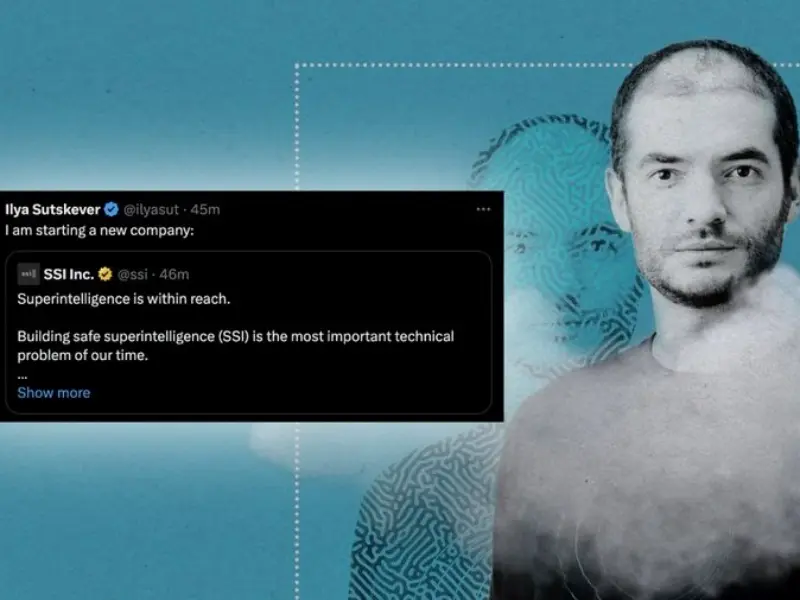
Safe Superintelligence Inc. is not selling a chatbot. It is selling a promise: build the machine that could outthink humanity, and make safety the first line of code rather than the last. One month after Ilya Sutskever walked out of OpenAI, he and co-founders Daniel Gross and Daniel Levy unveiled SSI with a name that doubles as a roadmap and a warning label. The Verge’s Nilay Patel, Alex Cranz and Alex Heath spent a compact podcast segment chewing over what the launch actually means. Their five sharpest threads are worth pulling.
1. The name is the product roadmap
Most AI startups pitch a product and sprinkle safety on top. SSI inverts the order. Its mission is “one goal and one product: a safe superintelligence,” and the company says its team, investors and business model are aligned to that single target. No side quests, no chatbot funnel, no “AI-powered” feature creep. Sutskever’s bet is that focus is not a luxury; it is the only way to keep safety ahead of capability. The Verge panel’s read: this is less a company launch than a research manifesto with a payroll.
Also read: Top tech news stories today: June 20, 2024
Also read: Ilya Sutskever launches new AI company
2. Safety has to be architecture, not compliance
“Safety cannot be an afterthought” is easy to say and expensive to mean. SSI’s framing puts safety inside the research loop—design, training, deployment, evaluation—rather than in a legal review at the end. That matters because superintelligence is not a feature you can patch after launch. If the thing is smarter than its makers, the governance has to be baked into the objective, the data, the evaluation and the release process. The Verge discussion lands on the uncomfortable question: who defines “safe” when the product does not exist yet?
3. Talent, capital and the small-team flywheel
SSI launched with the two currencies that matter in frontier AI: credible researchers and committed capital. Gross and Levy give it startup and research muscle; Sutskever gives it the kind of reputation that makes compute deals and hiring conversations easier. The company has offices in Palo Alto and Tel Aviv, a signal that it intends to recruit globally rather than build a single-campus cult. The Verge panel’s point is sharper: a small team with a single mission can move fast, but it also concentrates risk. Fewer people, fewer checks, higher stakes.
4. Governance is the hard part
Ethical AI governance sounds like a committee. In practice it is a set of enforceable decisions: who audits the model, who can stop a release, who owns the safety veto, and what happens when commercial pressure meets a red line. SSI says its business model insulates safety from short-term commercial pressure. Good. Now prove it. The Verge conversation circles the accountability gap: a private company promising to police superintelligence is asking for trust before it has shipped a single public artifact. Transparency is not a press release; it is a paper trail.
5. The commercial paradox: no product, no revenue, no distraction
SSI’s lack of a product is not a bug. It is the point. No product cycle means no quarterly feature scramble; no revenue plan means no customer pulling the roadmap toward a shinier demo. But it also means the company must survive on conviction, talent and capital long enough to matter. The Verge panel’s skepticism is fair: the most honest AI safety company may also be the hardest to evaluate. A promise is not a benchmark. A mission is not a moat. And “safe superintelligence” is either the most important product category of the century or the most elegant way to avoid shipping anything.
Sutskever’s SSI is a bet that the AI race will be won not by the company with the loudest demo, but by the one that builds safety into the stack before the stack becomes smarter than us. That is a serious thesis. It is also, for now, a thesis with no public test. The Verge’s panel got the tension exactly right: SSI has one job, and the world has no way to grade it until the job is done. The next move is not another manifesto. It is evidence.




