
Summary
- Zebra Technologies is best understood as an inventory-certainty business wrapped in rugged hardware. Its scanners, mobile computers, printers, RFID readers, machine-vision tools, Workcloud software, VisibilityIQ dashboards, OneCare support plans, LifeGuard updates, channel partners and repair operations all sit around the same buyer problem: proving that the right item, worker, shelf, parcel or asset is in the right state at the right moment.
- The financial record supports a mixed model rather than a pure software story. Zebra's 2025 annual report shows $5.396 billion of net sales, including $4.418 billion from tangible products and $978 million from services and software, while first-quarter 2026 filings show $264 million of services and software on $1.495 billion of sales. The hardware base remains central, but remaining performance obligations, deferred revenue, support contracts and software subscriptions give the installed base a recurring tail.
- The strongest evidence is the operating anatomy: rugged Android devices with Wi-Fi 6E, 5G and private LTE support; scanners built for damaged labels and long warehouse ranges; RFID and printer ecosystems; cloud-based visibility and Workcloud applications; OneCare repair and update plans; global channel partners; customer cases in logistics, retail and manufacturing; ARIN/BGP records for an enterprise network estate; and a supply chain that depends on contract manufacturing, components, distributors and regional repair hubs. The main judgement hinge is whether that system can preserve pricing power as Honeywell/Brady, Datalogic, Cognex, Scandit, consumer smart devices, cheaper Android terminals and warehouse automation platforms keep pressing the edges.
The missed scan is the business case
The warehouse manager does not wake up worrying about scanner specifications. She worries about whether the outbound lane is telling the truth. A carton is picked from a rack, a worker points a handheld device at a label, the warehouse management system accepts the transaction, and downstream promises are made. The replenishment team assumes the shelf is lower. The labour planner assumes the pick was complete. The transport team assumes the pallet will close on time. The customer service team assumes the item exists because the system says it exists. The financial team assumes inventory has moved from one status to another.
If the scan is missed, duplicated, delayed, rejected by the wireless network or accepted against the wrong location, the error is no longer a device problem. It becomes an inventory fact that may be wrong.
That is the right starting point for Zebra Technologies Corporation. The company is not merely selling barcode scanners or label printers. It is selling the physical layer through which enterprise systems learn what is happening at the edge of a warehouse, store, hospital, factory, delivery route or repair operation. Zebra's 2025 annual report describes a global business focused on digitizing and automating frontline operations, with mobile computers, rugged tablets, interactive displays, frontline software, AI agents, data capture, printing, machine vision, RFID and services across retail, e-commerce, manufacturing, transportation and logistics, healthcare, hospitality, public sector and other markets: https://s23.q4cdn.com/838148541/files/doc_financials/2026/ar/Zebra-2025-Annual-Report-to-Stockholders.pdf.
The investment case and the customer case are related but not identical. Investors can see a company with large hardware revenue, almost 50 percent gross margin in the latest quarter, meaningful debt after acquisitions and a management story around intelligent operations. Customers see a more practical bargain. They are paying to reduce the number of moments when the operating record diverges from reality. A scanner is a means to that end.
So is a label printer, a battery, a cradle, a rugged case, an Android security update, an MDM integration, a repair plan, an RFID portal, a cloud dashboard and a partner who knows how to connect the device to the warehouse management system.
That is why a low-cost scanner comparison can be misleading. A cheap terminal may capture a code in a quiet office. A warehouse fleet must survive drops, dust, gloves, long shifts, cold rooms, forklifts, weak Wi-Fi, thousands of labels, impatient workers, inventory peaks, old application code and a support queue that cannot wait for a consumer device replacement cycle. Zebra's own warehouse inventory page frames the outcome in operational terms: real-time inventory insights, reduced errors, alignment of stock with demand and avoidance of stockouts and overstock: https://www.zebra.com/us/en/industry/transportation-logistics/use-case/warehouse-inventory-management.html. The page is company marketing, but it names the buyer's actual problem accurately.
The question for Zebra is whether it can keep converting that problem into an integrated subscription-like account. Its strongest customers do not simply buy a device and disappear. They deploy a fleet, standardize accessories, certify workflows, train staff, write applications, connect MDM tools, buy support, refresh Android versions, tune Wi-Fi, order supplies, replace batteries, repair screens, add printers, scan more processes and then expand to RFID, machine vision or workforce software. The installed base becomes the route to future revenue.
The risk is that the same installed base can also become a resentment point if devices feel slow, updates feel gated, repairs feel expensive or a software layer makes the fleet harder to escape.
The public evidence therefore supports a conditional thesis. Zebra matters because it sits between physical operations and digital records. It has scale, product breadth, a large channel network and deep workflow experience. But the premium is not guaranteed by the word "rugged." It depends on whether the full stack makes inventory, labour and delivery promises more reliable than a buyer could achieve through cheaper Android hardware, smartphone scanning software, competing industrial devices, robotics platforms or a less integrated combination of warehouse tools.
The device is an endpoint for a workflow, not a gadget
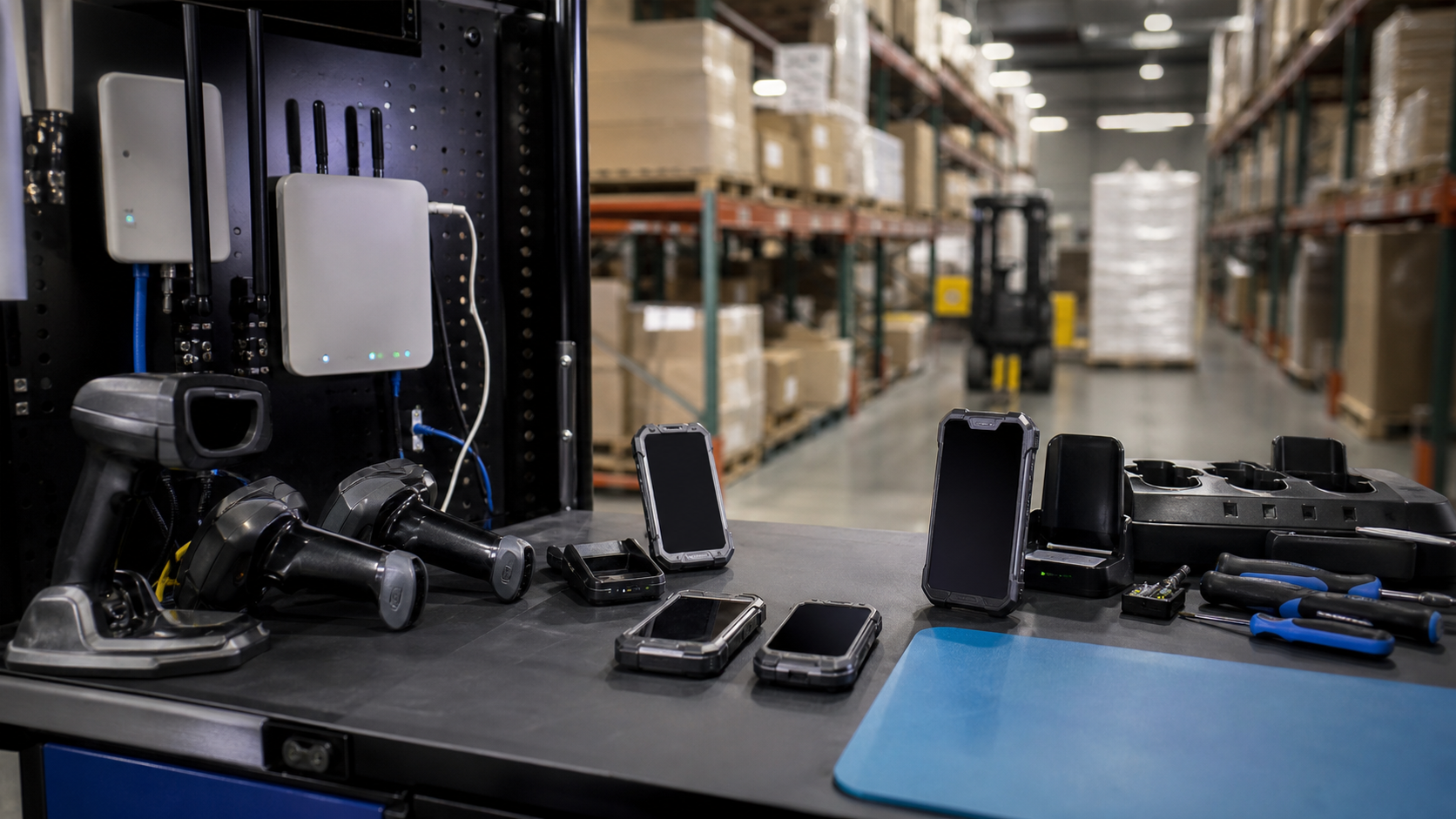
Zebra's product pages show why the scanner needs to be read as a workflow endpoint. The TC53 and TC58 mobile computer specification sheet lists 5G, Wi-Fi 6E and CBRS private LTE support, a Qualcomm 6490 processor, up to 8 GB of RAM, up to 128 GB of flash, a two-terabyte MicroSD slot and Mobility DNA tools intended to reduce IT complexity across the device lifecycle: https://www.zebra.com/us/en/products/spec-sheets/mobile-computers/handheld/tc53-tc58.html. Those details matter because a warehouse terminal is no longer just a laser gun attached to an ERP screen. It is an Android computer with radios, identity, applications, security posture, battery analytics, peripheral dependencies and a worker interface.
The TC53e, TC53e-RFID and TC58e pages push that point further by describing dustproof, waterproof, drop-proof and tumble-proof devices, RFID variants and durable performance for demanding work environments: https://www.zebra.com/us/en/products/spec-sheets/mobile-computers/handheld/tc53e-tc53e-rfid-tc58e.html. The hardware earns its keep only when it survives ordinary abuse. A device that fails after a fall is not a capital item; it is a queue delay. A device that loses connectivity in a high-bay aisle is not a wireless detail; it is a gap in the inventory record. A device that cannot receive security updates over a long enterprise lifecycle is not merely out of date; it may become a compliance problem.
The scanner pages tell the same story from the data-capture side. Zebra's DS3600 series is sold for labels that are far away, damaged, dirty or covered by shrinkwrap, with real-time analytics and fleet management around the devices: https://www.zebra.com/us/en/products/scanners/ultra-rugged-scanners/ds3600-series.html. The DS3600-ER specification sheet says the extended-range scanner can capture one-dimensional and two-dimensional barcodes from three inches to 70 feet away, with a 10-foot drop specification to concrete and IP65/IP68 sealing: https://www.zebra.com/us/en/products/spec-sheets/scanners/ultra-rugged-scanners/ds36x8-er.html. Those claims should be treated as product specifications, not proof of customer outcomes. But they show how the hardware premium is justified: not by scanning a perfect label at a desk, but by reading imperfect labels in high-volume physical conditions.
Printing and RFID extend the same inventory-certainty logic. Zebra's printer page describes desktop, mobile, industrial and portable printers for barcode labels, receipts, RFID tags and cards: https://www.zebra.com/us/en/products/printers.html. Its RFID page says RFID automates data capture, reduces errors and delivers timely operational insights across assets, inventory and employees: https://www.zebra.com/us/en/products/rfid.html. The fixed RFID reader page says RAIN RFID fixed readers help identify, track and store inventory for control of operations: https://www.zebra.com/us/en/products/rfid/rfid-readers.html. The 123RFID Desktop page goes to a quieter but important point: deployment tools are part of the product because readers must be configured, optimized and supported by people who may not be RFID specialists: https://www.zebra.com/us/en/support-downloads/software/rfid-software/123rfid.html.
This is where lock-in begins. A fleet is not locked in because the label says Zebra. It is locked in because the buyer has standardized charging cradles, replacement batteries, spare parts, label media, printer languages, device management policies, staging scripts, scanning SDKs, RFID reader configuration, line-of-business applications and worker training around a particular device family. Zebra's software names make that explicit.
The company describes Zebra DNA as a suite of enterprise software for the lifetime of every Zebra device, while the same product navigation points to mobile computer software, printer software, scanner software, RFID software, developer software and machine-vision software. The more useful the device becomes, the more it becomes part of an operating architecture rather than a purchase order.
For a manager, that is not automatically bad. Lock-in has a negative sound in procurement, but a warehouse needs standardization. A chaotic mix of terminals, printers, labels, MDM policies, support vendors and scan engines can create more downtime than it saves in purchase price. The economic question is whether Zebra's standardization improves the whole cost equation. If the answer is yes, the scanner fleet behaves like a durable subscription to inventory certainty. If the answer is no, the buyer has simply paid a premium for a proprietary version of a commodity Android and print environment.
The accounts show hardware with a recurring tail
The numbers put a useful limit on the story. Zebra is not a pure SaaS company and should not be valued or judged as one. Its 2025 annual report shows total net sales of $5.396 billion, split between $4.418 billion of tangible products and $978 million of services and software. The Connected Frontline segment reported $2.960 billion of net sales, of which $804 million was services and software. The Asset Visibility & Automation segment reported $2.436 billion, of which $174 million was services and software. In other words, most revenue is still physical product, but the software and services tail is large enough to matter: https://s23.q4cdn.com/838148541/files/doc_financials/2026/ar/Zebra-2025-Annual-Report-to-Stockholders.pdf.
The first quarter of 2026 preserved that shape. Zebra reported net sales of $1.495 billion, with $825 million in Connected Frontline and $670 million in Asset Visibility & Automation. Its Form 10-Q disaggregated the quarter into $1.231 billion of tangible product revenue and $264 million of services and software. The same filing reported remaining performance obligations of $1.15 billion for services and software arrangements with terms over one year, expected to be recognized over about two years, and deferred revenue of $832 million at April 4, 2026: https://www.sec.gov/Archives/edgar/data/877212/000162828026034109/zbra-20260404.htm. That is the financial footprint of support, subscriptions and multi-year obligations attached to a device estate.
Zebra's own first-quarter 2026 release gave management's public version of the same picture. Net sales grew from $1.308 billion to $1.495 billion year over year, gross margin was 49.6 percent, adjusted gross margin was 50.4 percent, adjusted EBITDA was $347 million, and full-year free cash flow was expected to exceed $900 million: https://www.zebra.com/us/en/about-zebra/newsroom/press-releases/2026/zebra-technologies-announces-first-quarter-2026-results.html. Those figures are strong enough to show that Zebra is not simply competing on device price. They also show why management wants investors to see the business as intelligent operations rather than a hardware replacement cycle.
Segment profitability supports the point. In 2025, Connected Frontline generated $585 million of segment operating income on $2.960 billion of net sales, while Asset Visibility & Automation generated $514 million on $2.436 billion. Corporate costs and acquisition-related items reduced total operating income, but the segment numbers show that the core businesses can be economically attractive when demand, supply and pricing align. The gross margin profile is unusual for a company whose product is so physical, which suggests value in software, service, channel reach, brand, device engineering and workflow integration.
The channel record is a second important feature. Zebra says it sells through a direct sales force and more than 10,000 channel partners in 179 countries. The annual report also says three distributor customers each accounted for more than 10 percent of total company net sales in 2025, with approximate total-company shares of 29 percent, 15 percent and 15 percent. That is not end-customer concentration; it is distributor concentration. But it means much of the revenue machine depends on channel economics, reseller health, stocking decisions, credit, rebates, partner expertise and the ability of distributors to support a wide set of end users.
That channel structure cuts both ways. It lets Zebra scale into many countries and verticals without owning every integration relationship. It also means the customer experience is often mediated by a reseller, system integrator, independent software vendor or services partner. If the partner ecosystem is strong, Zebra becomes easier to adopt and harder to replace. If the partner ecosystem creates price opacity, inconsistent support or integration friction, the installed base can become a source of dissatisfaction.
The revenue recognition policy is also telling. Zebra says tangible products are generally recognized on shipment, services over time and software either on delivery or over time depending on control transfer. When products, services and software are bundled, judgement is needed to allocate revenue across performance obligations. That accounting language mirrors the commercial reality. A customer may think it is buying scanners, but the economic account includes devices, software rights, support, maintenance, repairs, updates, managed services, analytics and partner-led deployment.
The visible purchase is hardware; the profitable account is the lifecycle.
Software and support turn the scanner into a subscription
The subscription quality begins with support. Zebra OneCare is positioned as coverage beyond the manufacturer's warranty, including normal wear and tear, accidental damage, certified repairs with authorized parts, security patches, firmware updates and software updates: https://www.zebra.com/us/en/services/support-services/zebra-onecare-support-services.html. The same page describes repair turnaround tiers, technical support, LifeGuard for Android updates, on-site plans and VisibilityIQ OneCare dashboards. A buyer can view that as insurance. Zebra can view it as recurring revenue and customer attachment.
LifeGuard for Android is a separate piece of the same attachment. Zebra says LifeGuard delivers regular operating-system updates to address emerging security threats while letting customers migrate at their own pace; it also says support on the current version is included with a Zebra OneCare contract: https://www.zebra.com/us/en/software/mobile-computer-software/lifeguard.html. This is not a minor add-on. Many enterprise buyers keep devices longer than consumer phone lifecycles. Warehouses do not refresh every handheld because a new Android version appears. They need a way to keep the fleet secure and supportable without breaking the applications that run the operation.
Managed services push the account closer to an outsourcing model. Zebra describes Managed Services as device management for mobile computers and printers through dedicated experts: https://www.zebra.com/us/en/services/managed-device-service.html. Its 2025 annual report says professional and managed services help customers design, test, deploy and manage mobility devices, software applications and workflows, while maintenance services include updates, technical support, repair and recycling. A fleet then becomes more than a set of capital assets. It becomes an operating service in which availability, configuration, security, repair and refresh all have to be managed.
The cloud layer is where data dependency enters. Zebra's VisibilityIQ Foresight is described as a cloud-based solution that aggregates data from MDM and other device data sources to give business intelligence about the device fleet: https://www.zebra.com/us/en/services/visibility-services/visibilityiq-foresight.html. Zebra's Savanna Data Services announcement described a platform able to connect real-time edge-device data, product and services portals, third-party data services and APIs for developers: https://investors.zebra.com/news-and-events/news/news-details/2019/Zebra-Technologies-Introduces-Savanna-Data-Services-to-Power-Next-Generation-Enterprise-Applications/default.aspx. The company also describes Workcloud as enterprise software to improve inventory management, communication and resource optimization: https://www.zebra.com/us/en/software/workcloud-solutions.html.
This cloud layer is valuable because a warehouse does not only need working devices. It needs to know which devices are missing, underused, unpatched, damaged, failing, idle, misallocated or generating operational exceptions. Visibility can reduce downtime before a broken device reaches the floor. It can also create a data-locality question.
If fleet health, worker task execution, device telemetry, inventory actions and demand signals flow into cloud applications, customers need to know where the data is hosted, who can access it, how long it is retained, how it is segmented from other customers, how it is exported and how the system behaves when connectivity fails.
Zebra's annual report acknowledges the broader risk environment. It says the company uses cloud-based services hosted by third parties for confidential and proprietary information, has less influence over those providers' security protocols, and faces cybersecurity, data protection and AI-related risks. It also says its workflow optimization offerings are typically delivered through cloud-based software subscriptions that use big data, AI and mobile or web applications to forecast demand, prescribe actions, schedule workers and enhance collaboration. These are not admissions of weakness.
They are the normal risks of turning an edge-device business into a cloud-connected workflow platform.
For customers, the key distinction is between value-creating lock-in and hostage lock-in. Value-creating lock-in means Zebra's software and support turn the fleet into a more reliable operating system for the physical business. Hostage lock-in means the customer pays recurring fees simply to keep expensive devices functional, patched and repairable. The public record shows enough product breadth to make the first version plausible. It does not disclose enough pricing, churn, support satisfaction, cloud outage history or repair performance to prove it across the installed base.
The supply chain is part of the margin
Zebra's hardware economics depend on a supply chain the customer rarely sees. The 2025 annual report says final assembly of hardware products is performed by third-party electronics manufacturing services companies and joint design manufacturers, with products produced mainly in Asia-Pacific facilities in China, Malaysia, Vietnam and Taiwan, and in Mexico. Zebra says it maintains control over supplier selection and price negotiation for key components, while manufacturers generally purchase components and subassemblies. It also says products are shipped to regional distribution centers, where some are reconfigured through firmware downloads, packaging and customer-specific customization before shipment: https://s23.q4cdn.com/838148541/files/doc_financials/2026/ar/Zebra-2025-Annual-Report-to-Stockholders.pdf.
That detail matters because a rugged device premium is only partly engineering. It is also supply planning, component access, firmware staging, regional logistics, compliance, partner stocking and repair capacity. Zebra says production facilities for supplies and sensors are located in the United States, Mexico and Europe, supplemented by third-party manufacturing principally in Asia-Pacific. It says repair services are performed by Zebra's own operations or by third parties, with repair hubs in each region served. A customer sees a replacement device arrive.
The economic machine behind it is inventory, labor, parts, logistics, warranty reserves, supplier contracts and service-level promises.
The risk factors are direct. Zebra says it may depend on electronics manufacturers as sole sources for certain hardware products and may have no other means of final assembly until it secures another facility or develops alternative capability. It says some components are sole-source or limited-source and that shortages, transport costs, supplier credit constraints and multi-year purchase commitments can affect cash flow and results. It also says tariffs and trade disputes, including issues involving China, could hurt financial performance because the company imports a significant percentage of offerings into the United States.
This cost base is the reason services and software matter. If a device maker is exposed to component cycles, manufacturing disruptions, inventory obsolescence, freight, tariffs, warranty, returns and distributor credit, it wants a bigger share of revenue to come from software, supplies, sensors, support and recurring obligations. Zebra's 2025 service and software revenue of $978 million does not erase hardware cyclicality. But it gives management a route to smoother economics if attach rates rise.
The inventory line shows the physical burden. Zebra reported $729 million of inventories at the end of 2025, including $230 million of raw materials and $492 million of finished goods. Raw materials include product components and supplies used in repair operations. That means repair readiness itself consumes inventory. If a customer pays for rapid repair, Zebra or a partner has to hold parts, replacement units, trained technicians and logistics capacity somewhere. The support subscription is therefore not an abstract margin stream. It is a priced commitment against a physical service operation.
The supply chain also changes the competitive comparison. A low-cost Android scanner vendor may sell cheaper devices, but if it lacks global repair hubs, enterprise security updates, regional distribution, rugged accessories, long-term availability and partner integration, the total risk may be higher for a complex operation. Conversely, if a buyer's use case is simple, local and low-volume, the cheaper device may be economically rational. Zebra's premium is most credible where downtime, picking errors, label quality, update discipline and support response affect revenue or safety.
It is less credible where scanning is occasional and the process can tolerate replacement friction.
That makes Zebra vulnerable to both ends of the market. At the high end, warehouse automation, robotics, fixed scanning, computer vision and RFID can reduce dependence on handheld workers. Zebra participates in those categories through machine vision, fixed industrial scanners, RFID and autonomous mobile robot software, but it also faces specialized competitors. At the low end, smartphone scanning software and ruggedized consumer-style devices can satisfy lighter workflows.
Zebra's challenge is to keep the middle from hollowing out: enough physical durability for harsh environments, enough software to manage fleets, enough support to reduce downtime and enough integration to justify standardization.
Network records show operating infrastructure, not a cloud moat
Network-resource evidence is useful when it is treated modestly. ARIN lists AS33442 as ZEBRA-TECHNOLOGIES-BGP-AS-NUMBER for Zebra Technologies Corporation, with the organization address at 3 Overlook Point in Lincolnshire, Illinois: https://rdap.arin.net/registry/autnum/33442. ARIN also lists direct allocations for 149.23.0.0/16 under ZBRA-149-23-0-0 and 157.235.0.0/16 under ZEBRA-TECHNOLOGIES, both registered to Zebra Technologies Corporation: https://rdap.arin.net/registry/ip/149.23.0.0 and https://rdap.arin.net/registry/ip/157.235.0.0. RIPEstat's announced-prefixes data for AS33442 shows a set of announced IPv4 and IPv6 prefixes, including the two /16s and IPv6 /48s: https://stat.ripe.net/data/announced-prefixes/data.json?resource=AS33442. BGP.Tools provides an external view of AS33442's announced prefixes and upstreams: https://bgp.tools/as/33442.
Those records do not prove that Zebra runs a public cloud, hosts customer Workcloud data on its own network or has a cloud moat. They do show that Zebra is not just a domain name and a reseller storefront. It has an enterprise network footprint that fits a global technology company with corporate operations, service systems, product portals, support infrastructure and internal connectivity needs. The correct reading is not "Zebra is a network operator." It is "Zebra's inventory-certainty system sits on top of a real enterprise technology estate, and that estate should be included in continuity and security analysis."
This distinction matters for the topics of cloud dependency and data locality. A customer using Zebra scanners can run local applications and on-premises warehouse systems. A customer using Workcloud, VisibilityIQ or cloud-connected analytics is depending on a hosted service, device data flows, MDM connections and third-party cloud providers. The ARIN record does not answer where the customer data is stored. It simply contributes to the evidence that Zebra has its own network administration surface, abuse contacts, routing records and operational responsibility in the internet resource layer.
For a sophisticated buyer, the procurement questions should be specific. Which Zebra services are cloud-hosted? Which cloud providers are used? Which regions are available? Is device telemetry personal data under the buyer's jurisdiction? What worker identifiers are transmitted? Can the buyer disable certain telemetry? How does Workcloud behave during WAN outage? Can scans continue locally and synchronize later? What export formats exist if the buyer changes platforms? How are support logs, repair data and MDM integrations retained? Which subcontractors can access customer data? Are there customer-specific controls for regulated sites?
The annual report makes clear why those questions are not theoretical. Zebra says disruptions at cloud computing, server, systems and other third-party IT service providers could interfere with operations, interrupt order processing and shipments, damage relationships and affect results. It also says new business models relying on global digitization, cloud, big data, mobile and social media could expose the company to more cybersecurity threats. The same risk applies to customers at a smaller scale.
If a warehouse treats Zebra's cloud-connected tools as the source of fleet visibility, downtime in those tools becomes part of operational risk.
This is where SMEs deserve special attention. A large retailer may have internal network engineers, MDM specialists, security teams and multiple vendor escalation paths. A mid-sized distributor may depend heavily on a reseller and Zebra support. If the scanner estate is the main bridge between physical stock and the business system, the smaller buyer's continuity posture can be fragile. A support plan may be valuable precisely because the buyer cannot staff a device engineering team. But it also means the buyer's resilience depends on external service levels and the clarity of contract commitments.
The network records therefore strengthen the article's evidence base without changing the identity of the company. AS33442, IP allocations and BGP announcements are evidence of Zebra's infrastructure surface. They are not entities, products or customers. They help ask better questions about cloud dependency, operational continuity and the difference between local device function and hosted fleet intelligence.
Customer signals show the cost of being wrong
The most persuasive customer evidence is not a logo list; it is the operational failure mode. Zebra's Vera Bradley distribution-center case says the retailer deployed more than 300 Zebra devices in its distribution center, including scanners, printers and mobile computers, to move boxes through outbound processes and maintain inventory count accuracy. It describes more than three miles of conveyor, barcode labels on boxes, scans directing boxes to the right place and mobile computers for regular inventory counts: https://www.zebra.com/us/en/resource-library/success-stories/vera-bradley-improves-fulfillment-process-with-mobile-solutions.html. The case is company-controlled, but it illustrates why the device estate becomes embedded. The scanner is inside the fulfillment method, not beside it.
The Logistics Plus case is more explicit about error reduction. Zebra says the logistics company wanted to eliminate paper-based order picking, reduce manual errors and manage changing goods assortments. The published benefits include a 70 percent drop in picking errors, from nearly 30 per 1,000 picks to under 10, plus real-time data capture and validation: https://www.zebra.com/us/en/resource-library/success-stories/logistics-plus-eliminates-mispicks-speeds-up-order-fulfillment-and-empowers-teams-with-zebra.html. That is exactly the kind of outcome that supports Zebra's premium if the figures are current and comparable. The buyer is not paying for a scanner; it is paying for fewer wrong picks.
Apex Steel's case shows the manufacturing version. Zebra says Apex moved from paper dockets and manual floor searches toward real-time stock and production visibility, using Zebra mobile computers, industrial printers, scanners and StageNow. The benefits include inbound logistics cycles reduced from 30-60 minutes per order to 10-minute real-time cycles, high 90 percent-plus stock accuracy at initial rollout sites and fewer manual errors: https://www.zebra.com/us/en/resource-library/success-stories/apex-steel-boosts-next-day-delivery-confidence-to-99-with-zebra-inventory-visibility-solutions.html. Again, it is vendor-published evidence, but it links the scanner to order confidence and staff leverage.
Retail RFID cases point to a similar mechanism. Zebra announced that Boggi Milano achieved 99 percent inventory accuracy after deploying RFID solutions with Zebra and partners: https://www.zebra.com/us/en/about-zebra/newsroom/press-releases/2026/boggi-milano-achieves-99-inventory-accuracy-with-rfid-solutions-from-zebra-technologies.html. The result should not be generalized to every retailer, but it supports the idea that Zebra's best account is a system account: tags, readers, handhelds, software, partners and process change. When the record is accurate, replenishment, store operations, omnichannel promises and loss management all improve.
The transportation signal is different but related. Zebra's Evri case says the parcel company equipped thousands of out-of-home delivery points with self-service kiosks, ET45 tablets, ZD621 printers, linerless media and OneCare Fastrack service. The listed outcomes include a roughly 99 percent reduction in kiosk outages, 66 percent more labels per roll and downtime reduced to a single day with next-day swap-outs: https://www.zebra.com/us/en/resource-library/success-stories/evri-scales-its-out-of-home-delivery-network-of-7000-shops-with-dependable-sustainable-zebra-technology.html. For a parcel network, label printing and scanner reliability are not back-office details. They are customer-visible service continuity.
These cases should be weighted carefully. They are selected, promotional and not independently audited in the public material. They do not disclose full project costs, failed pilots, support tickets, refresh costs, discounting, churn or what happened three years later. But they show the shape of demand. Customers do not standardize Zebra because a handheld looks good in a brochure. They standardize because they need fewer stock discrepancies, fewer order errors, faster receiving, smoother returns, clearer task completion, more reliable label output and support arrangements that keep the physical network moving.
Unofficial buyer chatter points to the other side. Warehouse and IT forums frequently discuss Zebra, Honeywell, Datalogic, consumer Android devices, MDM integration, Wi-Fi issues, repairs, LifeGuard updates, printer maintenance and support pricing. Reddit threads on warehouse mobile computers and central management of Zebra scanners show buyers comparing rugged devices, MDM realities and fleet-update friction: https://www.reddit.com/r/sysadmin/comments/188rkmp/best_mobile_computer_for_warehouse/ and https://www.reddit.com/r/msp/comments/18nogu5/central_management_of_zebra_scanners/. Threads about Zebra printer repairs show that repair economics can become a practical pain point: https://www.reddit.com/r/sysadmin/comments/kch6ih/zebra_printer_repairs/. This material is anecdotal and cannot prove market share or product quality. It is useful because it reveals how buyers experience the category: not as a clean hardware comparison, but as a messy operating decision involving devices, software, repair, wireless, support and user behavior.
Competitors and substitutes set the ceiling
Zebra's moat is not that nobody else can scan a code. The competitive set is broad. Honeywell's automation business presents barcode scanners and handheld computers for warehouse supply chains, manufacturing, retail and healthcare: https://automation.honeywell.com/us/en/products/productivity-solutions/barcode-scanners and https://automation.honeywell.com/us/en/products/productivity-solutions/mobile-computers/handheld-computers. In April 2026, Honeywell agreed to sell its Productivity Solutions and Services business to Brady Corporation for $1.4 billion, with the business described as mobile computers, barcode scanners, printing solutions, software and services for high-volume automated data collection and tracking: https://investor.honeywell.com/news-releases/news-release-details/honeywell-sell-productivity-solutions-and-services-business and https://www.bradyid.com/corporate/investors/press-release-detail?releaseid=29746. That transaction is a market signal: the category remains valuable enough for Brady to buy a large competitor, but Honeywell also saw it as divestable within its own portfolio.
Datalogic competes in automatic data capture and industrial automation, including barcode readers, mobile computers, sensors, RFID, vision and laser marking systems: https://www.datalogic.com/eng/index.html. Cognex competes more heavily in machine vision and industrial barcode reading, with logistics solutions aimed at throughput, cost-effectiveness and automation: https://www.cognex.com/ and https://www.cognex.com/en/products/machine-vision-and-industrial-barcode-reading-products. Scandit is a different kind of substitute: it sells smart data capture software that runs on camera-enabled smart devices, positioning smartphones and other devices as barcode and ID scanning platforms: https://www.scandit.com/ and https://www.scandit.com/products/.
These competitors attack different parts of Zebra's account. Honeywell and Datalogic can contest rugged scanners and mobile computers. Cognex can contest fixed industrial scanning, vision and automation use cases where a handheld may no longer be the right instrument. Scandit and similar software vendors can contest lighter workflows where a smartphone or tablet is good enough. Low-cost Android scanner brands and private-label rugged devices can contest price-sensitive buyers. Robotics vendors can move data capture into automated picking and sortation.
Warehouse management systems can reduce the visible value of device vendors by treating scanners as peripherals.
Zebra's response is breadth. It can sell handhelds, wearables, vehicle-mounted computers, scanners, printers, RFID, supplies, machine vision, fixed industrial scanners, tablets, self-service devices, autonomous mobile robot software, Workcloud applications, OneCare, LifeGuard, VisibilityIQ, professional services and partner-enabled integration. Breadth can be a moat when customers want one accountable ecosystem. It can also be a burden if the portfolio becomes complex, acquisition-heavy or hard to support.
The company's recent acquisitions show the strategic direction. The annual report says Zebra acquired Photoneo in February 2025 for $62 million, expanding 3D machine vision offerings, and acquired Elo Holdings in September 2025 for $1.303 billion, expanding self-service and consumer-facing workflow offerings. Zebra's investor release said the Elo acquisition increased focus on customer-facing workflows and expanded the addressable market by about $8 billion: https://investors.zebra.com/news-and-events/news/news-details/2025/Zebra-Technologies-Completes-Acquisition-of-Elo-to-Accelerate-Connected-Frontline-Experiences/default.aspx. The Photoneo release framed the acquisition as broadening the 3D machine vision portfolio: https://www.zebra.com/us/en/about-zebra/newsroom/press-releases/2025/zebra-technologies-completes-acquisition-of-photoneo.html.
Those moves are logical. If more warehouse and store processes become automated, visual and self-service, Zebra needs to be present beyond handheld data capture. The risk is integration. Acquisitions add product categories, software stacks, sales motions, amortization, debt and operational complexity. First-quarter 2026 operating expenses increased partly because of acquired businesses and amortization. The strategic question is whether the acquired portfolio deepens the inventory-certainty account or simply adds adjacent hardware categories that require more support.
The substitute threat is strongest where Zebra cannot prove lifecycle value. A small retailer doing occasional stock counts may choose smartphone scanning software. A warehouse with a modern automation platform may invest in fixed scanners, robotics and machine vision rather than more handhelds. A price-sensitive distributor may accept a cheaper Android scanner if replacement units are easy and the workflow is simple. Zebra wins when the cost of a wrong scan, dead battery, unpatched device, failed label, broken screen or support delay exceeds the savings from cheaper alternatives.
Data, AI and regulation make the certainty promise harder
Zebra's current language is full of AI, intelligent operations, digital twins, cloud analytics and context-aware software companions. That is not just marketing fashion. The company is trying to move from capturing a transaction to interpreting operations. Its annual report says data from assets, including status, condition, location, utilization and preferences, is analyzed in the cloud to produce prioritized insights. It says workflow optimization software can analyze labor, inventory, transaction and situational data to forecast demand, prescribe actions, schedule workers and enhance collaboration. The Workcloud Inventory Optimization page describes tools for real-time inventory monitoring, SKU tracking, loss prevention and demand alignment: https://www.zebra.com/us/en/software/workcloud-solutions/workcloud-inventory-optimization-suite.html. The Workcloud Task Management page says the software prioritizes and allocates tasks to employees: https://www.zebra.com/us/en/software/workcloud-solutions/workcloud-enterprise-collaboration-suite/workcloud-task-management.html.
The commercial prize is clear. If Zebra can connect device activity, inventory signals, worker tasks, demand forecasts, shelf availability, RFID events, printer health and repair data, it can sell a more durable operating layer. The scanner becomes a sensor, the printer becomes a continuity point, the support contract becomes a data source, and Workcloud becomes a system for allocating human attention. The customer may then judge Zebra not on device price but on whether the operation becomes more certain.
The governance challenge is equally clear. Worker task data, device location, inventory movement, customer-facing self-service records and demand forecasts can be sensitive. Some are commercially sensitive; some may be personal data depending on jurisdiction and implementation. Zebra's annual report acknowledges data protection risks, customer reluctance tied to data obligations, AI regulatory uncertainty and the possibility that actual or perceived failure to protect personal data could lead to enforcement, claims and reputational harm.
Customers should therefore treat cloud-connected device management and Workcloud deployment as data-governance decisions, not only operations projects.
Data locality is not only about geography. It is about operational control. A multinational retailer may accept centralized cloud analytics if export, access and incident terms are clear. A regulated healthcare, government or defense-adjacent buyer may require stricter controls. A small distributor may not have the expertise to evaluate those terms and may rely on a reseller. The more Zebra's value shifts from rugged capture to cloud intelligence, the more the company must make data-residency, security, availability and exit commitments understandable.
The AI layer adds another kind of uncertainty. Zebra's annual report says AI technologies can be complex, expensive and subject to data privacy, copyright, data quality, bias and third-party vendor risks. It also references the European AI Act and other emerging frameworks. That matters because warehouse and retail AI is not abstract. A poor recommendation can create bad replenishment, misallocated labor, unfair worker pressure or wrong exception handling.
If Zebra's software becomes more prescriptive, customers will ask how models are trained, what data is used, how results are audited and who is responsible when a recommendation disrupts operations.
This does not weaken the overall Zebra thesis; it sharpens it. The more physical operations become data-rich, the more valuable a trusted edge platform can be. But trust has to be earned through evidence: uptime, repair performance, patch cadence, data controls, integration discipline, measurable inventory accuracy, transparent service levels and fair pricing. A scanner that simply captures data is replaceable. A system that makes the physical business auditable is harder to replace. A system that captures data without giving the buyer control creates a future procurement fight.
What would change the judgement
The case for Zebra is strongest where the customer has many frontline workers, many physical exceptions and a high cost of being wrong. Large warehouses, parcel networks, omnichannel retailers, manufacturers, healthcare systems, field-service operations and regulated inventory environments can justify rugged devices, barcode and RFID systems, printers, software, support and repair services when accuracy and uptime affect revenue, compliance or safety. Zebra's public product record, financial mix and customer cases all support that conclusion.
The judgement would become stronger with better public evidence on lifecycle outcomes. Zebra does not disclose fleet retention, average support attach rate, repair turnaround performance by region, LifeGuard update adoption, Workcloud renewal rates, customer churn, installed base age, service gross margin, downtime reduction across cohorts, cloud uptime history or independent customer satisfaction by product line. Some of those figures may be commercially sensitive.
Their absence means outside observers must infer durability from revenue mix, remaining performance obligations, deferred revenue, channel breadth, customer cases and qualitative signals.
The judgement would weaken if hardware refresh cycles slowed without services and software growth compensating, if distributors reduced inventory materially, if lower-cost Android scanners gained share in core warehouses, if smartphone scanning software moved upmarket, if Honeywell's PSS assets became more aggressive under Brady, if Cognex or other vision specialists displaced handheld capture in logistics, if repair economics angered customers, if cloud outages damaged Workcloud or VisibilityIQ trust, or if data-governance requirements made global cloud services harder to deploy.
It would also weaken if acquisitions such as Elo and Photoneo added complexity without increasing attach rates or addressable account value.
The most useful way to price Zebra is therefore not as a scanner maker and not as a software company, but as a provider of inventory certainty with a physical installed base. Tangible products still carry most revenue. Services and software make that revenue more durable. Support and repair keep the fleet operating. Cloud tools turn device and workflow data into management visibility. Partners scale deployment. Supply chain and component risks cap margin confidence. Competitors and substitutes set the ceiling. Data, AI and locality obligations define the next stage of trust.
For the warehouse manager, the final test is simple. After a missed scan breaks inventory truth, who can prevent the next one? If Zebra's hardware, software, support and partner system reduces that failure rate enough to change labour planning, stock availability, delivery confidence and customer trust, the scanner is not a gadget. It is the paid edge of an operating subscription. If it does not, it is an expensive Android device in a rugged case, waiting to be replaced by the next cheaper terminal.