
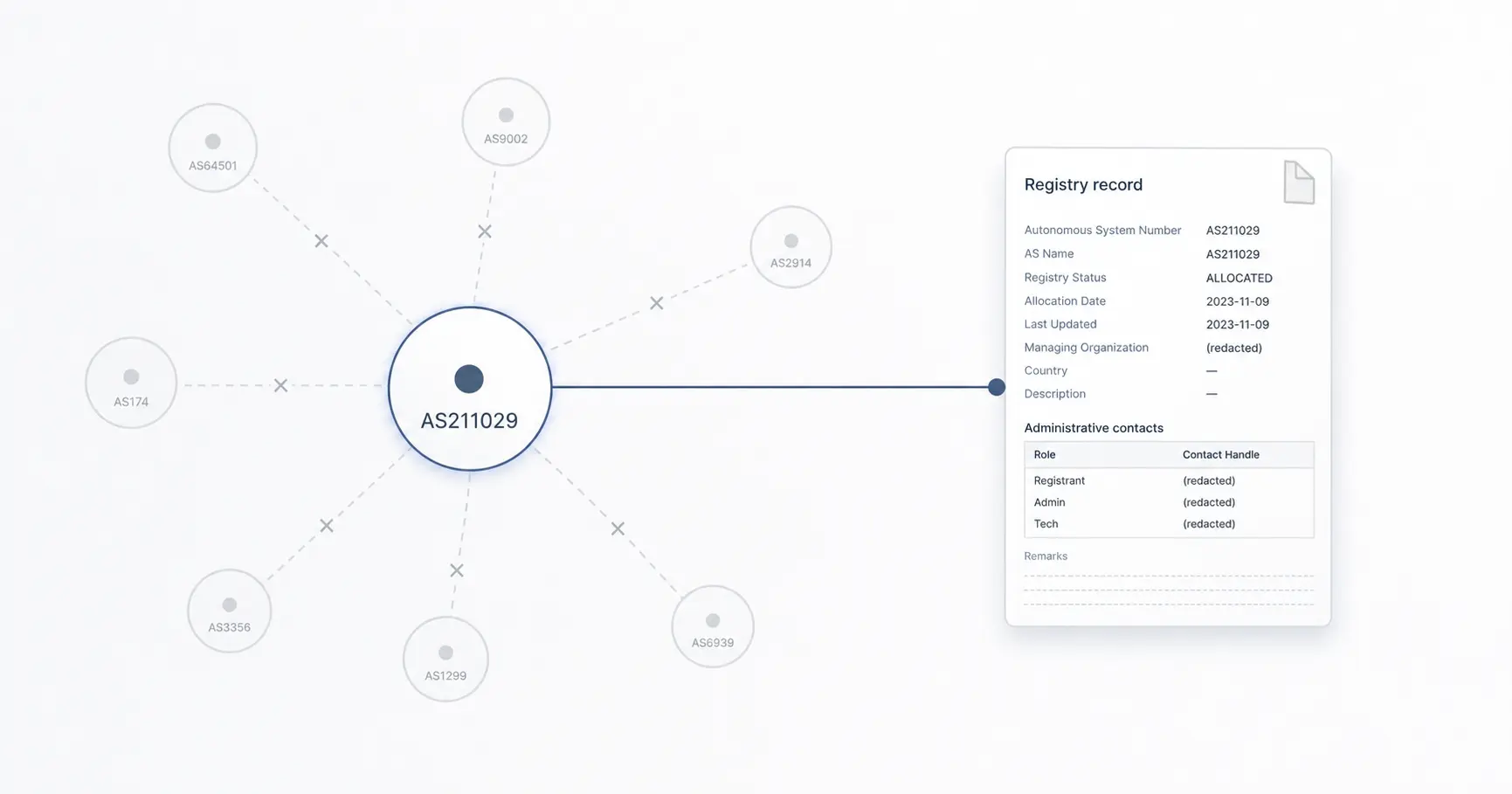
XTX is a registry entity linked to AS211029 with no operational evidence. The profile is built solely on RDAP, bgp.tools, and RADb sources, establishing only the ASN assignment. Business model, customers, and services are unknown. Watchpoints: any BGP announcement, registry change, or corporate web presence would change the assessment from latent to active.
XTX
XTX is the name associated with Autonomous System AS211029 in public internet number registry records, with no verified operational activity or corporate identity. Its internet significance is latent, dependent entirely on whether the ASN ever becomes active in global routing.
Why It Matters
The current impact is latent; without active prefixes, XTX does not influence internet routing. Any future prefix announcements or peer relationships would make its routing policy and security posture directly consequential for downstream connectivity.
What Public Sources Show
XTX is the name that appears in public internet registry records as the holder of Autonomous System number AS211029. This fact is attested by the RDAP directory and by routing‑observability pages such as bgp.tools. No corporate website, verified legal name, or operating jurisdiction accompanies that registry entry.
An autonomous system is the unit of routing policy on the internet. If AS211029 were to originate or transit IP prefixes, the networks that learn routes through it could become dependent on its stability and security. At present, however, there is no public evidence that AS211029 has ever announced any active address prefixes.
In the absence of operational signals, XTX’s observable role is limited to a registry holding. A search of the Internet Routing Registry via RADb does not return route entities that could confirm routing intentions. The entity’s business model, customers, and services remain unknown.
The impact of XTX is therefore latent. Should AS211029 begin to carry traffic, its routing policy and security posture would become material to any network that accepts its routes. A poorly managed or compromised autonomous system could cause reachability problems or serve as a vector for route hijacks.
Because the registry record provides only a thin identity layer, readers should treat any assessment of XTX’s importance as provisional. The most valuable intelligence is what changes: a new prefix announcement, a PeeringDB entry, a corporate website, or a published contact points. Each of those would move the entity from an anonymous assignment toward a known infrastructure entity.
Watchpoints centre on two signals: routing visibility and record movement. A fresh BGP observation of a prefix originated by AS211029 would instantly raise the entity’s relevance. Likewise, any alteration to the RDAP record—a new address, telephone number, or abuse contact—would provide clues to its real‑world backing.
Until such evidence appears, XTX remains an entry in a public database. The current source base is sufficient to confirm the ASN registration but not to characterise the organisation’s scale, intent, or trustworthiness. Future updates will depend on surface‑web collection and BGP monitoring checks.
Operating Surface
XTX's observed role is that of a registrant of AS211029, visible only through RDAP and BGP tooling pages. There is no confirmed service, customer base, or operational network attached to this entity.
AS211029, if announced, could affect reachability for networks that depend on routes originated or propagated through it. The thin evidence makes XTX a watchpoint for any change in routing visibility or registry records that would move it from a latent to an active infrastructure entity.
Watchpoints
XTX represents a potential but unverified routing entity. Until AS211029 shows activity, it poses no immediate risk but remains a candidate for future BGP monitoring. The entity's opacity is typical of dormant or early-stage ASN holdings.
- First BGP announcement of a prefix by AS211029; 2) Changes to RDAP/WHOIS data; 3) Appearance of a website, PeeringDB record, or contact information; 4) New route/aut-num entities in IRR databases.
No corporate website, legal name, jurisdiction, staff, or customer details. No routing history. Every non-registry aspect of the organisation is unverified. Additional sources are needed to confirm operational status and sector.
Sources
- Registry RDAP / WHOIS record - public-source identity and registry context for XTX.
- bgp.tools - Public BGP observability page lists AS211029 and can be used to check whether the ASN has visible prefixes, peers, or announcements.
- radb.net - Public Internet Routing Registry search can be used to verify whether route or aut-num entities exist for AS211029.
Signal Brief
- Signal: XTX
- Region:
- Market Class: Global Regional ISP Trends
Operating Footprint
- public operating records
- official service pages
- documented relationships updates
Market Context
- The current impact is latent; without active prefixes, XTX does not influence internet routing. Any future prefix announcements or peer relationships would make its routing policy and security posture directly consequential for downstream connectivity.
- Operational relevance: Medium
- Time Horizon: Next quarter
What To Watch
- official company sources
- public registries
- operator-published records
Member Briefing
Deeper Trend Context
Sign in with the right membership level to unlock the full briefing and source notes.
Only for Strategic Circle
Strategic Circle
Open to all readers. Unlock trend briefings after joining and signing in.
Join Strategic CircleOnly for Leadership Alliance
Leadership Alliance
For operators, investors, and policy teams that need relationship evidence, failure paths, and source notes. Sign in to unlock.
Join Leadership AllianceSnapshot
Category
Global Regional ISP TrendsXTX's observed role is that of a registrant of AS211029, visible only through RDAP and BGP tooling pages. There is no confirmed service, customer base, or operational network attached to this entity.
Content Type
EventPrimary Domain
MarketImpact
MediumThe current impact is latent; without active prefixes, XTX does not influence internet routing. Any future prefix announcements or peer relationships would make its routing policy and security posture directly consequential for downstream connectivity.
Confidence
High confidence (95%)Confidence score guide
Several public sources