
Summary
- What it says: XG INTERNET PRIVATE LIMITED is a young Kanpur-registered ISP with an UP East license, a Delhi-heavy interconnection footprint, borrowed-looking route evidence from nearby networks, retail broadband prices that look local, and enterprise claims that sound national. Its economics t
- Main topic: Regional ISP economics; Network-resource evidence; Peering and transit; Registry governance
- Context: market / company research report / Global
The company is not hard to find, but it is hard to place
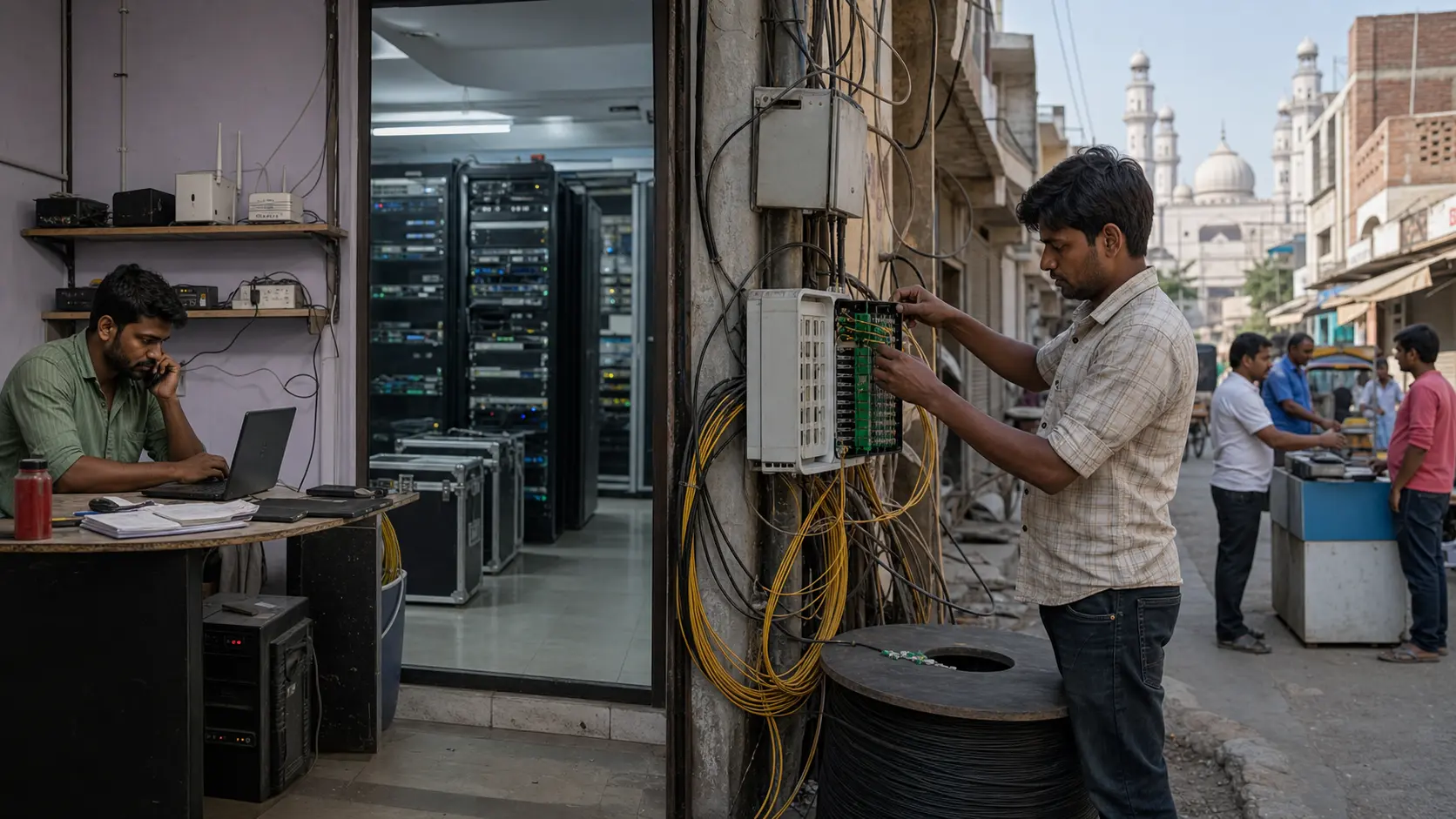
XG INTERNET PRIVATE LIMITED is a useful case because the public record does not let the reader settle on one simple geography. The company is registered in Kanpur, licensed for Uttar Pradesh East, marketed from a Kanpur broadband brand, listed by APNIC and IRINN as an Indian network, visible in Delhi and Noida interconnection records, and presented on its own website as a business with a much wider footprint. That is not automatically a problem.
Many Indian connectivity providers combine a local access base, metro data-center presence, upstream transit in Delhi or Mumbai, local-cable partners, managed-service resellers, and branded retail offers. The problem is that each of those geographies carries a different commercial meaning.
The legal identity is clear enough. IndiaFilings lists XG INTERNET PRIVATE LIMITED as an active unlisted private company incorporated on 28 August 2024, with Corporate Identification Number U61900UP2024PTC208402, registered under RoC-Kanpur, authorised capital of Rs 15 lakh and paid-up capital of Rs 2 lakh. The registered address is 117Q391 Sarda Nagar, Saketpuri, Kanpur Nagar, Uttar Pradesh 208025. The same profile names Amrat Singh Chandel and Kushang Dixit as directors from the incorporation date.
Tofler gives the same broad picture: an active Uttar Pradesh private company, incorporated on 28 August 2024, with two directors and no public revenue figure on the free profile.
The operating brand is also visible, though less tidy. The company website is xtremefiber.in, branded around XG Internet, X.G. Internet, Xtreme Broadband and Xtreme Giganet language. PeeringDB lists the network as XG INTERNET PRIVATE LIMITED and gives "Xtreme Giganet" as the also-known-as name. The website footer identifies "X.G. Internet Private Limited." The homepage says the company offers broadband, IPTV, OTT, internet leased line, SD-WAN, MPLS and point-to-point services.
The page also says the founder of Xtreme Broadband has been in the ISP industry since 2016, while the current XG Internet company was incorporated in 2024 and its public autonomous system was registered in 2025. That can be read as a brand migration, a founder history, a related-company transition or a marketing shortcut. Public sources do not fully resolve it.
That ambiguity matters more than corporate tidiness. A broadband customer wants to know who sends the technician when service fails. A business customer wants to know who owns the circuit, who controls the router, who has upstream authority, and who is responsible under the service contract. A regulator wants to know which legal entity holds the authorization and whether the service is being offered in the permitted service area. A transit provider wants to know who originates the prefixes and who handles abuse. The same name can be commercially valuable if it concentrates trust.
It can be commercially costly if customers, partners and suppliers have to ask which Xtreme, XG or related operator is actually responsible.
The commercial reading is therefore not "this is merely a confusing website." It is that XG Internet's business depends on converting several kinds of geography into one promise. The customer-facing geography is Kanpur and UP East. The interconnection geography is Delhi and Noida. The registry geography includes XG's own resources and prefixes whose underlying APNIC descriptions point to other Uttar Pradesh networks. The marketing geography hints at several Indian states and data centers.
The revenue geography may include direct home broadband, enterprise leased lines, partner broadband support, cloud storage and downstream connectivity. That is a lot of territory for a company whose paid-up capital is publicly listed at Rs 2 lakh and whose current ISP authorization is young.
The license says UP East, while the sales page reaches wider
The strongest public license evidence comes from the Department of Telecommunications UL ISP and UL ISP VNO list as on 28 February 2026. The list includes XG INTERNET PRIVATE LIMITED at serial 1674, with license number DS-11/253/2024-DS-III, Category B, service area Uttar Pradesh East, director Amrat Singh Chandel, the Sarda Nagar/Saketpuri Kanpur address, email xginternetservices@gmail.com and dates shown as 25 September 2025. The company website repeats the same core claim in a public-facing way: the UPE LSA granted Category-B ISP authorization to XG Internet Private Limited on 25 September 2025 under Unified License.
Category B is not a national retail license. The Director General Telecom's public license taxonomy describes Internet Service Category A as all-India, Category B as jurisdiction in a service area, and Category C as jurisdiction in a secondary switching area. The UP East service area includes Kanpur and many other districts, but it is still a bounded service area. That matters because the website also displays counters claiming 10,000 happy customers, presence in 18 states, 200 enterprise customers and five data-center presences in India.
Those claims may combine direct access customers, partners, enterprise circuits, hosted services, call-center support customers, historic brand activity or aspirational marketing. But they should not be read as simple proof that XG Internet is a direct licensed retail ISP in 18 states.
This is the first economic tension. If the business is primarily a UP East retail ISP, the path to margin is local density: more subscribers per feeder, faster field response, lower support travel, fewer network surprises and stronger neighborhood reputation. If the business is an enterprise and partner-services platform, the path to margin is aggregation: many local ISPs or business locations using XG for upstream, support, software, marketing, hardware, peering or managed services. Those are different companies in practical terms. They need different capital, contracts, staff, regulatory discipline and service guarantees.
The public record suggests XG is trying to do both. Its website offers consumer broadband plans and "Buy Now" links through WhatsApp. It also pitches internet leased lines, SD-WAN, MPLS, point-to-point circuits, cloud storage and enterprise network monitoring. It advertises a partner program with revenue-sharing sales support, social media marketing, H8 customer-management software and ONT/OLT services with a security deposit. It even offers a virtual call center for "Lasmile" users, promising L1, L2 and L3 support. That language is not just retail ISP language.
It is the language of a service stack sold to smaller access providers, business customers and possibly cable-broadband partners.
The question is whether the legal and operational structure is strong enough to support that range. A young Category-B ISP can legitimately buy upstream capacity, peer in Delhi, offer local broadband in UP East, and sell managed enterprise connectivity where permitted. But if it markets broad presence without explaining which services are direct, which are partner-delivered, which are hosted, and which depend on other licensees, it creates avoidable trust friction. Geography does not only affect compliance. It affects price.
Customers will pay more when they believe a provider controls the service path; they discount the offer when it feels like a chain of resellers.
The retail price ladder is aggressive but not strange
XG Internet's public retail broadband prices are simple and aggressive. The site lists a Basic plan at 200 Mbps for Rs 699 plus GST, a Premium plan at 300 Mbps for Rs 799 plus GST, and a Pro plan at 400 Mbps for Rs 899 plus GST. Each plan is unlimited for 30 days and includes OTT bundle language. The page also says the company offers broadband speeds up to 1 Gbps. For a customer comparing local broadband options in a large Indian city, those prices are plausible: not impossibly low, but clearly built for a market where national operators and local fiber providers have trained customers to expect hundreds of megabits at household prices.
The economics of those plans are not just about headline bandwidth. A Rs 699 household plan leaves limited room after GST, local collection cost, router or ONT support, fiber maintenance, upstream bandwidth, power backup, customer service, rights of way, bad debt and license-related costs. The plan becomes attractive if the provider can keep many customers on the same local plant, shift heavy traffic through peering and caches, avoid truck rolls, and keep evening contention below the level that triggers churn.
It becomes dangerous if customers use the line as a heavy streaming, gaming and work-from-home pipe while the provider has to buy expensive backhaul and transit for every extra gigabyte.
XG's website reveals the cross-subsidy logic. Retail broadband attracts volume and brand awareness. Enterprise leased lines promise better margins and more predictable contracts. SD-WAN and MPLS sell control rather than raw access. Point-to-point circuits use location-specific needs. Cloud storage and hosted services try to turn data-center presence into recurring revenue. The partner program tries to turn other ISPs' customer acquisition and support pain into XG's revenue. The virtual call-center offer tries to monetize support competence without owning every customer line directly.
That mix can make sense. A small ISP often cannot survive on low-margin home broadband alone, especially when national operators advertise low-priced fiber and 5G fixed-wireless alternatives. The operator needs business customers, local institutions, downstream providers, or value-added services. But every added service increases the need for evidence. A home user may accept a WhatsApp sign-up and a fast technician. A business customer buying a leased line will ask about service levels, upstream diversity, route control, data-center handoff, support escalation and who pays when the line is down.
A local ISP buying support or hardware through a partner model will ask whether XG has enough inventory, NOC staff and billing discipline.
The website's support language shows this split. One section says enterprise users receive 24/7 NOC support and broadband subscribers get support from 10 AM to 7 PM. Later enterprise-product sections repeatedly use 24/7 monitoring language. That may be operationally reasonable: businesses pay for a higher support tier, households receive working-hours support with emergency handling. But it underlines the difference between customer classes. XG's economics depend on segmenting support and pricing correctly. If household customers expect enterprise-level response at Rs 699, service costs rise.
If enterprise customers suspect they are buying a retail-grade support model with enterprise words attached, they will discount the offer or choose a larger operator.
The network record is young, real and more Delhi-facing than Kanpur-facing
The network evidence is more substantial than a brochure page. APNIC RDAP lists AS154360, named IRINN-XGNET-AS-IN, as active, registered on 12 November 2025 and described as XG INTERNET PRIVATE LIMITED. The administrative contact address is the same Sarda Nagar/Saketpuri Kanpur address visible in corporate and license records. APNIC also shows XG's own IPv4 allocation 138.252.190.0/23 and IPv6 allocation 2402:38e0::/32, both registered on 12 November 2025. Those are not giant resources, but they are enough to make the company a real routed network rather than only a local reseller name.
Public BGP views show AS154360 originating six IPv4 /24s and one IPv6 /32: 103.3.234.0/24, 103.3.235.0/24, 138.252.190.0/24, 138.252.191.0/24, 202.47.166.0/24, 202.47.167.0/24 and 2402:38e0::/32. BGP.tools marks those prefixes as having valid RPKI. IPinfo similarly lists the same IPv4 ranges as RPKI valid. RPKI validity is not a complete route-security program, but it is a meaningful hygiene signal, especially for a new network. It means the route-origin story is not obviously casual.
The prefix descriptions are where the geography becomes more interesting. XG's own 138.252.190.0/23 and 2402:38e0::/32 are described by APNIC as XG INTERNET PRIVATE LIMITED. The 103.3.234.0/23 resource is described as ENET SERVICES, with an address in Panki, Kanpur. The 202.47.166.0/23 resource is described as SSN NETWORK PRIVATE LIMITED, with another Kanpur address. BGP.tools and IPinfo show AS154360 originating /24s from those two /23s. That can have legitimate explanations: customer routes, downstream relationships, acquisition or lease arrangements, route-origin authorizations, or operational consolidation among nearby networks.
It is not proof of a problem. It is, however, exactly the kind of detail that changes how a sophisticated customer reads the company.
If XG controls only its own resources and provides transit to other local operators, then it is playing a useful upstream role in the Kanpur broadband ecosystem. If those prefixes are effectively borrowed capacity for XG retail use, then customers and suppliers need to understand the contractual and abuse-handling chain. If the other networks are related through directors, partners or local infrastructure, that relationship should be documented in commercial agreements even if it is not explained on the website. In route economics, the right to announce an address block is only part of the story.
The customer also wants to know who handles abuse, who receives regulator notices, who configures RPKI, who updates IRR objects, and who fixes reachability when another operator changes policy.
PeeringDB gives XG a much larger operational posture than the corporate age alone would imply. The PeeringDB network record lists AS154360, website xtremefiber.in, an open peering policy, Cable/DSL/ISP type, IPv6 support, 50-100 Gbps self-reported traffic, 20 IPv4 prefixes and 20 IPv6 prefixes. Those prefix counts are self-reported and do not match the current six IPv4 and one IPv6 origin count visible in BGP.tools; the mismatch may simply reflect stale operator-maintained fields, route-set expectations or planned customers. But the interconnection data is concrete.
PeeringDB lists a 100G operational connection at Extreme IX Delhi and a 10G operational connection at DE-CIX Delhi, both as route-server peers. It also lists facilities at TATA Communications Delhi, TATA Communications GK1, Sify Greenfort in Noida, STT Delhi 1, STT Delhi 2, STT Delhi 3 and Web Werks Delhi NCR 1 in Noida.
That is the second geographic tension. The company is licensed and registered around Kanpur and UP East, but its public interconnection record is anchored in Delhi and Noida. That is not surprising for a north Indian ISP. Delhi is a major interconnection and data-center market; a Kanpur operator may reasonably peer there because that is where content, transit and exchange density are available. But it does mean the economics are not purely local.
A customer in Kanpur may judge XG by neighborhood support, but traffic quality may depend on capacity to Delhi, exchange-port performance, transit providers in Delhi, facility availability in Noida, and the cost of backhaul between the access footprint and those metros.
The supplier stack is the invisible part of the balance sheet
BGP.tools lists two upstreams for AS154360: Tata Communications and Joy Services. IPinfo lists three upstreams, adding Anonet Network Private Limited. Public views differ because they collect routes at different points and times, but they agree on the main theme: XG is not a completely isolated access network. It is buying or exchanging reach through larger and nearby providers while also peering at Delhi exchanges. The same public BGP views show downstreams including Entire Cable And Broadband Opc Private Limited and R P World Telecom Pvt Ltd. Again, the exact commercial terms are not public. But the direction is important.
XG appears to sit between larger upstreams and smaller or related networks.
That middle position is commercially attractive but operationally demanding. It lets XG buy from a carrier such as Tata, use exchange connectivity to improve local and content paths, and provide reach to smaller operators that may not want to manage their own transit blend. It also means XG inherits problems from both sides. If a large upstream has congestion, pricing changes, route leaks or contract friction, XG's customer experience suffers. If a downstream produces abuse, misconfigures routes or has poor customer identification, XG can receive complaints.
If backhaul to Delhi fails, the local retail customer sees the outage even if the last-mile cable is fine.
The public website claims "dual-ring fiber architecture," high-capacity switches and proactive monitoring for leased lines. It offers scalable leased-line speeds up to 100 Gbps. Those are strong claims for a young company and should be read in the context of supplier dependency. XG may be able to deliver high-capacity enterprise service by assembling leased fiber, data-center ports, exchange ports and upstream circuits from larger infrastructure providers. That is a normal and legitimate model. But it is not the same as owning every route.
The margin lies in knowing which pieces to own, which to lease, and how to price the service so that redundancy is paid for rather than silently absorbed.
The cost base has several visible layers. There is the regulatory layer: Unified License obligations and the general Indian ISP license-fee environment, where DoT materials state a license fee of 8 percent of adjusted gross revenue, inclusive of the USO levy that is presently 5 percent of AGR. There is the interconnection layer: exchange ports, cross-connects, data-center space and facility presence. There is the transit layer: upstream commitments to Tata, Joy or other providers. There is the access layer: local fiber, ONTs, OLTs, field technicians, power and customer equipment.
There is the software/support layer: H8 customer management, partner support, billing, reconnection, NOC monitoring and marketing. A low retail price is sustainable only if the operator earns enough from density, business services and partner services to cover that stack.
The supplier stack also affects trust. When the company says it has five data-center presences in India, PeeringDB helps make that claim partly legible: it lists seven facilities, all in Delhi, New Delhi or Noida. That is evidence of a real metro interconnection footprint, not evidence of national access coverage. When the company says it has presence in 18 states, the public evidence does not yet show how those states are served. They may be partner relationships, enterprise circuits, managed-service customers, call-center clients, or historical brand reach. The difference matters.
A customer buying connectivity in Kanpur wants local support. A partner in another state wants to know whether XG is a direct service provider, an upstream, a support vendor or a reseller. Each answer carries a different price and liability.
The customer base is more claim than proof
XG's website says it has 10,000 happy customers and 200 enterprise customers. Those numbers may be true, but they are not independently verified by the public sources available here. The public corporate filings do not show revenue. The free company profiles do not show subscriber counts. The PeeringDB traffic field is self-reported. APNIC Labs' customer-population estimate for India places AS154360 around rank 1070 with roughly 3,093 modeled users and 2,255 samples in the fetched table. That APNIC number is not a subscriber count.
It is an advertising-measurement signal, and small-network estimates can move with sampling, NAT, downstream users and traffic mix. Still, it gives a useful caution: public measurement does not obviously corroborate a large direct retail base on AS154360 itself.
This does not mean the website's customer number is necessarily wrong. A broadband company can have customers behind another ASN, customers on partner networks, legacy brand customers, cable-network customers using separate addressing, business circuits not heavily visible to APNIC's measurement, or customers whose traffic emerges through shared NAT. The point is narrower. The public evidence does not yet let an outside reader reconcile the claimed customer base with the visible autonomous system footprint.
The company's public social surface is also thin. A Facebook page for Xtreme Giganet in Kanpur links to xtremefiber.in, gives a Kanpur address and phone number, and is shown as not yet rated. Search results surface more general Kanpur broadband chatter around JioAirFiber and Airtel Xstream than direct XG customer discussion. That is not unusual for a small ISP; many customers deal through WhatsApp, local cable operators and neighborhood referrals rather than public review platforms. But thin chatter limits confidence.
Local broadband reputation is often the best early-warning signal: customers complain when evening speeds collapse, technicians disappear, bills are mishandled or outage communication fails. XG's public footprint does not yet provide enough visible customer testimony to score support quality.
The company can turn that weakness into an advantage if it publishes clearer service boundaries. A local ISP does not need a national social-media presence to be trustworthy. It needs a clear support number, transparent package terms, realistic promised speeds, an outage practice, a written enterprise escalation path and a way for customers to know whether they are buying direct XG service or partner-delivered service. The current website gives many product promises but little operating transparency. For a household, that may be acceptable if installation is fast and the line works. For enterprises and partners, ambiguity costs money.
India gives the opportunity and the pressure at the same time
The national market context explains why a company like XG can exist and why it is under pressure from day one. TRAI's May 2026 subscription data shows India with 1,080.15 million broadband subscriptions, up from 1,073.44 million in April. But the composition is uneven. Fixed wired access stood at 47.40 million subscriptions, fixed wireless access at 17.97 million, and mobile wireless access at 1,014.79 million. The top five broadband providers across wired and wireless held 98.59 percent of the market, led by Reliance Jio at 529.61 million and Bharti Airtel at 376.11 million.
In fixed wired broadband, the top five held 71.53 percent, with Jio, Airtel, BSNL, ACT and Kerala Vision leading the list.
Those numbers say two things at once. First, fixed broadband still has room for local and regional providers. A 47.40 million fixed-wired market in a country of India's size is large enough to contain thousands of small ISPs, cable broadband operators, enterprise access specialists and local fiber brands. Second, the pricing umbrella is set by giants. Jio and Airtel can bundle mobile, content, brand trust, app-based care, fixed wireless and fiber. BSNL has legacy reach. ACT and other larger fixed operators have dense urban networks. A new regional ISP cannot win merely by saying it has high-speed broadband.
It must be sharper on local installation, support, business relationships, price, routing quality or partner economics.
Fixed wireless makes the pressure sharper. TRAI's May 2026 data shows 12.73 million 5G FWA subscribers and 4.73 million UBR FWA subscribers nationally. FWA is not a perfect substitute for fiber, but it weakens the old local-cable advantage in areas where running last-mile fiber is slow or politically difficult. For a Kanpur-oriented ISP, this means the household customer may compare XG not only with another local fiber provider but also with a national operator's wireless home broadband.
XG's response has to be local reliability, lower friction, better peak-hour performance, business-grade customization or a partner model that lets local operators compete under a stronger network umbrella.
The regulatory environment also rewards seriousness. India has a structured Unified License framework, service-area categories and revenue-based license fees. The public DoT list shows XG in the authorized ISP list, which is a credibility point. It also exposes the company to obligations that weaker informal operators may avoid until they are forced into compliance. If enforcement tightens, compliant young ISPs with real ASNs, RPKI-signed routes and documented contact details can benefit. But compliance is not free.
A provider competing at Rs 699 per month has to pay for regulation, accounting, network security, lawful process, customer support and upstream bills while competing with operators that can spread overhead across millions of lines.
The best market case for XG is therefore not that it becomes a national challenger. It is that it becomes a useful node in northern India's regional connectivity stack: a Kanpur-rooted operator with enough Delhi interconnection to deliver credible routes, enough local support to keep customers, enough enterprise service to improve margins, and enough partner tooling to help smaller broadband sellers operate without building a full NOC. That is a realistic niche if execution is strong. It is also a niche that punishes overstatement.
The more XG markets itself as everywhere, the more it will be judged against operators with national balance sheets.
Geography is the commercial problem
The assignment of value in this case depends on where control sits. A customer connection can be local while the traffic handoff is in Delhi. A route can be originated by XG while the underlying allocation is described as another Kanpur network. A company can be registered in Kanpur while its interconnection facilities are in Delhi and Noida. A website can claim 18-state presence while the license record shows UP East authorization. None of those facts individually proves weakness. Together, they define the core business risk.
Control geography asks who can fix the service. If the problem is the drop cable, XG or its local partner must fix it. If the problem is backhaul to Delhi, a transport provider may be involved. If the problem is exchange congestion, XG needs capacity and peering discipline. If the problem is a route-origin dispute on an ENET or SSN block, the relevant resource holder and route object chain matter. If the problem is a business customer's remote office outside UP East, the contractual and licensing path matters. Customers pay for fewer handoffs because each handoff creates delay, blame-shifting and uncertainty.
Customer geography asks where revenue is actually earned. A dense Kanpur access base has one economics: local plant, household churn, installation cost and support reputation. Delhi exchange and data-center presence has another economics: ports, cross-connects, peering, enterprise handoff and transit quality. Partner operations have a third: sales commissions, hardware deposits, software support, NOC outsourcing and the quality of someone else's last mile. XG's public materials include all three. The company may know internally which one dominates, but outsiders cannot tell.
Liability geography asks which legal entity is accountable. XG Internet has a clear company registration and license. Xtreme Giganet appears as an older related or associated brand/company with a shared director, active status and its own registered address. ENET and SSN address resources appear in XG's originated route set. XG's website uses Xtreme Broadband founder history. Public customers may not care until something fails. Then the question becomes central: whose bill, whose SLA, whose abuse desk, whose license, whose route authorization and whose refund obligation?
Registry geography asks whether the network's public identifiers match the commercial story. AS154360 and XG's own 138.252.190.0/23 and IPv6 /32 are straightforward. The ENET and SSN prefixes are more nuanced. The public BGP record is RPKI-valid, which is positive, but a sophisticated customer would still ask for an explanation: are these customers behind XG, related networks, leases, acquisitions, managed announcements or transit customers? That is not a hostile question. It is routine due diligence for a provider that wants to sell enterprise-grade service.
Support geography asks where the human operating surface is. XG's website gives a Kanpur address and support email. PeeringDB lists a public policy contact with an xtremefiber.in email. APNIC lists xginternetservices@gmail.com and Kanpur contact details. The website offers a virtual call center for other providers' users. That suggests support is not only an internal cost; it is also a product. If XG can genuinely provide L1, L2 and L3 support to partner networks, it can earn margin from operational know-how. But that claim raises the evidence bar. A call-center product is only valuable if ticket handling, escalation, billing integration, outage messaging and network visibility are real.
The strongest argument for XG
The bullish case is that XG is assembling the right pieces unusually quickly. It has a visible Indian company, an active Category-B ISP authorization for UP East, an ASN, its own IPv4 and IPv6 resources, RPKI-valid route origins, two Delhi exchange connections, seven listed Delhi/Noida facilities, a recognizable retail broadband offer, enterprise products, a partner-service model and public contacts. In a fragmented fixed-broadband market, those pieces matter. Many local operators have customers but poor routing. Some have local fiber but no serious interconnection. Some have a website but no ASN.
XG has moved beyond the most basic local ISP posture.
The company also appears to understand that home broadband alone is a difficult profit pool. The public product mix tries to attach higher-value services to the access base: leased lines, SD-WAN, MPLS, point-to-point connectivity, cloud storage, enterprise monitoring and partner support. If XG can sell even a modest number of business circuits, support smaller ISPs, and use Delhi peering to improve traffic economics, it can build a business that is more resilient than a simple Rs 699 broadband shop. Its role does not have to be national to be valuable.
A well-run Kanpur and UP East operator with Delhi-grade interconnection can be commercially meaningful.
There is also a timing advantage. AS154360 is new, which means the company can build routing hygiene from the start rather than inheriting years of messy objects. It already has visible IPv6 resources and IPv6 exchange addresses. It has public peering records. It is present in the IRINN affiliate list. It appears in the DoT authorization list. That gives it a formal foundation from which to sell to customers who care about legitimacy. In local broadband, legitimacy can become a price signal when customers are tired of informal providers that cannot escalate problems or provide proper invoices.
The strongest argument against it
The bearish case is that the public story is too stretched for the available proof. The company is young, its paid-up capital is small, revenue is not publicly visible, direct customer evidence is thin, and the website's 18-state and five-data-center positioning may make the company sound broader than its license and public access evidence support. The product list is ambitious: consumer broadband, OTT bundles, cloud storage up to 10,000 TB, leased lines up to 100 Gbps, SD-WAN, MPLS, point-to-point service, enterprise monitoring, partner marketing, hardware, customer-management software and virtual call-center support.
A larger operator can spread such complexity across departments. A small or newly formalized operator can lose focus.
The network evidence also raises due-diligence questions. PeeringDB self-reports 20 IPv4 and 20 IPv6 prefixes, while BGP.tools currently shows six IPv4 and one IPv6 originated prefix. XG originates prefixes described in APNIC records as ENET SERVICES and SSN NETWORK PRIVATE LIMITED. IPinfo shows important routers concentrated in Delhi/New Delhi with one visible Kanpur point. APNIC Labs' current customer-population signal for AS154360 is modest and does not reconcile neatly with the website's 10,000-customer claim. None of these points is fatal.
Together they mean the outside reader should not treat the sales page as audited evidence of scale.
The regulatory geography is another risk. A Category-B UP East ISP can be a strong local license. It does not by itself explain a public claim of presence in 18 states. If those states are partner relationships, the company should explain that. If services outside UP East are enterprise managed services riding other licensed providers, that is a different claim. If the company intends to expand, it may need additional authorizations, partner structures or clearer disclosures. Ambiguity may be harmless in early marketing, but it becomes costly when a business customer, regulator or upstream asks for documents.
Finally, support promises can outrun operations. Local broadband reputation is built during outages, not on package pages. If XG can maintain field service, NOC escalation, route hygiene and customer communication, it can earn trust. If it sells too many geographies and too many service types before its operating system is mature, every outage will expose the distance between the website and the network. In a market with Jio, Airtel, BSNL, ACT, many local ISPs and expanding FWA, weak support has a short shelf life.
What would change the judgement
Several facts would materially improve confidence. First, a clear statement of service geography would help: which services are offered directly under the UP East ISP authorization, which are partner-delivered, which are enterprise managed services, and which locations are data-center or exchange points rather than retail access areas. Second, documentation of the relationship between XG Internet, Xtreme Giganet, Xtreme Broadband, ENET SERVICES and SSN NETWORK PRIVATE LIMITED would clarify customer liability and route authority.
Third, independent customer counts, revenue split and churn would show whether XG is primarily a home broadband provider, an enterprise connectivity seller, a partner-services platform or a small transit aggregator.
Fourth, a public network map with backhaul, data-center handoffs, upstream commitments and peering capacity would let customers price risk. Fifth, enterprise references or published service-level templates would support the leased-line and SD-WAN claims. Sixth, a route-policy and abuse-handling statement would make the originated third-party-described prefixes easier to underwrite. Seventh, evidence of IPv6 deployment to real access customers would show whether the IPv6 allocation is operationally meaningful beyond exchange presence.
The biggest single fact would be customer geography. If most revenue is in dense Kanpur and nearby UP East areas, XG should be valued as a local access operator with useful Delhi interconnection. If most revenue is from partner ISPs and enterprise services across multiple states, the company should be valued as a managed connectivity platform with license and partner-dependency questions. If the business is mostly a brand wrapper over other local networks, the trust and margin analysis changes again. The public record does not yet choose among those models.
Public evidence used for this assessment
The core identity evidence comes from IndiaFilings and Tofler profiles for XG INTERNET PRIVATE LIMITED, which show incorporation in August 2024, active status, Kanpur registration, directors and capital structure. The Department of Telecommunications UL ISP and UL ISP VNO list as on 28 February 2026 supports the Category-B UP East authorization, license number DS-11/253/2024-DS-III, director name, address and September 2025 dates. The Director General Telecom license taxonomy supports the distinction between all-India, service-area and secondary-switching-area ISP authorizations.
The company website at xtremefiber.in supports the retail broadband plans, service menu, OTT bundle language, enterprise leased-line, SD-WAN, MPLS, point-to-point, cloud storage, support, partner, H8 software, hardware and virtual-call-center claims. It also supports the website's own statement that UP East granted the Category-B ISP authorization to XG Internet on 25 September 2025, and its public contact address in Sarvodaya Nagar, Kanpur.
The network evidence comes from APNIC RDAP for AS154360, XG's IPv4 and IPv6 resources, APNIC RDAP for ENET SERVICES and SSN NETWORK PRIVATE LIMITED address blocks, PeeringDB's AS154360 record, PeeringDB's netixlan API, BGP.tools, IPinfo, BGP.he.net, IPGeolocation and TheIpAPI. These sources support the ASN registration, originated prefixes, RPKI-valid public route view, upstream and downstream view, exchange ports, facilities and Delhi/Noida concentration. PeeringDB fields such as traffic and prefix counts are treated as operator-maintained data, not audited facts.
The market evidence comes from TRAI's May 2026 telecom subscription release and the related PIB publication, which support the size of India's broadband, fixed wired, fixed wireless and mobile broadband markets, top-provider concentration and current wireline/wireless subscriber context. APNIC Labs provides a weak but useful measurement signal for AS154360's customer population and IPv6 visibility, and for India's wider IPv6 capability. Public social evidence is thin; the Xtreme Giganet Facebook page mainly supports the existence of a public Kanpur-facing social surface, not service quality.
Core source URLs for the public record include XG's official website at https://xtremefiber.in/, the DoT UL ISP and UL ISP VNO list at https://www.dot.gov.in/static/uploads/2026/03/1583eeb1e6fe5cf8a56110195d8320e9.pdf, the Director General Telecom license taxonomy at https://dgtelecom.gov.in/type-of-licenses/, DoT fee context at https://www.eservices.dot.gov.in/fees-charges-for-services, IndiaFilings for XG at https://www.indiafilings.com/search/xg-internet-private-limited-cin-U61900UP2024PTC208402, Tofler for XG at https://www.tofler.in/xg-internet-private-limited/company/U61900UP2024PTC208402, IndiaFilings for Xtreme Giganet at https://www.indiafilings.com/search/xtreme-giganet-private-limited-cin-U64200UP2022PTC164586 and the IRINN current affiliate list at https://irinn.in/CurrentAffiliate.action. The routing and interconnection record is anchored by APNIC RDAP for AS154360 at https://rdap.apnic.net/autnum/154360, APNIC RDAP for 138.252.190.0 at https://rdap.apnic.net/ip/138.252.190.0, APNIC RDAP for 2402:38e0:: at https://rdap.apnic.net/ip/2402:38e0::, APNIC RDAP for ENET SERVICES at https://rdap.apnic.net/ip/103.3.234.0, APNIC RDAP for SSN NETWORK PRIVATE LIMITED at https://rdap.apnic.net/ip/202.47.166.0, PeeringDB at https://www.peeringdb.com/net/40852, PeeringDB API records at https://www.peeringdb.com/api/net/40852 and https://www.peeringdb.com/api/netixlan?asn=154360, BGP.tools at https://bgp.tools/as/154360, IPinfo at https://ipinfo.io/AS154360, Hurricane Electric at https://ipv4.bgp.he.net/AS154360, IPGeolocation at https://ipgeolocation.io/browse/asn/AS154360 and APNIC Labs at https://stats.labs.apnic.net/cgi-bin/aspopjson?c=IN and https://stats.labs.apnic.net/cgi-bin/json-table-v6.pl?x=IN154360. The market backdrop uses TRAI's May 2026 release at https://www.trai.gov.in/notifications/press-release/trai-releases-telecom-subscription-data-may-2026, the TRAI PDF at https://www.trai.gov.in/sites/default/files/2026-06/PR_No78of2026.pdf and the PIB summary at https://www.pib.gov.in/PressReleasePage.aspx?PRID=2277922&lang=1®=3.
A narrow reading is the fairest one
XG INTERNET PRIVATE LIMITED should be read as a real but early-stage regional connectivity operator whose public value is strongest when described narrowly. It has a lawful UP East ISP foundation, a Kanpur identity, real number resources, visible Delhi exchange presence and a product set aimed at both households and businesses. That is enough to matter. It is not enough to treat the company as a proven national broadband platform.
The company's economic task is to make its several geographies work together instead of letting them create doubt. Kanpur gives it local relevance. UP East gives it license scope. Delhi and Noida give it interconnection. APNIC and PeeringDB give it technical visibility. Partner services may give it scale without building every last mile. But each layer has to be explained and priced honestly. If XG can turn local support, clean routing, Delhi peering and partner operations into a coherent offer, it can occupy a useful middle position in India's fixed-broadband market.
If it continues to let geography blur across legal address, license area, exchange city, resource origin and customer claims, the ambiguity that helps marketing today will become the reason cautious customers ask for a discount tomorrow.