
Summary
- What it says: World Faith Communication is not publicly visible as a large Bangladeshi access network.
- Main topic: Regional ISP economics; Peering and transit; Wholesale access economics; Local support labour
- Context: Asia-Pacific regional ISP
The business is smaller than the name, and that is the point
World Faith Communication should not be read as a grand national network simply because the name sounds broad. The useful reading is more local and more economic. Its official website presents the company as an internet service provider in Dhaka, says it is a BTRC approved ISP, gives offices around Mohakhali and TB Gate in Banani, and advertises home broadband, corporate internet, data connectivity, LAN and WAN networking, CCTV, and dedicated server hosting (https://worldfaithcommunication.com/). The Internet Service Providers Association of Bangladesh lists World Faith Communication as member A-864, with BTRC licence 14.32.0000.702.46.146.22.746 under the Upazila/Thana category, an address at G.P-Cha 169, Mohakhali, T.B Gate, Banani, Dhaka-1213, the website, a mobile number, and a Gmail contact (https://ispab.org/members/W).
Those two public records give the first judgment. World Faith Communication is best understood as a local access business, not as a large carrier. It has enough public identity evidence to be treated as a real ISP: its own website, ISPAB membership, licence reference, APNIC registration, an autonomous system, a routed IPv4 prefix, and visible upstream routing. It does not have the public footprint of a large scaled operator: no broad national coverage map, no public subscriber base, no extensive exchange profile, no visible downstream customer network, no published service level data, and only sparse social proof.
The economic question is therefore not whether World Faith Communication can overpower Bangladesh's large broadband brands. It is whether a small licensed operator can turn local trust, prepaid collection, and field repair into a durable business when public scale signals remain thin.
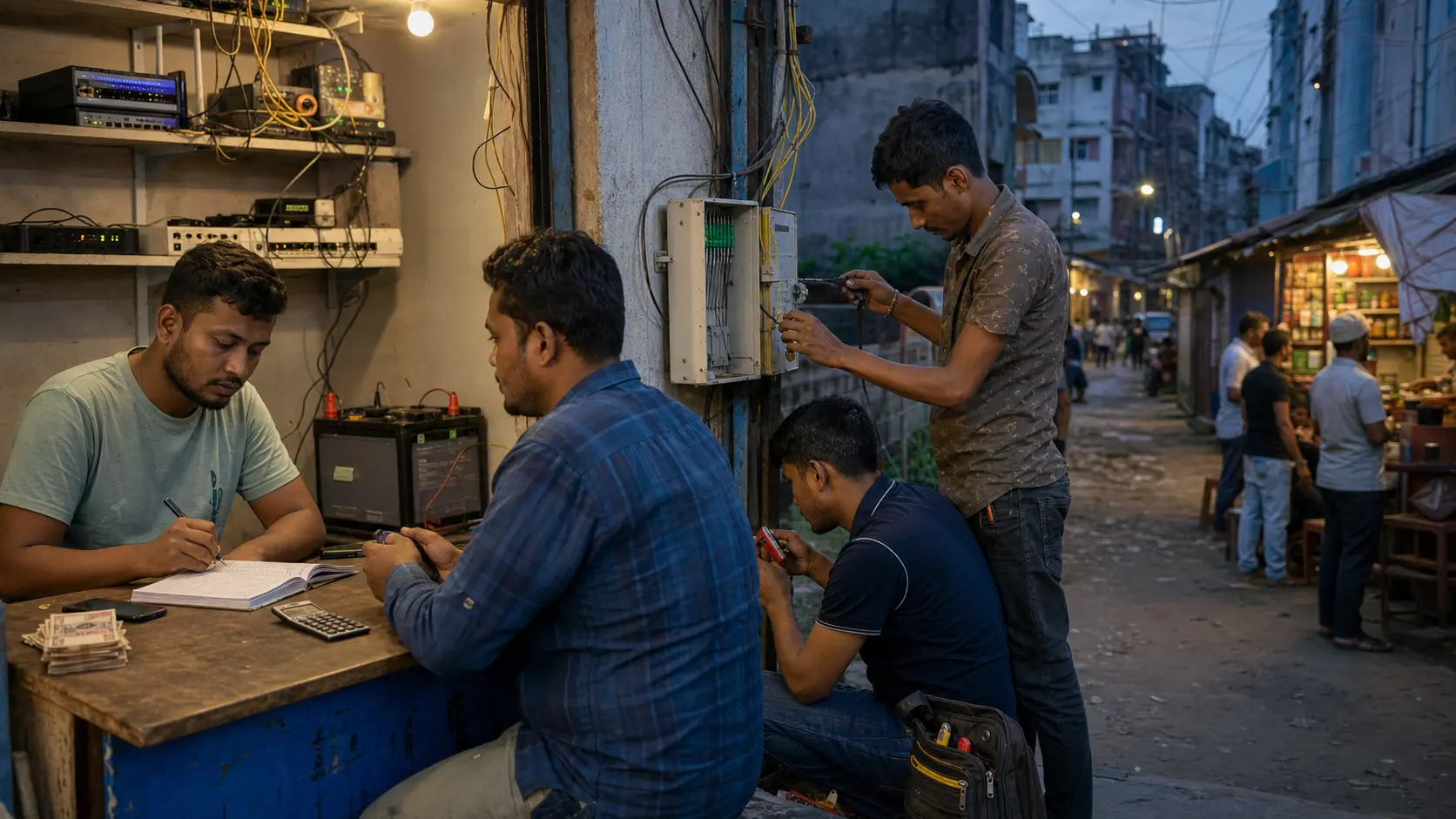
That makes the company worth studying. Bangladesh's broadband market is not just a story about megabit prices. It is a dense, labor-heavy access economy. A customer in Mohakhali, Banani, Korail, Tejgaon, Badda, or another crowded urban area may not buy service only because a website says FTTH. The customer buys because the installer arrives, the line stays live through the month, the bill can be paid through cash or bKash, the help line answers, and someone can separate a router problem from a fiber cut. World Faith Communication's own FAQ makes those realities explicit: it says installation is BDT 1,000 before discounts, public or real IP costs an extra BDT 300 per month, the service is fully prepaid, bills can be paid by cash or bKash, customers can ask for bill collection assistance, and setup inside coverage areas can take from 15 minutes to three days (https://worldfaithcommunication.com/).
This is the business behind the public facts. A local ISP sells a low-ticket monthly promise, but the costs are not low just because the advertised package is low. The provider needs bandwidth, transport, routers, fiber, optical network terminals, field technicians, support staff, payment follow-up, local sales, office space, regulatory compliance, and the working capital to restore faults before the customer loses faith.
The hardest asset may be reputation: if customers believe the provider will answer, they will tolerate modest advertised speeds; if they believe the provider disappears after installation, even cheap bandwidth becomes expensive.
Identity: the records line up around one Mohakhali-based ISP
The identity record is unusually consistent for a small ISP. The official website uses the name World Faith Communication and describes a Dhaka ISP with head office at G.P Cha-169, Mohakhali, TB Gate, Banani, Dhaka-1212, and a corporate office at G.P Cha-150/4 in the same area. It lists info@worldfaithcommunication.com and sales@worldfaithcommunication.com, phone numbers including 01916-834478, 01673-889293, 02222281971, and 01915-000383, and service pages for corporate internet, home internet, data connectivity, networking solution, CCTV, and dedicated server hosting (https://worldfaithcommunication.com/).
The ISPAB record reinforces the same geography and role. It lists World Faith Communication under the W member page with the Mohakhali, T.B Gate, Banani address, mobile 8801703979798, website https://worldfaithcommunication.com, and BTRC licence 14.32.0000.702.46.146.22.746 under Upazila/Thana (https://ispab.org/members/W). The category matters because BTRC's ISP licensing guideline separates ISP licences into Nationwide, Divisional, District, and Upazila/Thana types, with the Upazila/Thana licence authorising service in the administrative area of a particular upazila or thana (https://lims.btrc.gov.bd/uploads/service_guideline/Regulatory%20and%20Licensing%20Guideline%20for%20Internet%20Service%20Provider%20%28ISP%29%20in%20Bangladesh.pdf). A small Dhaka-area footprint is therefore not a weakness by itself. It is what the licence category implies.
The network registration record also points to the same company. BGP.Tools lists AS151054 as World Faith Communication, registered on 27 March 2023, active under APNIC, operating in Bangladesh, with website http://worldfaithcommunication.com, one originated IPv4 prefix, and no originated IPv6 prefix (https://bgp.tools/as/151054). IPinfo similarly identifies AS151054 as World Faith Communication in Bangladesh, classifies the ASN type as ISP, links the company website, and shows 256 IPv4 addresses and no IPv6 addresses (https://ipinfo.io/AS151054). IPIP's APNIC-derived whois view names WFC-AS-AP, World Faith Communication, country Bangladesh, registry APNIC, and an organisation address at CHA-169, Mohakhali TB gate, Dhaka-1213, with the email worldfaithcommunication@gmail.com and abuse mailbox abuse@worldfaithcommunication.com (https://whois.ipip.net/AS151054).
There is no need to split these records into multiple entities. The website, ISPAB listing, BTRC licence reference, APNIC organisation, autonomous system, and routed prefix all describe the same public business. The clean public identity is a Dhaka-based licensed ISP trading as World Faith Communication and operating visible network resources under AS151054. The remaining uncertainty is not identity. The uncertainty is scale, profitability, resilience, and how much customer trust the company has built beyond the small public traces visible online.
The product is ordinary broadband, but the operating signals are specific
World Faith Communication's website does not present a complicated product portfolio. Its strongest claims are practical. The company says it provides broadband internet with 24/7 support, FTTH fibre-to-the-home technology, dedicated bandwidth, multiple IIG, a dedicated movies, FTP and TV server, and support for home, corporate, SME, data connectivity, networking, CCTV, and server hosting needs (https://worldfaithcommunication.com/). The language is promotional, and readers should not treat every adjective as audited performance. But the listed services still show what the company thinks its customers buy: household internet, small-business continuity, local networking, surveillance connectivity, and some local content/server convenience.
The FAQ is more valuable than the sales copy. A provider that says it is "fully prepaid" is telling the market how it manages risk. The site says if a customer pays before the billing date, the connection remains alive; otherwise it is suspended right after the billing date. It says World Faith Communication accepts cash and bKash payments and that customers can ask for assistance to collect a bill from their place. It says public or real IP service costs an extra BDT 300 per month. It says connection setup inside coverage areas can be completed in a minimum of 15 minutes and a maximum of three days.
These details reveal a small-operator cash-flow model, not just a technical product.
Prepaid collection is central. A BDT 500, 800, 1,000, or 1,200 monthly plan does not leave much room for loose receivables. If a provider lets customers run unpaid for weeks, it is effectively financing customer access while paying upstream and transport costs in real cash. World Faith Communication's strict billing rule protects liquidity. The cash and bKash options widen the collection funnel: some customers prefer digital wallet payments, some still operate around cash, and some may need collection help. The convenience is not just customer service. It is a working-capital control.
The package ladder also tells a story. The website lists 5 Mbps at 500 Taka per month, 10 Mbps at 800 Taka per month, 15 Mbps at 1,000 Taka per month, and 20 Mbps at 1,200 Taka per month (https://worldfaithcommunication.com/). These prices resemble the older Bangladesh "One Country One Rate" tariff logic reported in 2021, where BTRC fixed maximum broadband charges around Tk 500 for 5 Mbps, Tk 800 to Tk 1,000 for 10 Mbps, and Tk 1,100 to Tk 1,200 for 20 Mbps (https://www.thedailystar.net/frontpage/news/btrc-fixes-minimum-broadband-charges-2106189; https://www.tbsnews.net/bangladesh/telecom/btrc-announces-unified-tariff-broadband-internet-256753). That alignment is economically important. World Faith Communication is competing in a price-shaped market where the regulator and customer expectations both push basic broadband toward standardised affordability.
The upside is demand. A cheap fixed line can be essential for family video, schoolwork, freelance work, shop connectivity, CCTV viewing, gaming, religious and social video use, and office communication. The downside is margin. When the entry package is only BDT 500 per month, one unnecessary truck roll, one router swap, one long support call, one bad payment month, or one upstream price change can erase the profit from several customers. The operator needs density.
A technician already nearby, a line already pulled along a shared route, a customer who pays on time, and a support team that solves router faults by phone instead of dispatching a field visit are all margin events.
Network evidence: real routing, limited public scale
The network record is credible but modest. BGP.Tools shows AS151054 originating 103.121.184.0/24, a single IPv4 /24, with no IPv6 prefix originated. It shows one upstream carrier: AS58715, Earth Telecommunication (Pvt) Ltd. It also lists two peers in the connectivity section: Earth Telecommunication and Race Online Limited (https://bgp.tools/as/151054). IPinfo reports the same basic scale: 256 IPv4 addresses, zero IPv6 addresses, one peer, one upstream, zero downstreams, and the prefix 103.121.184.0/24 marked RPKI valid (https://ipinfo.io/AS151054). IPIP also shows one IPv4 prefix, 256 IPv4 addresses, zero IPv6 prefixes, valid ROA and IRR indicators for 103.121.184.0/24, and Earth Telecommunication as the related upstream network (https://whois.ipip.net/AS151054).
That is enough to distinguish World Faith Communication from a purely informal reseller page. The company has a visible ASN, a routed prefix, APNIC registration details, and routing security evidence for its advertised address space. It is not simply a Facebook brand with no network identity. But it is also not a visibly deep autonomous network. One /24 gives room for 256 IPv4 addresses before internal private addressing and customer NAT choices are considered. No IPv6 origination is a sign that the public routing footprint is still basic.
Zero downstreams means there is no visible evidence that other networks depend on World Faith Communication for routing. One visible upstream means the public path to the wider internet appears highly dependent on Earth Telecommunication.
The company's website says it has "multiple IIG" to ensure uptime and fast routes (https://worldfaithcommunication.com/). Public BGP views do not prove the full commercial reality behind that statement. In Bangladesh, an ISP may buy international internet through IIG arrangements and transmission through NTTN operators, while public BGP may still expose only one visible upstream path at a given moment. The important analytical point is the gap: the sales promise is route diversity, while the public routing evidence visible to an outside reader is narrow. That does not prove the promise is false. It says customers and analysts should care about fault isolation. If World Faith Communication has multiple upstream relationships or backup paths, the company would strengthen its public case by making the resilience logic clearer.
Upstream dependence is not just technical. It is economic. BTRC's ISP guideline says ISP licensees shall connect to International Internet Gateway operators, lease transmission networks from NTTN operators, and connect to the National Internet Exchange for domestic inter-operator data traffic (https://lims.btrc.gov.bd/uploads/service_guideline/Regulatory%20and%20Licensing%20Guideline%20for%20Internet%20Service%20Provider%20%28ISP%29%20in%20Bangladesh.pdf). A small ISP therefore sits between regulated wholesale inputs and price-sensitive retail customers. It can reduce costs through local density and efficient support, but it cannot avoid the need to buy or lease upstream and transport capacity. If wholesale terms tighten, if a feeder route fails, if NTTN availability is weak in the area, or if a supplier outage occurs, a local ISP's brand suffers even when the root fault lies above it.
This is why the word "dedicated" needs care. World Faith Communication advertises dedicated bandwidth and stable secure connectivity (https://worldfaithcommunication.com/). In retail broadband, customers often hear that as a promise of consistent speed. In network economics, it can mean many things: dedicated access line, package bandwidth, business-class service, public IP, or less-contended service than a cheaper shared plan. The company does not publish contention ratios, utilisation, repair times, or independent speed measurements. The honest conclusion is that World Faith Communication has credible public routing evidence for a small network, but not enough public performance evidence to prove how the network behaves at peak hours or during area faults.
Payment discipline is not a side detail; it is the business model
The most economically revealing sentence on the website is not about fibre. It is the prepaid rule. World Faith Communication says it is fully prepaid and that service will be suspended after the billing date if the customer does not pay (https://worldfaithcommunication.com/). For a small access provider, that rule can determine whether growth is healthy or dangerous. A broadband operator can add customers quickly by being lenient, offering flexible payments, and delaying suspensions. But a local ISP still has to pay staff, upstreams, equipment suppliers, rent, power, taxes, licence fees, and maintenance. Subscriber growth without payment discipline becomes a cash drain.
Bangladesh's broadband demand is large, but household cash flows can be uneven. AMTOB's industry statistics, sourced to BTRC, show 134.07 million internet subscribers in Bangladesh at the end of May 2026, including 119.12 million mobile internet subscribers and 14.95 million ISP plus PSTN subscribers (https://www.amtob.org.bd/home/industrystatics). Daily Star's June 2026 report, using BTRC data, said broadband subscriptions rose to 1.49 crore in April 2026 and noted that BTRC compiles ISP data through market analysis, consultation, and information collected from most ISPs (https://www.thedailystar.net/business/economy/news/internet-subscribers-grew-18-lakh-april-4195621). Fixed broadband has enough demand to matter, but mobile still dominates internet access. That means a local wired ISP has to earn the monthly fixed bill.
The prepaid rule helps explain the plan prices. A BDT 500 plan is not designed for long invoice cycles. It is designed to be treated like a household utility payment. The customer pays, the line stays live, and the provider avoids accumulating many small debts. bKash support matters because Bangladesh's digital wallet behavior makes monthly micro-payments more plausible. Cash collection assistance matters because local field agents and support staff can keep customers inside the paid base. The same human network that sells and repairs service also protects revenue.
There is a trust tradeoff. Strict suspension protects the provider but can irritate customers if billing communication is weak or if a customer misses payment because of a temporary problem. Local trust is what turns strictness into acceptance. A customer may tolerate prepaid discipline if the provider is equally disciplined about installation, support, and repair. The moment the provider suspends quickly but repairs slowly, the trust contract breaks. World Faith Communication's economics therefore depend on symmetry: fast collection must be matched by fast service recovery.
The public or real IP add-on is another signal. At BDT 300 extra per month, it can serve gamers, CCTV users, small offices, remote access customers, or technically demanding households. It also shows how a local ISP can lift average revenue without only selling more speed. Add-ons such as public IP, office networking, CCTV setup, and dedicated server hosting may be more profitable than basic residential plans if they reduce churn and attach service labor to customer needs. But they also increase support complexity. A CCTV customer whose cameras are unreachable will call. A public IP customer may expect routing help.
A small business may need after-hours troubleshooting. Higher-value customers can improve revenue only if support execution keeps pace.
Repair labor is the hidden capacity constraint
World Faith Communication advertises 24/7 support and says connection setup can take 15 minutes to three days inside coverage areas (https://worldfaithcommunication.com/). That promise is meaningful in a dense Dhaka environment. A customer who waits a week for installation may choose another ISP. A customer whose line fails during rain may not care whether the problem is inside the router, at a splitter, in a building riser, on a pole, in an NTTN segment, or at an upstream provider. The customer experiences one thing: the internet is down.
Local ISPs live or die by repair triage. A small operator needs to decide when to send a technician, when to reset remotely, when to replace customer equipment, when to escalate upstream, and when to tell a customer that non-payment, not a fault, caused the suspension. Field work is expensive because it consumes time, transport, cable, connectors, safety risk, and customer patience. It is also reputationally valuable because a visible technician can do what a distant call centre cannot: make the customer believe the company is present.
Dhaka's physical environment increases the value and cost of that labor. Crowded buildings, informal cable routes, shared poles, construction, water exposure, power interruptions, and heavy traffic all add friction. The website's FTTH claim is positive because fibre avoids some copper-era problems and can improve stability, but fibre is not magic. Drop fibres can be cut, connectors can fail, optical power can degrade, routers can lock up, power adapters can burn out, and customer Wi-Fi can be mistaken for internet failure. The FAQ even frames fibre as protection against packet loss and device burn risk during thunderstorms, which shows the company understands weather and electrical anxieties as part of the sale (https://worldfaithcommunication.com/).
The labor model also affects trust. A large national brand may have stronger systems but feel remote. A local ISP may have weaker systems but feel reachable. World Faith Communication's published phone numbers, office addresses, bKash/cash handling, and payment collection assistance all point to a relationship-heavy model. That can be an advantage in dense neighbourhoods where recommendations travel through landlords, small shops, building managers, technicians, and family networks. It can also become a bottleneck if growth outruns staff.
A small provider with a good reputation can damage that reputation quickly by overselling capacity or under-hiring repair staff.
The biggest unseen operating metric is not the advertised speed. It is mean time to restore service. The second is first-contact resolution: how many problems can support solve without a field visit? The third is repeat fault rate: how often the same building or customer calls again. None of these are public for World Faith Communication. That absence is normal for a small ISP, but it limits confidence. The company has enough public facts to show what it sells. It does not provide enough public facts to show whether its repair operation is strong.
Local sales channels matter because public reputation is thin
World Faith Communication's public reputation footprint is unusually light. Its Facebook page appears in search as a Dhaka page with only a small visible audience and a basic description of fast reliable broadband and 24/7 professional support (https://www.facebook.com/wfc.communication/). A second Facebook interest page appears under a similar name with even less public signal (https://www.facebook.com/pages/World-Faith-Communication-Limited/2119844658282456). The company website is clear, but not rich: it has a homepage, service descriptions, prices, FAQ, and contact information, but no public coverage map, no customer reviews, no outage notices, no case studies, no speed-test transparency, and no detailed corporate history.
That thin public chatter should not be mistaken for failure. Many neighborhood ISPs in Bangladesh sell through local visibility rather than searchable reputation. A customer may learn about a provider from a building sign, an installer, a neighbour, a local shop, a community group, a landlord, or a phone number shared through messaging apps. In that world, a small Facebook audience is not decisive. But for outside analysts, sparse public chatter means customer satisfaction is hard to verify. The evidence supports identity and basic operations more than brand strength.
Local sales economics are different from national marketing economics. A large ISP buys brand awareness, broad advertising, call-centre systems, apps, and partner channels. A small ISP can win a building at a time. Once a technician serves several apartments in one lane or building cluster, installation cost falls and word of mouth rises. The same technician may become a sales channel. A customer who trusts the technician may call him before the office. That can produce strong retention, but it can also create person-dependent operations. If one technician leaves, a micro-area relationship can weaken.
The company name itself may help and hurt. "World Faith Communication" is memorable, but it does not immediately identify a Dhaka neighbourhood or a technical capability. For trust, the practical markers matter more: office address, reachable phones, bKash payment, installer availability, and a line that works when customers need it. The website's strongest public trust marker is not brand storytelling. It is the combination of BTRC approval, ISPAB membership, APNIC routing identity, and local payment/service details.
The biggest sales risk is that customers compare World Faith Communication with many alternatives that make similar promises. ISPAB says it represents over 900 companies in the Bangladesh internet sector (https://ispab.org/). Daily Star reported in June 2026 that Bangladesh has around 2,500 ISP licences and had nearly reached 3,000 before August 2024, contributing to market disorder, fragmented infrastructure, and inconsistent service quality (https://www.thedailystar.net/business/economy/news/broadband-sector-set-major-overhaul-4172536). In such a crowded field, a basic promise of fast fibre and 24/7 support is not enough. The provider has to be known locally as the one that actually shows up.
Competition is price-capped and crowded
World Faith Communication competes in a market where affordability is not optional. The 2021 One Country One Rate framework put public pressure on basic broadband pricing, and WFC's published plans sit inside that logic: 5 Mbps at BDT 500, 10 Mbps at BDT 800, 15 Mbps at BDT 1,000, and 20 Mbps at BDT 1,200 (https://worldfaithcommunication.com/; https://www.tbsnews.net/bangladesh/telecom/btrc-announces-unified-tariff-broadband-internet-256753). The customer sees a predictable price ladder. The provider sees compressed margin.
Crowding compounds the pressure. Bangladesh has hundreds of formal ISPAB members, thousands of licences or licence references, and a reported long tail of unlicensed or semi-formal operators. Daily Star's broadband reform report said officials estimate 7,000 to 8,000 unlicensed ISP operators are active across Bangladesh, and that regulators are considering a reseller model to bring them into a legal framework (https://www.thedailystar.net/business/economy/news/broadband-sector-set-major-overhaul-4172536). For a licensed small ISP, this is both threat and opportunity. The threat is undercutting by informal operators who do not carry the same compliance burden. The opportunity is that formalisation could make licence, routing identity, and service accountability more valuable.
Competition also comes from mobile internet. AMTOB/BTRC statistics show mobile internet at 119.12 million subscribers against 14.95 million ISP plus PSTN subscribers at the end of May 2026 (https://www.amtob.org.bd/home/industrystatics). Mobile data is not a full substitute for stable home broadband in every use case, but it is a constant fallback. If a household is unhappy with a local ISP, it can ration mobile data, use a hotspot temporarily, or wait for another provider. A local fixed ISP has to justify the monthly bill through reliability, unlimited use, better latency, local content, real IP options, or business-grade dependability.
Larger fixed ISPs and city brands add another layer. They may have stronger apps, larger support teams, more visible packages, better upstream diversity, and deeper relationships with NTTN or IIG suppliers. World Faith Communication cannot easily outspend those players. It can only out-localise them: faster installation in its service pocket, better payment handling, closer repair, more flexible small-business support, and a stronger human relationship with customers.
The strategic problem is that out-localising is labor-intensive. Every advantage requires people: installers, support agents, collectors, field technicians, sales contacts, and network engineers. Labor is cheaper than national advertising, but not free. It must be scheduled, supervised, trained, and retained. If a small ISP hires too little, faults linger. If it hires too much, low monthly ARPU cannot carry the payroll. The economic sweet spot is narrow: enough staff to protect reputation, enough density to keep each staff hour productive, enough upstream quality to avoid repeat faults, and enough payment discipline to keep cash moving.
Supplier dependence is the hard cost under the soft promise
The central tension is between a soft promise and a hard cost. The soft promise is local trust: we are nearby, we answer, we collect conveniently, we repair quickly, we know your area. The hard cost is the regulated network stack above the local relationship. BTRC's ISP guideline says licensees shall lease transmission from NTTN operators, connect to IIGs, connect to NIX for domestic inter-operator traffic, and observe last-mile limitations and local authority directives (https://lims.btrc.gov.bd/uploads/service_guideline/Regulatory%20and%20Licensing%20Guideline%20for%20Internet%20Service%20Provider%20%28ISP%29%20in%20Bangladesh.pdf). A small ISP cannot wish away those dependencies.
World Faith Communication's public BGP record shows Earth Telecommunication as the visible upstream (https://bgp.tools/as/151054; https://ipinfo.io/AS151054). Earth is therefore economically important to the public reading of WFC. The visible internet path is narrow, but the public data does not disclose the full commercial contract. If Earth supplies transit, aggregation, or upstream reach, WFC's cost and resilience depend partly on Earth. If WFC uses additional IIG or transport suppliers that are not visible in BGP, those arrangements are not publicly demonstrated in the same way.
This matters for customer trust because customers rarely separate supplier layers. A local user blames World Faith Communication for a slow evening, even if the constraint is upstream congestion. A shop blames WFC for CCTV access failure, even if the customer router is misconfigured. A household blames WFC for packet loss during rain, even if the problem sits in a building's power or cable path. The local ISP owns the explanation. It has to translate the supply chain into a simple customer experience.
Supplier dependence can be managed, but the public evidence does not show how far WFC has gone. Good signs would include visible multi-homing, IPv6 deployment, published NOC contacts, public outage communication, exchange participation, or documented enterprise service levels. Current public records show a valid small network, not a sophisticated resilience story. That does not make the company weak; it means the company is operating in a trust business where customers must judge by experience more than public technical transparency.
Regulation is becoming a business pressure, not just a licence badge
BTRC approval is a trust marker, but it also creates duties. The ISP guideline states that no person or business entity may build, maintain, or operate ISP systems and services without a licence, and that licensees may provide internet/data and IP-based services to end users within licence rules (https://lims.btrc.gov.bd/uploads/service_guideline/Regulatory%20and%20Licensing%20Guideline%20for%20Internet%20Service%20Provider%20%28ISP%29%20in%20Bangladesh.pdf). It sets categories, fees, bank guarantee requirements, renewal rules, and operational expectations. For a small ISP, each compliance item is a cost. For a serious small ISP, compliance is also protection against informal competitors.
World Faith Communication's ISPAB record lists an Upazila/Thana licence reference (https://ispab.org/members/W). That provides public legitimacy, but Bangladesh's licensing environment is under review. Daily Star reported in June 2026 that the government was considering a major broadband overhaul, including reducing four ISP licence tiers into two categories, national and district-level, while allowing existing divisional and upazila operators to migrate (https://www.thedailystar.net/business/economy/news/broadband-sector-set-major-overhaul-4172536). For WFC, the implication is practical: licence structure could change the costs, permissions, or competitive position of small local providers.
Regulatory reform can help customers by reducing disorder and raising service standards. It can hurt small providers if compliance costs rise faster than revenue. A small ISP with clear records, a visible ASN, a known address, and disciplined payment systems may be better placed than a purely informal reseller. But the company still needs management bandwidth to deal with renewal, reporting, tax, consumer complaints, technical standards, and potentially changing licence categories. Those tasks do not show up in a speed package, yet they consume margin.
There is also physical and political risk around broadband infrastructure. The Financial Express reported in June 2026 that ISPAB condemned attacks, vandalism, looting, extortion, and attempts to seize network operations targeting internet service providers in Dhaka and other parts of the country, and called for stronger protection of ICT infrastructure (https://thefinancialexpress.com.bd/trade/ispab-condemns-attacks-on-internet-service-providers). That is not a specific allegation about World Faith Communication. It is market context. It shows that local ISP operations can face non-technical threats, including office security, equipment loss, extortion pressure, and continuity risk. A small provider's resilience is not only upstream routing. It is also local protection and governance.
Customer dependency is stronger than public scale suggests
The public network scale for World Faith Communication is small, but customer dependency may still be meaningful. A /24 in BGP does not reveal every household behind NAT. A sparse Facebook page does not reveal every building where a technician is known. A small licence category does not tell how important the connection is to a shop, family, student, office, or CCTV customer. Local broadband can be economically modest and socially important at the same time.
The company's services point to that dependency. Home internet covers entertainment, online class, video calls, gaming, social media, and routine household administration. Corporate internet and SME connectivity cover offices that need stable access for accounts, messaging, payments, cloud tools, customer calls, and remote work. Networking solution and CCTV services connect WFC to physical premises, not just monthly bandwidth. A dedicated server hosted on the customer end suggests support for local content, file access, or business applications (https://worldfaithcommunication.com/).
That mix creates retention opportunities. A customer who only buys the cheapest home line may switch quickly. A customer whose CCTV, public IP, office LAN, and staff workflow depend on WFC faces more friction. The provider can earn loyalty by solving practical problems around equipment and configuration, not just by selling a faster package. The danger is that each dependency raises expectations. A small office will judge WFC by business disruption, not by whether the package was cheap.
Customer trust can offset thin public scale evidence, but only locally. A good reputation in a few lanes or buildings can create dense demand. It cannot automatically produce bargaining power with upstream suppliers, national brand recognition, or resilience against regulatory change. Trust is therefore a bridge, not a shield. It can help WFC retain customers despite modest public network scale. It cannot fully protect the company from wholesale price pressure, power issues, infrastructure cuts, illegal competition, or larger ISPs entering the same buildings.
The best version of WFC's business is a disciplined neighbourhood network: prepaid collection keeps cash predictable; field technicians restore quickly; real IP and small-business services lift revenue; upstream quality is good enough for the package promises; support communicates clearly; and local relationships keep churn low. The weaker version is a low-price access provider stuck with supplier dependence, no visible scale, basic routing, reactive support, and customers who switch whenever another provider knocks on the building door.
Market chatter: the silence is itself a signal
There is little public customer chatter about World Faith Communication compared with more visible ISP brands. Search results show the official website, ISPAB listing, APNIC and BGP records, a small Facebook page, and secondary business-directory summaries. There is no large public review corpus, no active Reddit thread dedicated to the company, no broad news coverage, and no obvious stream of customer complaints or praise. That silence should not be overread, but it should be noticed.
For a local ISP, sparse chatter can mean several things. It may mean the customer base is small. It may mean customers discuss service in private groups rather than indexed public forums. It may mean the provider sells through local relationships rather than online marketing. It may mean the brand has not invested in public communication. Or it may mean the service has not generated enough controversy or enthusiasm to become searchable. The evidence does not let a reader choose one explanation confidently.
The silence changes how judgement should be formed. With a large operator, public reviews, speed tests, app feedback, complaint patterns, and news stories can provide external texture. With World Faith Communication, the stronger evidence is structural: licence, address, packages, payment rules, services, ASN, prefix, upstream, and market context. The customer-experience layer remains mostly hidden. That makes any durable assessment necessarily conditional.
The useful signal is that WFC's public trust stack is formal rather than social. It relies on official-looking markers: BTRC approval, ISPAB membership, APNIC records, a website, fixed addresses, phone numbers, and package prices. The company does not yet present a rich public reputation file. If it wants customers beyond immediate word of mouth, it could improve trust by publishing coverage areas, support processes, outage notices, customer service commitments, business packages, IPv6 plans, upstream resilience, and realistic installation timelines. Those disclosures would not need to reveal sensitive network details.
They would help customers understand why a small provider is dependable.
What would change the judgement
The current judgement is cautious but not dismissive. World Faith Communication has enough public evidence to be taken seriously as a licensed Dhaka local ISP. The official website, ISPAB listing, APNIC whois, BGP.Tools, IPinfo, and IPIP records all support the identity and basic routing footprint. The company publishes concrete package prices, payment methods, support claims, public IP pricing, setup timing, service categories, and contact details. Those are useful facts.
The judgement would improve if WFC disclosed subscriber count ranges, coverage areas, average installation time, repair performance, business support hours, outage communication practice, and whether its "multiple IIG" claim corresponds to diverse upstream paths or commercial IIG access behind one visible upstream. Public IPv6 deployment would also improve the technical case. More visible peering, a PeeringDB profile, additional upstreams, or documented resilience arrangements would reduce concern about dependency.
Customer references from SMEs, apartment buildings, or CCTV/networking clients would show that the company can turn local service into retention.
The judgement would worsen if customer evidence showed repeated peak-hour congestion, slow repair, aggressive suspension without matching support responsiveness, unclear billing, or poor fault communication. It would also worsen if the company remained dependent on one visible upstream while claiming broad route resilience, if the BTRC licence category became problematic under reform, if informal competitors undercut prices in its service area, or if staff capacity lagged behind new customer growth. For a small ISP, weak operations usually show up first as broken trust, not as a balance-sheet headline.
Three hard questions remain unanswered. First, how many active paying broadband lines does World Faith Communication serve, and how concentrated are they around Mohakhali/Banani? Second, what is the real cost structure behind the BDT 500 to BDT 1,200 package ladder once upstream, transport, field labor, equipment, payment handling, tax, and licence costs are included? Third, how quickly can the company restore service when the fault is not inside the customer's router but in a building route, feeder cable, supplier path, or wider network event? Those questions determine whether local trust is a moat or just a sales story.
Bottom line
World Faith Communication is a small but real Bangladesh broadband operator whose public evidence is stronger on identity than on scale. It has a Dhaka address, BTRC licence reference through ISPAB, official service and pricing pages, APNIC routing records, AS151054, and a valid IPv4 /24. It sells the classic small-ISP bundle: affordable FTTH-style home broadband, support, public IP add-ons, SME connectivity, networking, CCTV, and local payment convenience.
The economic judgment is that World Faith Communication can matter locally if it makes trust operational. In this market, trust means more than friendly branding. It means prepaid billing that is clear, bKash and cash payment that actually works, field technicians who arrive, upstream service that does not collapse at peak times, and support that explains faults honestly. The company cannot prove durability through public scale evidence today. It can only earn it customer by customer.
That is also the risk. A BDT 500 entry package creates little room for mistakes. A single visible /24 and one visible upstream make the public network look narrow. Bangladesh's crowded ISP market, regulatory reform, unlicensed reseller pressure, mobile substitution, and infrastructure security concerns all weigh on small operators. Customer trust can offset those pressures only if it is backed by repair labor, payment discipline, and supplier resilience. For World Faith Communication, the central question is not whether it can sound like a fast ISP.
It is whether a small Dhaka access provider can keep enough customers believing that the line will be fixed, the bill will be fair, and the service will be there tomorrow.
Public evidence and what it supports
- Official website: https://worldfaithcommunication.com/ - supports the company's identity, Dhaka offices, services, package prices, FTTH and support claims, FAQ, public IP add-on price, prepaid policy, cash and bKash payment, bill-collection assistance, and setup timing.
- ISPAB member record: https://ispab.org/members/W - supports membership no. A-864, BTRC licence 14.32.0000.702.46.146.22.746, Upazila/Thana category, Mohakhali address, mobile number, email, and website.
- BGP.Tools AS151054: https://bgp.tools/as/151054 - supports AS151054, World Faith Communication, registration date, Bangladesh operation, one originated IPv4 prefix, no IPv6 origination, visible upstream Earth Telecommunication, peer listing, and 103.121.184.0/24.
- IPinfo AS151054: https://ipinfo.io/AS151054 - supports World Faith Communication as an ISP ASN in Bangladesh, 256 IPv4 addresses, no IPv6 addresses, prefix 103.121.184.0/24, RPKI validity, one peer/upstream, and no downstreams.
- IPIP AS151054 whois: https://whois.ipip.net/AS151054 - supports WFC-AS-AP, APNIC registration details, organisation address at CHA-169 Mohakhali TB gate, abuse mailbox validation, 256 IPv4 addresses, and valid ROA/IRR indicators.
- BTRC ISP guideline: https://lims.btrc.gov.bd/uploads/service_guideline/Regulatory%20and%20Licensing%20Guideline%20for%20Internet%20Service%20Provider%20%28ISP%29%20in%20Bangladesh.pdf - supports licence categories, authority to provide internet/data/IP services, NTTN leasing, IIG and NIX connection requirements, last-mile limits, fees, renewal, and compliance context.
- One Country One Rate reporting: https://www.thedailystar.net/frontpage/news/btrc-fixes-minimum-broadband-charges-2106189 and https://www.tbsnews.net/bangladesh/telecom/btrc-announces-unified-tariff-broadband-internet-256753 - supports Bangladesh tariff context for low-cost broadband and the similarity between WFC's published prices and regulated affordability bands.
- Bangladesh subscriber context: https://www.amtob.org.bd/home/industrystatics and https://www.thedailystar.net/business/economy/news/internet-subscribers-grew-18-lakh-april-4195621 - supports current internet subscriber scale, mobile versus ISP/PSTN mix, and BTRC data methodology context.
- Broadband reform and sector fragmentation: https://www.thedailystar.net/business/economy/news/broadband-sector-set-major-overhaul-4172536 - supports the crowded licensing environment, proposed reform from four licence tiers to two, market disorder concerns, employment and footprint estimates, and reseller-model debate.
- ISP infrastructure security context: https://thefinancialexpress.com.bd/trade/ispab-condemns-attacks-on-internet-service-providers - supports sector-level risk around attacks, vandalism, extortion, and protection of internet infrastructure; not used as a claim about WFC specifically.
- Public social signal: https://www.facebook.com/wfc.communication/ - supports the existence of a small public Facebook presence and basic marketing description; not used as proof of service quality.