
Institution Profiling / Internet infrastructure institution

What is hyper-converged infrastructure?

What is hyper-converged infrastructure? is tracked as a internet infrastructure institution within the internet infrastructure ecosystem.

What is hyper-converged infrastructure?

Evidence Pack

Primary-source references used for classification and impact scoring.

CategoryInstitution Type

What is hyper-converged infrastructure? is tracked as a internet infrastructure institution within the internet infrastructure ecosystem.

RegionGlobal

What is hyper-converged infrastructure? has public-source relevance to network operations, governance, dependency mapping, or market structure.

Signal FocusInternet infrastructure institution

What is hyper-converged infrastructure? has public-source relevance to network operations, governance, dependency mapping, or market structure.

Content TypeProfile

What is hyper-converged infrastructure? is tracked as a internet infrastructure institution within the internet infrastructure ecosystem.

Primary DomainSecurity

Public-source signals support medium-impact monitoring for infrastructure visibility and dependency analysis.

TopicInternet infrastructure institution

What is hyper-converged infrastructure? is profiled by BTW Media because public-source evidence links it to internet infrastructure, governance, operational dependencies, or market visibility.

ImpactMedium

Public-source signals support medium-impact monitoring for infrastructure visibility and dependency analysis.

Confidence?Confidence Grade · doctrine v2 §8 / SOP §2
0.90–1.00AHigh — direct sources
0.75–0.89A/BStrong
0.55–0.74B/CMedium
0.35–0.54C/DWeak–medium
0.10–0.34DWeak signal
0.00–0.09DInternal monitoring
C · 0.82

Mixed-source

What is hyper-converged infrastructure? is profiled by BTW Media because public-source evidence links it to internet infrastructure, governance, operational dependencies, or market visibility.

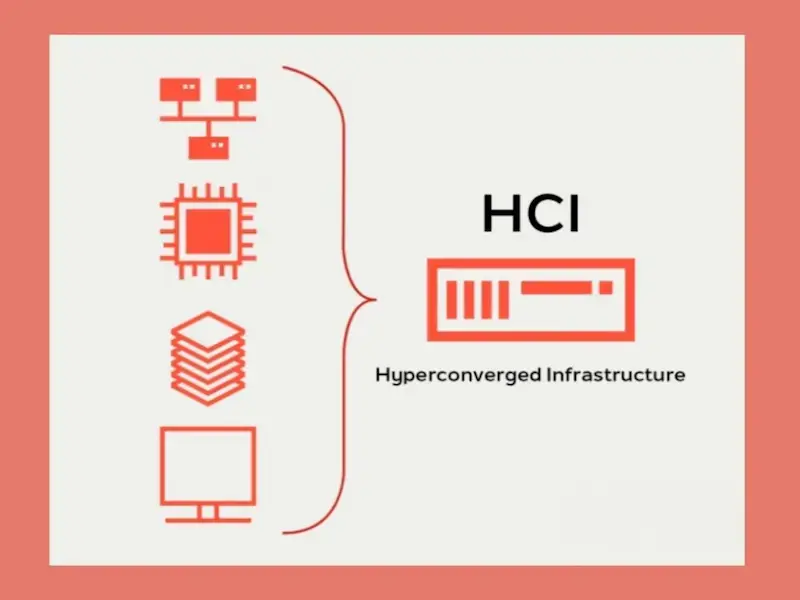
  • Hyper-converged infrastructure integrates compute, storage, and networking into a single system, simplifying data centre management.
  • This solution improves scalability, reduces costs, and enhances efficiency through automation and virtualisation.

Hyper-converged infrastructure (HCI) is a software-driven solution that consolidates compute, storage, and networking into a cohesive, virtualised platform. Traditional data centres often rely on disparate hardware components, leading to complexity in management and scaling. In contrast, HCI leverages software to pool these resources, enabling IT teams to manage them centrally through a unified interface. This integration simplifies infrastructure management and ensures consistent performance across different workloads.

Advantages of hyper-converged infrastructure

The primary benefit of HCI is its flexibility. Organisations can scale their resources up or down depending on demand, without the need for additional hardware investments. This scalability is particularly beneficial for businesses with fluctuating workloads or those operating in dynamic industries. Additionally, HCI enhances operational efficiency by automating many routine tasks, such as provisioning and resource allocation. This not only reduces the workload on IT staff but also decreases operational costs. Security and disaster recovery are also improved, as HCI can automatically create backups and restore systems with minimal downtime.

Also read: What is security vulnerability management?

Also read: What is automated test equipment?

The future of hyper-converged infrastructure

The rise of hybrid and multi-cloud environments is likely to drive further adoption of HCI, as it can seamlessly integrate with cloud solutions to deliver a unified infrastructure. As organisations seek more agile and scalable systems, HCI will play a crucial role in bridging the gap between on-premises and cloud environments. Furthermore, with ongoing advancements in artificial intelligence and machine learning, HCI systems are expected to become more intelligent, optimising resource allocation in real-time and predicting system failures before they occur. This next generation of HCI will not only enhance IT infrastructure but will also play a key role in digital transformation efforts across industries.

Core Entity Brief

  • Entity: What is hyper-converged infrastructure?
  • Subject Type: Internet infrastructure institution
  • Region: Global
  • Classification: Institution Type

Service Surface / Control Surface

  • Public records support monitoring of governance, service, and infrastructure control surfaces.

Governance and Policy Surface

  • Public-source signals support medium-impact monitoring for infrastructure visibility and dependency analysis.
  • Operational criticality: Medium
  • Time horizon: Quarter (30-120d)

Decision Trigger Matrix

  • Monitoring focuses on verified service continuity, governance changes, and relationship signals.
NowMedium priority

Current state favours active tracking due to infrastructure relevance.

QuarterMedium policy sensitivity

Public-source signals support medium-impact monitoring for infrastructure visibility and dependency analysis.

YearQuarter (30-120d) continuity dependency

Long-cycle infrastructure decisions likely to remain path-dependent.

Member Unlock

Restricted Profile Intelligence

Login is required to unlock full profile briefings and deep-dive sections.

Only for Strategy Circle

Strategic Circle Access

Open to all readers. Unlock profile briefings after joining and logging in.

Join Strategic Circle

Only for Leadership Alliance

Leadership Alliance Access

For owners and management of IP-holding companies. Login required to unlock.

Join Leadership Alliance
← BackAll Companies