
Summary
- In a representative internal carrying task, Wetour says its vision-only pipeline failed to locate the hand in 21.8% of frames and had a longest continuous dropout of 4.32 seconds. Those are camera observations, not combined-system recovery results.
- The on-device model produced 20 joint angles and processed a one-second sEMG window in 50.4 milliseconds with zero lookahead. Wetour explicitly says that figure is model-processing time, not end-to-end latency.
- The force-estimation pipeline was validated end to end on synthetic data. Validation with live wristband force recordings, and the cross-modal correction strategy itself, remain under development.
- An August prospectus permits up to US$75 million of at-the-market share sales. It establishes financing capacity, not a sale, cash receipt or proof that Orchestra is commercially ready.
The 21.8% gap belongs to the camera
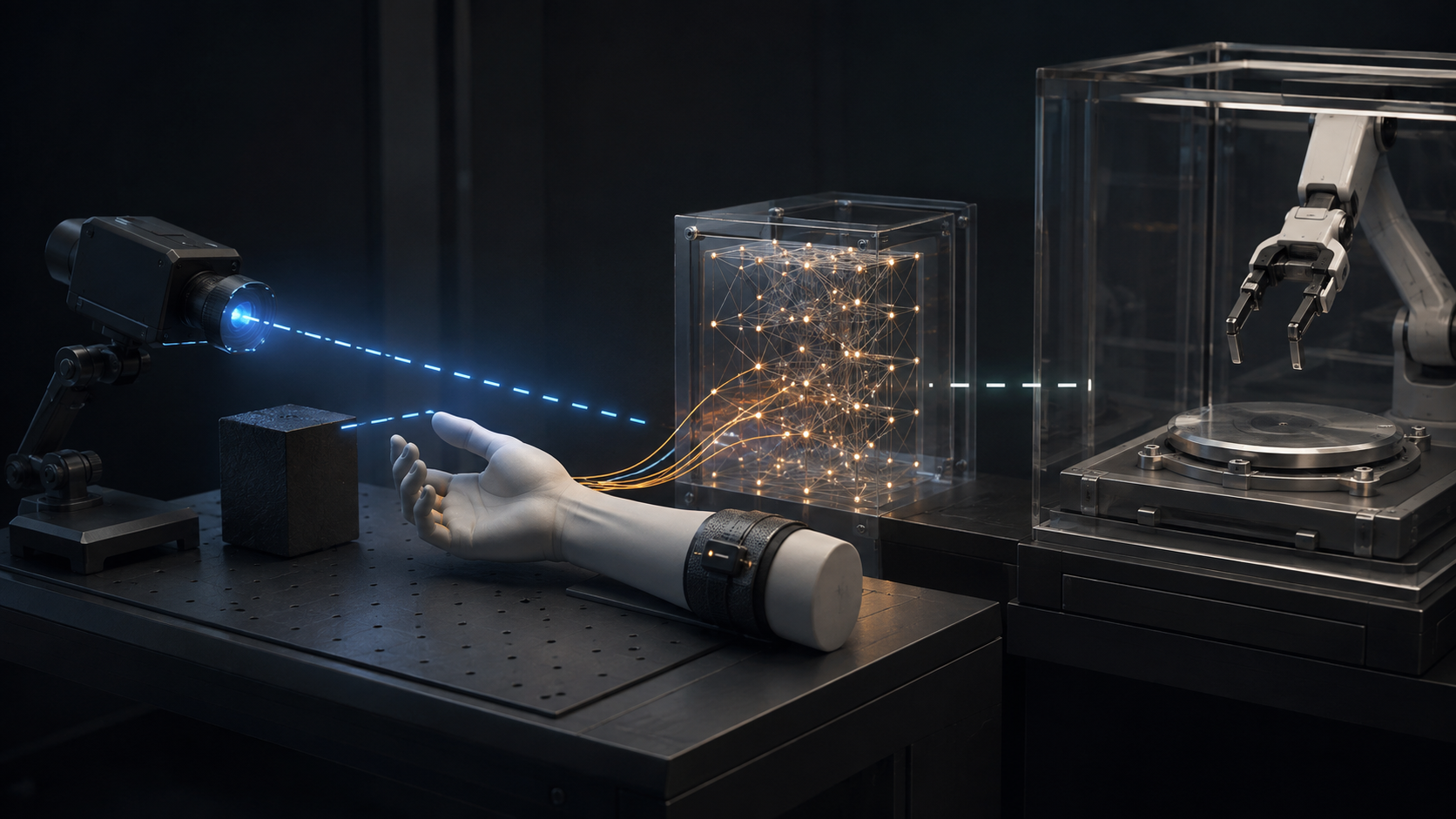
Wetour's 4 September Form 6-K furnishes a company press release dated 1 September. In that development-demonstration release, Orchestra is described as a local fusion architecture for two inputs. Conductor is an eight-channel surface-electromyography wristband; VisionLink is a first-person camera. Vision supplies position and scene context. The wristband is meant to add muscle activity when the hand is hidden and potentially before motion becomes visible.
The release then reports a striking number: in what Wetour calls a representative internal carrying task, the vision-only pipeline failed to locate the hand in 21.8% of frames. The longest uninterrupted miss lasted 4.32 seconds. This identifies the problem the second sensor is supposed to solve. It does not measure the solution.
Wetour says the architecture is designed to use sEMG during those missing visual intervals, but adds that the cross-modal correction strategy remains in validation. No recovered-frame denominator follows. The release does not say how many of the missed frames received usable muscle-derived estimates, whether position remained accurate through the 4.32-second gap, or whether a fused output was better than another visual baseline. Reading 21.8% as an achieved recovery rate would move a number from one system state into another without evidence.
Fifty milliseconds begins after a one-second window exists
A second measurement concerns a different component. The current on-device model outputs 20 joint angles. In an internal benchmark, processing one second of sEMG input took 50.4 milliseconds with zero lookahead. The release immediately limits the number: it is model-processing time, not end-to-end system latency.
That boundary matters. A live loop must first collect the observation window, sample and condition the muscle signal, align it with images, perform fusion, label or infer an action and deliver the result to whatever consumes it. The release does not report those stages as one latency measurement. “Zero lookahead” says the model does not require future samples beyond its defined window; it does not erase the one second of history in that window or make the whole system respond in 50.4 milliseconds.
The result is still informative. It shows that a stated model workload ran locally within a fraction of its input-window duration. It does not show time from physical muscle activation to a robot-ready command, nor does it establish sustained performance on a production device.
Synthetic force can test plumbing without testing a wearer
The most important qualification appears in Wetour's force claim. The pipeline is designed to convert sEMG into scale-calibrated, kilogram-equivalent grasp-force estimates. Calibration uses a scale as a reference and is fitted to the wearer and wearing session. That last detail signals why live evidence is harder: muscle signals vary across bodies, sensor placement, skin contact, fatigue and repeated donning.
Wetour says the force-estimation pipeline has been validated end to end on synthetic data. It then says validation with live wristband force recordings remains under development. “End to end” therefore describes the extent of the pipeline exercised, not the biological realism of the input. Synthetic data can verify that the stages connect, accept expected formats and produce outputs. It cannot by itself establish that live readings map to real force with an acceptable error distribution.
The missing public receipt is not merely a video of motion. It is a paired live test: the wristband signal, force ground truth from a scale or instrument, wearer- and session-specific calibration, held-out trials and errors across tasks. The release supplies no mean or tail error, no number of wearers, trials or frames, no synchronization drift and no comparison with a simpler baseline.
Five tasks are examples, not a benchmark population
The demonstration covers packing a lunch box, sorting pills, disassembling a pen, measuring a drone with calipers and installing a drone propeller. These are sensible examples because they mix occlusion, precision and changing effort. They show the intended problem space. They do not reveal the size of the dataset behind the disclosed percentages.
The filing does not state whether the five tasks involved one wearer or many, one session or repeated sessions, staged lighting or varied environments. It provides no independent reviewer, external test protocol, customer acceptance, commercial availability, deployment or revenue for Orchestra. That is not proof that the system fails. It locates the current evidence on a development ladder: architecture, internal component observations and synthetic pipeline validation are visible; live paired-sensor accuracy, quantified correction and external reproduction are not yet visible.
Financing capacity is a separate state machine
Wetour also has a capital-market clock. Its 26 August prospectus supplement permits the company to offer and sell ordinary shares with an aggregate offering price of up to US$75 million through or to Rodman & Renshaw. The agent is not required to sell a specific amount, Wetour may suspend sales and actual proceeds depend on future transactions and market conditions. Commission can be as high as 3% of gross sales.
The ceiling is not a cash balance. The prospectus says the actual total offering price, commissions and net proceeds were not determinable when filed. Nor do the sources establish that the product demonstration was timed to support share sales. The appropriate link is analytical, not causal: when a development-stage company can raise capital through the market, investors need unusually clean separation between an internal technical observation, a validation result, a commercial milestone and cash actually received.
The next receipt should join the streams without joining the claims
The useful next disclosure would keep denominators visible. For vision, it would report how many missing frames the fused system recovered and with what position or action error. For force, it would publish live paired ground truth, calibration protocol, wearer and session counts, central and tail errors, and failure cases. For latency, it would measure the complete path rather than one model stage. For financing, it would report executed sales and net proceeds rather than restating capacity.
Orchestra may prove that muscle sensing adds information a camera cannot see. The current filing does not establish that result. It establishes a plausible architecture, a quantified camera problem, a bounded processing observation and a synthetic pipeline test. Keeping those receipts separate is not skepticism about the technology. It is the condition for knowing when the technology has crossed from a demonstration into dependable training data.
Sources
Member Briefing
Deeper Profile Context
Sign in with the right membership level to unlock the full briefing and source notes.
Only for Strategic Circle
Strategic Circle
Open to all readers. Unlock profile briefings after joining and signing in.
Join Strategic CircleOnly for Leadership Alliance
Leadership Alliance
For qualified IP-asset owners and management; sign in to unlock alliance briefings.
Join Leadership Alliance