
Summary
- What it says: WestCall is no longer the Russian conglomerate of yesterday. Now a Moscow-based subsidiary of VimpelCom, it survives in fixed-line telecoms by betting on building access, enterprise services, and a precise niche in the local loop economy.
- Main topic: Network-resource evidence
- Context: Infrastructure / Company research / Russia
The company that remains after the break-up of the WestCall group is easier to misunderstand if you only look at the brand. Historically, "WestCall" was not just a Moscow access operator. It was a broader Russian telecom group that had established itself in Moscow, Saint Petersburg, Ryazan, Samara and other cities, and at its peak, it looked like one of the classic post-incumbent Russian alternative operators: local fibre, enterprise telephony, broadband and a patchwork of urban assets accumulated over time. In 2012, the group's revenue was ₽4.2 billion and the group reported 228,000 residential broadband subscribers.
By August 2020, however, public reports describe WestCall as operating only in Moscow, after Saint Petersburg went to ER-Telecom and the AIST structure in Samara to Rostelecom. That is the first fact that matters commercially: today's WestCall is not the former conglomerate. It is the surviving Moscow economic core.
The chronology is particularly revealing. Russia Partners II bought 62.96% of ZAO "West Call Ltd" in 2007, at a time when the sector still rewarded regional assembly and operational leverage. In 2016, ER-Telecom acquired 100% of WestCall SPb and associated assets in Ryazan for around ₽3.87 billion, while Rostelecom bought AIST in Samara for ₽1.42 billion. In 2020, VimpelCom acquired 100% of OOO "West Call Ltd" in Moscow, with market estimates valuing the transaction between ₽1.5 and ₽2 billion.
This sequence is important because it shows the asset at different stages of revaluation: first as a regional consolidator, then as a collection of municipal assets, and finally as a Moscow enterprise access operator valuable enough to be absorbed by a national historical mobile operator.
The current legal identity is clear in public registries. WestCall's official site identifies the operating company as OOO "VEST KOLL LTD", with INN 7702388235 and OGRN 1157746738742. The RBC registry page lists the same legal entity, indicates its Moscow address, mentions PAO "Vimpel-Communications" as the sole founder, and reports 205 employees. It also shows that the company remained financially active in 2025, with revenue of ₽1.557 billion and a net profit of ₽284.5 million. This is not the profile of a dead brand maintained for historical billing.
It is a living operational subsidiary, or at minimum an active operational shell with significant revenue flowing through it.
An underestimated clue is the brand itself. The "ВЕСТКОЛЛ WESTCALL" trademark was registered in October 2021, after VimpelCom had already acquired the company in 2020. This strongly suggests that the new owner did not buy WestCall simply to migrate customers and retire the name. It kept the label. In telecoms, maintaining a brand after an acquisition usually means one of three things: the acquired company has a useful channel into a specific customer segment, it has a commercial culture that the buyer does not want to dilute, or the buyer wants to preserve an option while slowly integrating operations.
WestCall's current product assortment and commercial footprint suggest that all three reasons could be true.
This makes the central question more interesting than "how does a small operator survive?" WestCall did not survive by staying small and pure. It survived by becoming specific. It appears to have abandoned the geography that made it look like a mini-federal operator to refocus on the dense, permission-requiring, relationship-heavy part of Russian fixed telecoms: Moscow buildings, enterprise connectivity, telephony, operator interconnection and the adjacent services that rely on the local loop.
This is not glamorous, but it is exactly where a non-incumbent operator can still have bargaining power if it controls access to the riser, the number block, the customer relationship and operational responsiveness. Public traces still point toward this model.
What WestCall actually sells The official site looks less like that of a consumer ISP and more like a connectivity toolbox for offices. WestCall's home page highlights professional Internet, DDoS protection, IP telephony, corporate mobile, virtual PBX, video surveillance, and cloud services. Its service pages add professional Internet up to 10 Gbit/s, Wi‑Fi, redundant connectivity, 8‑800 numbers, direct 495/499 numbers, hosting and VDS, IT support, electronic document management and targeted offers for government entities and small businesses. In other words, WestCall does not primarily sell "Internet" as a commodity.
It sells a managed communications stack to businesses that want a single provider to run the office.
Pricing clues reinforce this interpretation. WestCall markets DDoS protection from ₽3,000 per month, corporate mobile from ₽300 per month, virtual PBX from ₽150 per month on its home page, and VDS from ₽500 per month on the cloud page. The virtual PBX tariff page advertises packages at ₽1,000 and ₽1,790 with 5 and 10 extensions included respectively, while direct 495/499 numbers are marketed from ₽250 per month. These are not high amounts, but that is precisely the point. Once a customer is on the network, the operator does not need each layer to generate a standalone gross margin.
It can let the local access line do the heavy lifting, then add small monthly services that increase retention, raise the average revenue per connection and make defection more painful.
A concrete public contract shows what this looks like in practice. A 2025 telecom services contract with the Moscow State Academy of Veterinary Medicine and Biotechnology designates WestCall as the operator of a dedicated Internet line up to 153,600 kbit/s, with unlimited traffic and ten fixed IP addresses, priced at ₽24,400 per month including VAT. The same contract template also shows that WestCall was operating under a set of telecom licenses covering intrazonal telephony, local telephony, data transmission, telematic services and voice-over-data services.
This is useful because it pulls the economics out of marketing talk and into a real customer context: WestCall monetizes a dedicated line not simply as bandwidth, but as a bundle of guaranteed connectivity, address space and institutional service assurance.
This type of contract also helps understand why enterprise access is economically different from consumer access. A household buys throughput and complains when it drops. A university department, a clinic, an office tower tenant or a subcontracting firm buys continuity, fixed IPs, accessibility to internal systems, telephone numbers and someone to answer when a circuit goes down. The circuit price therefore reflects a different demand curve. A residential customer will compare 300, 400 and 500 rubles.
A business customer that depends on remote workstations, SIP trunks and building access control may care more about outage response time, routability and the operator's ability to deliver an address block or connect a backup line to the office with minimal delay. WestCall's public offering is designed for that buyer, not for the bargain-hunting residential subscriber.
The company's pages aimed at other operators make the same point on the wholesale side. WestCall announces that it provides interconnection and voice traffic transit at the local and zonal levels with numbers in the Moscow area codes 495, 499 and 498. Its "new operators" page goes further by offering "more than 2,000 km" of fibre in Moscow and the Moscow region, its own numbering resources in 495, 499, 498 and 812, and a modern telecom platform to operators using its network as a launchpad. Economically, this means that WestCall is not simply a reseller of access to end-user businesses.
It also understands its network as an enabling platform for smaller operators and voice service providers that do not want to build a local presence from scratch.
The real commercial advantage of these businesses is not the cable itself. It is the right to monetize several services over the same cable. If the operator can enter a building once, it can then sell the main Internet, backup Internet, SIP trunks, cloud PBX, urban numbers, 8‑800, video surveillance connection, guest Wi‑Fi authentication, colocation, hosting, IT support and sometimes mobile-FMC convergence. WestCall's pages show precisely this logic. A company that looked like "just a local ISP" twenty years ago today reads more like a bundled provider of office infrastructure.
That is why the business survives between larger infrastructures: the margin does not lie solely in brute transit arbitrage. It lies in the local connection.
A consumer shadow persists around the brand, but it appears secondary. WestCall retains a page for "individuals", and comparison portals still list historical residential tariffs and user comments. Yet a Moscow comparison site currently indicates that no tariffs are available in the region, while WestCall's active site heavily and overwhelmingly highlights professional Internet first. This looks like a residual residential presence or a legacy page architecture rather than a consumer growth engine. The company may still serve households in some buildings. But the current commercial centre of gravity is clearly enterprise services.
The building is the franchise For a Russian alternative fixed-line operator, the scarce asset is often not spectrum, backbone or brand. It is permission. More precisely, it is the right to enter a building, to pull fibre to the basement and the riser, to place equipment, to consume electricity, to maintain access and to sign up subscribers before someone else gets there first. WestCall has been telling this story for years.
As early as 2007, it described itself in the real estate press as offering property developers and investors telecom solutions for commercial and residential real estate, including communications services, consulting, investment in construction and management of the property's telecom infrastructure. This narrative is important because it positions the operator not as a passive service provider, but as a co-builder of the building's internal communications asset.
The company's historical growth metrics also read like indicators of real estate economics rather than generic telecom growth. Presenting its 2007 results, WestCall indicated that the total area of connected commercial real estate added in Moscow and Saint Petersburg exceeded 1.5 million square metres, while its fibre optic network length doubled. These are the statistics of a local loop franchisee. The operator was not simply buying Internet customers one by one; it was accumulating addressable floorspace. Once a building is connected, each tenant becomes an additional sales opportunity.
This is why urban operators so ardently court commercial real estate: the building compresses customer acquisition cost, concentrates demand, and creates ongoing dependence on whoever controls the first working active cable.
Current recruitment reinforces the same idea. WestCall's job postings explicitly mention seeking and attracting new customers at its commercial real estate sites, including tenants, and other separate job offers mention establishing partnerships in the commercial real estate segment — business centres, shopping centres, co‑working spaces and management companies. This is evidence of unusual frankness about the origin of distribution, according to the company. It does not win market share through television advertising or SIM card shops. It works with the owner, the management company and the rental ecosystem.
In its world, the sales funnel begins with the real estate relationship.
The residential side of this story is rougher, and that roughness is economically revealing. Old press articles and Saint Petersburg forums show exactly the kind of friction that defines this market: cable cuts, conflicts with housing management companies and physical exclusion from buildings. CNews reported in 2007 deliberate damage to home network infrastructure in a Saint Petersburg district. A later corporate profile page retaining references to Delovoy Peterburg indicates that WestCall and other operators were disconnected from electrical networks in hundreds of housing units during a conflict with a housing office.
These episodes are old, but they explain the economics of the sector. Fixed access in Russian cities has never been simply "pass the homes and connect subscribers". It was a permanent struggle for physical access, tolerated equipment and local power supply.
This is important because it turns "market share" into something hyperlocal. In residential markets, the operator that has effective legal and physical access to the building can behave like a small monopolist, even if three large national players exist elsewhere on the map. Customer reviews sometimes describe exactly this condition. A Moscow review says that WestCall was effectively a monopolist in its building and could not be recommended despite weak support and unstable throughput, because there was no practical alternative.
A Saint Petersburg review complains that the operator and a single competitor were the only real choices available through the building's management, and an external IP cost extra. These are anecdotal, unaudited data, but they are commercially useful: they show that the last hundred metres determine bargaining power.
The lesson for the general public is simple and brutal. If you are the only operator with significant access to a given building, you can recover installation costs, impose ancillary fees and survive with mediocre support longer than a competitive textbook would suggest. If a second competent operator gets the same access, your weakness is exposed almost immediately because residential churn is ruthless and throughput is easy to compare. This is why building relationships matter more than brand slogans, and why alternative access operators spend so much energy on property managers.
WestCall's very service design, recruitment profile and historical real estate market narrative imply that it understands this better than most.
There is a second version of the same economic logic in commercial real estate. A business centre tenant does not want to negotiate with five different providers for Internet, telephony, guest Wi‑Fi, video surveillance connection and emergency failover. The owner wants one operator, or at least a lead integrator, that can make the building "ready". WestCall's product menu — Internet, telephony, Wi‑Fi, surveillance, cloud and system integration — is exactly what this demand produces on the landlord side. In other words: WestCall's real product is not broadband. It is the pre-installed communications optionality in a building.
Broadband is only the visible part of the bill.
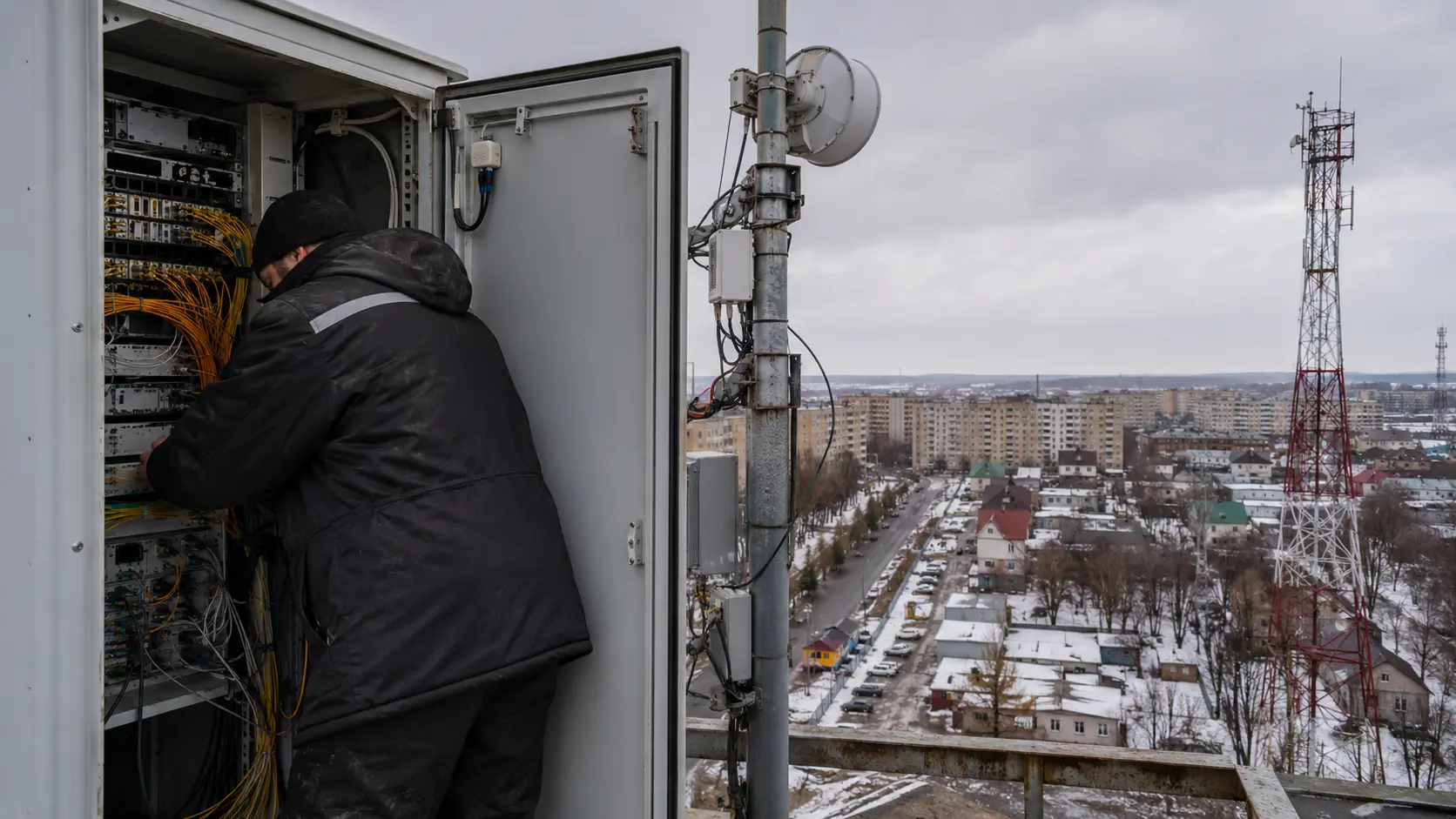
A real network leaves public traces The most useful thing about telecoms is that real operators leave technical residues. If WestCall were today nothing more than a commercial front or a billing shell, the routing footprint would look thin, obsolete or borrowed. That is not the case. RIPEstat identifies AS8595 as WESTCALL-AS, holder OOO WestCall Ltd, allocated in December 1997. Lookups in the RIPE database for WestCall-addressed resources show the organisation entity ORG-WL4-RIPE and WestCall's responsibility for specific IPv4 ranges.
This is direct evidence from network resources that the company still owns and manages real Internet numbering resources, not just a brochure.
Peering and routing visibility strengthens the case. PeeringDB lists AS8595 under WEST CALL LTD with the sitehttps://westcall.ru, the IRR set AS-WESTCALL-MSK, and public peering presence visible at the MSK‑IX Moscow and PITER‑IX nodes in Frankfurt and Helsinki. Hurricane Electric BGP data also observes AS8595 at Global‑IX in Amsterdam, MSK‑IX Moscow and PITER‑IX Moscow as well. BGP.tools describes AS8595 as a 28-year-old network with 103 peers and 4 upstream operators; BGP.he.net reports 83 observed peers and five Internet exchange points. These are significant numbers. They indicate that WestCall still operates an active, multi-homed network with external peering.
This has economic consequences. MSK‑IX itself describes its purpose as helping companies develop networks and services faster and at lower cost by giving access to an exchange platform and associated infrastructure. For an operator selling Internet, voice, cloud access and video, this matters in the most prosaic way: peering reduces paid transit, lowers latency and makes quality less hostage to a single upstream operator. If WestCall can settle a larger share of its traffic locally or at the exchange points it already reaches, it improves the gross margin on every customer connection that would otherwise consume costly external transit.
This advantage is rarely visible on the retail tariff page, but it is one of the quiet reasons why independent operators remain viable.
The presence at European exchange points is particularly interesting. The current self-reported PeeringDB registration shows two 50G ports at PITER‑IX in Frankfurt and Helsinki and a 20G port at MSK‑IX Moscow, while BGP.he.net observes AS8595 at Global‑IX Amsterdam. This does not automatically mean that WestCall is itself a major international operator; PeeringDB can lag reality and some exchange point registrations are self-managed. But even with that caveat, the overlap between self-reported and routing-observed presence suggests a network that still values cross-border peering options.
In sanctions-era Russia, this matters not only for cheaper traffic, but for path diversity and quality of service toward international resources still relevant for professional customers.
Public routing history also suggests that WestCall is not purely an end-customer network. BGP.tools shows smaller AS numbers such as AS47925, AS208047 and AS50713 using AS8595 as upstream or peer, and AS50713 explicitly displaying both WestCall and VimpelCom as upstream. This indicates at least a wholesale or quasi-wholesale role. In the local loop economy, this is important because an operator that can sell to other operators extracts more value from the same metropolitan fibre and exchange point presence. Wholesale is not always glamorous revenue, but it stabilises utilisation and makes the physical network more productive.
There is, however, a sceptical detail in the same routing data. BGP.he.net reports that AS8595 announces more than a hundred prefixes but only three "RPKI originated valid" entities in the visible summary, while RIPEstat pages for some WestCall prefixes indicate "UNKNOWN" because they are covered by no VRP. This does not mean the network is dangerous or poorly managed. Many competent operators still have partial RPKI deployment. But it suggests a network whose operational hygiene is real rather than fashionable: clearly maintained, clearly peered, but not necessarily rebuilt around the latest paperwork and automation standards.
This is consistent with a business optimised for continuity and local monetisation, not for public Internet prestige.
Another small clue is the route inventory itself. BGP.tools shows that AS8595 announces numerous IPv4 ranges labelled WestCall and, interestingly, at least one block described as PJSC VimpelCom, which is consistent with some degree of post-acquisition integration. This is probably the right way to think about WestCall today: not as a fully independent island, but as a still-distinct metropolitan network and business unit whose economics are increasingly shaped by a much larger parent. The routing traces prove both halves of that sentence. The AS is real. The independence is relative.
Sanctions have made engineering a balance-sheet problem If this were only a story of fibre in basements, WestCall's survival would be simple. But it is not. Russian fixed-line operators entered the sanctions era with infrastructures built on years of mixed vendor dependency. WestCall's historical public profile and later job listings clearly show the contours.
Old company descriptions associated the broader WestCall story with equipment from Ericsson, Avaya, NEC, Harris and Cisco, while current engineering positions still require competence on Cisco and Juniper core network equipment as well as technical support familiar with Cisco routers and switches. This means the company's economic problem is not simply whether it can sell new access lines; it is whether it can maintain, replace and integrate a heterogeneous fleet of foreign vendors under sanctions pressure and gappy supply.
This problem became much harder after 2022. Reuters reported that Ericsson suspended its activities in Russia in April 2022 and later sold its customer support operation in Russia, while Nokia said it would cease operations in Russia and exit the market. Reuters also reported in December 2022 that Russian operators faced a risk of constant deterioration with the departure of Nokia and Ericsson.
These articles focused largely on mobile networks, but the broader implication extends to fixed-line telecoms: support contracts vanish, certified parts are harder to find, software updates become politically and logistically complicated, and renewal cycles become accounting choices rather than engineering choices.
For a metropolitan operator like WestCall, this is where capex, opex and resilience meet. A national incumbent can spread the pain over millions of subscribers, internal repair chains and large purchase volumes. A local or sub-scale fixed-line operator cannot. It can still run old Cisco, Juniper or voice platforms for years, but every deferred replacement becomes a latent liability on the balance sheet. Every port that can no longer be extended at low cost, every chassis kept alive by grey-market parts, every software image harder to patch ends up increasing the marginal cost of growth.
In these conditions, the rational response is often not aggressive expansion into new neighbourhoods. It is denser monetisation of already-connected buildings with higher-margin services. WestCall's visible product assortment looks exactly like that response.
This is one reason why the cloud, PBX and managed service layers matter so much. A company that can no longer count on cheap, abundant, vendor-supported operator equipment must extract more revenue from every safely operational access port it already controls. Selling a second fixed line in a building is an investment job. Selling another 8‑800 number, another hosted PBX seat, another surveillance stream, another VDS tier or a monthly DDoS service is mostly a sales job. When equipment constraints tighten, work and sales discipline becomes relatively more important than heroic network expansion.
WestCall's pages on IT support, system integration, electronic document exchange and business automation naturally fit into this sanctions-era logic.
There are also compliance costs that hit smaller voice-focused operators harder than outside observers sometimes think. Public information on the Russian anti-fraud regime shows that Roskomnadzor and prosecutors have gone after operators that failed to connect to the anti-fraud system, with ComNews and TAdviser identifying WestCall among the Saint Petersburg cases. The precise legal relationship between those references and the present Moscow LLC is not perfectly clear from public extracts alone, so one must not overstate it. Nevertheless, the episode is economically important.
Voice services now bear not only the cost of interconnection and numbering administration, but also the compliance cost, the integration burden and significant inconvenience if the operator lags behind state-mandated systems. Small and medium-sized operators feel this burden far more acutely than national groups.
Customer complaints in the WestCall ecosystem also hint at the operational tension that equipment transitions can create. A Saint Petersburg review complains of repeated outages and indicates that the company itself said it was changing equipment and expected the disruption to continue. Another Moscow review complains of unstable speeds and support that did not work at night. These anecdotes do not prove systemic failure, and review platforms are noisy. But they match the broader pattern: in fixed-line telecoms, equipment renewal is not a smooth abstraction.
It becomes visible to customers as speed jitter, queues, unavailability windows and longer restoration times. This is where sanctions, vendor dependency and attrition meet.
The paradox is that sanctions might actually strengthen the case for some local operators, even if they weaken their engineering comfort. If multinational vendors withdraw and the supply chain becomes more difficult, the large incumbents become even more dominant in national infrastructure. But local operators with well-established building access rights, historical customer relationships and functional legacy networks can still survive because customers do not want the disruption of a switch, and because the operator can keep extracting value from already-installed assets.
Sanctions, then, do not automatically eliminate the regional alternative. They make it more conservative, more service-focused and more dependent on the established local franchise. WestCall's public evidence closely matches this pattern.
The ownership change altered the economics more than the logo The simplest way to think about the VimpelCom acquisition in 2020 is as a pure consolidation play. That is correct, but incomplete. Yes, VimpelCom wanted fixed assets and business customers in Moscow. The company said so through the transaction logic, and analysts noted that fixed connectivity offers a clearer path to B2B revenue growth than the mass segment. CNews at the time described WestCall as serving 10,000 business customers in Moscow, with 2019 revenue of ₽1 billion and a net profit of only ₽4.65 million.
ComNews reported transaction estimates around ₽1.5–1.7 billion, while CNews cited an external valuation around ₽2 billion. On those numbers, VimpelCom did not buy WestCall as a high-margin compounder. It bought access, customers and a position.
The most interesting part is what happened next. By 2025, public registry pages show WestCall revenue of ₽1.557 billion and net profit of ₽284.5 million, with gross profit above ₽590 million. These numbers are markedly stronger than the pre-acquisition profitability profile. There are at least three plausible explanations, and the public evidence cannot cleanly discriminate among them. One is that the business mix improved: more enterprise services, less low-margin exposure, better monetisation of the connected base. Another is that being inside VimpelCom improved purchasing, upstream access and capital discipline.
A third is that intra-group accounting, cost allocations or asset transfers changed where the profit sits. The cautious conclusion is not that WestCall suddenly became a miracle operator. It is that the ownership change materially shifted the economics, without public data showing exactly how.
The continued existence of the brand suggests that WestCall has retained commercial usefulness inside the parent. The 2021 trademark registration, the still-active website, the visible AS8595 network and the WestCall-branded sales pages all point in the same direction. VimpelCom appears to have kept WestCall as a specialised vehicle rather than instantly flattening it under the Beeline fixed-access brand. This may be because WestCall still speaks more naturally to SMEs, office managers and real-estate-linked buyers than a consumer mobile brand would.
It may also be because the Moscow B2B fixed-access market still rewards small-business sales behaviours — direct contact, flexible packaging, building-level knowledge — that large consumer-facing operators often struggle to replicate.
There are hints that this niche is as social as it is technical. Employee review sites describe WestCall as a fast company with little bureaucracy and a strong B2B niche in Moscow; job pages show active hiring in support, planning, ERP 1C development and real-estate-tied sales. This does not prove cultural excellence, and employee reviews are as noisy as customer reviews. But it is consistent with a specialised operator acting more like a compact service organisation than a giant national operator department. For a local loop business, that can be an advantage.
The person who knows which building manager actually answers the phone is often worth more than a national advertising campaign.
The "state-customer" angle also matters. Checko shows more than 200 government contracts in the aggregated public procurement data, and published individual contracts show WestCall providing dedicated Internet access to a Moscow higher education institution. WestCall also markets directly to government entities on its own site. Government and para-public contracts are not necessarily high-margin business — public auctions can be brutally competitive — but they help stabilise revenue, utilise network assets and reinforce the operator's identity as an approved, service-capable professional provider rather than a pure retail ISP.
In a market where customer acquisition can be local and political, these references matter.
So who depends on WestCall today? The public record suggests several overlapping groups. One is the SME and mid-market office customer that wants a single point of contact for Internet, telephony and office communications. Another is the commercial real estate ecosystem — developers, management companies, business centres and tenants — where building access is itself a monetisable permit. A third is the small operator or specialist carrier that buys interconnection or upstream connectivity to Moscow numbering and metropolitan infrastructure.
A fourth is the parent group, which can use WestCall as a distinct channel to B2B fixed segments that do not naturally fit into the Beeline consumer machine. This is a far more durable recipe for survival than an "independent regional ISP". It is narrow, but it is real.
What the public record still cannot answer is as important as what it shows. It does not detail revenue by service line. It does not reveal customer concentration. It does not tell us how many business centre relationships WestCall controls under exclusive terms, how much of its network capex is now funded or guaranteed by the parent, or what share of the visible international peering infrastructure is fully active versus partly historical. It does not show attrition, failure rates or the split of revenue from voice versus access versus cloud. For a serious commercial due diligence process, these items would be central.
But the existing evidence is already enough to make a solid judgement: WestCall survives because it holds rare local permissions and wraps multiple service revenues around them; it does not survive because basic broadband is a bargain.
Evidence register Official site and service pages of WestCall URL:https://westcall.ru/URL:https://westcall.ru/service/svyaz-i-internet/URL:https://westcall.ru/service/svyaz-i-internet/internet-for-business/Source type: Company website. What it supports: WestCall’s current commercial self-presentation is centred on professional Internet, DDoS protection, telephony, virtual PBX, mobile, cloud, surveillance and adjacent managed services. What it does not prove: It does not prove customer volumes, realised prices, margins or quality of service. Why it is economically important: It shows where management is trying to earn revenue today: bundled office communications rather than pure residential access.
WestCall pages aimed at other operators URL:https://westcall.ru/operators/URL:https://westcall.ru/new-operators/Source type: Company website, wholesale/interconnection pages. What it supports: WestCall markets interconnection, local and zonal voice transit, numbers in 495/499/498, and claims more than 2,000 km of fibre in Moscow and the region. What it does not prove: It does not independently verify route volumes, actual bilateral agreements or the current full network length. Why it is economically important: It shows that WestCall monetises network assets not only at retail but also as a platform for other operators, which improves asset utilisation.
WestCall's pricing and adjacent services pages URL:https://westcall.ru/cloud-service/URL:https://westcall.ru/service/svyaz-i-internet/ip-telefoniya/atc/tarify/URL:https://westcall.ru/service/svyaz-i-internet/ip-telefoniya/ustanovka/Source type: Company website, tariff pages. What it supports: VDS from ₽500 per month, PBX packages from ₽1,000/₽1,790, urban numbers from ₽250 per month, and other low-cost add-on services layered on top of connectivity. What it does not prove: It does not show attach rates or whether these prices are representative of final negotiated enterprise contracts. Why it is economically important: These pages show how a local loop operator increases ARPU and reduces attrition through small captive services attached to an on-net customer.
WestCall notifications page URL:https://westcall.ru/uvedomleniya/Source type: Company website, customer notices. What it supports: WestCall publicly informed its customers that starting 1 March 2026, IP address service would be billed separately. What it does not prove: It does not show the total revenue impact or the number of customers affected. Why it is economically important: Separate billing for IP resources is a modest but telling sign of more explicit monetisation of scarce technical inputs in a mature customer base.
RBC registry page for OOO "VEST KOLL LTD" URL:https://companies.rbc.ru/id/1157746738742-ooo-obschestvo-s-ogranichennoj-otvetstvennostyu-vest-koll-ltd/Source type: Company registry aggregator using corporate registry data. What it supports: Sole ownership by PAO "Vimpel-Communications", 205 employees, and 2025 revenue/profit figures. What it does not prove: It does not provide segment revenue, transfer pricing detail or operating cash flow quality. Why it is economically important: It anchors the post‑acquisition financial profile and shows that WestCall remains a living operational economic unit within the parent group.
Checko and Audit-It registry pages URL:https://checko.ru/company/vest-koll-ltd-1157746738742URL:https://www.audit-it.ru/contragent/1157746738742_ooo-vest-koll-ltdSource type: Russian registry and financial data aggregators. What it supports: 2025 revenue/profit, participation in public procurement, number of licences, and long corporate history. What it does not prove: It does not resolve exactly how profits are generated by service category or the extent to which they are organic or group‑influenced. Why it is economically important: It corroborates that the company is neither dormant nor purely nominal and that it participates in institutional telecoms provision.
Roskomnadzor licence page and public contract text URL:https://rkn.gov.ru/communication/register/license/?id=%D0%9B030-00114-77/00057735URL:https://mgavm.ru/sveden/files/viz/Provaider_1_VEST_KOLL_LTD_(Rezervnyi_kanal)(1).pdfSource type: Regulator registry and published customer contract PDF. What it supports: WestCall holds telecom licences and publicly contracts for local telephony, intrazonal telephony, data transmission, telematic services and voice‑data services; the 2025 contract also shows an example of a real dedicated Internet tariff. What it does not prove: It does not prove national scope nor reveal the current full licence status across all categories without direct registry verification. Why it is economically important: The licence breadth is essential to bundle voice and data revenues, and the contract offers a concrete glimpse of enterprise line monetisation.
RIPEstat and RIPE database records for AS8595 and WestCall prefixes URL:https://stat.ripe.net/resource/AS8595URL:https://apps.db.ripe.net/db-web-ui/lookup?key=94.199.104.0+-+94.199.104.31&source=ripe&type=inetnumSource type: Regional Internet registry and routing statistics services. What it supports: AS8595 belongs to OOO WestCall Ltd and WestCall is responsible for IP resources visible in RIPE. What it does not prove: It does not in itself show traffic volumes, customer quality or network profitability. Why it is economically important: Resource ownership is tangible proof that WestCall still controls real Internet infrastructure, a prerequisite for peering, upstream negotiation and enterprise credibility.
PeeringDB, MSK‑IX and BGP.he.net URL:https://www.peeringdb.com/net/11644URL:https://www.msk-ix.ru/en/members/?org_id=212187URL:https://bgp.he.net/AS8595Source type: Exchange/member directories and public BGP observation. What it supports: WestCall’s public peering presence at MSK‑IX and several other exchange points, with public evidence of exchange participation and observed peers. What it does not prove: PeeringDB can be self-reported and some exchange data may lag real operations. Why it is economically important: Peering reduces transit cost and improves path quality, which protects margins in a business selling Internet, SIP and adjacent cloud services.
BGP.tools and downstream AS records URL:https://bgp.tools/as/8595URL:https://bgp.tools/as/50713URL:https://bgp.tools/as/47925Source type: Public BGP observation and routing intelligence. What it supports: WestCall has multiple peers and upstream operators and appears as upstream or peer for smaller AS numbers, which implies at least wholesale functionality. What it does not prove: It does not reveal contractual terms or the revenue split between wholesale and retail. Why it is economically important: Wholesale adjacency increases network utilisation and reinforces the idea that WestCall is a genuine operator platform, not just a retail brand.
ComNews, CNews and TASS on the 2020 sale URL:https://www.comnews.ru/content/208795/2020-08-27/2020-w35/vym-pelko-m-zavershil-sdelku-vest-kollURL:https://www.cnews.ru/news/top/2020-09-03_bilajn_kupil_odnogo_izURL:https://tass.ru/ekonomika/9359021Source type: Trade press and national news agency. What it supports: The timeline of the VimpelCom acquisition, market valuation ranges, and WestCall’s role as a significant independent fixed-line operator in Moscow with about 10,000 business customers. What it does not prove: It does not explain post‑transaction integration in detail. Why it is economically important: The sale price and buyer rationale illuminate the inventory of assets and relationships that national incumbents deemed worth buying.
2016 M&A reports on the dismantling of the former group URL:https://www.vedomosti.ru/technology/articles/2016/08/26/654528-er-telekom-vest-koll-spbURL:https://www.company.rt.ru/ir/news_calendar/d435788/Source type: Business press and official corporate news. What it supports: ER‑Telecom’s acquisition of WestCall SPb and Rostelecom’s acquisition of AIST. What it does not prove: It does not show the residual economics of the Moscow company on its own. Why it is economically important: These transactions explain why today’s WestCall must be analysed as the Moscow remnant of a dismantled regional group, not as the former group in miniature.
Reuters on vendor exits from Russia URL:https://www.reuters.com/business/media-telecom/russian-mobile-calls-internet-seen-deteriorating-after-nokia-ericsson-leave-2022-12-21/URL:https://www.reuters.com/business/media-telecom/nokia-says-stop-doing-business-russia-2022-04-12/URL:https://www.reuters.com/business/ericsson-says-suspend-business-russia-indefinitely-2022-04-11/Source type: International news reporting. What it supports: The post‑2022 withdrawal of major foreign telecom equipment vendors and the resulting pressure on Russian telecom maintenance and renewal. What it does not prove: It does not name WestCall specifically as a customer of these vendors in the current period. Why it is economically important: Sanctions and vendor exits alter the replacement cost, reliability profile and growth strategy of any operator using mixed foreign infrastructure.
Customer reviews and outage discussions URL:https://www.moskvaonline.ru/rating/westcallURL:https://piter-online.net/rating/westcallURL:https://downradar.ru/reviews/WestCall.ruSource type: Customer review platforms and outage reporting. What it supports: Anecdotal evidence of unstable speeds, gaps in support coverage, building‑level monopoly conditions, extra charges such as external IPs and visible frustration during outages or equipment changes. What it does not prove: It does not prove statistically representative quality of service. Why it is economically important: Complaints are noisy, but in local loop businesses they are often the first public signs of attrition pressure, support understaffing or ageing infrastructure.
What would reprice this company The facts that would most change the commercial view are not abstract macro numbers. They are local facts. If public evidence emerged that WestCall is losing building access agreements, especially in large Moscow business centres, the survival thesis would quickly weaken because the company’s leverage appears to come from an entrenched position rather than national scale. If, conversely, it disclosed a larger portfolio of exclusive or quasi‑exclusive commercial real estate relationships, the local loop thesis would materially strengthen.
A second repricing fact would be the publication of revenue composition. If WestCall’s revenues turned out to be dominated by low‑margin wholesale connectivity resold to price‑sensitive accounts, the current profitability would look fragile. If the composition were heavily weighted toward PBX, numbering, managed security, cloud and real‑estate‑linked services, current profits would seem far more durable. The public record does not detail this, so any credible segment disclosure would have a disproportionate impact.
A third would be tangible proof on network modernisation. If it were shown that WestCall has replaced key dependencies on foreign vendors with maintainable or sanctions‑resilient domestic alternatives, the resilience narrative would improve. If, on the contrary, major parts of the network still relied on legacy platforms that are hard to support with thin spare‑parts coverage, the equity‑type value of the current profit stream would deserve a discount. Public job listings and sanctions reporting imply that this question is current, not hypothetical.
The last repricing fact would be to know to what extent WestCall is still WestCall. If AS8595, the brand, the licences and the sales channel remain distinct because they still generate cash on their own, then the company is a useful specialised operator within a larger group. If the bulk of the economics has already migrated into VimpelCom and WestCall is mainly a customer‑facing wrapper, then the right evaluation lens is not the economics of a standalone operator, but the economics of distribution inside the parent. The public trace today suggests a hybrid. That hybrid is exactly why the company remains interesting.