
Summary
- Vodacom says it will invest more than R500 million in Western Cape network infrastructure during the current financial year, with approximately R380 million allocated to radio-access-network modernisation.
- The release separately describes 50-plus sites for modernisation or replacement and 50-plus sites for 700MHz 4G capacity upgrades. It does not say whether these groups overlap, give a count for new 5G sites, or attach dates and outcome measures to the work.
- The announcement is a capital commitment, not evidence that the amount has already been spent or that coverage, quality, uptime or customer economics have improved.
A budget is not a coverage result
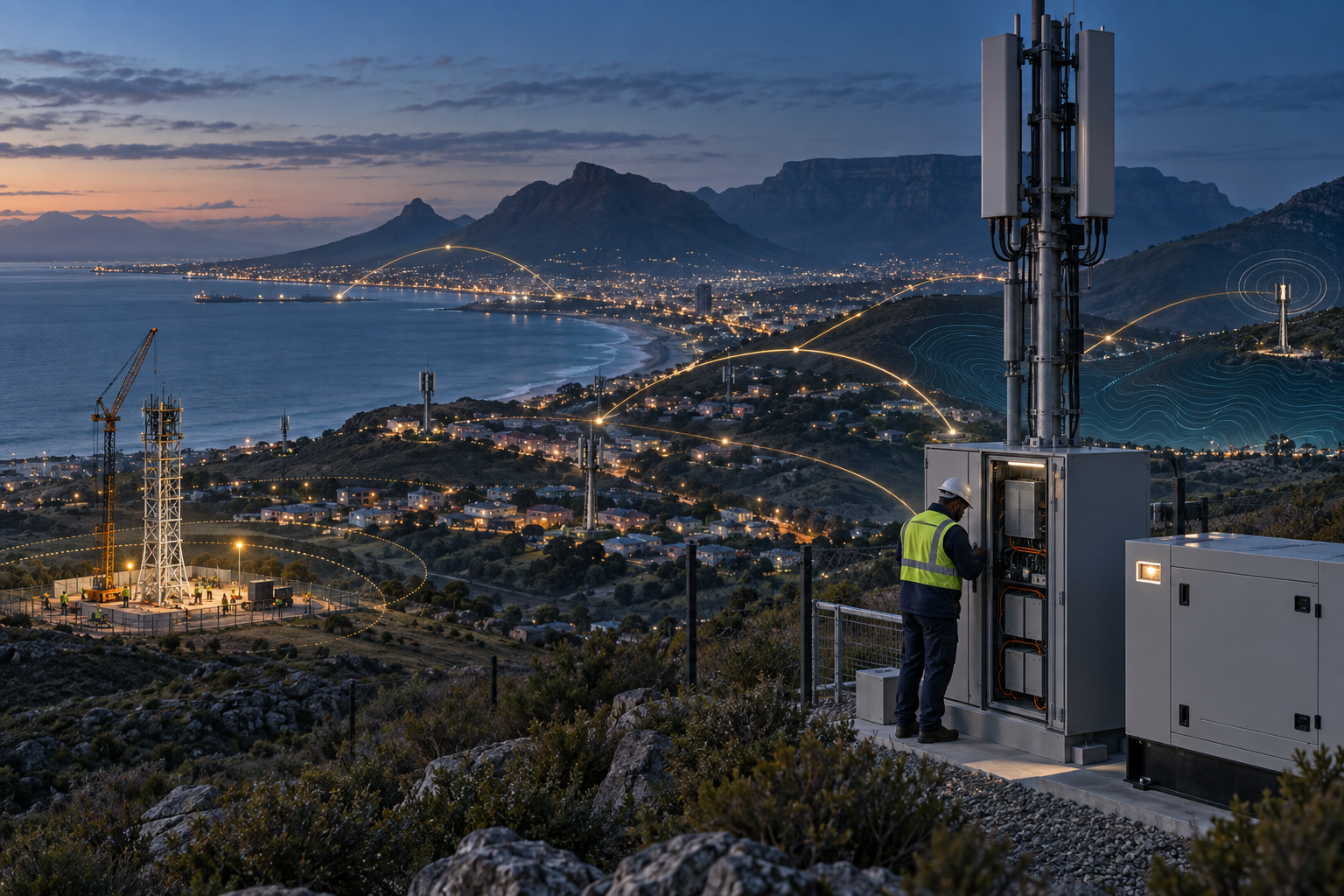
Vodacom’s 6 October announcement gives the Western Cape a headline investment of more than R500 million for the current financial year. About R380 million is earmarked for radio access network (RAN) modernisation: more than 50 sites are to be upgraded or replaced with newer hardware, software and architecture. A separate passage says more than 50 sites will receive 4G capacity upgrades using 700MHz spectrum. The release also promises new 5G sites in key towns and directs the remaining investment toward generators and battery modernisation for energy resilience. (Vodacom announcement)
The distinctions matter because these are not interchangeable outputs. Replacing equipment at an existing site, adding low-band 4G capacity, building a new 5G site and improving backup power solve different constraints. The announcement does not state how many new 5G sites are planned, how much the resilience programme receives, or which locations correspond to each workstream. Most importantly, it does not say whether the two “more than 50” site groups are separate. Adding them to claim at least 100 distinct sites would invent a fact.
The release’s approximately R380 million figure is about 76% of the R500 million headline floor, but that is only illustrative arithmetic: the overall commitment is “more than” R500 million and the RAN amount is approximate. It is not a company-reported budget share. Nor can the residual be treated as a fixed R120 million for 5G, power and other work. The announcement leaves the exact allocation open.
A repeated promise, a changing evidence standard
This is not the first Western Cape R500 million announcement. In July 2022, Vodacom described a plan above R500 million and paired it with prior network figures, including 38 newly switched-on sites and 4G capacity upgrades across more than 75% of the existing base-station estate. (2022 release) In December 2025, the company said R450 million had been invested in the region during that financial year and listed reported outputs: 5G added to 138 towers, 4G capacity to 406, six temporary and nine permanent base stations, plus battery and power upgrades. (2025 release)
Those disclosures show that Vodacom can report physical work alongside a regional spend figure. They do not prove that every listed output was financed by that exact sum, disclose unit costs, or provide comparable definitions across years. The periods and scopes differ. They are evidence that a better output ledger is possible, not a clean productivity benchmark or proof that the latest plan is inadequate.
The commercial question is therefore not whether R500 million sounds large. It is whether later reporting connects committed capital to completed work and observable service changes. A useful follow-up would identify unique sites by workstream, distinguish replacement from net-new coverage, report completion dates, and give a before-and-after measure such as capacity, congestion, availability or outage duration. For backup power, the relevant evidence would include sites protected and the change in interruption exposure—not simply the number of batteries installed.
Vodacom names Khayelitsha, Delft, Gugulethu, Langa, Mitchells Plain and Philippi among the communities in focus. That is a geographic intention, not a site list or proof of improved access in each place. The release also says Western Cape data usage grew by more than 40% over the past year, but gives no baseline, traffic volume or revenue bridge. Rising usage may indicate demand; it does not by itself show that this investment caused the increase or that higher traffic produces better returns.
For now, investors and customers can verify the announced allocation categories, not the resulting coverage or economics. If Vodacom later publishes a reconciled site-and-spend schedule, the commitment can be tested against delivery. If it reports only another regional headline, the number will remain an input whose public value is difficult to audit.
Sources: Vodacom, 6 October 2026; Vodacom, 9 December 2025; Vodacom, 12 July 2022.
Member Briefing
Deeper Profile Context
Sign in with the right membership level to unlock the full briefing and source notes.
Only for Strategic Circle
Strategic Circle
Open to all readers. Unlock profile briefings after joining and signing in.
Join Strategic CircleOnly for Leadership Alliance
Leadership Alliance
For qualified IP-asset owners and management; sign in to unlock alliance briefings.
Join Leadership Alliance