
Summary
- What it says: Vocus' new ducted fibre corridor signals a shift towards resilient, upgradeable backbone infrastructure as AI, hyperscale cloud and data centre growth reshape Australia's connectivity priorities.
- Main topic: Regional ISP economics; Cloud service dependency; Local cloud substitution; Network-resource evidence
- Context: market / briefing / Asia Pacific
•Vocus plans Australia's first ducted Sydney-Melbourne fibre route for network resilience
•Shifts from diverse routing to physically separated infrastructure to cut dual-route failure risk
The fact
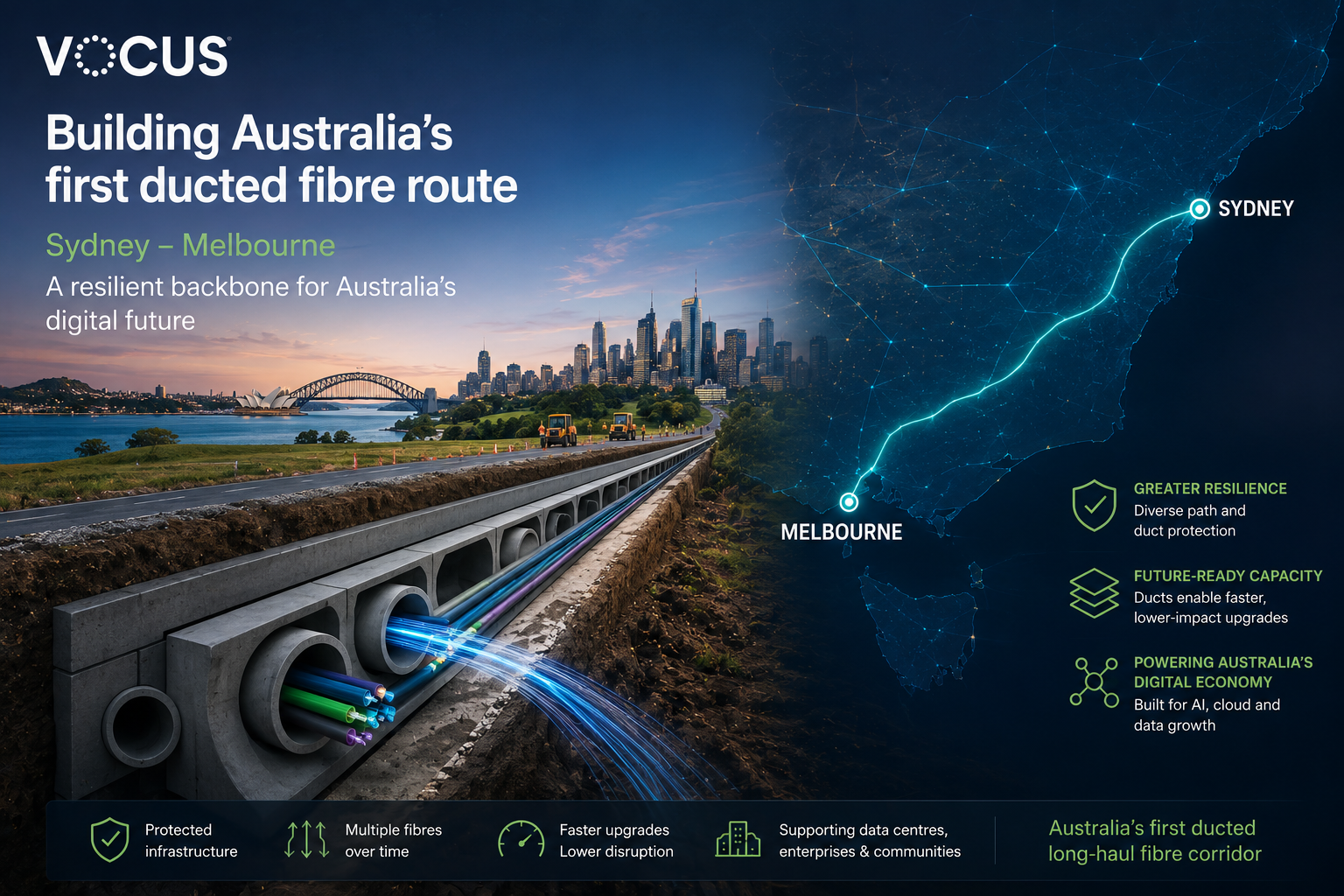
Vocus has announced plans to build Australia's first ducted long-haul fibre route between Sydney and Melbourne, creating a protected intercapital corridor designed to improve network resilience while simplifying future capacity expansion. Unlike conventional fibre deployments, the project includes dedicated underground ducts that allow additional fibre to be installed without extensive civil works as demand grows.
The new route will complement Vocus' existing national fibre network, serving wholesale carriers, hyperscale cloud providers, government agencies and enterprise customers. According to the company, the investment responds to increasing demand for high-capacity connectivity driven by AI workloads, cloud services and the continued expansion of Australia's digital infrastructure.
Sydney and Melbourne are Australia's largest concentrations of data centres and cloud infrastructure, making the corridor one of the country's most heavily utilised telecommunications routes. By introducing a physically diverse ducted pathway, Vocus aims to strengthen redundancy while creating a long-term platform capable of supporting future increases in fibre capacity as traffic continues to grow.
The assessment
The strategic importance of the project lies less in laying another fibre route than in changing the economics of backbone infrastructure. As AI training, inference and cloud services generate larger volumes of traffic between Australia's major data centre markets, uninterrupted connectivity is becoming essential to maintaining the utilisation of increasingly expensive computing infrastructure. A network outage today affects far more than internet access—it can interrupt cloud services, enterprise applications and AI workloads operating across multiple locations.
By installing ducts alongside the initial fibre deployment, Vocus is investing in infrastructure that can be expanded repeatedly without reopening the entire corridor. While the upfront construction cost is higher, future capacity upgrades become faster, less disruptive and significantly less expensive because the civil engineering work has already been completed. In effect, the ducts become a long-lived infrastructure asset rather than a one-off construction feature.
For BTW readers, the project illustrates a broader pattern: as digital services become more critical, physical-layer resilience matters as much as software-defined redundancy. Australia's geography concentrates traffic along a single Sydney-Melbourne axis, making physical separation the most effective way to improve resilience without adding geographic diversity.
What to watch
Watch for construction milestones, customer commitments and any government approvals as the project progresses. It will also be important to monitor whether competing Australian backbone providers adopt similar ducted infrastructure strategies as AI investment and data centre development continue to reshape long-haul network demand.
