
Summary
- The paid unit is the card authorization, clearing and settlement transaction. Visa Europe Limited sells the rules, processing and network reach that let an acquirer ask an issuer whether a cardholder can pay, then convert that approval into clearing, dispute handling and final settlement between financial institutions.
- The merchant's substitute set is real but uneven: domestic card rails, account-to-account payment, cash, bank transfer, wallet bypass and surcharge steering can lower some visible costs, but each can push fraud risk, refund handling, reconciliation, consumer habit or acceptance friction back to the seller.
- Public evidence is strongest on Visa Europe's legal identity, regulatory perimeter, disclosed operating model, regulator fee concerns and market scale. It cannot prove Visa Europe's internal authorization algorithms, per-merchant margins, private fee negotiations, actual service-level incidents, fraud-loss allocation by cohort or merchant retention after fee increases.
- Regulators have turned the toll into a public question. The UK Payment Systems Regulator says Mastercard and Visa raised core scheme and processing fees to acquirers by at least 25% since 2017, costing businesses at least GBP 170 million extra per year, and separately says UK-EEA online interchange increases cost businesses GBP 150 million to GBP 200 million extra annually.
- Visa's defence is not just brand. Its own PFMI disclosure describes authorization, clearing and settlement through VisaNet, settlement finality, member-default procedures, fraud and dispute monitoring, open access criteria and oversight by the Bank of England, the PSR and European central-bank authorities. Those controls are exactly what account-to-account challengers must reproduce if they want to displace the card rail for ordinary merchants.
The merchant is deciding who absorbs the checkout burden
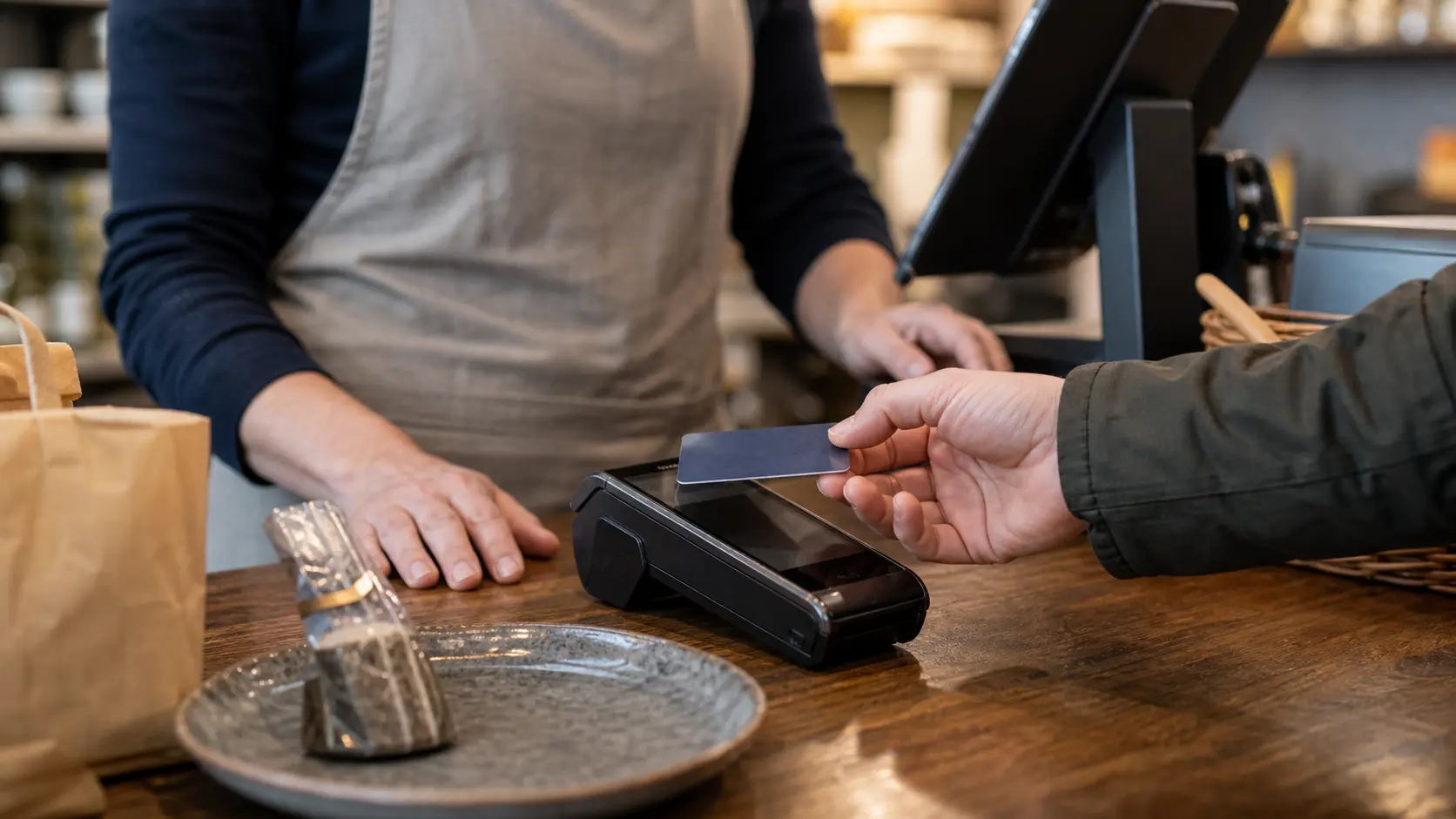
A grocery shop in Manchester, a hotel in Barcelona and a web merchant in Dublin face the same small moment many times a day. A buyer reaches the checkout and offers a contactless card, a stored wallet credential, a bank-transfer link, a local debit scheme, cash or a phone-based account-to-account payment. To the buyer, the difference may be a tap, a scan or a confirmation screen. To the seller, it is a choice about who carries the risk after the buyer leaves.
The operating unit in this article is the card authorization, clearing and settlement transaction supplied through Visa Europe Limited's European payment-system role. Authorization asks whether the issuer will approve the cardholder's transaction. Clearing packages the transaction details for exchange between the acquiring and issuing sides. Settlement turns a promise into money owed and paid between regulated participants. Around that unit sit rules for disputes, fraud monitoring, chargebacks, tokenization, member obligations, access criteria and settlement finality.
The merchant does not buy these pieces separately at the till, but the merchant service charge and the upstream scheme, processing and interchange economics are all priced around them.
The substitute is not a single rival. Cash has no card fee and settles in the drawer, but it leaves counting, theft, banking, hygiene, change and reconciliation with the merchant. A domestic card rail can reduce dependence on an international network in some countries, but it may lack the same cross-border recognition, online acceptance or wallet reach.
A bank transfer or open-banking account-to-account flow can move money directly from a customer's bank account, but it can make refund handling, consumer protection, scam reimbursement, failed authentication and reconciliation more merchant-specific unless another provider adds those services. A wallet bypass can hide the card from the user interface, but many wallets still sit on card credentials. Surcharge steering or discounting can move a price-sensitive customer to a cheaper rail, but it risks conversion loss when the customer simply wants the payment method already in her hand.
That is why the authorization message is best read as a risk-control toll. The visible toll may be measured in basis points, pence, scheme fees, processing fees and interchange. The hidden bargain is wider. A seller pays to reduce the chance that the card is stolen, to receive a recognizable approval response, to use rules that define liability and dispute windows, to have an acquirer and issuer linked by a common operating rulebook, to receive funds through settlement cycles, to accept visitors and online shoppers from other banks and countries, and to tell staff that "card accepted" is a simple answer.
Public evidence can prove a great deal about the perimeter of that bargain. Companies House lists Visa Europe Limited as an active private company incorporated in England and Wales, with company number 05139966, registered office at 1 Sheldon Square, London, W2 6TT, SIC 64999, last accounts made up to 30 September 2025 and a latest confirmation statement dated 19 May 2026 (https://find-and-update.company-information.service.gov.uk/company/05139966). Visa Europe's 2025 PFMI public disclosure says the company is incorporated in England and Wales, is a wholly owned subsidiary of Visa Europe Holdings Limited and part of the Visa Inc. group, and is responsible for representing the Visa brand and facilitating commerce across a Europe region covering 38 countries, including the UK, EU/EEA countries, Turkey, Israel, Switzerland and European microstates (https://www.visa.co.uk/content/dam/VCOM/regional/ve/unitedkingdom/PDF/visa-in-europe/uk-vel-pfmi-2025.pdf). That disclosure also says Visa Europe is the principal contracting entity for the operation of Visa within the Europe region.
Public evidence cannot prove the private economics of each transaction. It does not show the exact authorization-decline logic for a particular merchant, the internal latency of each route, the full fee stack negotiated through every acquirer, the marginal cost of one more tap, the share of disputes absorbed by each participant, or the merchant churn created by a fee rise. It also cannot prove whether a lower-cost substitute would preserve the same conversion rate for a merchant selling to tourists, mobile-wallet users, subscription customers or cross-border shoppers.
The useful public question is therefore narrower: does the visible evidence suggest that Visa Europe's risk controls and acceptance reach still justify the toll, or is the toll increasingly exposed because cheaper rails can absorb enough of the same burden?
Visa Europe is not just a brand licence in the evidence
Visa Europe Limited's strongest public evidence is not advertising. It is the overlap between Companies House identity, Bank of England and PSR oversight, Visa's own PFMI self-assessment and the operational language Visa uses to describe VisaNet. In the 2025 PFMI document, Visa Europe says it provides transaction processing services, primarily authorization, clearing and settlement, to financial-institution and merchant clients through VisaNet.
It describes the familiar four-party model of consumers, issuing and acquiring financial institutions and merchants, while noting that the ecosystem now includes digital banks, wallets, fintechs, governments and non-governmental organizations.
The same disclosure explains the card transaction as a sequence. The merchant presents transaction data to an acquirer. Through VisaNet, the acquirer presents the data to Visa. Visa contacts the issuer to check the cardholder's account or credit line for authorization. After authorization, the issuer effectively pays the acquirer the transaction value less the interchange reimbursement fee, and the acquirer pays the merchant the purchase amount less the merchant discount rate. That description matters because it places the paid unit in the middle of a rule-governed settlement chain rather than in a marketing promise.
Visa is careful about what it does not do. The PFMI disclosure says Visa is not a financial institution, does not issue cards, extend credit or set rates and fees for cardholder accounts, and does not earn revenue from or bear credit risk for those activities. It also says default interchange reimbursement fees generally are paid by acquirers to issuers and are set independently from Visa's issuer and acquirer revenue. Visa's public interchange page makes a related point: interchange is retained when the cardholder's bank sends payment to the acquirer, Visa does not receive that fee, and the merchant service charge incorporates interchange, acquirer service costs, guaranteed payment and acceptance technology (https://www.visa.co.uk/about-visa/visa-in-europe/fees-and-interchange.html). Merchants may dispute the economic effect of those rules, but the distinction is important. Visa Europe's toll is mainly a scheme, processing, rules and network toll, while interchange is a transfer inside the card economics that Visa helps structure through default rates.
The regulatory perimeter reinforces the point. Visa Europe's PFMI disclosure says HM Treasury categorized Visa Europe as a recognized payment system in March 2015 for the purposes of Part 5 of the Banking Act 2009, after which the Bank of England assumed oversight. The Bank of England's public financial-market-infrastructure pages list Visa Europe, operated by Visa Europe Limited, among UK-law systems designated under the Settlement Finality Regulations (https://www.bankofengland.co.uk/financial-stability/financial-market-infrastructure-supervision/who-are-we). The PSR's public "who we regulate" page lists Visa Europe among designated payment systems (https://www.psr.org.uk/how-we-regulate/who-we-regulate/). The ECB identifies the Visa Europe Payment System in the United Kingdom among offshore payment systems monitored or overseen in the Eurosystem context (https://www.ecb.europa.eu/paym/pol/systems/html/index.en.html).
This regulatory status does not prove fair pricing. It proves that the payment system is important enough to attract financial-market-infrastructure supervision, settlement-finality treatment and competition-focused payment-system oversight. That status is a double-edged asset. It supports merchant confidence that the network is not a thin software vendor. It also gives regulators the standing and public interest rationale to question the fee stack when merchants say acceptance has become too expensive to avoid.
The toll is being questioned because merchants cannot easily leave it
The UK Payment Systems Regulator has made the merchant complaint concrete. In its March 2025 final report on card scheme and processing fees, the PSR said cards are the most popular way for UK consumers to pay and that every Mastercard or Visa debit or credit card transaction with a UK business triggers scheme and processing fees, some mandatory or core and some optional. It found that Mastercard and Visa increased their core scheme and processing fees to acquirers by at least 25% since 2017, costing businesses at least GBP 170 million extra per year, and that poor fee transparency imposed costs on acquirers and merchants, including small retailers (https://www.psr.org.uk/publications/market-reviews/mr22110-market-review-of-card-scheme-and-processing-fees-final-report/).
The PSR's framing is useful because it separates card value from card pricing power. A merchant can value the service and still lack bargaining power. The regulator's market-review page, updated in May 2026, says scheme fees are charged by scheme operators to participate in the scheme, while processing fees are charged for authorization, clearing and settlement. It says the final report found that Mastercard and Visa do not face effective competition, fees have risen and businesses lack clarity about how much they will have to pay to accept card payments. In December 2025, the PSR said it planned to implement an information, transparency and complexity remedy and a pricing-governance remedy, with a further regulatory financial-reporting remedy still in consultation (https://www.psr.org.uk/publications/consultations/cp253-market-review-of-card-scheme-and-processing-fees-proposed-directions/).
For the merchant, the fee issue is not academic. The British Retail Consortium's 2024 Payments Survey said debit and credit cards accounted for more than 75% of retail transactions and 85% of spending in 2023, while card fees paid by retailers to banks and card schemes rose by more than 25%, adding GBP 380 million of extra cost and bringing total card fees to GBP 1.64 billion (https://brc.org.uk/market-intelligence/publications/benchmarks/payments-survey/payments-survey-2024/). A later BRC statement on 2024 said total card fees fell slightly from 2023 but remained GBP 1.48 billion, more than double the 2019 level, and called for stronger PSR action (https://brc.org.uk/news-and-events/news/corporate-affairs/2025/ungated/high-interest-rates-push-shoppers-from-credit-to-debit-cards/). Retail associations are advocacy sources, not neutral regulators, but they are useful because they show the buyer side of the toll: retailers are not simply annoyed by a line item; they see a growing mandatory cost attached to the dominant method customers expect.
Cross-border interchange has brought the same logic into sharper relief. The PSR says that after the UK left the EU framework, Mastercard and Visa increased card-not-present UK-EEA consumer debit and credit interchange fees from 0.2% and 0.3% to 1.15% and 1.5%, respectively. In its market-review page for cross-border interchange, updated in October 2025, the regulator says Mastercard and Visa account for 99% of UK debit and credit card payments, were not subject to effective competitive constraints, raised fees without regard to business and customer impacts, and imposed GBP 150 million to GBP 200 million of extra annual cost on businesses (https://www.psr.org.uk/our-work/market-reviews/market-review-into-cross-border-interchange-fees/). It has stepped back from an interim cap while developing a longer-term methodology, partly because of litigation over its powers, but the economic finding remains part of the public record.
This matters for Visa Europe because a toll earns legitimacy differently from a normal supplier fee. A normal supplier can say: if you do not like the price, buy elsewhere. A network with very broad consumer reach cannot rely on that answer. Merchants accept the price because customers carry the credential, tourists expect it, wallets tokenize it, issuers promote it and acquirers bundle it. The stronger the network effect, the more regulators ask whether the toll reflects value, market power or both.
Scale makes the authorization useful and difficult to discipline
The pro-Visa side of the case begins with reach. Visa Inc.'s 2025 annual-report site reports USD 40.0 billion of net revenue, 257.5 billion processed transactions and USD 14.2 trillion of payments volume for fiscal 2025 (https://annualreport.visa.com/home/default.aspx). The full 2025 annual report says Visa connects approximately 12 billion endpoints, more than 175 million merchant locations and nearly 14,500 financial institutions, and says total payments and cash volume was USD 17 trillion while 329 billion Visa-branded transactions were processed by Visa or other networks (https://s29.q4cdn.com/385744025/files/doc_downloads/2025/Visa-Fiscal-2025-Annual-Report.pdf). Those are group figures, not Visa Europe stand-alone unit economics. They do, however, explain why the card rail is hard to replace at checkout: a merchant is not only buying a local authorization; it is buying into a global habit and credential universe.
UK data show the same dependency in a national market. UK Finance's Payment Markets 2025 summary says 48.8 billion payments were made in the UK in 2024, card payments accounted for 64% of all payments, debit cards alone accounted for 53%, debit-card volumes rose 6% to 26.1 billion payments, credit-card payments reached 5.0 billion, and contactless payments reached 18.9 billion (https://www.ukfinance.org.uk/system/files/2025-10/Payment%20Markets%20Report%20Summary.pdf). The same summary says cash fell to 9% of all payments and Faster Payments plus other remote banking reached 5.6 billion payments, overtaking cash and Direct Debit as the second most frequently used UK payment method.
Europe-wide data make the card habit broader than a UK peculiarity. The ECB's first-half 2025 payment statistics show 77.7 billion non-cash euro-area payment transactions, of which card payments accounted for 57%. Euro-area card payments numbered 44.0 billion with a value of EUR 1.7 trillion. Contactless card payments at physical terminals reached 29.6 billion, and POS terminals in the euro area reached around 24.7 million, 93% of them contactless-enabled (https://www.ecb.europa.eu/press/stats/paysec/html/ecb.pis2025h1~36edd636c8.en.html). The ECB's consumer payment-attitudes study for 2024 says cards were the most important single instrument by value at point of sale, with 45% of value, while cash still accounted for 52% of POS transactions by count and 39% by value (https://www.ecb.europa.eu/stats/ecb_surveys/space/html/ecb.space2024~19d46f0f17.en.html).
Those figures show both the strength and limit of the toll. Cards dominate many transaction counts and consumer expectations, especially where contactless acceptance is universal. But card use is not the only rail moving money. Credit transfers dominate value in the euro area: the ECB says euro-area credit transfers in the first half of 2025 totaled 16.8 billion transactions and EUR 107.3 trillion, accounting for 92% of non-cash payment value. In the UK, Faster Payments and other remote banking are now a mass retail and business behavior. A card network therefore faces a two-front discipline.
It is entrenched in small and medium checkout transactions; it is surrounded by account rails that already move much larger values and are becoming easier to wrap in merchant-facing checkout products.
The network's real product is exception handling before and after approval
The Visa card tap feels instant because the exception work is hidden. The acquirer needs a response. The issuer needs to authenticate and authorize. The merchant needs to know whether to hand over the goods. The customer needs a familiar path if the transaction is declined, duplicated, fraudulent or disputed. The system needs rules that say when settlement is final and what happens if a participant defaults.
Visa Europe's PFMI self-assessment is valuable because it exposes that hidden work. It says the Visa Fraud Monitoring Program and Visa Dispute Monitoring Program have been combined into the Visa Acquirer Monitoring Program, which monitors card-not-present sales, fraud, disputes and enumeration performance of acquirers and merchants and takes corrective action when thresholds are reached. It describes Visa Token Service as replacing 16-digit Visa account numbers with tokens and cryptographic data, aiming to improve authorization, reduce fraud and improve customer experience.
It describes risk and identity solutions that help financial institutions and merchant clients prevent fraud and protect cardholder data. These are company claims, but they are made in a public disclosure submitted to the Bank of England, not in a checkout advertisement.
Settlement certainty is the other side of the product. Visa Europe's PFMI disclosure says its rules define when settlement within Visa is final, unsettled payments cannot be revoked by members and must instead be corrected through disputes, and final settlement is completed no later than the end of the value date. It says Visa Europe operates a deferred net settlement system on a batch-processing basis rather than real-time settlement.
It also says Visa Europe can use its own liquidity to meet a member's settlement obligations before seeking reimbursement if a member is unable to meet obligations, and that it has rules, collateral arrangements, stress tests and loss-sharing tools for member default. A merchant rarely sees this machinery. It is part of what the merchant buys when it treats an approval as good enough to complete the sale.
Operational resilience is not a decorative risk term here. Visa Europe's 2025 governance report says the board considers regulatory obligations relating to its role as a systemic risk manager, including operational resilience, financial strength and stability, capital and liquidity, and management of critical third-party suppliers (https://www.visa.co.uk/content/dam/VCOM/regional/ve/unitedkingdom/PDF/visa-in-europe/vel-fy25-governance-report.pdf). The same report says Visa Europe engages closely with Visa Technology and Operations, an intra-group critical supplier, through board reporting, CEO meetings and annual reports to the board. That means the European entity's value depends partly on group technology and operations. The public evidence proves governance and supplier oversight structures; it does not prove that no operational outage, latency problem or resilience weakness exists.
This is why "trust" needs decomposition. A merchant trusts the card rail when the failure cost is lower than the cost of avoiding it. That failure cost includes false declines, fraud losses, customer abandonment, chargeback handling, settlement delay, disputed refunds, acquirer support, reconciliation errors, terminal downtime, card-not-present abuse, and the cost of explaining a failed payment to a buyer. Visa Europe's toll is defensible where it reduces those burdens enough that the merchant values acceptance even at a higher fee.
The toll weakens where a cheaper rail offers similar conversion, better settlement speed, comparable fraud controls and simpler reconciliation.
Account-to-account payments are the strongest substitute and the clearest admission of the card rail's value
Account-to-account payments are the most serious strategic substitute because they attack the fee stack at its source. They can move funds directly between bank accounts over domestic or SEPA rails, avoid card interchange in many forms, give merchants faster access to funds, and use banking authentication instead of card credentials. In the UK, the use base is no longer marginal. UK Finance says Faster Payments and other remote banking reached 5.6 billion payments in 2024 and became the second most frequently used payment method, while 50% of payments made by businesses used Faster Payments. Open Banking Limited said in early 2026 that open banking reached 16.5 million user connections by December 2025, up 36% over the prior year, and the FCA/PSR December 2025 update on commercial variable recurring payments said open banking had more than 16 million active users and 53% year-on-year growth in open-banking payments (https://www.openbanking.org.uk/insights/open-banking-in-2025-now-part-of-the-uks-everyday-financial-life/; https://www.psr.org.uk/media/xgjcblmb/cvrp-update-on-delivery-_-dec-2025.pdf).
The EU is also pushing the account rail closer to retail checkout. The ECB's Instant Payments Regulation explainer says the regulation, adopted on 13 March 2024, requires payment service providers that offer credit transfers to offer instant credit transfers, requires instant-transfer charges to be no higher than corresponding standard credit-transfer charges, and introduces verification-of-payee requirements for standard and instant credit transfers (https://www.ecb.europa.eu/paym/retail/instant_payments/html/instant_payments_regulation.en.html). The deadlines are staggered, but for euro-area banks the receiving obligation applied from 9 January 2025 and the sending and verification-of-payee obligations from 9 October 2025. That does not create a merchant checkout scheme by itself. It lowers the infrastructure barrier for payment products that do.
Wero, the European Payments Initiative wallet, is the clearest market signal of that ambition. EPI presents Wero as a European account-to-account payment solution built with leading banks and payment service providers, using instant account-to-account infrastructure in new ways and aiming to serve consumers and merchants across in-store, online and person-to-person use cases (https://epicompany.eu/). In an interview published by the European Payments Council, EPI said Wero began with person-to-person payments, would add e-commerce and m-commerce in 2025, and planned point-of-sale, subscriptions and value-added services in 2026 and 2027 (https://www.europeanpaymentscouncil.eu/news-insights/insight/wero-shaping-future-european-payments). Media reports in late 2025 described Wero moving into online commerce, but those reports are best treated as market-color evidence rather than proof of durable merchant conversion.
The most revealing evidence, however, may come from Visa itself. Visa's UK page for Visa Protect for Account-to-Account Payments sells AI-powered real-time risk scoring for account-to-account fraud detection, says UK APP scams and fraud caused GBP 600 million of losses in 2023, and says Visa's Pay.UK pilot analysed billions of transactions covering more than 50% of annual UK account-to-account payments and identified 54% of fraudulent transactions that had already passed through bank and PSP fraud systems (https://www.visa.co.uk/products/visa-protect-a2a-payments.html). This is a Visa product claim, not a neutral benchmark, but it is strategically important. It shows that the card network understands the substitute's missing layer: account-to-account rails can be cheap and fast, but merchants and banks still need fraud scoring, scam controls, exception handling and confidence that a payment should proceed.
In that sense, account-to-account payments validate the toll even as they challenge it. They say the merchant does not necessarily need a card network to move money. They also say somebody must price fraud, consent, reimbursement, error correction, refund workflow, name matching, authentication failures and customer support. If the account-to-account provider charges less because those burdens sit elsewhere, the merchant's total cost may not fall as much as the payment fee suggests. If the provider genuinely automates those burdens, then Visa Europe's authorization toll faces a deeper threat.
Domestic rails and cash discipline Visa differently
Domestic card rails attack the cross-border network premium. In countries with strong domestic debit schemes, merchants and banks can route some local transactions away from international schemes or use co-badging to preserve domestic economics. Domestic rails can be politically attractive because they keep governance and data closer to national institutions, support local fee bargaining and reduce exposure to global scheme pricing. They can also be operationally narrow. Tourists, cross-border e-commerce customers, corporate cards, mobile-wallet credentials and international subscriptions often expect Visa or Mastercard acceptance.
A domestic rail may be a strong local checkout substitute and a weak travel or online substitute at the same time.
Cash disciplines the bottom of the market. UK Finance says cash fell to 9% of UK payments in 2024, but the parliamentary Treasury Committee's 2025 report on cash acceptance emphasized that cash remains important for budgeting and inclusion, and cited evidence that merchants and communities still see cash acceptance as socially and commercially relevant (https://publications.parliament.uk/pa/cm5901/cmselect/cmtreasy/324/report.html). The ECB's 2024 payment-attitudes study says cash still made up 52% of POS transactions in the euro area by count and 62% of consumers considered it important or very important to have cash as a payment option. Cash is therefore not a full replacement for online or cross-border commerce, but it remains a negotiation benchmark for small physical transactions.
Bank transfers discipline high-value payments and business payments. The ECB's first-half 2025 data show credit transfers accounting for 92% of euro-area non-cash payment value, while UK Finance says businesses increasingly use Faster Payments and that 50% of business payments in 2024 used Faster Payments. A merchant paying suppliers already understands account-to-account settlement. The barrier is not conceptual. It is whether the same account rail can deliver consumer checkout conversion, instant confirmation, refunds, fraud protection and dispute experience in a way customers accept.
Wallets are more ambiguous. Apple Pay, Google Pay and other wallets can make card acceptance stronger because they preserve Visa credentials behind a better interface. They can also train consumers to care less about the underlying rail. UK Finance says mobile-wallet users reached half of the adult UK population in 2024 and that mobile wallet payments increasingly replace contactless physical-card payments. If the wallet owns the consumer relationship, Visa retains value only if the wallet keeps routing through Visa credentials or Visa-like risk services.
If a wallet can switch a user from a stored card to an account-to-account balance without harming conversion, the visible consumer brand is no longer the card scheme.
Merchant steering is the most direct but riskiest substitute. A merchant can discount bank transfer, offer cash prices, surcharge cards where allowed, push a local rail or reorder checkout buttons. But steering only works if the customer does not abandon the purchase. The more urgent, travel-related, cross-border or high-trust the transaction, the more likely the customer is to choose a known card even when another method is cheaper. Visa Europe's toll is strongest where customer confidence is part of conversion.
It is weakest where the buyer and seller already know each other, the transaction repeats, the payment is domestic and refund or dispute expectations are simple.
Regulation is narrowing the room for unexplained price rises
The UK and EU regulatory story is not one single attack on Visa. It is a set of overlapping constraints on different parts of the card price. The EU Interchange Fee Regulation capped most EEA domestic and cross-border consumer debit and credit interchange at 0.2% and 0.3%, and Visa's own interchange page says the IFR applies to most product types within the EEA. Visa Europe's PFMI disclosure says the IFR also required separation of scheme and processing services, with UK law incorporating the provisions.
The European Commission accepted commitments from Visa and Mastercard in 2019 on inter-regional interchange fees for cards issued outside the EEA and used at EEA merchants; Commission communications in July 2024 said the caps would remain for another five years until November 2029. Visa's own UK interchange page points merchants to inter-EEA and intra-EEA fee schedules and country schedules.
The UK post-Brexit split made the limits visible. The EU IFR no longer applied to UK-EEA transactions after withdrawal, and the PSR says online consumer debit and credit interchange rose sharply for UK-EEA card-not-present transactions. That episode is important because it is a natural test of market power. When the cap stopped applying, the fee rose. Visa and Mastercard can argue that online cross-border card-not-present transactions carry higher fraud, authorization and issuer-incentive costs. The PSR says it did not identify sufficient justification for the increases and found annual business harm.
The resulting debate is exactly the risk-control toll question: what added risk was priced, and who can verify the price?
Litigation has added another front. The Competition Appeal Tribunal's Merchant Interchange Fee Umbrella Proceedings page says judgment on Trial 1 was delivered on 27 June 2025, after merchant claims against Visa and Mastercard over multilateral interchange fees (https://www.catribunal.org.uk/cases/151711722-um-merchant-interchange-fee-umbrella-proceedings). The judgment itself states that the IFR caps consumer debit and credit interchange at 0.2% and 0.3% for intra-EEA and domestic consumer transactions but not for inter-regional or commercial cards, and it analyzes whether default interchange fee rules restrict competition. A March 2026 Court of Appeal hearing page says Visa sought permission to appeal the CAT judgment and summarizes the Tribunal's finding that default multilateral interchange fees acted as a non-negotiable pricing floor in the merchant service charge for certain transactions (https://www.judiciary.uk/live-hearings/1-visa-ors-applicants-v-the-umbrella-interchange-fee-claimants-2-mastercard-inc-ors-applicants-v-the-umbrella-interchange-fee-claimants/). Because appeal processes are ongoing, the safest use is not to treat the issue as commercially settled. It is to note that merchant legal pressure around the fee floor remains active.
The PSR's December 2025 proposed directions show where regulation may move next. The information remedy would improve what acquirers and, through contracts, merchants receive about scheme and processing fees. The pricing-governance remedy would require evidence behind pricing decisions. This does not cap the toll directly. It makes the toll explain itself. For a systemic network, that may be more significant than it sounds. Once a fee rise needs a clearer evidence trail, a card network must tie price more tightly to cost, risk, service quality, investment or user value. Vague acceptance inevitability becomes a weaker defence.
Data sovereignty is a political pressure, not a clean substitute
European payments politics often talk about sovereignty. The word can obscure more than it clarifies. For a merchant, sovereignty matters only if it changes cost, resilience, reach, data handling, regulatory comfort or customer conversion. A domestic or European account-to-account wallet can satisfy policy goals and still fail if consumers do not use it at checkout. Conversely, a global card network can be politically uncomfortable and still commercially necessary if it provides the only common credential for tourists, online shoppers and corporate users.
Visa Europe's evidence sits in the middle. The company is incorporated in England and Wales, has UK and European regulatory oversight, and acts as the principal contracting entity for Visa's Europe region. But it is part of Visa Inc., a US-listed group regulated by the SEC and supervised by US federal financial-institution examination bodies. Visa Europe's governance report says the board includes independent non-executive directors, shareholder representatives appointed by Visa Inc., and executive directors including the Europe CEO and CFO.
It also says Visa Europe relies on Visa Technology and Operations as an intra-group critical supplier. The European entity therefore gives local contracting and oversight, not complete regional independence from the global group.
That distinction is enough for merchant analysis. Public evidence supports saying Visa Europe has local governance, local regulatory obligations and European operating responsibility. It does not support saying European payment data, technology control or resilience are wholly local. The PFMI disclosure talks about a Europe region and VisaNet; it does not provide a full data-locality map, a country-by-country processing architecture or a merchant-specific data-residency guarantee. Data sovereignty remains a watchpoint rather than a proven weakness.
Account-to-account challengers are not automatically sovereign in the practical sense either. A European wallet may use European banks and SEPA instant rails, but it still needs cloud providers, fraud vendors, identity services, device platforms, acquirers, processors and merchant-service providers. The question is not whether a payment method has a European label. It is whether the operating chain that authorizes, scores, confirms, refunds and settles the transaction is resilient, auditable and acceptable to merchants and regulators. Visa Europe's advantage is that much of this chain already exists at scale.
Its disadvantage is that global scale invites regulatory scrutiny over control, data, fees and strategic dependence.
The merchant's total cost is broader than the fee schedule
A narrow comparison says account-to-account is cheaper because it avoids card interchange and some scheme fees. That can be true. A total-cost comparison asks what happens when the payment fails, is fraudulent, is disputed, needs refunding, crosses borders, lacks customer recognition, requires extra reconciliation, or introduces support contacts. For a low-margin merchant, both numbers matter.
Consider a recurring subscription. A stored card can fail because the card expires, is replaced after fraud, hits strong customer authentication friction or is declined by issuer risk controls. An account-to-account variable recurring payment can reduce card lifecycle failures and lower fees, but it needs consent management, bank availability, mandate controls, cancellation clarity, refund process and scam protections. The FCA/PSR December 2025 commercial VRP update says variable recurring payments account for 16% of open-banking payments and are being developed for wider commercial use. That is meaningful progress.
It also shows the substitute is still being built, not already universal.
Consider a tourist hotel. A domestic account rail may be useless to a foreign guest. Cash carries theft and reconciliation costs. A bank transfer may be slow, unfamiliar or hard to reverse. A Visa authorization gives the hotel a known path for deposits, no-shows, incidental charges and chargebacks, albeit at a cost. The more cross-border the customer base, the stronger Visa's acceptance premium.
Consider a small retailer. UK Finance says card acceptance has continued to expand among small businesses and low-value transactions without minimum-spend thresholds. For such a seller, card acceptance increases conversion because customers carry cards and phones. But BRC evidence says card fees are a large and rising cost. The seller may want an account-to-account option at checkout, but only if staff can explain it, the customer trusts it, refunds are simple and the acquirer or payment provider integrates it into the same reconciliation workflow. Otherwise the merchant has gained a cheaper button and lost time at the counter.
The total-cost test also explains why Visa is extending itself into non-card risk tools. Visa A2A Protect is not a contradiction. It is a hedge against the possibility that the authorization toll migrates from card rails into risk scoring across rails. If Visa can sell fraud intelligence and decisioning into account-to-account payments, then even rail substitution may preserve part of Visa's economics. If banks, domestic schemes or specialist fintechs can provide equivalent risk control more cheaply, Visa's network premium narrows.
What public evidence still cannot settle
Three missing proof categories matter most. The first is economics. Public filings and regulator reports do not show Visa Europe's merchant-level margin by transaction type, the marginal cost of authorization, the profitability of UK scheme and processing services, or the net effect of client incentives, rebates and fee changes by acquirer. The PSR itself says assessing UK financial performance is difficult because Mastercard and Visa do not report financial performance for their respective UK businesses in a clean public way. That gap is central.
A fee can look high to a merchant and still fund real risk-control investment; it can also look justified by scale and still exceed competitive levels.
The second is reliability. Visa Europe's PFMI disclosure describes operational resilience, crisis exercises, incident controls, settlement finality and observed PFMI principles. It does not disclose authorization uptime by country, latency distribution, false-decline rates, incident counts, acquirer support resolution or card-not-present dispute-cycle performance by merchant segment. A merchant deciding whether the toll is worth paying needs those operational facts, but they are not fully public.
The third is retention. Public sources show that card usage is large and that account-to-account payment is growing. They do not show what happens when a merchant actively steers consumers away from cards, how conversion changes by sector, whether a lower fee offsets lost sales, or whether customers who try account-to-account keep using it for ordinary purchases. Wero's roadmap, UK open banking growth and Faster Payments adoption are important signals. They do not yet prove that a mass of merchants can replace card acceptance without losing customers.
These gaps should not paralyze the analysis. They define the watchpoints. If PSR remedies force clearer fee reporting, the economics gap narrows. If open-banking VRP and instant-payment schemes deliver strong fraud controls, the reliability gap narrows. If merchants publish evidence of stable conversion after steering to account-to-account or domestic rails, the retention gap narrows. Until then, Visa Europe's toll remains exposed but not obsolete.
The investment case is a regulated toll under substitution pressure
Visa Europe's card authorization economics are durable because they sit on a habit that customers, issuers, acquirers and merchants already share. The network's value is not merely that a card works. It is that the approval, decline, clearing, dispute and settlement consequences are governed before the customer arrives. That institutional memory is hard to copy quickly. Account-to-account payments can be faster and cheaper, but they must become equally boring in the face of fraud, refunds, scams, failed authentication, consumer confusion and merchant reconciliation.
The fee pressure is also durable. Regulators have found weak competitive constraints, opaque fee information and costly increases. Merchants have organized their complaint around real money, not ideology. Courts and regulators keep returning to the fact that default fees can become a non-negotiable floor in merchant acceptance costs. Even if Visa succeeds in defending parts of its legal and regulatory position, the era of unexplained price expansion is becoming harder to sustain.
The best reading is therefore balanced. Visa Europe Limited is not a replaceable checkout widget. It is the European contracting and regulatory face of a global payment network whose authorization, clearing and settlement services reduce merchant risk and support mass acceptance. But it is also a toll collector in a market where the toll is increasingly compared with instant credit transfers, open banking, domestic schemes, cash and wallets. The more Visa can show that each extra fee buys measurable fraud reduction, settlement certainty, dispute efficiency, resilience or acceptance reach, the stronger the toll.
The more account-to-account and domestic rails bundle those same controls into cheaper merchant workflows, the more Visa Europe's economics shift from inevitability to proof.
For a merchant, the practical question at checkout remains simple: what am I paying to avoid? If the answer is fraud screening, dispute handling, settlement certainty, recognizable acceptance and fewer abandoned sales, Visa Europe's card authorization remains worth real money. If the answer becomes only "because customers have always used cards," the toll will be regulated, routed around or competed down.