Summary
- Verizon Communications, Inc. added 406,000 postpaid phones, 231,000 retail postpaid connections and 166,000 retail connections in the quarter ended 30 September 2026 — one quarter, three nested counts, three sizes of the same growth.
- It prices by the account and grows by the connection, and prints neither the average account count behind its $168.08 wireless retail postpaid ARPA nor the average connections per account that would join the two populations.
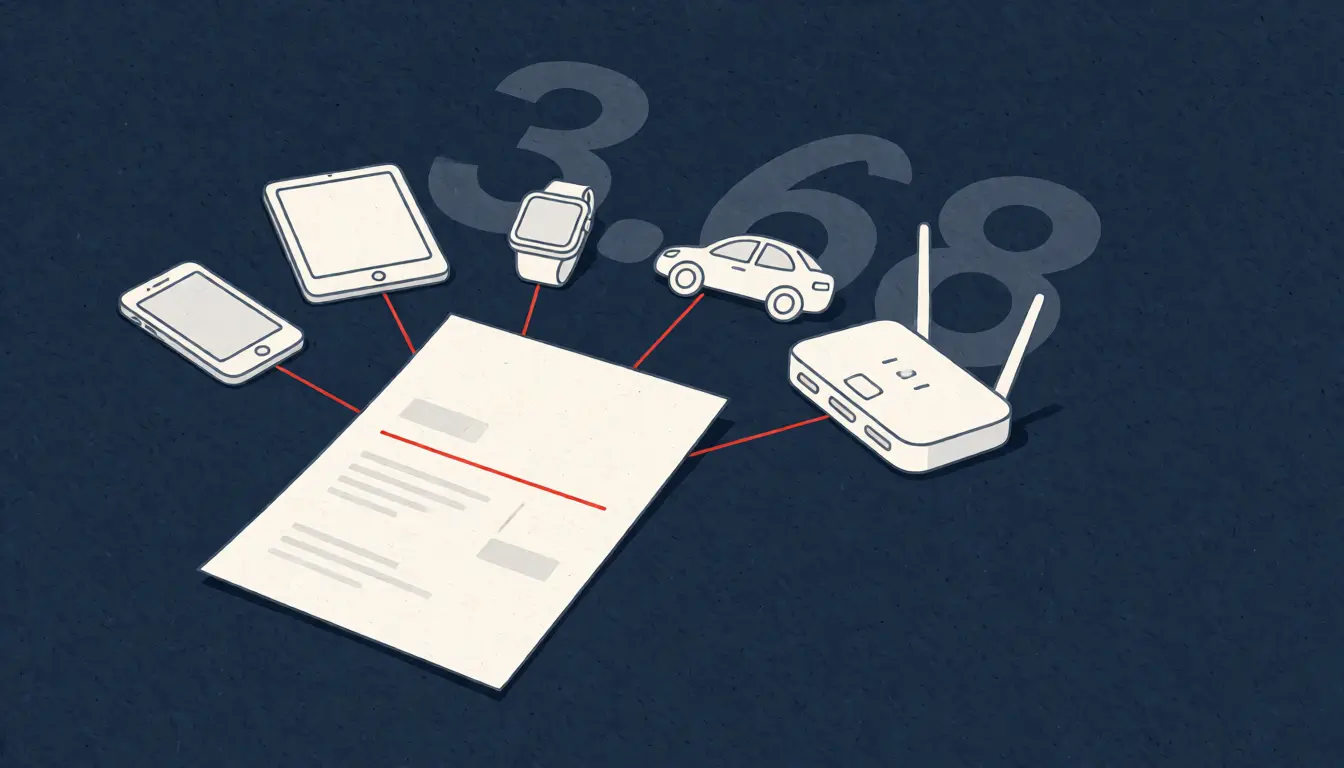
- Against the one account balance it does print — 34,471 thousand at 30 September 2026 — retail postpaid connections work out at 3.68 per account, putting a postpaid connection at about $45.68 a month and a postpaid phone line at about $61.30. Both quotients are arithmetic, not disclosure.
Three numbers in one release, all called growth
Earnings releases are small documents with a large appetite for adjectives. Verizon's third-quarter release, published on 26 October, opens with "another record-breaking quarter" and the figure 406,000 — postpaid phone net additions for the three months to 30 September 2026. It is a good number. It is also the narrowest of the three the company reports.
One count wider sits retail postpaid connections, which added 231,000. Wider again sits retail connections, which added 166,000 (https://www.verizon.com/about/file/78531/download?token=3veIZyIp). Same operator, same quarter, same accounting. The only variable is how many kinds of thing you agree to count. A phone that survives the quarter lands in all three. A tablet on a family plan, a watch sharing a number, a connected car, a retail IoT device, a 5G Home router: each lands in the last two and not the first.
So "how fast did Verizon grow?" has three defensible answers, because all three are printed. The one on the cover is the one that shows the most. The one that actually moves the connection balance is the one that shows the least. That is not a contradiction. It is a menu.
What a connection is, in the company's own words
The definitions are not hidden. The 2025 Form 10-K sets them out on printed pages 27 and 28 (https://www.sec.gov/Archives/edgar/data/732712/000073271226000007/vz-20251231.htm). Wireless retail connections are ending postpaid and prepaid customer-device connections, and the list that follows is the whole argument: phones, fixed wireless access, tablets, other internet devices, wearables and retail IoT devices. Wireless retail postpaid accounts are customers directly served and managed under Verizon — unlimited, shared-data, corporate, legacy single-connection and multi-connection family plans — and the filing adds, in a sentence worth the price of the document, that a single account may include monthly wireless services for a variety of connected devices.
Read the two definitions side by side and the ratio between them stops being a mystery. It is the product. Verizon sells a household a bill, and inside that bill it sells the household as many devices as the household will carry. The count of devices and the count of bills are both published. The number that converts one into the other is not.
The identity nobody writes down
Average revenue per account is not a price. It is a price multiplied by a mix. If $168.08 arrives from each account each month and each account carries an average of 3.68 postpaid connections, a postpaid connection costs $45.68. If the same accounts carried 2.74 phone lines each, a phone line costs $61.30. If they carried all 4.27 of their retail connections, the average connection would fetch $39.39.
One price, four denominators, four different businesses. At the account level Verizon is charging slightly less than it charged a year earlier. At the phone-line level it is charging 56 per cent more than at the retail-connection level, on identical revenue. Nothing in the filing is wrong. The denominator was chosen, and the choosing was never explained.
That matters most when the number moves, because arithmetic does not fix the direction. ARPA fell from $171.27 to $168.08, or 1.86 per cent (https://www.verizon.com/about/file/78531/download?token=3veIZyIp), and 1.83 per cent over the nine months to $167.49. Both statements are exact. Neither tells you whether Verizon cut the price of connectivity or sold fewer connections to each account. A price cut and a mix shift toward single-line accounts draw the same falling line and demand opposite management responses. To separate them you need the connections-per-account factor — the one cell the table does not carry.
The wider the count, the smaller the quarter
Line the flows up and they decompose with uncomfortable neatness. Postpaid phones added 406,000. Retail postpaid connections added 231,000. The 175,000 between them is the non-phone postpaid connections that left the count. Retail connections added 166,000, and the 65,000 between that and 231,000 is what retail but not postpaid contributed. Add it back and you are at 166,000 again.
That is the article in one line: the wider the count, the smaller the quarter. Verizon lost 175,000 postpaid watches, tablets, routers and connected devices, net, while gaining 406,000 phones — and it is unlikely to have lost them in any ordinary sense. Devices come off bills when promotions lapse and when a household consolidates. The count records the lapse. The release records the phones.
The account side is stranger. Verizon reported 137,000 postpaid net account additions for the quarter, its best in over a decade (https://www.verizon.com/about/news/verizon-delivers-another-record-breaking-quarter). Divide 231,000 by 137,000 and each net new account arrived carrying 1.69 connections, against a stock average of 3.68. The marginal customer is a single-line customer. The installed base is a family. A company adding its smallest accounts fastest will watch ARPA fall while its connection count rises — and will report both as growth, because both are.
Then set the year beside the quarter. Ending postpaid accounts were 34,470 thousand on 30 September 2025 and 34,471 thousand a year later (https://www.verizon.com/about/file/78533/download?token=Bq3XobkS). One thousand accounts, net, across four quarters that each contained a positive account figure, one of them a decade-best 137,000. The quarterly gains and the annual change differ by roughly 136,000, and the difference is account churn that no table in the set isolates.
The average that never appears
The Form 10-Q defines the measure cleanly on printed page 42: ARPA divides wireless retail postpaid service revenue by average wireless retail postpaid accounts in the period (https://www.sec.gov/Archives/edgar/data/732712/000073271226000052/vz-20260930.htm). It also lists what the numerator leaves out — recurring device payment plan billings, insurance premiums, regulatory fees — which is a polite way of saying the price excludes the handset, the insurance and the tax.
Then the filing prints an ending account balance and calls it an ending balance. Footnote 3 of the operating supplement says so explicitly: 34,471 thousand at 30 September 2026, 34,334 thousand at 30 June 2026, 34,470 thousand at 30 September 2025, all end-of-period statistics (https://www.verizon.com/about/file/78533/download?token=Bq3XobkS). No average is printed. Nor is a retail-postpaid-only service revenue line, nor separate prepaid and wholesale wireless service totals. I went looking for all three across the Form 10-Q, the financial statements, the operating supplement and the earnings release itself, on 29 November, and found none of them.
So the reconciliation has to be built on a convention, and the convention is mine. Take the mean of the two most recent printed ending balances, 34,402.5 thousand accounts. Multiply by $168.08 a month and by three months: $504.24 per account per quarter, or about $17.35 billion. That is 83.0 per cent of the $20.9 billion wireless service revenue line in Note 2 (https://www.sec.gov/Archives/edgar/data/732712/000073271226000052/vz-20260930.htm). The remaining $3.55 billion is prepaid, wholesale, roaming, whatever else rides in that line, and no page in the set splits it.
Wireless service revenue itself fell from $21.0 billion to $20.9 billion, about half a per cent, in a quarter when the company added 406,000 phones. Both facts belong in the same paragraph. The gap between them is price, mix and the perimeter of a line item, and the document that would apportion them is the document Verizon has chosen not to publish.
A home router that is two subscribers at once
One category inside the connection count deserves its own paragraph, because it is the cleanest example of the pattern. Fixed wireless access is a wireless connection: 6,369 thousand of them at 30 September 2026, 4.33 per cent of the 147,098 thousand retail connections (https://www.verizon.com/about/file/78533/download?token=Bq3XobkS). It is also a broadband subscriber: total broadband is 17,437 thousand, comprising fiber at 11,068 thousand plus fixed wireless access at 6,369 thousand, and the same supplement prints both rows without embarrassment.
One box on one kitchen windowsill is therefore one wireless connection and one broadband subscriber. A company that reports broadband net additions and wireless connection net additions in the same quarter is reporting the same household twice, in two vocabularies, to two audiences. Nobody is double-counting revenue. The counts are simply counted twice, and the reader who adds them is the one who pays.
Frontier walked into the base mid-year
A second perimeter problem has a date. Frontier Communications Parent, Inc. is the fibre company named in Verizon's 5 September 2024 acquisition announcement (https://www.verizon.com/about/sites/default/files/Frontier-Press-Release.pdf), and its results entered Verizon's reported figures on 20 January 2026, the closing date (https://www.verizon.com/about/sites/default/files/Verizon-Earnings-Press-Release_0.pdf). Every count in this article dated after that day includes it. None dated before does.
The arithmetic that follows is mine and the warning is Verizon's. Fiber broadband connections were 7,741 thousand at 31 December 2025 and 10,757 thousand at 31 March 2026, and the first quarter's fiber net additions were 127 thousand (https://www.verizon.com/about/file/78533/download?token=Bq3XobkS). Subtract and 2,889 thousand fiber connections arrived from somewhere other than construction. The acquisition is the obvious somewhere, and the supplement itself says operating statistics may include acquisition and other adjustments. What the set never does is disclose how many subscribers Frontier brought. The announcement said 2.2 million fiber subscribers — in September 2024, some sixteen months before the closing (https://www.verizon.com/about/sites/default/files/Frontier-Press-Release.pdf). Anyone quoting that number as the acquired base in January 2026 is quoting an old measurement of a moving population.
Why a missing multiplier is a management fact
It would be easy, and wrong, to file this under disclosure hygiene. The missing connections-per-account factor is load-bearing because it is the only number that decides what the company's headline price series means. Verizon rents connectivity by the device inside a bill priced by the household. Revenue per account can rise while the price of every device falls, and the same measure can fall while the price of every device rises, if the mix moves faster than the price.
That is not a scandal. It is a control surface. Whoever chooses the denominator chooses which of those two stories reaches the investor, and the choice is available every quarter, costs nothing to make, and requires no explanation. The count that gets headlined is the narrowest. The count that gets reported as a balance is the widest. The price gets quoted on the population that sits between them and is never disclosed at all. A reader who knows only the release will believe the quarter was large. A reader who does the division will know it was large in exactly one place.
Verizon Communications, Inc. is the issuer whose filings are cited here (https://btw.media/en/directory/verizon-communications-inc), and Frontier Communications Parent, Inc. is the acquired company whose subscribers entered its counts on 20 January 2026. Both are in the same table now, which is how a growing connection count and a flat account count can belong to the same company in the same year.
Member Briefing
Read the full trend briefing
Members read the full briefing with the source notes behind every finding.
Strategic Circle
A daily briefing in your language, built from changes we have verified.
Join for USD 20/monthCancel anytime.
Members also get the full research library, a daily briefing on the networks they follow and the private forum.