
Summary
- Tyvasviazinform's economic problem is not whether people in Tuva need connectivity. They do. The problem is whether a small regional fixed operator can make enough recurring cash from households, public institutions, businesses, channel rental and continuity services to maintain long routes across a territory with roughly two residents per square kilometre.
- The strongest evidence for the company is operational embeddedness. Official pages and regional sources show district offices, public-sector customers, more than 3,000 km of fibre laid over five years, schools and social facilities connected, GPON upgrades, business VPNs, IP-TV, video surveillance, operator channel rental and AS49732 routed on the public internet.
- The weak point is margin. Public financial pages show 2024 revenue around RUB 697.9 million and a small net loss; 2025 registry-aggregator figures indicate recovery to roughly RUB 765.5 million revenue and RUB 3.7 million profit, but that still implies a very thin net margin. A sparse network can run for years on thin margins, but it cannot absorb repeated route damage, unpaid public bills, power failures, equipment replacement and underpriced service obligations.
The annual bill starts before the subscriber pays
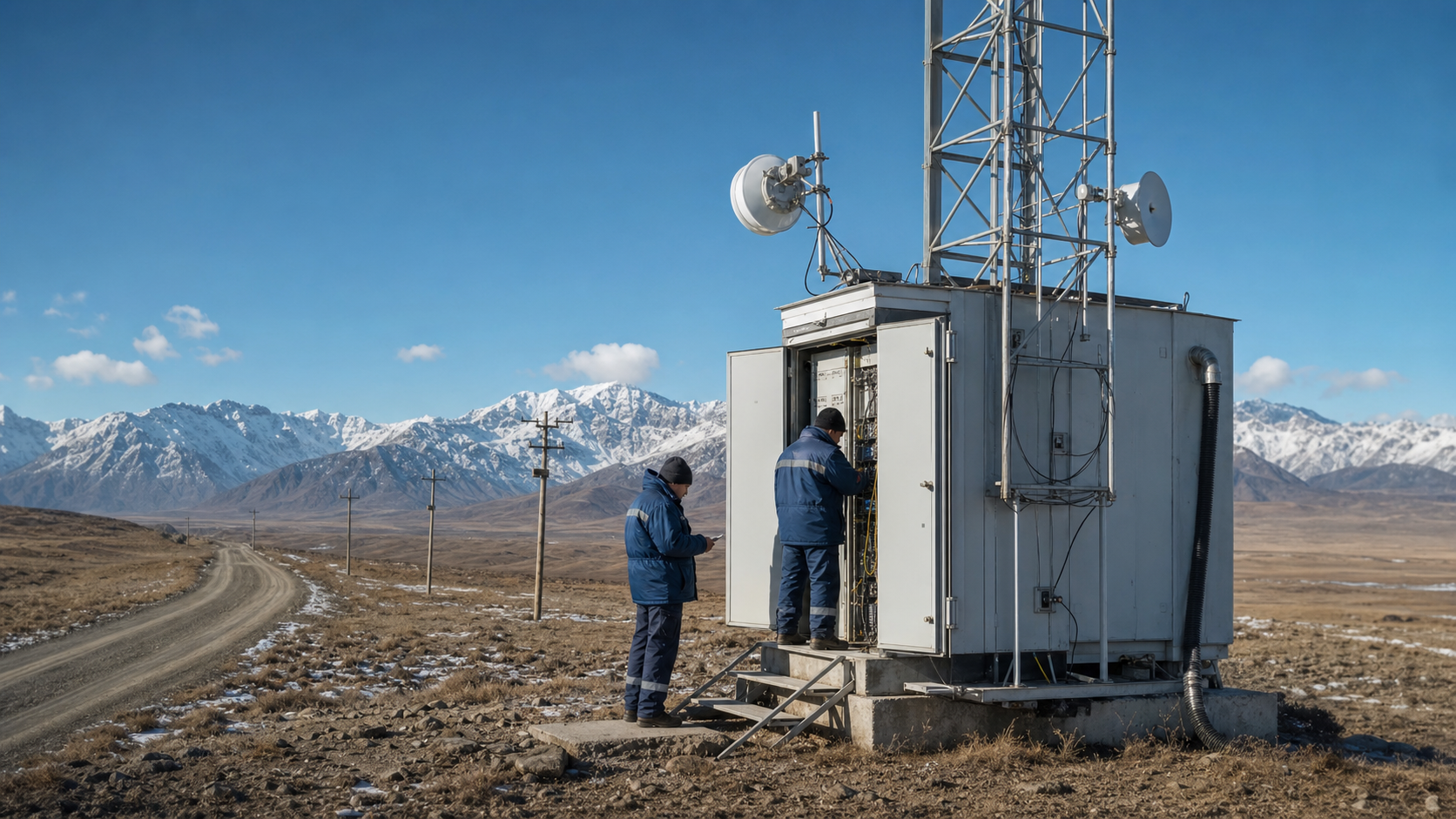
The useful starting point is one remote settlement that must remain reachable all year. Before anyone debates brand, speed or market share, somebody has to pay for the route into that settlement, the local access plant, the active equipment, the power, the premises, the batteries, the monitoring, the customer premises equipment, the field visit when a cable is damaged, and the people who answer calls when the service fails. That annual bill exists whether the village has a rush of new subscribers or only a few institutions and households that pay on time.
That is why Tyvasviazinform should not be analysed like a city broadband entrant. Tuva is large and thinly populated. Official regional profiles put the republic at about 168,600 square kilometres and roughly 338,000 residents in 2025. That is about two people per square kilometre before the reader accounts for the fact that the population is unevenly distributed. Kyzyl and several central or western districts are denser; remote mountain, basin and northern districts are much thinner. A fixed operator in that geography is not just selling bits.
It is selling the practical possibility that a school, clinic, administration, business, family or emergency office can remain connected in a place where a service visit may be a trip, not a dispatch around the corner.
The official and regional record gives the company a real operating base. Tyvasviazinform's own site describes it as the republican fixed telecommunications operator and lists internet access, local and intrazone telephony, communication channels, IP-TV, video surveillance, smart intercom and business services. Its business pages claim about 350 employees, local support, a network monitored around the clock, and a broad set of engineering services. The contact and office pages show a Kyzyl head office and a district-facing service footprint across much of the republic.
That matters because local telecom in a sparse territory depends on repair memory, local rights of way, personal customer service and knowledge of where routes actually run.
The record also shows why the economics are difficult. Regional-government material says more than 3,000 kilometres of fibre were laid to remote villages and districts over a five-year period, connecting socially significant objects with communications and high-speed internet. Spread over Tuva's whole population, that is about 8.9 route metres per resident before local access drops, equipment, power, spares and future replacement are counted. That is not a precise cost allocation, because one route can serve many uses and not every resident sits on that route. It is still a useful scale test.
In a dense city, a few metres of fibre can pass dozens or hundreds of apartments. In Tuva, many kilometres can be needed before a village, public office or school becomes serviceable.
The 2025 regional-government article on Kara-Khol, Kyzyl-Khaya and Kungurtug makes the point sharper. Those three villages were described as the only Tuva settlements with more than 1,000 people still lacking fibre because of distance and difficult terrain, with about 400 kilometres of fibre needed to connect them. On a simple average, that is about 133 kilometres per village. If the minimum population threshold is used as the denominator, the project implies more than 130 route metres per resident before local distribution.
Actual population may reduce that figure, but it does not change the structure of the problem: the hard edge of the market requires route kilometres that no ordinary household tariff can repay quickly.
That does not mean the route should not be built. It means the customer bill cannot be confused with the full economic bill. A household may buy a 100 Mbit/s promotional tariff at a few hundred rubles per month because that is the socially and commercially tolerable price. The network behind that household may require public support, business anchor demand and institutional contracts because its replacement and maintenance costs are much larger than the monthly charge implies. Tyvasviazinform's task is to keep those layers visible to itself, even if the public retail page is simple.
The operating boundary is public, commercial and local at once
Tyvasviazinform's public identity is broader than household broadband. The official about page says the company is a main supplier for government bodies of the Republic of Tuva, federal structures and corporate users. Its business page sells internet, telephony, VPN, Wi-Fi, IP-TV and video surveillance to companies. Its operator page says it rents communication channels on its own transport network, offers E1, VPN, voice-frequency channels and last-mile channels, and provides interconnection and traffic services. Its consumer pages sell broadband, home phone, IP-TV, packages, video surveillance and smart intercom.
The result is not a single product business. It is a local communications utility with several revenue surfaces.
That mix is economically sensible for Tuva. A household broadband base alone would be too small and too support-heavy to justify long routes. A pure public contractor would risk becoming dependent on budget cycles and procurement. A pure wholesale operator would have too little visible demand in many districts. The company needs all three layers: public institutions to anchor routes, households to raise utilisation and political value, and business or carrier services to pay for reliability where customers can justify higher service expectations.
The public-service layer is evident. Regional-government coverage says Tuva connected all 408 socially significant objects to the internet over ten years, including 172 schools, 80 libraries, 89 feldsher-midwife points, 108 rural administrations and 8 fire stations. Another official article says Tyvasviazinform participated in the national Education project, connecting 32 schools and families of more than 100 disabled children for distance learning. The same public record refers to InfoVUZ for vocational educational institutions and a regional health-ministry programme for social-payment automation. These are not incidental users.
They are the reason a remote route has value beyond its retail take-up.
There is also a continuity layer. Tuva-Online reported that Tyvasviazinform provided services for a remote forest-fire monitoring system for the regional forest ministry, including equipment support and communication channels. The official business and operator pages emphasise channel rental, VPN, monitoring and service availability. These functions matter more than ordinary consumer bandwidth because failure has an institutional cost. A forest-fire camera, a rural administration, a health point, an exam site or an emergency service does not value connectivity only by megabits. It values whether the link is present when needed.
The local-support layer is just as important. The official site lists offices or nodes across many districts, while also showing that Tere-Khol lacks a local sales office and is directed to the Kyzyl head office. That detail is not trivial. The hardest places to serve are often also the places where local customer interaction is least efficient. A provider can announce republic-wide ambition, but the economics are made in the gap between a customer's problem and the cost of reaching the customer.
This is why Tyvasviazinform's best operating boundary is narrower than the geography it is expected to help. It can be the local fixed-network specialist for Tuva, the public-institution continuity provider, and a business channel provider where its route control matters. It should not pretend that every remote settlement is equally commercial or that every household account has the same contribution. In sparse territory, averaging hides the truth. Some routes are public policy. Some are commercial. Some are both. The company needs to know which is which.
AS49732 proves a real network, not a national scale story
The internet routing evidence confirms Tyvasviazinform is not merely a reseller brand. RIPE records identify AS49732 as TYVASVIAZINFORM-AS, assigned in 2009, with Joint Stock Company Tyvasviazinform as the organisation behind it. The RIPE organisation object lists the company as a local internet registry, gives its Kochetova Street address in Kyzyl, and matches the Russian registration number used in business registries. RIPEstat showed AS49732 announced at the July 25, 2026 observation time.
The route table is modest. RIPEstat routing-status data showed nine visible IPv4 route entries and 5,120 announced IPv4 addresses, with no visible IPv6 announcement at the observed time. Announced IPv4 routes included the 94.230.240.0/20 range and several more specific 94.230.24x/23 or 94.230.25x/23 routes, plus 185.193.196.0/22 and more specific 185.193.196.0/23, 185.193.198.0/24 and 185.193.199.0/24 routes. RIPE prefix overview also shows an IPv6 resource, 2a0b:980::/32, but the routing-status observation did not show visible IPv6 prefixes. That distinction matters.
A resource can exist without being a visible production announcement in the observed routing view.
The aut-num policy lists upstream imports from AS12389, AS31133 and AS8359, and a relationship with AS44693. In practical terms, Tyvasviazinform is a regional network that depends on larger Russian carriers and its own local routing decisions to deliver service. Multiple upstream paths are helpful. They can improve reachability and reduce single-supplier exposure. They do not make the company independent of national backbones, exchange points, transport prices or upstream service quality.
The modest public internet footprint should discipline the analysis. A 5,120-address IPv4 footprint can support a real regional access network. It does not support a claim that the company is a large backbone carrier. The visible route table is consistent with a local operator whose physical obligations are much larger than its internet-numbering footprint. That mismatch is not a flaw; it is the nature of fixed access in sparse territory. A rural fibre route can be expensive even when the AS looks small.
PeeringDB returned no public network profile for AS49732 in the fetched API lookup. That should not be overread. Many practical regional operators do not maintain a PeeringDB page. But it does support a conservative conclusion: Tyvasviazinform is not publicly presenting itself as a broad open-peering or wholesale internet platform. The public network evidence is enough to prove operational substance; it is not enough to prove high-margin interconnection economics.
The important routing question is therefore not "how big is AS49732?" It is "does the routed network support the physical and institutional commitments that make Tyvasviazinform valuable?" If AS49732 helps deliver public services, business VPNs, local access, video surveillance, telephony and carrier channels over assets the company can maintain, it is an economic tool. If route complexity grows faster than paying demand, it becomes another fixed cost in a low-density market.
Retail pricing is useful, but it cannot carry the trunk
The official tariff pages show an operator trying to keep consumer products within familiar household ranges. The consumer internet page lists 100 Mbit/s promotional pricing at 550 rubles per month for apartments and 800 rubles per month for private houses, with a 100 Mbit/s "Mega" tariff at 1,620 rubles per month and lower-speed "Kontakt" tiers. The telephony page lists home phone service at 264 rubles per month. The IP-TV page lists home IP-TV at 210 rubles per month and advertises more than 150 channels. Bundles put internet and television into a more complete household package.
Those tariffs make sense for adoption. They are not priced like remote-route capital recovery. A 550 ruble monthly tariff produces 6,600 rubles per year before support, taxes, access equipment, transit, billing and collection costs. An 800 ruble tariff produces 9,600 rubles per year. Even the 1,620 ruble tariff produces less than 20,000 rubles per year. Those numbers are not a criticism of the company. They explain why the company needs public and business revenue layers. Household tariffs in Tuva must compete with incomes, mobile alternatives and customer expectations; they cannot simply be marked up until a long route becomes attractive.
The connection charges on official pages help, but they do not solve the lifecycle problem either. A connection fee can recover installation labour and customer equipment. It does not pay for the trunk, the district node, the monitoring system, the next electronics refresh, or the winter trip after route damage. The economics of a dense apartment building and a private house at the edge of a settlement are not the same, even if both buy "internet."
This is why take-up quality matters more than subscriber count. A household that connects over already-built GPON in Kyzyl or a district centre can be a good account. A household that requires a difficult extension, repeated service visits and subsidised equipment may be socially valuable but commercially weak. A public institution on a long route may justify the route; nearby households may improve utilisation. If the order is reversed, and the route is justified by hoped-for household take-up alone, the project is much riskier.
The 2025 GPON update is a positive sign because it focuses on densifying and improving existing access in the capital and ten districts, with upgrades completed in Turan, Saryg-Sep, Beldir-Aryg and Kyzyl-Mazhalyk. Upgrading GPON ports is not as visually dramatic as a new long-distance route, but it can be better economics. It raises service quality where the company already has demand, reduces support problems caused by old access equipment, and lets households and businesses use a route more intensively. In a sparse region, sweating existing route assets matters as much as expanding into the last unserved villages.
Collections discipline is another part of retail economics. Public Telegram-channel mirrors show payment reminders telling subscribers to pay internet bills by the 25th of the month and warning of temporary restriction from the 26th if unpaid. That is ordinary telecom practice, but in this context it is economically meaningful. A small regional operator cannot allow residential arrears to accumulate while it carries power, upstream, payroll and repair costs. Connectivity may be socially important; cash collection still decides whether the operator can keep replacing equipment.
Public demand is the anchor, not a side market
Tyvasviazinform's public-sector role is the strongest economic reason for the company to exist. Official material says the company is a main supplier for Tuva government bodies, federal structures and corporate customers. Regional articles connect the company to schools, distance learning, vocational institutions, social payments, public events, forest-fire monitoring, social facilities and communications history. Registry and contractor profiles point to public bodies as material customers. That combination makes the company less like a pure retail ISP and more like a local continuity contractor with retail access attached.
The upside is durable demand. A rural school, local administration, health point, emergency office or public-safety system cannot easily treat connectivity as discretionary. If service is required for exams, social payments, health coordination, administrative filings or public alerts, the buyer's willingness to keep the service alive is higher than that of a household choosing between broadband plans. Public demand can justify routes that no private operator would build for residential accounts alone.
The downside is concentration and payment risk. Public institutions may be reliable in policy terms, but public budgets are still budgets. Contract renewals, delayed payments, tariff caps, procurement disputes and changes in federal programmes can all shift risk back to the operator. A public customer may be sticky, but it can also be price-sensitive and formal. If service levels are underpriced, the operator carries the repair burden while the institution treats continuity as expected.
The regional-government article saying 408 socially significant objects were connected is encouraging, but it also raises the standard. Once a school, rural administration, fire point or medical facility depends on the link, the operator's outage is not merely a consumer complaint. It becomes a service-delivery problem for the region. Tyvasviazinform's official operator page claims redundancy, monitoring and 99.99% availability. If that is a measured, contract-backed standard for relevant services, it supports premium pricing.
If it is mainly promotional language, the company faces a reputational gap when difficult-terrain failures occur.
The forest-fire monitoring example is a useful model. It layers cameras, equipment support and communication channels onto existing capabilities. That is better than selling only bandwidth because it ties the operator to an outcome: early detection and continuous functioning. The same logic can apply to public administration, education, health and business VPNs. Tyvasviazinform should prefer contracts where the customer pays for continuity and support, not only for a nominal data pipe.
There is a strategic trap here. Because the company is locally embedded, public bodies may expect it to solve uneconomic edge cases. Because the company has a public-service reputation, residents may expect low prices and fast repairs. Because it has its own network, other operators may want last-mile access at prices that do not reflect route risk. The company can only handle that if subsidy, tariff and service-level design are honest. A route built for social need should be funded as social infrastructure. A business SLA should be priced as business continuity. A household plan should not be asked to hide either cost.
Capex and maintenance are seasonal, physical and exposed
The hardest costs in Tuva are not only equipment costs. They are distance, season, access and physical exposure. The 2012 Kyzyl-Shagonar article described a rocky construction section where 24 kilometres of trunk had been laid and work was slower than desired. The same article said rural areas lacked quality internet access, mobile modem capacity was limited, and the older intrazone analogue network from the 1970s and 1980s could not provide the capacity rural districts needed. That historical detail still matters because networks do not jump from scarcity to abundance without carrying the old maintenance burden.
A fibre route has to survive roadworks, weather, power problems, third-party construction, poles, ducts, river or terrain crossings, cabinets and customer premises. The official social-channel material warning residents to check for underground communication lines before construction is a practical signal. Route damage is not a theoretical cost. If a private build or excavation breaks a line, the operator must diagnose, dispatch, repair and explain the outage to users who often care only that the service stopped.
Energy is part of the same burden. Active nodes need electricity. Access equipment, switches, routers, optical transport systems, cameras, intercom infrastructure and customer devices require power and sometimes backup. A city operator can spread node power and backup across many customers. In a small settlement, the same fixed equipment may serve a thin base. When batteries age or a power arrangement fails, the repair cost is not proportional to the number of monthly bills in that place.
Replacement capital is the hidden test. Public articles like to count kilometres built and settlements reached. Financial durability depends on what happens after the first build. GPON equipment, routers, optical modules, batteries, surveillance systems, servers, call-centre systems, vehicles and customer hardware all age. If annual accounts show revenue but not enough renewal investment, the network can appear profitable while service quality quietly decays. If the company spends properly, margins may look thin because maintenance is being recognised honestly.
The 2024 financials suggest little room for error. B2B.house shows revenue of about RUB 697.9 million, cost of sales about RUB 576.6 million, operating profit about RUB 13.4 million and net loss about RUB 3.4 million. Operating profit margin was only about 1.9%. Public registry aggregators indicating 2025 revenue around RUB 765.5 million and net profit around RUB 3.7 million point to recovery, but the implied net margin is still around half a percent. That is a narrow cushion for a company expected to maintain a republic-wide communications role.
The balance sheet is not empty. Public financial pages show fixed assets above RUB 500 million and capital above RUB 600 million. The company has substance. The question is whether the asset base is being renewed at the rate demanded by the geography. In a sparse network, a small underinvestment can have a large service effect because failure points are far apart and alternatives are weaker.
Customers, support and the local labour bargain
Tyvasviazinform's local labour is part of its product. The official site repeatedly emphasises local support, offices, managers, round-the-clock contact and on-site service. In a remote region, that is not just customer service branding. It is a competitive asset. A national carrier may have more capital and broader backbone reach; a local operator may know the route, the district office, the school, the administration and the household support pattern.
The cost is that local support is labour-intensive. A phone call, an office visit, a payment question, an installation check and a field dispatch all require people. Registry profiles and official pages put the workforce in the mid-300s. That is a meaningful team for a regional operator, but not large for the obligations described: household broadband, home phone, IP-TV, business services, VPN, video surveillance, smart intercom, channel rental, public institutions, district offices, routing and repair. The company must standardise where it can and reserve skilled labour for failures that matter.
The office footprint shows both reach and limits. The official offices page lists district offices and communications nodes in places such as Kyzyl-Mazhalyk, Chadan, Saryg-Sep, Turan, Mugur-Aksy, Khandagayty, Shagonar, Samagaltay, Toora-Khem and others. It also says there is no office in Tere-Kholsky district. This is the real map of economics. A sale in a district with a service point is one kind of account. A sale in a hard-to-reach place without a local office is another.
The smart-intercom page is a good example of disciplined local economics. It says the company may co-finance up to 50% of installation if an entrance has more than 15 apartments, while other cases are considered individually. That is the right instinct. A shared entrance with enough apartments creates a base over which installation and service costs can be spread. A smaller case may still be worth doing, but it must be evaluated. That same principle should govern broadband extensions, surveillance projects and business circuits.
The customer app and payment channels matter because they reduce support cost. The App Store page for the My TSI application says subscribers can check balances, view account turnover, change internet tariffs and read company news. The official payment page supports online payment through the Fast Payment System and bank cards. Every payment or tariff change that moves from an office visit or phone call to self-service lowers the labour burden. That is not digital fashion. It is margin defence.
Unofficial and social signals should be used carefully. Telegram-channel mirrors show posts about payment reminders, cable protection and tariff selection. Map reviews and social comments can show frustration with speed, outages or support, but they are not audited measurements. The economic reading is narrower: users judge the company by working service, not by kilometres of fibre or public policy goals. Once a household pays monthly, it behaves like a customer. Public-service language does not excuse poor execution.
Suppliers and upstreams set the price ceiling
Tyvasviazinform has local assets, but it does not control every part of the service chain. RIPE records show upstream relationships with larger networks such as Rostelecom, MegaFon and MTS identifiers. Regional connectivity articles show Rostelecom-linked universal-service and mobile-expansion activity. MTS and Beeline have their own mobile upgrades in Tuva. The same companies can be suppliers, alternatives, competitors or partners depending on the route and customer.
Upstream dependence is normal. A regional AS needs national and wider internet reach. The risk is bargaining power. Large carriers spread backbone, peering, security and operations costs across national bases. Tyvasviazinform must buy or interconnect in ways that make sense for a much smaller traffic base. If upstream terms rise, if a transport path fails, or if mobile substitutes improve, the local operator's room to price above cost can narrow.
The company's official operator page claims a strong local proposition: channel rental on its own transport network, last-mile services, interconnection, local and zonal telephony, redundancy, monitoring and 99.99% availability. That is the right way to defend against national carriers. The company should sell what outsiders cannot easily duplicate: local route control, district presence, public-institution relationships and support accountability. It should not compete only on generic internet price where larger operators and mobile networks can compress margins.
Supplier risk also includes equipment. Public pages refer to GPON, IP-TV media devices, video-surveillance apps, smart intercom, VPNs, IP telephony and monitoring systems. These require vendors, spares, software support and technical staff. Russian telecom operators have had to manage changing vendor availability and import-substitution pressures. The public sources do not give Tyvasviazinform's vendor mix, so the article should not invent one. The general risk is clear enough: a small regional operator can be hit hard by a failed platform if replacement choices are costly or delayed.
Power and infrastructure counterparts matter too. Telecom routes may share poles, ducts, rights of way and sites. Older regional court snippets involving operators and utility assets in other contexts show why support structures and line placement can become disputed. For Tyvasviazinform, the local lesson is practical: route rights, cable protection, utility coordination and construction discipline are part of the cost base. A price that ignores them is not a real price.
The company therefore needs contract discipline. Public customers should pay for service levels and route difficulty. Business customers should pay for VPN, monitoring and support requirements. Other carriers should pay for last-mile use in a way that reflects field risk. Households should get transparent products, but not be used as the hidden funding source for routes built primarily for social need.
Alternatives discipline the company, but do not replace it everywhere
The strongest alternative to a fixed local operator is mobile broadband. Regional-government coverage says mobile service was expected to reach 141 of 152 settlements after 2024 station launches, with 133 settlements on 4G. MTS has reported 4G strengthening around tourism and remote areas, including A(d)yr-Kezhig on the route to Lake Azas. Tuva's digital ministry and Beeline coverage say 4G was added in 11 settlements and expanded in six more, reaching more than 40,000 people in updated coverage. These are real substitutes for many household tasks.
But mobile is not a full replacement for Tyvasviazinform's fixed and institutional role. Mobile service depends on backhaul, power, spectrum, tower economics and the number of users sharing capacity. It can be excellent for a household, tourist or small business. It may be insufficient for a school network, public administration, business VPN, surveillance system, fixed telephony replacement, carrier last mile or high-reliability local service. Fibre also improves mobile economics when it provides backhaul. The relationship is therefore both competitive and complementary.
Satellite is another alternative. The 2024 regional-government article says satellite communication had been brought to 10 hard-to-reach settlements. Satellite is essential where terrain or distance makes terrestrial service uneconomic. It can provide backup and reach. It can also be expensive in capacity, equipment and latency terms compared with fibre or strong 4G. The 2025 article on the three remaining larger villages is telling: the policy answer was not simply "use satellite forever." The answer was to seek high-speed access through universal-service funding and about 400 kilometres of fibre.
Rostelecom is both an alternative and part of the infrastructure context. The 2012 Kyzyl-Shagonar article said Rostelecom had brought trunk fibre to Kyzyl in 2010, expanding internet possibilities in the republic, while rural areas still lacked quality access. The 2024 regional-government article says Rostelecom was expanding base stations under agreement with the government. For Tyvasviazinform, Rostelecom can be upstream, rival, public-programme partner or benchmark depending on the market slice.
The regional competition roadmaps show why alternatives do not erase the local operator. The 2019 roadmap said operators were concentrated mainly in Kyzyl and that Tyvasviazinform had the most significant infrastructure for fixed broadband. The 2026-2030 roadmap still identifies 18 settlements without fibre and 12 without cellular service at the end of 2025. The hard edge remains hard. As coverage improves, the easy customers become more contested while the remaining unserved places stay expensive.
That is a difficult competitive curve: competitors pressure price in better markets, while public need pulls the local operator toward harder markets.
The correct strategy is not to fight every alternative. It is to use alternatives to allocate capital. If mobile can serve a low-density household cluster adequately, Tyvasviazinform does not need to overbuild for pride. If satellite is the only reasonable backup, it should be integrated into continuity planning. If fibre is needed for public institutions, mobile backhaul and business reliability, the company should make sure the route has anchor contracts. Strategy in sparse territory is choosing the right technology for the job, not proving that one network can solve every use case.
The judgement
Tyvasviazinform is economically credible as a local communications utility with disciplined commercial layers. It is not credible as a simple retail broadband growth story. The company has real assets, public recognition, district presence, a routed network, official business and operator products, and a public-sector role that national carriers may not replicate with the same local accountability. Those are meaningful advantages.
The constraint is that almost all of those advantages come with obligations. Local presence means labour cost. Public-sector trust means service expectations. Fibre across remote districts means route maintenance. Channel rental means SLA risk. Smart intercom, video surveillance and IP-TV mean platform support. AS49732 means routing, abuse handling and upstream management. A company can survive these obligations only if customers pay for the specific value they receive.
The financial record argues for caution. The 2024 accounts show revenue but little profit cushion. A small 2025 profit, if the registry-aggregator view is confirmed, is better than a loss but still not enough to justify complacency. A company with hundreds of employees, more than RUB 500 million of fixed assets and republic-wide service obligations needs margin to replace assets before they fail. Thin profit is acceptable if it reflects heavy renewal and public-service stability. It is dangerous if it reflects underpriced obligations.
The company's best economic lane is clear. First, keep public institutions and business continuity contracts at the centre of route economics. Second, use household broadband, IP-TV and smart-building services to raise utilisation where routes already exist. Third, avoid treating every remote extension as a commercial project when it is really public infrastructure. Fourth, price operator channels and business VPNs for field risk, not only bandwidth. Fifth, keep payment, tariff changes and routine support moving into self-service so local labour can be reserved for failures and installations that require physical work.
The public sector has a responsibility too. If Tuva wants the last remote villages, schools, administrations, health points and public-safety systems connected, it should not pretend household subscriptions can cover the full bill. Universal-service funds, republic support, public contracts and transparent service-level payments are the right instruments. Hidden cross-subsidy can keep a route alive for a while, but it eventually blurs which services are profitable and which are social obligations.
The hardest truth is that sparse-territory reliability is not a one-time build. The route must be kept working after the ribbon-cutting, after the first tariff promotion, after the first wave of sign-ups, and after the first cable break. Tyvasviazinform's value lies in being the operator that can make that continuing work visible, fundable and locally accountable.
What would change the view
The judgement would improve if public sources showed three things. The first is settlement-level take-up and churn after GPON upgrades and new route builds, especially in districts outside Kyzyl. If connected settlements show strong adoption without heavy support cost, the household layer is more valuable than the conservative case assumes.
The second is durable public and business contract evidence. Multi-year agreements with schools, clinics, administrations, emergency services, forest monitoring, mobile operators, enterprises or carrier customers that explicitly cover maintenance and service levels would make the fixed asset base more defensible. The strongest evidence would be route-by-route revenue tied to route-by-route maintenance cost.
The third is transparent renewal spending. If Tyvasviazinform is replacing access equipment, batteries, customer devices, routers, vehicles and monitoring systems while staying profitable, the thin margins are less worrying. If profit depends on deferring replacement, the business is weaker than headline revenue suggests.
Other favourable facts would include lower-than-expected cost for the roughly 400 km of fibre to the remaining larger remote villages, verified improvement in outage frequency and repair time, more business VPN or channel-rental revenue using already-built transport routes, and measured evidence that digital payment and self-service reduce support cost.
The judgement would worsen if the remaining unserved settlements require substantially more capital than expected, if public contracts are delayed or repriced below maintenance cost, if route damage becomes frequent, if mobile operators capture the profitable customers while Tyvasviazinform keeps the hardest obligations, or if financial statements show persistent losses after replacement capex is recognised.
The key uncertainty is not demand. Tuva needs reliable communications. The uncertainty is allocation: who pays for distance, who pays for repair, who pays for redundancy, and who pays when the social value of a route is higher than its commercial return. Tyvasviazinform can work if those answers are explicit. It becomes fragile when everyone agrees the connection is necessary but nobody pays its full annual cost.
Sources
- https://btw.media/en/directory/joint-stock-company-tyvasviazinform-ru
- https://tuva.ru/
- https://tuva.ru/about/
- https://tuva.ru/about/contact/
- https://tuva.ru/about/offices/
- https://tuva.ru/faq/
- https://tuva.ru/pay/
- https://tuva.ru/rates/internet/
- https://tuva.ru/rates/telefoniya/
- https://tuva.ru/rates/iptv/
- https://tuva.ru/rates/pakety/
- https://tuva.ru/rates/videonablyudenie/
- https://tuva.ru/rates/umnyy-domofon/
- https://tuva.ru/business/services/
- https://tuva.ru/business/internet/
- https://tuva.ru/business/telephony/
- https://tuva.ru/business/services/vpn/
- https://tuva.ru/for-operators/
- https://apps.apple.com/ru/app/%D0%BC%D0%BE%D0%B9-%D1%82%D1%81%D0%B8/id6757784312
- https://telemetr.me/content/tsi_tuva
- https://vk.com/tyvasvyaz
- https://rtyva.ru/press/news/2951/
- https://rtyva.ru/press/news/1820/
- https://rtyva.ru/press/news/5330/
- https://www.tuvaonline.ru/2025/08/23/v-stolice-tuvy-i-10-kozhuunah-respubliki-vedetsya-obnovlenie-gpon-seti.html
- https://www.tuvaonline.ru/2012/09/07/tyvasvyazinform-provedet-volokonno-opticheskuyu-liniyu-svyazi-do-shagonara.html
- https://www.tuvaonline.ru/2023/04/14/
- https://www.tuvaonline.ru/2021/11/19/istoriyu-razvitiya-svyazi-v-tuve-uvekovechili-tyvasvyazinform-otkryl-korporativnyy-muzey.html
- https://base.garant.ru/72933578/
- https://base.garant.ru/414352913/948c9c0734b6e944a4727660f2d5a027/
- https://www.garant.ru/hotlaw/tyva/819527/
- https://council.gov.ru/en/structure/regions/TY/
- https://www.cbr.ru/tuva/ekonom_profil/
- https://17.mchs.gov.ru/glavnoe-upravlenie/harakteristika-subekta/kratkaya-geograficheskaya-i-socialno-ekonomicheskaya-harakteristika-respubliki-tyva
- https://companies.rbc.ru/amp/ogrn/1021700516518/
- https://saby.ru/profile/1701034426-170101001
- https://companium.ru/id/1021700516518-tyvasvyazinform
- https://b2b.house/company/AO-TYVASVYAZINFORM_b1ba43f6-6450-4bf7-bb58-a244c02fcbdd/financial-statements/
- https://star-pro.ru/proverka-kontragenta/organization/1021700516518--ao-tyvasvyazinform
- https://www.cbr.ru/rbr/insideDKO/doc?id=41297
- https://base.garant.ru/408904583/
- https://rg.ru/documents/2024/04/19/fas-prikaz35-24-site-dok.html
- https://base.garant.ru/72297288/
- https://stat.ripe.net/AS49732
- https://stat.ripe.net/data/as-overview/data.json?resource=AS49732
- https://stat.ripe.net/data/announced-prefixes/data.json?resource=AS49732
- https://stat.ripe.net/data/routing-status/data.json?resource=AS49732
- https://stat.ripe.net/data/asn-neighbours/data.json?resource=AS49732
- https://rest.db.ripe.net/ripe/aut-num/AS49732.json
- https://rest.db.ripe.net/ripe/organisation/ORG-JSCT10-RIPE.json
- https://stat.ripe.net/data/prefix-overview/data.json?resource=94.230.240.0/20
- https://stat.ripe.net/data/prefix-overview/data.json?resource=185.193.196.0/22
- https://stat.ripe.net/data/prefix-overview/data.json?resource=2a0b:980::/32
- https://bgp.he.net/AS49732
- https://bgp.tools/as/49732
- https://ipinfo.io/AS49732
- https://radar.cloudflare.com/as49732
- https://www.peeringdb.com/api/net?asn=49732
- https://tyva.mts.ru/about/media-centr/soobshheniya-kompanii/novosti-mts-v-regione/2025-06-10/mts-podgotovila-set-4g-v-mestah-plyazhnogo-otdyha-v-tuve-k-letnemu-sezonu
- https://tyva.mts.ru/about/media-centr/soobshheniya-kompanii/novosti-mts-v-regione/2024-07-15/k-sezonu-cveteniya-kuvshinok-mts-usilila-set-4g-po-doroge-k-ozeru-azas-v-tuve
- https://mis.rtyva.ru/events/21962/
- https://beelinenow.ru/articles/rost-skorosti-i-pokrytiya-4g-bilayn-rasskazal-kak-uluchshil-svyaz-v-respublike-tyva-v-2022-godu/
- https://www.tuvaonline.ru/2024/07/17/v-tuve-esche-v-dvuh-otdalennyh-selah-poyavitsya-vysokoskorostnoy-internet.html
- https://tuvapravda.ru/natsionalnye-proekty/novaya-faza-czifrovizaczii/
Member Briefing
Deeper Profile Context
Sign in with the right membership level to unlock the full briefing and source notes.
Only for Strategic Circle
Strategic Circle
Open to all readers. Unlock profile briefings after joining and signing in.
Join Strategic CircleOnly for Leadership Alliance
Leadership Alliance
For qualified IP-asset owners and management; sign in to unlock alliance briefings.
Join Leadership Alliance