
Summary
- ISLIM TELCO SAPI DE CV is the legal provider behind the Netwey retail name, not merely an entity with a similar address or an internet-number registration. Netwey’s own approved consumer contract names ISLIM as provider and Netwey as commercial name; independent corporate and regulatory records reinforce that bridge.
- The original Netwey fixed-wireless proposition is a cash-flow product as much as a radio product. A household buys a modem, registers it to one address and adds finite seven- or 30-day data packages when money and demand permit. There is no recurring bill for an unused month, but service stops when the allowance or validity ends.
- The retail relationship belongs to ISLIM, while the most consequential wireless infrastructure dependency is Altán’s wholesale 700 MHz network. Public technical documents show how much serviceability, device binding, session control, traffic accounting and outage exposure can sit across that boundary.
- Netwey’s fibre expansion can reduce dependence on wholesale radio capacity in selected places, but it introduces a different operating model: civil access, installation, maintenance, contractors and long-lived capital. Group financing announcements are evidence of the transition, not audited proof of ISLIM’s standalone subscriber count or profitability.
- A serious buyer should test the precise address, product, registered tariff, equipment ownership, support path, data treatment and outage escalation before purchasing. The most important watchpoints are the wireless-to-fibre customer mix, Altán wholesale terms, contractor performance, service-quality disclosure and the reconciliation of inconsistent public scale claims.
A broadband month that can end on Tuesday
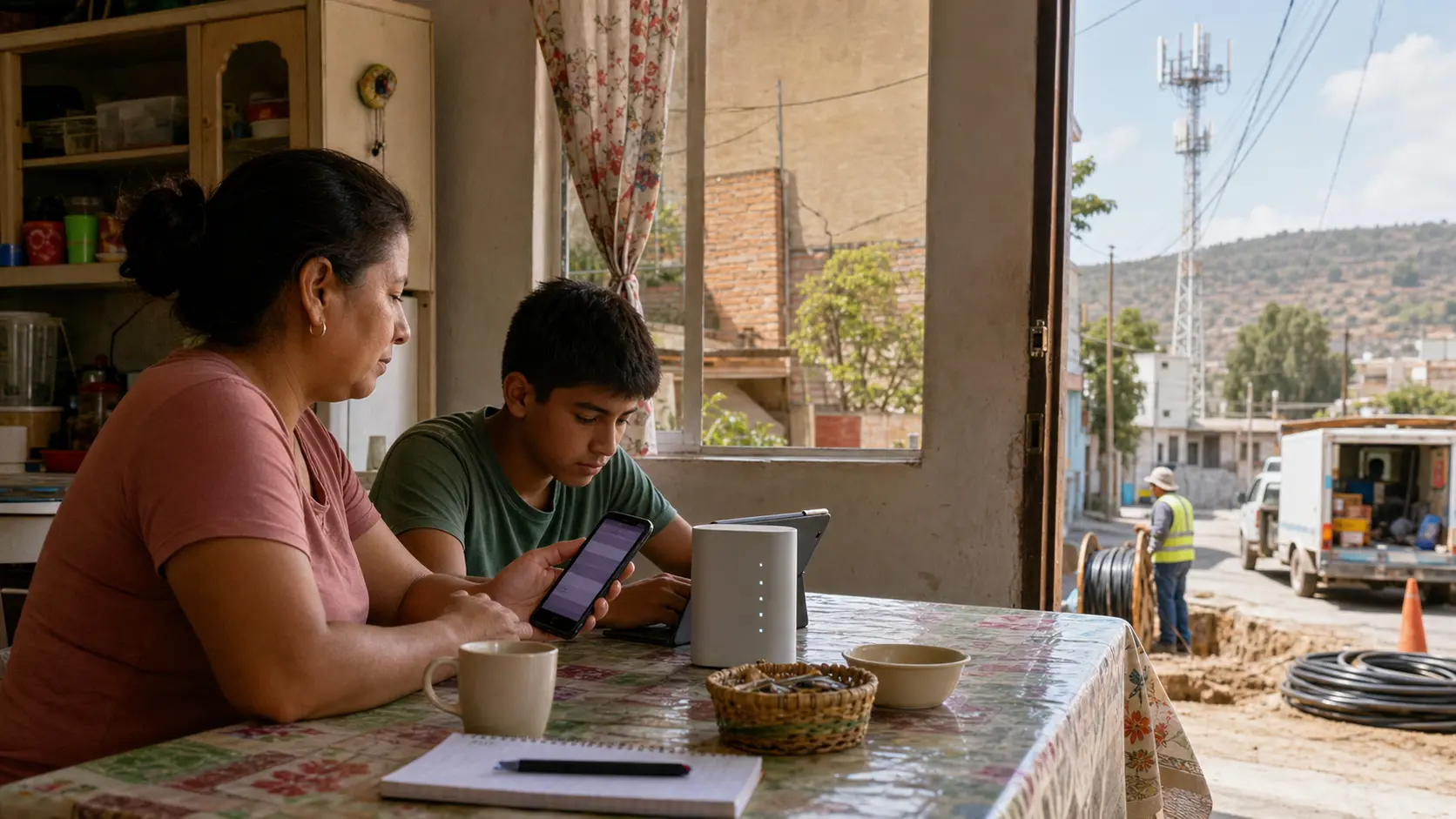
The easiest way to misunderstand Netwey is to begin with a speed test. Begin instead with a kitchen-table decision. A family has a Netwey modem, a school assignment due on Thursday and enough cash on Saturday for a seven-day recharge. It chooses 20 gigabytes. The service may remain technically available for a week, but if a software update, several video lessons and an evening of streaming consume the allowance by Tuesday, the broadband week is over. The radio has not failed. The account has done exactly what the product was designed to do.
That distinction is the centre of ISLIM TELCO SAPI DE CV’s business. On its current home-internet page, Netwey advertises prepaid fixed wireless with no compulsory term and makes the limit conspicuous: its packages are not unlimited. As observed on 17 July 2026, the page offered 20GB for MXN119 and 30GB for MXN149, each valid for a week, and 90GB, 120GB and 140GB monthly packages for MXN429, MXN529 and MXN599. These are a dated observation, not a promise that the prices will remain unchanged. They nevertheless expose the product’s governing unit. Netwey does not principally sell a continuous line at a monthly speed tier. It sells time-bounded buckets of consumption delivered to a registered home.
The company’s frequently asked questions make the workflow unusually legible. The customer buys a modem and a package. The modem needs electricity rather than a new cable into the building. Consumption can be checked through Mi Netwey. Recharges can be made online or through cash-oriented retail channels. If the bucket is depleted before its seven- or 30-day validity expires, another recharge is required. The SIM works only in the Netwey modem, and the fixed service is associated with a registered address. Moving it to another home without changing the registered location can cause it to be blocked.
This is not a minor variation on postpaid broadband. It reallocates risk. ISLIM avoids carrying as much unpaid monthly receivables risk and can serve households whose income arrives irregularly or whose credit history does not fit conventional billing. The user avoids paying for a month in which service is not wanted. In exchange, the user carries consumption risk, recharge friction and the possibility that connectivity disappears at precisely the moment it is most valuable. “No forced term” is therefore only one side of the proposition. The other is “no paid allowance, no service.”
That exchange can be rational. A household beyond an incumbent fibre footprint may value a quickly activated radio connection more than a nominally cheaper wired tariff that cannot be installed. A seasonal worker may prefer not to finance an unused line. A renter may prize a modem over a drilling appointment. But affordability cannot be judged from the smallest recharge alone. It must be judged by the amount of useful connectivity the household obtains, the frequency of top-ups, the cost of the equipment and the quality available at the exact address. Netwey’s most important innovation is not that it made radio broadband look like fibre.
It made home internet behave like prepaid electricity.
The exact company behind the Netwey name
The identity question can be answered without substituting a better-known affiliate or treating a brand as a legal person. Netwey’s legal-document hub lists consumer contracts under the Netwey name and identifies their registration history. The fixed prepaid internet adhesion contract registered as 810-2019 states that the provider is ISLIM TELCO, S.A.P.I., the commercial name is NETWEY and the contracted service is internet. It also cites the national telecommunications-reseller authorisation FET096752AU-517058, valid to 19 April 2028. That is the strongest public bridge because it joins legal provider, retail name, service and regulatory permission in the document that governs the customer relationship.
The 2025 Commercial Practices Code repeats the connection. It says the authorisation was granted in 2018 in favour of ISLIM TELCO and defines the company as “NETWEY” for the document. The code describes online, telephone, WhatsApp and representative-led sales, customer identification, recharge, fault handling and service suspension. In other words, ISLIM is not a dormant name found only in an old contract. It remains the named operator in Netwey’s current public customer-governance material.
Two external identity records add useful, but differently weighted, corroboration. The Global Legal Entity Identifier Foundation record lists ISLIM TELCO S A P I DE CV, Mexican tax identifier ITE180215P68 and a Santa Fe address, with active entity status at the research cut-off. GLEIF is strong evidence for the registered entity and identifier; it does not by itself prove a consumer brand or network role. A Dun & Bradstreet company profile labels ISLIM TELCO SAPI DE CV as doing business as NETWEY and points to netwey.com.mx. D&B is a commercial directory and should not outrank a signed or approved contract, but here it agrees with the primary record.
There is also a network-number clue. LACNIC’s RDAP record for AS272384 names ISLIM TELCO SAPI DE CV as registrant and uses a netwey.com.mx contact address. That is a clean legal-to-domain link, although, as discussed later, the allocation does not prove that Netwey currently originates customer traffic under the ASN.
The conclusion is narrow and firm: the assigned entity, ISLIM TELCO SAPI DE CV, is the provider behind Netwey’s retail contract. It is not necessary—and would be wrong—to replace it with Altán, which supplies wholesale network capability, or with Netwey Infraestructura, an affiliated concession holder associated with fibre development. Those organisations matter because they shape ISLIM’s operating surface. They are not the same company.
One brand, several corporate and infrastructure boundaries
The Netwey name appears across documents that refer to different legal layers. This makes brand-level growth claims easy to over-attribute. An IFT resolution issued in 2025 describes Netwey Infraestructura, S.A. de C.V. as the holder of a 30-year commercial concession granted in 2023. It says Desarrollos Gopca owns 99.8% of Netwey Infraestructura and separately notes that Gopca holds a majority participation in ISLIM TELCO, which has the national authorisation to commercialise telecommunications services. The same resolution concerns investment by IDB Invest and Finnfund in Gopca.
That record supplies a map, not a licence to collapse the map. ISLIM is the retail provider named in the fixed-wireless contract. Netwey Infraestructura is a group affiliate with a concession that can support internet, data transmission and resale of capacity. Desarrollos Gopca is the holding-company layer described by the regulator. Altán is the external wholesale mobile-network operator. A customer may experience all of this as “Netwey,” but due diligence must ask which party owns an obligation, employs or contracts the technician, holds the relevant concession, receives investment and controls the failure domain.
The strongest operational bridge between the retail and investment stories is an IDB Invest environmental and social review. It calls ISLIM TELCO SAPI the company, says it also trades as Netwey and describes financing for expansion of a fibre network belonging to it. The review says Netwey was founded in 2018, served low-income households with fixed and wireless internet, used existing CFE infrastructure for fibre deployment and had more than 1,500 kilometres of fibre at the review date. Because the document arose from lender due diligence and names ISLIM, it is more probative for this article than a generic brand biography.
Yet even that source needs boundaries. Its operational figures are observations and company information assembled for an environmental and social review, not audited financial statements. An IDB Invest project page describes more than 250,000 connected homes and operation in 17 of Mexico’s 31 states, while the review summary describes presence in 27 states. The measures may refer to different dates, products, corporate perimeters or definitions of “presence” and “connected.” Public material does not reconcile them. The proper conclusion is not to select the larger number. It is to mark the denominator as unresolved.
This corporate separation matters most during an outage or complaint. The customer’s contract and first call remain with ISLIM/Netwey even if a wholesale radio element failed. A fibre cut might belong to an affiliate’s infrastructure or a contractor’s work package. A radio-core problem may sit inside Altán. Investors may have governance rights at Gopca. Brand unity is commercially useful; operational accountability still follows control.
Prepaid is a technical architecture expressed as a price
Prepayment is often treated as a marketing choice. In Netwey’s case it reaches deep into system design. To sell 20GB for seven days, the operator must know that a valid package exists, when it began, how many bytes have been counted, whether the modem is at an authorised location, which SIM and device belong together and what should happen at depletion. The retail promise depends on identity, provisioning, policy and charging systems operating in concert with the wholesale network.
The 810-2019 contract says recharging manifests acceptance of the relevant offer and that the customer must purchase another recharge after the included benefits are consumed. The 2025 practices code says service is suspended when a package is exhausted and restored with a new package. The FAQ adds the visible customer path: acquire equipment, activate it, register a location, connect through the local Wi-Fi credentials, observe consumption, top up and troubleshoot. This is a state machine presented as convenience.
That state machine has at least six control points. First is serviceability: can the registered address receive an adequate Altán signal or a Netwey fibre connection? Second is subscriber creation: are the customer, SIM, modem and address correctly recorded? Third is payment: did a cash or online transaction reach the balance system? Fourth is entitlement: did the correct data bucket and validity period attach to the account? Fifth is network enforcement: does the access network recognise the device, apply the service policy and account for traffic?
Sixth is restoration: when a customer recharges after depletion, how quickly do all relevant systems converge on the new state?
Each control point creates a distinct support diagnosis. “No internet” might mean no radio coverage, a misplaced modem, no power, an exhausted balance, a payment not posted, a SIM-device mismatch, an address lock, a congested cell, an Altán platform failure or a Netwey account error. A conventional fibre subscriber also faces layered faults, but prepaid fixed wireless adds entitlement and location state to every investigation. That is why the FAQ’s first advice is to check balance before treating a loss of service as a network failure.
The economic advantage is equally structural. Prepayment limits credit exposure and makes cash sales possible through stores. Small packages reduce the entry amount. A self-installable modem can avoid the cost and delay of a truck roll. The trade-off is that recharge distribution, real-time charging and customer education become core infrastructure. If a store clerk cannot find the correct payment flow, the access network may be healthy while the household remains offline. Netwey acknowledges this edge case in its FAQ by offering recharge manuals and asking customers to identify a retail point whose staff need training.
The reasonable inference is that Netwey’s moat, if it has one, is not exclusive radio technology. It is the orchestration of a low-friction retail channel around wholesale connectivity: address qualification, modem distribution, cash acceptance, package accounting, support and the ability to turn a recharge into a working session. Public sources do not disclose activation success rates, payment-posting latency, recharge failure rates or cost per support contact. Those are precisely the metrics a serious investor or wholesale partner would request.
Altán owns the decisive wireless dependency
The connection to Altán is not speculative. In June 2018, El Economista reported that ISLIM was the first customer of Altán’s Red Compartida. The report described a wholesale contract signed in March 2018 and notified to the relevant authorities, and it traced ISLIM’s incorporation and reseller authorisation in the same period. A second contemporary account of Altán’s first three contracts said the ISLIM agreement was non-exclusive, that commercial terms were confidential and that Altán managed its own network hardware and software while clients remained responsible for equipment outside Altán’s network boundary.
Netwey’s own traffic-management and network-administration policy is more direct. It identifies ISLIM as Netwey, says the service is provided through Altán and explains that network-management measures are based on Altán’s policy. It describes a best-effort service and the possibility of congestion management. This establishes the material dependency: for the original wireless product, Netwey does not simply buy generic backhaul at a replaceable edge. It relies on a named wholesale access network for the radio service its customers perceive as Netwey.
Altán’s public model is designed for such separation. Its operator onboarding page explains that end users obtain services through retail operators that buy from the wholesale network. Altán supplies coverage and wholesale products; the retailer packages, sells and supports an offer. This can lower entry barriers because a retail provider need not acquire national spectrum and build every radio site before signing its first household. It can also concentrate failure risk because many retail brands share the same upstream access platform.
Independent reporting helps size the shared dependency without assigning Altán’s entire base to Netwey. In October 2021, DPL News reported Altán’s claim that the Red Compartida supported about 1.142 million fixed-internet subscriptions, all reached through third-party operators. That is an Altán aggregate, not an ISLIM subscriber count. In February 2025, El Economista reported Altán’s claims of roughly 18 million indirect users, MXN9.15 billion of 2024 revenue and its first month of operating profit in January 2025. Those figures show a network of national consequence, but they remain company-reported numbers carried by a newspaper.
The dependency has a public-policy layer. The IFT’s 2022 decision on Altán’s restructuring and financing maintained the wholesale-network model while changing financing and coverage timing after financial distress. In 2025, the regulator imposed conditions on CFE’s indirect participation, including safeguards intended to preserve independence, non-discrimination and competitive neutrality. ISLIM therefore depends not only on Altán’s technology. It depends on a wholesale institution whose solvency, coverage obligations and governance have required continuing state attention.
What the reference architecture reveals—and what it cannot prove
Altán publishes a detailed technical appendix for its standard home-broadband wholesale service. It is valuable because it shows how a retailer can be integrated with the Red Compartida. It is not a public copy of ISLIM’s confidential contract, and it must not be read as proof that Netwey selected every optional element. Used carefully, it exposes the control questions that matter.
At the radio layer, the reference service uses LTE in band 28 at 700 MHz. A compatible customer-premises router contains a SIM, and the design can bind that SIM to an approved router identifier. The service is anchored to an authorised location rather than sold as freely mobile broadband. Those architectural features align with Netwey’s public statement that its SIM only works in its modem and that using the modem away from the registered home can trigger a block.
Altán’s side of the reference boundary includes the radio access network and mobile-core elements needed to establish a data session. The retailer can remain responsible for substantial commercial and policy systems: subscriber records, package creation, charging, provisioning, payment, customer portals, logistics and device management. Interfaces exchange serviceability, activation, package state, address changes, usage and billing records. The appendix also discusses the ability to use Altán-provided internet egress or a retailer-controlled alternative, with different implications for DNS, firewalling and carrier-grade address translation.
This matters because “uses Altán” does not answer who controls the customer experience. Consider four examples.
First, coverage qualification may depend on Altán radio information while the accuracy of the address captured by Netwey depends on the retailer’s sales process. If an agent records the wrong location or promises coverage based on an optimistic map, the wholesale signal may be within specification and the installation may still disappoint.
Second, a usage dispute crosses systems. Altán can measure traffic at its network elements and generate usage records; Netwey must translate those records into a retail bucket, display the remaining amount and explain depletion. The customer needs a single answer even if the raw accounting traverses two companies.
Third, device security is joint. Altán can require network-compatible, validated equipment and enforce SIM-device association. Netwey controls procurement, distribution, local Wi-Fi credentials, customer instructions and much of the replacement workflow. A secure radio attachment does not guarantee that the home router has current firmware or a strong Wi-Fi password.
Fourth, capacity management is shared. The standard appendix addresses interface utilisation and scaling triggers, but the subscriber sees only variable performance. Cell load, radio conditions, transport capacity, internet egress, Wi-Fi interference and application behaviour can all alter a speed test. A best-effort label is accurate but insufficient for procurement. Buyers need observed busy-hour performance at the intended address.
The reference architecture also explains why switching wholesale networks would not be instantaneous even if ISLIM’s 2018 Altán agreement is non-exclusive. A new wholesale partner would require coverage matching, device and SIM compatibility, provisioning integration, charging reconciliation, address migration, support training and probably equipment replacement. Contractual non-exclusivity reduces one barrier; it does not erase technical switching costs.
No public evidence reviewed for this article provides Netwey’s exact network diagram, its chosen internet-egress option, its current interfaces with Altán, its modem firmware lifecycle, its redundancy arrangements or its wholesale unit prices. The appendix should therefore be used as a due-diligence test framework, not a diagram of the deployed service.
The ASN paradox: a number is not a network
ISLIM has an autonomous-system number, but that fact is easy to inflate. LACNIC’s official record assigns AS272384 to ISLIM TELCO SAPI DE CV. The record is useful identity and resource evidence: it shows that the exact company obtained a globally unique routing identifier. It does not show that the identifier is actively announcing customer prefixes, carrying Netwey traffic or operating a national backbone.
At the research cut-off, the public IPinfo profile for AS272384 showed no IPv4 or IPv6 prefixes and classified the ASN as inactive. A route collector can miss private use, future preparation or transient announcements, so “no observed prefixes” is not proof that ISLIM has no network engineering. It is proof that an analyst should not convert an ASN registration into a claim of visible internet scale.
The distinction is especially important here because a wholesale model can work without the retail provider originating every customer session under its own ASN. Internet egress could be supplied by Altán or another arrangement. Conversely, ISLIM could activate the ASN later as fibre operations mature or as it takes more control of egress. The right watchpoint is change: new route announcements, prefixes, upstream relationships, routing-security objects and evidence linking those resources to the service. Until then, AS272384 is an option and an identity marker, not demonstrated production reach.
Coverage is not capacity, and capacity is not a household experience
The 700 MHz band is well suited to broad coverage because lower-frequency radio generally travels farther and penetrates buildings better than higher-frequency alternatives. That is central to the social and commercial case for the Red Compartida. It also means that a single coverage claim says little about the capacity available to one household at eight in the evening.
Netwey tells users to check their address before purchase and to place the modem near a window, away from concrete walls and microwave ovens. Those instructions admit the physical variability of fixed wireless. The same package can feel generous in a lightly loaded cell with a clear signal and inadequate in a dense area, an obstructed building or a household with many devices. Data volume and radio performance are separate constraints: unused gigabytes do not guarantee a good video call, and a fast connection can consume a small bucket quickly.
Altán’s reported population coverage is useful for national context, not a service-level commitment to Netwey customers. Likewise, the DPL figure of more than one million wholesale fixed subscriptions in 2021 shows adoption across retail operators, not a guaranteed Netwey port at a particular tower. For purchasing, the hierarchy should be: serviceability at the exact address; measured signal and busy-hour throughput; the registered tariff’s promised and minimum characteristics; then national coverage.
The address lock has an operational purpose. A fixed-wireless product can be dimensioned around where devices are expected to attach. Allowing every modem to roam freely could concentrate traffic in unplanned cells and blur the distinction between fixed and mobile offers. But the control also creates a user burden. Netwey’s FAQ says customers receive two free address changes and later changes cost MXN103, subject to coverage at the new home. That is a modest explicit switching charge, yet the larger cost may be uncertainty: a service that works at one address may not work after a move.
The economics hidden inside five recharge buttons
The smallest Netwey package minimises cash outlay, not unit cost. At the observed prices, 20GB for MXN119 is about MXN5.95 per included gigabyte; 30GB for MXN149 is about MXN4.97; 90GB for MXN429 is roughly MXN4.77; 120GB for MXN529 is about MXN4.41; and 140GB for MXN599 is about MXN4.28. These simple divisions ignore unused data, taxes already embedded in retail prices, traffic mix, wholesale commitments and equipment cost. They nevertheless show the incentive: larger buckets reduce the nominal price per gigabyte, while small weekly packages sell liquidity.
For a household that repeatedly exhausts 20GB, the weekly entry price can become expensive. Four 20GB recharges would cost MXN476 for 80GB, more than the observed 90GB monthly package at MXN429. Five would cost MXN595. The customer does not need a finance model to discover this; repeated outages and top-ups provide the lesson. Netwey’s FAQ itself suggests moving to a larger package when early depletion happens often.
Comparison with fibre must be address-specific. Telmex’s public home page, observed on the same research date, advertised a 120Mbps internet-only tier at MXN349 per month and a telephone-plus-internet tier at MXN389, subject to its terms, technology and availability. That makes 90GB of Netwey wireless at MXN429 look costly where Telmex fibre at the advertised conditions is actually installable. Where it is not installable, the comparison is fictional. Netwey is competing not only with another tariff but with the time and capital needed to reach the address.
This is why a conventional average-revenue-per-user analysis is incomplete. Prepaid revenue varies with household cash flow, season, school calendars, entertainment use and periods of non-use. Gross margin depends on confidential Altán wholesale pricing, committed capacity, recharge-channel fees, modem subsidy, customer acquisition, support and bad-device replacement. Churn is also ambiguous: an account that has not recharged for six weeks may be lost, temporarily dormant or waiting for income.
The original PC Capital investment announcement said in 2022 that Netwey had grown revenue at a compound annual rate of about 400% since 2018 and that investment would fund its own infrastructure and fibre. That is an investor statement, not audited evidence of sustainable unit economics. The historic IDB project record carried ambitious customer-growth objectives but now labels that project cancelled. Targets, approvals, disbursements and outcomes are different facts. The public record supports rapid expansion and continuing capital needs; it does not disclose wireless contribution margin, fibre payback or standalone ISLIM profitability.
The contract is part of the network
For prepaid connectivity, consumer governance cannot be separated from technical operation. Netwey’s contract defines when a recharge becomes binding, what happens at depletion, how equipment is treated, what information a user must provide and which complaint mechanisms apply. Those rules determine whether an automated suspension is a correct state transition or an unfair surprise.
Mexico’s minimum telecom-user rights page gives consumers a public route to understand rights and seek help. The official NOM-184 telecom commercial-practices text sets requirements around adhesion contracts, clear information, cancellation, consumer attention, interruption, refunds, equipment and privacy. Netwey’s publication of Profeco registration numbers and its practices code makes the paper trail easier to inspect than an unregistered web-only offer.
Registration is not the same as flawless execution. A consumer still needs the package shown at sale to match the package loaded, the balance meter to be intelligible, a recharge to post promptly and a complaint to produce a traceable answer. An automated system can comply with the package logic and still fail the user if the sales representative promised “monthly internet” without explaining that it ends at 90GB, or if the portal displays usage too late to prevent depletion.
Netwey’s practices code promises multiple contact and sales channels and describes notice around planned interruptions. Its customer-service procedure page provides a public support path, while the site lists service hours rather than claiming continuous human assistance. Those details matter during a weekend fault. The access network operates continuously; the retail escalation window may not.
The purchasing test is therefore documentary as well as technical. Before paying, capture the exact offer, tariff registration, data allowance, validity, equipment price and ownership, installation or activation charge, address-change rules, minimum or expected speed, cancellation path and bonus terms. After activation, retain the account identifier and recharge receipts. In a layered network, evidence is a consumer control: it helps distinguish “package expired,” “payment missing” and “network unavailable.”
The public fixed-wireless contract dates from 2019, while other Netwey documents have later revision dates and the product page changes dynamically. That is not necessarily a contradiction; contracts, tariffs and operational codes have different update cycles. It does mean the current applicable document set should be confirmed at purchase rather than inferred from a single PDF.
Support is where a wholesale network becomes a retail service
A household does not call Altán when the Netwey modem shows a red light. It calls Netwey. This makes support the place where ISLIM must absorb the complexity of wholesale radio, retail charging, customer Wi-Fi and physical equipment into one diagnosis.
The first-line diagnostic sequence is sensible: check balance, power-cycle the modem, inspect the indicator and confirm location. But a durable support operation needs more than scripts. It needs visibility into package state, payment events, device and SIM binding, recent address changes, radio registration, local cell incidents, traffic-policy actions and replacement eligibility. It also needs an escalation contract that moves an Altán-side fault upstream without forcing the consumer to understand corporate boundaries.
The IDB Invest environmental and social review gives rare evidence about the labour model. At its review point it described only ten direct employees and roughly 1,230 subcontracted workers, with much marketing, customer service, fibre assembly and maintenance outsourced. These counts are dated and may cover a group perimeter rather than today’s exact ISLIM headcount. They nevertheless show that contractor governance is not peripheral. The customer experience and the safety of fibre deployment can depend on people who are not direct Netwey employees.
Outsourcing can convert fixed payroll into variable capacity and let a growing operator enter many communities quickly. It can also create inconsistent sales explanations, uneven installation quality, repeat visits and weak incident feedback. The review identified work-at-height, electrical and road risks, and it called for stronger environmental and social management, contractor controls and an external grievance mechanism. Those are lender due-diligence findings, not proof of a realised accident or systematic abuse.
The operating questions follow. What percentage of wireless activations works on the first attempt? How many support contacts are balance questions rather than network faults? What is the average time to replace a modem? How are field partners trained and audited? Does one ticket remain visible when responsibility moves from a retail agent to Altán? What compensation is applied after a verified outage? Public sources do not answer these questions. In a prepaid wholesale model, they are closer to the product’s quality than a national coverage map.
The data trail is larger than the pink modem
Fixed wireless looks physically simple: a SIM, a router and a power socket. Its data trail is not. The customer account can contain name and contact details, address and geolocation, modem and SIM identifiers, package history, payments, traffic records, support interactions and network-security events. Address enforcement and usage charging require more observation than a cash purchase might lead a customer to expect.
Netwey’s privacy notice dated 30 October 2025 names ISLIM as the responsible party and describes processing for service provision, billing, portability, complaints, network security, legal cooperation and other purposes. It discusses location, network and traffic information; transfers to service providers, group companies, authorities and transaction counterparties; payment processing through a PCI DSS-certified provider; and automated or artificial-intelligence-supported processing with a route for human intervention.
The notice is evidence of declared practice, not an independent security audit. It does not disclose the retention period for every traffic field, the modem firmware support term, encryption architecture, privileged-access model, incident history, security certifications held by ISLIM itself or the division of breach-notification responsibility with Altán. Its opening language also appears to refer to recruitment candidates before moving into subscriber processing, a drafting discontinuity that warrants clarification rather than an accusation of non-compliance.
The technical boundary creates at least four security owners. The customer controls local device placement, Wi-Fi password use and connected equipment. Netwey controls account recovery, sales data, payment integration, customer portal, device distribution and much of the support record. Altán controls critical radio and mobile-core surfaces and can hold network telemetry. Contractors and processors may handle installation, support, analytics or payments. An incident can cross all four.
The SIM-device binding and registered-address controls help limit unauthorised use and preserve the fixed-service model. They can also make recovery harder when a modem fails or is resold. Account recovery becomes a security-sensitive support workflow: a weak process could expose a customer’s service or data, while an overly rigid process could strand a legitimate user. Buyers should ask how identity is verified for modem replacement, address change, phone-number change and portal reset.
There is no public evidence in the frozen source set of a confirmed ISLIM customer-data breach or a regulator security sanction. That absence must not be converted into “no incidents.” It means no substantiated company-specific incident was found in the reviewed sources. The defensible assessment is of exposure and control questions, not an invented breach history.
When the wholesaler fails, the retailer still owns the explanation
Shared infrastructure creates shared blast radius. In April 2024, Expansión reported repeated disruption affecting services on Altán’s network. The report said the regulator had received explanations that involved equipment used to register and enable users and noted that several retail operators depended on the common platform. In October 2025, N+ reported an Altán incident that the network attributed to an unusual external signalling surge overloading central platforms, with partial national effects on voice and data before mitigation.
Neither report establishes the number of Netwey households affected. It would be wrong to turn an Altán-wide event into a company-specific outage claim without Netwey telemetry. The incidents are still relevant because they demonstrate plausible common-mode failures in the infrastructure on which ISLIM’s wireless service relies.
Wholesale dependence changes incident management in three ways. First, detection can be asymmetric. Altán may see a signalling or core-platform event before Netwey can distinguish it from individual modem faults. Second, communication can lag while the retail support team waits for an upstream diagnosis. Third, remedy is split: Altán may repair the network, but ISLIM must explain the impact, reconcile package validity or consumption and apply any retail compensation.
A prepaid bucket makes time restoration especially subtle. Suppose a seven-day package remains valid during a six-hour outage. Restoring the radio does not restore the household’s lost opportunity to use those hours. If an incident causes repeated modem retries or inaccurate accounting, a user may also dispute consumption. A robust operating agreement should therefore cover notification, incident severity, customer-impact data, usage reconciliation, service credits and post-incident evidence—not merely network availability.
Public documents reviewed here do not reveal ISLIM’s service-level agreement with Altán, its escalation timers, its redundant access options or its customer-credit policy for an upstream incident. The 2018 reporting says the contract was non-exclusive, but no evidence shows that Netwey wireless sessions fail over to another radio network. Resilience should be demonstrated by architecture and tests, not inferred from contractual freedom.
Fibre changes the dependency rather than eliminating it
Netwey’s more recent story is increasingly about fibre. The shift is strategically logical. Fibre can provide larger or unlimited allowances, more predictable capacity and a stronger foundation for households whose usage has outgrown prepaid wireless. Owning or controlling more access infrastructure can also move economics away from a per-session wholesale relationship.
But fibre is not simply Altán without the radio. It demands rights of way or infrastructure access, local construction, optical distribution, customer drops, installations, power and active equipment, spares, field maintenance and long-term capital. The IDB environmental and social review says Netwey uses existing CFE infrastructure and highlights contractor-heavy fibre assembly and maintenance. That can accelerate deployment while making permit, pole, safety and contractor controls central to continuity.
Netwey’s legal hub includes a Profeco-approved 2023 postpaid fibre contract, again naming ISLIM in the customer-document chain. A separate simplified registered tariff for a 50Mbps fibre offer in Ameca illustrates why procurement must be locality-specific: it states a particular speed, price, minimum characteristics and installation conditions for that offer, not for every Netwey address.
Capital announcements show the direction, with important attribution limits. Proparco said in June 2026 that it was investing US$10 million in Netwey, joining PC Capital, IDB Invest, Finnfund and management. It described a transition since 2022 from fixed wireless toward fibre, claimed more than 110,000 fibre subscribers and set an objective of connecting another 53,000 households. These are Proparco and company representations around an investment; they are not audited ISLIM-only results. The IFT corporate map indicates that investment can occur at the Gopca holding layer, while customer contracts and network assets may sit with different group companies.
The strategic question is whether the two access models reinforce each other. Wireless can test demand and acquire customers before fibre reaches a neighbourhood. Fibre can graduate high-consumption households and release radio capacity. The brand, recharge network and support channels can lower customer-acquisition cost across both. On the other hand, two architectures double some complexity: different contracts, installation flows, fault trees, capacity measures and cost bases must coexist under one brand.
Netwey’s future should therefore not be described as a simple migration from “rented network” to “owned network.” Some wireless customers may remain economically rational for years. Fibre can still depend on leased ducts, poles, transport or third-party contractors. The more useful metric is the proportion of customer value and service control that Netwey can reliably govern in each location.
Competition changes at the edge of the fibre footprint
Netwey does not compete in one national broadband market. It competes address by address against whatever can actually be installed and paid for. In a dense fibre-served area, an unlimited or high-capacity wired product at a comparable monthly price makes a 90GB wireless bucket hard to defend on raw value. In a settlement where fixed infrastructure is absent, a self-installed prepaid modem can be the fastest practical route to household connectivity.
There are at least four competitor classes. National fixed operators compete on fibre or cable speed, unlimited use, bundles and established field operations. Other retailers on Altán can offer a similar radio footprint, making brand, equipment, package design and support more important than underlying coverage. Mobile hotspot use competes for households with light demand and an existing handset, though it may be less suitable for shared fixed use. Satellite broadband reaches another set of remote addresses but usually brings different equipment, power, sky-view, latency and price considerations.
The most revealing competition is internal to Netwey’s own portfolio. A wireless customer who regularly buys multiple buckets is a candidate for fibre where Netwey can build it. Migrating that customer can improve experience and reduce radio load, but it can also cannibalise a flexible prepaid revenue stream and require installation capital. The company must decide where fibre density and expected tenure justify the build.
Wholesale competition is equally important. Altán’s non-discriminatory wholesale mandate can lower entry barriers for many retailers, but it also limits the exclusivity of the underlying radio coverage. ISLIM’s differentiation must sit above the radio—distribution, address data, pricing, customer trust, support, brand and perhaps an owned fibre path. If those layers are weak, a rival buying from the same wholesaler can reproduce much of the offer.
Public evidence does not provide Netwey’s churn, acquisition cost, share by municipality, porting flows, customer satisfaction or overlap with competitor footprints. The IFT’s preliminary fixed-internet market report for the first quarter of 2025 lists large reporting providers but does not present Netwey as a separate line in its main table. That absence is not a zero and may reflect reporting scope, classification or scale. It shows why brand claims cannot replace regulator-compatible subscriber definitions.
Switching is contractually easy and operationally uneven
Prepayment lowers one kind of lock-in. A wireless customer can stop recharging without negotiating the end of a long billing term. That is a meaningful consumer benefit. It does not make every switching cost disappear.
The modem is a sunk cost if it cannot be used with another provider. Netwey says its SIM works only in the supplied modem, while the Altán reference design allows SIM-device binding and approved-equipment controls. Public sources do not establish whether a customer-owned Netwey modem can be unlocked or reprovisioned for a technically compatible service, so resale value should not be assumed. A new provider may require a new device.
There is also an information cost. The household has learned where to recharge, how to read the indicators, how quickly each package depletes and which room has the best signal. It may have registered an account and trained family members on Mi Netwey. Those are small investments individually, but together they create inertia.
Address changes create another friction. Two moves are described as free and later changes carry a charge, but coverage must be requalified. A renter cannot carry the historical performance of one cell to another. Fibre switching introduces familiar physical costs: installation appointments, landlord permission, cable routing, equipment return and interruption between providers.
For a small business, the largest switching cost is continuity. A store using Netwey for messaging, cloud point of sale or card-terminal backhaul may prefer to keep a functioning modem as a secondary link even after fibre arrives. That is a plausible use, not a Netwey-marketed service-level guarantee. The buyer should test whether the package, address restriction, network translation and support terms fit business use and whether the fair-use rules permit the intended workload.
The correct conclusion is that Netwey has low contractual retention for prepaid wireless but potentially meaningful device, learning, coverage and continuity retention. That can be healthy if customers stay because the service is convenient. It becomes problematic if equipment portability and account closure are opaque. Churn data segmented by voluntary stop, temporary dormancy and fibre migration would clarify the difference.
The household procurement test
A household should not ask only “Does Netwey cover my municipality?” It should run a short acceptance test at the exact home.
First, verify the legal offer. Record the package, price, gigabytes, validity, modem cost, activation terms, address-change rule and applicable contract. Confirm whether the product is wireless prepaid or fibre and whether any salesperson’s promise appears in the registered terms.
Second, test the physical service during the return or cancellation window. Place the modem as instructed, then measure download, upload, latency and packet loss at morning, afternoon and busy evening hours. Repeat from the devices and rooms that matter. Note whether rain, wall position or concurrent use changes results.
Third, test the account. Activate Mi Netwey, record the starting allowance, run a known amount of traffic and see whether consumption updates intelligibly. Make a small recharge through the intended channel and measure posting time. Save the receipt.
Fourth, test support before an emergency. Confirm service hours, account-recovery requirements and the path for a payment that posts without restoring service. Ask how an Altán outage is communicated and how validity or credit is handled.
Finally, compare the likely monthly pattern rather than the cheapest button. A 20GB week may be economical for occasional use and poor value for daily video. Check wired and satellite availability at the same address, including installation and equipment. The best product is the one that survives the household’s actual cash flow and traffic, not the one with the largest coverage slogan.
The small-business and institutional procurement test
Netwey’s consumer proposition can be useful to a microbusiness, clinic, school outpost or field office, particularly as a quickly installed secondary connection. That does not turn a consumer best-effort package into an enterprise service. Procurement should make the difference explicit.
Start with workload. Estimate ordinary and peak gigabytes for cloud applications, software updates, security cameras, video meetings and backups. A finite bucket can disappear quickly when a device synchronises in the background. Ask whether traffic shaping, carrier-grade network address translation or location binding interferes with VPNs, inbound connections, remote management or payment terminals. The public standard Altán appendix describes several possible egress arrangements, but it does not reveal the exact Netwey implementation.
Then test failure. Disconnect power and time recovery. Exhaust a test bucket and observe alerts and restoration after recharge. Open a support case and record whether the agent can distinguish account state from network state. If continuity matters, use a router capable of failing over to an independently sourced network; two retail brands on the same Altán infrastructure may share a common-mode outage.
Security review should cover modem administration, default credentials, firmware updates, remote-management access, logging, account recovery, processor access and breach notification. Privacy review should map which traffic and location records sit with ISLIM, Altán and other processors. A promise that payments use a PCI-certified provider is helpful but does not cover the rest of the customer-data environment.
Contract review should identify service levels, maintenance notice, compensation, equipment replacement, support hours, data rollover, termination and dispute paths. The consumer contract and public practices code are not substitutes for a negotiated institutional agreement where operations depend on connectivity. If no stronger commitment is offered, the buyer should price Netwey as best effort and design its own redundancy.
For a public or development-finance buyer, contractor and social controls also matter. Request current evidence that lender action items have been closed, including grievance handling, field safety, supply-chain controls and environmental treatment of batteries, modems and electronic waste. The investment narrative is about inclusion; the procurement test should verify that deployment practices do not externalise avoidable risk onto local workers and communities.
Evidence gaps that should remain gaps
The public evidence is unusually strong on legal identity and the existence of the Altán dependency. It is much weaker on current operating performance. A responsible assessment must preserve that asymmetry.
There are no audited ISLIM financial statements in the frozen evidence pack. Investor announcements describe rapid growth, capital commitments and subscriber objectives, but they do not disclose revenue by wireless and fibre, gross margin, cash burn, debt, churn, modem subsidy, wholesale cost or capital expenditure by legal entity. Those figures should not be reconstructed from brand-level claims.
There is no reconciled current subscriber series. Historic materials refer to more than 90,000 families, later project materials to more than 250,000 connected homes and Proparco to more than 110,000 fibre subscribers. These may all be internally consistent if they use different dates, products and definitions. The sources do not demonstrate that consistency. A clean disclosure would show wireless active accounts, fibre active lines, unique homes, geography and measurement date.
There is no deployed architecture diagram. Altán’s standard appendix illuminates possible interfaces but not Netwey’s selected topology, internet egress, redundancy, policy systems or security configuration. AS272384 is allocated to ISLIM, yet no public prefixes were observed in the reviewed routing profile. That combination is a question, not a contradiction.
There is no company-specific public postmortem for the upstream incidents cited. The articles establish Altán failures and shared-network risk, not Netwey impact. ISLIM’s incident detection, customer communication, credit and escalation performance remain unverified.
There is no independent longitudinal service-quality dataset for Netwey in the reviewed pack: no address-level busy-hour speed distribution, latency, packet loss, activation failure, recharge-posting time, complaint rate, repair time or modem replacement rate. Customer anecdotes could generate hypotheses but would not substitute for a representative sample.
There is no complete security-assurance record. The privacy notice explains declared processing, but public evidence does not establish ISLIM’s security certifications, penetration-test results, firmware support policy, retention schedule, privileged-access controls or breach exercise outcomes. Absence of a reported breach in this research is not evidence that none has occurred.
Finally, there is no current proof that all environmental and social action items identified in the 2024 lender review are closed. It would be unfair to assume they are open; it would be equally unfair to call the financing “impact” without testing implementation.
Holding these gaps open is not timidity. It protects the article’s central finding. The legal bridge between ISLIM and Netwey is proved. The wholesale dependence on Altán is proved. Everything beyond that should carry the evidentiary weight it has actually earned.
What to watch as Netwey moves from radio reach to fibre depth
The first watchpoint is product mix. Proparco’s 2026 announcement suggests fibre has become a substantial business. Future disclosures should show whether wireless accounts are growing, declining or serving as a funnel into fibre, and whether the models are profitable in different settlement types.
The second is wholesale exposure. Altán’s financial health improved by its own reported operating measure, but its restructuring history and changing public-sector governance remain relevant. Watch wholesale tariff changes, service-level terms, coverage milestones, major incidents and evidence of fair treatment among retail operators.
The third is network control. New route announcements from AS272384, published prefixes, routing-security registrations or named upstreams would indicate that ISLIM is exercising more visible internet-layer autonomy. Fibre concession activity and asset ownership should be attributed to the correct group company.
The fourth is consumer clarity. Netwey should make it easy to match each live offer to a registered tariff and current contract; explain gigabyte depletion in ordinary language; publish useful service-quality measures; and state what happens to package validity during a verified outage. Any gap between salesperson language and the finite-bucket product is a governance risk.
The fifth is contractor execution. Investors should look for closure evidence from the environmental and social plan, alongside first-time installation success, repeat-visit rates, worker incidents, grievance outcomes and e-waste handling. A fibre footprint is only as durable as the crews and controls that build it.
The sixth is support integration. Upstream incident notifications, payment reconciliation and address changes should produce one customer-visible ticket. A retailer that can explain layered failures quickly turns wholesale dependence into an efficient model. One that cannot merely passes complexity to households least equipped to absorb it.
The seventh is affordability after consumption. Track the effective monthly spend of customers who buy several weekly packages, the rate of early depletion and migration to larger buckets or fibre. The smallest recharge proves access to a transaction. It does not prove access to a month of useful broadband.
These watchpoints are measurable. They avoid the false choice between celebrating Netwey as an inclusion success and dismissing it as a reseller. ISLIM has built a real retail, contract and support layer on top of a real wholesale network. The quality of the business lies in how well those layers meet.
The modem is simple; the bargain is not
Netwey’s fixed-wireless offer compresses a national infrastructure stack into an appliance that can be carried into a home and plugged into a wall. That simplicity has value. It lowers installation friction, turns irregular cash into periods of connectivity and gives ISLIM a route to households that conventional fixed operators may not reach on acceptable terms.
The simplicity ends at the casing. Behind it sit ISLIM’s contract, sales channels, payment ledger, package engine, support operation and privacy duties; Altán’s spectrum, radio access, mobile core and shared failure domain; group financing and fibre assets; and a contractor network that increasingly builds and repairs physical infrastructure. The customer sees one brand because someone must integrate all of that.
The thesis is not that wholesale dependence makes Netwey weak. Wholesale access is what made this form of entry possible. Nor is it that prepaid service is inherently exploitative. For a household with irregular income or no wired option, paying only when connectivity is needed can be more useful than a nominally superior monthly plan.
The test is governance. Does the package explain itself before it runs out? Does a recharge reliably become service? Can support locate a failure across company boundaries? Are Altán incidents translated into timely customer remedies? Can fibre investment produce better capacity without losing control of contractors and capital? Are scale and inclusion claims defined well enough to be checked?
ISLIM TELCO SAPI DE CV is the company accountable for answering those questions to the Netwey customer. Altán may own the radio dependency, investors may fund the next fibre kilometre and affiliates may hold infrastructure rights, but the retail promise remains at ISLIM’s side of the modem. A week of broadband is a small purchase. Making it dependable requires an institution.