
Summary
- Polibrás has a verifiable operating footprint rather than merely a persuasive website: Brazilian government records identify the exact legal company, TOTVS documentation names a Polibrás sales-force integration, Apple lists the company as seller of its core PoliEquipes app, and Google identifies it as developer of multiple customer-branded distribution apps.
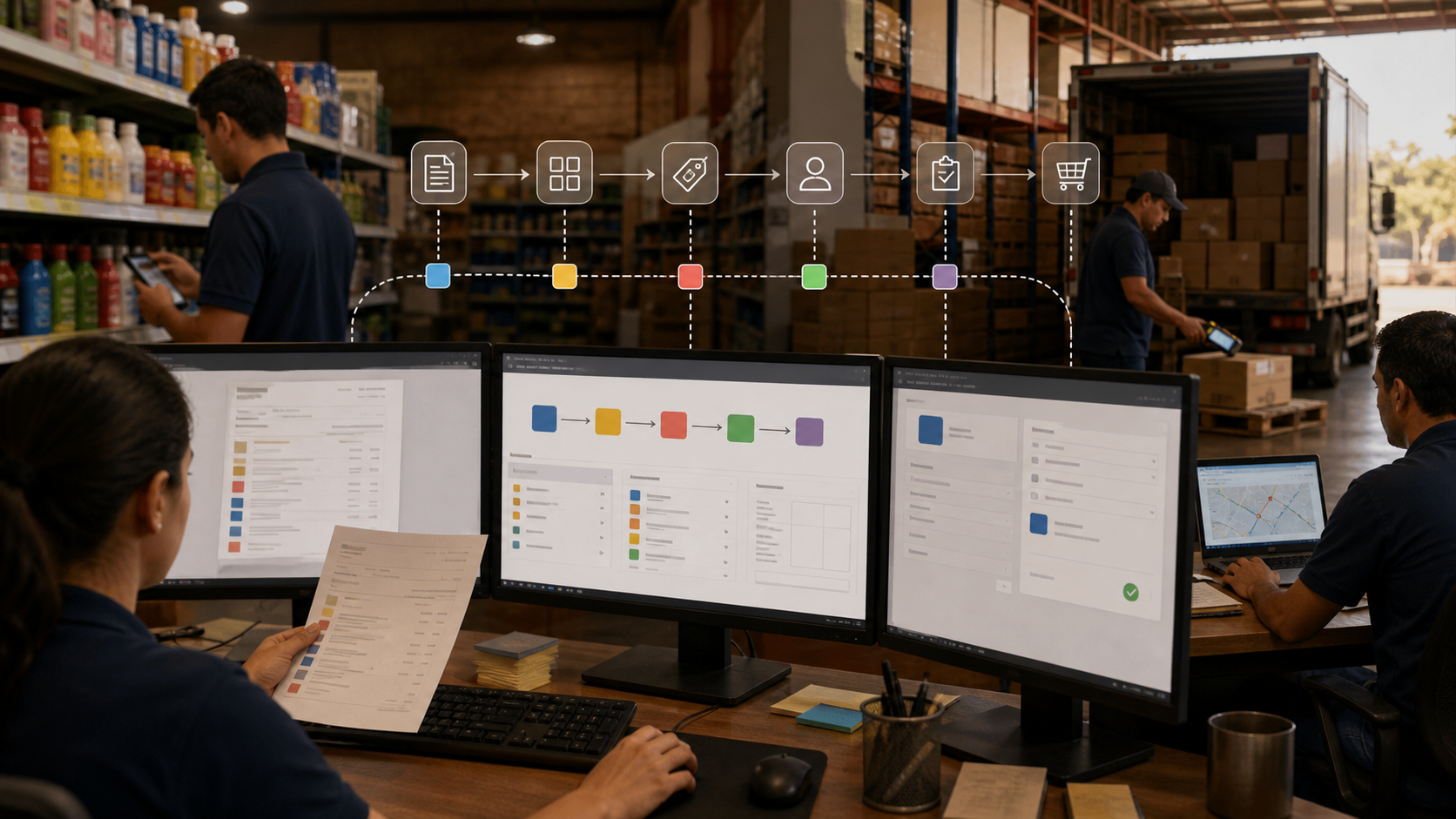
- Its most consequential role is translation. E-Pedidos turns retailer order documents into structured entries for an ERP or sales system, while PoliEquipes, Monitore and Roteirizze turn commercial policy into the daily sequence of customers, prices, visits, locations and approvals that a field team can execute.
- The same embedded rules that create efficiency also create switching costs. Customer and product mappings, ERP connectors, route histories, mobile synchronisation, branded apps, training and exception handling can become more expensive to replace than the licence itself.
- Public materials establish real customers, support channels and one offer-specific set of SaaS terms, but they do not provide a complete production assurance pack. A buyer still needs contractual evidence for uptime, recovery, security testing, encryption, data export, integration ownership and an executable exit.
The half-hour that changes the economics of a route
The revealing unit of work at Polibrás is not a login or a dashboard. It is the interval between receiving an order and being able to act on it.
In 2021, the trade publication Distribuição, produced by Brazil’s wholesale-distribution association ABAD, described a customer with 29 stores sending orders to Grupo Ibiapina. The old process could consume more than a day as a salesperson re-entered product descriptions and quantities before the warehouse could begin separation. The publication reported that Polibrás software cut the processing interval to less than 30 minutes. The time saved, Ibiapina’s commercial manager said, could be used to strengthen the customer relationship rather than transcribe documents. The independent ABAD account called the tool Polipedidos PDF; Polibrás now markets the relevant document-recognition proposition as E-Pedidos. The naming history should be confirmed in a purchase, but the operating bridge is unusually clear: retailer document, recognition and review, structured commercial data, then fulfilment.
That half-hour matters because a wholesale order is perishable even when the goods are not. Stock can be allocated elsewhere. A price campaign can end. A credit limit can be consumed by another transaction. A truck can leave with unused space. A missing item can become an empty shelf, which then becomes a retailer’s lost sale and a manufacturer’s lost visibility. Manual entry does not simply consume clerical time; it delays every decision that depends on a valid order.
Polibrás is best understood as the software layer before the invoice and before the route. It sits between the formats in which people actually work—PDFs, phones, customer visits, local knowledge—and the controlled records on which a distributor invoices, separates, ships and collects. That position can be commercially powerful. It is also unforgiving. A tool that saves 23 hours on a normal day can cause disproportionate damage if it accepts the wrong product, repeats an offline order, applies an outdated price or sends a salesperson to the wrong territory.
This is why the investment case cannot stop at “automation with AI.” Recognition is only the opening act. The durable value lies in how accurately Polibrás carries the customer’s commercial rules across unreliable networks and between systems owned by different suppliers. The durable risk lies in the same place.
Proving which Polibrás this is
The name presents a basic diligence hazard. “Polibras” and similar spellings appear across unrelated businesses and domains, including companies outside Brazilian enterprise software. The relevant company here is the exact directory entity Polibrás Brasil Software Ltda, not a namesake, a customer brand or a product label.
The bridge begins with legal identity. Brazil’s Portal da Transparência identifies POLIBRAS BRASIL SOFTWARE LTDA under CNPJ 41.336.116/0001-83 and classifies it as a limited business company. The BNDES Prosoft consultation independently lists the same legal name and CNPJ among Brazilian software companies. Polibrás’s own company page repeats that CNPJ, the Aquiraz address and the legal name while presenting E-Pedidos, Roteirizze, Monitore, PoliEquipes and PoliAtividades as its products.
The bridge then leaves company-owned territory. Apple lists PoliEquipes Anywhere with POLIBRAS BRASIL SOFTWARE LTDA as seller. Google Play attributes customer-branded apps—including CANTU B2B, Grupo Multigiro App, Biz Distribuidora, Roma Distribuidora, Nova Era App, DSL Distribuidora and Elsons App—to the same legal developer and Aquiraz address. These listings do not prove that every customer uses every Polibrás product, but they do prove a company-to-software-to-customer connection that a collection of logos cannot.
The strongest integration bridge comes from a third party whose software often sits on the other side of the connection. A detailed TOTVS WinThor manual contains fields explicitly “utilizado para o força de vendas Polibrás,” including a payment-plan field for the Polibrás sales-force partner. The WinThor documentation is historical in parts, so it is not proof of the currently supported connector version. It is nevertheless direct evidence that Polibrás was integrated into the commercial rule set of a major Brazilian distribution ERP, not merely exporting a generic spreadsheet.
ABAD’s older supplier and partnership guide adds historical continuity. It says PolibrásNet was founded in 1992, describes sales-force mobility, server and application integration, customisation, routing and support, and names customers across distribution and industry. Some of that entry was likely supplied by the company, and its customer totals do not align neatly with today’s website. It should be treated as corroboration of market presence, not an audited census. Taken with government identity records, app-store seller records, the TOTVS manual and ABAD’s separate customer reporting, however, the identity and operating bridge is sufficient.
The software layer between an order and an invoice
An ERP is designed to preserve commercial truth: which customer is buying, which legal entity will invoice, which product code is valid, what stock is available, which price and tax treatment apply, whether credit permits the sale, and what must happen next. A field-sales tool is designed to let a representative act without carrying the ERP’s complexity into every shop. E-Pedidos has a third task: convert a buyer’s chosen document into data the other two systems can understand.
Polibrás says E-Pedidos receives an order in the customer’s layout and produces data ready for an ERP or sales-force system. Its case material says the salesperson sends a PDF, reviews the interpreted content and follows the order. That review step is important. It implies that the practical design is not “machine decides, warehouse obeys,” but “machine proposes a structured order, an authorised person confirms it, then downstream controls apply.” A buyer should insist that this distinction survives implementation.
The hard technical work is not extracting a number from a page. It is resolving meaning. A retailer may call a product by its own code, abbreviate a description, order by consumer unit while the distributor sells by case, or place identical-looking goods in different tax or promotional arrangements. One document can contain delivery dates, store destinations, free goods, substitutions, notes and totals that do not map one-for-one to the distributor’s records.
The system has to know whether “12” means bottles, packs or cases; whether a line is a purchase or an informational total; and whether the product belongs to the branch that will fulfil it.
No public technical paper explains E-Pedidos’ current recognition method, confidence thresholds, mapping store, exception queue or training procedure. It would be wrong to invent them. What can be inferred from the verified workflow is that successful operation requires at least three forms of translation: document structure into line items, retailer nomenclature into distributor nomenclature, and a proposed order into the receiving system’s validation rules. The second translation is likely the stickiest because it accumulates customer-specific knowledge.
The receiving ERP must remain authoritative for commercial controls. If a recognition service silently overrides price, stock, credit, minimum order, branch, tax or payment rules, a fast order can be worse than a slow one. TOTVS describes WinThor as spanning purchasing, inventory, sales, logistics, finance and fiscal operations, and its sales-force integration guidance tells integrators to align scope in advance and verify which fields are supported. That is a warning against treating “integrates with the ERP” as a complete specification.
A good implementation therefore records every transition: original document, interpreted line, mapping applied, human change, validation response, final order number and any rejection. It also makes replay safe. If a connection fails after the ERP accepts an order but before E-Pedidos receives confirmation, retrying must not create a duplicate. The public material proves the workflow’s commercial purpose. It does not establish these control details, which belong in acceptance evidence.
E-Pedidos is a labour reallocation system
The most credible E-Pedidos claim is not that software can read a PDF. It is that the seller’s scarce time moves from transcription to selling.
Polibrás reports that Grupo Multigiro reduced the time required to process more than 70 orders from 24–48 hours to roughly two or three hours, and that more complex key-account orders fell from one or two hours to about 30 minutes. The Multigiro case is company-published and should be treated as a customer claim rather than a controlled study. It is made more credible by the independent Google Play record, which identifies Polibrás as the developer of Grupo Multigiro’s ordering app and directs support to a Multigiro address.
The Ibiapina evidence is stronger because ABAD independently quoted the customer on the document-processing gain. Polibrás’s own Ibiapina case adds implementation detail: a sales supervisor led the project, colleagues standardised product names, codes, prices and customer identification, and the software was supplied with data from the distributor’s ERP. The company reports that return losses attributed to order-completion errors fell from 10% to zero in the first five months. That outcome is plausible but not independently audited in the available material, so it should remain attributed.
The labour effect has a second side. Removing typing does not remove work; it changes its shape. Someone must maintain mappings when a retailer adds a store, a distributor changes a code, a manufacturer repackages a product or a price table changes. Someone must investigate low-confidence lines and rejected orders. Someone must decide whether the source document, the mapping or the ERP is wrong. A salesperson may spend less time entering lines while an operations specialist spends more time maintaining clean reference data.
That is not a defect. It is the normal economics of automation: repetitive effort is exchanged for governance and exception management. The mistake is to count only minutes saved by representatives and ignore the cost of keeping the translation accurate. A credible business case measures touchless acceptance, review time, rejected lines, downstream corrections, duplicate orders, returns caused by entry error, mapping maintenance and time from receipt to warehouse release. It also separates normal accounts from the difficult accounts with unusual documents, mixed units or frequent catalogue changes.
The product’s real value appears when the exception rate remains low as volume and customer variety rise. If every new retailer needs extensive manual tuning, revenue can grow while service effort grows almost as quickly. If mappings are reusable and review focuses on genuine ambiguity, Polibrás gains operating leverage and the distributor gains a faster commercial cycle. Public sources show impressive examples; they do not reveal the distribution of outcomes across all 215-plus customers the company currently claims.
A route is an allocation of commercial attention
Roteirizze is described as route optimisation, but distance is only one variable. Its product page says it assigns customers to portfolios and days, sets visit frequency, forecasts route revenue, estimates service time, accounts for holidays, reallocates low-potential customers and adjusts when customers or representatives change. This is not just navigation. It is a recurring allocation decision: which customers receive human attention, how often, from whom and at what expected return.
That distinction matters in distribution. The shortest path can be commercially poor if it over-serves familiar stores, neglects a growing account, places a specialist with the wrong customer or sends the representative to a shop on a day when its buyer is absent. Polibrás itself describes the “comfortable route”—the habit of revisiting easy relationships while harder or more distant opportunities receive less attention. A route engine can challenge that habit, but only if the supplied priorities reflect strategy rather than merely encode yesterday’s sales.
The offer-specific Roteirizze terms hosted by Senior reveal the required ingredients. A remote implementation asks for representative names, hierarchy and home coordinates, plus customer assignments, categories, coordinates and addresses. The terms also specify a local Linux integration machine and hosting in the Polibrás cloud. This is unusually useful evidence because it shows where the optimisation depends on the customer: route quality begins with complete and accurate coordinates, customer classification and assignment data.
Roteirizze’s recommendation can have organisational consequences. Rebalancing a territory changes earning opportunity, travel burden and ownership of relationships. Forecasting revenue by route can influence targets and supervision. Reallocating a low-potential customer may be economically rational but can become self-fulfilling if reduced attention suppresses future sales. A buyer needs controls for manual exceptions, reasons for changes, approval levels and a record of who accepted each territory move.
Polibrás publishes endorsements from JSB Distribuidora and Grupo Ibiapina. Its JSB case says the distributor moved from undefined territories and manual route creation to assigned regions and parameterised routes. These are supplier-published outcomes, useful for identifying the intended control surface but insufficient for estimating a universal return. A purchaser should test route recommendations against a holdout territory, not only compare them with a visibly inefficient manual baseline.
The deeper point is that Polibrás can sit upstream of revenue without ever booking the revenue itself. By determining visit frequency and sequence, it shapes which demand gets discovered. That gives the route layer strategic importance—and makes transparent override and measurement essential.
Monitoring turns field activity into management data
PoliEquipes, Monitore and PoliAtividades extend the control surface from planning into execution. PoliEquipes combines orders, visit journeys, check-in and check-out, targets, fixed periodic routes, competitor-price research and custom checklists. Monitore shows representative location, forecast revenue, planned and completed visits, and stores with a sale. PoliAtividades adds field surveys, photos, before-and-after evidence, shelf gaps, timers and visit reports.
Together, these tools convert a manager’s question—“What happened in the territory today?”—into recorded events. That can improve coaching and reduce the lag between a missed visit and corrective action. It can also intensify workplace surveillance. Location, timestamps, photographs and productivity measures concern identifiable workers and sometimes identifiable shop owners. The operational benefit does not remove the need for a lawful purpose, proportional collection, retention limits, role-based access and clear worker communication.
The quality of the resulting management data depends on how events are interpreted. A check-in proves a device reached a location under defined conditions; it does not prove a useful commercial conversation occurred. Time in store may indicate diligent service, a difficult problem or an idle phone. A photograph can evidence shelf execution but can also capture people or commercially sensitive surroundings. A “positive” visit usually means an order was obtained, yet rewarding that measure alone can encourage representatives to favour easy low-value orders over difficult account development.
The tools should therefore support judgement rather than replace it. Managers need context for exceptions: customer closed, buyer absent, safety issue, wrong address, stock unavailable, credit blocked or visit merged with another account. Representatives need a way to challenge an incorrect location or route assignment. Access to individual location history should be narrower than access to aggregate territory performance.
Polibrás’s privacy materials say it may process location, behaviour, transaction history and other variables for service, security, improvement and personalisation. Its privacy policy is broad and has an effective date of December 2020. It is useful as notice, but a corporate customer should not mistake a website policy for the complete allocation of responsibilities for workforce and retailer data. The purchase agreement should identify who decides the purpose of each use, who acts on instructions, which subcontractors are involved, where information is held, and what happens when an employee leaves.
The commercial opportunity is strong: planning, execution and outcome can be compared in one daily loop. The governance burden rises for exactly the same reason.
Offline work turns the phone into a temporary source of truth
Field software in Brazil cannot assume uninterrupted connectivity. Anatel explains that the regulatory coverage requirement can be satisfied with signal across at least 80% of the urban area of a municipal seat, and its consumer guidance explicitly discusses coverage and shadow zones. Representatives travel through buildings, roads, peripheral districts and rural areas where a coverage map is not a guarantee of usable service. Offline operation is therefore not a convenience feature; it is part of service continuity.
Polibrás’s FAQ says a good sales-force platform should work online and offline. A public help article supplies a more concrete clue. When switching users on a shared device, PoliEquipes instructs the representative to synchronise first so unsynchronised information is not lost, to confirm that orders are current, and to keep users on the same app version. Those instructions prove that the device can temporarily hold meaningful state and that version and synchronisation order matter.
This changes the architecture of risk. While disconnected, the phone may hold customer details, prices, stock snapshots, credit information, route assignments, location history and unsubmitted orders. A lost or shared phone is no longer just an endpoint for a cloud service; it is a small operational store. When the connection returns, the software must reconcile what happened in the field with changes made elsewhere.
The difficult cases are predictable. Two representatives may edit the same customer. Stock may fall below the quantity shown on the phone. A price or campaign may expire. A credit block may be imposed. A salesperson may press send, see no confirmation and press again. The device clock may be wrong. The user may switch accounts before a queue is cleared. An app upgrade may change validation behaviour while some phones remain on the old release.
Procurement should turn these cases into tests. Place orders offline, change price and stock upstream, then reconnect. Interrupt the connection at each stage of submission. Repeat an identical order and verify that only one is accepted. Remove a user while the phone is disconnected and confirm what remains accessible. Fill device storage. Restore from a dead battery. Upgrade half the fleet first. Measure how the support team identifies and repairs a stuck queue.
Security testing must cover the same state. The OWASP Mobile Application Security Verification Standard treats secure local storage as a distinct control group, alongside authentication, network communication and resilience. A buyer should ask how offline data is encrypted, how keys are protected, whether screenshots and backups expose information, how remote revocation works, and whether a rooted or compromised device is detected.
Offline capability is one of Polibrás’s most valuable promises because it preserves the selling day. It is also where reliability, security and support become inseparable.
WinThor shows where integration becomes dependency
“Integrates with any ERP” is a sales phrase; a working connector is a long-lived joint responsibility. Polibrás’s public pages make the broad claim, while the TOTVS evidence shows one historically concrete relationship. WinThor exposes distribution rules for products, customers, branches, price plans, credit, order origins and sales-force use. The Polibrás-specific fields in its manual demonstrate that integration reached beyond a file landing in an inbox.
That depth produces value. A representative can see the right assortment, price and payment conditions; an order can arrive without re-entry; managers can route based on customer history; and E-Pedidos can feed an established commercial process. It also produces coupling. A change in a WinThor routine, field, authentication method or supported service can break behaviour that neither vendor controls alone.
TOTVS’s integration guidance says new sales-force integrations should be aligned with commercial and product teams and that supported fields must be checked. That language suggests an important procurement rule: compatibility must be stated by version, endpoint and business function, not by logo. “WinThor integrated” should expand into a matrix covering customer and product loads, price and stock freshness, credit, payment plans, order create and cancel, returns, branch selection, taxes, promotions, status feedback and error handling.
Ownership is equally important. The Senior-hosted Roteirizze terms require a local Linux integration machine but say the SaaS is hosted in the Polibrás cloud. A failure can therefore cross the customer’s network, the local connector, Polibrás hosting and the ERP. The service desk must be able to identify which segment failed without sending the buyer between suppliers. Logs should share a correlation reference from field action to ERP response. Credentials should have least privilege and a documented owner. Connector upgrades should be tested against the customer’s actual rules before production release.
The buyer also needs to know where transformation logic lives. If product conversions, customer aliases or payment mappings are configured only inside Polibrás, they become part of the switching cost. If they live in custom code maintained by a consultant, continuity depends on that consultant. If they are split across both vendors, neither side may possess a complete specification. Documentation, export and change control matter more than the language in which the connector is written.
This is the central architectural tension in Polibrás. The more faithfully it reflects a distributor’s peculiar commercial rules, the more useful it becomes. The more those rules are embodied in proprietary configuration and undocumented integrations, the harder it becomes to test, upgrade or replace.
The customer footprint is visible, but unevenly measurable
Polibrás says it serves more than 215 companies, more than 30,000 users and customers in 21 Brazilian states. An older ABAD guide said more than 600 companies and roughly 30,000 users. The difference may reflect active customers versus historical projects, corporate groups versus installations, or a change in counting. There is no basis to choose one explanation. The discrepancy is a reason to request a consistently defined customer cohort, not a reason to dismiss the footprint.
The app stores provide a useful lower bound. Cantu, Multigiro, Biz, Roma, Nova Era, DSL and Elsons each have a distinct branded app whose developer details point back to Polibrás. Download bands range from hundreds to thousands. These bands are not active users, paying seats or successful transactions; store counts can include reinstalls and old devices. They do show that Polibrás has repeatedly delivered customer-facing mobile software rather than only a single corporate app.
The apps also show different stages of upkeep. Biz’s Google listing was updated in January 2026, while several branded ordering apps show their latest listed update in 2024. That does not by itself mean abandonment: a stable app can remain useful, and release timing varies between stores. It does mean a purchaser should examine the supported operating-system range, security patch policy and ownership of customer-branded releases rather than infer the condition of the whole estate from one app.
Customer scale varies. Nova Era describes 29 business units and operations across three northern states. Cantu and Multigiro’s app listings describe retailer ordering, price consultation and order-status workflows. These are consequential business channels. Their presence supports Polibrás’s claimed specialisation in wholesale execution, even though app-store evidence cannot reveal what share of each customer’s orders or field workforce runs through the software.
Case claims must remain attributed. Polibrás says Donizete’s customer app expanded ordering beyond representative hours and reached locations its field team did not cover; the Donizete case reports that more than 90% of app orders occurred outside commercial hours. That is a powerful example of software changing channel economics, but it is not an audited metric. A buyer should ask a reference customer for order share, peak-day performance, support history, upgrade disruption and the effort required to add a new branch or price policy.
The independent evidence answers “Is Polibrás deployed?” with yes. It does not answer “How consistently does it perform across the installed base?” Public disclosure is not granular enough for that. Reference calls and a representative pilot remain essential.
Implementation begins with cleaning commercial truth
Polibrás’s strongest case study inadvertently explains why implementation risk is high. Ibiapina did not merely activate E-Pedidos. A project leader studied the tool, trained colleagues and standardised product names, codes, prices and customer identifiers before feeding ERP data into the service. The improvement was partly software and partly disciplined reference data.
Roteirizze has the same dependency in geographic form. Its Senior-hosted terms require home and customer coordinates, hierarchy, assignments, categories and addresses. A route calculation cannot correct a customer pinned to the wrong street, a closed store left active, an incorrect service time or a high-potential account placed in the wrong category. Automation accelerates whatever truth it receives.
An implementation plan should start by defining authority. The ERP should own products, customers, commercial conditions and final order status unless a deliberate exception is agreed. Human-resources or sales administration should own representative status and hierarchy. A geographic service should provide coordinates with a quality flag. Polibrás should own its transformations and route configuration. Every field copied between systems should have an owner, freshness expectation and failure response.
The next step is a representative sample, not the easiest customer. Test the retailer with the largest document, the one with unusual units, the account with multiple delivery addresses, a branch with unreliable connectivity and a territory with frequent representative changes. Include returns, free goods, substitutions, minimum order, expired campaigns, blocked credit and an unavailable item. A pilot that covers only clean orders proves the demonstration, not the operation.
Training must include exception work. Representatives need to know when to trust a suggested mapping, when to correct it and when to stop the order. Supervisors need to read route changes and override them without losing accountability. Support staff need to trace a transaction across the connector. Managers need to distinguish a failed visit from a failed synchronisation. The customer should retain its own runbook rather than depend on oral knowledge.
Finally, success measures should be frozen before launch. For E-Pedidos: receipt-to-release time, line accuracy after review, human corrections, downstream rejections, duplicate rate, returns caused by entry error and cost per processed order. For field sales: time to first usable screen, offline completion, synchronisation lag, order acceptance and battery impact. For routing: kilometres, visits, sales per visit, coverage of target accounts, manual override and territory fairness. For support: time to acknowledge, diagnose, work around and restore.
This discipline prevents a common mistake: crediting software for every commercial improvement while treating every data problem as the customer’s fault. Polibrás and the distributor jointly produce the outcome.
Support is part of the product
Enterprise software for a distributor is purchased twice: once in the contract and again each morning when the field team depends on it. Support determines whether an error becomes a five-minute correction, a lost selling period or a delayed truck.
Polibrás’s current FAQ advertises telephone support from 7:30 a.m. to 7 p.m. on weekdays and from 8 a.m. to noon on Saturdays, with web tickets available through the customer platform. Its public help centre provides tutorials and a ticket link. These are useful signs of an established service operation.
The Senior marketplace terms provide a narrower, offer-specific view for Roteirizze: support described as 8x5 from 8 a.m. to 4 p.m., using Polibrás’s Syncon ticket system. The same document gives “attendance” targets of four or six hours for high criticality, eight or twelve for medium, and 24 or 36 for low, depending on service level. It also says the service should be available 24x7 except for notified maintenance and justified events beyond control.
These statements are not necessarily contradictory. The FAQ may describe today’s general desk, while an older marketplace offer defines a particular plan. They do show why buyers should not rely on a website summary. “Attendance” may mean acknowledgement, first response, diagnosis or restoration. Twenty-four-hour availability is not the same as a quantified uptime commitment. The terms do not state a percentage, measurement window, service credit, recovery-time target or recovery-point target in the visible document.
The procurement test should use operational severity. An order duplication risk during peak cut-off is high even if only one user is affected. A route dashboard outage may be less urgent if representatives already have the day’s work. Loss of all offline queues is severe even after service returns. The severity table should specify examples, clock hours, escalation contacts and who can declare restoration.
Support ownership across vendors also needs a “no bounce” rule. If the symptom is “order missing from WinThor,” Polibrás should trace its side and provide evidence of the ERP response; the customer should not have to prove which supplier is responsible before either begins work. Joint incidents should have one coordinator. Planned maintenance should account for sales cut-off, weekend ordering and early warehouse shifts rather than rely on a generic business day.
Reference customers are especially valuable here. Ask for the most serious incident in the last year, the longest open integration issue, how releases are communicated, whether emergency work required paid consulting, and whether the support desk could reproduce an offline fault. A polished feature demonstration cannot answer those questions.
Pricing hides in scope, and scope hardens into lock-in
Polibrás does not publish a current public price card for the product family. The visible sales motion is consultation and demonstration. That is normal for software requiring ERP work and commercial-rule configuration, but it makes the cost architecture easy to underestimate.
The archived Senior marketplace terms show one possible structure for Roteirizze. The service is SaaS; prices depend on the selected offer; functionality outside the purchased plan may require an upgrade; unplanned adjustments may cost extra; on-site travel can be charged to the customer; monthly fees rise annually with Brazil’s INPC; and additional training requires a quotation. The terms also describe a penalty equal to 50% of the remaining value during the first 12 months, followed after that period by a 90-day cancellation notice.
These terms may no longer be current and should not be generalised to every Polibrás sale, but they demonstrate that licence price is only one component.
The economic denominator should be a three-year operating cost: subscription, implementation, connector, local infrastructure, app distribution, custom work, training, support tier, travel, change requests, reference-data maintenance, customer labour and exit. Price should be tested against orders processed, active field users, customer locations and transaction peaks, because each basis creates different incentives. A low per-user price can become costly as occasional users proliferate; a transaction fee can become expensive as E-Pedidos succeeds; a fixed enterprise fee can favour growth but hide service constraints.
Scope becomes lock-in through five layers. First are mappings between retailer descriptions and distributor products. Second are ERP transformations and credentials. Third are commercial rules—discounts, payment options, route frequency and approval. Fourth are operational histories, including routes, visits, exceptions and support knowledge. Fifth are habits: representatives, managers and retailer customers learn the branded app and its workflow.
Customisation compounds this effect. Polibrás promotes parameterisation and the ability to add functions. That can create an excellent fit, but every deviation from a common release raises regression effort and makes competitors’ standard demonstrations less comparable. The Senior terms say later functionality is delivered only when included in the contracted plan; buyers should establish how custom features are maintained across releases and who pays when an upstream ERP change requires rework.
The right question is not whether lock-in exists. Useful enterprise software always embeds itself. The question is whether the buyer receives enough documentation, export rights, testing access and contractual leverage to manage it. Healthy dependence is observable and reversible at a known cost. Unhealthy dependence is discovered only when the customer tries to change a rule or leave.
Security claims need control-level evidence
Polibrás has visible privacy infrastructure. Its website identifies a data-protection contact, and its data-subject portal supports access, correction, sharing information, consent withdrawal and deletion requests. The Senior-hosted terms commit the supplier to administrative, physical and technical defences and restrict access to customer data to service, support and troubleshooting.
These are positive signals, not a security assessment. The public policy does not name hosting regions, subprocessors, retention periods by data class, encryption controls, certification details, audit scope, penetration-test cadence, vulnerability disclosure, recovery design or breach history. A buyer should request auditable control evidence rather than infer it from general assurances.
App-store disclosures sharpen the questions. Several Google Play listings for Polibrás-built customer apps say they may collect location, personal information and other data, and that the disclosed data is not encrypted. CANTU B2B, Grupo Multigiro, Biz, Nova Era, DSL and Elsons show versions of that declaration. Apple’s PoliEquipes page says location and identifiers may be linked to a user and that background location may be used. These disclosures are supplied by developers, can vary by app and are not equivalent to technical testing. Nor does one app’s answer prove the posture of E-Pedidos or Roteirizze.
Still, a purchaser should reconcile them with any claim that all service traffic is encrypted.
The questions should be control-specific. Is transport encryption enforced for every API and synchronisation path? Is offline data encrypted on Android and iOS, including logs, files, cached images and backups? Are keys bound to device security? Is multifactor authentication available to administrators? Can access be separated by branch, supervisor, representative and support technician? Are privileged support actions logged and reviewed? How quickly can a lost device or departing user be revoked? Are customer environments separated? Are backups immutable and restoration-tested? Which suppliers can see location or order information?
Brazilian law supplies a minimum governance context. The LGPD requires security measures and allocates responsibilities between the party deciding the processing and the service provider acting on instructions. ANPD’s small-business security guide recommends access control, contractual security clauses and organisational as well as technical measures. The regulator’s 2024 incident rules require qualifying incidents to be notified within three business days and records to be kept for at least five years; ANPD’s incident guidance explains the process.
A contract should therefore require rapid customer notification that leaves enough time for the customer to meet its own duties, evidence preservation, cooperation, root-cause reporting and tested response contacts. Compliance language is necessary. Demonstrable controls are what keep an offline sales day from becoming a privacy incident.
Reliability has to be tested at the seams
No verified public status page, uptime history, security advisory archive or detailed incident postmortem appeared in the frozen evidence set. No credible report of a major Polibrás breach or prolonged outage appeared either. These two absences cancel each other: they establish limited public observability, not high or low reliability.
Public release notes show ordinary maintenance. Biz’s app reported fixes for synchronisation with the server and local storage in January 2026. PoliEquipes’ Apple history includes a fix involving invalid sales conditions. Polibrás’s help article warns about synchronising before user switching. These are normal signs of living transactional software, but they identify the seams most worth stressing.
The first seam is document ingestion. Build a test library from real retailer formats, including scans, rotated pages, low contrast, repeated headers, handwritten notes, changed columns, mixed units, zero quantities, negative lines and totals that disagree. Measure line-level precision and the rate at which a reviewer sees an explicit uncertainty rather than a confident error. Change a retailer’s layout without notice and observe detection.
The second seam is commercial validation. Feed the same proposed order through changed price, stock, credit, branch and payment conditions. Confirm that the ERP remains authoritative and that the user receives a useful reason for rejection. Test partial acceptance and correction without rebuilding the entire order.
The third seam is delivery semantics. Cut connectivity before send, during send, after acceptance and before confirmation. Repeat the request. Verify idempotent behaviour, visible queue state and reconciliation. Change device time and user. Upgrade the app mid-queue. Restore service from backup into a test environment and prove that pending and accepted orders do not cross.
The fourth seam is route execution. Add, close and move customers; change a representative; introduce a holiday; remove GPS coordinates; insert an impossible service window. Compare suggested routes with commercial constraints and record manual overrides. Ensure a manager can explain why a customer’s visit frequency changed.
The fifth seam is support. Run a controlled high-severity exercise outside ordinary desk hours. Measure acknowledgement, competent ownership, evidence collection, workaround and restoration. Confirm that the customer can export logs without exposing unrelated customer data and that both Polibrás and the ERP supplier use the same transaction reference.
Reliability in this category is not a single uptime number. The service can be online while an integration queue is stuck, a phone holds stale prices or a recognition rule maps the wrong product. The acceptance plan must follow an order from retailer request to invoice-ready state and a representative from route download to confirmed sale.
Competition makes transparency a product feature
Polibrás competes in a crowded Brazilian field-sales and distribution-software market.
Mercos advertises more than 200 ERP integrations and publishes a searchable partner catalogue. Its distribution page offers a seven-day test without automatic charging and positions the service as the commercial complement to an ERP. These are supplier claims, but they set a transparency bar: a prospect can inspect named integration coverage and begin a bounded trial.
MáximaTech’s maxPedido emphasises offline pre-orders and WinThor integration. Its public knowledge base exposes detailed release histories, configuration dependencies and connector layouts. That documentation does not guarantee better implementation, but it lowers the buyer’s cost of understanding how product, price, stock and commercial restrictions cross the boundary.
TOTVS itself can extend WinThor, while other vendors combine ERP and field sales more tightly. A unified supplier can reduce hand-offs but may increase dependence on one suite. A specialist can move faster in document recognition or route allocation but creates another critical connection. A custom build offers control but leaves the distributor responsible for mobile releases, security, support and every regulatory or ERP change.
Polibrás’s defensible difference is likely not the phrase “offline sales force.” It is accumulated knowledge of Brazilian distributor execution: retailer order formats, WinThor-era commercial details, branded B2B channels, territory rules and a support practice built around wholesale exceptions. E-Pedidos’ document-to-order bridge is particularly distinctive when customers still send large, inconsistent documents.
To convert that experience into a stronger competitive position, Polibrás could make assurance more visible: a current connector matrix, version policy, public release notes, security documentation, subprocessor list, service-status history, standard export catalogue and clearly defined pilot. Transparency would not reveal customer secrets. It would let buyers distinguish a mature operating layer from a persuasive demonstration.
For the buyer, competition should be run on the same evidence. Give each vendor identical order documents, offline scenarios, ERP rules and exit requirements. Price the same three-year scope. Ask the same reference questions. A feature comparison list rewards broad claims; a scenario comparison reveals who actually understands the route.
The exit plan should be designed before go-live
The costliest time to discover data portability is after notice has been served. Polibrás’s public data-subject portal addresses an individual’s legal rights; it does not describe export of a distributor’s product mappings, order history, route configuration, visit evidence, customer aliases, audit records or support history. The Senior terms discuss cancellation but do not set out a complete operational handover in the visible text.
An exit schedule should identify every data class and its usable format. Orders need original source documents, interpreted lines, human corrections, ERP references and status. Customer mappings need both retailer and distributor codes, units and effective dates. Routes need territories, coordinates, frequencies, constraints and override history. Field activity needs visits, timestamps, outcomes and evidence with lawful retention. Configuration needs roles, branches, commercial rules and integration settings. Audit and support records need enough context to resolve later disputes.
“CSV export” is not sufficient if relationships, history or code meanings are lost. The customer should receive a data dictionary, stable identifiers of its own choosing, timestamps with time zone, attachment export, mapping documentation and an incremental export that can be tested during the contract. APIs should not be the only exit route because access may end with the service. Conversely, a one-time dump should not be the only integration route because the customer needs to validate portability before departure.
The transition plan should allow parallel operation. A replacement system can consume a copy of products, customers and rules while Polibrás continues to serve the field. Selected representatives can run both paths for controlled accounts, with duplicate prevention at the ERP. At cutover, pending offline orders must be reconciled before devices are deauthorised. Customer-branded apps need a store-transfer or retirement plan, retailer communication and redirect to the new channel.
Deletion comes after verified receipt and retention decisions, not immediately at cancellation. The supplier should return or securely delete customer information, identify backup expiry, revoke credentials and provide written confirmation, subject to legal retention. The customer should preserve records needed for tax, commercial dispute and privacy duties. Assistance rates and staff availability should be agreed while the relationship is healthy.
The archived marketplace terms’ first-year penalty and later 90-day notice may be reasonable for an implementation-heavy service, but they make early exit testing more important. A customer that cannot reproduce its configuration outside the service has less negotiating power long before it formally leaves.
Portability is not an anti-Polibrás demand. It is evidence that the service is confident enough to compete on continuing value rather than friction.
A procurement trial that tests the workday, not the demonstration
The qualification question is whether customers can test reliability, security, integration ownership, portability, support and exit. Public evidence alone does not let them do so. It does, however, reveal enough of the operating surface to design a serious trial.
The trial should cover one complete commercial territory and several deliberately difficult accounts. It should include at least one retailer with a large document order, one with unusual codes and units, one multi-store account, one weak-connectivity route and one customer whose price or credit changes during the day. It should connect to a non-production copy of the actual ERP configuration, not a simplified demonstration environment.
Before starting, the parties should agree quantitative acceptance:
- Every accepted order must be traceable from source document to ERP reference, with no unexplained duplicate and no silent product substitution.
- Recognition quality must be reported by line and by retailer format; low-confidence content must require visible review.
- Offline orders must survive loss of connectivity, battery and app restart, then reconcile against changed commercial conditions.
- Route recommendations must respect declared constraints, expose overrides and improve a defined combination of distance, coverage and productive visits without unfairly concentrating opportunity.
- High-severity support exercises must meet agreed acknowledgement, diagnosis and workaround times, including a joint fault with the ERP supplier.
- The customer must complete a full export, reconstruct key configuration in a neutral environment and verify deletion procedures before final acceptance.
Security evidence should be provided under confidentiality where appropriate: architecture and data-flow diagrams, penetration-test summary and remediation, dependency scanning, access-control matrix, privileged-access process, encryption design, backup and restoration evidence, incident plan, subprocessor list, ISO certificate if claimed, and mobile controls mapped to OWASP MASVS. A sample lost-device exercise should prove revocation and local-data protection.
Integration ownership should be written as a RACI-like responsibility schedule without relying on jargon: who supplies the local machine, installs and updates the connector, owns credentials, approves ERP changes, monitors queues, investigates failures, pays for compatibility work and coordinates incidents. The same schedule should cover retailer document-layout changes.
The trial should run through at least one peak order cut-off and one planned release. Representatives and warehouse staff should record friction directly. A reference customer with a similar ERP, geography and order shape should validate that the observed service is representative. Commercial terms should make trial data exportable and permit withdrawal if critical controls fail.
Only after these tests should the distributor extrapolate savings. Time saved in a clean demonstration is real but incomplete. The purchase becomes compelling when speed survives ambiguity, disconnection, upgrade and failure.
Continuity questions for an SME supplier with national reach
Polibrás combines the advantages and risks of a specialised, long-lived Brazilian software supplier. The evidence supports more than three decades in the market, a national customer footprint, named distribution customers, active apps and established support. Specialisation can mean faster access to people who understand wholesale rules rather than a general help desk reading a script.
Scale also matters. A supplier serving more than 200 companies and 30,000 users, as it currently claims, must maintain mobile releases, cloud operations, connectors, customer customisations, security and support across many environments. Public sources do not disclose revenue, recurring-revenue mix, profitability, customer concentration, engineering headcount, ownership succession or disaster-recovery staffing. Those are not accusations; they are normal continuity questions for software that can delay orders.
A buyer should ask who can maintain each critical product and connector, whether knowledge is documented beyond its original developers, how after-hours incidents are staffed, and how many customer-specific branches of software exist. Key-person risk is especially relevant where ABAD’s historical guide names technologies and customisation practices from an earlier mobile era. That history demonstrates adaptability, but old customer configurations can create a long maintenance tail.
Mobile lifecycle is another continuity test. Customer-branded apps extend Polibrás’s reach but multiply release obligations. The supplier needs a clear minimum Android and iOS policy, response time for urgent platform changes, certificate and store-account ownership, and a process for customers that delay upgrades. Shared devices and mixed versions, already acknowledged in the help material, make fleet governance a joint duty.
Financial diligence should focus on service resilience rather than demanding public-company disclosure from a private supplier. Obtain credit and tax standing, insurance where relevant, a current customer-retention view, investment plans for E-Pedidos and connectors, and evidence that backups and source control are not dependent on one office or person. Consider continuity escrow for essential documentation and configuration where the risk warrants it; for a cloud service, data and operational handover are usually more useful than code alone.
The strongest continuity signal is tested recoverability. Ask Polibrás to restore a customer-like environment, rebuild an integration machine from documented steps, rotate credentials, publish a mobile hotfix and operate the incident bridge. Longevity is reassuring. Rehearsed recovery is evidence.
What to watch from July 2026
The first watchpoint is whether E-Pedidos becomes more observable as its automation advances. Polibrás describes AI-driven processing but publishes no accuracy measure, confidence policy or format-change history. Buyers should track touchless acceptance, corrections and downstream returns by retailer. Improvements should reduce review effort without hiding uncertainty.
The second is the integration surface. WinThor and connected ERPs continue to evolve. Each ERP release can alter fields, validations or authentication. Polibrás should maintain a current compatibility matrix and prove changes before customers reach production. The frequency and clarity of connector releases will matter as much as new front-end features.
The third is mobile assurance. Some customer apps’ Google Play data-safety declarations deserve resolution, especially the statement that disclosed data is not encrypted. Watch for updated declarations, current releases, stronger authentication and published mobile-security scope. A correction in a store form is not proof on its own, but unexplained inconsistency between contract claims and store disclosures is avoidable.
The fourth is support transparency. Polibrás has visible hours and ticketing, while the marketplace contract offers one historical service table. A current service catalogue with severity definitions, uptime measurement, restoration targets and status communications would materially improve procurement confidence.
The fifth is customer evidence. App listings and named cases prove deployment, but most outcome figures remain supplier-published. Independent customer accounts that discuss implementation effort, difficult incidents and long-term maintenance—not only headline gains—would make the value case more robust.
The sixth is the wholesale market itself. ABAD and NielsenIQ reported R$616.6 billion in 2025 sector revenue, using an expanded 2026 reading of the channel. A large, nationally varied sector creates room for a specialist, particularly in the Northeast where Polibrás has deep roots. It also attracts ERP suites, field-sales vendors and commerce platforms. Product breadth alone will not protect the company; integration quality and trust will.
Finally, watch whether Polibrás makes exit easier. Standard exports, configuration documentation and customer-owned integration references may look like concessions, but they shorten sales diligence and reduce perceived risk. In mature enterprise software, reversibility can become a competitive feature.
Verdict: real operating depth, incomplete buyer observability
Polibrás Brasil Software Ltda clears the central identity and deployment test. The exact legal company is verified in federal records and BNDES material. Apple lists it as seller of the core PoliEquipes app, while Google ties it to multiple customer-branded apps. TOTVS documentation confirms a historically specific Polibrás connection inside WinThor’s commercial rules. ABAD independently reports a named customer using its document-order technology. Domain collisions do not explain away that evidence.
The company also controls meaningful operating decisions. E-Pedidos influences how quickly and accurately a retailer request becomes executable. PoliEquipes carries prices, products, customers and orders into the field. Monitore and PoliAtividades make location and visit execution visible. Roteirizze allocates commercial attention across customers and days. Connectors decide how all of that meets the ERP.
The thesis is therefore not that Polibrás is a small app vendor with an AI feature. It is that the company can become the connective tissue between a distributor and the route. Its advantage is accumulated translation: customer documents, product aliases, commercial rules, weak connectivity, territories and Brazilian ERP practice. Its risk is accumulated dependence in the same places.
Can customers test reliability, security, integration ownership, portability, support and exit? They can, but they cannot complete that assessment from public materials. The available evidence supports a serious pilot and demanding diligence, not blind trust and not dismissal. Polibrás publishes enough to show a genuine business, real products and real operating use. It does not yet publish enough to make production assurance self-service.
For a distributor with high document-entry cost, fragmented routes and an established ERP, the potential return is concrete: shorter order cycles, fewer entry errors, broader coverage and more selling time. The buying decision should turn on whether Polibrás can reproduce those gains in the customer’s hardest accounts while passing failure, security and exit tests.
The half-hour from Ibiapina’s 29-store order is a compelling opening. The durable contract begins with the next question: what happens in minute 31 when the network drops, a price changes, the app retries and the warehouse still needs one correct order? The supplier that can answer that question with evidence owns more than a feature. It owns a trusted place in the distribution day.