
Summary
- What it says: A twenty-five-year-old network operator in Hofheim am Taunus sells fibre lines, mailboxes and rack space within commuting distance of Europe's largest internet exchange.
- Main topic: Regional ISP economics; Data centre power and permitting; Satellite connectivity; WHOIS/RDAP accountability
- Context: titan-networks.de / Company research analysis / Germany (Hofheim am Taunus, Hesse; Frankfurt Rhine-Main)
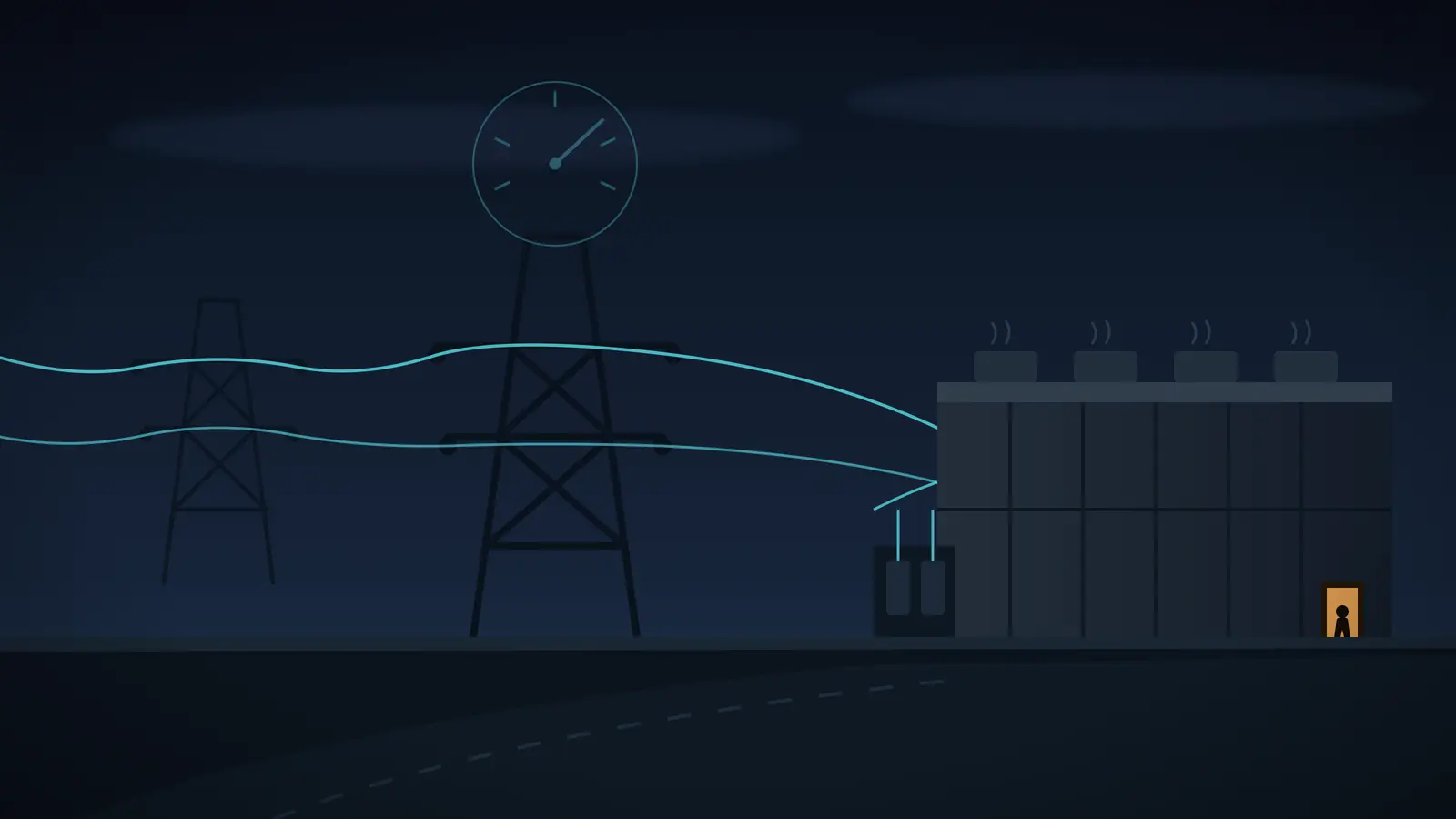
Start with the meter, because in Germany the meter now outranks the router. A single equipment rack drawing four kilowatts around the clock consumes roughly 35,000 kilowatt-hours a year. At the 17.8 cents per kilowatt-hour that the utility association BDEW reports as the average new-contract price for small and mid-sized industrial buyers in 2025 (bdew.de), that rack runs an electricity bill of about 6,200 euros before a single fan spins to remove its heat. Add the cooling and distribution overhead that German law now polices, and the true figure moves toward 9,000 euros. The most expensive product Titan Networks sells to a household — a gigabit fibre line in Hofheim am Taunus — bills 79 euros a month before VAT, 948 euros a year, according to the company's own price list (titan-networks.de). One rack's power bill equals nine or ten gigabit subscriptions, before anyone has been paid a wage, bought a switch, or answered a support call.
That ratio is the story. Twenty years ago the scarce input for a German internet company was the wire: who controlled the copper, who could reach the exchange, who could afford transit. Today transit at Frankfurt scale costs pennies per megabit and the exchange will practically pay you to show up, while the electron has become the input that decides who profits.
Titan Networks, a company small enough to fit in one building on Bleichstrasse in Hofheim, has spent a quarter of a century adjusting to exactly this inversion, and because German registries, routing databases and archived web pages are unusually candid, the adjustment can be reconstructed from the outside in some detail.
A quarter-century on Bleichstrasse
The identity is unusually clean for a small operator. The legal entity is Titan Networks Internet & Telecommunications Service Providing GmbH, registered at the district court of Frankfurt am Main under HRB 52075 with the statutory minimum share capital of 25,000 euros (northdata.com). The company's own history page dates the founding to April 2001 in Hofheim am Taunus (titan-networks.de), and the RIPE address registry quietly corroborates it: the firm's core IPv4 allocation, 217.173.128.0/20, carries the network name DE-TITANNET-20010409 — the ninth of April 2001 baked permanently into the internet's land register. The autonomous system that still carries the business, AS20640, was registered in September 2002, and the company has been a RIPE local internet registry in its own right since 2004, listed at Bleichstrasse 1 in Hofheim's Wallau district.
Around that legal core sits a small constellation of names that a directory compiler could easily mistake for separate firms. TitanAccess and TitanDSL are product brands. MTKom — Main-Taunus-Kommunikation — is the regional consumer brand under which the company builds and sells fibre in the Main-Taunus district, with domains such as mtkom.de and ipnr.de resolving to the same product pages, and the customer router even branded MTKomBox in the price list. The English-language carrier shopfront lived at titan-networks.com, and PeeringDB records the operator as "Titan Networks GmbH (also known as MTKom)" (peeringdb.com). One company, one meter, several coats of paint.
Management is a family affair in the way that German Mittelstand usually means it. Thomas Wild, who the company says had worked in the internet business since 1998, ran the firm from its founding; Stefan Boffin appears alongside him in the register from 2013. In May 2025 the register records a change: Thomas Wild steps out of the managing-director role and a Stefan Wild steps in. The routing tables had foreshadowed the succession — an autonomous system named for a Stefan Wild engineering operation, AS44227, has long sat as a customer behind Titan's network and inside its registered customer cone. LinkedIn places the company in the 11-to-50-employee bracket (linkedin.com); the phone is answered from Hofheim, weekdays nine to five.
Nothing about this identity is contested, which is itself worth noting. No insolvency traces, no register disputes, no rebrandings that hide a failure. The company that took a /20 of address space in the spring of 2001 still announces it from the same town today. In a market segment where directory records are frequently a palimpsest of dead brands, Titan Networks is a rarity: the name on the door, the name in the register, and the name in the routing table all match.
Three businesses, one meter
What does it sell? Three layers, each paying differently, each with a different exposure to the power price.
The first layer is access. The current price list, dated 30 September 2025 and refreshed in a contract bundle on 1 June 2026, runs from a 16-megabit DSL line at 28 euros net a month to the gigabit product at 79 euros net, with a 500-megabit tier at 59 euros and a 100-megabit tier at 42 euros. Setup costs 140 euros on a twelve-month commitment, halving on a twenty-four-month one. A static IPv4 address is eight euros a month, a two-channel phone option another eight, a rented FritzBox between 2.48 and 4.16 euros. Comparison portals list the same tariffs with VAT — 42.84 euros for the 50-megabit line, 94.01 euros for the gigabit — and note the month-to-month terms (internetanbieter.de). Two things stand out. These prices sit well above the promotional rates of the national mass market, where gigabit promotions from the large carriers routinely undercut them by a third. And the contracts run month to month, which the mass market's do not. Titan is deliberately selling flexibility and proximity at a premium rather than lock-in at a discount — a pricing posture only sustainable where the customer is buying trust, not megabits.
The geographic split matters. Nationwide, TitanAccess rides resold copper and fibre — the company's own material describes DSL and VDSL availability across Germany and "a strong partnership with Deutsche Telekom." In its home district the company owns the last metres itself: fibre-to-the-home builds in Hofheim's outlying districts of Wildsachsen, Lorsbach and Langenhain, sold under the MTKom brand at gigabit speeds (titan-networks.de). Television arrives wholesale from the Austrian platform Ocilion, which supplies IPTV to dozens of German local operators — the trade press noted Titan among the operators whose customers could receive the BILD channel through that platform in 2021 (teltarif.de, ocilion.com).
The price list's back pages reveal a second pricing philosophy: labour is billed like the scarce resource it is. An on-site installation costs 75 euros and is offered only inside the home district. A technician visit occasioned by the customer's own error bills 50 euros; a fault report that turns out to be unjustified costs the reporter 80 euros; even a paper invoice carries a three-euro charge. This is the fee structure of a firm that knows its constraint is not bandwidth or even electricity but the working hours of a very small team, and prices every avoidable interruption accordingly.
Where Hetzner automates the human out of the transaction, Titan meters the human in.
The second layer is hosting in the broad, old-fashioned sense: mailboxes on customer domains run on what the company pointedly calls a mail system operated in Germany, web hosting with the usual scripting and database furniture, virtual servers as "the affordable entry into the server world," domain services built on DENIC and CORE memberships, VPNs, SSL certificates and IT consulting (titan-networks.de). No prices are published; the pitch is individual quotation, which for a firm this size means the sales cost is a conversation and the margin is whatever the relationship will bear. The German-jurisdiction framing is not decoration. Since the European court decisions that unsettled transatlantic data transfers, a mailbox held by a German GmbH in a German facility under German law has been a compliance answer as much as a product, and it is one of the few products whose value rises with regulatory anxiety while its cost of production stays flat.
The third layer, mostly invisible on today's consumer site but explicit in the archived English carrier pages, is wholesale. In its 2016 form, the company sold wholesale DSL with L2TP hand-off or full service including RADIUS and accounting; IP transit from AS20640 with Deutsche Telekom's AS3320 among its upstreams; transport between Frankfurt data centres and Amsterdam; domain wholesale; colocation; and, most tellingly, resold ports on the Amsterdam exchange — "AMS-IX from 250 euros a month," delivered in Frankfurt so the customer needs no Dutch infrastructure of their own (web.archive.org). This is classic interconnection arbitrage: buy a big port, slice it, sell convenience. The customer references the company still lists — the town of Hofheim itself, a Bavarian municipal administration, Star Alliance Services GmbH, D-Link's German arm — sketch the buyer profile: institutions and Mittelstand firms that want a counterparty they can drive to.
The routing table adds names the marketing omits. Millhouse GmbH, a Hofheim dental-technology manufacturer of about forty staff whose robots mill prosthetics for laboratories across Germany (millhouse.de), holds its own /24 of address space — and that block, 91.202.2.0/24, is announced to the world by Titan's AS20640. Since late 2023 a Swiss counterparty has appeared: JustFiberNet GmbH of Baden, a fibre-planning and IP-address business (peeringdb.com), sits as a transit customer behind Titan, while Titan in turn announces a /23 carved from JustFiberNet's 82.206.0.0/17 — evidence of the quiet, mutually convenient trade in scarce IPv4 that small operators now conduct among themselves.
What the routing tables admit
For a private company that publishes no accounts, the network is the most honest financial statement available, and Titan's can be read line by line.
The autonomous system announces roughly 4,864 IPv4 addresses today — the own /20 from 2001, Millhouse's /24, the leased /23 — plus a /32 of IPv6, and is visible to about 129 BGP peers (bgp.he.net). PeeringDB, updated by the company in September 2023, declares 5-to-10 gigabits per second of traffic, a 10-gigabit port at DE-CIX Frankfurt, and presence in seven interconnection facilities: Digital Realty in Düsseldorf and Frankfurt, Equinix in Frankfurt and twice in Amsterdam, the DNS:NET colocation site in Berlin, and the SOCO data centre in Düren (peeringdb.com). In the observable routing data, Hurricane Electric is by far the widest path into the network, with Zayo among the visible adjacencies; the registry's own policy entries preserve older relationships — the Göttingen fibre operator goetel, Cologne's tal.de, Düren's SOCO, Kiel's TNG — like growth rings in a tree.
Read against the 2016 snapshot, the footprint tells a story of consolidation rather than growth. Then, the company advertised presence in Interxion Frankfurt on two campuses, TeleCity Frankfurt, ITENOS, the ANCOTEL carrier hotel on Kleyerstrasse, a facility in Eschborn — and, crucially, "our own Internet Data Center" of more than 800 square metres in Eschborn, on the site now listed as the ColoCenter facility on Schwalbacher Strasse (datacentermap.com). Today's public materials contain no such claim. The consumer site's product menu runs from fibre to consulting with no housing offer at all; the colocation language survives only in third-party directories and the company's generic self-description. The names changed with the industry — Interxion is now Digital Realty, TeleCity is Equinix — but the deeper change is in the role: a firm that once described itself as the operator of a data centre now describes itself as a tenant of seven.
Between those two snapshots sits the German energy crisis, and it would be difficult to invent a cleaner illustration of its selective pressure. An 800-square-metre hall with UPS, air conditioning and fire suppression is exactly the class of asset whose economics broke after 2021: too small to negotiate industrial power tariffs or justify the capital cost of modern heat-recovery cooling, too large to hide in an office's utility bill. Germany's efficiency statute now requires existing data centres to reach a power-usage-effectiveness of 1.5 by July 2027 and 1.3 by 2030, sets 1.2 for new builds from July 2026, adds mandatory waste-heat-reuse quotas for new facilities, and has demanded reporting to a federal efficiency register since May 2024 (gesetze-im-internet.de; germandatacenters.com). The statute's duties bite from a few hundred kilowatts of IT load — the size of one serious server room. A 2005-vintage small hall meets those numbers only with capital its cash flow cannot service. The rational move is the one the record implies Titan made: surrender the landlord role, rent metered space inside carrier hotels whose owners can amortise cooling plant across hundreds of megawatts, and keep the parts of the business the meter cannot reach.
Energy as the new rent
The macro numbers behind that squeeze deserve a moment, because they define every hosting margin in the country. German data centres consumed about 20 billion kilowatt-hours in 2024 and an estimated 21.3 billion in 2025 — more than all German hydroelectric generation — on a capacity base that grew nine per cent in a year to just under three gigawatts (borderstep.de; bitkom.org). Frankfurt is the centre of gravity: the city drew roughly 6.5 terawatt-hours in 2024, with data centres consuming more than the airport, and the grid operator Mainova reports five to ten qualified connection requests a year at 50 to 100 megawatts each — while warning that large new connections will not be broadly possible again until the mid-2030s (igorslab.de). Meanwhile the traffic that justifies all this keeps compounding: DE-CIX Frankfurt set an all-time record of 18.73 terabits per second last December, on a night when Eintracht Frankfurt hosted Barcelona (de-cix.net), and the exchange group's worldwide peak crossed 25 terabits in April 2025 (de-cix.net).
Scarce power plus insatiable demand equals repriced space. CBRE's global survey now puts Frankfurt at the top of the European colocation market at 235 to 265 dollars per kilowatt per month, after a fifteen per cent jump in 2024, with vacancy stuck around five per cent (cbre.com). The industry's landlords no longer absorb power risk; they meter it through. Equinix told investors to expect roughly 350 million dollars of incremental power cost recovered from customers in 2023, mostly in Europe (omdia.tech.informa.com). And the price signal reached even the most aggressively cheap corner of the German market: Hetzner, the country's low-cost hosting benchmark, raised prices about ten per cent in 2022, explaining that its planning basis for electricity had risen from 29 to 45 cents per kilowatt-hour, and lifted its German colocation power surcharge from 34.51 to 53.55 cents per kilowatt-hour (heise.de).
Those Hetzner numbers are the ones to hold on to, because Hetzner is the price floor for every German hosting product. When the floor-setter's own electricity assumption implies that a four-kilowatt cabinet carries about 1,500 euros a month in power charges alone, three consequences follow for everyone smaller. First, colocation resale by small operators is dead as a margin business: a firm renting space in a Digital Realty or Equinix hall pays the landlord's metered tariff and cannot underprice the landlord's own retail.
Second, the surviving hosting margin migrates into services indifferent to wattage — a mailbox, a domain, a VPN, a consulting day all consume trivial power per euro of revenue. Third, whoever owns efficient, already-amortised capacity gains an almost regulatory moat, because the efficiency statute prices retrofits in capital that only scale can raise. None of this is speculative for Titan Networks; it is the plain reading of a company that stopped advertising an 800-square-metre hall and now lists seven tenancies.
It is worth recalling how fast this world turned over. Before 2021, German operators planned on industrial electricity in the low teens of cents; the 2022 gas shock briefly took exchange prices past multiples of that, and although the spot market has calmed, the settled level remains structurally above the old planning basis while the regulated components grind upward.
The federal government moved the renewable levy out of power bills and capped prices during the acute crisis, but those interventions expired into a market where the durable escalation now comes from the grid itself: network charges — the regulated tolls for using the distribution system — averaged 10.9 cents per kilowatt-hour on household bills in 2025 by BDEW's reckoning, and rise as the energy transition's copper and steel are financed through them. A hosting company can hedge the commodity; it cannot hedge the toll.
That second, subtler exposure lands directly on the access network. Titan's fibre cabinets, DSL line cards and points of presence sit in small street-side and basement locations across the Main-Taunus district — Hofheim, Marxheim, Wallau, Eppstein-Vockenhausen in the archived list — and every one of those sites pays retail-adjacent rates. The access network's power bill is small per site and unavoidable in aggregate, and unlike the carrier-hotel meter it cannot be handed to a landlord.
The arithmetic of a four-kilowatt rack
Assembling the unit economics from public parts requires saying plainly what is evidence and what is inference. The evidence: Titan's published tariffs (28 to 79 euros net across the access range; eight euros a month for a static IPv4 address; installation, hardware-rental and service fees itemised to the cent); its declared 5-to-10 gigabits of traffic and 10-gigabit exchange port; the 4,864 IPv4 addresses it announces; Frankfurt colocation at 235 to 265 dollars per kilowatt per month; Hetzner's 53.55-cent power surcharge as the German pass-through benchmark; IPv4 blocks trading at roughly 25 to 41 dollars per address in 2025 auctions (auctions.ipv4.global) and leasing for 25 to 55 cents per address per month (ipxo.com); a reseller packaging DE-CIX Frankfurt 10-gigabit access at about 2,100 euros net a month (xsserver.eu); and a headcount bracket of 11 to 50. The inference: subscriber counts, wholesale input prices and the revenue mix, none of which the company publishes.
Take the access line first. A 100-megabit resold line bills 42 euros net. The regulated wholesale inputs — local loop or bitstream from the incumbent, plus backhaul — plausibly land in the low-to-mid twenties per month for a line of that class; that is inference from the structure of regulated German wholesale pricing, not a published contract. Call the gross contribution fifteen to twenty euros per line per month before support, billing and the backbone.
A staff of even fifteen people costs somewhere near 1.2 to 1.5 million euros a year fully loaded in the Frankfurt labour market — again inference, from regional wage levels rather than any filing. Access alone would need six or seven thousand lines to carry that payroll, which a company selling premium-priced, month-to-month tariffs in one district plus a nationwide long tail is unlikely to have.
The arithmetic therefore insists on what the product page implies: the access book is the anchor and the advertisement, while the contribution margin lives in the second and third layers — hosting relationships billed by quotation, wholesale hand-offs, and the fibre in the ground at Hofheim, where the company keeps the whole retail price because it owns the last metres.
Now the addresses. The static-IP option prices scarcity with a straight face: eight euros net a month for one IPv4 address, roughly twenty times the wholesale leasing rate, packaged with the service that makes it useful. The company's own /20 — 4,096 addresses received free in 2001 — would fetch on the order of 100,000 to 170,000 dollars at current auction prices, and could yield perhaps 15,000 to 25,000 dollars a year if leased out wholesale. Every static-IP surcharge collected retail beats both numbers per unit by an order of magnitude.
For a firm of this size, the 2001 allocation is a quietly appreciating asset that costs nothing to hold, generates fee income at retail rates, and remains invisible in any balance sheet a bank would see. The JustFiberNet relationship shows the same logic running the other direction: when Titan needs more space, it leases a /23 rather than buying at auction — renting scarcity in, selling scarcity out, capturing the spread in service.
Finally the rack. Suppose Titan resells a cabinet in one of its seven tenancies. At Frankfurt market rates the capacity envelope for four kilowatts costs 940 to 1,060 dollars a month; the electricity flowing through it, at Hetzner-style pass-through rates, is worth roughly 1,500 euros a month at full draw — and whichever side of the contract carries the consumption line, the landlord prices it through. The resale price a small operator can command sits barely above those inputs.
What remains is the interconnection margin — blending a 2,100-euro exchange port and transit across many customers — plus remote hands billed by the hour and the customer's unwillingness to move a working installation for a ten per cent saving. That is a real business, but it is a services business wearing a data centre's clothes. The meter took the rest.
Upstream, the incumbent and the landlord
Titan's dependency map has three heavy nodes, and all three have grown heavier since 2001.
Deutsche Telekom comes first. The nationwide access product exists only by grace of regulated wholesale on the incumbent's copper and fibre; the archived carrier pages even list Telekom's AS3320 among the network's transit sources, and the fibre-marketing pages describe a partnership alongside the company's own builds. This is a dependency with a clock on it: the incumbent's long-signalled migration off copper will, district by district, retire the VDSL lines Titan resells and force customers onto whoever owns the replacing fibre. Where that owner is Titan — Wildsachsen, Lorsbach, Langenhain — the transition is an upgrade.
Where it is Telekom or an overbuilder, Titan's premium-priced resale line must survive a re-sale conversation it does not control.
The landlords come second. Digital Realty, Equinix, DNS:NET and SOCO set the terms — including the power tariff — for every rack Titan operates outside its own district. The 2022-2023 repricing demonstrated the mechanics: when the landlord's energy clause moves, the tenant's cost base moves the same quarter, with no offsetting pricing power unless the tenant's own customers are equally captive. Being present in seven facilities diversifies failure risk but not tariff risk, because all seven buy power in the same national market.
Third, the quiet suppliers: AVM's FritzBox hardware in every MTKomBox living room, Ocilion's platform behind the television offer, DENIC and CORE behind the domain business, the RIPE NCC behind the address holdings. Each is replaceable in principle and none in practice, at this company's scale.
Customer-side dependency runs the other way and is Titan's real asset. A static IP address is wired into the customer's firewalls, VPNs and DNS; a mailbox on a customer's own domain is the definition of switching cost; a municipality that has run procurement once does not enjoy running it again; a dental manufacturer whose /24 is announced by its ISP moves providers only with planning and pain. Titan's month-to-month consumer tariffs look like generosity and function as confidence: the company that lets you leave any month is betting you will not, and pricing the bet at a premium.
The wholesale relationships — a Swiss address trader, an engineering firm's autonomous system, the registered customer cone — are small in number and sticky by construction, because renumbering out of an upstream is the network equivalent of moving house.
Hetzner below, Telekom everywhere, hyperscalers above
Competitively, Titan Networks lives in a canyon with three walls. Below, on hosting price, stands Hetzner and its cohort — IONOS, netcup — whose scale economics no regional firm can chase; when the cheapest serious host in Europe raises prices ten per cent and explains itself with a power-price table, the message to smaller hosts is not comfort but a preview. Above, on cloud capability, stand the hyperscalers, whose Frankfurt regions absorbed exactly the Mittelstand workloads — the ERP test system, the customer portal — that once rented a small operator's virtual servers.
Everywhere, on access, stands Deutsche Telekom itself, plus Vodafone and 1&1, selling gigabit promotions below Titan's list price with television thrown in; and in the surrounding countryside, overbuilders like Deutsche Glasfaser and regional fibre firms turn district after district into contested ground.
The company's answer is to sell what none of those can: presence. The mail system advertised as operated in Germany speaks directly to the buyer for whom jurisdiction is a feature — the association, the practice, the town hall that wants its data under German law and its provider under German small-claims jurisdiction. The 24/7 fault line answered by the same dozen people who installed the connection speaks to the buyer who has experienced a hyperscaler's ticket queue. The quarter-century-old routing record, unbroken and unblemished, is legible to any technical counterparty in thirty seconds.
These are trust products, and their unit economics are beautiful precisely because their marginal cost is reputation, not electricity. The substitutes creeping in at the edges — 5G fixed wireless for the impatient household, Starlink for the farmhouse — attack the access commodity, not the trust product.
The lens the energy market adds: every one of Titan's competitors except the trust segment is more power-intensive per euro of revenue than Titan's residual business is. A price war in German hosting is now a proxy war over electricity procurement, and the smallest sustainable position is the one that consumes least. Shrinking out of the data-centre landlord business was not retreat; it was choosing the defensible side of the meter.
The sound of a quiet company
The unofficial record around Titan Networks is defined by silence, and the silence has texture worth reading. The big German review platforms hold essentially nothing: the 11880 directory lists the firm without a single submitted review (11880.com); the tariff-archive at teltarif preserves a lone customer comment from 2006 praising the flexibility of its prepaid dial-up — a fossil from a previous internet (teltarif.de). For a consumer ISP of any size, twenty years without accumulated public complaint would be implausible; for a firm whose consumer base is concentrated in a few Taunus villages and whose real book is institutional, it is exactly the expected signature. The absence suggests a small, direct-relationship customer base whose complaints go to a phone number, not a portal. What would settle it is a subscriber figure, and none is published.
The web presence sends mixed signals that are more informative than either alone. The public site still carries Google+ icons a half-decade after that network's burial, and the .com shopfront greets visitors with an expired security certificate — surface neglect that would alarm a retail buyer. Yet the contract documents were refreshed on 1 June 2026, the RIPE organisation object was touched in May 2026, the customer-cone records in February 2025, and the PeeringDB entry in September 2023.
The pattern is a company that maintains precisely what its paying relationships require and nothing that mere onlookers see — thrift, not decay, though the distinction would be settled quickly by an accounts filing or a burst of job advertisements, neither of which the public record currently offers.
Two newer traces point at strategy. The May 2025 management change from Thomas to Stefan Wild, read together with the Wild engineering autonomous system that has sat behind the network for years, looks like generational succession executed without drama — the exact opposite of the buy-out-and-strip pattern that has consumed many small German ISPs. And the appearance of a Swiss IP-address dealer as both customer and address source since late 2023 suggests the company is leaning further into the interconnection-and-scarcity trade — the highest-margin, lowest-wattage corner of its business.
Neither reading is provable from outside; both would be confirmed or broken by the next few years of register entries and routing changes.
The labour market is similarly silent. No churn of job advertisements, no employer-review profile accumulating grievances, no LinkedIn exodus — for an 11-to-50-person firm this reads as a stable, tenured team, which fits both the succession story and the personal-service pricing. The stray domains tell the same small story from another angle: mtkom.de, ipnr.de and other odds and ends resolve to the same product pages, remnants of two decades of regional marketing rather than any structural complexity.
The Bundesnetzagentur's registers hold the company as an ordinary notified telecom provider, with the 24/7 fault obligation the consumer pages advertise; no enforcement traces surface in public reporting.
What is conspicuously absent from the record: outage chatter, court records, procurement disputes, distressed-asset signals, and any trace of the company seeking capital. A firm this old, this small and this quiet is usually one of two things — comfortably profitable at its chosen size, or slowly liquidating its customer relationships. The June 2026 paperwork, the fresh fibre marketing in Hofheim's villages and the active registry maintenance weigh toward the first.
What would change the judgement
The picture drawn here — a low-wattage survivor that traded its landlord ambitions for tenancy, scarcity assets and trust products — rests on inference at several load-bearing points, and specific facts would rework it.
Published financials would do the most work. German micro-companies disclose little, but even an abbreviated balance sheet in the federal gazette showing equity trend, or a filing revealing revenue mix between access, hosting and wholesale, would replace the payroll-versus-contribution arithmetic above with fact. A revenue base materially smaller than the staffing bracket implies would turn the quietness reading from thrift toward decline.
The Eschborn question is open. If the company in fact retains owned or long-leased data-centre space there — under the ColoCenter name or otherwise — the energy-exposure analysis sharpens considerably, because it would face the 2027 efficiency deadlines directly and its capital position would matter. Confirmation either way, from the efficiency register's public data, a lease record or simply an updated facility list, would settle the single most important factual gap in this profile.
The Telekom copper timetable is the largest external variable. A firm date for VDSL retirement across Titan's resale footprint would start a countdown on the 28-to-59-euro middle of its price list; conversely, a wholesale-fibre agreement that lets Titan resell the incumbent's FTTH at workable margins would extend the model a decade. Watch equally for overbuild announcements in the Main-Taunus district: a Deutsche Glasfaser or Telekom fibre build through Wildsachsen, Lorsbach and Langenhain would attack the only part of the network Titan wholly owns.
On the asset side: a sale or large-scale lease-out of the 217.173.128.0/20 block would signal either monetisation of the reserve or a shrinking service base needing fewer addresses — the surrounding facts would say which. A DE-CIX port upgrade past 10 gigabits, new facility entries, or growth of the registered customer cone would evidence the wholesale trade expanding. And in the register: any change in ownership, a merger with a regional utility, or the arrival of private-equity directors would end the family-succession reading and, with it, the assumption that the company optimises for longevity over exit value.
Finally, the meter itself. A sustained fall in German industrial power prices toward pre-2021 levels — or a policy shift that exempts small operators' sites from rising grid fees — would soften the thesis's central constraint and make small-scale German hosting margins reconstructable. The evidence currently runs the other way.
Sources and signals
The company's own documents anchor the profile: the history and product pages at titan-networks.de/unternehmen and titan-networks.de establish founding, services and the German-operated mail positioning, while the tariff annexe at titan-networks.de/files/.../07_Preisliste_TitanAccess_20251001.pdf prices every product to the cent and the fibre pages at titan-networks.de/Glasfaser-Hofheim document the MTKom build. Identity and governance rest on the Frankfurt register extract via northdata.com. The network evidence is independently checkable in the routing and interconnection records at peeringdb.com/asn/20640 and bgp.he.net/AS20640, and the carrier-era strategy in the archived English site at web.archive.org.
- Market position and tariffs with VAT: internetanbieter.de/titan-networks; provider history, legacy tariffs and the Ocilion television note: teltarif.de/a/titan; the IPTV platform itself: ocilion.com/en.
- Customer and counterparty traces: Millhouse GmbH, the Hofheim dental manufacturer whose /24 Titan announces: millhouse.de; JustFiberNet GmbH, the Swiss address and fibre firm behind the newest wholesale relationship: peeringdb.com/net/34495; the former own-facility site in Eschborn: datacentermap.com.
- Energy and regulation: industrial power prices from bdew.de; the efficiency statute's data-centre duties at gesetze-im-internet.de/enefg/__11.html with an industry summary at germandatacenters.com; Frankfurt's grid constraint reporting at igorslab.de; national consumption data at borderstep.de and bitkom.org.
- Price benchmarks: Hetzner's energy-driven repricing at heise.de; Frankfurt colocation rates at cbre.com; landlord power pass-through at omdia.tech.informa.com; exchange-port resale at xsserver.eu/ix; DE-CIX traffic records at de-cix.net and the global record note.
- Address-market pricing: sale benchmarks at auctions.ipv4.global/prior-sales and leasing rates at ipxo.com.
- Soft signals: the reviewless directory entry at 11880.com and the staffing bracket at linkedin.com/company/titan-networks-gmbh.
RIPE database objects for the autonomous system, the 2001 address allocation and the customer-cone records were read directly from the registry's public interface and corroborate the founding date, the Hofheim-Wallau address, the customer relationships and the maintenance timestamps cited throughout.