
Summary
- What it says: In Zielona Gora, the decisive broadband question is not only whose advert promises more megabits.
- Main topic: Regional ISP economics; Telecom spectrum and security
- Context: market / company research report / Europe / Poland
The offer starts in the basement, not on the coverage map
In a Polish apartment block, broadband competition usually arrives as a poster in the stairwell before it arrives as an engineering fact. A national brand can put a low monthly price on the lift noticeboard. A comparison site can rank 300 Mbps, 600 Mbps and gigabit packages as if every address were only a billing choice.
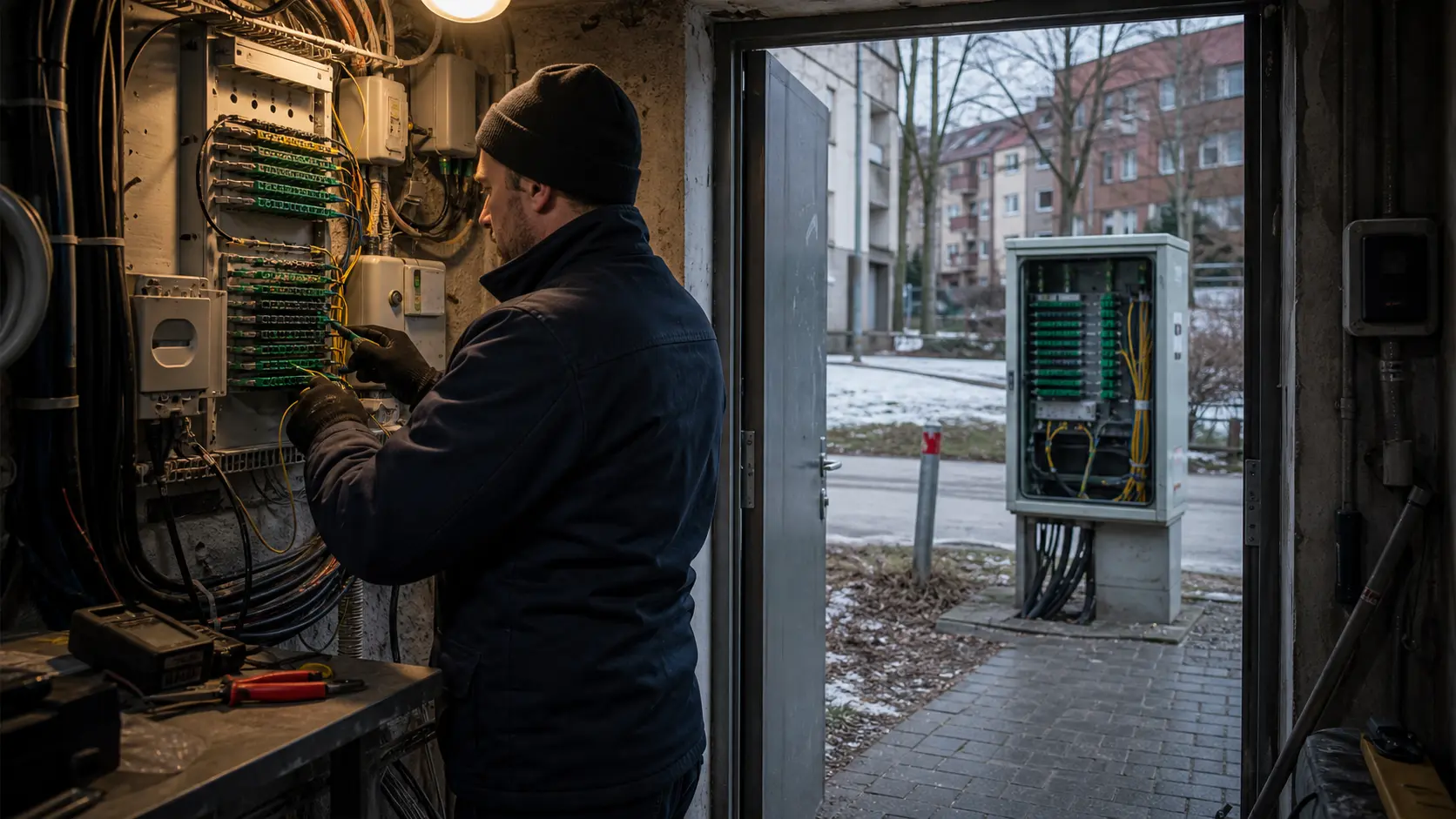
But the actual sale is settled somewhere less polished: in the basement where old copper routes meet newer fibre, in the building association's permission file, in a street cabinet whose power and access are not abstract, and in the memory of the technician who remembers which riser was blocked the last time somebody tried to pull a drop cable through it.
Terra Telekom is interesting because it sits exactly at that level of the Polish broadband economy. It is not a national incumbent. It is not a pure data-centre or wholesale carrier. The public record points to a Zielona Gora-based regional provider whose own site sells fibre internet, radio internet, television packages and customer contact through a local office. The company lists Terra Telekom sp. z o.o. at ul. Poznanska 7B, 65-138 Zielona Gora, with NIP 9731024787 and REGON 363112551, and publishes customer-service and order phone numbers at https://www.terratelekom.pl/ and https://www.terratelekom.pl/Kontakt.htmlx. UKE's telecom entrepreneur register likewise lists Terra Telekom with the same NIP, registered from October 2007, offering retail fixed internet access over fibre and unlicensed wireless in Poland (https://rejestry.uke.gov.pl/export_csv_rpt). That is the first boundary of the story: Terra is a real operator in the local access market, but the value of such an operator is not visible only from a national fibre map.
The national map is still important. Poland has been filling in fixed-broadband coverage quickly. The Ministry of Digital Affairs said its end-2025 SIDUSIS-based report counted 7,905,930 address points within fixed broadband coverage, up from 7,831,968 at the end of September 2025 and 7,634,907 a year earlier (https://www.gov.pl/web/cyfryzacja/jaki-jest-zasieg-internetu-stacjonarnego-w-polsce-sprawdz-to-w-raporcie-polska-w-zasiegu-stacjonarnego-dostepu-do-internetu2). UKE's 2024 market summary put Polish telecom market value at PLN 44.4 billion, fixed internet users at 9.8 million, and fixed-internet revenue at PLN 6.3 billion, up 7.4% year on year (https://uke.gov.pl/en/newsroom/report-on-the-state-of-the-telecommunications-market-in-2024%2C413.html). These figures explain why infrastructure funds and local roll-up platforms care about Polish fibre. They also explain why a small regional provider cannot simply stand still and wait for loyalty to protect it.
Yet coverage is not service quality, and service quality is not only speed. A household or small business can be technically in range of several offers and still choose the operator whose installer answers, whose support desk understands the building, whose technician can get access to a locked room, and whose local reputation has either survived or failed in the neighbourhood. Terra Telekom's economics therefore sit below the visible layer of price and coverage. The company must turn local trust into recurring revenue while national and platform-backed competitors make the headline speed cheaper every year.
The judgment is mixed but not dismissive. Terra has a long local trail, current retail offers, a regulator entry, public routing evidence and the backing of the FixMap group. It also has evidence of pressure: small-company financial losses in public data, a routing record now tied into the Enformatel/FixMap stack, a legacy wireless base that must be upgraded or defended, and thin public customer evidence. The business is best read as a field-trust asset inside a consolidating Polish fibre platform. Its upside is not that it can outspend national operators.
Its upside is that it may know how to win and keep hard-to-serve local buildings where the national offer is cheap but operationally impersonal.
The public identity is clear enough, but the control stack matters
The legal identity is straightforward in the main public records. Rejestr.io lists TERRA TELEKOM SPOLKA Z OGRANICZONA ODPOWIEDZIALNOSCIA, KRS 0000588820, NIP 9731024787, REGON 363112551, registered on 1 December 2015, with a seat at Poznanska 7B in Zielona Gora and share capital of PLN 1.5 million (https://rejestr.io/krs/588820/terra-telekom). The same page shows FixMap sp. z o.o. as the shareholder from 30 October 2018, holding 14,500 shares with a stated value of PLN 1.5 million and full ownership. Rejestr.io's FixMap relationship page independently lists Terra Telekom under FixMap's ownership links from 30 October 2018 (https://rejestr.io/krs/688736/fixmap/powiazania). Terra's own website and privacy page show the same corporate identifiers and office address (https://www.terratelekom.pl/Polityka-prywatnosci.html).
That identity trail has two implications. First, the company is not merely an unverified trade name. It has a regulator entry, a company register trail, customer-facing tariffs and public contact points. Second, Terra should be analysed as part of a platform rather than as a fully stand-alone local operator. FixMap's own site presents Terra Telekom among its group companies and describes a model in which acquired operators keep their local brand, pricing and team while receiving group resources, technical migration and common operating standards (https://fixmap.eu/en). Arcus Infrastructure Partners' portfolio page describes FixMap as a Polish FTTH company with 23 subsidiaries, about 482,000 homes passed and about 155,000 homes connected, positioned in semi-rural Poland and supported by a buy-and-build strategy (https://arcusip.com/portfolio-item/fixmap/). That puts Terra in a wider capital and operating frame.
The change is not cosmetic. A local ISP before consolidation is often a founder-led field business: subscribers, vans, building permissions, radio masts, some fibre, a billing system, and personal relationships with customers who may know the owner by name. A platform-owned local ISP is different. It can draw on central purchasing, integration know-how, common TV relationships, shared network engineering and possibly lower cost of capital. But it can also lose the founder intimacy that made the local provider worth buying.
Terra's valuation depends on whether FixMap's scale improves the local service experience without turning Terra into just another logo on a national spreadsheet.
Telko.in's 2019 report on FixMap's investment history is useful because it captures the transition moment. It reported that FixMap had 90% of Terra Telekom from the Lubuskie region, that the Terra stake cost PLN 1.1 million according to FixMap's 2018 annual report, and that Terra had nearly 1,800 subscribers at the end of 2018, 73% of them on WiFi, while FTTH customers were growing and WiFi customers were declining (https://www.telko.in/piotr-muszynski-kupil-kolejnego-isp). That data is old, but strategically important. It shows that the company was already a migration story: from wireless dependence toward fibre, from local founder economics toward platform capital, from small balance-sheet constraint toward a roll-up model.
The public company register also suggests why the roll-up matters. BizRaport's KRS-based financial aggregation shows 2024 revenue of about PLN 1.891 million, net loss of about PLN 869,000, EBITDA of about negative PLN 133,000, assets of about PLN 3.938 million and liabilities of about PLN 8.580 million (https://www.bizraport.pl/krs/0000588820/terra-telekom-spolka-z-ograniczona-odpowiedzialnoscia). Aggregated financial portals should not be treated as audited analysis by themselves, but those figures are consistent with a business where capex, debt, field labour and migration weigh heavily on a small revenue base. A local access provider can look strategically valuable while reporting weak stand-alone profitability. That is exactly the kind of asset a platform buys when it believes central scale can rescue local economics.
The tariff says "cheap fibre"; the balance sheet says "field cost"
Terra's consumer offer looks sharp enough to compete. Its website lists fibre internet plans at 300 Mbps down / 100 Mbps up for PLN 55 per month, 600/200 Mbps for PLN 72, and 900/300 Mbps for PLN 85, with higher business prices shown at PLN 67.65, PLN 88.56 and PLN 104.55 respectively (https://www.terratelekom.pl/). It also lists a one-off installation charge from PLN 199, router lease from PLN 123 and possible local network-maintenance fees in some locations. The radio internet plans are materially weaker on speed and not much cheaper: 5/2 Mbps at PLN 49, 15/3 Mbps at PLN 74 and 30/4 Mbps at PLN 98, with installation from PLN 49 and availability only in selected locations.
The tariff structure tells a hard economic story. Fibre is the future product, but it requires ducts, drops, permissions, splicing, ONT/router logistics, fault restoration and enough take-up per street or building to justify capital. Radio is the legacy reach product, but it carries support risk, spectrum sensitivity, line-of-sight constraints and customer impatience when a neighbour on fibre can buy far higher speed for similar money. Terra's old 2018 mix, as reported by Telko.in, was heavily WiFi-based; the current retail page now makes fibre the headline. That is the right direction, but the move from wireless to fibre is not free.
It often creates a period in which the operator carries old support obligations while funding the new network.
The customer may see only monthly price. The operator sees a much more complex unit economics problem. A PLN 55 fibre plan can be attractive if the building is already wired, the customer-installation path is clean, the churn risk is low, and customer support calls are manageable. It is much less attractive if the installer needs repeated visits, the building manager delays access, a duct is blocked, the customer needs in-home Wi-Fi support, or a competitor overbuilds the same address with a subsidised promotional price.
The visible monthly tariff is therefore only the top line of a cost model that includes labour availability, vehicle time, passive-material cost, customer premises equipment, upstream transit, pole or duct access, marketing, bad debt and support calls.
Terra's own contact page reinforces the labour question. The office is listed as open Monday to Friday from 8:30 to 15:30, with after-hours contact through eBOK or email and individual technical problems after office closure taken up on the first working day (https://www.terratelekom.pl/Kontakt.htmlx). That is understandable for a small operator, but it defines the service promise. A household may accept next-business-day handling if the price is low and the relationship is local. A small business with card terminals, cameras, cloud accounting or evening trade may not. The business offer at PLN 67.65 to PLN 104.55 per month for fibre is still a low-ticket connectivity product. It cannot easily fund enterprise-grade support unless the service terms, customer mix and support automation are tightly managed.
The TV bundles add another revenue lever. Terra's site advertises Jambox packages bundled with fibre: for example, FIBER 300 plus SMART at PLN 102.40 per month, FIBER 600 plus SMART at PLN 117.70, and FIBER 900 plus SMART at PLN 129.40, with richer OPTIMUM and PLATINUM tiers at higher prices (https://www.terratelekom.pl/Pakiety-2w1.htmlx). Its television page also lists Polsat Box and Jambox options, including Polsat packages and the statement that Polsat decoders work over Terra Telekom fibre without a satellite dish (https://www.terratelekom.pl/Internet-i-telewizja-Lubonet.htmlx). Bundling can raise ARPU and reduce churn, but it also imports content costs, set-top support, activation work and customer confusion. It is not simply margin; it is another operational promise.
That is why the financial data matters. A local provider can advertise low fibre prices and still lose money if the cost of maintaining the network and serving customers runs ahead of the revenue curve. BizRaport shows wages of about PLN 559,824 in 2024 and operating costs of about PLN 2.136 million, with wages equal to about 26% of operating costs (https://www.bizraport.pl/krs/0000588820/terra-telekom-spolka-z-ograniczona-odpowiedzialnoscia). The exact accounting categories need source-file diligence, but the broad signal fits the business model. Regional broadband is not a pure software margin. It is a labour, civil-work and maintenance business wrapped in a subscription.
The routing record is real, but it points to dependence
The network-resource evidence is credible but should not be overread. PeeringDB lists a network record for TERRA TELEKOM SP. Z O.O. with AS61233, website http://www.terratelekom.pl/, RIR status ok and last update in July 2022, but no public exchange or facility entries in the PeeringDB record (https://www.peeringdb.com/net/12800). RIPE RDAP for AS61233 shows the name TERRA-NET-AS, active status, registration on 28 December 2012 and last change on 17 February 2023, with Enformatel sp. z o.o. as registrant and a Terra Telekom abuse contact at ul. Poznanska 7B (https://rdap.db.ripe.net/autnum/61233). RIPE RDAP for 185.14.148.0/22 similarly shows a Polish Enformatel allocation registered in February 2023, again with Terra-related abuse contact information (https://rdap.db.ripe.net/ip/185.14.148.0/22).
The route table shows continuity. RIPEstat's routing-status endpoint observed 185.14.148.0/22 as originated by AS61233 as far back as February 2013 and as recently as 3 July 2026, with IPv4 visibility across RIPE RIS peers and no visible IPv6 route in that endpoint snapshot (https://stat.ripe.net/data/routing-status/data.json?resource=AS61233). BGP.tools identifies the current public view as Enformatel sp. z o.o., shows the Terra website, classifies the network as eyeball, lists one originated IPv4 prefix, no originated IPv6 prefix in its current view, and shows M3.NET sp. z o.o. / FixMap Group as the visible upstream (https://bgp.tools/as/61233). IPinfo likewise lists AS61233 under Enformatel, with 1,024 IPv4 addresses, a large IPv6 range, and upstreams including FixMap Group and Stowarzyszenie e-Poludnie in its observed view (https://ipinfo.io/AS61233).
This is not a contradiction that needs to be forced into a simple answer. It is a control-stack signal. Terra's customer-facing brand and abuse contact are visible. The registered internet-resource layer now appears tied to Enformatel, another FixMap group company, and the upstream path visible in public routing is heavily group-linked. For customers, that can be positive if it means a stronger engineering backbone, shared routing discipline and access to group resources. For independence, it means Terra is not best valued as a large stand-alone network with deep public peering.
It is a local access and customer asset plugged into a larger Polish fibre platform.
The absence of public PeeringDB exchange and facility entries matters because the article's round lens is not about a glamorous interconnection business. Terra is not showing the profile of a multi-site peering-heavy backbone operator. Its network evidence is enough to show routing substance and long-standing address resources, but not enough to support a claim of extensive independent peering. The economic value therefore sits closer to access than to transit.
Terra's bargaining power depends on subscribers, buildings, local reach, brand persistence and operational knowledge, while routing scale is likely mediated by FixMap group resources.
This also changes the supplier question. A small local ISP can be squeezed by upstream dependence if wholesale bandwidth, backhaul, routing support or shared platform costs move against it. At the same time, group dependence can lower procurement cost and improve resilience. The key diligence question is not whether Terra has an ASN in public records. It is whether the end-to-end service path, from apartment drop to wider internet, is engineered and supported well enough that customers experience reliability rather than organisational complexity.
For business customers, the distinction is important. If a shop, clinic, workshop or local office buys Terra because the technician can get into the building and fix a line quickly, it may not care whether the route registry says Enformatel or Terra. But if faults cross organisational boundaries, the customer will care whether responsibility is clear. Platform integration helps only if it simplifies escalation. It hurts if it creates a gap between the local support person and the network layer that actually needs to be fixed.
FixMap scale can help, but only if it protects the local reason to buy
FixMap's platform is the most important strategic variable around Terra. The local brand is part of a much larger consolidation story. Arcus describes FixMap's market as fragmented, semi-rural and underpenetrated enough to support buy-and-build value creation (https://arcusip.com/portfolio-item/fixmap/). Grant Thornton, in a 2025 note on advising FixMap's acquisition of Internet Union, described FixMap as owning and managing 20 subsidiaries at that time, with roughly 270,000 homes passed and 100,000 homes connected, while pursuing acquisitions of high-speed internet providers across Poland (https://grantthornton.pl/en/article/grant-thornton-advised-fixmap-on-the-acquisition-of-internet-union/). Arcus later put the portfolio at 23 subsidiaries, about 482,000 homes passed and 155,000 connected. The platform has clearly grown.
For Terra, scale can solve practical problems. A small provider can struggle to buy equipment, negotiate content packages, maintain systems, recruit engineers, obtain financing, and standardise documentation. FixMap can centralise some of that work. Its public site emphasises due diligence, technical audit, network review, financial review, integration, migration and common standards while preserving local brands and teams (https://fixmap.eu/en). That model is rational in Polish FTTH because the market is fragmented and many valuable networks are too small to finance the next wave alone.
The risk is that scale can overstandardise what made the local provider useful. Terra's site sells a local-company narrative: the local firm that invests earnings into network expansion and keeps developing. That claim resonates only if the customer still experiences local responsiveness. If the group improves back-office systems but support becomes distant, the local brand loses its premium. If the group improves routing and purchasing while keeping field teams empowered, Terra's economics can improve without destroying the trust asset.
The investor case also depends on take-up. Homes passed are not homes connected. A fibre footprint has value only when enough customers choose the service at a price and support cost that recover capital. Arcus's portfolio framing notes demand growth, low levels of network overbuild and expected ARPU growth in Poland. But at Terra's level, overbuild is not an abstract national percentage.
It is the same staircase getting a second or third fibre offer, the same small business comparing a group-owned local brand with Orange, Netia, Vectra, Play, T-Mobile or another regional operator, and the same building owner deciding whose installer gets access first.
This is where the "national fibre map" can mislead investors. A white spot filled on a map is politically and socially meaningful. It does not guarantee that a local provider earns attractive returns. If public funding, wholesale access, new network builds and consolidation all target the same regions, a small operator can find itself with higher capex and lower pricing power. Terra's advantage would be to hold addresses where it has real access, customer memory and service trust.
Its disadvantage is that customers increasingly benchmark the local provider against national price points even when the local provider bears more field friction.
Trust is a labour model
The customer's language is simple: "Does the internet work?" The operator's answer is a labour model. Someone has to survey the building, pull cable, maintain cabinets, monitor links, answer calls, handle invoices, explain router placement, resolve Wi-Fi complaints that are not always access-network faults, and revisit addresses when a neighbour's renovation damages a cable. In a low-price market, each support hour consumes a meaningful part of the monthly fee.
Terra's own tariff hints at this reality through one small line: in some locations, a network-maintenance charge may be added (https://www.terratelekom.pl/). That is the honest economics of regional access. The expensive part is often not the wholesale bandwidth; it is the local physical layer and the human response. Duct access, building permissions, radio-site maintenance, last-metre cabling and customer handholding are hard to compress into a national advertisement. They are also the reason a local operator exists.
The fixed wireless legacy sharpens the point. In radio networks, support often becomes more visible because the customer can experience weather, interference, line-of-sight, premises equipment and shared-capacity issues as instability. Fibre reduces many of those problems, but only after the operator has financed the upgrade and installed the premises. Terra's current fibre pricing is competitive, but its radio prices show that a legacy wireless customer can pay nearly the same or more for far lower speed. That creates migration pressure.
If Terra cannot move those customers to fibre or preserve them where fibre is uneconomic, the old product becomes a churn risk.
The social proof is mixed. A customer-listing page at Dostawcy-internetu.pl says the predecessor business began on 7 November 2005, used radio links and fibre in the Zielona Gora district, and served Zielona Gora, Swidnica, Sulechow, Swiebodzin and surrounding users, including public institutions, associations, individual customers and businesses (https://www.dostawcy-internetu.pl/operator/TERRA-TELEKOM-SP--Z-O-O-%2C1400.html). That same page includes a very old 2009 user complaint about disconnections and weekend support. The complaint is not current evidence of service quality; it is too stale for that. But it is a useful reminder of the trust problem that local wireless providers had to solve. A network can be locally loved by some customers and locally unforgiven by others because both experiences are intensely personal.
Other public-review signals are thin rather than conclusive. Cylex/Yably shows Terra Telekom with a weak aggregate rating of 2.7 from 27 reviews, without enough detail in the accessible page to validate each review (https://www.cylex-polska.pl/firmy/terra-telekom-sp--z-o--o--13438047.html). Oferteo says Terra has no reviews on that listing (https://www.oferteo.pl/terra-telekom-sp-z-o-o/firma/4013424). GoWork primarily exposes company and employer-profile data rather than a robust customer-service corpus, though it repeats the corporate identifiers and shows generated financial snapshots (https://www.gowork.pl/terra-telekom-sp.-z-o.o.%2C21548282/dane-kontaktowe-firmy). The market signal is therefore not "Terra has bad service" or "Terra has good service." It is that public reputation evidence is sparse and uneven, which increases the importance of local field performance that may not be visible in national datasets.
Overbuild turns local memory into either an asset or a trap
Polish broadband policy and capital both push toward more fibre. The European Commission's Poland connectivity page summarises the national broadband plan's goals: universal 100 Mbps access with upgrade potential to gigabit speed, at least 1 Gbps for socio-economic drivers, and 5G connectivity on major routes and urban centres (https://digital-strategy.ec.europa.eu/en/policies/digital-connectivity-poland). The Ministry's SIDUSIS coverage reports show the address map filling in. Arcus says Poland remains attractive partly because overbuild is comparatively low, but that is a platform-level view. For a regional operator, the decisive question is whether overbuild arrives exactly where its paying customers are.
If overbuild is limited, Terra's local knowledge is an asset. It can connect buildings the national players do not prioritise, use existing customer relationships, and defend a service base with credible response. If overbuild accelerates in its strongest streets, local knowledge can become a trap: the operator carries the cost of old network paths while competitors skim the easiest customers with promotional fibre. The company then has to choose between matching low prices, improving service quality, bundling TV, leaning into business customers, or accepting churn in low-margin addresses.
The business-customer angle is especially important. Terra's website publishes separate business prices but does not present a fully developed enterprise-service story on the accessible pages. The economic opportunity is that small firms value reliability, local intervention and direct accountability. The challenge is that the tariff premium over household plans is modest. A local shop may pay more than a household, but not enough to justify unlimited urgent support unless the service product is disciplined. Terra can win businesses if it turns local field knowledge into clear restoration expectations and better in-building execution.
It cannot win them merely by labelling a consumer fibre plan as business.
The apartment-block opening matters here. A national offer can be cheaper because it standardises. A regional provider can be better because it remembers. But memory is costly. It lives in technicians, notes, permissions, local contact books and repeated site visits. If FixMap can digitise and finance that memory without erasing it, Terra's local position improves. If the memory remains informal while the market professionalises, Terra becomes vulnerable: the customer still expects the intimacy of a local provider but compares the price and polish of a national one.
Television and bundles test whether Terra can lift ARPU without lifting complaints
TV is both a revenue opportunity and a support burden. Terra's television page advertises Polsat Box packages and Jambox packages, while the bundle page combines fibre tiers with SMART, OPTIMUM and PLATINUM TV plans (https://www.terratelekom.pl/Internet-i-telewizja-Lubonet.htmlx and https://www.terratelekom.pl/Pakiety-2w1.htmlx). In a regional ISP, bundling can protect the access line. A customer with internet plus TV is harder to lose than a customer buying broadband alone. Bundling also helps position the local provider as a household utility rather than a single-purpose pipe.
But TV does not automatically solve margin pressure. It adds content relationships, decoder logistics, activation issues, remote-control questions, in-home wiring confusion and support calls that may not be solved by the access-network technician. It also exposes the provider to national consumer expectations. A customer who sees Polsat or Jambox as part of the package may expect the polish of a national entertainment service and blame Terra for every disruption in the chain.
The better reading is that TV gives Terra a churn-management tool, not a simple profit engine. It is useful where fibre has already been installed and household ARPU can be lifted with limited incremental visit cost. It is dangerous where each bundle requires heavy support. The same applies to business connectivity. The attractive customer is the one who pays for reliability and creates predictable work. The unattractive customer is the one whose support load consumes the margin.
That is why Terra's 2024 revenue and loss profile should be read as a warning rather than a verdict. The company may be investing ahead of future cash flow. It may be carrying platform integration cost, debt cost, network upgrade cost or legacy obligations. But the numbers make one thing clear: low-price access does not leave much room for operational mess. If Terra wants to remain valuable inside FixMap, it needs the next revenue zloty to arrive with less incremental field cost than the last one.
Regulation is not a formality for a small operator
UKE registration gives Terra legitimacy, but it also places the company in a compliance environment that small operators cannot ignore. The UKE register lists Terra's retail fixed-internet service and access technologies; the separate UKE activity CSV includes entries for data transmission network, public mobile network, data-transmission service and internet-access service categories (https://bip.uke.gov.pl/download/gfx/bip/pl/defaultstronaopisowa/35/5/73/rejestr_pt_rodzaj_dzialalnosci.csv). Customer contracts and pre-contract information on Terra's site reference UKE-measurement concepts and consumer rights, including the UKE-certified speed measurement context in the accessible PDF snippets (https://www.terratelekom.pl/files/7111/IP_B2C.pdf and https://www.terratelekom.pl/files/7111/UMOWA_B2C.pdf).
For a large operator, compliance is a department. For a small operator, it is management attention. Consumer-contract changes, speed claims, fault handling, number portability where relevant, privacy duties, accessibility, cybersecurity expectations, register filings and public funding obligations can all consume time. The old Telko.in report also noted Terra's exposure to 3.6-3.8 GHz local spectrum questions and UKE's policy direction at the time (https://www.telko.in/piotr-muszynski-kupil-kolejnego-isp). Even if the current product focus is more fibre-led, the history shows how policy can affect a regional provider's network path.
There is also a geopolitical layer, though it should not be exaggerated. Poland's broadband infrastructure is part of national resilience, EU digital policy, public-funding programmes and regional development. A small ISP in Lubuskie does not carry the systemic weight of a national backbone operator, but its local access layer matters to households, schools, small firms and public institutions. If local operators fail, national coverage may still look adequate, but the last-mile service experience can become less responsive. If local operators consolidate well, Poland gets both scale and local access knowledge.
The operating risk is practical. Field labour is scarce. Materials and energy cost can move. Customers increasingly use cloud services, video, remote work, home monitoring and streaming, so tolerance for outages falls. Customer premises Wi-Fi becomes part of the complaint even when it is not the access provider's network. Any local ISP that sells a low monthly price while providing human support must keep the support ratio under control. Terra's future depends less on heroic network claims and more on whether ordinary faults are resolved cheaply and quickly enough.
What would change the judgment
The positive case would become stronger if Terra or FixMap published current address coverage, active subscriber counts, fibre share, churn, ARPU, business-customer share, fault-resolution metrics and planned build areas for Terra's footprint. Current public evidence proves the operator's identity, tariffs, regulator registration, group ownership and routing trail. It does not prove customer count, take-up by building, service quality, actual fibre penetration, or profitability after platform allocations. Those are the missing facts that matter most.
The financial judgment would improve if the 2025 accounts showed revenue growth with narrowing EBITDA losses, lower debt ratio, higher fibre customer mix, or lower operating cost per subscriber. It would weaken if revenue stagnated while liabilities and wage/support costs rose. The 2024 BizRaport numbers are not fatal for a network undergoing transition, but they leave little room for complacency (https://www.bizraport.pl/krs/0000588820/terra-telekom-spolka-z-ograniczona-odpowiedzialnoscia).
The network judgment would improve if public records showed clearer group architecture: which resources are Terra-branded, which are Enformatel/FixMap-operated, what redundancy exists, and how Terra customers are routed during faults. It would weaken if the visible route path became more opaque, if support responsibility was unclear, or if public reviews converged around unresolved reliability complaints. The current evidence points to a real service wrapped into a platform, not to an independent interconnection-heavy network.
The commercial judgment would improve if Terra's business plans were more differentiated from household fibre: defined service windows, optional backup, small-business installation support, predictable response commitments and clear pricing for managed premises work. It would weaken if the business offer remained only a VAT-adjusted consumer plan while customers expected business-grade response. The small-business segment is where local trust can become premium revenue, but only if it is sold honestly.
The competitive judgment would improve if the Lubuskie footprint had low overbuild in Terra's strongest zones and if FixMap's Eden Internet acquisition, reported by market sources as geographically linked to Terra's Zielona Gora surroundings, created real operational density rather than just another small brand to integrate (https://www.telecompaper.com/news/fixmap-acquires-eden-internet--1571703). It would weaken if new fibre builds targeted Terra's best apartment blocks and businesses with aggressive introductory prices.
The investment case is local surface plus platform discipline
Terra Telekom's public record does not support a grandiose story. It supports a more useful one. This is a regional Polish ISP with a long local trail, a current fibre and wireless retail offer, TV bundles, UKE registration, a visible routing history, group ownership by FixMap, and financial signs of pressure. The asset is not an exotic technology position. It is the ability to serve local premises in and around Zielona Gora at a time when Poland's fibre map is filling in but the economics of service still live in basements, cabinets and field calendars.
The core tension is between price and trust. Terra's fibre prices must be low enough to compete with national offers. Its service must be local enough to justify choosing it over those offers. Its cost base must be disciplined enough that the technician memory does not become an unfunded promise. FixMap can help by lowering procurement costs, standardising systems and improving engineering support. It can hurt if it turns local accountability into centralised ambiguity.
The right judgment is therefore cautiously constructive. Terra is not a high-confidence stand-alone growth story on public evidence alone. It is a potentially valuable local access surface inside a better-capitalised Polish fibre consolidation platform. Its economics will improve if fibre migration continues, support load falls per connected customer, business and bundle ARPU rise without excessive complaints, and group integration clarifies rather than complicates responsibility.
Its economics will deteriorate if overbuild attacks its strongest addresses, wireless legacy remains expensive, debt and wage costs outrun revenue, or local trust thins out.
In the apartment block, the customer still asks a simple question: who will come when it breaks? That question is where Terra Telekom either earns its place below the national fibre map or gets flattened by it. The national market can count homes passed, revenue growth and coverage percentages. Terra's real test is smaller and harder: whether the operator can turn the expensive memory of local field work into a subscription business that survives cheaper offers, platform integration and the next wave of Polish fibre build.