
Summary
- What it says: A Dominican local broadband provider can look small on a national map and still carry a hard economic question: what does it cost to sell reliable support, repair speed and credible bandwidth when the largest carriers, coastal weather and upstream dependence set the boundaries of
- Main topic: Regional ISP economics; Peering and transit; Local support labour
- Context: market / company research report / Dominican Republic
The invoice, the outage and the person who answers
Picture a small Dominican business in Santiago at the end of a humid afternoon. It may be a dental office in Los Salados, a parts distributor with a front counter and a WhatsApp sales line, a family-run hotel outside the city core, or a call-heavy service shop that cannot tell customers to wait because the router is blinking. The owner has three calculations on the desk. The first is price: a national carrier can put a familiar logo on a bundle, advertise a discount, and make fibre feel like a commodity.
The second is outage risk: a heavy rain band, a power cut, a snapped drop cable, a weak WiFi router or a congested upstream path can turn a cheap connection into lost sales. The third is support: when service fails, the most valuable feature may be not another 50 megabits of advertised speed but a technician who knows the street, picks up the phone and can decide whether the fault is in the home, the cabinet, the pole, the tower or the handoff to an upstream provider.
That is the economic space in which Telemarch sits. The company presents itself publicly as a Santiago-based provider of high-speed internet and digital television for homes and businesses. Its own residential page lists fibre-style home plans from 15 Megas at RD$1,100 per month to 200 Megas at RD$3,600 per month, with router class moving from WiFi 4 at the lower plans to WiFi 5 or WiFi 6 at higher tiers: https://www.telemarch.com.do/residencial. Its business page moves the offer into dedicated connectivity, static IPs, service-level commitments, security add-ons and monitored support, including 500 Megas at RD$8,500 and 1 Giga at RD$15,000: https://www.telemarch.com.do/empresarial. Its contact page places the company at Calle 9 Los Salados Viejos Numero 16, Santiago, República Dominicana, with 809-576-6551 as its central phone number: https://www.telemarch.com.do/contacto.
The public evidence does not support a grand national story. It supports a narrower, more interesting one. Telemarch is a local alternative trying to turn regional presence into trust in a country where the broadband market is already highly connected, still uneven, and increasingly demanding. DataReportal's 2026 country report says the Dominican Republic had 10.5 million internet users at the end of 2025, equal to 91.0 percent penetration, and a median fixed internet download speed of 49.88 Mbps: https://datareportal.com/reports/digital-2026-dominican-republic. That sounds like a mature market, but maturity is not the same as comfort. In a mature market, customers know what service failure costs them. The local provider's opportunity is not to prove that the internet matters. It is to prove that a smaller operator can deliver enough reliability, enough repair speed and enough price discipline to matter beside Claro, Altice, Viva, satellite options and a long list of Dominican regional ISPs.
The judgment here is cautiously constructive but not romantic. Telemarch has more public operating evidence than a mere reseller with a website: it has an autonomous routing registration, visible exchange connectivity, published tariffs, an INDOTEL authorization trail and a service footprint centered on Santiago and nearby municipalities. It also has the vulnerabilities of its type: limited public scale, dependence on upstream carriers and wholesale arrangements, exposure to storm repair and power continuity costs, and a competitive ceiling set by national carriers with stronger brands and larger balance sheets.
Its economics are not those of a platform company. They are the economics of a local network business, where the margin is made or lost in installation discipline, truck rolls, peering choices, unpaid invoices, customer density, support labour and the cost of keeping service credible after the weather has punished the plant.
A company with enough records to be real, and enough gaps to be interesting
Identity comes first because local broadband markets often blur corporate identity, brand identity and network identity. Telemarch's public site uses the consumer-facing brand Telemarch. LACNIC's RDAP record for AS272011 identifies the registrant as TELEMARCH S.R.L, with registration on 8 November 2021 and an address in Los Salados Viejos, Santiago: https://rdap.lacnic.net/rdap/autnum/272011. The RDAP record also gives named administrative and technical contacts. Those names should not be overread as a governance map, but the record is useful because it anchors the network to the company name and to Santiago rather than only to a marketing page.
INDOTEL then fills in the retail authorization perimeter. Resolution DE-116-2024, published as a PDF by the Dominican regulator, records that TELEMARCH, S.R.L. requested inscription in the special register to resell public internet access in the urban area of Santiago de los Caballeros, Monte Adentro Abajo, Santiago Oeste, San Francisco de Jacagua, Palmar Abajo and Palmar Arriba in Villa González. The same resolution says the service is provided through a resale contract with Punto Call Lora Communications Dominicana, S.R.L., and sets the term at two years: https://indotel.gob.do/wp-content/uploads/2025/01/1_res._de_116_2024_telemarch_srl_1_1_.pdf. A later INDOTEL resolution, DE-142-2025, modifies the authorized geography to add Hato del Yaque and several Valverde localities including Boca de Mao, Esperanza, Maizal, Cruce de Guayacanes, Laguna Salada, Ámina and Mao while preserving the original Santiago and Villa González zones: https://indotel.gob.do/wp-content/uploads/2025/12/Res._DE-142-2025_TELEMARCH_SRL.pdf.
This matters economically because authorization geography is not just compliance language. It describes where Telemarch is trying to make the density equation work. A small ISP needs customers close enough together to justify fibre drops, distribution cabinets, customer-premises equipment, rooftop wireless backhaul where applicable, technician routes and a support desk. It also needs the right kind of density. A street full of low-ARPU households can generate traffic but consume support. A cluster of small businesses can pay more but asks harder questions about uptime, static addressing and response times. A WISP customer can carry wholesale-like volume but expects network coordination rather than ordinary retail handholding. Telemarch's PeeringDB profile says the network serves residential, business and WISP customers in the Dominican Republic and is interested in direct peering and content caches: https://www.peeringdb.com/asn/272011. That short statement explains the company's incentives better than a slogan would. It is trying to make regional traffic heavy enough, sticky enough and local enough to justify operating its own routing edge.
The caveat is that public records do not disclose subscriber count, revenue, churn, debt, ownership economics, tower inventory, exact fibre route miles, wholesale contract price or repair performance. Those are not small omissions. They are the difference between a company that is promising and one that is merely present. The analysis therefore has to treat Telemarch as a visible regional ISP with credible network evidence, not as a proven scale winner.
The tariff card is where the strategy starts
Telemarch's residential pricing is unusually revealing because it shows how the company chooses to position itself against the national market. A 15-Mega plan at RD$1,100 and a 30-Mega plan at RD$1,250 keep the entry ticket low. The 50-Mega, 75-Mega and 100-Mega tiers at RD$1,700, RD$2,000 and RD$2,200 create a gentle upgrade slope. The 200-Mega plan at RD$3,600 is a more meaningful premium, but still framed as a home product rather than an enterprise line: https://www.telemarch.com.do/residencial. The ladder is not designed only around bandwidth. It is designed around household segmentation. The site recommends lower tiers for one to three users or basic streaming, middle tiers for multiple devices and remote work, and higher tiers for gaming, multiple 4K streams and larger homes.
The plan ladder tells us three things. First, Telemarch is not trying to be the cheapest possible wireless substitute. It is selling a household broadband experience with routers, installation and support. Second, the company is trying to monetize the practical problem that advertised speed is not the same as household experience. The included router changes at 50 Megas and above, which means Telemarch recognizes that poor indoor WiFi can create the same support burden as a bad access line. Third, the high end is priced to make local support plausible.
A customer paying RD$2,200 to RD$3,600 per month can be worth a technician visit if the churn risk is real. A customer paying much less cannot absorb many truck rolls before the account becomes a margin problem.
The business plans show the other side of the model. Telemarch's 500-Mega business offer at RD$8,500 includes a dedicated business network, 99.9 percent SLA language, static IPs and priority support. The 1-Giga business offer at RD$15,000 adds redundant link language, firewall, site-to-site VPN and monitoring: https://www.telemarch.com.do/empresarial. Those features matter more than the raw speed because business broadband is priced on interruption cost. A small office does not pay a premium merely to watch faster video. It pays to keep card payments, cloud accounting, reservations, IP cameras, point-of-sale systems and WhatsApp channels alive. If Telemarch can really supply fast fault isolation, static addressing and credible escalation, the enterprise offer can subsidize the fragility of the residential base. If it cannot, the enterprise page becomes dangerous marketing: SLA promises raise the cost of failure.
The national price context is tough. Altice's public triple-play fibre page lists 75 Megas plus TV and voice at RD$2,395, 100 Megas at RD$2,745, 200 Megas at RD$3,346, 500 Megas at RD$4,345 and 1,000 Megas at RD$6,945, with promotions such as discounted months and bundled subscriptions: https://altice.com.do/personal/hogar/planes/tripleplay/red-fibra. Claro's home internet page emphasizes 100 percent fibre, free installation, a WiFi modem and 24/7 support, with national brand reach and a sales funnel built around switching: https://www.claro.com.do/personas/servicios/servicios-hogar/internet/internet-fijo/. Viva's mobile-home offer starts from RD$909 for lower-speed mobile-home internet and emphasizes no contract or penalty: https://tiendavirtual.viva.com.do/collections/planes-y-servicios. Telemarch therefore has to sit between two pressures: national fibre bundles that can discount the first months and mobile substitutes that can undercut installation friction.
The local alternative survives by selling something the national carrier finds expensive to personalize. That can be a fast installation appointment. It can be a technician who remembers the building. It can be a service area where the national carrier's map says yes in theory but the actual drop remains slow, congested or absent. It can be a business plan where the customer wants a direct phone number more than a call-centre ticket. But all those advantages cost labour. The smaller ISP wins only if local knowledge reduces truck-roll cost faster than lower scale raises procurement and upstream cost.
Upstream dependence is the hidden line item
Telemarch has an independently visible routing footprint, but that does not mean independence from upstream economics. BGP.tools lists AS272011 as active under LACNIC, originating several IPv4 prefixes and one IPv6 prefix, with two upstreams shown as Dominican Telecom Prime, DTP, S.R.L. and High Data Connection LLC: https://bgp.tools/as/272011. The same public view lists peers and a downstream, but the important lesson is simpler: Telemarch is not merely a WiFi brand sitting behind a single retail connection, yet it is still a regional network buying or exchanging reach through a small set of counterparties. That is exactly where margin sensitivity lives.
Wholesale bandwidth, transit, transport and international reach do not move in perfect lockstep with retail plans. Customers buy flat monthly service, then stream more video each year. DataReportal's speed and user figures show a country where internet use is already mass-market, and Telemarch's PeeringDB note says traffic growth is being driven by video platforms and social networks: https://www.peeringdb.com/asn/272011. If the provider has no local cache or favourable peering path for that traffic, each customer upgrade can raise cost as well as revenue. If it can keep popular traffic local at an exchange, a 75-Mega or 100-Mega plan becomes more attractive because the incremental megabit is cheaper.
This is why the peering records matter. Telemarch's own peering route page presents AS272011 and lists peering locations in Santiago de los Caballeros and Puerto Plata: https://www.telemarch.com.do/peering. Public interconnection records place Telemarch at STIX.DO with an open peering policy and 100 Gbps port speed, and at PIT Dominicano with visible exchange addresses: https://pulse.internetsociety.org/en/ixp-tracker/ixp/1302/ and https://bgp.he.net/exchange/Punto%20de%20Intercambio%20de%20Trafico%20Dominicano%20S.%20R.%20L. BGP.tools' exchange section similarly shows STIX.DO and PIT Dominicano, with link-speed entries that signal a real exchange presence rather than only a paper network: https://bgp.tools/as/272011.
Peering is not magic. A 100 Gbps exchange port does not prove average traffic, utilization, profitability or cache success. It does, however, show the right strategic response to island broadband economics. A regional ISP cannot control the Atlantic cable system, cannot control national carrier promotions and cannot make every video platform build a cache inside its own network. It can put itself where regional traffic can be exchanged, lower dependency on paid transit for some flows, and improve latency for content that can stay local. The business case is not only technical. It is financial.
Every gigabit kept off an expensive upstream path is a small defence of retail margin.
The island layer is unavoidable. The Dominican Republic is connected by multiple submarine systems and new routes, including mature Caribbean systems such as ARCOS-1, which connects landing points including Puerto Plata and Punta Cana, and newer investment such as Telxius's SAm-1 extension between Punta Cana, Puerto Rico and wider U.S./Latin America routes: https://www.submarinenetworks.com/en/systems/brazil-us/arcos-1 and https://telxius.com/en/telxius-accelerates-caribbean-connectivity-with-an-ultra-high-capacity-cable-between-the-dominican-republic-puerto-rico-and-the-u-s/. This international depth is an advantage for the country, but it does not erase local dependence. A Santiago provider still has to buy reach, transport traffic from coast or capital to its own service area, maintain redundancy it can afford, and decide how much backup capacity customers will pay for. The country's international connectivity makes Telemarch possible. The price and resilience of access to that connectivity decide how attractive the margin can become.
Regulation turns local ambition into a bounded business
The Dominican regulator's treatment of reseller authorization is central to Telemarch's shape. INDOTEL's service page for special-register inscription explains that applicants for resale services must present an agreement with a concessionaire, a customer contract model and legal documentation: https://indotel.gob.do/todos-los-servicios/inscripcion-en-registro-especial-para-operar-servicios-privados-de-telecomunicaciones-o-realizar-actividades-relacionadas-a-la-operacion-de-ciertos-servicios-publicos-de-telecomunicaciones/. Resolution DE-116-2024 then applies that framework to Telemarch: the company is authorized to resell internet access provided by Punto Call Lora Communications Dominicana in specified Santiago-area localities for two years: https://indotel.gob.do/wp-content/uploads/2025/01/1_res._de_116_2024_telemarch_srl_1_1_.pdf.
This creates a bounded business rather than an unconstrained network land grab. Telemarch can sell into named areas and then, through later modification, into additional named areas. That protects consumers and the market from unregistered resale, but it also means expansion is administrative as well as operational. A provider cannot simply market wherever its sales team sees demand. It must align the service area, the wholesale contract, the customer contract and the local plant. Resolution DE-142-2025 is economically important because it shows Telemarch seeking more geography rather than only maintaining its first registration: https://indotel.gob.do/wp-content/uploads/2025/12/Res._DE-142-2025_TELEMARCH_SRL.pdf. The added Valverde areas point to a regional growth pattern along the Cibao corridor rather than a leap to Santo Domingo scale.
INDOTEL's broadband-speed rule raises the floor. Resolution 148-2024 redefined fixed broadband as at least 30 Mbps down and 10 Mbps up, replacing the older 4 Mbps down and 1 Mbps up definition: https://indotel.gob.do/wp-content/uploads/2025/01/res._148_2024_dicta_la_definici_n_de_banda_ancha_signed.pdf. For Telemarch, that is a mixed development. It improves the market by pushing low-quality offers out of the broadband label. It also compresses the bottom of the tariff ladder. A 15-Mega plan can still be sold as internet, but the market's policy definition now pushes household expectations toward the 30-Mega tier and above. If customers internalize that standard, the lowest plan becomes a budget accommodation rather than the symbolic entry to broadband.
Regulation also affects competitive substitution. INDOTEL's 2026 Starlink resolution records the request by Starlink Dominican Republic, S.R.L. to provide public satellite carrier service nationally: https://indotel.gob.do/wp-content/uploads/2026/04/Res._DE-049-2026_IRE_y_Confidencialidad_-_STARLINK.pdf. Satellite broadband is not the main threat to a dense Santiago fibre provider on price, but it changes the conversation in rural and storm-prone areas. A business that values continuity more than low price may see satellite backup as a resilience tool. A remote household outside reliable terrestrial reach may see it as the first serious option. For Telemarch, satellite competition is less a direct replacement than a benchmark: if the local network fails too often, customers with money have an alternative story to tell themselves.
The cost base is a repair business disguised as a subscription business
The seductive part of broadband finance is recurring revenue. A customer signs up, pays monthly and keeps paying if the service works. The harsher part is that the network does not repair itself. Telemarch's consumer installation page and support copy frame installation speed, router provisioning and 24/7 help as part of the value proposition: https://www.telemarch.com.do/instalacion. Those features are not costless. They require inventory, vehicles, tools, appointments, dispatch discipline and the unglamorous ability to diagnose whether a complaint is caused by a bad drop, poor indoor WiFi, overloaded sector, failed customer equipment, local power, upstream congestion or an application problem.
This is where the assigned lens of island cost becomes concrete. A Dominican regional ISP must buy or lease enough upstream and transport capacity, pay for exchange ports and cross-connects where applicable, maintain routers and optical equipment, finance customer-premises devices, hold spare cable and connectors, and pay field staff. It must also absorb the financial noise of late payments and short-tenure customers. A national carrier spreads that noise across millions of accounts. A local provider feels it street by street. Customer density can be a blessing if many homes on one route pay on time.
It becomes a liability if the same route is exposed to a recurring power issue, flood-prone access, pole disputes or a cluster of households that churn after promotional switching.
Storm exposure makes the repair ledger more expensive. The Dominican Republic's geographic and insular condition leaves it extremely vulnerable to droughts, floods, storms, hurricanes, landslides and forest fires, and the World Bank notes that climate events can cause losses of up to 1 percent of GDP: https://www.worldbank.org/en/news/feature/2024/05/28/republica-dominicana-sistema-proteccion-social-a-prueba-cambio-climatico. GFDRR's disaster-resilience profile estimates historical disaster losses at 0.69 percent of GDP, or US$420 million per year over 1961-2014, and says 92 percent of GDP is located in areas at risk: https://www.gfdrr.org/en/dominican-republic-building-physical-and-fiscal-resilience-ensure-shared-prosperity. Those national figures are not telecom-specific, but they describe the operating weather for any network with fibre cabinets, poles, rooftops, tower sites, customer drops and powered nodes.
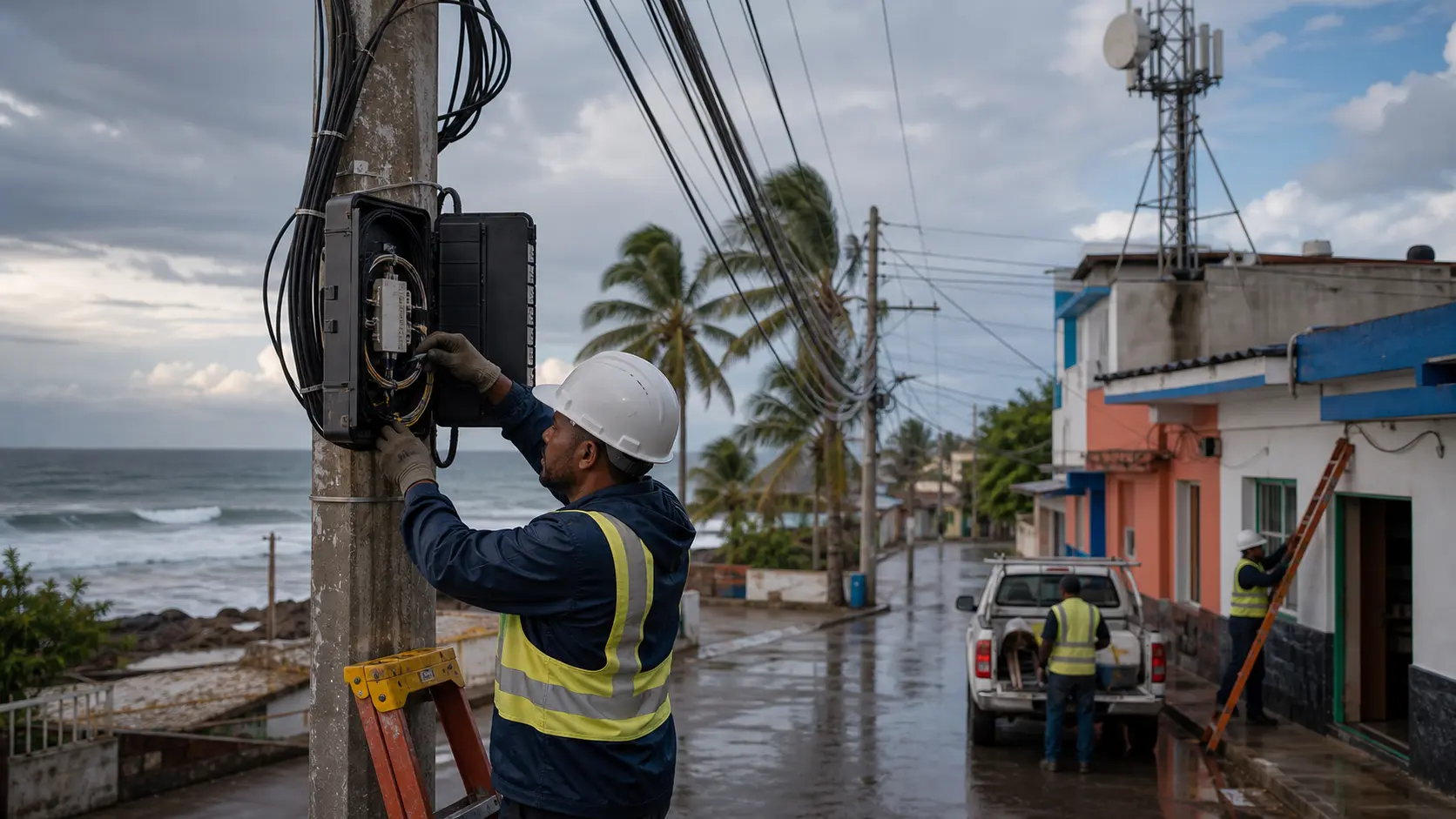
A smaller ISP's resilience problem is not only whether its core survives a storm. It is whether it has enough field capacity after the storm to triage service in the right order. Business customers with card payments and cameras call first. Residential customers call in volume. A WISP customer may need upstream or interconnection help. A fibre cabinet may have water intrusion. A rooftop radio may be misaligned. A pole route may be blocked by a fallen tree. Power may be absent at the customer site even if the network is alive.
Every hour spent explaining that the router is not the fault consumes the same support staff needed to handle a true outage. The best local operators reduce this cost through geographic memory: they know which streets flood, which buildings have poor wiring, which customer complaints usually mean a neighbourhood issue, and which faults need a field crew before a reboot script wastes time.
That local knowledge is Telemarch's strongest possible asset. It is also perishable. If the company grows too fast outside its technician memory, repair quality falls. If it grows too slowly, fixed costs and upstream minimum commitments bite. The most attractive version of the company is therefore not the one with the flashiest advertised speed. It is the one that can densify one operating zone at a time, keep service records clean, negotiate enough upstream resilience and avoid turning support into a backlog.
Customer concentration is geographic before it is financial
There is no public customer list, and the article should not invent one. The visible concentration is geographic and product-based. The first authorization focuses on Santiago de los Caballeros and nearby Santiago/Villa González localities. The later modification adds Valverde zones and Hato del Yaque. The official site markets homes, businesses, digital TV, cloud-style solutions and support. PeeringDB adds WISP customers as a network audience: https://www.peeringdb.com/asn/272011. That mix can be healthy, but only if each customer type is priced to its cost.
Residential customers create volume and brand familiarity. They also create many small support events. A router in a bad corner of the apartment can look like a network failure. A congested WiFi channel can become a cancellation threat. A family that buys 15 Megas but runs multiple phones, a smart TV and video calls can blame the provider for a plan mismatch. Telemarch's own FAQ-style guidance recognizes this by explaining that 15-30 Megas fits basic use and that heavier streaming, gaming and many devices need 50-100 Megas or more: https://www.telemarch.com.do/residencial. The commercial challenge is to upsell without sounding like an excuse.
Business customers create higher ARPU and stronger willingness to pay for restoration. They also ask for static IPs, monitoring, security and accountability. A 500-Mega business line at RD$8,500 may seem expensive beside a consumer plan, but it is cheap beside a day of failed card transactions, missed reservations or staff idle time. The 1-Giga business plan at RD$15,000 is a signal that Telemarch wants accounts where connectivity is part of operations rather than entertainment: https://www.telemarch.com.do/empresarial. The risk is that service-level language becomes a promise the company cannot financially support during widespread faults. A local ISP should sell priority support only where it has actual dispatch priority and upstream escalation, not merely because the words improve conversion.
WISP customers are a different calculation. They can aggregate demand from areas where Telemarch does not want to own every end-user relationship. They can also create wholesale-like traffic without wholesale-like contract discipline if not managed well. If a WISP customer over-sells its own access layer, Telemarch may inherit reputation problems through complaints that originate beyond its direct plant. If a WISP customer depends on Telemarch during storm repairs, the company may face pressure from many indirect users through one account. The appeal is scale. The danger is a support shadow larger than the invoice.
This is why customer concentration cannot be judged only by revenue. A small number of business and WISP accounts may produce a large share of traffic and margin. Losing one could hurt. But a larger number of underpriced residential accounts can also consume support capacity and make the network feel worse than its engineering. The facts that would change the judgment are simple: subscriber count by plan, ARPU by segment, churn by municipality, trouble tickets per 100 accounts, average repair time, business revenue share and the percentage of traffic carried by the top ten accounts.
Without those, Telemarch should be read as a geographically concentrated operator with plausible but unproven segment economics.
National carriers set the ceiling, local support sets the floor
Claro and Altice are not merely competitors. They define the customer's reference price, reference bundle and reference expectations. Claro's home internet page tells consumers that fibre is available "en cada rincón del país," offers free installation and WiFi equipment, and wraps internet inside a broader home-service ecosystem: https://www.claro.com.do/personas/servicios/servicios-hogar/internet/internet-fijo/. Altice's triple-play page gives a long tariff ladder from 75 Megas to 1,000 Megas with TV, voice and promotional gifts: https://altice.com.do/personal/hogar/planes/tripleplay/red-fibra. Even when the national carrier does not reach a specific street with the same quality, its marketing sets what customers think broadband should include.
Telemarch cannot win a national advertising war. It can win moments of disappointment. A customer with no fibre from the national operator, or with repeated delays, or with poor support routing, is open to a local alternative. The same customer may return to a national brand when a promotion arrives, unless Telemarch has built enough trust to make the switching hassle unattractive. That is why the first ninety days after installation matter. If the drop is clean, the router is appropriate, the billing is clear and the support phone works, the local provider earns a psychological credit.
If the first fault is mishandled, the customer sees the small brand as a risk.
Viva and mobile-home products pressure the bottom. Viva's internet móvil hogar pitch starts from RD$909 and emphasizes no contract, no penalty and no technician installation: https://tiendavirtual.viva.com.do/collections/planes-y-servicios. That is not a like-for-like substitute for a stable fibre line, but it appeals to renters, temporary households and customers who dislike installation appointments. It also teaches the market to value flexibility. Telemarch's response cannot simply be "we are faster." It has to show why a fixed line with local support is worth the commitment.
Satellite pressure works from the other direction. Starlink-type service can be expensive relative to local fibre, but it gives remote and backup-oriented customers a way to escape terrestrial fault patterns. A rural or semi-rural business outside the best fibre footprint may value independence from the local pole route. A coastal business may value backup after a storm. That does not destroy Telemarch's market. It forces the company to define when terrestrial local support is better than hardware autonomy and an exposed sky view.
Non-official signals: small footprint, real local interest
The unofficial market signal around Telemarch is not a flood of consumer complaints or praise. It is a small, local digital footprint with hints of demand in places the largest carriers do not satisfy. The company's Facebook page is visible at https://www.facebook.com/telemarch/ and search snippets show a modest page presence tied to Santiago, fibre internet and digital cable. Its Instagram profile at https://www.instagram.com/telemarch/ presents the same brand and the same WhatsApp-style sales channel. Posts and snippets around slow internet, WiFi tips and local service recommendations are not audited performance data, but they are useful market evidence: Telemarch is selling into a consumer pain point that Dominicans describe in ordinary language as slowness, drops and coverage gaps.
One especially telling pattern is that Telemarch appears in social search results when people ask for alternatives to Claro or Altice in Santiago. The statement "Telemarch es buenísimo pero no llega donde me mudé" appears in a public Facebook-search snippet associated with local internet recommendations. That should not be treated as proof of quality, but it shows the kind of reputation a local ISP needs: not universal awareness, but neighbourhood recall. A local provider does not need every Dominican household to know its name. It needs enough people in the authorized footprint to hear the name when the national options fail them.
The small footprint cuts both ways. A modest social following can mean an under-marketed company with real operations, or it can mean limited scale. A website with modern plan pages can mean active commercial discipline, or it can mask thin back-office capacity. Public routing records can show technical seriousness, but not customer satisfaction. The right reading is neither skepticism for its own sake nor promotional confidence. Telemarch has visible local market traction and visible network infrastructure. The open question is whether that traction is dense enough to fund the support and resilience claims the market will test.
What could make Telemarch more valuable
The upside case begins with density. If Telemarch can keep adding customers inside Santiago, Hato del Yaque, Villa González and Valverde corridors without scattering crews too thinly, the economics improve. Installation cost per customer falls when technicians repeat routes. Spare inventory becomes easier to stage. Outage diagnosis becomes faster because patterns repeat. Local content and exchange traffic become more valuable because aggregate traffic grows. Business support becomes easier because the provider can prioritize known clusters rather than drive across an unfocused footprint.
The second upside lever is peering and caching. The public PeeringDB statement says Telemarch is interested in hosting CDN caches and direct content peering: https://www.peeringdb.com/asn/272011. If that becomes reality, the company can turn traffic growth from a pure cost into a partial advantage. Video and social traffic are expensive when every bit rides paid upstream; they are less painful when popular content sits closer to the user. Lower latency and fewer upstream bottlenecks also reduce support calls that begin as "the internet is slow" but are really congestion complaints.
The third lever is enterprise discipline. Telemarch's business plans include features customers understand: static IPs, monitoring, firewall, VPN and priority support: https://www.telemarch.com.do/empresarial. The valuable version of this offer is not a generic business page. It is a controlled portfolio of clinics, offices, hotels, small industrial firms, schools, retailers and local service businesses whose outage cost is high enough to pay for better support. The danger is discounting business lines until they become residential economics with business expectations. A small ISP should protect enterprise margin because that is what funds the spare parts and overtime that residential customers also benefit from.
The fourth lever is resilience productization. In a storm-exposed island market, backup power, redundant route options, secondary wireless paths and satellite backup integration can be sold as risk reduction rather than as technical extras. The World Bank and GFDRR risk data make the national case for resilience, but Telemarch has to translate it into local options: a business package with power-tested customer equipment, a backup path, a clear post-storm priority policy and honest limits. The provider that tells customers what will fail and what will not fail earns more trust than the provider that promises perfection.
What could break the case
The first downside risk is upstream fragility. If Telemarch's effective upstream cost rises, or if a key upstream path performs poorly, retail tariffs may not leave enough room to invest in support. BGP.tools' current view of two upstreams is not necessarily a problem, but it is a risk marker: https://bgp.tools/as/272011. The economic question is whether the company has enough route diversity and contract leverage to protect customers during upstream faults. For a regional ISP, the worst outage is one it cannot fix locally but still has to explain locally.
The second downside risk is overexpansion. The INDOTEL area modification suggests ambition beyond the first Santiago footprint: https://indotel.gob.do/wp-content/uploads/2025/12/Res._DE-142-2025_TELEMARCH_SRL.pdf. Expansion can create growth, but it can also create a repair map that the support organization cannot handle. Local broadband businesses often fail not because demand is absent but because they accept too many low-density installations, too many hard-to-reach customers and too many promises of fast repair outside the realistic crew radius.
The third risk is price compression from national carriers. If Claro or Altice decide to compete aggressively in Telemarch's strongest neighbourhoods, the local provider must choose between matching price and preserving service quality. Matching price without national scale is dangerous. Refusing to match price requires a support reputation strong enough that customers accept the premium or accept fewer bundled extras. This is where Telemarch's small size becomes both shield and weakness. A national carrier may ignore a small local operator until it becomes visible enough to attack.
But once attacked, the local operator has fewer financial buffers.
The fourth risk is credibility. A business page promising SLA, redundant links and monitoring invites serious buyers to ask for service history, uptime, escalation paths and compensation terms. If Telemarch can answer those questions, the business plan is an asset. If it cannot, the marketing creates expectation without margin. In a market where social media quickly circulates outage stories, the gap between promise and support reality can become expensive.
The facts that would change the judgment
Several facts would move this assessment sharply upward. The strongest would be hard operating numbers: active subscribers, business-account share, ARPU by plan, churn by locality, average installation time, average restoration time and complaint rates. A second would be technical proof of resilience: upstream contracts, route diversity, cache deployments, exchange utilization, backup power policy and storm-repair staffing. A third would be commercial proof: named enterprise customers willing to speak publicly, case studies of post-storm restoration, or audited customer satisfaction.
A fourth would be expansion evidence showing that Valverde and added Santiago-area authorizations have translated into dense, profitable service rather than scattered coverage.
Several facts would move the assessment downward. A pattern of unpaid regulatory obligations, expired authorization, persistent social complaints about outages, evidence that business SLA language is not backed by support practice, loss of exchange connectivity, or reliance on a single underperforming upstream would all weaken the case. So would tariff cuts that make no sense against the cost of field repair. Broadband customers often buy price first, but they remember failure. A local ISP that trains customers to expect cheap service and instant support eventually has to pay for both.
The most honest current reading is that Telemarch is a real regional operator with a plausible niche and a demanding cost base. It is not protected by mystery. Its public footprint shows a company trying to formalize local broadband service in Santiago and nearby corridors, operate an independent routing edge, use peering to reduce dependence where possible, and sell both household affordability and business support. Its vulnerability is that every advantage requires execution. Local support only matters if it answers. Peering only helps if traffic actually follows better paths.
A business plan only earns premium margin if the outage response is real. Expansion only creates value if density follows.
For the Dominican business owner at the beginning of this story, the decision is not ideological. It is arithmetic. If Telemarch's price is close enough, the installation is fast enough, the router is good enough, the support number works and the service survives the next heavy-weather week with fewer surprises, the local alternative has value. If the national carrier is cheaper, the mobile substitute is easier and the local repair promise fails, the brand becomes just another name on a bill.
In an island broadband market, that is the cost of being the alternative: you do not have to be the largest network, but you do have to be the one whose local promises survive contact with weather, upstream dependence and customers who cannot afford another outage.