
Summary
- The article reads TELEM as critical island infrastructure, not merely a bundle of broadband, mobile and TV plans.
- It connects retail prices to submarine-cable failures, public ownership, hurricane risk, mobile competition and Starlink pressure.
- The strategic value is high, but the financial case depends on capital discipline, redundancy and whether local control improves resilience.
A $65 fiber bill carries the price of an island backup plan
On Sint Maarten, a home broadband bill is not just a consumer price. It is a small monthly claim on a network that must survive sea, weather, imported equipment, regulatory fees, scarce technical labor, and the cost of routes off the island. TELEM's current retail fiber page lists a 75 Mbps download and 25 Mbps upload home plan at $65 per month on one tab, with another 75 Mbps plan at $55 per month, and higher packages reaching 250 Mbps download and 100 Mbps upload at $115 to $125 per month (https://telem.sx/service/fiber/). Those numbers look ordinary beside North American or European broadband price tables. On a 34 square kilometer island economy, they carry a much heavier burden: every extra megabit has to be bought, routed, protected, powered, supported, and repaired across a geography that does not forgive thin redundancy.
That is the central problem for TELEM Group. The company sells local services in a small retail market, but the cost base is shaped by international connectivity and storm resilience. Its own website describes Telem as government-owned, locally owned, and active across fiber internet, mobile, TV, landline, and international services (https://telem.sx/about-us/). Its home page presents the company as Sint Maarten's local telecom provider with fiber, mobile, TV, and business services (https://telem.sx/). Its business page offers high-speed internet, mobile and landline service, PBX, dedicated internet access, and IPTV solutions (https://telem.sx/service/business/). The retail surface looks broad. The economic base is narrow.
The island has seen what happens when offshore capacity fails. In 2011, public reporting said damage to the SMPR-1 submarine cable left St. Maarten with limited international voice and data service, affected ATM, internet, roaming, BlackBerry, and international calling services, and required temporary rerouting through French-side and Puerto Rico partners (https://pearlfmradio.sx/2011/09/05/telem-group-calls-in-dive-company-to-survey-damage-to-smpr-1-cable/). In December 2016, local reporting again described SMPR-1 damage, alternative routing to Puerto Rico, banking and airport connectivity being prioritized, and a 10 Gbps capacity path being optimized while repair arrangements were made (https://www.sxm-talks.com/721news/telem-group-businesses-a-priority-in-restoration-of-services-after-major-outage-sunday/). A month later, TELEM announced a $3.3 million backup plan for SMPR-1, explicitly tied to the need to keep telecom services running after future cable damage (https://www.721news.com/2017/01/telem-group-announces-3-3m-backup-smpr-1-undersea-cable/).
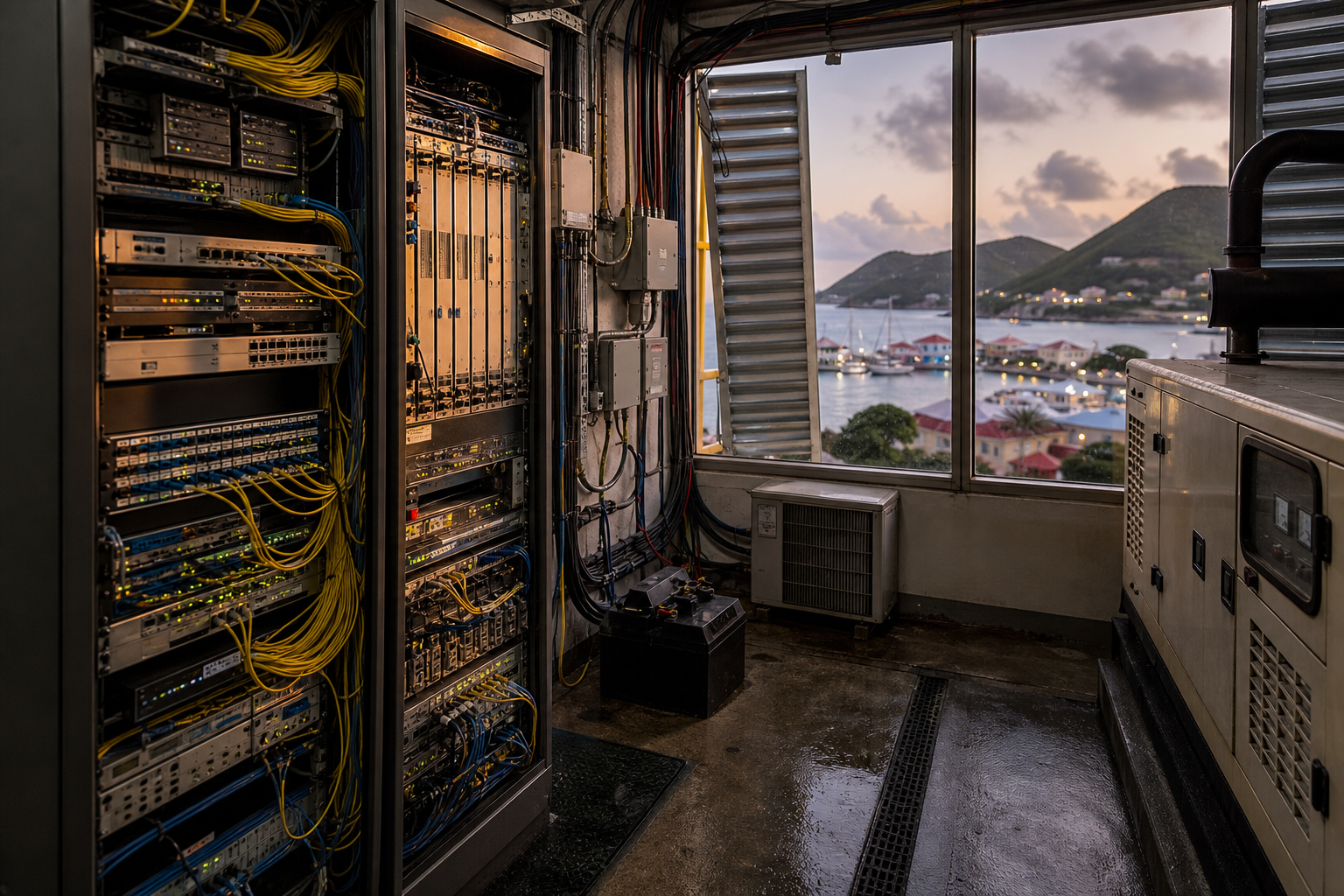
That opening history matters because it turns the company from a simple broadband provider into a public-infrastructure bet. A mainland operator can average cable cuts, weather losses, and customer density over millions of premises and many routes. TELEM cannot diversify away from the island. Its economics are closer to an airline or port utility than to a software platform: fixed assets are lumpy, demand is local, and the biggest failures arrive as physical events. The value of the business is therefore not measured only by whether a $65 fiber plan is cheap or expensive.
It is measured by whether that price can finance a network that still moves payments, airport information, hotel traffic, emergency coordination, and family communications when a cable, a node, or a storm fails.
The national provider is a group of companies, not a single retail brand
TELEM is often encountered by customers as a local brand, but the public company structure is wider. Business View Caribbean, in a 2019 interview with then CEO Kendall Dupersoy, described TelEm Group as the government-owned Sint Maarten Telecommunication Holding Company N.V. and listed operating companies including Sint Maarten Telephone Company N.V., TelCell N.V., St. Maarten International Telecommunication Services (SMITCOMS) N.V., SMITCOMS Inc., SMITCOMS Dominicana Ltd., and Caribbean Teleview Services N.V. (https://businessviewcaribbean.com/telem-group-st-maarten-connecting/). The Overseas Countries and Territories Association profile gives a similar structure and says the group provides landline, mobile, international bandwidth, cable television, and internet services to residents, businesses, and visitors (https://www.overseas-association.eu/community/telem-group/).
That group structure explains why a narrow retail reading misses the asset. Fixed voice, mobile, international transport, TV, and local business connectivity do not have the same economics. Mobile prepaid plans sell small, flexible data units: TELEM's prepaid page lists one-day and 30-day bundles from $2 to $40, with data, SMS codes, rollover terms, roaming rules, and top-up mechanics (https://telem.sx/service/mobile/). Postpaid mobile plans range from $25 junior and senior plans to $175 plans with larger data allowances and on-net allowances (https://telem.sx/service/mobile-postpaid/). TV packages range from a $11.99 lite product to $80 premium packages with more channels, plus equipment and account terms (https://telem.sx/service/tv/). Customer support is also a physical and operational cost: TELEM lists Philipsburg and Simpson Bay contact points, phone and WhatsApp support, and a typical 3 to 5 business day technician assignment window that can vary with outage severity (https://telem.sx/customer-support/).
The company is therefore a retail bundle on one side and an engineering organization on the other. Its current leadership page lists a management board entry for CFO Randell Hato and a supervisory board including Dagmar Daal, Earl Wyatt, Janelle Presentacion, Damien Schmidt, and Robert Budike (https://telem.sx/our-leaders/). That presentation matters because public ownership places financial discipline, labor decisions, and service continuity inside the same political frame. The shareholder is the country, customers are also voters, and the network carries essential public and private traffic.
The company's own messaging emphasizes local ownership and community investment. Its news page shows commercial, community, and network-transformation items, including branch reopening, Super Wi-Fi, Ookla awards, and customer-account notices (https://telem.sx/news/). That is normal for a national operator, but it also illustrates a strategic tension. The company has to present itself as a friendly retail provider while managing the risk profile of a critical carrier. A bad mobile offer can cost customers. A weak international route can cost the island.
For BTW's purposes, the right lens is not whether TELEM is large in global telecom. It is not. The better question is whether TELEM has enough local control, technical depth, and capital discipline to keep Sint Maarten from becoming dependent on providers whose incentives are regional, offshore, or purely satellite-based. In that sense, the group-of-companies structure is not corporate clutter. It is the institutional container for the island's fixed, mobile, TV, and international-connectivity choices. The cost of that container is visible whenever a simple retail bill has to support assets that a small household cannot see.
Submarine faults turned redundancy from a technical feature into an economic demand
The SMPR-1 history is the most revealing public evidence about TELEM's operating surface. Submarine cable maps identify the Sint Maarten-Puerto Rico Network One system as a cable connecting Sint Maarten and Puerto Rico (https://www.submarinecablemap.com/submarine-cable/sint-maarten-puerto-rico-network-one-smpr-1). The map does not explain the island's lived risk by itself. The local outage record does. When the cable was damaged in 2011, the operational fix involved a dive survey, an alerted U.S. repair company, rerouting through French-side links, assistance from Puerto Rico partners, and temporary restoration through a physical cross-connect arrangement (https://pearlfmradio.sx/2011/09/05/telem-group-calls-in-dive-company-to-survey-damage-to-smpr-1-cable/). The technical story reads like a shipping and civil-works story because, in an island telecom market, network continuity often is one.
The 2016 outage made the same point with more commercial detail. TELEM prioritized banking, financial-sector leased lines, and airport information systems while an alternative cable route to Puerto Rico was brought up through other carriers (https://www.sxm-talks.com/721news/telem-group-businesses-a-priority-in-restoration-of-services-after-major-outage-sunday/). The article named Digicel, Telefonica, and Dauphin Telecom as assisting in the alternative arrangement, a reminder that even competitors and neighboring carriers become operational partners when geography dominates rivalry. A network with only one affordable path is not resilient because its marketing says so. It is resilient only if commercial agreements, landing access, equipment, permits, and engineering staff can create a second usable route under pressure.
TELEM's January 2017 redundancy announcement put a price on that lesson. The company described a $3.3 million plan to reroute traffic via a second fiber optic cable, with backup capacity coming from a 10 Gbps link through SSCS, St. Kitts, PCCS, Jacksonville, and a Miami point of presence (https://www.721news.com/2017/01/telem-group-announces-3-3m-backup-smpr-1-undersea-cable/). For a small island provider, that is not a discretionary upgrade. It is the price of turning a retail network into an economic lifeline. The same report said the SMPR-1 repair could take months because of permitting and reef work in Puerto Rico, which is exactly the kind of delay that a local operator cannot solve by better customer service.
A later infrastructure feature adds a more favorable version of the same story. Panorama reported TELEM's statement that SMPR-1 repair allowed more bandwidth and lower-cost service, and that after Hurricane Irma the company rebuilt with stronger infrastructure, central offices described as bunker-like, and more underground cabling intended to restore connectivity within 12 to 24 hours after a major storm (https://sintmaarten.panorama.uk.com/unsung-heroes-of-sint-maarten-infrastructure/). That claim should be read as management's account of its resilience posture, not as proof that every outage has been eliminated. In March 2025, a network restoration update said a Smitcoms building node suffered a faulty-card event that interrupted business customers and mobile radio users before LTE voice and data were restored and longer-term fixes were promised (https://smn-news.com/index.php/st-maarten-st-martin-news/47317-telem-group-network-restoration-update.html).
The pattern is important. TELEM's strongest public argument is not that it never fails. It is that it has a local restoration obligation and physical control surfaces that can be reinforced over time. Submarine capacity, node redundancy, fiber depth, customer premises support, and backup routes are not separate subjects. They are one balance-sheet question: how much recurring revenue can a small island extract from households, hotels, businesses, and visitors without pricing itself out of the market, while still carrying enough capital to repair the network when the next fault is wet, windy, expensive, and urgent?
Public routing records show an island network with offshore dependencies
The retail brand becomes more concrete in internet-number records. LACNIC's RDAP record for TELEM GROUP shows the registrant handle SX-TEGR-LACNIC, an address at Soualiga Boulevard in Philipsburg, and allocated IPv4 block 131.161.84.0/22 plus IPv6 block 2803:7380::/32 (https://rdap.lacnic.net/rdap/entity/SX-TEGR-LACNIC). The RDAP record for 131.161.84.0/22 identifies TELEM GROUP as registrant and shows reverse DNS delegations to NS1.TELEM.SX and NS2.TELEM.SX (https://rdap.lacnic.net/rdap/ip/131.161.84.0/22). Separately, the AS27781 RDAP record identifies SMITCOMS N.V. as the registrant of that autonomous system and lists a 2005 registration date (https://rdap.lacnic.net/rdap/autnum/27781).
Those records should not be mistaken for a list of business units or customers. They are technical evidence about routing responsibility. But the routing evidence aligns with TELEM's public group structure. PeeringDB lists SMITCOMS as "also known as TELEM Group of Companies," identifies ASN 27781, describes a network-service-provider type, shows 10 to 20 Gbps traffic level, and lists interconnection or facility presence in Sint Maarten, Curacao, Miami, and Puerto Rico (https://www.peeringdb.com/net/1645). BGP.tools also identifies AS27781 as SMITCOMS N.V., marks it active under LACNIC, lists upstreams including Telxius, Columbus Networks USA, and Verizon Business, and shows TELEM GROUP prefixes under the origin set (https://bgp.tools/as/27781).
That footprint makes TELEM more than a local last-mile operator. It is part of the routing fabric for Sint Maarten. IPinfo's AS27781 page identifies SMITCOMS N.V. as a Sint Maarten autonomous system and describes it as a major ISP, while the country page ranks SMITCOMS/AS27781 among the visible ASNs in Sint Maarten by IP count (https://ipinfo.io/AS27781 and https://ipinfo.io/countries/sx). Again, these are not audited market-share accounts. They are outside views of public internet routing. They support the practical conclusion that TELEM's technical role extends beyond storefront service and into traffic exchange, upstream buying, and number-resource stewardship.
The dependencies are visible inside the data. A Miami exchange, Puerto Rico facility, Curacao interconnection, and upstreams from global carriers are not signs of weakness. They are how an island network reaches the world. The vulnerability lies in the economics. TELEM cannot simply "go local" for the most expensive part of international service. The island has to buy transit, maintain relationships, manage peering, and keep enough route diversity to avoid single points of failure. That is why the 2016 redundancy path through St.
Kitts, PCCS, Jacksonville, and Miami matters: it was a commercial and geographic workaround, not a software setting.
The routing layer also reframes competition. A satellite terminal can bypass some terrestrial constraints for a customer, and a regional carrier can bring another branded retail option. But mass-market latency, capacity, emergency coordination, lawful numbering, business connectivity, and local installation still sit inside a regulated network environment. TELEM's defensible role is strongest where the retail subscription, local premises work, island support, and international routing contract meet. If the company loses that meeting point, it becomes just another seller of bandwidth.
If it protects it, it remains a national utility with commercial upside.
The local market sets a ceiling that technology upgrades cannot fully lift
Sint Maarten's official statistics page lists a 2023 population of 42,938 and a 2022 real GDP growth figure of 16 percent (https://stats.sintmaartengov.org/). Those numbers are useful because they expose the scale problem. A telecom operator can upgrade equipment and products, but it cannot turn a 43,000-person country into a million-home market. Business View's 2019 interview gave the same constraint in operator language: TELEM had to buy equipment comparable to larger carriers while serving a customer base that Dupersoy described as peaking around 12,000 (https://businessviewcaribbean.com/telem-group-st-maarten-connecting/). Even if that figure has changed since the interview, the structural point remains. The minimum efficient scale of telecom gear is not designed for micro-island economics.
TELEM has tried to answer the constraint with fiber value rather than only price. In 2022, local reporting said the company nearly doubled fiber speeds without raising prices, with packages then starting at $55 for 25 Mbps download and 10 Mbps upload and rising to 150 Mbps download and 75 Mbps upload at the top end (https://smn-news.com/index.php/st-maarten-st-martin-news/40445-telem-group-once-again-significantly-increasing-fiber-speeds-for-customers-at-no-extra-charge.html). The current fiber page now lists higher speeds, including 250 Mbps download and 100 Mbps upload packages (https://telem.sx/service/fiber/). TELEM's September 2025 announcement said Ookla recognized it for Fastest Internet, Best Internet, and Best Internet Gaming Experience in Sint Maarten for Q1-Q2 2025, and attributed the awards partly to fiber and core upgrades, network enhancements since late 2024, and a new mobile core deployed in June 2025 as a foundation for future 5G (https://telem.sx/2025/09/24/telem-wins-triple-recognition-at-ookla-speedtest-awards/).
The upgrade story is commercially important. Customers judge speed, price, stability, and installation, not capital-structure elegance. If TELEM can use fiber upgrades to raise customer satisfaction without pushing prices beyond local incomes, it gains time. But the economics still have a ceiling. A speed increase at no extra charge can defend share, yet it also means more traffic must be carried, cached, routed, and supported for the same monthly revenue. That is attractive when the network core has unused capacity or when churn reduction is worth more than incremental bandwidth cost.
It is dangerous if it becomes a habit of giving away capacity faster than revenue or cash flow can absorb.
That is why the service mix matters. Mobile prepaid generates frequent small transactions and captures visitor or budget-sensitive demand. Postpaid plans create steadier monthly revenue. TV adds content and equipment obligations. Business service can deliver higher-value relationships, especially for hotels, government offices, professional services, banks, marinas, and airport-linked users. Dedicated internet access and PBX are not glamorous products, but they can anchor enterprise accounts that care more about support and uptime than a headline consumer speed.
The ceiling is also social. The company is publicly owned and locally embedded; it cannot behave like a venture-funded challenger that burns cash to gain share and then reprices aggressively. Its own customer-facing terms refer to contract periods, equipment fees, account rules, fair-use limits, roaming charges, and local application requirements (https://telem.sx/service/tv/ and https://telem.sx/service/mobile-postpaid/). Those details reveal an operator trying to convert a small, mixed customer base into predictable cash. The strategic question is whether predictable cash is large enough to fund the next core upgrade, the next fiber build-out, the next storm hardening, and the next cable redundancy bill.
Competition now comes from Flow, applications, and satellites at the same time
TELEM's competitive problem is not one rival. It is the combination of three forces. The first is conventional telecom competition. Flow markets St. Maarten internet packages, including an Internet 300 monthly product shown at $79 on its local consumer site (https://discoverflow.co/web/st-maarten/internet/overview). Flow's prepaid mobile page offers data and combo bundles for the same island market (https://discoverflow.co/web/st-maarten/chippie/plans/prepaid). Flow Business advertises business internet in Sint Maarten with speeds up to 500 Mbps, fixed or dynamic IP options, mobile add-ons, and local support contact channels (https://flowbusiness.co/sint-maarten/core-solutions/internet). This is direct competition for household, mobile, and business customers.
The second force is application substitution. Business View's 2019 interview made the point plainly: TELEM was no longer competing only with domestic providers because WhatsApp, Skype, Zoom, and other internet applications were replacing traditional voice revenue (https://businessviewcaribbean.com/telem-group-st-maarten-connecting/). That pressure is common across telecom markets, but it is sharper on small islands because voice-margin decline cannot be offset by tens of millions of new data customers. When customers use Wi-Fi to avoid overseas calling charges, the operator still needs the broadband network but loses the older revenue logic that helped pay for international connectivity.
The third force is satellite broadband. In August 2024, BTP advised that Starlink antennas were not authorized on the Dutch side of Sint Maarten and that sale, distribution, installation, or use without authorization was unlawful (https://btp.sx/btp-advises-public-on-prohibition-of-starlink-antennas-usage-135.html). By May 2025, local reporting said the Ministry of TEATT granted Starlink SXM B.V. a license to provide broadband across terrestrial, maritime, and aviation zones, with reported pricing around $80 per month and a $700 setup cost (https://smn-news.com/index.php/st-maarten-st-martin-news/48100-starlink-now-legal-in-st-maarten-opening-new-doors-for-connectivity.html). Starlink's own availability map is the public global reference for service availability and coverage checks (https://starlink.com/map).
Satellite does not make submarine fiber irrelevant. High-capacity fixed networks remain the cheaper way to serve dense demand, enterprise links, content delivery, and low-latency mass usage. But satellite changes bargaining power. A hotel, marina, government department, remote villa, backup-conscious business, or high-income household can now treat terrestrial broadband as one option rather than the only way out. In a hurricane-prone island, that backup psychology matters even when satellite is not the cheapest daily connection.
TELEM's answer cannot be nostalgia for national ownership. It has to be a credible combination of price, local service, speed, and resilience. Its best argument is that a terrestrial fiber and mobile operator with local technicians, regulated numbering, business support, and physical repair capability remains indispensable even when some customers buy satellite backup. Its weakest position would be a network that is slower than Flow, less flexible than satellite, and politically constrained in its pricing. The risk is not that every customer leaves.
The risk is that the highest-value, most resilience-sensitive customers buy alternatives first, leaving TELEM with the expensive public-service role and a thinner commercial surplus.
Local repair capacity is the advantage that satellites do not replace
The strongest defense for TELEM is not that satellites are inferior or that regional carriers lack resources. It is that an island needs people, spares, premises access, customer records, regulatory familiarity, and field routines that can be mobilized locally. TELEM's support page is mundane in the useful way: it lists branch offices, phone and WhatsApp contact channels, help-desk hours, outage reporting, and technician assignment after a customer reports a problem (https://telem.sx/customer-support/). In normal times, that is customer service. In storm season, it is part of a restoration map.
The repair record shows why this matters. The 2011 SMPR-1 incident required a dive company near Great Bay Beach, coordination with a U.S. cable-repair company, rerouting through French-side infrastructure, and help from Puerto Rico partners (https://pearlfmradio.sx/2011/09/05/telem-group-calls-in-dive-company-to-survey-damage-to-smpr-1-cable/). The 2016 outage required business prioritization, alternate routes, and coordination with other carriers while repair timing depended partly on specialist vessel availability and holiday-season constraints (https://www.sxm-talks.com/721news/telem-group-businesses-a-priority-in-restoration-of-services-after-major-outage-sunday/). The March 2025 network update was smaller in scale but similar in logic: a failed card in the Smitcoms building interrupted mobile and business services, and restoration depended on technicians moving traffic to an alternative network path (https://smn-news.com/index.php/st-maarten-st-martin-news/47317-telem-group-network-restoration-update.html).
This operational knowledge is difficult to value in a monthly plan comparison. A Starlink terminal can give a household or hotel an independent path when terrestrial service is weak. Flow can offer regional scale and competing product design. But neither of those facts eliminates the need for a local carrier that understands where ducts, cabinets, mobile sites, customer circuits, public buildings, hotel clusters, and cable landing dependencies sit. The first hours after an outage reward physical familiarity. They also reward relationships with government, banks, airport operators, other carriers, and emergency managers.
There is a financial catch. Local repair capacity costs money even when no one is repairing anything. Staff, training, spare cards, vehicles, generators, pole and duct work, customer service, and vendor contracts all sit inside the cost base before the next storm arrives. That is why the company can be valuable and financially stressed at the same time. The island benefits from standby capability, but customers usually buy visible bandwidth. If the public shareholder wants TELEM to maintain a deeper repair bench than a lean private operator would choose, the support model has to recognize that public value explicitly.
TELEM's local advantage therefore becomes credible only when matched by measured performance. The company should be able to show restoration times by outage class, fiber repair intervals, mobile-site hardening progress, spare-parts readiness, and enterprise failover options. Those measures would turn "local" from a slogan into a service attribute. Without them, local ownership risks becoming sentimental cover for ordinary outages. With them, TELEM can defend a premium position even in a market where customers have more ways than ever to buy bandwidth.
Regulation and public finance make the network a fiscal choice
The regulatory setting is not a side issue. BTP presents itself as the telecommunications and postal regulatory authority of Sint Maarten and points users to telecommunications policies, legislation, numbering plans, consumer resources, and publications (https://btp.sx/). The 2015 National Numbering Plan explains that Sint Maarten entered the North American Numbering Plan, received area code 1-721, and manages scarce numbering resources under domestic telecommunications law and NANP/ITU principles (https://btp.sx/f/Telecommunications/Policies/10t98467536585). NANPA's own public explanation describes the North American Numbering Plan as a shared integrated numbering plan across countries including Sint Maarten, with regulatory authorities controlling local numbering resources (https://www.nanpa.com/about). This means TELEM operates inside a national and regional numbering system, not merely a retail internet market.
Public ownership adds fiscal tension. The 2020 TELEM-BTP settlement shows how regulatory fees, concessions, refinancing, and fiber funding became linked. BES Reporter wrote that after nearly five years of dispute, the TEATT minister mediated a settlement among TELEM, BTP, and the Government of Sint Maarten, allowing the ministry to grant a concession agreement and protecting refinancing of an existing bond and an additional $44 million loan from Windward Islands Bank for fiber-to-the-home work (https://www.bes-reporter.com/news/government/60522/on-st-maarten-telem-settles-dispute-with-btp). StMaartenNews.com reported that the settlement left questions about the amounts and noted that TelEm had stopped paying dividends since 2016 because loan agreements limited distributions to the shareholder (https://stmaartennews.com/telecommunications/telem-btp-settlement-leaves-many-questions-unanswered/).
The public-finance story did not end there. The Daily Herald reported in December 2020 that BTP needed US$784,000 to meet commitments through December and that BTP had paid NAf 4 million in concession fees for 2020, while also noting settlement mechanics related to TelEm balances (https://www.thedailyherald.sx/islands/btp-needs-us-784-000-to-meet-commitments-to-dec-2). In September 2025, SMN News reported that MP Ludmila de Weever asked the government about TELEM's future, citing a fragile financial position, a requested NAf 5 million government guarantee, severance-linked obligations to redundant workers, and the broader question of whether Sint Maarten should maintain its own telecom network after Starlink authorization (https://smn-news.com/index.php/st-maarten-st-martin-news/48880-de-weever-questions-govt-on-telem-s-future.html).
These reports mix confirmed public events with political claims and stakeholder arguments. Their common signal is still strong: TELEM is not being judged only by customer speed tests. It is being judged as a public asset with debt, labor, concession, and strategic-control consequences. A purely private operator might sell assets, cut payroll, narrow service obligations, or exit uneconomic areas faster. A public operator has to manage those choices with political accountability. That can slow restructuring, but it can also preserve national capability where a private market would underinvest.
The fiscal question is whether government support buys reform or merely postpones another shortage. A guarantee that stabilizes severance obligations and protects network investment may be rational if it preserves a viable carrier. The same guarantee is weak if it allows underpriced services, delayed maintenance, and opaque governance to continue. The facts that matter are not slogans about national pride or market liberalization. They are audited cash flow, debt maturity, capex needs, subscriber retention, vendor arrears, network performance, and whether management can convert public ownership into lower risk rather than slower decisions.
Tourism makes reliability more valuable than headline speed
Sint Maarten's economy makes telecom reliability unusually important. The World Bank says Hurricane Irma caused roughly $1.38 billion in damages and $1.35 billion in losses, about 129 percent and 126 percent of GDP respectively, and affected 90 percent of infrastructure (https://www.worldbank.org/ext/en/country/sintmaarten). The National Recovery and Resilience Plan estimated total damages and losses from Hurricanes Irma and Maria at about $2.7 billion and projected recovery and resilience needs at $2.3 billion (https://documents1.worldbank.org/curated/en/793011623753566547/pdf/Sint-Maarten-National-Recovery-and-Resilience-Plan-A-Roadmap-to-Building-Back-Better.pdf). The 2022 Sint Maarten Trust Fund annual report also describes the economy as mainly tourism dependent and says restaurants, hotels, and tourism-related sectors account for about 45 percent of GDP while tourism accounts for 73 percent of foreign exchange income (https://nrpbsxm.org/wp-content/uploads/2023/07/Sint-Maarten-2022-Annual-Report-Final.pdf).
That economic base changes how a telecom outage should be valued. If tourists cannot pay, hotels cannot reconcile bookings, airlines cannot move information, businesses cannot process card transactions, and residents cannot reach family or authorities, the damage is not limited to frustrated browsing. It becomes a tax on the island's reputation. Government data for 2025 passenger and cruise arrivals reported 1,597,940 cruise visitors and quarterly air-arrival growth, reinforcing that Sint Maarten's communications network supports a much larger daily population than the resident count alone suggests (https://www.sintmaartengov.org/news/Pages/Passenger-Arrivals-and-Cruise-Arrivals-Show-Growth-in-2025.aspx).
This is where TELEM's business case is strongest. The company can argue that local network resilience is part of the tourism product. Business View's interview made that point directly, with Dupersoy saying that an island depending almost exclusively on tourism needs good infrastructure because visitors must get information in and out and upload vacation photos (https://businessviewcaribbean.com/telem-group-st-maarten-connecting/). That sentence may sound light, but it captures a real economic mechanism. Tourism is sold through platforms, payments, reviews, maps, messaging, airline systems, and social media. Telecom failure can turn into revenue leakage.
The tourism case also explains why pure price comparisons can mislead. A household may compare TELEM fiber to Flow wireless or Starlink satellite and choose the cheapest acceptable connection. A country has to ask a different question: which mix of local fiber, mobile coverage, international routes, satellite backup, carrier agreements, and emergency systems keeps the whole destination functioning? BTP's May 2025 publication list includes a Prime Minister agreement to launch Cell Broadcast for disaster resilience and public safety, showing that communications policy is being pulled toward emergency notification as well as consumer service (https://btp.sx/publications_1.html). For a hurricane-belt island, resilience is not a premium feature. It is a public safety layer.
The danger is that reliability value is hard to monetize. Visitors do not pay TELEM directly for the confidence that airport systems stay online. Hotels may buy business connectivity, but the island-wide resilience benefit spills beyond one account. Government may want national capability, but the operator has to fund equipment and payroll every month. That creates a classic public-good problem: the island needs more resilience than any one customer wants to pay for in a broadband bill.
TELEM's future depends on whether Sint Maarten can close that gap through disciplined public ownership, smarter wholesale and enterprise pricing, and targeted support for resilience investments rather than generalized bailouts.
The company has upgraded its network, but the balance-sheet test is still ahead
TELEM's current public story has genuine positives. The company has a refreshed website, visible product tiers, a stated fiber offer, business services, mobile and TV packages, local support points, and public leadership information (https://telem.sx/ and https://telem.sx/our-leaders/). Its 2025 Ookla announcement says fixed-network awards followed core and fiber upgrades and that the June 2025 mobile core created a path toward future 5G services (https://telem.sx/2025/09/24/telem-wins-triple-recognition-at-ookla-speedtest-awards/). Its PeeringDB and routing records show an active AS27781 network with upstream and interconnection presence beyond the island (https://www.peeringdb.com/net/1645 and https://bgp.tools/as/27781). Its history after Irma and SMPR-1 damage shows practical restoration experience.
The negatives are also visible. A company that has repeatedly needed settlement, refinancing, public questions, redundancy investments, and labor restructuring is not simply a hidden gem. Public reporting around the 2020 settlement tied the concession question to bond refinancing and a large Windward Islands Bank loan (https://www.bes-reporter.com/news/government/60522/on-st-maarten-telem-settles-dispute-with-btp). Later reporting raised the requested NAf 5 million government guarantee, severance payments, staffing concerns, and the possibility that failure to support TELEM could shift salary obligations onto the public purse (https://smn-news.com/index.php/st-maarten-st-martin-news/48880-de-weever-questions-govt-on-telem-s-future.html). Those are not minor optics issues. They are signals that network modernization has to be matched by financial modernization.
The strategic judgment is therefore mixed but not neutral. TELEM remains important because Sint Maarten needs a locally accountable operator that controls more than a reseller relationship. It is vulnerable because the island's scale limits revenue, competitors can attack profitable segments, and public ownership can blur the line between resilience investment and political delay. The company can win if it turns fiber and core upgrades into lower churn, higher enterprise value, better uptime, and disciplined capex sequencing.
It will struggle if upgrades become an endless promise that each new technology wave will fix economics that were weak before the upgrade.
Three operating measures would clarify the trajectory. First, TELEM should show whether fiber coverage and active subscriptions are growing in areas that matter commercially, not just whether packages exist on the website. The 2019 FTTH target described 20,000 to 25,000 homes by a planned 2020 completion window, which makes actual current coverage a critical missing fact (https://businessviewcaribbean.com/telem-group-st-maarten-connecting/). Second, it should demonstrate whether international route diversity is now stable enough that a future SMPR-1 fault does not recreate the 2011 and 2016 scramble. Third, it should prove that any public support is tied to measured service reliability, audited reporting, and debt reduction rather than unstructured cash relief.
The strongest commercial path is not to out-Starlink Starlink or to out-regional Flow. It is to be the island's best integrated local network: fiber where density supports it, mobile with credible 4G and future 5G evolution, business service that treats hotels and public institutions as high-value resilience customers, and international routing that is transparent enough for serious enterprise buyers. The political path should be equally plain: if Sint Maarten wants a national telecom capability, it has to demand national-asset governance.
That means financial reporting, board accountability, measurable performance, and a support model that separates public resilience from inefficient operations.
The judgment changes if resilience, capital discipline, or market share move sharply
The present judgment is that TELEM is strategically necessary but financially exposed. It is necessary because a tourism-dependent hurricane-belt island benefits from a local operator with fixed, mobile, international, and support capability. It is exposed because the same island cannot give the operator mainland scale, and new competition can skim the most attractive customers while leaving the public asset with heavy infrastructure obligations. That judgment would change in either direction if several facts moved.
It would improve if TELEM published or the government disclosed current audited financials showing positive operating cash flow after maintenance capex, manageable debt service, and a clear plan for the fiber loan and any government guarantee. It would improve if current FTTH coverage, active fiber subscriptions, customer churn, and enterprise-account retention showed that network upgrades are translating into revenue quality, not just better advertised speeds.
It would improve if route-diversity evidence showed that the SMPR-1 dependency has been materially reduced through usable alternate capacity, tested failover, and clear repair agreements. It would also improve if the new mobile core led to a credible 5G timetable tied to enterprise and tourism use cases rather than a vague technology label.
The judgment would weaken if public support becomes recurring without audited reform, if Flow or Starlink take high-margin business and hospitality accounts faster than TELEM can replace them, if outage incidents continue to point to core fragility, or if labor restructuring reduces the local technical depth that makes the operator valuable in the first place. It would also weaken if the government treats TELEM as a symbol to defend while withholding the governance discipline a national infrastructure company needs. A protected operator without performance pressure becomes expensive.
A fully exposed operator without resilience support becomes brittle. Sint Maarten needs neither.
The best reading of TELEM is therefore not sentimental. It is a small, state-owned telecom group carrying a large island dependency. Its public value is highest in the hard moments: a damaged cable, a failed node, a storm, a busy tourism season, a bank transaction that needs to clear, or an emergency message that has to reach people quickly. The company has public evidence of real assets, real upgrades, and real restoration history. It also has public evidence of financial stress and unresolved scale economics. Geography created the need for TELEM. Geography also caps the easy returns.
The next phase depends on whether management and government can turn that constraint into disciplined resilience rather than another expensive argument about who should pay for the island to stay connected.