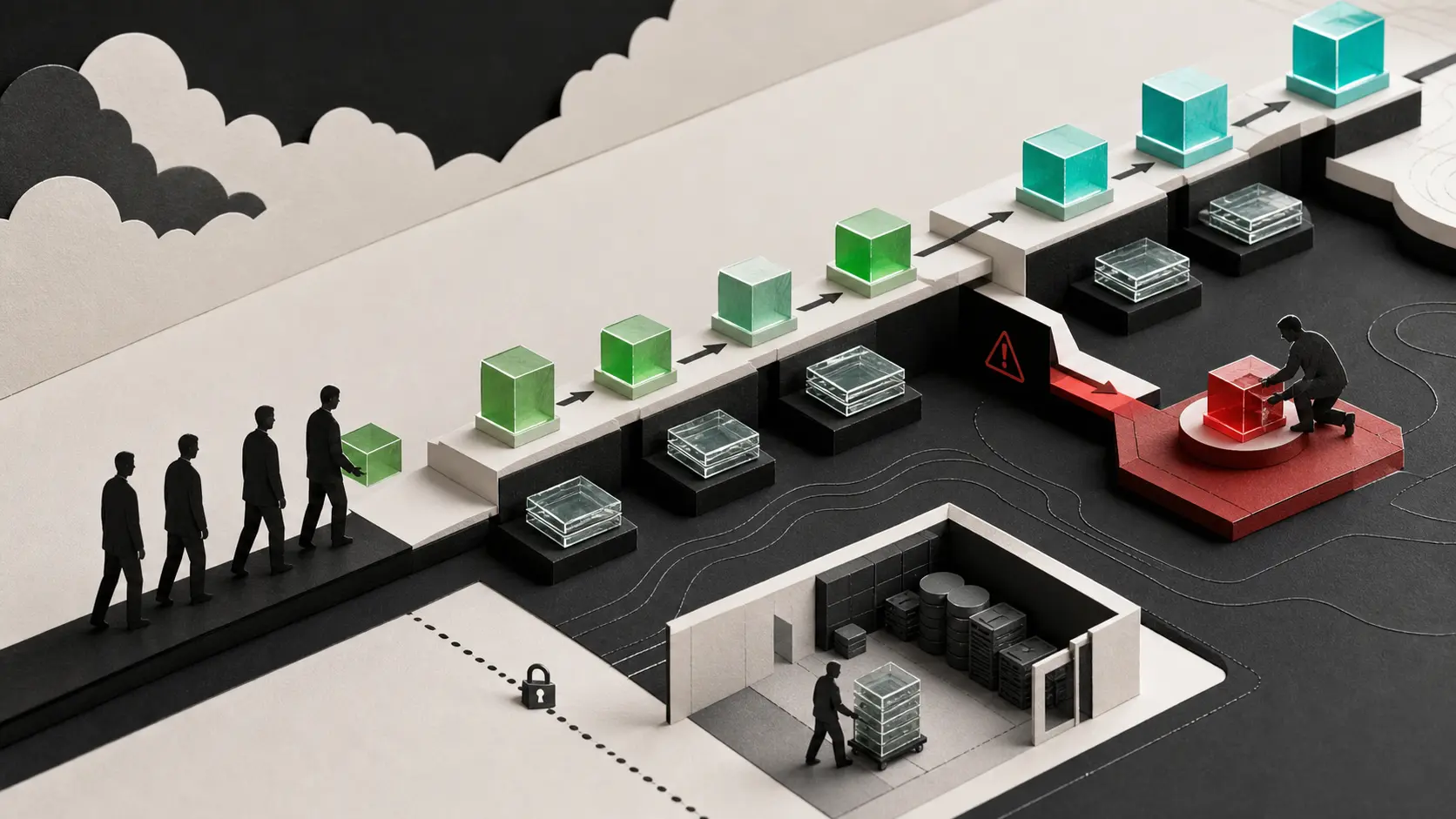
Summary
- SUSE can remove substantial repetition from Linux and Kubernetes operations, especially when an estate is standardized around SLES, Rancher Manager, RKE2 or K3s, Fleet and a validated support matrix. What it sells commercially is less the open-source code than a maintained sequence of versions, signed artifacts, documented exceptions and access to engineers when that sequence fails.
- The supported sequence is deliberately constrained. Rancher minor releases must be crossed one at a time from the latest patch to the latest patch; rollback is a backup restore rather than a Helm downgrade; RKE2 automation does not prevent an invalid Kubernetes downgrade; Longhorn allows sequential minor upgrades and no downgrade after success; and Rancher's own backup protects the management application, not every downstream workload or volume.
- Public customer stories show that SUSE can compress ordinary provisioning and release work from hours or days to minutes. They do not publish enough failed attempts, upgrade windows, support-resolution times or maintenance labour to establish total lifecycle savings. A buyer should judge SUSE by cost per cluster-month kept within supported boundaries and by recovery from representative exceptions, not by the speed of the happy path.
One overdue cluster turns a product bundle into a sequence
Imagine a platform team with an ordinary problem. Its Rancher management server is one minor release behind. Twelve RKE2 clusters span two datacentres and three edge sites. One site has no direct internet access. Fleet distributes a monitoring chart and several house applications. Longhorn stores data for two stateful services. The Linux hosts are on different SLES service packs because a database vendor certified one group late. An identity provider, private registry, load balancer, storage driver and several admission webhooks sit outside SUSE's direct control.
The request sounds simple: apply the security fixes and return the estate to support. It is not one upgrade. The team must identify the current patch of Rancher, inspect the next release's known issues, check the supported Kubernetes versions, verify the host operating systems, test every important chart and controller, mirror a changed image set into the disconnected registry, back up the management application, snapshot each downstream control plane, protect application data, drain nodes in the right order, observe Fleet reconciliation, verify storage health and decide what "back" means if only half the changes succeed.
This sequence is SUSE's real commercial surface. Linux and Kubernetes are open source. Rancher Manager, RKE2, K3s, Fleet and Longhorn also have public source and community builds. A competent team can operate them without a SUSE contract. The subscription buys something harder to reproduce: a vendor's claim that a particular route through changing upstream projects has been tested, that release artifacts can be traced, that support engineers will engage, and that an obsolete path will remain maintained for a stated period.
The value of that route cannot be judged from a fresh installation. Installation is an event; lifecycle management is a repeated task. A platform may install cleanly ten times and still be expensive if the eleventh change strands a custom controller, if a restore omits credentials, or if an old cluster requires three sequential upgrades before the current version will even accept it. The useful denominator is therefore not clusters created. It is cluster-months kept secure and supportable, plus accepted changes completed without unplanned service loss.
SUSE's documentation is unusually candid about many of the boundaries. That is a strength. It also makes clear that the company does not abolish upgrade work. It organizes the work into a narrower path and agrees to stand behind that path. The question is whether customers can remain on it without turning every local exception into a bespoke engineering project.
The SUSE name covers a company, several products and many upstreams
The BTW directory entry Only for Strategic Circle identifies the company covered here, but its network-derived summary is not enough to define the business. SUSE describes itself through a history beginning in 1992 and a portfolio built around enterprise open source. Its current corporate boundary is less transparent than it was as a listed issuer. SUSE says it left the Frankfurt exchange in November 2023 through a merger into an unlisted Luxembourg company. Its last public quarterly statement before that transaction reported $173.3 million of adjusted revenue in the third quarter of fiscal 2023 and $664.9 million of annual recurring revenue measured three months in arrears. Those figures establish a material subscription business, not current product revenue or support quality.
The product boundary matters more. SUSE Linux Enterprise Server is the commercial Linux distribution and support offer. Rancher Manager came through SUSE's completed acquisition of Rancher Labs in December 2020. Rancher Manager is a multi-cluster administration product, not Kubernetes itself. RKE2 is SUSE's Kubernetes distribution aimed at datacentres and security-conscious deployments. K3s is a smaller distribution used heavily at the edge. Fleet applies desired application and configuration state across clusters. Longhorn, sold in the portfolio as SUSE Storage, provides distributed block storage. Each product has its own version, data, controllers, recovery procedure and upstream dependencies.
Rancher Prime is not a secret proprietary fork that replaces those projects. SUSE's own glossary describes the commercial edition as built on the same source code as community Rancher, with trusted delivery, extended lifecycle, security assurances, focused architecture guidance and advisories added around it. This distinction is central to the economics. Customers are not mainly paying for permission to execute the code. They are paying for a tested and supported operating envelope.
That envelope does not make SUSE responsible for everything visible in the Rancher screen. A cluster may be hosted by Amazon, Microsoft or Google; use a third-party network and storage layer; authenticate against an external directory; and run charts from a customer repository. Rancher can request a change to those systems without controlling their availability or semantics. RKE2 packages upstream Kubernetes with selected components and defaults, but a customer can add webhooks, operators and kernel modules that alter the result. Fleet can apply a chart, but the chart's author owns much of its behaviour.
Longhorn can replicate blocks, but an application still needs a consistent database backup.
The correct judgment therefore has three levels. Upstream technology defines what Linux, Kubernetes, Helm and the relevant controllers can do. SUSE's product decides which versions, components, defaults and procedures it will test and support. The customer deployment combines those choices with local infrastructure, applications and operating discipline. A success or failure at one level is not automatically evidence about the other two.
Support begins by refusing most possible combinations
The phrase "open choice" can suggest that any conformant component can be mixed with any other. In production, support works by doing the opposite. It reduces a combinatorial problem to a finite set.
SUSE's Rancher support matrix names exact Rancher, Kubernetes, operating-system, architecture and component combinations. Its lifecycle table gives separate dates to Rancher and RKE2 release lines. Rancher 2.14, for example, reached general availability in April 2026; the table gives it six months to end of maintenance and a later end-of-life date. RKE2 minors follow another calendar. SLES service packs have another overlay. Longhorn has its own Kubernetes requirements. The fact that software can compile or start outside those rows does not mean SUSE has tested the combination or will resolve its defects under ordinary terms.
This is not a SUSE peculiarity. Upstream Kubernetes supports only a moving set of recent releases and imposes strict version skew and upgrade order. API servers cannot skip minor versions. Kubelets cannot be newer than the API server. Admission webhooks need to understand the resources and fields the new server will send. A distribution must select and test combinations while upstream projects change independently.
SUSE's commercial contribution is partly the decision to say no. It can backport fixes, publish compatible builds and give a customer a known target. The support matrix also tells an operator when an exception has escaped that target. A private-registry configuration, a modified package, an unsupported CNI or an end-of-life minor may still work, but the customer carries more of the diagnosis.
That creates a useful discipline. A platform team can inventory every cluster against a finite matrix and convert "probably fine" into an explicit exception list. It can measure exception age, owner and removal date. It can decline a new local variation if the business value does not justify permanent testing. The matrix becomes more valuable as the estate grows because the cost of one approved combination can be spread across many repeated clusters.
It also creates lock-in of a subtle kind. A customer that depends on SUSE's tested envelope must follow SUSE's release cadence, deprecation choices and packaging. Rancher 2.14 removed support for Kubernetes 1.32 and replaced an embedded Cluster API implementation with Rancher Turtles. Fleet moved to a new Helm generation. A future chart-retention policy will stop presenting old application-chart versions in newer branches. These may be sound maintenance decisions, but the customer does not control their timing.
The subscription is valuable when the cost of following those decisions is lower than maintaining an equivalent validation function internally. It is weak when the customer's estate is so unusual that few important combinations remain inside the matrix. In that case, the company is buying a supported centre and operating an unsupported perimeter.
Rancher upgrades are controlled migrations, not package replacements
The current Rancher upgrade guide defines only one tested and supported path between minor versions: move from the latest patch of the current minor to the latest patch of the next minor. A team on 2.11 cannot jump directly to 2.14. It must first reach the latest 2.11 patch, then traverse 2.12 and 2.13 in sequence, checking each release's notes and support status.
That rule turns neglect into compound work. If a platform skips a year, it does not merely accumulate missing security fixes. It accumulates intermediate data conversions, chart changes, removed Kubernetes versions and expiring support windows. Each hop needs preparation, execution, verification and a decision to continue. A supposedly cheap decision to postpone maintenance borrows from a future window whose duration is unknown.
The guide tells operators to back up the Kubernetes cluster running Rancher, update the chart repository, inspect feature-chart versions, run the Helm upgrade and verify the deployment. Air-gapped installations must first populate their private registry with the new release's images. These instructions are straightforward, but the state transition is not confined to one deployment. Rancher stores custom resources for clusters, users, permissions, catalogues and management functions. Installed charts and downstream agents have their own compatibility.
External identity and cloud credentials can be syntactically valid while failing against a changed provider.
Release notes show why an upgrade procedure cannot be generic. The 2.14 release line changed the Cluster API manager, disabled one Fleet-based add-on provider by default, migrated Fleet from Helm 3 to Helm 4 and continued several known recovery and authentication limitations. The 2.13.1 notes warned that a chart-name change caused upgrade complications and recommended that existing customers keep the old name while SUSE prepared a smoother route. They also disclosed a case in which OIDC settings could be lost during an upgrade and an air-gapped provisioning defect caused a Cluster API controller not to become active.
These are not evidence that every Rancher upgrade fails. They are evidence that release-specific review is part of the product. The support value lies partly in collecting such exceptions before a customer encounters them. The operator's task is to identify whether any applies to the estate, reproduce the transition in a representative environment and stop before a known issue becomes a production incident.
Verification must go beyond the Rancher pods becoming ready. The management server may be healthy while a downstream agent cannot check in, an identity group no longer maps correctly, Fleet targets the wrong cluster, or a cloud driver stalls. A public Rancher issue records a historical upgrade in which RKE2 and RKE1 clusters remained non-Active while Fleet chart installation failed, requiring work across teams. One issue says nothing about frequency. It illustrates why "Rancher is running" and "the estate is manageable" are separate postconditions.
A serious acceptance test should therefore traverse the user journeys that create operational authority: sign in through each identity provider, enumerate clusters with the right role, reconcile a harmless Fleet change, provision a disposable node, retrieve logs, take a downstream snapshot and confirm that alerts arrive. Only then has the management function, rather than its container, returned.
Rollback is a restoration with several clocks
Rancher's documentation uses precise language that buyers should preserve. Changing to an older Rancher version with Helm or kubectl is unsupported. A rollback means restoring a backup made under the old version and starting that old version again. The destination must still be supported.
This is different from undoing a package. An upgrade can convert custom resources, replace controllers and create records in new formats. Running old code against that newer state may be unsafe even if the containers start. Restoration returns the management data to an earlier point, which means changes made after the backup can disappear. The operator must decide whether that loss is acceptable and how to reconcile anything that continued changing outside Rancher.
Rancher 2.14 provides a concrete example. Its Cluster API dependency moved custom resources from one API version to another. When restoring older backup data on a cluster that now contains newer custom resources, the older definitions cannot simply replace the new ones while those records exist. The rollback guide prescribes additional cleanup. This is a normal distributed-data problem exposed in Kubernetes form: software versions and stored representation must move together.
There are at least four recovery clocks in a full SUSE estate.
The first is the Rancher management application. The Rancher backup operator runs in the local management cluster and backs up the Rancher application. It does not back up all downstream clusters. Its resource set is predefined, and current documentation warns that certain secrets referenced by Fleet repositories are not included unless separately handled.
The second is each downstream Kubernetes control plane. For Rancher-created RKE2 and K3s clusters, snapshots can include etcd data, Kubernetes version and cluster configuration. SUSE recommends an external S3-compatible target because local snapshots disappear if all etcd nodes are lost. Restoring etcd can return Kubernetes objects and cluster settings. It does not necessarily return application bytes stored elsewhere.
The third is persistent application data. Longhorn has its own volume snapshots and remote backups. External arrays, cloud disks and managed databases have different mechanisms. A Kubernetes object saying that a database pod should exist is not a transaction-consistent copy of the database. Recovery has to align control-plane time with data time.
The fourth is external state: DNS, cloud instances, load balancers, identity groups, registry content, certificates and records created through other systems. Restoring Rancher to Tuesday does not make a cloud load balancer forget Wednesday. Fleet may reapply Tuesday's desired state to a cluster containing Wednesday's data. A complete rollback is a reconciliation exercise across clocks, not one button.
Even the backup itself has dependencies. SUSE's detailed usage guide says sensitive values can be stored in plaintext unless backup encryption is configured, while the encryption configuration must be saved separately because the operator does not back it up. A team that encrypts the archive and loses the key has achieved confidentiality by making recovery impossible.
The right test is therefore a restore drill, not a backup-success event. Begin with a known workload transaction, modify management and application state, remove the management environment, restore into the allowed topology, recreate separately held secrets and verify both old and new state. Measure human minutes and elapsed time. A backup file is evidence of preparation. A recovered service is evidence of recovery.
RKE2 can automate node work without deciding whether the estate is ready
RKE2 turns Kubernetes installation and upgrades into a more repeatable distribution task. Its manual procedure tells operators to upgrade server nodes one at a time before agents. It offers stable, latest and version-specific channels. It also warns that nothing in the process protects an operator from an unsupported Kubernetes version change.
The system-upgrade-controller removes more repetition. A Plan selects nodes and a target version. The controller schedules privileged jobs, and a node receives a completion label when its job finishes. Maintenance windows can limit when new jobs start, although jobs already created may continue after the window closes.
This is useful automation. Without it, an engineer would log into hosts, replace packages or binaries, restart services, watch membership and repeat the sequence. A controller can enforce ordering and make progress visible. At fleet scale, that can remove many hours of identical work.
It does not decide whether the workload survives. A completed node job proves that its prescribed operation ended successfully at that layer. It does not prove that the PodDisruptionBudget allowed a healthy drain, the storage replica rebuilt, the admission webhook accepts new objects, the application meets latency targets or an old client still works. Those postconditions belong to other systems.
The controller's privileges show the stakes. SUSE documents host namespace access, permission to reboot and a read-write mount of the host root. This is appropriate for node maintenance and makes the controller part of the estate's highest-trust surface. Plan creation, image provenance, target selection and change approval therefore deserve stronger control than an ordinary application deployment.
Downgrade has another sharp edge. Kubernetes does not support downgrading control-plane components in place, and SUSE notes that the RKE2 upgrade image does not prevent a Plan from targeting an older version. A valid recovery combines an older binary with a datastore snapshot known to be readable by it. The automation can execute the instruction; it cannot make an invalid instruction safe.
This distinction separates capability from reliability. The underlying Kubernetes technology supports rolling component replacement within defined skew. RKE2 packages components and automates node operations. Product reliability depends on the controller, images, sequencing and observability working. Deployment outcome depends on customer workloads, disruption budgets, data systems and recovery practice. A vendor statement about automated upgrades applies mainly to the middle layer unless customer evidence covers the last.
Fleet makes the ordinary cheap and the mistake scalable
Fleet addresses another repeated task: applying applications and configuration to many clusters. Desired state lives in Git. Fleet turns repository content into bundles, targets clusters and applies releases through agents. A platform team can group clusters, partition a rollout, pause before promotion and cap how many targets are unavailable.
Those controls can transform work. An engineer no longer needs to visit two hundred edge sites to edit the same resource. A change can move through a canary group, a regional partition and then the remaining estate. The repository records intent. Status reveals which clusters accepted it. This is the mechanism behind customer claims that a prepared environment can appear in minutes rather than days.
The Fleet configuration reference also exposes the difficult choices. Drift correction is optional. Ordinary correction uses Helm's merge behaviour; forced correction can delete and recreate resources. Failed rollback history can be discarded unless retention is enabled. Dependencies can sequence bundles, but only if operators model the dependencies. Default rollout thresholds may be too permissive for a critical estate.
Drift is not always an error. An incident responder may change a replica count, network policy or image to keep a site running. Automatic correction can erase that emergency action before it is recorded in Git. Leaving correction off preserves the action but allows the estate to diverge. A good operating model needs a break-glass path that records owner, reason, expiry and reconciliation plan.
Troubleshooting remains distributed. Fleet's own guide tells operators to examine controller logs, repository jobs, bundle counts, commit state and the agent in a target cluster. A repository can stop synchronizing after timeouts or conflicts. A bundle can remain modified because a controller continually rewrites one field. A cluster can be unavailable. Under high load, a default conflict retry of one may be insufficient.
Fleet's success metric should not be "commit observed." The accepted unit is a bundle whose intended resources reached the correct clusters, whose health checks passed, whose application behaviour remained acceptable and whose exceptions are visible. Target count belongs in the denominator. If 999 sites update and one disconnected site silently remains vulnerable, a dashboard percentage can look excellent while the most exposed location is unchanged.
This is where SUSE can create genuine leverage. Rancher supplies a common inventory and identity layer; Fleet supplies a repeated delivery mechanism; support can help distinguish product defects from target-specific problems. The leverage is strongest when clusters share tested shapes. Every unique chart override, local label convention and emergency mutation reduces it.
Longhorn makes the asymmetry of upgrades impossible to ignore
Storage is where reassuring words such as "rollback" become dangerous. A stateless controller can often be redeployed. A volume contains an application history that cannot be reconstructed from a chart.
Longhorn's current upgrade policy allows one minor version at a time. A move from 1.5 to 1.6 is supported; a jump over a minor is not. Pre-upgrade checks reject an invalid path. Once an upgrade to the new release succeeds, downgrade is not supported. A Helm rollback before successful completion is not the same as running the older storage engine after data and custom resources have moved forward.
SUSE Storage's important notes make the safety case more specific. Newer releases require a minimum Kubernetes version because the snapshot component changed. Automated checks do not cover every scenario. Operators are told to avoid upgrading faulted volumes, detach volumes using the newer data engine and create a system backup. A failed backing image or unusable replica can turn cleanup into permanent data loss if no remote backup exists.
These constraints are not signs that the project lacks automation. They are evidence that storage state has direction. A new engine may write metadata an old engine cannot interpret. A new custom-resource version may not be reversible. A replica rebuild that is harmless when two good copies exist can be fatal when the remaining copy is damaged.
The ordinary path can still be efficient. Pre-checks catch obvious version skips and unhealthy conditions. A standard cluster can drain and update components in sequence. A shared support matrix reduces uncertainty about Kubernetes and storage versions. The operator no longer invents every command.
The exception path remains human. Someone must decide whether a degraded volume is safe to repair, whether a snapshot is application-consistent, whether the remote backup is current and whether the business can tolerate detachment. After upgrade, someone must verify bytes at the application layer. "All volumes healthy" is not proof that a database can read its most recent committed transaction.
This changes the economics of the whole suite. If a customer chooses Longhorn, Rancher and RKE2 together, it gains a more coherent supported combination. It also concentrates several lifecycle decisions in one vendor's release cadence. If it keeps an external storage platform, it retains another supplier and compatibility boundary but may preserve existing operational expertise. There is no universal answer. The relevant measure is recovery work per protected workload, including drills, not storage installation speed.
SLES stretches the lifecycle, but service packs still create deadlines
SUSE's Linux heritage offers a different kind of lifecycle value. SLES advertises a 13-year major-release life: ten years of general support and three of extended support. That headline can sound like permission to leave a machine unchanged. The detailed policy is more disciplined. Service packs arrive roughly every 12 to 14 months. The previous service pack normally receives six months of support after the next one. Long Term Service Pack Support can buy more time, while extended phases narrow which new deployments, enhancements and fixes are covered.
The SLES 15 SP6 upgrade guide allows only limited service-pack skipping on a supported path. Older systems need intermediate releases or LTSS entitlement. The guide also warns that the OS path is not necessarily the application path: databases can require an intermediate version even when Linux could move further.
This is commercially sensible. Enterprises run applications whose vendors certify operating systems slowly. SUSE can backport security fixes and keep a service pack viable while a customer tests the next one. That converts an emergency migration into a planned project. The customer pays for time and engineering continuity.
Time is not the same as no work. Backports mean package version numbers may not resemble the upstream version carrying the same fix. Security teams must use SUSE advisories rather than simplistic version scanners. LTSS has to be purchased, enabled and tracked. Modules and extensions have dependencies. A server on a long-lived service pack can remain secure while gradually becoming unusual compared with new hardware, software and staff experience.
SLES also supplies useful local recovery. On a default Btrfs root layout, Snapper can create pre-change snapshots and boot a prior root state. The service-pack rollback procedure gives an operator a way to inspect a read-only prior snapshot, make the rollback permanent and repair repository registration.
The limits matter. SUSE's Snapper documentation says a complete identical system restoration is impossible. Only the root subvolume returns. Excluded locations continue forward. Applications can break if old code meets data written in a new format, or if ownership changed. Snapshots live on the same filesystem and consume space. Registration can point to the wrong repositories after a rollback if it is not reconciled.
Kernel live patching narrows some maintenance windows but does not remove rebooting. SUSE says live patches cover qualifying critical fixes when technically feasible, are tied to exact kernel revisions and are a temporary measure until a normal kernel update and reboot. Changes to data structures may be impossible to apply live.
SLES therefore offers a credible supported runway, not suspension of time. Its economic value is highest when downtime is expensive, certification is slow and the customer has enough similar systems to standardize patching. It is lower for disposable cloud workloads that can be rebuilt quickly on a provider image or for teams whose applications already require a faster platform cadence.
Air-gapped operation replaces cloud dependence with inventory work
Disconnected operation is one of SUSE's strongest reasons to exist. A public-cloud control plane can remove maintenance from a customer, but it cannot serve every defence, industrial, telecom or regulated environment. Rancher, RKE2, K3s and SLES can run where the customer controls the machines and registry.
The freedom has a concrete cost. For an air-gapped Rancher installation, operators download a release-specific image list and save/load scripts, add certificate-management images when needed, pull the set on a connected workstation, move the archive through an approved boundary and populate a private registry. Windows and ARM deployments add variants. Every release changes the bill of materials.
The public artifacts make that surface measurable. A direct static check of the stable Rancher v2.14.2 rancher-images.txt found 760 unique non-empty image references. The v2.14.3 list contained 856, with 126 additions and 30 removals relative to the earlier patch. The published checksums for the image list and Linux digest list matched the streamed files.
Those figures are not the number of containers in a running minimal Rancher server. The list covers installation, cluster provisioning and optional Rancher tools. Nor do the counts reveal bytes or transfer time. They do show why "supports air gap" is not a binary feature. A customer must decide which artifacts are required, mirror them with their digests and signatures, scan or approve them, preserve sources, test private-registry references and prove that no component reaches an unavailable public endpoint.
An omitted image can wait until the worst moment to appear. The management server may upgrade correctly while a later node replacement requests a version that was never mirrored. A monitoring chart may use an image outside the core list. An edge site may have the right image but an expired registry credential. The ordinary upgrade succeeds in a connected laboratory and fails at a disconnected site because its supply state differs.
SUSE Prime can reduce this work through a trusted registry, signed artifacts, source and origin lists, and a known inventory. It cannot carry bytes across a customer's security boundary or approve them under local policy. The customer still owns capacity planning, retention, credentials and disaster recovery for the private registry. If that registry is down during a node rebuild, local sovereignty has created a local cloud dependency.
The correct denominator is images and clusters reconciled per release, including exceptions. Measure bytes transferred, approval hours, missing artifacts found before deployment, failed pulls during change and time to rebuild a site with public access removed. Only then can a customer compare air-gapped Rancher with a managed cloud that is operationally cheaper but legally or physically unavailable.
Paid support buys access and prioritization, not a guaranteed recovery time
The support contract is the least reproducible part of the product from public evidence. SUSE publishes useful terms. Rancher Prime support gives Standard customers a target initial response of two business hours for a critical case and Priority customers one hour, with different coverage hours. SUSE also advertises upgrade-path validation, supportability reviews and standby assistance.
"Initial response" is the important phrase. It is not time to diagnosis, workaround, patch or restoration. A one-hour acknowledgement can still lead to a long incident if the problem crosses Rancher, an upstream controller, a cloud provider and customer configuration. Conversely, an experienced engineer can resolve a known defect quickly even when the contract allows longer.
Support creates value in several ways that are easy to miss. Engineers may recognize a failure signature that would take a customer days to isolate. SUSE can interpret its own support matrix and advise whether a configuration must change before an upgrade. It can coordinate a fix in a project it maintains. It can keep a critical patch available for an older commercial release. A named account team can help a customer maintain discipline before a crisis.
Support also introduces work. Cases need diagnostics, logs, reproduction, severity justification and a responsive customer contact. Sensitive environments may not allow logs to leave. A fault must be reduced enough to identify whether SUSE owns it. The customer usually executes the change and validates the business service. Escalation moves work between organizations; it does not make work disappear.
Public price examples help frame the decision without completing it. SUSE's Rancher Prime shop displayed a one-year Standard subscription at $6,525 for a 1-2 socket, up-to-64-core unit and $2,175 for a smaller 2-core or 4-vCPU unit at the time of research. Priority for the smaller unit was $2,900. These are stated MSRP examples, not a quote for a heterogeneous fleet. Contract units, minimums, add-ons, discounts and enterprise terms can change the total.
The subscription is only one numerator. Add the Rancher management cluster, private registry, monitoring, backup storage, Longhorn capacity, implementation, training, test environments and platform engineers. Add the work of keeping versions current. Then subtract labour the platform genuinely removes, outages avoided and migrations deferred. Do not count a dashboard action as saved labour if engineers still spend the same time preparing and validating it.
A support contract earns its price when it shortens the costly tail: the rare upgrade that otherwise consumes several senior engineers for days, or the security fix whose backport avoids a rushed migration. Public evidence does not reveal that distribution. Buyers should request anonymized resolution statistics by severity and product, renewal references with similar topologies, and a scoped upgrade validation before purchase.
Customer stories prove leverage, not a general reliability rate
SUSE publishes credible examples of ordinary work becoming faster. German IT provider ECKD says a release deployment that once took roughly four hours, even with scripts, fell to about 15 minutes with Rancher Prime and Kubernetes. The same customer story says SUSE Customer Success helped address urgent issues. That combination is plausible: standardization and repeated automation compress an established path, while human support handles exceptions.
Armedia describes an even larger reduction. In a SUSE-hosted interview, a company leader says preparing infrastructure for an application fell from seven to 14 days to about 12 minutes using Rancher and Fleet across cloud and on-premises environments. This is useful evidence for a paved path. It does not mean the platform took 12 minutes to design, integrate, secure or maintain.
Polish insurer PZU provides a more relevant lifecycle example. SUSE's case study says PZU adopted Rancher Prime in an air-gapped on-premises environment after an older Kubernetes platform accumulated technical debt, and can now upgrade containers without downtime for live production systems. The wording is narrower than a cluster-upgrade benchmark. Updating an application container can be routine while upgrading Kubernetes, storage or the management plane remains difficult.
None of these public accounts gives the denominator needed for a reliability claim. They do not publish every attempted change, intervention, rollback, outage, support case or staff hour. They do not isolate Rancher from Kubernetes, new operating practices, hardware replacement or application redesign. They are selected by the vendor.
Independent reporting adds a useful counterweight without producing a benchmark. A 2023 TechTarget report described one company that retained open-source Rancher for multi-cluster management but left paid support after its internal team developed more expertise. One customer cannot establish churn. It demonstrates the substitute most relevant to commercial open source: not another product, but the same source code operated by a more capable internal team.
The balanced conclusion is that SUSE can create major gains on repeated, standardized tasks. Public evidence is weakest exactly where a subscription is supposed to matter most: failed changes, deep escalation and recovery. That gap should lower confidence, not erase the documented benefits.
The substitutes move work to different owners
Community operation is the closest substitute. A customer can run Rancher, RKE2, K3s, Fleet and Longhorn from public projects, buy support from an integrator or build its own validation. This avoids SUSE subscription cost and gives more control over timing. It requires staff who can follow upstream changes, reproduce defects, maintain artifacts and accept that no vendor owns the assembled result.
Managed Kubernetes moves the control plane to a hyperscaler. Amazon EKS offers 14 months of standard support and another 12 months of paid extended support for a Kubernetes minor, then eventually upgrades the control plane. Its documentation still leaves add-ons and many nodes with the customer. Azure AKS provides automatic channels and planned maintenance but recommends windows of four hours or more and still depends on disruption budgets, node images and operator practice.
These services can be cheaper for teams already committed to one cloud, because the provider operates control-plane machines and integrates identity, networking and support. They are weaker for disconnected sites, multi-cloud consistency and customers that cannot accept the provider boundary. Using Rancher to manage EKS or AKS can unify inventory while retaining both vendors' lifecycle rules. It does not turn them into one stack.
Red Hat OpenShift is the strongest enterprise-distribution substitute. It integrates an operating system, Kubernetes, operators and an update service more tightly. OpenShift's update graph exposes recommended paths and conditional risks. That can give a customer a more opinionated tested unit, with less freedom and a large migration and subscription commitment. Its existence also shows that narrow upgrade paths are a feature of responsible enterprise Kubernetes, not evidence of SUSE weakness.
A smaller platform can use kubeadm, Kubespray, Talos, Canonical Kubernetes or another distribution and choose Argo CD or Flux instead of Fleet. The best option depends on existing skills and constraints. Rancher is attractive when a customer needs one view across many infrastructure providers and wants a relatively open management layer. It is less compelling when nearly every workload fits a single cloud's managed service or when the company already has a mature internal platform that treats clusters as disposable.
Switching cost does not reside only in data formats. Kubernetes resources are portable in principle, but Rancher roles, Fleet targeting, custom charts, RKE2 configuration, Longhorn volumes, SLES automation, private-registry procedures and staff habits accumulate meaning. A migration may preserve YAML and still require a new identity model, storage move, monitoring design and incident practice.
The way to test portability is to exercise it. Take one representative cluster out of Rancher management without rebuilding the application. Reconcile its access control and monitoring elsewhere. Move one Fleet-managed application to another delivery tool. Restore one Longhorn-backed service onto another storage system. Export the inventory and audit evidence needed for operations. The effort is a better lock-in measure than the license of the source code.
The economic unit is a supported month and an accepted change
SUSE's portfolio should be measured through two linked denominators.
The first is a supported cluster-month or server-month. Count every managed system that remains on a security-supported OS, Kubernetes, Rancher and storage combination. Subtract periods outside the matrix, with expired credentials, missing artifacts or untested recovery. This denominator rewards the unglamorous work a commercial distribution is meant to perform.
The second is an accepted change. A patch, service pack, Rancher minor, Kubernetes minor, Fleet bundle or storage upgrade counts only when the intended versions are active, applications pass their service checks, data is consistent, access still works and a recovery point is valid. A controller completion label is an intermediate event.
The numerator should include subscription, infrastructure and all human work. Preparation includes version discovery, release-note review, compatibility checks, image mirroring and approvals. Execution includes drain, restart and observation. Exception handling includes support cases, workarounds and retries. Recovery includes restoring management, control-plane and application state. Maintenance includes keeping test environments representative and removing local variations.
Report the median, but do not let it conceal the tail. Standard automation may reduce 95 ordinary deployments from four hours to 15 minutes. Five exceptions can still dominate annual cost if each consumes several people for days. Weight failures by consequence: one wrong storage recovery is not offset by many fast stateless updates.
Compare like with like. A managed cloud price includes control-plane operation but may add network, extended-version and provider-support charges. Community software has no subscription but requires more internal engineering. OpenShift bundles more components and can reduce integration choices while increasing commitment. An old virtual-machine process may be slow but already amortized and familiar.
Labour transfer should be explicit. Rancher can remove host-by-host work and create platform-policy work. Fleet can remove repeated application edits and create repository, targeting and exception work. SLES backports can remove rushed application migration and create lifecycle tracking. Support can remove some diagnosis and create case coordination. These transfers may be excellent bargains; calling them elimination obscures the staffing required to keep the system safe.
A buyer should begin with failure, not a clean install
No direct SUSE deployment was available for this research. The product was not scored for uptime, upgrade duration, support or total cost. A credible evaluation would begin with a representative estate and deliberately inconvenient cases.
Use at least 24 clusters across HA datacentre RKE2, small K3s edge, one public-cloud service and a disconnected group. Include OIDC, a private registry, Fleet, a stateful Longhorn service, an external storage class, monitoring, admission webhooks and real disruption budgets. Use synthetic data and isolated accounts.
Pre-register ordinary patch changes and sequential minor upgrades, then add the failures that usually escape demonstrations: one missing air-gap image, an expired registry credential, a webhook that rejects the new resource form, a drain blocked by a disruption budget, a Fleet target with a wrong label, a faulted volume, a full snapshot location, an offline edge site, a changed identity-provider certificate and a rollback across a custom-resource conversion.
Compare community operation, Rancher Prime and the most credible managed or enterprise alternative. Freeze exact versions and artifacts. Count every retry and human intervention. Do not allow engineers to remove a difficult case after seeing it fail.
The primary result is end-to-end accepted completion. Measure first-attempt success, service availability, human active minutes, elapsed time, partial completion, clusters left indeterminate, achieved recovery point and achieved recovery time. For air gap, count images, bytes, approvals and failed pulls. For support, record first response, useful diagnosis, workaround, engineering handoffs and final resolution separately.
Recovery must be tested at every clock. Restore Rancher management state. Restore a downstream etcd snapshot. Recreate separately held Fleet secrets. Recover a Longhorn-backed application and verify its transactions. Reconcile external load balancers and identity. If any layer returns a success status while the business service is wrong, the recovery has failed.
Run the exercise through at least one full release cycle. A clean installation shows architecture; an upgrade shows maintainability; a failed upgrade shows the product and support organization. Only the third reveals whether the subscription earns its margin.
Several results would strengthen the case for SUSE. Prime should materially reduce human minutes and the consequence-weighted failure tail against the same community stack. Upgrade validation should catch applicable release issues before change. Trusted artifacts should reduce air-gap approval work. Support should shorten diagnosis and restoration in cases that internal staff cannot quickly resolve. The estate should remain inside supported combinations without forcing frequent application redesign.
Results could weaken it. If most important integrations remain outside the matrix, support may spend its time defining boundaries. If paid cases receive quick acknowledgements but slow useful action, the target response has little operational value. If Fleet and Rancher simplify ordinary changes while storage and identity exceptions dominate cost, the suite may improve the dashboard more than the service. If managed Kubernetes meets the legal and geographic requirements at much lower staff cost, multi-cloud flexibility may be an expensive option that is rarely exercised.
The judgment
SUSE has a defensible commercial-open-source proposition. It takes fast-moving projects and sells maintained combinations, release artifacts, lifecycle commitments and access to engineers. SLES can defer disruptive migrations. Rancher can give heterogeneous clusters a common management surface. RKE2 and K3s can make cluster construction and node changes repeatable. Fleet can turn one approved change into many. Longhorn can provide a supported storage option where an external array or cloud disk is unsuitable.
The proposition is strongest for regulated, disconnected, edge and multi-infrastructure estates that cannot hand the whole control plane to one cloud provider. It is also strong for organizations with enough repeated clusters to spread the cost of a standardized operating model. In those environments, avoiding one severe outage or one rushed unsupported migration can justify substantial subscription expense.
The public evidence does not support the stronger claim that SUSE makes lifecycle work simple or generally cheaper. Its own documentation shows sequential paths, short maintenance windows for Rancher minors, separate backup domains, irreversible storage transitions, release-specific migrations and support targets limited to first response. Customer stories quantify fast ordinary workflows but leave the exception denominator empty.
That is not a contradiction. The supported path is valuable because the underlying state is difficult. A wide, unconstrained promise would be less credible. The test is whether the path remains broad enough for a customer's real estate and whether SUSE helps when reality pushes outside it.
The answer will differ by customer. A standardized RKE2 fleet with strict air-gap requirements may get high value from one accountable supplier and a validated inventory. A cloud-native team on one hyperscaler may be better served by the provider's managed control plane. A mature platform group may use the community projects and buy expertise only when needed. A heavily customized estate may discover that no subscription can turn its exceptions into a standard product.
The facts that would most improve confidence are operational rather than promotional: first-attempt upgrade results across representative fleets; median and worst-case support resolution by product; restore drills that cross Rancher, Fleet, Kubernetes and storage; air-gap refresh effort per release; and customer total-cost studies that include platform staff and failed changes. SUSE could publish these without pretending that every topology is comparable.
Until then, the right purchasing question is not whether SUSE has enterprise features. It does. The question is what proportion of the customer's repeated work falls inside SUSE's tested sequence, how expensive the exceptions are, and who can restore the service when several layers move in different directions. Commercial open source earns its price when the answer is a practiced route through change. It loses when "supported" becomes a label on the easy cases and a negotiation during the hard ones.