Summary
- The U.S. Space Force awarded SpaceX two launch task orders with a combined value of $1.6 billion.
- The orders cover 18 Falcon 9 launches from Vandenberg Space Force Base through the end of 2027.
- The missions support the Space Based Sensing and Targeting portfolio, which spans missile tracking, communications and targeting functions.
- Eighteen launches by the target date implies roughly one mission a month, but the cadence depends on satellites arriving ready for launch.
- Seven companies hold positions on the NSSL Phase 3 Lane 1 contract vehicle; eligibility does not mean each can substitute for SpaceX at this scale today.
- The award purchases launch services, not satellite manufacturing, completed launches or guaranteed operational constellations.
What $1.6 billion actually buys
The figure is the combined value of two task orders. It is not the price of one Falcon 9 launch, and the accessible report does not disclose the value of either order separately. Dividing $1.6 billion by 18 would also be misleading: a task order can include integration, mission assurance, range work and other services whose allocation is not public.
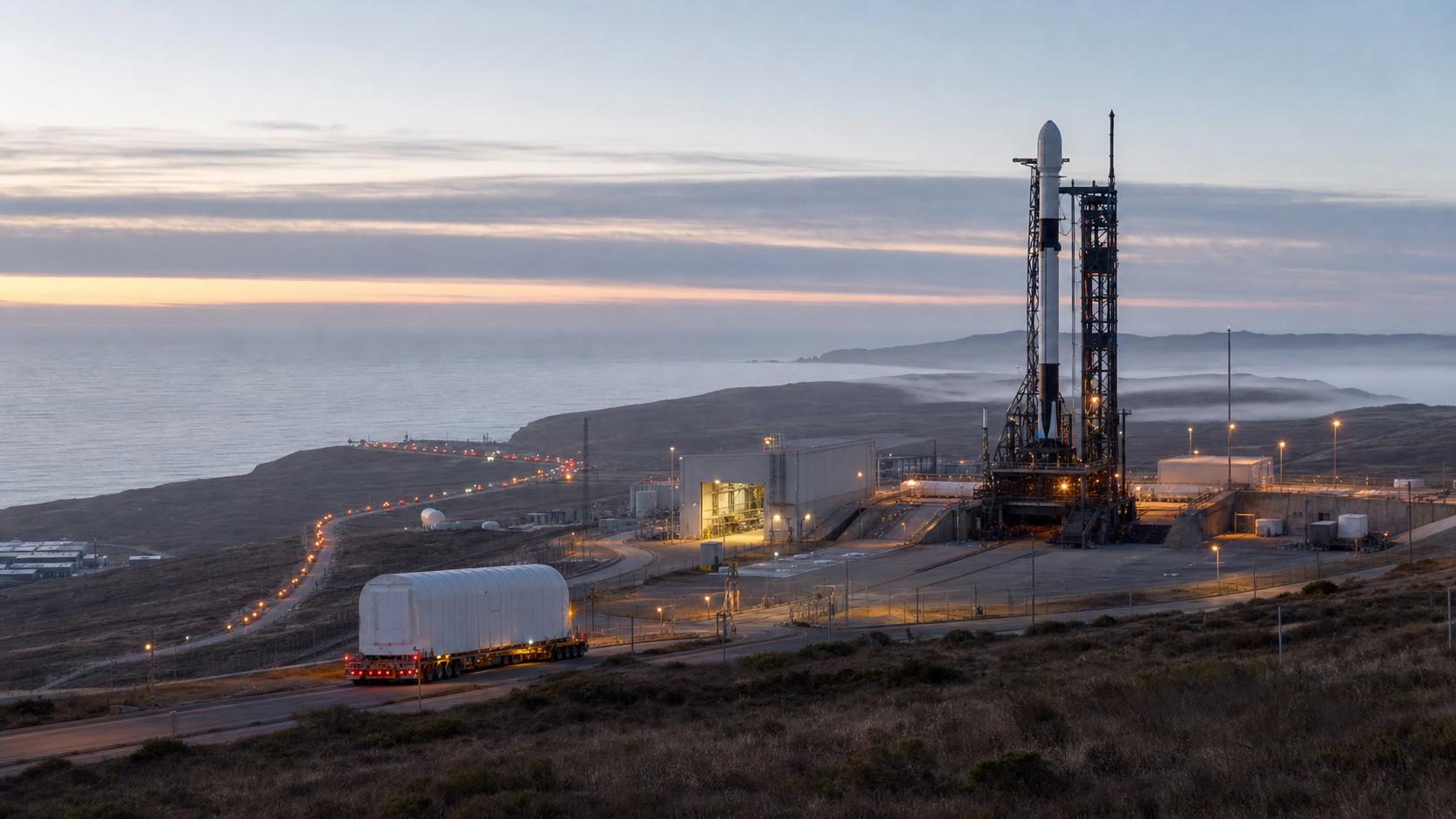
The purchased output is launch execution. SpaceX must provide Falcon 9 missions from Vandenberg Space Force Base in California for satellites supporting the Space Based Sensing and Targeting portfolio. That portfolio brings together systems intended to improve missile warning and tracking, move military data and support targeting. The contract therefore sits between satellite production and the capability the military ultimately wants in orbit.
That boundary matters. A launch-service award is not a satellite-manufacturing award. It does not prove that any of the 18 spacecraft groups is complete, that any launch has occurred or that a constellation has entered service. Contract signature moves the programme through a procurement gate; hardware delivery, launch integration, flight, checkout and network integration remain separate gates.
Eighteen missions turn cadence into infrastructure
The schedule runs through the end of 2027. From the award date, 18 missions translate arithmetically into about one launch per month. SpaceNews makes the same observation while attaching the essential condition: timing depends on satellite deliveries.
That condition prevents a simple “rocket factory” interpretation. Falcon 9 availability matters, but so do payload readiness, launch-site processing, range scheduling, weather, anomaly recovery and the order in which military customers need their spacecraft. A month without a ready payload cannot necessarily be recovered by owning another booster. Conversely, a cluster of delivered satellites can create pressure on processing capacity even when rockets are available.
The useful performance measure is therefore not a promise of exactly one launch every calendar month. It is whether the campaign can absorb uneven spacecraft arrivals and still complete 18 missions by the target date. The award supplies a queue; execution quality will be visible in how that queue is managed.
Vandenberg is the control surface
All 18 launches are reported for Vandenberg. That makes the West Coast launch complex more than a location label. It is the physical surface through which the contract must pass: pads, integration facilities, trained crews, range safety, transport and turnaround time.
Military low-Earth-orbit constellations often require orbital inclinations well served from Vandenberg. The site choice is therefore tied to mission geometry as well as SpaceX’s existing infrastructure. Moving a delayed mission to another coast is not a frictionless substitution if the target orbit, payload processing or range plan changes.
This is why launch capacity cannot be measured only by the number of rockets a company has built. A usable mission requires the vehicle, an operating launch site and repeated processes that work together. SpaceNews assesses that SpaceX is currently the only Lane 1 provider combining the necessary launch frequency, operational Falcon 9 fleet and West Coast infrastructure for a campaign of this scale. That is an analysis of present execution capacity, not a formal Space Force finding that every other provider was disqualified.
Seven eligible providers do not create seven interchangeable systems
Lane 1 is deliberately structured as a multiple-award vehicle. Official Space Force material describes annual on-ramps and launch-service task orders intended to let a broader provider pool compete for missions with a more risk-tolerant assurance model than the most demanding national-security launches.
Seven companies now hold positions on the vehicle, according to SpaceNews. That is meaningful competition at the eligibility layer. It can give the government more bidders over time and a route for emerging launch systems to win work when ready. But a place on an indefinite-delivery contract does not itself provide a pad, flight history or monthly cadence.
Operational substitutability has to be tested mission by mission. Can another provider reach the required orbit? Is its rocket operating rather than planned? Does it have a compatible West Coast site? Can it accept several missions inside the same period? The 18-launch award shows that the answer can be concentrated even when the framework is plural.
The procurement was also fast. Col. Eric Zarybnisky said the Space Force moved from identifying the requirement to award in roughly two months, including about one month for proposals. Speed reduces administrative delay, but it does not manufacture additional launch capacity. A fast contest can reveal the capacity that already exists.
Vertical integration raises a question, not a verdict
SpaceX also builds important parts of the satellite architecture served by the launch campaign under separate contracts. That gives the company roles on both sides of the interface: spacecraft supplier in parts of the portfolio and launch provider for the new task orders.
The combination may reduce coordination friction when hardware, integration data and launch planning sit inside one organisation. It may also deepen dependency on the same company for manufacturing and access to orbit. Neither effect can be quantified from the award alone.
It would be wrong to turn vertical integration into proof of foreclosure. The located sources do not say competitors were excluded unlawfully, identify who bid or disclose the evaluation. The stronger conclusion is narrower: when one supplier controls several delivery gates, schedule performance and contingency planning deserve closer observation.
The next evidence is in the launch manifest
The report does not publish the value of each task order, the mission-by-mission sequence, individual launch dates or satellite delivery milestones. Those are the next facts that can test whether the campaign is advancing.
Watch for named missions entering integration at Vandenberg, regulatory or range notices, actual launch intervals and any reordering after spacecraft delays. Each launch will complete only one part of the chain. Operational military capability will still depend on deployment, checkout, cross-link and ground-system integration.
The end of 2027 is therefore a target for launch services, not a guarantee that every resulting network will be operational by then. What the award establishes today is already significant: the Space Force has placed an unusually large batch of missions onto one executable launch system. Lane 1 broadened the contracting door; this order shows that physical capacity, not eligibility, remains the scarce asset.