
• SoftBank’s trial used a 3,000-metre aircraft to deliver 5G to standard smartphones
• The technology relies on High-Altitude Platform Stations (HAPS), not satellites
What happened:The trial setup
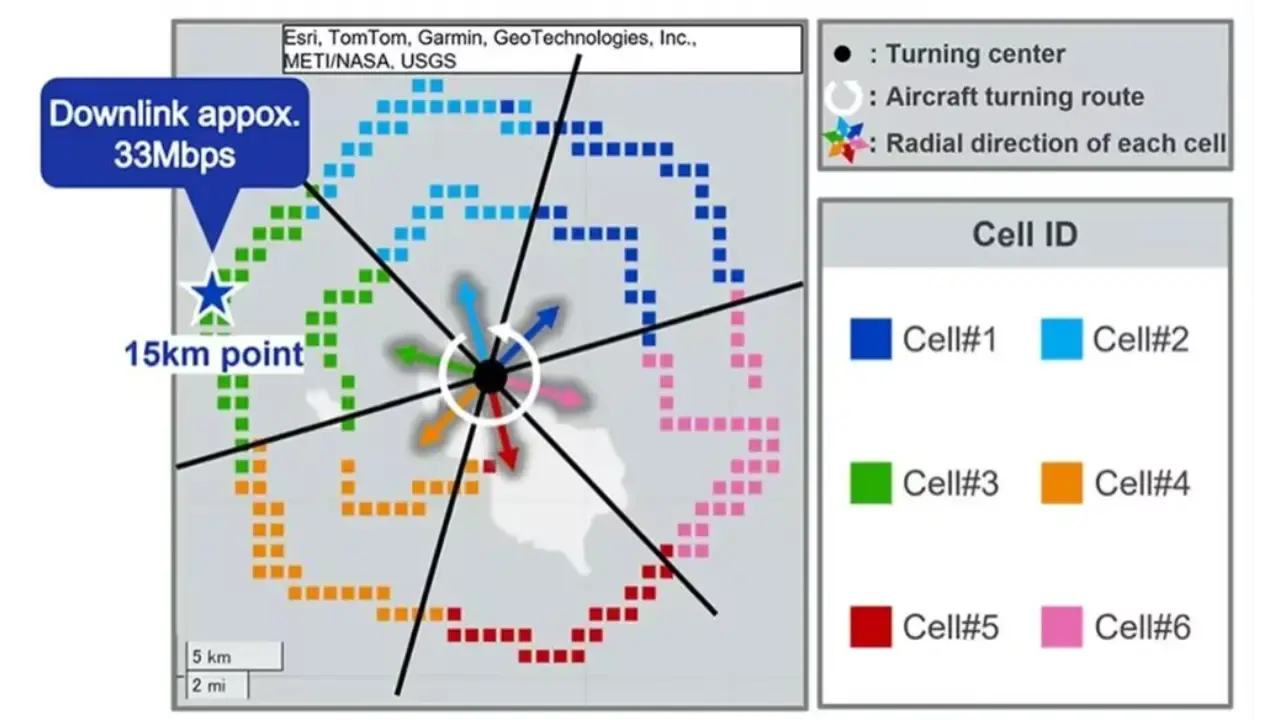
SoftBank has successfully demonstrated 5G connectivity to everyday smartphones using an airborne base station circling above Japan’s Hachijō Island. The June field trial employed a light aircraft flying at 3,000 metres to simulate a High-Altitude Platform Station (HAPS). Signals were transmitted via a 26 GHz feeder link from the ground and a 1.7 GHz service link to devices, a band already supported by most 5G handsets worldwide (Tom’s Hardware).
Unlike satellite-based “direct-to-device” systems, HAPS platforms hover in the stratosphere around 20 km up, reducing latency and avoiding Doppler and power challenges common in Low Earth Orbit. The aircraft-mounted array created six fixed ground cells, dynamically adjusting coverage as the plane circled. SoftBank also validated Doppler correction, adaptive beam tracking and automatic power control—core requirements for future commercial deployment. The International Telecommunication Union (ITU) recently approved spectrum allocations for HAPS at WRC-23, allowing operators to use terrestrial mobile bands such as 700 MHz, 850 MHz, 1.7 GHz and 2.5 GHz.
Also Read: Synapxe: Powering Singapore’s public healthcare transformation
Also Read: BBIX Singapore: Building Asia’s interconnection future
Why it’s important
The trial signals a potential breakthrough for delivering 5G in places where traditional cell towers are impractical. Rural communities, disaster zones and offshore regions could all benefit from stratospheric connectivity. SoftBank’s approach also offers spectrum reuse advantages over Low Earth Orbit (LEO) constellations, which face higher path loss and orbital drift issues.
Industry observers note that HAPS could complement—not compete with—initiatives like AST SpaceMobile’s LEO-based 5G trials. By providing coverage from nearer the Earth’s surface, SoftBank’s technology may deliver lower-latency services at scale. Although no commercial rollout timeline has been confirmed, the test underscores Japan’s growing role in pioneering non-terrestrial 5G. As Professor Rahim Tafazolli, head of the 5G Innovation Centre at the University of Surrey, has argued in related research, non-terrestrial networks are critical to achieving true global coverage.
For now, SoftBank’s experiment offers a glimpse of how everyday smartphones could one day stay connected far beyond the reach of traditional networks.