
Summary
- What it says: Smartnet Network is a small Talagante-area broadband operator whose public record shows both a real local need and a hard strategic question: in a Chilean market where fibre is now the mass-market default, a local ISP must prove that proximity, installation knowledge and service
- Main topic: Regional ISP economics; WHOIS/RDAP accountability
- Context: market / company research report / LATAM
A small operator in a country that no longer tolerates small speeds
Smartnet Network is not an important company because it is large. The public record does not support that reading. It is important because it sits at a point where several forces in Latin American connectivity collide: local access gaps, national fibre expansion, the falling price of high-speed broadband, the rise of 5G and satellite substitutes, and the question of whether a small regional ISP can remain economically useful once the market stops rewarding mere availability.
The company behind the network is Sociedad Smartnet Limitada, also presented in public interconnection records as Smartnet Telecom. Its visible footprint is concentrated around Talagante and nearby communes west and south-west of Santiago. The older public self-description is plain: residential and wholesale internet service in El Monte, Talagante, Melipilla, Isla de Maipo and Penaflor. That geography matters. This is not the Chile of central Santiago office towers, dense apartment blocks and easy payback on a fibre route.
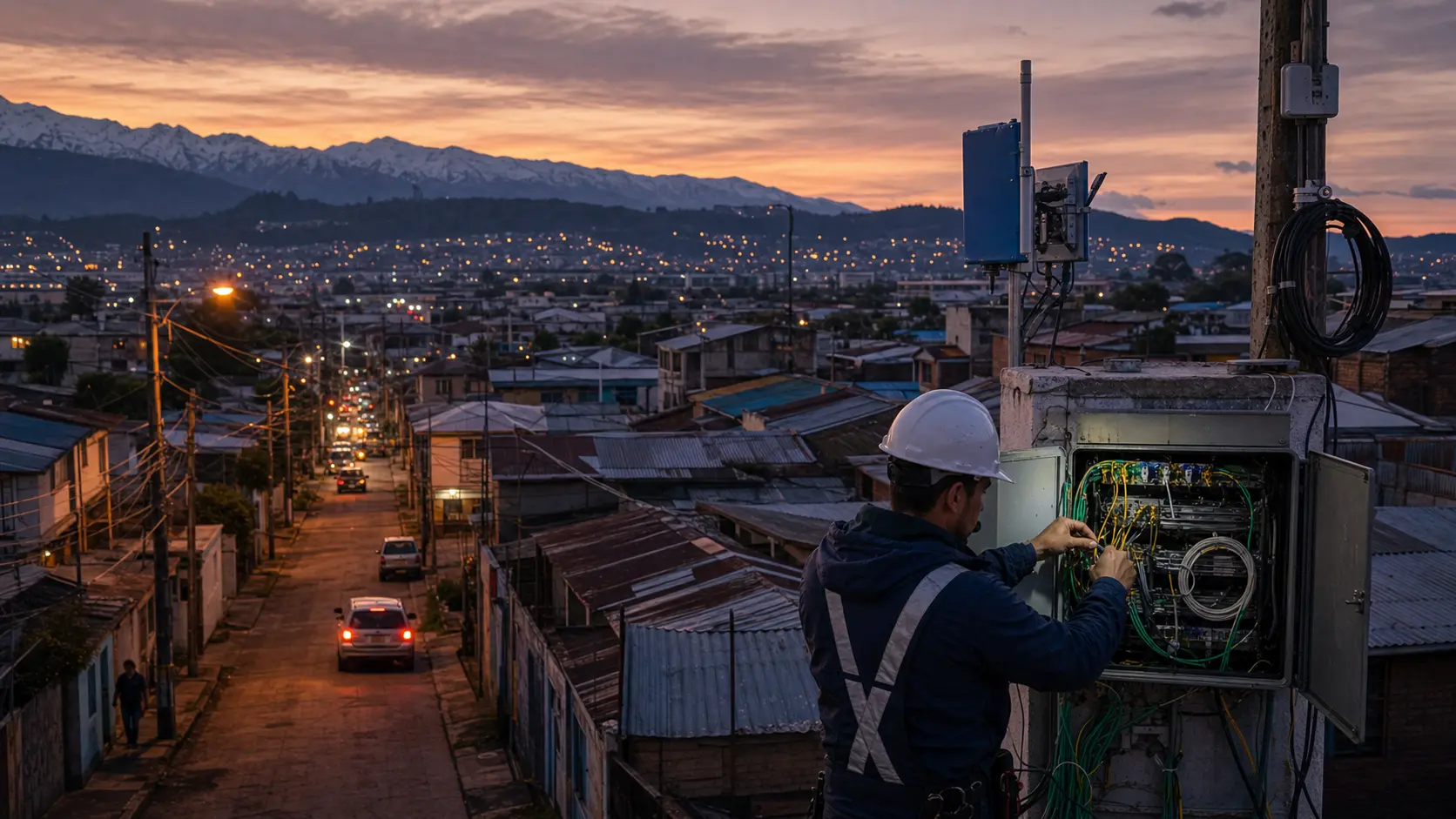
It is the commuter fringe, the agricultural and peri-urban belt, the places where a single street may combine dense housing, small workshops, plots, fields, new developments and old rights of way. Broadband economics in such places are rarely about one heroic technology. They are about whether a provider can identify enough paying homes and businesses along a route, install without burning too much labour, and keep the service working when trees, poles, weather, customer equipment and wholesale links create friction.
That is why Smartnet is a useful subject. It appears to have begun as the kind of operator that emerges when a community has internet access in theory but not good enough access in practice. A 2019 PIT Chile announcement described Smartnet as a new member beginning operation at PIT/IXP Santiago and framed the company's creation around the need to satisfy internet access demand in El Monte and Talagante, where service was available but often poor in quality or expensive.
Archived versions of the company's own site later advertised residential and rural plans with modest speeds, separate installation charges, business plans priced in UF, and a local office and WhatsApp channel. By 2023 the archived home page had shifted its branding toward "TV & Internet Fibra Optica", suggesting that Smartnet was trying to move from the older rural-access bargain into Chile's fibre era.
The problem is that Chile's fibre era is unforgiving. Subtel's first-quarter 2026 sector report says fixed internet connections reached about 4.86 million in March 2026, with fibre accounting for 85.3% of fixed connections. HFC had fallen to 10.6% and other wireless technologies to 3.6%. The same report puts rural fixed-internet household penetration at only 23.6%, far below the urban figure of 76.8%, while only 4.6% of fixed connections were rural. This is a market with a large remaining coverage challenge, but it is not a market where users are being educated slowly into broadband. They already know what fibre means.
They see national advertising, speed-test posts, 5G handsets, streaming platforms, work-from-home requirements and gaming latency. A local ISP can still win in pockets, but it no longer wins by being the only alternative to nothing.
The investment case around Smartnet, therefore, is not "small ISP grows because Chile needs more broadband." That is too crude. The better argument is conditional: Smartnet has economic value if it owns customer relationships and last-mile knowledge in places where national operators are present but operationally blunt, and if it can translate that local position into a credible fibre or hybrid-fibre access network.
If its network activity has instead faded behind a wholesale partner, become invisible to public routing tables, or lost the ability to present a live commercial front, then its value is more fragile: a concession, a domain, an address, some number-resource history and local brand residue, rather than an obviously expanding access business.
The company is real; the current signal is mixed
The identity layer is stronger than the live commercial layer. Public records do not leave much doubt that Sociedad Smartnet Limitada is a real Chilean telecom operator. Subtel's transparency archive records Decree 70 granting a public data-transmission service concession to Sociedad Smartnet Limitada, with publication in the Diario Oficial in June 2016. A Subtel TV cable workbook from June 2022 lists Sociedad Smartnet Limitada with RUT 76.291.359-3 for Talagante and El Monte. SERNAC has a provider page for Sociedad Smartnet Limitada under the internet telecom market.
Mercantil's company listing also identifies Sociedad Smartnet Limitada in Talagante with the same RUT, describing it as a microenterprise. These are not marketing claims. They are administrative traces that show a local provider has existed within Chile's regulated telecom and consumer environment.
The network layer is more complicated. PeeringDB records Smartnet Network as AS267733, under Sociedad Smartnet Limitada, with the website internetdeverdad.cl, an IRR set labelled AS-SMARTNETTELECOM, a Cable/DSL/ISP network type, four IPv4 prefixes, no IPv6 prefixes, traffic levels of 10-20Gbps, mostly inbound traffic and South America as geographic scope. PeeringDB also lists interconnection facilities at Grupo ZGH - La Florida and PowerHost Santiago. It shows no public peering exchange points on the network page, even though PIT Chile had announced the operator's connection at PIT/IXP Santiago in 2019.
Hurricane Electric's BGP toolkit adds a sharper warning: AS267733 has not been visible in the global routing table since January 4, 2024, and the page treats some information as historical. It also shows one observed IPv4 peer, PowerHost Telecom, and identifies the originated /24s within 45.167.192.0/22. IPinfo similarly classifies AS267733 as inactive and reports no currently hosted IPv4 or IPv6 addresses for the ASN.
That contrast is not a minor technical footnote. For a broadband access company, the public internet routing layer is part of the operating surface. A small access ISP can disappear from global BGP for benign reasons. It may have moved customers behind a larger upstream's ASN. It may have changed its network architecture. It may use private addressing and carrier-grade NAT, or rely on wholesale arrangements where the access brand survives while the autonomous-system record becomes less visible. It may also have suspended independent routing because customer volume no longer justifies the engineering overhead.
But the signal remains material: the public evidence supports Smartnet as a legally and historically real operator, while the current independent network signal is weak.
This mixed signal should shape any economic judgment. Smartnet is not a clean case of a growing regional fibre challenger whose network map, active BGP routes, public packages and customer channels all point in the same direction. It is a local ISP whose strongest public evidence is distributed across older site captures, telecom concessions, number-resource records, interconnection directories and local listings. That is enough to study. It is not enough to assume momentum.
Talagante is close to Santiago, but not the same market
The geography can mislead outsiders. Talagante sits within the Santiago Metropolitan Region, close enough to the capital that it may look like a suburb of a mature national broadband market. The economics are not that simple. The provincial and district records show a patchwork: Talagante, El Monte, Isla de Maipo, Penaflor and nearby Melipilla have real population scale, but also mixed density and pockets of rurality. The Biblioteca del Congreso's 2026 district report lists Talagante at 76,429 inhabitants, El Monte at 37,497, Isla de Maipo at 39,274 and Penaflor at 94,402 in the 2024 census data.
It also shows rural and peri-urban characteristics across the wider district, with Melipilla, Curacavi, Maria Pinto and other surrounding communes carrying substantial rural populations.
For a local ISP, those numbers mean two things at once. First, the addressable market is not tiny. A provider that can win a few thousand stable residential and business connections in such communes can build a meaningful local cash-flow business. Second, the market is not uniformly cheap to serve. The cost of a broadband connection is not just the cost of bandwidth at a data centre. It includes field surveys, line-of-sight checks, pole access, tower or rooftop equipment, customer-premises devices, fibre drops, repair truck rolls, weather exposure, billing, support and churn management.
The less uniform the neighbourhood, the more each connection requires local knowledge.
That local knowledge is the strategic reason operators like Smartnet exist. National networks are powerful at scale, but scale also pushes them toward standardised deployment rules. They prefer clean addresses, dense streets, repeatable installation, automated credit checks and customers that fit product categories.
Smaller operators often survive in the exceptions: a villa that is poorly served, a rural road with enough homes to justify a wireless sector, a business that needs someone to answer the phone, a small subdivision waiting for fibre, or a customer who wants a connection even when the big provider's database says coverage is unavailable.
Smartnet's archived coverage page from 2021 reads like the operating map of such a business. It listed named villas and sectors under Talagante and El Monte, and told customers to consult feasibility if their location did not appear. That kind of language is not the language of a national fixed network sold only through a coverage API. It is the language of a provider whose sales process still depends on the physical path between the customer and the network. The commercial question is whether that advantage remains valuable once fibre competition arrives.
The old bargain was scarcity; the new bargain is proof
The archived 2021 Smartnet plan page shows the old bargain clearly. Residential plans were advertised at up to 8, 10 and 12 Mbps down, with 2 Mbps up, at monthly prices around 16,980 to 24,980 Chilean pesos, plus a 20,000 peso installation cost. Rural plans showed the same nominal speed range but much higher monthly prices, from 28,980 to 48,980 pesos, and a 60,000 peso installation cost. Business plans were framed differently: from 8 Mbps, symmetrical speeds, from 2 UF plus VAT, and installation from 60,000 pesos. This was a rational structure for a wireless or hybrid local access operator.
Rural customers cost more to install and maintain; business customers value symmetry and service more than raw download speed; installation fees recover equipment and labour; and residential speeds reflect the capacity constraints of the last-mile technology and upstream sharing.
In 2021 that proposition could still make sense in under-served pockets. A household with no fixed alternative and weak mobile reception might accept 8 Mbps if the connection was stable enough for school, messaging, banking, YouTube and basic remote work. A small business might prefer a local provider with a reachable support channel over a cheap mass-market package that fails at the wrong moment. A rural customer might tolerate a higher installation charge because the alternative was no fixed connection, capped mobile data or a long wait for a national operator.
By 2026, the burden of proof is different. Subtel's data says Chile is overwhelmingly fibre-led. A separate Subtel news release in April 2026 said Chile's fixed internet was the cheapest in Latin America at US$3.12 per 100 Mbps, citing a JP Morgan study, and noted that 84.1% of connected homes had fibre as of January 2026. It also said a large share of fixed households had contracted speeds between 500 Mbps and 1Gbps. Whether each customer actually experiences those speeds at all times is another matter. The point is that consumer expectations have changed.
A plan that once looked like a practical answer to scarcity can look expensive once the reference product is hundreds of megabits over fibre.
This does not automatically kill a local ISP. It changes what the local ISP has to sell. It can no longer sell "internet" as a scarce commodity. It must sell proof: proof that it reaches addresses the large providers mishandle, proof that installation is faster, proof that support is human, proof that latency and uptime are good enough, proof that pricing is not simply a legacy scarcity premium, and proof that fibre branding corresponds to actual access upgrades. The archived 2023 site language around fibre plans shows Smartnet understood the direction of travel.
What is missing from the public record is current confirmation of how far that transition went.
A small block of addresses can say a lot, but not everything
The number-resource record gives Smartnet a more serious infrastructure identity than a simple reseller listing would. LACNIC-derived whois data for AS267733 identifies Sociedad Smartnet Limitada, created in November 2018, with the 45.167.192.0/22 inetnum. A /22 contains 1,024 IPv4 addresses. Hurricane Electric's historical routing view breaks that space into four /24 originated prefixes: 45.167.192.0/24, 45.167.193.0/24, 45.167.194.0/24 and 45.167.195.0/24. RPKI client data as of July 2, 2026 also shows a route origin authorization for 45.167.192.0/22 with a maximum length of /24 for AS267733.
Those facts matter because they show more than a brand name. A provider with its own ASN, address space and route authorization has at least attempted to occupy the internet as a network operator, not merely as a reseller of someone else's service. It can control routing policy, present a distinct network identity, negotiate peering or transit, and make itself visible in the technical ecosystem. In a regional ISP market, that can support better wholesale options and more credibility with business customers.
But address resources are not the same as active traffic. The BGP visibility issue is central. If the ASN is no longer globally visible and IPinfo reports the network as inactive, the number-resource record becomes an asset with ambiguous operating meaning. It might be dormant. It might be reserved for a future reactivation. It might be hidden behind another operator's network. Or it might be a remnant of a business model that has changed. The route authorization says the company can authorize the prefix for AS267733; it does not prove that customers are currently routed that way.
The absence of IPv6 in PeeringDB is another small but telling point. Chile's mass residential market may not punish a local ISP immediately for weak public IPv6 posture, but the direction of the internet is not favourable to IPv4-only small networks. Carrier-grade NAT can stretch scarce IPv4 resources, and many residential customers will not notice until gaming, remote access, business VPNs, security cameras or application behaviour make them notice. A provider trying to sell business-grade trust in 2026 should have a clearer public IPv6 and routing story than the current record shows.
Upstream power sits in Santiago
Smartnet's upstream and interconnection story points toward Santiago rather than deep local independence. PeeringDB lists facilities at Grupo ZGH - La Florida and PowerHost Santiago. Hurricane Electric's historical view identifies PowerHost Telecom as the observed IPv4 peer. PIT Chile's 2019 announcement placed Smartnet's interconnection story at PIT/IXP Santiago. These records do not prove current wholesale contracts, but they do point to the likely shape of the cost base: local access in Talagante and surrounding communes, with aggregation and upstream connectivity tied to Santiago facilities.
That structure is normal. A small ISP does not need to build a national backbone to matter. It needs reliable upstream capacity, enough redundancy to avoid embarrassing outages, sensible routing, and a local access network that does not oversell peak-hour demand beyond what the backhaul can carry. The economics are a balancing act. Too little upstream capacity and the service becomes visibly congested at night. Too much capacity and the operator pays for headroom that the customer base cannot monetise. Too little redundancy and every upstream or facility issue becomes a customer crisis.
Too much redundancy and the capex and recurring charges may exceed the margin from a small subscriber base.
This is why the PeeringDB traffic ratio of "mostly inbound" is plausible for a residential ISP. Eyeball networks pull content toward users: streaming video, app downloads, software updates, social media, gaming assets, cloud backups and video calls. The local ISP's job is to make that inbound flow cheap and predictable. Peering at an exchange, hosting caches, or buying better-connected transit can improve economics, but only if the operator has enough scale and engineering discipline.
A 10-20Gbps traffic-level record suggests a business larger than a hobby network, but not a market force capable of moving national pricing on its own.
The most important question is operational, not romantic: does Smartnet have enough active customers and current capacity to amortise the fixed costs of being independent? The public BGP record weakens confidence. A company can still serve customers while not originating its own routes, but if so, the business case shifts. It becomes less about owning a visible network and more about owning the local sales, installation and support layer over someone else's transport.
Installation fees reveal the real cost of the last mile
Old pricing pages often reveal more than polished corporate descriptions. Smartnet's 2021 installation fees are especially revealing. The residential installation charge was lower than the rural charge, and business installation started at the same higher level as rural. That is exactly what one would expect if the binding constraint was not bandwidth alone but the labour and equipment required to connect each customer.
In dense fibre economics, the dream is route density. A provider builds past many homes, signs enough of them, and spreads trenching, pole attachment, splitter, fibre and crew costs across a base that can pay back over time. In fixed wireless economics, the dream is line of sight and sector utilisation. A provider puts capacity on a tower or high point, installs customer equipment where it can see the access point, and adds subscribers until interference, backhaul and peak usage force upgrades.
In rural hybrid economics, the nightmare is the in-between case: too spread out for cheap fibre, too obstructed for easy wireless, too demanding for old low-speed packages, and too competitive for high monthly prices.
Smartnet's named coverage areas around Talagante and El Monte suggest a provider working neighbourhood by neighbourhood. That can create defensible micro-markets. A national operator may not prioritise a small pocket if the payback is uncertain. A local operator can know which streets have demand, which rooftops work, which customer clusters justify a sector, which local installers can be trusted, and which complaints must be handled before reputation collapses. But the same micro-market logic caps scale. The business grows through painstaking expansion, not through a single national brand campaign.
The fibre shift raises the capex burden. If Smartnet truly moved into fibre access after the older wireless-style plans, it would need either its own fibre routes, wholesale access to fibre infrastructure, or a pragmatic mix of wireless and fibre backhaul. Each choice changes the cost profile. Own fibre improves control but requires permits, construction coordination and capital. Wholesale fibre reduces build risk but limits margin and differentiation. Hybrid wireless keeps costs lower in sparse areas but fights a perception problem once customers compare it with symmetrical or high-speed fibre packages.
That is the central economic tension. Smartnet's original value likely came from solving a local access scarcity problem. Its future value depends on whether it can solve a more demanding problem: offering a credible, fairly priced, fibre-era service in places where the giants are present but not always attentive.
Competition has moved from coverage to abundance
Chile's fixed broadband competition is no longer a simple map of connected and unconnected areas. Subtel's March 2026 data shows Claro-VTR and Movistar together holding 53.3% of fixed internet connections, while Mundo Pacifico and Entel were growing. The same report shows "others" at 8.9%, a category where small regional operators live. This is a difficult position. The "others" category can be commercially meaningful in local pockets, but it is structurally squeezed by national scale above and customer expectations below.
The national operators have several advantages. They can spread advertising, billing systems, customer equipment procurement and backbone costs across millions of users. They can negotiate content delivery and transit at better rates. They can bundle mobile, fixed, TV and business services. They can offer headline speeds that would have seemed absurd in a small WISP market a few years ago. When the regulator and press talk about Chile having some of the cheapest fixed internet in Latin America per 100 Mbps, that is good for consumers and harsh for local providers that rely on high-touch installation economics.
The local providers have different advantages. They can respond to pockets of unmet demand before national maps catch up. They can use local reputation. They can install in awkward places. They can maintain relationships with customers who are not profitable enough to receive premium attention from a national call centre. They can make pragmatic technology choices instead of waiting for a perfect rollout model. In places where coverage databases are wrong, where mobile signal is weak, where a customer needs a technician who knows the road, or where a small business needs accountable support, the local provider can still win.
Mobile broadband and satellite add a further pressure. The Capa9 forum thread from 2020 is useful not because anonymous posts are definitive, but because it shows how customers thought about substitutes. Rural users compared point-to-point wireless, 4G routers, unlimited data packages, gaming latency and weather sensitivity. One participant pointed to Smartnet's rural Talagante coverage as a better option than very low-speed alternatives, while others debated whether 4G would be cheaper or more practical if signal was available.
By 2026, 5G has become much more prominent in Chile, and Starlink is a visible satellite alternative in many rural markets. That does not make fixed local ISPs irrelevant. It means they must defend themselves against more fallback options.
What customers are really buying
For a customer in Talagante or El Monte, the purchase is not simply megabits. It is a bundle of promises: the connection will be installed, it will keep working, the bill will be understandable, support will answer, video calls will not fail during peak hours, gaming latency will not be absurd, the router will not be abandoned, and the provider will not disappear after a storm. A local ISP can compete on these promises even when it cannot win a national speed advertisement.
This is where Smartnet's dependency surface is most visible. Its likely customer base is residential households, rural homes, small businesses and local users in coverage pockets. Some of those customers may be marginal to national operators but highly dependent on the provider that actually connects them. If a household has weak mobile signal, no practical fibre alternative and children using online education, the local ISP becomes essential infrastructure. If a small business uses the connection for payments, ordering, cameras, accounting, messaging and customer service, downtime is not a technical inconvenience; it is lost revenue.
The danger for Smartnet is that dependence can evaporate quickly when a better option arrives. A customer who tolerated 8 Mbps because nothing else worked may churn as soon as a national fibre offer appears. A customer who paid a high installation fee may still leave if the service feels slow against a neighbour's fibre connection. A business that once valued local support may move if a larger provider offers a service-level agreement at a competitive price. In broadband, loyalty is strongest when the provider is both trusted and technically adequate. Trust alone cannot compensate forever for a widening performance gap.
The archived 2023 shift toward fibre branding suggests Smartnet was trying to avoid that trap. If the company has upgraded enough of its footprint to fibre or fibre-fed local access, the local brand could remain valuable. If the fibre language was aspirational or limited, the company risks being caught between eras: too expensive for low-speed wireless, too small for commodity fibre, and too opaque for business-grade trust.
The uncomfortable signal from a quiet routing table
The most negative public signal is the routing record. A live ISP's website can be sparse; a local operator may prefer WhatsApp and local referrals to polished digital marketing. But an ASN that public tools describe as not visible since January 2024 is harder to dismiss. It does not prove the company is inactive as a service provider. It does prove that the independent AS267733 network identity is not currently presenting itself in the ordinary way to the global routing table.
There are several possible explanations, and they lead to different valuations. The first is operational retreat: Smartnet may have reduced or ceased independent network operations, leaving behind a dormant ASN, archived website and historical customer traces. That would make the company more of a local residual brand than an active infrastructure asset. The second is architectural consolidation: Smartnet may still serve access customers but rely on another operator's routing and address resources. That would reduce technical independence but could be rational for a small provider if it lowers engineering cost.
The third is transition: the company may be rebuilding or moving to a new commercial and network model, with the old public signals lagging. The fourth is data mismatch: public routing tools may not capture the full current arrangement, especially if the brand operates under another legal or network structure.
The public evidence cannot choose among those explanations. It can rank them by what would need to be shown. A current traceroute from customer lines, active route announcements, a live network status page, current customer packages, a current Subtel registration file, a working company site, or confirmation of wholesale arrangements would materially improve confidence. Without those, the analysis has to treat Smartnet as a real but partially opaque operator.
This is not a small problem for a company research judgment. Broadband businesses are valued on recurring revenue, churn, network assets, customer density, rights of way, support capability and expansion path. The public record gives hints for some of those, but not hard numbers. It supports the existence of a local access business. It does not support a confident claim about current subscriber scale, revenue, EBITDA, capex programme, customer churn or active route capacity.
The reputation market is informal, but it matters
The public conversation around rural internet in Chile is practical and unsentimental. Forum users do not ask whether a provider has a beautiful brand narrative. They ask whether point-to-point wireless is usable for games, whether oversubscription will ruin peak hours, whether 4G would be cheaper, whether trees and weather will break the link, whether an installer will come back, and whether the advertised speed is enough for modern applications. That kind of chatter is not audited evidence of Smartnet's performance. It is evidence of the buying environment in which Smartnet operates.
The Capa9 thread from July 2020 is especially revealing because Smartnet appears there as part of a local comparison. One user looking at rural options was worried about point-to-point internet and 4G data limits. Others explained that wireless quality depends on line of sight, bandwidth management and provider discipline. A participant then pointed to Smartnet's Talagante rural coverage as a more usable alternative than very low-speed competitors, while noting coverage and installation cost as issues. Later discussion returned to 4G as a substitute when signal was good enough.
This is exactly the reputation market a local ISP must win. Customers hear about providers through neighbours, local forums, WhatsApp groups and installers. They compare not only price and speed but the probability of annoyance. A provider's brand can be damaged by a few bad installations, slow repairs, overloaded sectors or unclear billing. It can also be strengthened by being the only provider that answers and solves a real problem. In such markets, the boundary between sales and operations is thin.
Every technician is a salesperson; every outage is a public review; every installation fee is a bet by the customer that the provider will still care after the router is installed.
For Smartnet, the informal chatter points to an opportunity and a risk. The opportunity is that rural and fringe customers often distrust generic coverage promises. A local operator that actually knows the terrain can convert that distrust into loyalty. The risk is that these same customers are highly sensitive to underperformance. If a point-to-point link fails in rain, if latency is poor for games, if a tower is oversold, or if national mobile data becomes good enough, the local provider's old advantage fades.
Regulation gives permission, not protection
Smartnet's concession and provider listings matter because telecom service is not just another retail business. Public data-transmission service permission, consumer visibility through SERNAC, and Subtel records establish a formal operating frame. They also create obligations. Customers can complain. Regulators can require information. Public policy can change installation, cable, service-quality and consumer-protection expectations. A small ISP cannot simply behave like an informal neighbourhood reseller forever if it wants to remain credible.
But regulation does not protect the business from economics. A concession allows service; it does not guarantee customers. Registration in a TV cable workbook or consumer provider list confirms presence; it does not prove competitiveness. Number resources allow a network to route; they do not create demand. The state can identify a service provider, but it cannot make that provider's old price-speed mix attractive once the market moves.
Chile's policy environment arguably raises the bar for Smartnet. Subtel's public statistics repeatedly emphasise fibre growth, 5G expansion, lower unit prices and national connectivity gains. That is good public policy news, but it narrows the space for providers whose offer depends on scarcity. A small ISP needs to show why it remains necessary in a market that is increasingly proud of abundance.
There is also an operational policy angle. Fibre and cable deployment can create conflicts around aerial plant, municipal permissions, pole congestion and cable removal. National operators can absorb compliance overhead more easily than micro and small providers. Local ISPs often know the terrain better, but they have less administrative slack. A change in enforcement, permitting, or infrastructure-sharing costs can hit them disproportionately. If Smartnet's current model depends on a mix of wireless, fibre, leased facilities and customer-site equipment, each layer carries different regulatory and operational exposure.
The business is most valuable if it is a service layer over scarce local knowledge
The strongest positive case for Smartnet is not that it becomes a national challenger. It is that the company owns a scarce local service layer in a set of communes where broadband demand is real, national coverage is not always smooth, and customers still value a provider that can make a connection happen. In that version of the story, the old wireless and rural plan evidence is not a weakness; it is proof that Smartnet learned the local access problem before fibre became fashionable.
The company then uses fibre where density supports it, wireless where terrain requires it, and wholesale backhaul where building everything would be irrational.
This model can be economically attractive at modest scale. Customer acquisition costs can be low if local reputation works. Support can be efficient if technicians know the same neighbourhoods repeatedly. Installation fees can offset capex. A small business customer base can improve ARPU. Wholesale bandwidth can be bought in Santiago while the local access edge remains differentiated. The company does not need to beat Movistar or Claro-VTR nationally. It needs to be better than them for specific customers in specific streets.
The weak case is that Smartnet is trapped in the middle. The old low-speed plans are no longer compelling. The fibre transition is not clearly evidenced in current public materials. The independent ASN is not visible. The website is not presently serving the company's operating site. National operators and mobile substitutes are stronger. In that version, Smartnet's assets are mainly historical: a concession, a local name, old customers, an address, and network resources that may or may not still be operationally central.
The public record does not allow a decisive conclusion between those cases. It does allow a probabilistic judgment. Smartnet looks like a real local operator that had a clear reason to exist in the Talagante-El Monte access gap and later tried to present itself as a fibre-era TV and internet provider. It does not currently look, from public routing and web signals, like a transparent independent network in growth mode. That makes the company worth tracking, but with a confidence discount.
What would change the judgment
Several facts would materially change the assessment. The first is current customer scale. A local ISP with 500 active subscribers is a different business from one with 5,000. The public record does not provide a current subscriber count. The second is current access technology by neighbourhood. If Smartnet has meaningful fibre coverage in Talagante, El Monte or Penaflor, the business is more defensible than if most customers remain on legacy point-to-point wireless. The third is the present routing arrangement.
Active BGP announcements, confirmed upstreams, IPv6 deployment, route monitoring and network-status evidence would improve confidence. If the company intentionally moved behind another operator, the economics should be analysed as a branded access reseller or local last-mile operator rather than as an independent AS-led ISP.
The fourth fact is pricing. Current fibre packages, installation fees, business plans and contract terms would show whether Smartnet has reset its offer to match Chile's low-price fibre market. The fifth is support quality. In local broadband, churn often follows support failure before it follows speed comparisons. Verified customer satisfaction, complaint levels or repair-time data would matter. The sixth is ownership and partnership structure. A partnership with a stronger upstream, municipal fibre arrangement, acquisition by a regional consolidator or wholesale access deal could materially improve the company's prospects.
Conversely, unpaid obligations, regulatory issues, or a pattern of unresolved complaints would weaken the case.
Finally, the public domain needs to work. A local ISP can sell through WhatsApp, but in 2026 a non-functioning public website is still a trust problem. It makes it harder for customers to verify plans, pay bills, request support or distinguish the company from similarly named Smartnet operators in Chile and elsewhere. It also makes outside assessment harder. The fact that the public website historically carried the company's offer but currently does not serve that site is not fatal on its own. Combined with the quiet routing table, it is part of the same opacity problem.
The judgment
Smartnet Network is best understood as a test case in the second phase of Latin American broadband competition. The first phase rewarded operators that could bring any usable connection to neglected households. The second phase rewards operators that can keep local trust while matching fibre-era expectations. Smartnet's public history fits the first phase well: a Talagante-area provider, legally visible, locally described, using its own network identity, offering residential, rural and business plans, and connecting into Santiago's interconnection ecosystem.
Its public present is less convincing: inactive-looking AS data, no visible independent routes since early 2024 in a major public BGP tool, no IPv6 profile in PeeringDB, a live domain that does not currently present the operating site, and limited current public commercial information.
That does not mean Smartnet is irrelevant. It means the value is conditional. If active customers remain and if the company has genuinely upgraded local access toward fibre, Smartnet could still be valuable as a focused local provider in a region where rural and peri-urban broadband gaps persist beneath Chile's impressive national fibre statistics. Its advantage would be local execution, not network scale.
It would matter because it knows which parts of Talagante, El Monte, Isla de Maipo, Melipilla and Penaflor are hard to serve, and because some customers still need a provider that solves the last-mile problem rather than merely advertises coverage.
If, however, the independent network has faded and the fibre transition is more brand language than active footprint, Smartnet's position is fragile. Chile's national broadband market is moving toward cheap, high-speed fibre, while mobile and satellite options keep improving. In that environment, a small ISP cannot live indefinitely on old scarcity economics. It must either become the best local service operator in its pocket, attach itself to stronger wholesale infrastructure, or risk becoming a historical trace in routing databases and archived plan pages.
The central argument is therefore narrow but important: Smartnet Network's future does not depend on whether Chile needs more broadband. Chile does. It depends on whether a small local operator can still convert neighbourhood knowledge into recurring value after the national market has taught consumers to expect fibre speeds at low prices. The public record says Smartnet once had a clear answer to the access gap. It has not yet shown, in current public evidence, a fully convincing answer to the fibre age.