
Summary
- SIMPLE CLOUD SOLUTION LLC is not an empty routing name. ARIN records AS63008 / SIMPLE-ASN and AS397968 / BBC-ASN as active resources registered to the company, and RIPEstat saw both announced at the 14 July 2026 route observation time.
- The public network footprint is narrow but current: RIPEstat listed 23.169.168.0/24, 2602:f9a9:201::/48 and 2602:f9a9:102::/48 under AS63008, and 23.169.169.0/24 plus 2602:f9a9:301::/48 under AS397968. Several of those routes validated under RPKI.
- PeeringDB records AS63008 as SIMPLE CLOUD SOLUTION LLC, also known as HaeImAlan Network, with one NRIX exchange connection, a 10 Gbps IPv6 interface, Asia Pacific scope, open peering policy and no listed facilities. That is an interconnection signal, not a rack map.
- The main company website and a geofeed URL on the haeimalan.com domain returned Cloudflare 403 responses from this review environment, while DNS placed the website behind Cloudflare and mail behind Microsoft 365. Public company copy is therefore thinner than the routing evidence.
- The evidence grade is Medium for network identity and public route visibility, but Weak for hosted-capacity resilience. Buyers should verify actual facility, rack, power, transit, support, stock and migration terms before treating the company as dependable cloud infrastructure.
The company is visible in routes before it is visible as a cloud
The first useful fact about SIMPLE CLOUD SOLUTION LLC is that its public routing record is clearer than its product story. The BTW directory page at https://btw.media/en/directory/simple-cloud-solution-llc identifies the directory entity. ARIN then gives the company two active autonomous-system registrations: AS63008 at https://rdap.arin.net/registry/autnum/63008 and AS397968 at https://rdap.arin.net/registry/autnum/397968. Both records name SIMPLE CLOUD SOLUTION LLC as the registrant. The company address shown in those records is 2020 N Academy Blvd Ste 261, Colorado Springs, Colorado. That is enough to anchor the legal identity behind the network resources.
The second useful fact is that those numbers were not merely dormant registry entries when checked for this article. RIPEstat's AS overview for AS63008 at https://stat.ripe.net/data/as-overview/data.json?resource=AS63008 identified the holder as "SIMPLE-ASN - SIMPLE CLOUD SOLUTION LLC" and showed the AS as announced for the 14 July 2026 query window. Its equivalent AS397968 page at https://stat.ripe.net/data/as-overview/data.json?resource=AS397968 identified "BBC-ASN - SIMPLE CLOUD SOLUTION LLC" and also showed announced=true. The routing-status views at https://stat.ripe.net/data/routing-status/data.json?resource=AS63008 and https://stat.ripe.net/data/routing-status/data.json?resource=AS397968 showed full observed IPv4 visibility and substantial IPv6 visibility in the same window.
That matters because small cloud and hosting businesses often leave behind a misleading trail. A corporate page can stay online while routes disappear. A plan page can advertise capacity while the ordering system has no stock. A domain can be parked while a network still carries customers. In this case, the public route evidence is live. It supports a narrower and more technical statement: SIMPLE CLOUD SOLUTION LLC controls or operates visible Internet routing resources.
It does not support a broader statement that the company has a large hosted-compute estate, a public cloud region, multiple facilities, spare hardware pools, customer failover options, or enterprise support coverage.
The distinction is the whole article. The planned subject is a cloud-service company, but the public evidence we can prove is mainly network-resource evidence. A responsible infrastructure assessment must therefore avoid filling the missing product layer with assumptions. "Cloud" can mean virtual machines, bare-metal servers, a resale platform, VPN services, network lab services, address leasing, transit-adjacent routing, colocation support, or a small mix of those activities. The public record around SIMPLE CLOUD SOLUTION LLC does not disclose enough to place every unit of service into one of those boxes.
PeeringDB adds a second name and a business-positioning hint. The PeeringDB network API at https://www.peeringdb.com/api/net?asn=63008 lists the network name as SIMPLE CLOUD SOLUTION LLC, the alternate name as HaeImAlan Network, the website as https://haeimalan.com, the network type as Cable/DSL/ISP, and a note describing it as a small end-user ISP and MVNO in the United States and Taiwan. That note is useful because it broadens the public surface beyond conventional virtual-server hosting. It points to access-network and mobile-service language as well as cloud-facing capacity. But PeeringDB is operator-maintained, and its business notes are not an audited customer inventory.
The home domain is less helpful. A direct request to https://haeimalan.com/ returned a Cloudflare 403 block page during this review, and the geofeed URL at https://geofeed.haeimalan.com/geofeed.csv returned the same kind of block page. DNS for haeimalan.com resolved to Cloudflare addresses, its nameservers were Cloudflare nameservers, and its MX record pointed to Microsoft 365. That is normal for a small operator that protects a public site and outsources mail. It also means the public website cannot be used here to prove live hosting products, service-level terms, capacity geography, support windows or customer ordering.
So the base finding is balanced. SIMPLE CLOUD SOLUTION LLC has genuine public network evidence. It has current route visibility. It has ARIN resources. It has an interconnection directory record. It has a protected public domain. What it does not have, in the public record reviewed here, is a transparent hosted-service catalogue that states where workloads run, which facilities are used, how much server inventory is installed, how support escalates, what recovery promises apply, or how customers can leave during a failure.
AS63008 is the strongest current operating signal
AS63008 is the cleaner of the two public network profiles. ARIN names it SIMPLE-ASN. RIPEstat saw it announced in the 14 July 2026 observation window. The announced-prefixes endpoint at https://stat.ripe.net/data/announced-prefixes/data.json?resource=AS63008 listed three routes: 23.169.168.0/24, 2602:f9a9:201::/48 and 2602:f9a9:102::/48. The prefix-overview view at https://stat.ripe.net/data/prefix-overview/data.json?resource=23.169.168.0/24 showed the IPv4 /24 announced by AS63008. The RPKI validation page at https://stat.ripe.net/data/rpki-validation/data.json?resource=AS63008&prefix=23.169.168.0/24 returned valid. The RPKI page for 2602:f9a9:201::/48 at https://stat.ripe.net/data/rpki-validation/data.json?resource=AS63008&prefix=2602:f9a9:201::/48 also returned valid, as did 2602:f9a9:102::/48 at https://stat.ripe.net/data/rpki-validation/data.json?resource=AS63008&prefix=2602:f9a9:102::/48.
Those are good hygiene signals. They show that the prefix-origin relationship is not merely visible but also aligned with Route Origin Authorization data at the time of query. In a small network, that matters. RPKI validity reduces the chance that a route will be rejected by strict upstreams or exchange route servers. It does not prevent every outage, but it lowers one common failure mode: a valid route is less likely to disappear because an upstream or route server filters it as invalid.
RIPEstat's AS63008 routing-status response is also stronger than a bare registry record. It showed one IPv4 prefix, two IPv6 prefixes, four observed neighbours, and full visibility across the IPv4 and IPv6 RIS peer sets in the queried snapshot. The ASN-neighbours endpoint at https://stat.ripe.net/data/asn-neighbours/data.json?resource=AS63008 listed AS216211, AS32595, AS40792 and AS46475 as observed neighbours, with the last showing both IPv4 and IPv6 peer visibility and the others appearing in IPv6-heavy observations. That is evidence of upstream or adjacent routing paths. It still does not identify the facility where a server sits, but it shows that the AS was not isolated from public route collection.
ARIN's address-resource records add another layer. The IPv4 allocation at https://rdap.arin.net/registry/ip/23.169.168.0 is named SIMPLE-CLOUD-GLOBAL-01 and registered to SIMPLE CLOUD SOLUTION LLC. The IPv6 parent resource at https://rdap.arin.net/registry/ip/2602:f9a9:: is also named SIMPLE-CLOUD-GLOBAL-01 and registered to the company. A more specific IPv6 record at https://rdap.arin.net/registry/ip/2602:f9a9:102:: is named HAEIMALAN-V6 and is shown under HaeImAlan Network. That mix is consistent with a small operator using the legal company, public network brand and IPv6 delegations together.
For a customer, however, the practical question is not just whether the AS is alive. The question is what sits behind it. A /24 can carry a wide variety of services: customer virtual servers, test endpoints, tunnel routers, VPN concentrators, mobile-core support systems, DNS, management hosts, reseller assignments, or a small lab. A /48 can support routed customer networks, internal links, tunnel endpoints or exchange-facing services. Public BGP shows reachability.
It does not show machine count, server type, memory capacity, disk inventory, virtualization platform, backup system, ticket queue, or whether any retail server can be ordered today.
That is why AS63008 should be treated as a strong network-identity signal and a weak capacity signal. It answers "is this network visible?" better than it answers "how much cloud service can it sell?" It is enough for monitoring. It is enough for a network map. It is not enough for procurement. A buyer should ask for a current service order, facility statement, upstream list, maintenance policy, abuse policy, backup model, support window and migration clause before relying on AS63008-hosted capacity.
AS397968 adds capacity signals, but it also adds ambiguity
AS397968 is registered to the same company, but its public shape is different. ARIN names it BBC-ASN, and RIPEstat shows it announced in the same July 2026 observation window. The announced-prefixes endpoint at https://stat.ripe.net/data/announced-prefixes/data.json?resource=AS397968 listed 23.169.169.0/24 and 2602:f9a9:301::/48. The routing-status response at https://stat.ripe.net/data/routing-status/data.json?resource=AS397968 showed one IPv4 prefix, one IPv6 prefix, one observed neighbour and full IPv4 visibility. The ASN-neighbours endpoint at https://stat.ripe.net/data/asn-neighbours/data.json?resource=AS397968 listed AS400810 as the observed neighbour.
The RPKI evidence is also positive. RIPEstat returned valid for https://stat.ripe.net/data/rpki-validation/data.json?resource=AS397968&prefix=23.169.169.0/24 and valid for https://stat.ripe.net/data/rpki-validation/data.json?resource=AS397968&prefix=2602:f9a9:301::/48. That means the public origin and the published route-origin authorization matched at query time. Again, it is a routing-quality signal, not a platform-size statement.
The ambiguity appears in the address records. When queried through ARIN RDAP, https://rdap.arin.net/registry/ip/23.169.169.0 returned a child record named STEALTHBYTE-NETWORK-LTD, with a registrant displayed as a private customer in North Kansas City, Missouri. That does not contradict AS397968 being registered to SIMPLE CLOUD SOLUTION LLC. It suggests that at least one announced IPv4 route may be assigned, delegated or otherwise labelled for another party at the address-record layer. The public record does not explain the commercial arrangement. It should not be converted into a durable relationship claim. It should be treated as evidence that the company may route third-party or customer-labelled space as part of its operation.
That matters for hosted-service risk. If the network carries only the company's own services, the failure analysis is mostly about its own racks, contracts and support. If the network also carries customer-labelled or delegated networks, the failure surface includes customer route dependency, reassignment accuracy, abuse handling, reverse DNS, reputation, upstream filtering and customer migration. When a route depends on a small operator and one observed neighbour, a customer should know whether service can be moved quickly if the upstream path changes.
AS397968 therefore makes the public company footprint larger but not simpler. It supports the idea that SIMPLE CLOUD SOLUTION LLC is actively operating visible routing resources. It does not prove a conventional "cloud region." It does not prove that AS397968 hosts retail virtual machines. It does not show whether the relevant machines are in Kansas City, Colorado, Taiwan, a remote colocation cabinet, a leased server environment, or a customer-controlled environment. It does not show backup locations or failover mechanics.
The safest public conclusion is that the second AS raises dependency questions. Why are there two ASNs under the same company? Which customers or services sit on each? Are the prefixes used for hosted capacity, access services, tunnel services, customer networks or experiments? Does each AS have independent upstreams, or is one a narrower route instance? Is AS397968 recoverable if AS400810 has an outage? None of those questions is hostile. They are normal due diligence for a small cloud-facing network.
PeeringDB points to NRIX, not to a complete facility map
PeeringDB is the only public source reviewed here that gives a facility-adjacent clue for the AS63008 network. The network record returned by https://www.peeringdb.com/api/net/35390 lists SIMPLE CLOUD SOLUTION LLC, aka HaeImAlan Network, as AS63008. It reports one exchange, zero facilities, no listed looking glass, no listed route server, ARIN::AS-NOVEMBER as the IRR AS-set, "Cable/DSL/ISP" as the type, "50-100Gbps" as the traffic band, "Balanced" as the ratio, "Asia Pacific" as the scope, IPv6 enabled and open general peering policy. The note says it is a small end-user ISP and MVNO in the United States and Taiwan.
Those details are useful, but every one of them needs a caveat. PeeringDB is a self-maintained interconnection directory. Operators often update it for peering, not for full-service disclosures. The "50-100Gbps" traffic band can be a broad directory value and may not represent sustained customer traffic. The "Asia Pacific" scope does not mean every customer workload is in Asia. The "zero facilities" field is especially important. It means the public PeeringDB profile does not name a data centre, rack location, colocation provider, cloud host, cabinet, power topology or remote-hands arrangement for this network.
The exchange-specific record at https://www.peeringdb.com/api/netixlan?asn=63008 is more concrete. It lists one NRIX connection, speed 10000, IPv6 address 2001:ded:c000::37, route-server peer true, operational true, and an update timestamp in March 2026. That is the best current interconnection signal. It says the network is recorded at NRIX with a 10 Gbps IPv6 interface. It does not show an IPv4 address at that exchange. It does not show traffic graphs. It does not show the physical rack used to reach the exchange. It does not prove that customer compute is located in the same room as the exchange.
The NRIX exchange record at https://www.peeringdb.com/api/ix/4299 identifies NRIX as NiceRoute Internet Exchanges in Taipei City, Taiwan. Its facility set includes Chief HD Building Taipei, a Chief Telecom Inc. facility in Taipei's Neihu district. The exchange record also states Best Effort service level and points to https://nrix.org, which redirected to the public documentation site at https://docs.nrix.org/ during this review. Those sources are enough to say that the exchange has a Taipei facility context. They are not enough to say SIMPLE CLOUD SOLUTION LLC has a rack, server room, power commitment or customer compute cabinet in that facility.
This is a classic boundary in Internet infrastructure. An exchange port can be reached through many arrangements: direct colocation, a sponsored port, remote peering, transport from another facility, a reseller, a lab network, a member connection supported by a friendly operator, or a virtualized routing environment. The public PeeringDB entry does not reveal which arrangement applies. It also records no netfac entries for the network, and the netfac API at https://www.peeringdb.com/api/netfac?net_id=35390 returned an empty data set. That is the line the article should not cross.
The most precise statement is this: SIMPLE CLOUD SOLUTION LLC has a public AS63008 interconnection record at NRIX, with IPv6 route-server participation and a 10 Gbps speed field, but it does not have a public PeeringDB facility listing. The NRIX exchange itself is associated with a Taipei facility, but that association is not proof of the company's own rack or workload locality. For cloud buyers, that means Taiwan may be part of the network operating story, while the exact location of compute and data remains a verification item.
Hosted capacity still depends on things not shown in BGP
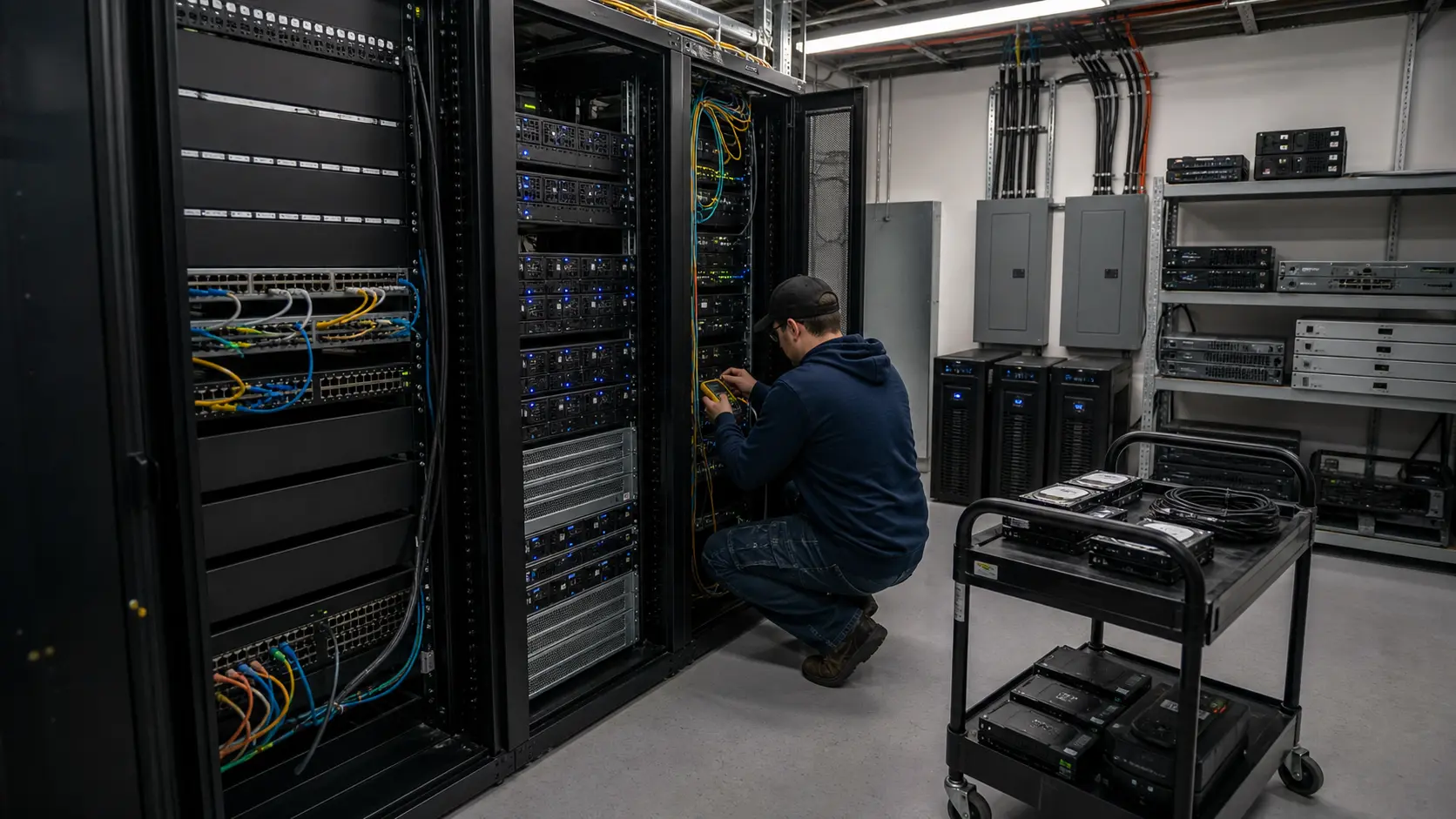
The assignment for this company asks whether hosted capacity depends on racks, transit and repair windows. The answer is yes, even though public sources do not disclose the exact racks. Internet routing is the path, not the platform. A small provider can announce prefixes cleanly and still have limited server inventory, one remote-hands path, one payment processor, one person handling tickets, a single upstream concentration, or no spare hardware in the room where the customer needs it.
If SIMPLE CLOUD SOLUTION LLC sells virtual servers, VPN nodes, bare-metal capacity, managed network endpoints or reseller hosting, the customer experience depends on a stack of physical and contractual dependencies. Servers need power, cooling and drive replacements. Routers need interfaces, optics and configuration control. Upstream transit needs contracts and credit standing. Exchange connectivity needs route-server compatibility and peering filters. DNS needs account access. Abuse desks need response times. Backups need separate storage. Migration needs documentation, images, exports and address-change planning.
None of those are visible from the RIPEstat route table. Route visibility can be excellent while a specific server is out of stock. RPKI can be valid while a disk array has no spare drives. An exchange port can be operational while customer VMs are somewhere else. A Cloudflare-protected homepage can load or block without telling the reader anything about the provider's own hosting network. An ARIN address record can be active while the actual customer service is manual, private, discontinued, experimental, or capacity constrained.
The public record does, however, give hints about the operating model. The company has direct ARIN resources and two ASNs. It has at least one exchange-facing presence. It uses Cloudflare for its public domain and Microsoft 365 for mail. It records a HaeImAlan Network brand in PeeringDB. It describes itself there as a small end-user ISP and MVNO in the United States and Taiwan. Those signals point to a network operator comfortable with BGP, IPv6 and public registry administration. They do not point to a conventional hyperscale cloud. The likely risk profile is small-provider infrastructure, not enterprise region failure.
Small-provider infrastructure can be perfectly useful. It may serve niche customers well, especially if those customers understand networking, need specific IPv6 routing, accept manual support, or value a particular geography or community relationship. The risk arises when buyers map the word "cloud" onto enterprise assumptions: instant replacement, multi-zone durability, broad spare pools, documented incident response, public status pages, audited controls and staffed support queues. Public evidence for SIMPLE CLOUD SOLUTION LLC does not support those assumptions.
That does not make the company weak. It makes the due-diligence target specific. Ask where the servers are. Ask whether the service is virtual, bare-metal, network-only or access-network related. Ask who owns the hardware. Ask whether power is redundant at the rack or only at the facility. Ask whether AS63008 and AS397968 are operationally independent. Ask which upstreams are paid transit, which are exchange peers and which are route-server paths. Ask which data can be exported, how quickly, and in what format. Ask whether a customer receives provider-assigned addresses that must change during migration.
In other words, the public route evidence is the start of the conversation, not the answer. It can support monitoring, threat modelling, procurement screening and dependency mapping. It cannot replace a service order, architecture diagram, support contract or tested recovery run.
The failure paths are ordinary, which is why they matter
The first failure path is facility access. PeeringDB tells us AS63008 appears at NRIX, and the exchange's PeeringDB record places the exchange in a Taipei facility context. But SIMPLE CLOUD SOLUTION LLC does not list a facility for its own network profile. If a customer workload depends on equipment physically near that exchange, the unknowns are practical: who has badge access, who can replace optics, how remote hands are ordered, whether after-hours support exists, how cross-connect faults are escalated, and whether the provider can move the workload during a building or cabinet event.
The second failure path is upstream concentration. RIPEstat saw four neighbours for AS63008 and one for AS397968. The neighbour count is not a full contract map; route collectors can see some relationships and miss others. Still, the AS397968 record is narrow in the public view. If that AS carries a customer-labelled route or a product class, a failure at the observed neighbour could matter. If AS63008 relies heavily on one exchange route-server path for IPv6, route-server policy, RPKI filters or exchange maintenance could matter. The customer needs to know whether paid transit, exchange peering and backup routing are actually diverse.
The third failure path is prefix policy. RPKI validity is good, but it also means route changes have to stay aligned with ROAs. If a prefix is moved to a backup AS or a different upstream without matching authorization, strict networks may reject it. That is a solvable operational task, but it must be managed during an outage. The public sources show valid origins for several current routes. They do not show the provider's emergency authorization process, who can change ROAs, or how fast a route can be moved.
The fourth failure path is address dependency. Customers that use provider-assigned addresses normally cannot take those addresses elsewhere. If a server on 23.169.168.0/24 or a network routed through AS397968 must be migrated, DNS, firewall rules, allow lists, certificates, mail reputation and abuse history may all need updates. If the service is IPv6-heavy, customers also need to know whether the destination provider can preserve prefix delegation or whether applications assume stable IPv6 addresses.
The fifth failure path is hardware stock. Nothing in the public record says how many servers, routers, switches, optics, power supplies, storage devices or spare machines the company has. A public AS can be run from a modest device. A VPS host needs compute and storage. A bare-metal offer needs spare machines. A network lab needs routers and remote access. Without public product pages or status pages, buyers cannot infer which hardware pool exists. If hardware fails, replacement time depends on inventory, access and money.
The sixth failure path is support depth. A small network operator can be technically skilled but still have thin staffing. PeeringDB points to a small end-user ISP and MVNO profile, not a large managed-services desk. The public domain uses Cloudflare protection, and the homepage was not directly readable from this review environment. No public support hours, escalation path, incident history, uptime commitment, service credits or repair target was visible in the reviewed material. That means customers should ask for explicit support terms before depending on the service for production workloads.
The seventh failure path is billing and continuity. Small providers sometimes operate through manual invoices, community arrangements, delegated network resources or private contracts. If payment, abuse handling or customer communication breaks, routing can be interrupted even when the hardware still works. The public record here does not provide a standard order form, cancellation terms or data-return commitment. For any hosted-capacity purchase, that missing contract layer is as important as the route table.
Installed capacity and usable capacity are different
The public route table can make a small provider look bigger or smaller than the customer experience. AS63008 has a visible IPv4 /24 and two visible IPv6 /48s. AS397968 has another visible IPv4 /24 and IPv6 /48. That is meaningful address space, especially for a young small network. But address space is not installed compute capacity. A /24 can support many small services, but it can also be mostly unused, delegated, reserved, filtered, or assigned to network infrastructure. A /48 can support many subnets, but it says nothing about the number of machines.
Installed capacity is the equipment the provider has under control. Usable capacity is the equipment that is powered, reachable, supportable, stocked with clean disks, assigned to a product, connected to appropriate upstreams and available under a contract the customer can rely on. A router can be installed but not suitable for customer traffic. A server can be powered but fully allocated. A prefix can be announced but not assigned to new workloads. A facility can host an exchange port but not customer compute.
This is why the PeeringDB no-facility record is so important. If the company listed multiple facilities and current exchange ports, we could at least map the public facility story. Instead, we can see the exchange connection but not the compute location. If the company ran a public order page with plans and stock, we could compare route evidence to commercial capacity. Instead, the public domain was not directly readable here. If the company published a status page, we could inspect incidents and maintenance notices. No public status page was found in the reviewed sources.
The absence of those details does not mean the company lacks capacity. It means the capacity is not publicly verifiable. A small operator may intentionally keep capacity private. It may sell by referral. It may serve a narrow community. It may operate access services rather than retail hosting. It may use cloud or colocation partners that are not disclosed. Each of those possibilities changes the risk model. Public evidence cannot choose among them.
For dependency mapping, the article therefore assigns different confidence levels. Identity confidence is high: ARIN and PeeringDB align on the company name and AS63008, and ARIN ties AS397968 to the same registrant. Current routing confidence is medium-high: RIPEstat sees announced routes and RPKI validates the key origins. Facility confidence is low: PeeringDB lists zero facilities for the company profile, even though the NRIX exchange has a Taipei facility context. Hosted-capacity confidence is weak: public sources do not disclose products, stock, server count, support terms or recovery commitments.
That confidence map is more useful than a yes-or-no label. It lets a reader use the positive evidence without overreading it. SIMPLE CLOUD SOLUTION LLC is visible as a network operator. It may sell or support hosted capacity. It cannot be treated as a public, fully documented cloud platform from the evidence available here.
Data locality is an unresolved operating question
Data-sovereignty analysis is especially difficult for small infrastructure companies because network geography, legal geography and data geography often diverge. SIMPLE CLOUD SOLUTION LLC's ARIN records place the legal registrant in Colorado Springs. PeeringDB lists the organisation city as Kansas City, Missouri. PeeringDB's network note mentions the United States and Taiwan. The NRIX exchange is in Taipei City. The public website resolves to Cloudflare addresses, and mail is handled by Microsoft 365. None of those facts alone tells a customer where application data, backups, logs or support access are located.
If the company provides access services or mobile-related services, traffic may traverse Taiwan without customer data being stored there. If it provides VPS or bare-metal service, the physical server location matters directly. If it routes customer networks, the customer's own equipment location may be separate from the AS holder. If it uses third-party hosting for management, tickets, billing, DNS or monitoring, those systems may introduce additional jurisdictions. The public sources do not give a complete data-flow map.
For a customer with locality requirements, "Global" service area should therefore be read as reachability, not storage. The Internet can reach a server from everywhere; that does not make the server global. A company can have a U.S. legal address, a Taiwan exchange port and Cloudflare fronting for a website. Data could still sit in one facility, in a rented server, in a customer's own environment or in an undisclosed third-party cloud. The only responsible public statement is that locality is uncertain.
That uncertainty has practical consequences. If an application must stay in the United States, the customer should require a written facility and backup-location statement. If an application needs Taiwan reachability, the customer should verify whether the service actually places compute near NRIX or simply routes there. If the workload handles personal data, the customer should ask who can access the server, where logs are stored, how abuse tickets are handled, and what subprocessors support the service. If the service depends on Microsoft 365 or Cloudflare for management surfaces, that should be included in the compliance map.
The address records also caution against simplistic locality labels. The 23.169.169.0/24 RDAP response shows a child record with a customer-style label and a Missouri location, while RIPEstat shows it announced by AS397968. The IPv6 2602:f9a9:102:: record shows HaeImAlan Network with a Missouri address in the child record. These records may reflect registration contacts, delegations or customer labels rather than actual server placement. They are evidence of administrative context, not proof of where every packet terminates.
That is why the best article posture is a watchpoint. SIMPLE CLOUD SOLUTION LLC has public network geography touching the United States and Taiwan. It has a company address in Colorado, an organisation city in Missouri, a domain protected by Cloudflare, and an exchange context in Taipei. None of that lets a buyer infer the storage location of hosted workloads. Data locality should be verified service by service.
What a customer should ask before relying on the service
A customer considering SIMPLE CLOUD SOLUTION LLC should start with the route evidence and then move quickly to operational proof. The route evidence is not the weak part. ARIN, RIPEstat and PeeringDB show enough to identify a real network. The weak part is the missing service layer. A buyer should ask for the service description in plain terms: VPS, bare metal, managed hosting, network transit, tunnel service, access service, mobile service, address routing or something else. Each service has a different dependency map.
The next question is facility. Where is the workload physically installed? Is it in a named data centre, a partner facility, a leased server, a remote colocation environment, an exchange-connected cabinet, a customer's own site or a third-party cloud? Who owns the hardware? Who can touch it? What is the remote-hands process? What is the expected repair time if a drive, power supply, router or optic fails? Are there spare machines or only best-effort replacement?
Then comes network diversity. Which AS carries the service? Is it AS63008 or AS397968? Which prefixes are used? Are there at least two upstream paths that can carry the service if an exchange path fails? Are route-origin authorizations already in place for emergency origin changes? Are route filters tested after changes? Does the provider rely on NRIX route-server connectivity for a critical path, or is there paid transit elsewhere? Is IPv4 availability the same as IPv6 availability?
Support terms matter just as much as routes. What hours are covered? How is a critical ticket escalated? Who monitors the network? Is there a public or customer status page? What incident history exists? What happens if abuse reports arrive after hours? What happens if a payment fails? How long is data retained after suspension or cancellation? Are support and billing handled by the same person? Can the provider give a customer a maintenance notice before route, facility or hardware work?
Migration terms are the final test. A customer should assume provider-assigned addresses will not move. That means DNS should be under customer control, backups should be outside the provider, deployment scripts should rebuild services elsewhere, and application secrets should not depend on one machine. If a workload uses IPv6 allocations under 2602:f9a9:: or IPv4 under 23.169.168.0/24, the customer should know how fast it can renumber. If the workload uses AS397968 through a customer-style delegation, the customer should know who controls the route and who can authorize changes.
None of these questions requires the company to be large. A small operator can answer them clearly and still be a good fit for a technical buyer. The point is that public sources do not answer them today. The public evidence gets a buyer to the door. The contract and proof have to do the rest.
The evidence grade is medium for routes and weak for resilience
SIMPLE CLOUD SOLUTION LLC deserves more than a dismissive "thin footprint" label. It has active ARIN resources, two visible ASNs, current RIPEstat route visibility, valid RPKI for key prefixes and a PeeringDB exchange record at NRIX. Those facts are stronger than many small hosting entries. They show a real network surface with current public reachability.
The same company also deserves a clear downgrade for hosted-capacity claims. The public website could not be directly read from this environment because Cloudflare returned a block page. PeeringDB lists no company facility. No public order page, server inventory, status dashboard, support SLA, incident archive, backup policy, hardware replacement policy or data-export policy was found in the reviewed material. The exchange record does not reveal compute location. The route records do not reveal customer count. The ARIN records do not reveal stock or repair windows.
The most useful final grade is therefore split. Network identity: strong. Current public route visibility: medium-high. Public facility evidence: weak. Public hosted-capacity evidence: weak. Public resilience evidence: weak. Overall network evidence grade: Medium, because the routing surface is real and current, but the public operating layer remains too thin to support an undowngraded cloud-service dependency rating.
For readers, the important takeaway is not that SIMPLE CLOUD SOLUTION LLC is unreliable. The public evidence does not prove that. The takeaway is that the network is visible while the service platform is opaque. A customer can monitor AS63008 and AS397968. A researcher can cite the ARIN, RIPEstat and PeeringDB records. A buyer should still demand proof of racks, transit contracts, power dependency, support escalation, spare hardware and migration rights before putting production workloads behind the company's hosted capacity.