
Summary
- Silicom says a new cloud-security customer has placed an initial order for a 5G-enabled edge device; annual revenue above $5 million is a full-ramp projection.
- Further Edge and GPU-based systems remain under evaluation. The commercial test is repeat deployment, not the number of platforms discussed.
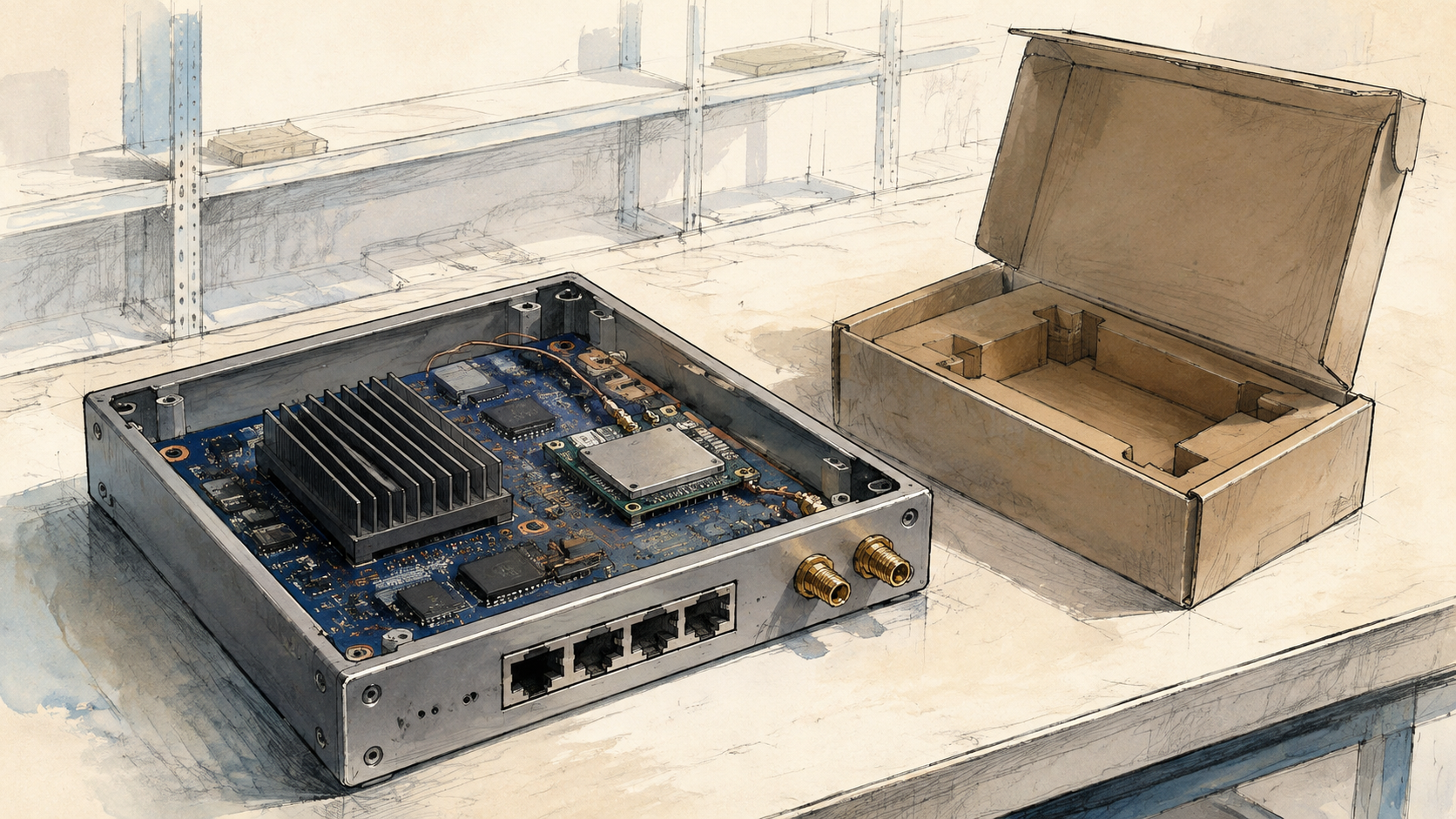
The first order matters more than the headline number. On 2 September, Silicom announced that an unnamed cloud-based cyber-security customer had chosen an edge networking device with integrated 5G and had already ordered it. The supplier expects the ramp to begin before the end of 2026. Its projection of more than $5 million in annual revenue applies after full ramp-up, for this device alone—not to the initial purchase or to a disclosed 2026 sales commitment. Silicom’s announcement gives neither a full-ramp date nor order quantities.
That distinction locates the bargaining power. Silicom has earned a place in a customer's hardware configuration; the customer still determines how quickly that configuration reaches deployment. A design selection narrows an engineering decision. It does not settle the pace of purchasing, the timing of shipments or the amount of revenue ultimately recognised. The initial order is evidence that the project has moved beyond evaluation, but its undisclosed size limits what can be inferred about scale.
Chief executive Liron Eizenman attributes the selection, following months of evaluation, to integrated cellular connectivity. This is the supplier's explanation, not a published customer comparison. The underlying commercial proposition is nevertheless intelligible: a cloud-delivered security service still needs a physical connection at the edge. Bringing cellular capability into the selected appliance can shift some integration work into the hardware qualification process. The release does not establish carrier approvals, SIM arrangements, failover behaviour or an availability guarantee.
This is also where the announcement's AI extension needs restraint. The customer is evaluating higher-end Edge platforms, including GPU-integrated systems. Those discussions may broaden the account; they do not constitute another award. A supplier can benefit from an established engineering relationship without every adjacent product becoming a purchase.
A superficially similar announcement shows why the unit of analysis should be the project, not the headline. On 26 May, Silicom described a white-label switch family selected by an unnamed cyber-security leader, with roughly $5 million of expected annual sales after ramp-up. That was a different product announcement. The disclosures do not establish whether the customers overlap, and the two forecasts should not be converted into a combined committed order book.
There is already a growing business underneath these prospective programmes. Second-quarter results released on 29 July reported revenue of $23.8 million, up 59% year on year, alongside a $2.1 million GAAP net loss. Those results predate the September announcement and cannot be credited to it. Management's $93 million–$95 million full-year revenue guidance was likewise a forecast, not a base to which every subsequent design-win estimate can automatically be added.
Silicom's opportunity is therefore more specific than an AI or 5G label suggests. Integrated connectivity can make a device easier to select as part of a security offering. Sustained revenue then depends on a less photogenic process: the customer repeatedly deploying the configuration it has chosen.
Member Briefing
Deeper Profile Context
Sign in with the right membership level to unlock the full briefing and source notes.
Only for Strategic Circle
Strategic Circle
Open to all readers. Unlock profile briefings after joining and signing in.
Join Strategic CircleOnly for Leadership Alliance
Leadership Alliance
For qualified IP-asset owners and management; sign in to unlock alliance briefings.
Join Leadership Alliance