
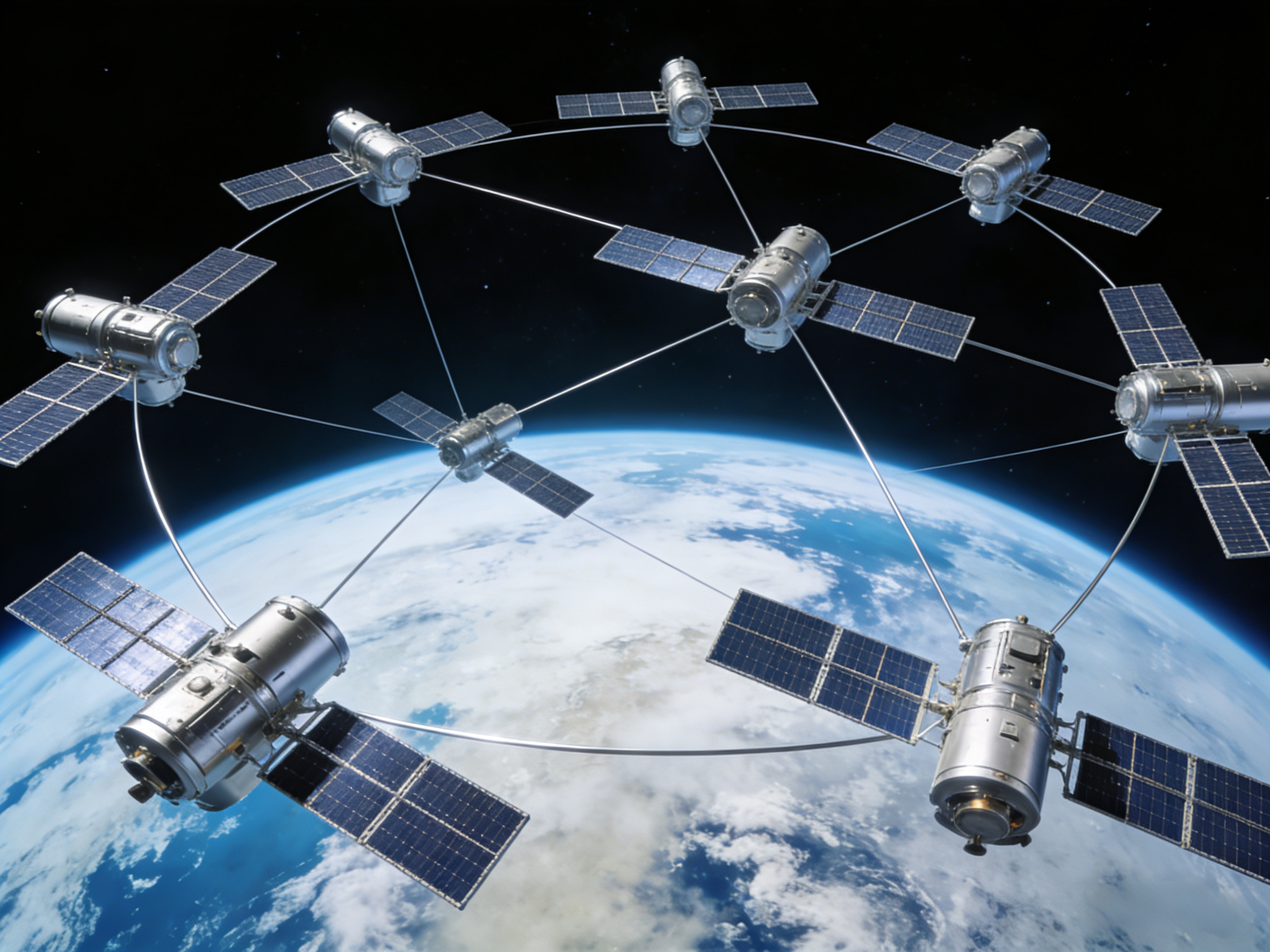
SES, a Luxembourg-based satellite operator, is planning to develop a new medium Earth orbit (MEO) constellation by 2030. This move is part of its broader multi-orbit strategy and aims to expand capacity and resilience in the global satellite connectivity market, which is seeing increased demand for low-latency, high-throughput services.
- On 24 March 2026 SES announced meoSphere, a next-generation MEO network targeted for operation in 2030, with an initial phase of 28 K2 Space satellite platforms.
- The announcement commits development work and 2026 capital, but it does not guarantee service in 2030: three years of pathfinder missions are intended to precede full-scale deployment.
An initial commitment, not an operating constellation
SES's 24 March announcement says it will deploy meoSphere by pairing software-defined payloads designed and manufactured in Luxembourg with 28 high-power K2 Space platforms. It calls those spacecraft the first phase of a network that can scale with demand. That is more than a research concept: SES has named a platform supplier, an initial architecture and funded development work.
The same release describes 2030 as a target and puts risk reduction ahead of full production. Over three years, SES plans several MEO pathfinder missions to test the bus, payload components and operating concepts in orbit. Proposed 5G non-terrestrial networking, optical inter-satellite links, new terminal sizes and pole-to-pole coverage are therefore design claims, not services available today.
What the disclosed capital supports
SES's first-quarter 2026 filing with the SEC places the first phase of meoSphere and IRIS² inside an aggregate 2026 capital-expenditure outlook of about €700 million. It does not allocate a meoSphere-only amount, disclose the network's full cost through 2030, or identify a separate board resolution that irrevocably authorises all 28 spacecraft and their launches.
The evidence supports two conclusions at once: SES has made a verifiable initial commitment, while full-constellation funding remains subject to milestones, demand and later decisions. The former article's estimated $4 billion cost for O3b mPOWER is not supported by the sources used here and is not a sound proxy for meoSphere.
O3b mPOWER is the network in service
Future and present capability must remain separate. O3b mPOWER became operational in April 2024, not 2023. SES then put six MEO satellites at roughly 8,000 km into service with an extensive ground system. By the first quarter of 2026, satellites 9 and 10 were serving customers while units 11 to 13 were scheduled for launch in the second half.
Those assets already deliver services from tens of Mbps to multiple Gbps. They demonstrate SES's operating experience in MEO; they do not demonstrate that meoSphere has been built or that its proposed terminals, optical links and multi-mission functions have passed acceptance.
The dependency chain to 2030
Design and manufacturing: K2 Space must industrialise the platforms, SES must complete and qualify its payloads, and the pathfinders must validate power, thermal control, propulsion, digital processing and operations. A weak result can change the design, schedule or first-phase scale.
Launch and authorisation: the spacecraft need launch contracts, slots and successful campaigns. Operation also requires spectrum, orbital coordination, earth-station licences and national landing rights. The FCC's SES–Intelsat order illustrates that fleets, stations and frequencies rest on specific licences and authorisations; it is not, by itself, an authorisation for meoSphere.
Network and customers: gateways, terminals, software, inter-satellite links, 5G-NTN integration, cybersecurity and country access arrangements must work as one system. Customer contracts and sufficient demand must then justify scaling beyond the first phase.
meoSphere is not IRIS²
SES says meoSphere will be compatible with IRIS². Compatibility does not make the programmes interchangeable. The European Commission describes IRIS² as a separate public-private SpaceRISE concession covering more than 290 spacecraft in several orbits and an associated ground segment. The initial 28 meoSphere platforms come from a separate SES/K2 announcement.
Evidence to watch
The useful milestones are public results from each pathfinder, bus and payload qualification, production contracts and cadence, spectrum and orbital filings, country licences, launch awards, gateway and terminal readiness, capital allocation and customer orders. Until those pieces converge, 2030 is a credible but conditional execution target.
Member Briefing
Deeper Trend Context
Sign in with the right membership level to unlock the full briefing and source notes.
Only for Strategic Circle
Strategic Circle
Open to all readers. Unlock trend briefings after joining and signing in.
Join Strategic CircleOnly for Leadership Alliance
Leadership Alliance
For operators, investors, and policy teams that need relationship evidence, failure paths, and source notes. Sign in to unlock.
Join Leadership Alliance