
Summary
- What it says: The Société Congolaise des Postes et Télécommunications, usually presented as SCPT SA or historically as OCPT, is best understood as a state infrastructure conversion problem.
- Main topic: Submarine cable infrastructure; Public-sector continuity; Registry governance; IPv4 scarcity economics
- Context: Infrastructure / Company research / Congo - Kinshasa
The Société Congolaise des Postes et Télécommunications, usually presented as SCPT SA or historically as OCPT, is best understood as a state infrastructure conversion problem. It is not just a postal company, not just a legacy telecom operator, and not a normal ISP. It sits at the intersection of three scarce asset pools in the Democratic Republic of Congo: national postal real estate, public telecom rights, and backbone/submarine-cable access. In a country where connectivity scarcity should be economically valuable, SCPT’s core question is not whether the state owns strategic infrastructure. It does.
The question is whether that ownership is being converted into cash flow, service quality, redundancy, customer trust and investable operating performance.
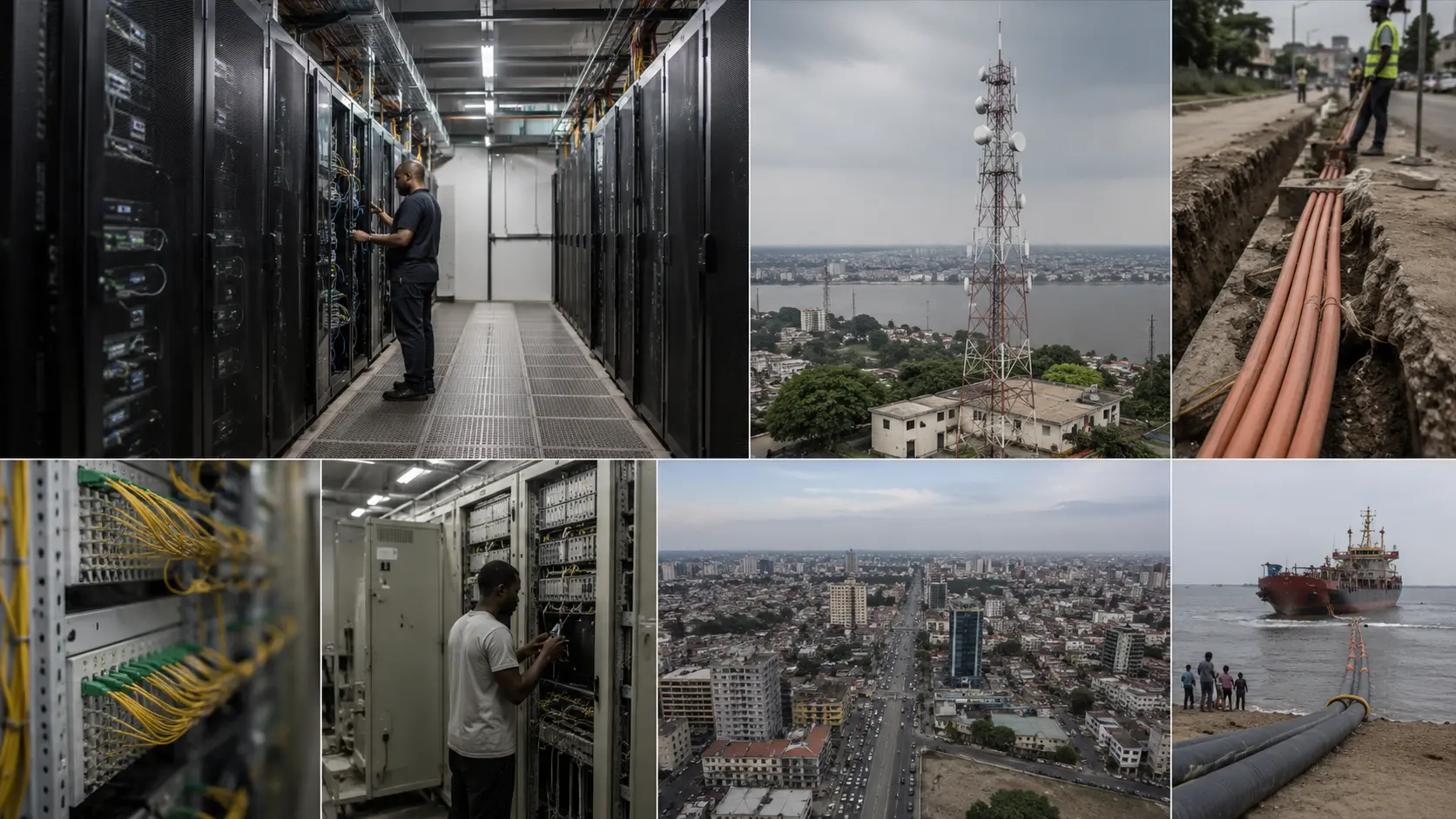
The answer from the public evidence is mostly negative, with important qualifications. SCPT is visible in official sources as the public postal and telecommunications operator, appears in regulator records as a national backbone operator, appears in routing data as AS37677, and is linked to the Muanda/WACS cable landing-station bottleneck that for years gave it strategic market power.
But the same evidence trail repeatedly shows the opposite side of the asset thesis: thin public retail product evidence, small visible internet-routing footprint, historical cable-defect and mismanagement allegations, World Bank concerns over SCPT’s governance and infrastructure-quality track record, delayed public backbone projects, private-operator workarounds, and new landing-station competition from 2Africa/Mawezi and potentially Liquid/Equiano-type routes. In economic terms, SCPT is a control asset whose monetisation has been impaired by execution risk.
The asset should be valuable
The DRC is the kind of market where neutral backbone infrastructure ought to be valuable. The country is large, under-fibred, logistically difficult, and increasingly data-driven. A 2026 market summary based on ARPTC data reported total DRC telecom-sector revenue of about $2.394 billion in 2025, with mobile internet generating about $1.287 billion, or roughly 53.8% of total sector revenue; the same summary reported 73.9 million active mobile subscriptions at the end of 2025, mobile penetration of 65.9%, mobile-internet penetration of 33%, and mobile-money active subscriptions of 34.3 million.
That means the growth pool is no longer legacy voice or traditional post. It is data, mobile financial services, applications and institutional connectivity.
The constraint is not demand alone. It is transport. RTI’s study of WACS and DRC connectivity estimated that WACS generated a 19% increase in GDP per capita by the end of 2017 through the economic activity catalysed by improved connectivity, and found that people in fibre-connected areas were 8.2% more likely to be employed. The same report stressed that the country’s major constraint was not only subsea capacity but the lack of a complete national fibre backbone capable of moving traffic inland. It described dependence on microwave and satellite backhaul as a source of higher latency, higher cost and weaker availability.
That is SCPT’s natural strategic opening. A state entity with postal real estate, public rights-of-way, a landing-station role, national-backbone status and official legitimacy should be able to sell wholesale capacity, dark fibre, colocation, government connectivity, enterprise access, postal-financial services and last-mile agency services. The problem is that these are not self-executing assets. Fibre only becomes an economic asset when it is lit, maintained, priced transparently, connected to demand nodes, trusted by operators, and protected by service-level performance.
Postal buildings only become economic assets when they are turned into distribution, payments, identity, e-commerce, public-service or telecom-service nodes with measurable throughput. A landing station only remains valuable if buyers cannot bypass it and if the operator is reliable enough not to trigger duplication.
Identity: the public operator, not a generic “SCPT”
The relevant company is the Société Congolaise des Postes et Télécommunications in Congo-Kinshasa, not similarly abbreviated entities elsewhere. SCPT’s official web presence describes OCPT/SCPT as the historical telecommunications operator, a “fournisseur de fournisseurs” and the designated public operator in the DRC, with the legacy OCPT created by ordinance-law in 1968. Its own site also shows service headings for EMS, real estate, post, Postefinance, Postemarket, telecommunications and Yeloo, although some product pages are thin or essentially placeholders.
State-control evidence is stronger than commercial-performance evidence. The Conseil Supérieur du Portefeuille lists “Société Commerciales des Postes et Telecom SCPT SA” as a public entity in the postal and telecom branch, next to SOCOF, the Société Congolaise de La Fibre Optique. The same official portfolio page describes the Conseil Supérieur du Portefeuille as the government technical body for monitoring and controlling public enterprises and managing state participations in mixed-economy companies.
The legal context matters because SCPT is a product of the DRC’s broader state-enterprise reform problem. Law No. 08/007 of July 7, 2008 said prior public enterprises had not achieved their economic and social objectives and needed reform to improve production, profitability and competitiveness. It provided for public enterprises to be transformed into commercial companies, public establishments/services, or dissolved; commercial companies in the market sector would be governed by ordinary law, with the state as sole shareholder in the relevant cases. The law’s own economic premise was that ownership without productive discipline had failed.
SCPT is a live test of whether that reform logic worked in telecom and post.
SCPT’s current public-facing leadership trail is visible but not sufficient for deep governance diligence. A 2025 SCPT page presents Sandra Tshibonge Mbiye as Directrice Générale of SCPT and associates her leadership with reinforcement of the national fibre network, Yeloo internet for homes, schools and SMEs, and extension of SCPT coverage across the 145 territories. That proves a public leadership representation and strategic language. It does not prove execution, customer numbers, revenue growth, asset condition or audited results.
The postal network is real, but the economics are not the old mail business
SCPT’s postal footprint is its most visible public-asset story. An official SCPT article says the postal network has 360 agencies across the national territory, and describes rehabilitation of postal buildings, interconnection of rehabilitated post offices to SCPT’s telecommunications network, relaunch of traditional postal services, postal-code work and financial-service relaunch efforts. That is a meaningful physical footprint in a country where formal distribution and addressing remain underdeveloped.
But the postal asset has to be valued as infrastructure optionality, not as a proven mail-profit engine. Traditional mail volumes are structurally weak in many emerging markets, and DRC’s geography makes branch maintenance expensive. ARPTC postal-observatory snippets indicate that SCPT had only 254 parcel shipments in the first half of 2024, representing 4.47% of that reported segment, then 4,493 shipments in the second half of 2024, representing 22.52%; a later 2025 snippet describes SCPT as the clear leader in local universal-service letters with nearly 60% share, while also noting very low volume.
The commercial signal is mixed: SCPT can retain share in a low-volume public-service niche, but the publicly visible figures do not yet support a high-throughput logistics valuation.
The rational monetisation path is therefore not nostalgia for a 1960s postal monopoly. It is conversion of branch real estate into multi-service points: postal relay counters, parcel pickup/drop-off, agency banking, government payments, SIM/telecom sales, identity or address services, e-commerce fulfilment, and enterprise/government connectivity. SCPT’s 2025 EquityBCDC memorandum fits that logic. SCPT said EquityBCDC would support modernisation of its payment infrastructure for postal and telecom services, targeting inclusion, financial support for SCPT and employee support.
That is commercially relevant because payments are one of the few scalable ways to monetise a national branch footprint without relying on mail volumes. But it remains an MoU/partnership announcement, not audited transaction volume.
The regulator classifies SCPT as a national backbone operator
The strongest regulatory evidence for SCPT’s telecom role is ARPTC’s operator register. In the postal section, ARPTC lists SCPT SA with a postal-exploitation entry shown as 2000-01-01 to 2050-01-01. In the telecom section, ARPTC lists SCPT SA under “Opérateur de Backbone National,” with fibre-optic technology and wholesale services described as sale of dark fibre, sale of capacity and hosting infrastructure. It lists SOCOF, Liquid Telecom DRC and Bandwidth and Cloud Services DRC in the same national-backbone category.
This is commercially important and frequently misunderstood. A regulator listing proves authorisation/category and permitted service type. It does not prove that SCPT has a functioning national network with high utilisation, strong uptime, transparent tariffs, or meaningful market share. The same ARPTC register shows many licensed internet-access providers, including Orange, Airtel, Vodacom, Africell, Liquid, GVA, C-Squared and others, and lists mobile telephony separately with the large MNOs. SCPT’s economics depend on selling wholesale inputs into this ecosystem, not on being the main retail mobile-data beneficiary.
The category matters because wholesale backbone is a fixed-cost, utilisation-sensitive business. Once fibre and landing-station equipment are installed, incremental data transport can be high-margin, but only if buyers trust the route and if capacity is easy to buy, activate and maintain. If MNOs and ISPs doubt quality or access terms, they build alternative routes, lease from private operators, use regional terrestrial links, or support new submarine landing stations. That is exactly the failure mode visible in DRC’s backbone history.
The internet-routing footprint is visible but small
SCPT’s public internet resource evidence confirms that it is not merely a paper postal entity. BGP data identifies AS37677 as “Societe Congolaise des Postes et Telecommunications (SCPT),” with AFRINIC registration, CD country information, SCPT address details in Kinshasa, and routed prefixes. BGP.tools classifies the network as an active government network and shows a small visible footprint: five IPv4 prefixes and no IPv6 originated in the page view summarised during research, with upstream/peer relationships including Congo Telecom, AFR-IX, Interfiber, UNLIMITED and ATOS.
The commercial interpretation is narrow but useful. BGP visibility proves that SCPT has internet number resources and participates in global routing. It does not prove the scale of its terrestrial fibre, landing-station utilisation, customer base, physical network condition, service-level performance, or revenue. In fact, the small visible routing footprint is not consistent with a large retail ISP at the centre of national data growth.
It is more consistent with a public operator whose strategic assets are mostly wholesale, infrastructure and institutional, while the large retail data-revenue pool is captured by mobile operators and private ISPs.
There are also tiny but useful customer/counterparty hints in routing data. BGP.tools shows AS6 ATOS as downstream of AS37677, and search results show UNLIMITED SARL using AS37677 as an upstream. These are market-signal clues, not signed-contract evidence. They imply that SCPT can provide routed connectivity to at least some counterparties, but they do not quantify revenue, contract duration, SLA quality or payment reliability.
WACS made SCPT strategically important; 2Africa makes it less protected
The highest-value SCPT asset historically was not the post office. It was the Muanda cable-landing bottleneck. A COMESA Competition Commission decision on the 2Africa/Mawezi transaction recorded that DRC had only one submarine cable landing, WACS, and that SCPT, as owner of the landing station, had held an effective monopoly and 100% share in cable landing-station services in the DRC. The decision expected the new JVCo/Mawezi landing-station entry to introduce competition and give MNOs and ISPs an alternative supplier.
That is the clearest example of the asset-owning fallacy. A 100% landing-station share is strategic control, but it is not automatically durable monopoly profit. If the bottleneck is unreliable, expensive, politically difficult or operationally slow, customers lobby for alternatives. In September 2023, Orange DRC and Airtel Congo RDC announced that the 2Africa cable had landed off Muanda through their joint venture Mawezi RDC SA, with Mawezi responsible for authorisations, station construction and open-access station operation so other internet players could use the additional international capacity.
By January 2026, Connecting Africa reported that WACS was one of two international submarine cables providing DRC connectivity and that 2Africa had gone live in December 2025.
WACS remains important but no longer looks like an unassailable rent source. A January 2026 WACS technical failure caused internet disruptions in the DRC, according to Connecting Africa, and the same report noted presidential pressure for operators to address recurring disruptions and potential sanctions if quality, continuity, coverage or user-protection criteria were not met. This is commercially damaging to any infrastructure owner because outages convert redundancy from a luxury into a purchasing requirement.
Liquid’s earlier licence also shows the same pressure. In 2020, ARPTC granted Liquid Telecom a licence for a second submarine landing station; industry reporting described DRC as having only one WACS landing at that time, noted WACS damage in January 2020 and said SCPT had held an effective monopoly in the sector. Liquid’s DRC terrestrial backbone and its likely connection to Equiano-type international capacity represented a direct challenge to SCPT’s bottleneck value, even before the 2Africa landing became operational.
The Chinese-financed backbone shows the debt-service problem
SCPT’s backbone story is inseparable from Chinese financing and vendor execution. AidData records a China Eximbank RMB 1.513 billion government concessional loan for Phase 2 of the national fibre-optic backbone project, signed in November 2011, with a 20-year maturity, five-year grace period, 1% fixed interest and a 0.75% commitment fee. The project purpose was to lay about 3,250 km of fibre along Kinshasa–Bandundu, Kinshasa–Mbuji and Mayi–Lubumbashi–Sakania sections, with CITCC as contractor. Crucially, the loan was collateralised by fees paid by users of fibre-optic infrastructure into a lender-accessible escrow account.
That collateral structure reveals the intended economics. The state was not just buying symbolic sovereignty. It was supposed to build a fee-generating infrastructure asset. User fees were expected to service the financing. If the network is delayed, defective, underutilised, badly maintained, politically blocked or bypassed, the economics deteriorate quickly: debt remains fixed while usage revenue underperforms.
Reuters reported in 2015 that a parliamentary mission had found millions of dollars misused in the first phase of the national fibre project.
The article said construction by SCPT and CITCC began in 2012 and was partly financed by China Exim Bank; it described the first Kinshasa–Muanda phase as costing about $70 million and said the mission report cited serious irregularities, including alleged withdrawal of at least $3.4 million intended for a landing station by beneficiaries “not directly linked to the project,” and allegations that the government paid more than double the standard rate for cables that were defective and unsuitable for underground use. Reuters also reported that the mission said mismanagement caused long delays and unreliable connections.
These are allegations and parliamentary-mission findings reported by Reuters, not a final commercial audit of SCPT’s current condition. But they are directly relevant to asset-quality and governance risk.
VOA’s 2012 reporting gives the earlier operating context. It reported that DRC had missed WACS connection deadlines; local sources said the Muanda–Kinshasa fibre had already been underground for years but could not be connected because the state had to approve, pay dues and build a landing station; local media reported the landing station was not built to standard, that $3 million had gone missing, and that a former SCPT director-general had been charged and jailed for three months in connection with the affair.
The same report quoted a union representative opposing a private Congo Cable structure and saying employees were owed years of back pay, while Microcom’s founder argued SCPT needed competent private-sector partners to install and maintain fibre. These are contemporaneous press and stakeholder signals, not conclusive proof of current liabilities, but they explain why private counterparties discount SCPT execution risk.
World Bank evidence: SCPT was too weak to be the backbone vehicle, then too important to ignore
The World Bank’s CAB5 implementation report is the most important institutional source because it explicitly links SCPT to the DRC’s execution problem. It notes that WACS was the only international submarine cable link landed in DRC at the time of the report, that SCPT’s Muanda–Kinshasa cable performance was widely considered substandard due to installation-related defects, and that a 2015 parliamentary mission alleged the cables were unsuitable for underground use. It also notes that private operators Airtel, Vodacom and Liquid invested in SNEL’s fibre because the national network faced major technical issues due to poor maintenance.
World Bank project design tried to solve the problem by creating SOCOF, a separate public fibre entity. The ICR says establishing SOCOF was justified because SCPT could have managed and operated the new fibre infrastructure but had governance issues and a poor track record in management and ensuring high-quality infrastructure standards; the government still wanted fibre ownership to remain public. That sentence is the centre of the SCPT investment case: SCPT owned or controlled assets that mattered, but the institution was not trusted as the operating vehicle for high-quality public backbone delivery.
The SOCOF workaround then created its own contradictions. The World Bank said the project tried to help SCPT remedy defects in its existing Muanda–Kinshasa link while also creating a new PPP structure that would build links, including another Muanda–Kinshasa link, effectively in competition with SCPT. The report called that strategy unattractive to SCPT and noted that even a restructured SCPT would remain in the broadband backbone business and remain responsible for at least 4,000 km of fibre already installed or being installed.
In other words, the state could not simply replace SCPT without creating political and asset-coordination friction.
Execution delays then weakened the value proposition. A 620 km SOCOF Kinshasa–Muanda link was completed in 2020 but was not operational because the PPP contract was pending and the link was not connected to the Muanda landing station. Meanwhile, Vodacom and Airtel built an additional Muanda–Kinshasa fibre link in 2021 connected to SCPT’s landing station, reducing near-term chances that they would use the SOCOF link. The World Bank noted that if access to SCPT’s Muanda landing station was blocked, the SOCOF concessionaire might commercialise via Angola.
This is the economic cost of poor coordination: parallel public assets, private duplication and external bypass routes.
The World Bank report also records fiduciary problems at CAB5/SOCOF level: financial-management risk was raised to high, audits were delayed, internal control weaknesses were identified, and a 2021 in-depth audit identified $1.714 million of questionable expenditures, which SOCOF management rejected; another review found $135,843 of ineligible expenditure and transactions with insufficient supporting documentation. This is not an SCPT-specific allegation. It matters because it shows that simply moving assets from SCPT to another public vehicle does not remove the DRC public-infrastructure execution problem.
The market is moving around SCPT
Private and quasi-private infrastructure has been filling the gaps. ARPTC lists Liquid, SOCOF and BCS alongside SCPT as national backbone operators, and lists multiple metropolitan-infrastructure and ISP competitors. That means SCPT is no longer the only formal fibre actor in the market. It may still own historically strategic assets, but its customers have alternatives in major corridors and cities.
Industry reporting in 2021 said SCPT signed a $35 million infrastructure modernisation agreement with LMS Holding, including a planned 3,000 km Muanda–Sakania fibre link via Kasumbalesa and Kinshasa, extension of SCPT’s backbone from Bukayu to Kasindi through Beni, Butembo and Goma, international links to Rwanda and Uganda, a 100 Gbps upgrade of the Muanda landing station, and fibre-access networks in several eastern cities. That is a potentially important plan, but the source trail visible here supports the announcement, not completion, utilisation or revenue.
A 2021 local press communiqué similarly said SCPT and Egypt’s BENYA had signed a contract for fibre-optic construction across the DRC, and described SCPT as operating postal, telecom, digital and financial services with more than 360 points of presence. Again, the commercially relevant signal is ambition plus partner-seeking, not verified delivery. In a weak-execution environment, announced kilometres are not bankable kilometres.
The DRC government is still launching or discussing new backbone ambitions outside a clean SCPT-only model. In June 2026, ACP reported a memorandum with China’s Genew Technologies for a fibre project along the Congo River and its tributaries, including 1,700 km of riverbed fibre from Muanda to Kisangani and about 400 km of terrestrial landing/junction links, with a reported total project cost of $1.5 billion and more than $400 million for the first phase. It also cited ARPTC first-quarter 2026 penetration figures: mobile penetration 66%, fixed network penetration 0.7%, mobile money 30.4%, and internet 43%.
Separately, 2026 reporting said the government was preparing an award procedure for an 11,500 km national fibre network, while a 2024 article citing ARPTC end-2023 data said DRC had installed about 9,600 km of fibre out of 50,000 km initially planned, or roughly 19%. Those numbers should be treated as media summaries of regulator/government material, not audited engineering inventory. Their economic meaning is still clear: the country is far from fully fibred, and the state is still trying to solve backbone scarcity through new programmes rather than merely monetising SCPT’s existing assets.
SCPT’s services: broad menu, limited proof of commercial depth
SCPT’s own web navigation and communications present a broad menu: EMS, post, real estate, Postefinance, Postemarket, telecommunications, Yeloo, and “ON” internet. A 2025 page says Yeloo targets homes, schools and SMEs, while the official telecommunications page visible in this research contained little beyond the page title and site footer. This is not a trivial detail. For a retail ISP or enterprise connectivity seller, weak public product pages are a commercial signal: pricing, coverage, SLA, support channels, installation process, business offers and customer proof are not clearly visible from the public website trail reviewed here.
The same applies to real estate. “Immobilier” appears in SCPT’s site navigation, and the postal network is described as having 360 agencies, but there is no public, reusable asset register in the source trail showing property titles, occupancy, rent roll, redevelopment concessions, maintenance backlog, encumbrances or valuation. SCPT may have a valuable national property footprint; it may also have a high-cost, under-maintained branch base. Without a rent roll and condition survey, real estate is not an asset value. It is an option with unknown capex.
SCPT’s satellite ambitions should be read similarly. A 2023 SCPT article said Monacosat and Congolese state telecom actors, including SCPT and Renatelsat, discussed a proposed public-private partnership for a 30 Gbps satellite over 15 years, evaluated at €120 million, with the satellite positioned as complementary coverage where fibre cannot reach. The same article said the project was still in the project phase and that the ball was with the government for signing a protocol of agreement. That is a pipeline signal, not a financed, launched or revenue-generating satellite business.
Customers and counterparties: evidence exists, but revenue visibility does not
SCPT’s natural customer base is not the mass consumer first. It is MNOs, ISPs, government, banks, public-service institutions, enterprises, postal customers and potentially international capacity buyers. Reuters reported that telecom companies connected to the backbone included Tigo, Vodacom, Airtel and MTN. BGP data shows routing relationships with ATOS and others. ARPTC classifies SCPT’s national-backbone services as wholesale dark fibre, capacity and hosting infrastructure. These sources support the conclusion that SCPT can be a wholesale/counterparty infrastructure provider.
They do not support any conclusion about revenue concentration, contract profitability, receivables quality, uptime or churn.
Key suppliers and partners include CITCC/China Eximbank for the national backbone, LMS Holding for a reported 2021 modernisation plan, BENYA in a 2021 fibre-construction announcement, EquityBCDC in the 2025 payment-infrastructure MoU, and Monacosat in the 2023 satellite PPP discussion. Key competitive or system counterparties include SOCOF, Liquid, BCS, Mawezi/2Africa, Orange, Airtel, Vodacom, Africell, and the regulator ARPTC. This is not a normal corporate supplier list; it is a public-infrastructure web. SCPT’s performance depends as much on interconnection governance, state coordination and political economy as on selling products.
The absence of audited public financials in this source trail is decisive. There is no reliable public revenue split by post, telecom, real estate, wholesale capacity, retail internet, financial services or government contracts. There is no public EBITDA, capex, debt-service schedule, staff-cost ratio, arrears schedule, receivables ageing, or SLA performance dashboard. The only defensible valuation stance is therefore asset-by-asset and contract-by-contract, not enterprise-wide optimism.
Unit economics: where value should appear, and where it leaks
SCPT’s wholesale backbone unit economics should be attractive in theory. Fibre has high upfront capex and maintenance cost, but low marginal cost per additional unit of traffic once lit. Revenue should come from IRUs, dark-fibre leases, managed capacity, colocation, landing-station access, interconnection, government networks and enterprise circuits. The financial model works when utilisation is high, uptime is credible, pricing is transparent, receivables are collected, and the operator reinvests enough to keep the route reliable.
The leakage points are visible. Defective or poorly maintained fibre raises repair cost and reduces uptime. Slow access to a landing station reduces customer willingness to depend on the route. Monopoly pricing creates political and competitive pressure for alternative landings. Procurement opacity and public-enterprise governance increase counterparty risk. If large mobile operators build their own Muanda–Kinshasa link, support Mawezi/2Africa, or lease from Liquid/BCS/SOCOF, SCPT’s theoretical scarcity rent is arbitraged away. World Bank and COMESA evidence shows these dynamics are not hypothetical.
Postal unit economics are different. Branches are fixed-cost nodes. They require staff, security, maintenance, cash handling, transport and technology. They become profitable only with high transaction density. Low-volume letters and parcels cannot carry the network. The right economic question is therefore: how many monthly transactions per branch can SCPT generate across payments, parcels, government services, agency banking, telecom sales and connectivity? The EquityBCDC partnership is directionally rational because financial transactions are higher-frequency than letters, but the evidence does not yet prove throughput.
Retail internet unit economics are the weakest visible case. SCPT’s Yeloo/ON narrative suggests consumer and SME ambitions, but the public evidence does not show subscriber count, ARPU, coverage map, installed base, churn, customer support quality or customer reviews at scale. In a country where MNOs dominate data usage and ISPs compete in fixed broadband, SCPT retail access is not investable on public evidence alone. It may be strategically useful as a service layer over public assets, but it is not yet demonstrated as a scalable retail business.
Ownership/control is a strength only if the state separates policy from operations
SCPT’s public ownership gives it legitimacy, access to public assets and potential government anchor demand. The DRC’s public-portfolio framework also gives the state tools to control and reform it. But state ownership is not a substitute for operating discipline.
A 2024 government briefing on public enterprises said 29 public enterprises and more than 89 mixed entities fell within the state portfolio, and that the quasi-totality of these enterprises had recorded negative performance over the prior three years because of insufficient governance and management not aligned with standards; it also cited debt accumulation, litigation and underexploited assets. This was not an SCPT-only diagnosis, but it describes the system in which SCPT operates.
The economically correct model is not “privatise everything” or “state keeps everything.” The first-principles model is to assign each function to the party with the right incentive and capability. The state should own or regulate scarce strategic corridors where sovereignty and open access matter. Operations, maintenance, sales and customer service should be performed under measurable contracts by entities with technical capability and financial consequences for failure.
Tariffs should be transparent; access should be non-discriminatory; revenues should be ring-fenced where debt service depends on usage; and asset condition should be independently audited. Without that, SCPT remains a symbol of control rather than a platform for productivity.
Competitive position: strategic but eroding
SCPT’s strengths are specific. It has official status, legacy public identity, postal reach, a regulator-recognised national-backbone role, historic landing-station control, public-rights logic, and a plausible route into government connectivity and financial-inclusion services. It is also embedded in the state’s broader digital-sovereignty narrative.
Its weaknesses are more commercially important. Public evidence does not show audited profitability or telecom-scale growth. BGP evidence shows only a small visible routing footprint. Historical execution evidence is poor. Public project announcements outnumber verified completion metrics. The landing-station monopoly is being diluted by 2Africa/Mawezi and potential Liquid-type alternatives. Large MNOs have the balance sheet and incentive to bypass weak public routes. ARPTC’s own register shows multiple backbone, ISP and metropolitan-fibre competitors.
The category recommendation is therefore: strategic state-infrastructure conversion risk; not a standalone growth telco on public evidence. For an investor, lender, vendor or large customer, SCPT should be engaged only through ring-fenced projects with audited assets, clear tariff schedules, enforceable SLAs, escrowed or directly collected revenues, independent technical monitoring, and step-in rights where possible. For policymakers, the priority is not another announcement of kilometres. It is monetisation of existing assets: publish open-access terms, settle interconnection disputes, audit fibre condition, connect landing stations, use post offices as payment and public-service nodes, and stop treating strategic ownership as equivalent to service delivery.
Evidence ledger
SCPT official website / OCPT home — https://www.scpt.cd/ — official company source. Supports identity as historical public telecom/post operator and service positioning. Does not prove audited performance, customer numbers or asset condition. Economically important because it frames SCPT as a “provider of providers,” not merely a post office.
Conseil Supérieur du Portefeuille company list — https://csp.cd/entreprise/liste-des-entreprises — official state-portfolio source. Supports SCPT SA as a public postal/telecom enterprise and SOCOF as another public fibre entity. Does not prove ownership percentages beyond the displayed public/portfolio classification. Economically important because SCPT must be analysed as a state-portfolio asset.
Law No. 08/007 on transformation of public enterprises — https://www.leganet.cd/Legislation/Droit%20Public/EPub/loi.08.007.7.07.2008.pdf — legal/public-sector reform source. Supports the DRC reform logic: public enterprises failed objectives and were to be transformed into commercial companies, public establishments/services or liquidated. Does not identify SCPT’s current audited governance. Economically important because it shows the policy problem predates SCPT’s current management.
ARPTC Solution operator register — https://www.arptc-solution.cd/ — regulator database. Supports SCPT as a postal operator and national-backbone operator selling dark fibre, capacity and hosting infrastructure; also identifies competitors SOCOF, Liquid and BCS. Does not prove actual traffic, uptime, revenue or contract quality. Economically important because licence category is necessary but insufficient.
BGP.tools / AS37677 — https://bgp.tools/as/37677 — public routing intelligence. Supports SCPT’s ASN identity, routed-prefix visibility and upstream/peer/downstream signals. Does not prove physical fibre extent, landing-station utilisation or revenue. Economically important because the visible internet footprint looks small relative to SCPT’s strategic claims.
COMESA Competition Commission decision on 2Africa/Mawezi — https://comesacompetition.org/wp-content/uploads/2023/11/CID-Decision-CCC-MER-08-26-2023.pdf — competition-authority merger decision. Supports SCPT’s historic 100% effective monopoly in DRC cable landing-station services and expected dilution by new entry. Does not prove monopoly profit or current post-2Africa market share. Economically important because it distinguishes bottleneck control from durable monetisation.
World Bank CAB5 Implementation Completion Report — https://documents1.worldbank.org/curated/en/271291649102938232/pdf/Eastern-Africa-Central-African-Backbone-SOP5-Project.pdf — multilateral project evaluation. Supports evidence of SCPT’s historical governance/infrastructure-quality concerns, SOCOF workaround, Muanda–Kinshasa link issues and PPP delays. Does not prove SCPT’s current management performance after the report. Economically important because it explains why public fibre ownership did not translate cleanly into working national backbone.
AidData China Eximbank Phase 2 backbone project — https://china.aiddata.org/projects/19149/ — development-finance database. Supports China Eximbank loan terms, CITCC role, 3,250 km phase and user-fee collateral/escrow structure. Does not prove current network condition or fee collection. Economically important because the financing assumed monetised infrastructure usage.
Reuters 2015 parliamentary-mission report coverage — https://www.reuters.com/article/markets/commodities/millions-misused-in-congo-fiber-optic-line-construction-report-idUSL5N0YB39S/ — international press based on parliamentary mission. Supports allegations of misuse, defective cables, delays and unreliable connections in the first fibre phase. Does not prove final judicial outcome or current SCPT condition. Economically important because it is a hard execution-risk signal.
VOA 2012 WACS delay coverage — https://www.voanews.com/a/dr-congo-misses-deadline-for-high-speed-internet/1084751.html — contemporaneous press and stakeholder commentary. Supports early landing-station delay, standards concerns, employee/back-pay signal and private-partner debate. Does not prove current liabilities. Economically important because it shows the political economy of public control versus competent operation.
RTI economic-impact study on WACS and DRC broadband — https://www.rti.org/publication/economic-impacts-submarine-fiber-optic-cables-broadband-connectivity-democratic-republic-congo/fulltext.pdf — research/economic analysis. Supports the macroeconomic value of connectivity and national-backbone scarcity. Does not value SCPT or prove SCPT captured WACS-driven gains. Economically important because it quantifies why the asset should matter.
Bankable Africa ARPTC/BDO 2025 telecom-market summary — https://bankable.africa/actualites/numerique — market press summarising regulator/BDO data. Supports 2025 telecom revenue, mobile-internet revenue share, subscriber counts and QoS concerns. Does not replace the raw ARPTC report. Economically important because it identifies where telecom profit pools are moving: mobile data and mobile money.
MarketScreener/APO 2Africa/Mawezi landing announcement — https://www.marketscreener.com/quote/stock/AIRTEL-AFRICA-PLC-61661826/news/Orange-DRC-Airtel-Congo-RDC-have-landed-the-2Africa-submarine-cable-in-the-Democratic-Republic-of-44897733/ — company/industry press distribution. Supports 2Africa landing in Muanda through Mawezi and open-access station intent. Does not prove realised traffic or pricing. Economically important because it weakens SCPT’s landing-station scarcity premium.
Connecting Africa 2026 WACS outage report — https://www.connectingafrica.com/connectivity/wacs-submarine-cable-outage-disrupts-drc-internet-access — industry press. Supports WACS outage/disruption, 2Africa live status, and regulatory/presidential QoS pressure. Does not prove SCPT fault for the outage. Economically important because outages increase buyer willingness to pay for redundancy and alternatives.
SCPT–EquityBCDC official announcement — https://scpt.cd/web/2025/06/25/accord-strategique-entre-la-scpt-et-equitybcdc/ — official company announcement. Supports payment-infrastructure and inclusion partnership intent. Does not prove implementation, transaction volumes or profitability. Economically important because payment rails are a plausible way to monetise postal real estate.
ACP Genew river-fibre MoU report — https://acp.cd/economie/rdc-chine-signature-dun-memorandum-pour-le-deploiement-de-1700kms-de-fibre-optique/ — official Congolese press agency report. Supports 2026 state backbone ambitions outside a simple SCPT-only model. Does not prove financing close, construction or future integration. Economically important because DRC is still seeking new backbone solutions instead of relying solely on existing SCPT assets.
Watchpoints
Track ARPTC’s conversion of operating titles under the newer telecom legal framework and verify SCPT’s exact current authorisations, expiries, renewal conditions and open-access obligations.
Monitor AS37677 monthly: originated prefixes, IPv6 adoption, upstreams, downstreams, RPKI/ROA status, route stability and any new interconnection that would indicate real wholesale growth.
Obtain SCPT audited financials or Ministry of Portfolio performance reports: revenue by segment, payroll, debt, arrears, receivables ageing, capex, litigation, property income and telecom wholesale revenue.
Verify the physical condition and commercial status of SCPT’s Muanda–Kinshasa assets: lit capacity, outage history, O&M contractor, repair backlog, SLA compliance and customer list.
Watch Mawezi/2Africa pricing and access terms. If MNOs and ISPs shift traffic materially to 2Africa, SCPT’s WACS landing-station scarcity value falls.
Track Liquid, SOCOF and BCS backbone routes, especially any Angola, Rwanda, Uganda or Zambia interconnects that reduce dependence on SCPT-controlled corridors.
Follow the 11,500 km national-fibre tender and the Genew river-fibre MoU: ownership model, concession terms, operator, financing source, escrow, route overlap with SCPT, and integration with existing assets.
Check whether the SCPT–EquityBCDC MoU becomes operational: number of post offices connected, transaction volume, agent liquidity, fraud controls, fee split and integration with Postefinance.
Audit the 360-agency postal footprint: titled versus occupied properties, condition, rent roll, redevelopment rights, operating cost per branch and transaction density.
Monitor labour disputes, wage arrears and court attachments against SCPT assets. Any unresolved social debt can turn real estate and cash accounts into contested collateral rather than monetisable infrastructure.
Track SCPT’s Yeloo/ON retail internet evidence: coverage maps, tariffs, installation lead times, subscriber counts, churn, enterprise references and public complaints.
Look for public procurement notices involving SCPT, SOCOF, ARPTC, the Ministry of Posts/Telecoms, FDSU and donor programmes. Procurement language often reveals whether SCPT is operator, beneficiary, asset owner or bypassed incumbent.
Verify whether the LMS, BENYA and Monacosat announcements produced signed financing, delivered assets, activated capacity or only public-relations optionality.
The decisive intelligence lead is simple: find one SCPT asset that is independently verified, technically working, commercially contracted, cash-collecting and protected by enforceable service obligations. Without that, SCPT remains a strategic infrastructure owner with weak evidence of monetisation.