
Summary
- Sage Weil developed Ceph as part of a collaborative research programme at the University of California, Santa Cruz, completing a 2007 doctorate after the foundational Ceph and CRUSH papers appeared in 2006.
- CRUSH calculates placement from cluster maps, weights, topology and rules rather than relying on a central lookup table; RADOS distributes object storage, replication, failure handling and recovery across monitor and OSD roles.
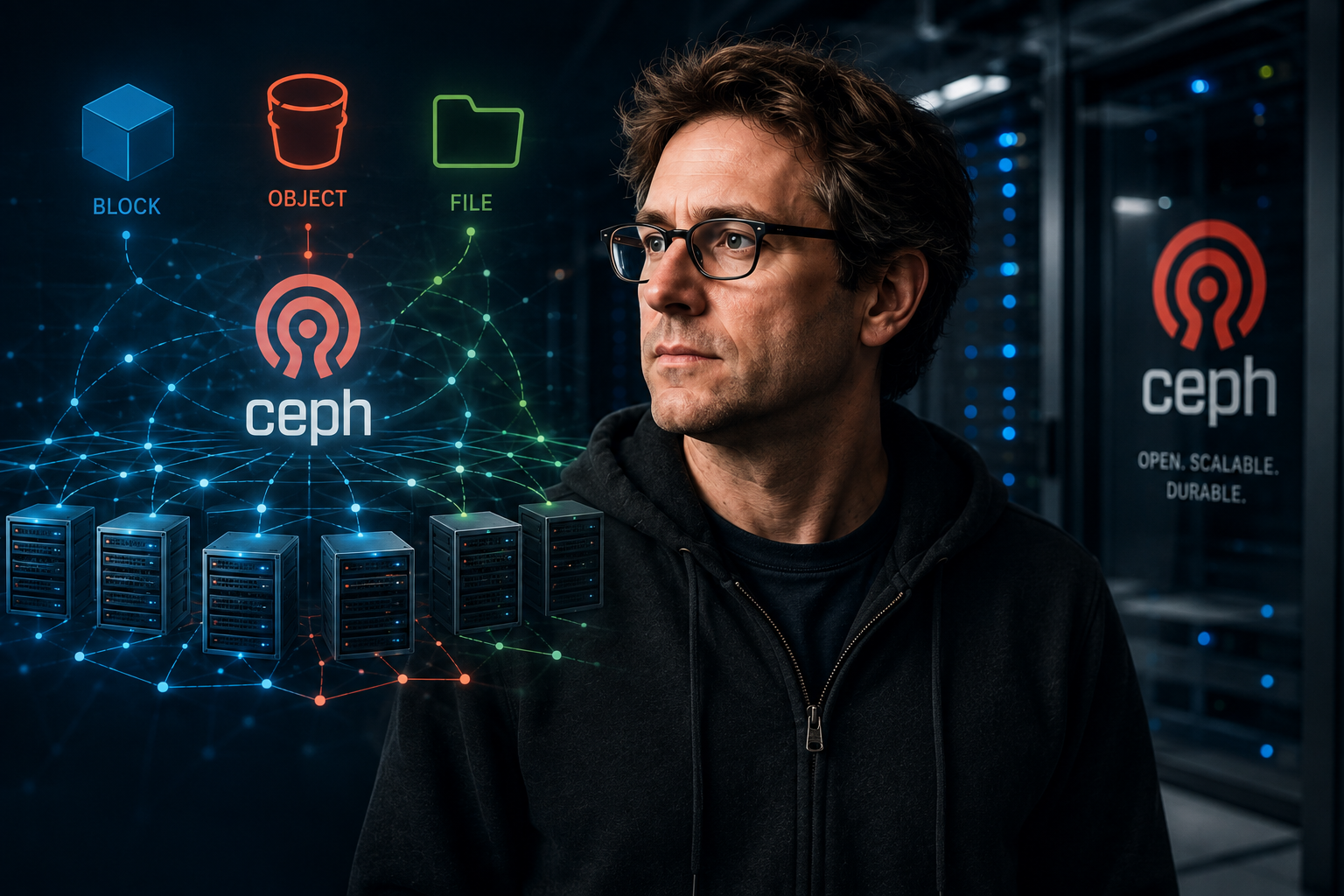
- Ceph exposes block storage through RBD, object storage through RGW and a POSIX-style filesystem through CephFS, all above the same distributed object substrate but with different metadata and operational paths.
- Weil co-founded Inktank in 2012 and served as CTO. Red Hat announced its $175 million acquisition of Inktank on 30 April 2014, bringing Ceph into a large enterprise open-source business without converting the project into proprietary storage.
- Weil later stepped back from full-time Ceph work and is now founder and CEO of Civic Media. Current Ceph authority lies with the project’s community, Steering Committee and Executive Council, not with its historical creator.
The storage array that became an algorithm
Ceph challenged the assumption that a storage system needed one central catalogue telling every client where each block lived. Its central move was to make placement calculable and to distribute much of the work of recovery across the storage fleet.
Sage Weil’s most important storage contribution was not one product feature but an architectural refusal to keep a central allocation table for every object. Ceph uses CRUSH, a deterministic placement function, so clients and daemons can calculate where data should live from a compact cluster map and placement rules. That decision reduced metadata dependence and made failure-domain policy part of the placement algorithm. CRUSH does not remove the need for monitors, placement groups, recovery traffic, accurate topology or operational tuning.
Ceph began as collaborative research at the University of California, Santa Cruz rather than as a startup product. The 2006 OSDI paper was authored by Weil, Scott Brandt, Ethan Miller, Darrell Long and Carlos Maltzahn, with laboratory and government research support. The collaboration established the separation of file metadata, object placement and device-level recovery that later became Ceph’s durable design language. Weil can be called founder, co-creator or original architect, but not the sole author of every foundational mechanism.
The architecture made RADOS the substrate and exposed several storage personalities above it. RBD provides block devices, RGW exposes object protocols and CephFS provides a file-system namespace while all use the same distributed object store. A single cluster can therefore serve different infrastructure layers and avoid separate proprietary arrays for each interface. Unified storage can also concentrate failure, performance contention and operational complexity if workloads are not isolated and governed carefully.
CRUSH turns physical and organisational failure assumptions into policy. A CRUSH map describes devices, hosts, racks, rooms or data centres and rules select replicas or erasure-coded shards across those domains. Operators can express resilience without maintaining an explicit object-to-disk lookup table. A rule is only as truthful as the topology labels, weights and hardware independence represented in the map. Ceph distributes work, but it does not eliminate coordination. Monitors maintain authoritative cluster maps and quorum, OSDs peer through placement groups, and managers and orchestrators expose control and observability.
The architecture avoids one data-path controller while preserving shared state for membership, policy and recovery. Quorum loss, map errors, unhealthy placement groups or overloaded recovery can still impair the whole cluster.
Weil helped convert the research system into a supported enterprise project through Inktank. He co-founded Inktank in 2012 as chief technology officer; Red Hat announced its acquisition in 2014 and continued investing in Ceph engineering and productisation. The commercial transition funded testing, support and integration while retaining an open-source core. Corporate investment did not make Red Hat the sole owner of all project governance, and acquisition terms do not establish Weil’s personal wealth.
The current project has institutionalised life beyond its founder. The Ceph Foundation funds ecosystem work, while the 2026 technical charter and governance documents assign technical oversight to the Ceph Steering Committee, Executive Council and maintainers. Current authority rests in roles, contribution and community process rather than founder status. Formal documents do not expose every employer influence, funding priority or informal architectural decision.
Ceph’s operational proposition is strongest when failure is treated as routine and recovery as a scheduled workload. OSDs detect changes, peer placement groups, replicate or reconstruct missing data and rebalance when devices enter or leave. Commodity components can form durable storage because the software continuously restores the intended redundancy state. Recovery consumes the same disks and network used by applications, so badly governed recovery can turn resilience into prolonged performance collapse.
Weil’s current professional identity is no longer storage infrastructure. Current Civic Media and Urban Triage biographies identify him as founder and CEO of Civic Media, focused on local radio, digital publishing and democratic institutions. That transition makes him a historical creator whose architecture must be assessed independently of his present employment. The article should not imply that current Civic Media ownership, funding or editorial authority has any governance relationship with Ceph.
The strongest profile thesis is that Ceph changed the storage purchase from a box into an operating model. Software calculates placement, distributes repair and exposes standard interfaces across fleets of servers and drives. The model broadened access to large-scale storage and influenced cloud and Kubernetes infrastructure. The system replaces proprietary-array dependence with new dependencies on skilled operations, network design, hardware quality, upgrade discipline and community maintenance.
Application or platform chooses block, object or file interface -> client obtains current cluster maps and capabilities -> object identifier maps to a placement group -> CRUSH calculates the acting OSD set from topology and rules -> primary OSD coordinates writes and replication or erasure coding -> monitors maintain authoritative maps and quorum -> OSD peering, recovery and backfill restore the target state after change -> managers, orchestrators and operators observe health, schedule maintenance and control upgrades. Evidence strength by area. Identity, education and current role. Strong.
Current biographies are clear, but a complete dated CV was not found. Foundational Ceph and CRUSH authorship. Very strong. Peer-reviewed papers establish collaborative credit and original design.
Current Ceph architecture. Very strong. Official documentation and source repositories are extensive. Inktank and Red Hat chronology. Strong. Official acquisition and historical biographies support the sequence. Current project governance. Very strong. 2026 charter and governance records define current authority. Deployment and performance. Moderate. Public cases and telemetry are selective; no universal independent census. Personal financial evidence. Insufficient. No net-worth, compensation or cap-table claims should be inferred. Current personal involvement in Ceph. Limited. No current operational leadership role was identified.
Sage Weil helped make distributed storage calculable: CRUSH replaced central placement tables with deterministic policy, while RADOS distributed repair and data movement across storage daemons. Ceph’s survival beyond his leadership is part of the achievement, but it also means current project performance, governance and release decisions belong to a community rather than to its founder. Ceph is digital infrastructure because it can hold the persistent state beneath clouds, virtual machines, Kubernetes clusters, scientific systems and object services.
A failure is not merely an application bug; it can remove the data layer on which many applications depend.
Weil’s relevance lies in the design boundary. By making placement calculable and recovery distributed, Ceph allowed operators to assemble storage from servers, drives and networks rather than buy a closed array whose controller owned the layout. The substitution is not “hardware versus software.” Ceph remains intensely physical: disk latency, flash endurance, network oversubscription, rack power, cooling and fault domains determine whether the software’s model is true. Cloud and hosting operators: Use RBD, RGW and CephFS as shared storage services. Availability depends on topology, lifecycle and skilled operations.
Kubernetes platform teams: Consume block, file and object storage through Rook and CSI integrations. Orchestration does not remove Ceph failure and upgrade semantics.
OpenStack operators: Use Ceph for images, volumes, ephemeral disks and object services. Control-plane and storage failure domains may become coupled. HPC and research institutions: Use CephFS and RADOS for scalable shared data. Metadata and small-file patterns require workload-specific design. Enterprise storage teams: Replace or complement proprietary arrays with software-defined clusters. Staffing and support obligations shift to the operator and vendors. Hardware vendors: Supply drives, NICs, servers and accelerators used by OSDs. Compatibility and firmware quality remain outside Ceph governance.
Open-source maintainers: Develop releases, backports, testing and subsystem roadmaps. Volunteer and employer capacity are uneven. Commercial Ceph vendors: Package, support and operate Ceph. Vendor offerings are not identical to upstream capability. Application owners: Rely on durability, snapshots and performance. Ceph health does not prove application-level recovery.
Civic Media and current colleagues: Define Weil’s present professional context. No operational relationship with Ceph should be inferred. What the subject does not own or control. Sage Weil does not currently control the Ceph Steering Committee, Executive Council or release process. He does not own every Ceph contribution, subsystem or trademark decision. Ceph software does not manufacture disks, servers, NICs, optics or power infrastructure. CRUSH cannot verify that operator-labelled failure domains are physically independent. Redundancy does not guarantee recoverability after correlated failure or administrative error.
A healthy cluster does not prove every application has usable backups or tested restore procedures. The Ceph Foundation does not directly control all technical decisions. Civic Media does not operate or govern Ceph.
Ceph’s long-term relevance is that it turned storage architecture into a transparent, programmable policy. The same transparency also reveals responsibility: an operator choosing commodity hardware and open software must own the failure-domain model, recovery budget, upgrade path and evidence that the data can actually be restored.
CRUSH does not make topology truthful by itself. Device weights, host and rack hierarchy and placement rules are operator-maintained representations. When they lag reality, deterministic calculation can reproduce the wrong placement with perfect consistency.
A research group, not a lone inventor
Founder stories can erase the conditions that make research possible. Ceph came from the UCSC Storage Systems Research Center, where papers, code, advisers, co-authors and institutional funding shaped the architecture alongside Weil’s leadership.
Canonical name: Sage A. Weil. Subject type: Distributed-systems researcher, open-source founder and entrepreneur. The dated context is Career. Current public role: Founder and CEO of Civic Media. Current Ceph governance role: No current formal project-lead, Executive Council or Steering Committee role identified. The dated context is 6 August 2026. Refresh immediately before publication. Undergraduate education: BS in computer science, Harvey Mudd College. The dated context is Historical. Use a primary institutional record if the exact year is material. Doctoral education: PhD from the University of California, Santa Cruz.
The dated context is Completed 2007. Thesis record supports date and institution. Ceph origin: UCSC research project. The dated context is Mid-2000s. Collaborative research group.
Foundational Ceph paper: OSDI 2006 paper with five authors. The dated context is November 2006. Do not use sole-creator wording. CRUSH paper: SC 2006 paper with four authors. The dated context is November 2006. Collaborative authorship. Doctoral thesis: Scalable Distributed Storage, 2007. The dated context is 2007. Core architectural substrate: RADOS distributed object store. Data placement mechanism: CRUSH deterministic pseudo-random placement. Primary service interfaces: RBD block, RGW object and CephFS file. Metadata role: CephFS metadata servers manage namespace and capabilities.
Cluster authority: Monitor quorum maintains authoritative maps and critical cluster state. Failure-recovery unit: Placement groups coordinate object placement, peering and recovery. Current object-store backend: BlueStore is the default OSD backend in current releases.
Inktank founding: Co-founded in 2012; Weil served as CTO. The dated context is 2012. Red Hat acquisition: Red Hat announced acquisition of Inktank. The dated context is 30 April 2014. Reported acquisition consideration: $175 million. The dated context is 2014. Company transaction value, not personal proceeds. Ceph Foundation formation: Industry directed fund under the Linux Foundation. The dated context is 2018 onward. 2026 technical charter: Adopted 12 February 2026. The dated context is 2026. Current technical oversight: Ceph Steering Committee and Executive Council.
Current Executive Council: Dan van der Ster, Neha Ojha and Patrick Donnelly. The dated context is 6 August 2026. Roster can change. Latest verified stable patch: Ceph Tentacle 20.2.3. The dated context is 5 August 2026.
Other active release line: Squid 19.2.5. The dated context is 14 July 2026. Source repository: github.com/ceph/ceph. Complete current deployment census: Not published. Do not infer from downloads or vendor claims. Personal net worth or Ceph-derived proceeds: Not publicly established for this pack. Do not estimate. Current personal Ceph decision authority: Not established. Historical influence is not current control. Late 1990s-2000: Weil studied computer science at Harvey Mudd College and participated in early internet and hosting projects. Built systems and entrepreneurial experience before doctoral storage research.
Early 2000s: He entered the Storage Systems Research Center at UC Santa Cruz. Placed him in a research group focused on large-scale storage and file systems.
2004-2005: Early Ceph architecture and object-storage research took shape. Established the separation of placement, metadata and device intelligence. November 2006: Ceph paper appeared at OSDI 2006. Publicly established the core distributed file-system architecture. November 2006: CRUSH paper appeared at Supercomputing 2006. Formalised calculable placement across weighted failure domains. 2007: Weil completed his doctoral thesis. Consolidated Ceph, CRUSH and distributed metadata research. 2007-2011: Ceph development continued with support from hosting and open-source communities.
Moved the project from academic prototype toward usable infrastructure. 2010: Ceph support entered the Linux kernel ecosystem. Expanded deployment and integration pathways. 2012: Weil co-founded Inktank and served as CTO. Created a commercial support and productisation vehicle.
30 April 2014: Red Hat announced its agreement to acquire Inktank. Brought Ceph into a large enterprise open-source company. 2014-2020: Weil worked in Red Hat’s Office of the CTO and continued leading Ceph architecture and community work. Combined upstream project leadership with enterprise storage strategy. 2018: The Ceph Foundation was created as a Linux Foundation directed fund. Separated ecosystem funding from any one vendor. 2020: Weil stepped back from full-time Ceph work to focus on voting rights and civic projects. Marked transition from current operator to historical creator. 2022: Civic Media was co-founded.
Established Weil’s current professional identity outside storage. 2024-2026: Ceph continued through Squid and Tentacle releases under community governance. Demonstrated project continuity without founder control.
12 February 2026: Ceph adopted a new technical charter under LF Projects. Formalised current Steering Committee technical oversight. 5 August 2026: Ceph Tentacle 20.2.3 was released. Latest verified project development at the cutoff. 6 August 2026: Current public records continued to identify Weil as Civic Media founder and CEO. Defines present professional position and the historical nature of the Ceph profile. Storage scale as a metadata problem. Large file systems traditionally depended on central allocation structures and metadata servers that knew where file blocks lived.
At petabyte scale, maintaining and distributing those maps became both a performance and reliability burden. Ceph’s origin was a search for an architecture in which data and metadata could scale independently and failure could be treated as normal.
The research prototype’s early benchmark claims describe its original environment, not current hardware or every production workload. The UCSC research group. Ceph came from a team at the University of California, Santa Cruz Storage Systems Research Center. The author list and acknowledgements show shared intellectual, engineering and funding contributions. The group context prevents founder mythology from erasing collaborators and explains why the system combined file systems, object storage and distributed algorithms.
Public papers document formal authorship; informal division of labour and later implementation contributions require interviews or repository history. Calculating placement instead of looking it up. CRUSH was designed to map placement groups to ordered device sets using weights, topology and rules. Any participant with the map could calculate the intended location.
This removed a central allocation lookup from the common I/O path and made cluster expansion or device loss a mapping change rather than a database rewrite. Determinism does not mean placement is always balanced, safe or low-cost; maps and rules must represent reality accurately. The research delegated replication, failure detection and recovery to object storage daemons rather than concentrating those activities in one controller. Commodity servers and disks could form one logical object store while repair work scaled with the fleet.
Distributed responsibility increases the importance of peering, backfill throttling, clock and network reliability, and operator visibility. From research code to institution. After the PhD period, hosting-company support, Inktank, Red Hat and eventually the Ceph Foundation funded engineering, testing, releases and ecosystem work.
The project’s institutional history shows how an open architecture becomes infrastructure only after years of operational investment. Funding and employment support do not establish ownership of every contribution or guarantee neutral priorities. Phase one: doctoral architecture, 2004-2007. The UCSC team built and published Ceph, CRUSH and the original distributed metadata design. The essential ideas were established: calculated placement, intelligent OSDs and separated metadata and data paths. The prototype used hardware and implementation components that differ substantially from current Ceph.
Phase two: Linux and open-source maturation, 2007-2011. The project gained developers, kernel integrations, production users and more stable interfaces. Ceph moved from a paper to an infrastructure option that distributions and cloud projects could integrate.
Early adoption evidence is selective and should not be equated with current scale. Phase three: Inktank commercialisation, 2012-2014. Inktank built enterprise support, packaging and services around the open project. Commercial accountability and dedicated engineering addressed a gap between available code and supported storage. The public record does not disclose every financing, customer, margin or founder-equity detail. Phase four: Red Hat scale and subsystem expansion, 2014-2018. Red Hat investment accelerated RBD, RGW, CephFS, BlueStore, testing and integrations with OpenStack and Linux distributions.
Ceph became a major general-purpose software-defined storage platform rather than only an academic file system. Current features are collaborative project output and cannot all be attributed to Weil. Phase five: foundation and founder transition, 2018-2022.
The Ceph Foundation created a multi-member funding home, while Weil reduced and then ended full-time storage focus. The project tested whether governance and contributor succession could replace founder authority. Employer concentration and resource asymmetry remain relevant even with formal neutral governance. Phase six: chartered community governance and current releases, 2023-2026. Steering Committee, Executive Council and component teams guided Squid and Tentacle development, culminating in a new LF technical charter and current patch releases.
Ceph’s present identity is an institutionalised community system with a living release and security process. A mature governance document does not remove upgrade risk, maintainer workload or commercial influence.
CRUSH: calculating where data belongs
CRUSH converts a cluster map and a placement rule into an ordered set of devices. The algorithm removes a lookup service from the common data path, but the result is only as sensible as the weights, hierarchy and failure domains represented in the map.
A person-profile structure must distinguish historical creative leadership from current project governance. Weil’s research and years as project lead were central; the present project explicitly treats leadership as service roles that can pass to others. The 2026 technical charter assigns technical oversight to the Ceph Steering Committee. Current governance pages also describe a three-person Executive Council and component team leads. The Foundation board supports budgets and ecosystem work but does not directly control technical direction. Current or historically relevant leadership.
Sage Weil: Ceph co-creator, original architect and former project lead. Historical role supported by papers, biographies and project history; not current formal governance. Scott A. Brandt: Foundational Ceph paper co-author and doctoral adviser/research leader. Essential academic and systems-research credit.
Ethan L. Miller: Foundational Ceph paper co-author. Storage-systems research contribution. Darrell D. E. Long: Foundational Ceph paper co-author. Storage-systems research contribution. Carlos Maltzahn: Ceph and CRUSH paper co-author. Research and community contribution. Ceph Steering Committee: Current technical oversight body. Voting members and role defined in current governance and charter. Ceph Executive Council: Current arbiter and coordination body. Dan van der Ster, Neha Ojha and Patrick Donnelly at cutoff. Component team leads and maintainers: Subsystem review, triage, releases and backports.
Authority follows current responsibility and contribution. Ceph Foundation Governing Board: Budget and ecosystem support. No direct technical control under Foundation documents. Red Hat, IBM, Clyso and other employers: Fund significant contributor time. Employment support does not establish sole project ownership.
Civic Media leadership: Current employer/company context for Weil. Separate from Ceph technical governance. Organisational or contribution structure.
researchers and early collaborators developed Ceph and CRUSH -> open-source contributors built clients, OSDs, gateways, file and block services -> Inktank and Red Hat supplied commercial engineering and support -> Ceph Foundation members pool ecosystem funding -> Ceph Steering Committee and Executive Council oversee current technical process -> component teams and maintainers review and release code -> operators deploy, configure and remain accountable for data, failure domains and recovery. The governance transition is evidence of project maturity rather than a reason to minimise Weil’s role.
An architecture becomes infrastructure only when maintainers can criticise, replace and extend its founder’s design without seeking personal permission.
Employer concentration should still be analysed. A formally open vote can coexist with unequal access to full-time engineering, test hardware and customer incident data. The defensible claim is distributed governance, not absence of influence. Related person or organisation: Relationship type. Period. Status. Description. Relevance. Sources. Confidence. UC Santa Cruz / SSRC: Originating research institution. Mid-2000s. Historical origin. Hosted Ceph research, papers and doctoral work. Architecture and collaborative authorship. Lawrence Livermore, Los Alamos and Sandia: Research funders and requirements context. Research period. Historical.
Supported large-scale storage research and evaluation. HPC failure and scale requirements. DreamHost / New Dream Network: Early sponsor and employer context. Post-PhD period. Historical. Supported continued Ceph development before Inktank. Bridge from research to open-source operations.
Inktank: Company co-founded by Weil. 2012-2014. Acquired. Commercialised Ceph support and enterprise development. Productisation and dedicated staff. Red Hat: Acquirer and major contributor. 2014 onward. Active ecosystem participant. Acquired Inktank and invested in Ceph products and upstream engineering. Enterprise scale and release support. Linux Foundation / LF Projects: Institutional host. 2018 onward. Active. Hosts directed fund and current project series framework. Neutral funding and legal infrastructure. Ceph Foundation: Directed fund. 2018 onward. Active. Pools member resources for community and ecosystem work.
Sustainability and outreach. Ceph Steering Committee: Technical governance body. Active. Oversees technical direction and governance. Current decision authority. OpenStack: Major integration ecosystem. 2010s-current. Active. Uses Ceph for images, volumes and compute storage. Cloud adoption path.
Rook / Kubernetes: Orchestration and consumption ecosystem. 2010s-current. Active. Deploys and consumes Ceph in Kubernetes environments. Cloud-native adoption and operational abstraction. Hardware and storage vendors: Implementation dependencies. Multiple. Supply devices, servers and networks used by clusters. Performance, durability and support boundary. High as category. Civic Media: Current company founded and led by Weil. 2022-current. Active. Local radio and digital-media company. Current professional identity, not Ceph governance.
The project’s ecosystem contains several distinct forms of power: research authorship, maintainer rights, employer-funded labour, Foundation budget votes, vendor support obligations and operator deployment choices. No single relationship should be presented as ownership of the whole system.
OpenStack and Kubernetes integrations are adoption mechanisms rather than parents. They can make Ceph easier to consume while adding their own controllers, upgrade dependencies and failure domains. The person, the project and the companies have different financial records. Research grants supported the original work; private and corporate capital supported Inktank and Red Hat development; Ceph Foundation membership supports current ecosystem activity; Civic Media has separate ownership and funding.
The public record does not justify a personal net-worth estimate, a claim that Weil received the entire Inktank transaction value, or a standalone valuation of Ceph. Open-source use does not generate one auditable project revenue number. Verified financial and funding evidence. Metric or funding item: Verified value or status. Period. Sources. Qualification.
Original research funding: Support from US government laboratories, NSF and research partners. Mid-2000s. Research support; not personal income. Inktank formation: Private startup; complete financing and cap table not assembled here. 2012. Do not infer founder ownership percentages. Red Hat acquisition: $175 million reported transaction consideration. 2014. Corporate purchase price, not Weil’s personal proceeds. Red Hat project investment: Engineering, support and product resources. 2014 onward. No Ceph-only lifetime total published. Ceph Foundation model: Premier and General member fees plus invited Associate members.
Budget supports project ecosystem; exact annual allocation varies. Ceph standalone revenue: Not applicable/not published. Cutoff. Open-source project with multiple commercial vendors. Sage Weil personal net worth: Not publicly established. Cutoff. Do not estimate from transaction values or media-company ownership.
Civic Media funding: Current company says Weil is founder, majority investor and major funder. 2026. Current-media context; no Ceph funding relationship. Funding and sustainability risks. Maintainer capacity can depend heavily on a small set of employers. Foundation membership priorities may not match every operator’s needs. Commercial vendors can carry fixes privately before or differently from upstream. Large-scale test hardware and failure data are expensive and unevenly available. Long support windows create backport and security workload. Open-source availability can obscure the true labour cost of safe operations.
Founder history can be used as marketing even when present responsibility lies elsewhere. Private personal and company financials invite unsupported speculation.
Ceph demonstrates a hybrid sustainability model: shared code, vendor products, member funding and operator contribution. The model diversifies support but also makes responsibility harder to see when a production incident crosses upstream, distribution, hardware and local configuration. For a person profile, the acquisition is relevant because it funded institutional scale. It should not become a wealth narrative. The editorial value lies in what the transaction changed for Ceph engineering and governance. Weil’s biography is rooted in California research and technology companies and now in the US Midwest through Civic Media.
Ceph’s real footprint, however, is global software distribution and operator-controlled clusters.
A deployment country does not establish a Ceph office, Foundation ownership or Weil’s involvement. The infrastructure geography is expressed through failure domains, data locations and contributors more than corporate branches. Location or footprint: Confirmed function. Qualification. Claremont, California: Harvey Mudd education context. Historical educational presence. Santa Cruz, California: UCSC doctoral research and Ceph origin. Foundational location, not current project headquarters. Los Angeles / California hosting ecosystem: DreamHost and early post-research development context. Historical and company-specific.
Red Hat global engineering: Enterprise Ceph development and support. Distributed employer contribution, not sole project geography. Linux Foundation / global community: Foundation, governance and contributor infrastructure. Digital and organisational footprint. Wisconsin and Upper Midwest: Civic Media radio and digital operations. Current professional geography, separate from Ceph.
Operator data centres worldwide: Production Ceph clusters and failure domains. No complete public deployment inventory. The most meaningful geographic question for Ceph is not where the founder lives. It is whether racks, rooms and sites in a CRUSH map correspond to genuinely independent power, network and operational domains. Geographic resilience is an implementation fact, not a label inherited from open-source software.
RADOS and the decision to distribute repair
RADOS turns many object storage daemons into one logical substrate. Monitors maintain authoritative maps and quorum, while OSDs store objects, peer, replicate and recover, pushing work toward the devices that know their own state.
Weil’s professional work spans research, project leadership, company formation and a later move into civic media. The infrastructure profile should keep his own contributions separate from the current Ceph product portfolio while explaining why the original design still shapes each interface. Ceph architecture: Separated file metadata, data placement and object storage responsibilities. The main users or beneficiaries are Storage researchers, cloud operators and system developers., through Research papers, code and project leadership. Its infrastructure role is Foundation for software-defined distributed storage.
The principal limit is Collaborative authorship and years of later engineering.
CRUSH: Calculates data placement from maps, weights, rules and failure domains. The main users or beneficiaries are Ceph clients, OSDs and operators., through Algorithm, research paper and implementation. Its infrastructure role is Eliminates central per-object placement lookup. The principal limit is Topology and rule errors can create correlated risk. RADOS: Stores objects, replicates or erasure-codes data and repairs failures. The main users or beneficiaries are RBD, RGW, CephFS and direct librados applications., through Distributed OSD and monitor architecture. Its infrastructure role is Common durable substrate.
The principal limit is Recovery and peering compete with workload resources.
CephFS: Provides a distributed file-system namespace and metadata service. The main users or beneficiaries are HPC, analytics, Kubernetes and shared-file workloads., through MDS cluster plus RADOS data path. Its infrastructure role is File service over the common object store. The principal limit is Metadata hotspots and MDS operations require specialist care. RBD: Exposes thin-provisioned block images and snapshots. The main users or beneficiaries are OpenStack, virtualisation and Kubernetes platforms., through Kernel and userspace clients over RADOS. Its infrastructure role is Distributed block storage for compute platforms.
The principal limit is Latency, network and recovery behaviour differ from local disks.
RGW gateway: Provides S3- and Swift-compatible object interfaces. The main users or beneficiaries are Cloud applications, backup systems and data platforms., through Gateway services backed by RADOS. Its infrastructure role is Object API and multi-site capability. The principal limit is Protocol compatibility and metadata workloads vary by feature. Project leadership: Set architecture, reviewed design and built contributor community. The main users or beneficiaries are Ceph maintainers, vendors and users., through Open-source governance and technical work. Its infrastructure role is Converted research into a durable project.
The principal limit is Historical leadership is not current control.
One object store, three storage interfaces
Ceph’s ambition was to support several storage products without building separate backends. RBD, RGW and CephFS share RADOS yet expose different contracts, bottlenecks and failure modes to virtual machines, applications and users.
Inktank: Provided enterprise Ceph support and productisation. The main users or beneficiaries are Organisations deploying production storage., through Commercial company and services. Its infrastructure role is Professional support bridge. The principal limit is Private business economics are incompletely disclosed. Red Hat storage strategy: Integrated Ceph into enterprise Linux and cloud portfolios. The main users or beneficiaries are Enterprise storage and OpenStack customers., through Office of the CTO and product engineering role. Its infrastructure role is Scaled project investment and distribution.
The principal limit is Employer strategy is not identical to upstream community strategy.
Open-source advocacy: Explained software-defined storage and community governance. The main users or beneficiaries are Developers, operators and technology buyers., through Talks, interviews and community participation. Its infrastructure role is Ecosystem formation and adoption. The principal limit is Advocacy claims require independent operational evidence. Civic Media leadership: Builds and operates local radio and digital media platforms. The main users or beneficiaries are Listeners, journalists and local communities., through Private/public-benefit media company.
Its infrastructure role is Current professional work outside digital infrastructure. The principal limit is Not a Ceph or storage governance function.
Civic and nonprofit work: Supports voting rights and democratic institutions. The main users or beneficiaries are Community organisations and voters., through Board, funding and organisational activity. Its infrastructure role is Explains career transition after Ceph. The principal limit is Should not be conflated with technical project outcomes. Historical mentorship and architecture influence: Established concepts later developed by many maintainers. The main users or beneficiaries are Distributed-storage engineers., through Papers, code history and design patterns. Its infrastructure role is Long-term intellectual infrastructure.
The principal limit is Influence is difficult to measure and does not imply present authority.
Research-to-company formation: Translated academic work into an open commercial ecosystem. The main users or beneficiaries are Researchers and open-source entrepreneurs., through Inktank formation and acquisition. Its infrastructure role is Case study in sustaining infrastructure software. The principal limit is One successful transaction is not a universal commercial model. The article should not present Ceph as a finished invention that left the laboratory unchanged.
The operating system, storage backend, gateway, file system and orchestration layers evolved through later maintainers; the founder’s durable contribution is the architectural grammar that made those extensions coherent.
Ceph’s open architecture changes who bears integration risk. Users can choose hardware, distributions and service providers, but they must validate the combination. A proprietary array may hide more of the stack behind one support boundary; Ceph exposes freedom and responsibility together.
Placement groups, recovery and the price of failure
Placement groups make a huge object namespace manageable by grouping objects for mapping and recovery. They also turn failure into a controlled movement of data whose network, disk and operator cost can dominate a degraded cluster.
Weil’s career also illustrates an important success test for an infrastructure creator: whether the project can continue when the creator leaves. Current governance and release evidence make succession a central part of the story rather than a biographical afterthought. Ceph maps objects into placement groups before mapping those groups to OSDs. The indirection limits the amount of peering and placement state compared with managing every object independently and gives recovery a manageable unit. Placement groups bridge a vast object namespace and a changing set of devices.
The operational boundary is that Too few or too many PGs can create imbalance, overhead or long recovery; current autoscaling does not remove the need for capacity planning.
CRUSH map models OSDs and failure domains such as hosts, racks and data centres. Rules choose replicas or erasure-code shards across that hierarchy using weights and deterministic pseudo-random selection. The mechanism translates a resilience objective into calculable placement. The operational boundary is that Wrong device classes, weights or topology labels can satisfy the rule syntactically while violating real independence. Monitors use consensus to maintain maps covering OSDs, monitors, pools, authentication and other critical state.
Clients and daemons subscribe to map epochs and use the current version to calculate and validate operations. Small authoritative state replaces a central data-path controller. The operational boundary is that Quorum loss, latency or incorrect maps can block state changes and degrade cluster operations even when data disks are intact.
For a placement group, one OSD acts as primary and coordinates writes to replicas or erasure-coded shards. Acknowledgement policy depends on the pool and successful durable operations across the acting set. The primary model provides ordered updates without routing every write through a central appliance. The operational boundary is that A slow or failing primary, network asymmetry or storage latency can dominate client performance. OSDs compare placement-group histories after membership or map changes. They select authoritative histories, identify missing objects and replicate or reconstruct data until the PG returns to the target state.
Peering is the mechanism by which Ceph establishes what data is current after failure.
The operational boundary is that Incomplete histories, lost objects or excessive simultaneous recovery can prolong unavailability and require operator judgement.
From PhD code to Linux infrastructure
A research prototype becomes infrastructure only through years of packaging, kernel integration, testing, documentation and production correction. Ceph’s path through Linux and cloud ecosystems mattered as much as the originality of its papers.
When devices are added, removed or reweighted, CRUSH changes the intended placement for a subset of PGs. OSDs move data toward the new acting sets while throttles and schedulers balance recovery against client traffic. The fleet can grow incrementally and restore balance without a central migration controller. The operational boundary is that Migration consumes network, CPU and disk bandwidth and can create a long performance tail in large or heavily utilised clusters. Pools can store complete replicas or split objects into data and coding chunks.
Replication trades capacity for simpler recovery and small-I/O behaviour; erasure coding improves usable capacity at compute and write-amplification cost. Policy can match durability and economics to workload.
The operational boundary is that Small objects, partial writes, failure-domain count and recovery conditions materially change the result. BlueStore writes object data directly to raw devices and uses RocksDB and BlueFS for metadata. It separates data, database and WAL placement options while exposing checksums, compression and device-aware behaviour. The local store determines how a distributed promise becomes durable bytes on one OSD. The operational boundary is that DB sizing, flash endurance, spillover, fragmentation and device firmware can impair an otherwise healthy cluster design.
CephFS delegates namespace operations, capabilities and metadata caching to MDS daemons while clients access file data through RADOS. Dynamic subtree and rank mechanisms distribute metadata load and allow active/standby operation.
The design keeps metadata out of the bulk data path and can scale shared namespaces. The operational boundary is that Hot directories, session recovery, cache pressure and damaged metadata require specialised operations. RBD maps virtual block images to objects and supports snapshots, clones, layering and mirroring. Compute platforms see a block device while Ceph distributes its extents across the object store. Block storage becomes software-defined and can inherit common cluster durability. The operational boundary is that Application latency, fencing, exclusive-lock behaviour and mirroring recovery must be validated for each platform.
RGW translates S3 or Swift operations into RADOS objects, metadata and indexes. Gateway fleets can scale independently from OSD capacity and may replicate across zones. Ceph can serve object-storage applications without a separate proprietary system.
The operational boundary is that API compatibility, bucket-index behaviour, multi-site lag and small-object overhead differ from raw RADOS performance.
Inktank, Red Hat and commercial accountability
Inktank supplied commercial support and engineering around the open project; Red Hat’s acquisition gave Ceph a larger enterprise home. The transaction created accountability and resources while raising familiar questions about vendor influence and open governance.
Ceph authenticates clients and grants capabilities scoped to pools, namespaces and services. Monitors issue or validate keys, and daemons enforce permitted operations in the data and metadata paths. One cluster can serve multiple tenants and services with explicit authority. The operational boundary is that Key distribution, broad caps, compromised clients and management-plane access remain operator risks. cephadm deploys containerised daemons and the manager orchestrator coordinates placement and upgrades. Operators express service specifications and the orchestration layer reconciles desired daemon placement across hosts.
Lifecycle management reduces manual variance across a large cluster. The operational boundary is that A bad specification, image, dependency or upgrade can distribute failure quickly; non-cephadm environments retain separate procedures.
OSDs perform regular and deep scrubs to compare object metadata and data checksums across replicas or shards. Health reports expose inconsistencies and repair paths when checks find divergence. Distributed storage needs continuous verification, not only redundancy. The operational boundary is that Scrubbing consumes I/O and repair is not always automatic or lossless when all trustworthy copies are gone. Ceph maintains named major release lines with backports, support windows and ordered upgrade paths. Clusters normally upgrade one supported major step at a time while maintaining daemon-version compatibility rules.
A maintained release process is part of data durability because on-disk and protocol changes outlive individual servers.
The operational boundary is that There is no general downgrade path, and unhealthy clusters should not be treated as safe upgrade candidates. Current governance assigns technical authority to maintainers, component leads, the Steering Committee and the Executive Council. Roles can rotate and decisions are intended to follow participation and consensus rather than founder privilege. Institutional succession protects a critical project from personal dependency. The operational boundary is that Formal openness does not equal equal employer resources, and consensus can still be slow or concentrated.
The project learns to live without its founder
The strongest evidence of a founder’s success is a project that continues after the founder steps away. Weil’s move into civic technology makes present-day Ceph performance and governance the responsibility of current maintainers, not a biographical extension.
- UCSC research formation. A storage research group framed scale, failure and metadata as one architectural problem. What to monitor: Further archival records or interviews that clarify division of contribution. 2. OSDI and CRUSH publication. Peer review established the design and collaborative authorship in 2006. What to monitor: How later mechanisms diverged from the prototype. Kernel and distribution support moved Ceph toward ordinary infrastructure consumption. What to monitor: Current client and protocol compatibility. A company assumed support and productisation obligations around the open code. What to monitor: Historical customer and engineering records. 5. Red Hat acquisition. Large-vendor investment gave Ceph enterprise reach and staff at a decisive stage. What to monitor: Employer diversity in current contribution. Funding moved toward a multi-member directed-fund model.
What to monitor: Budget transparency and membership concentration. Weil’s move away from storage tested whether the community could continue without personal control. What to monitor: Any current formal or advisory Ceph role. 8. 2026 technical charter. Technical oversight was formalised under LF Projects and the Steering Committee. What to monitor: How the charter interacts with existing governance practice. 9. Tentacle release line. Current releases show continued architectural expansion and maintenance nearly two decades after the papers. What to monitor: Upgrade adoption, security fixes and support-window execution.
Profiles often compress a five-author research system and years of community work into “Weil created Ceph.” This erases collaborators and later subsystem owners and can turn current project claims into personal claims.
Publication treatment: Use co-creator, founder or original architect; name paper co-authors and later community governance. Calculated placement can encode false topology. CRUSH relies on maps, weights and failure-domain labels supplied by operators. A logically diverse replica set can share a power feed, controller, switch or building in reality. Publication treatment: Treat resilience as topology-specific and require evidence of physical independence. Recovery competes with production. Backfill, reconstruction and scrubbing consume disk and network resources.
A cluster can remain technically available while applications suffer prolonged latency or reduced throughput. Publication treatment: Describe recovery budgets, throttles and utilisation headroom, not only replica counts. Ceph combines consensus, placement, networking, local storage, security, services and upgrades. The open licence does not make the system simple or cheap to operate safely.
Publication treatment: Assess staffing, observability, support and tested procedures alongside hardware savings. Placement-group and capacity planning. PG counts, fullness ratios, pool design and autoscaling affect balance and recovery. Misconfiguration can create hotspots, blocked writes or excessive control overhead. Publication treatment: Use version-specific guidance and workload measurements. Small-object and metadata cost. Objects, indexes and file metadata can generate overhead disproportionate to payload size. A capacity-efficient bulk design may perform poorly for billions of small items or hot directories.
Publication treatment: Do not generalise large-object or sequential benchmarks to all workloads. Correlated failure and administrative error. Shared credentials, orchestration and broad commands can change many daemons or pools at once. Software-defined infrastructure can distribute an error faster than a manual array workflow.
Publication treatment: Analyse RBAC, approvals, backups and blast-radius controls. On-disk, protocol and feature changes follow supported upgrade paths and often lack a simple downgrade. An unhealthy or partially upgraded cluster can enter a difficult recovery state. Publication treatment: Date release guidance and require staged, tested upgrades with rollback at service level. Vendor and upstream boundary. Commercial distributions, backports and support terms differ from upstream releases. Users can misattribute responsibility during incidents or assume an upstream feature is supported by their vendor.
Publication treatment: Name the exact distribution, version and support contract. Historical biographies can continue calling Weil Ceph leader after he moved to other work. A stale title distorts present governance and accountability.
Publication treatment: Use current Civic Media role and identify Ceph leadership as historical. No complete independent deployment census. Repositories, telemetry and vendor references reveal use but not the whole installed base. Popularity claims can become marketing rather than measurable infrastructure evidence. Publication treatment: Use named deployments and opt-in telemetry with explicit limits. The evidence shows architectural trade-offs, commercial influence and attribution risks rather than substantiated personal misconduct. (Entire source base).
A critical profile should not manufacture controversy from complexity or career transition. Publication treatment: Separate governance analysis from allegations and use documented incidents only.
The founder profile therefore has two timelines. One follows Weil from doctoral research through Inktank, Red Hat and Civic Media. The other follows Ceph into institutions capable of making releases and decisions after he left. The second timeline is the stronger test of durable infrastructure.
Member Briefing
Deeper Profile Context
Sign in with the right membership level to unlock the full briefing and source notes.
Only for Strategic Circle
Strategic Circle
Open to all readers. Unlock profile briefings after joining and signing in.
Join Strategic CircleOnly for Leadership Alliance
Leadership Alliance
For qualified IP-asset owners and management; sign in to unlock alliance briefings.
Join Leadership Alliance