
Summary
- What it says: The dependency surface is education continuity. If a provider handles internet access, filtering, safeguarding and managed IT support, a disruption or product change can affect classroom access, child-safety workflows and administration at the same time.
- Main topic: SME service continuity
- Context: infrastructure / profile / Europe & Middle East
Executive Summary
RM Education Ltd is the company entity. RMIFL and Internet for Learning are better treated as network or service labels, not as the legal name. The directory row mixed a routing-style label with the company name; the corrected profile keeps RM Education as the legal subject and uses RMIFL/AS5503 as evidence.
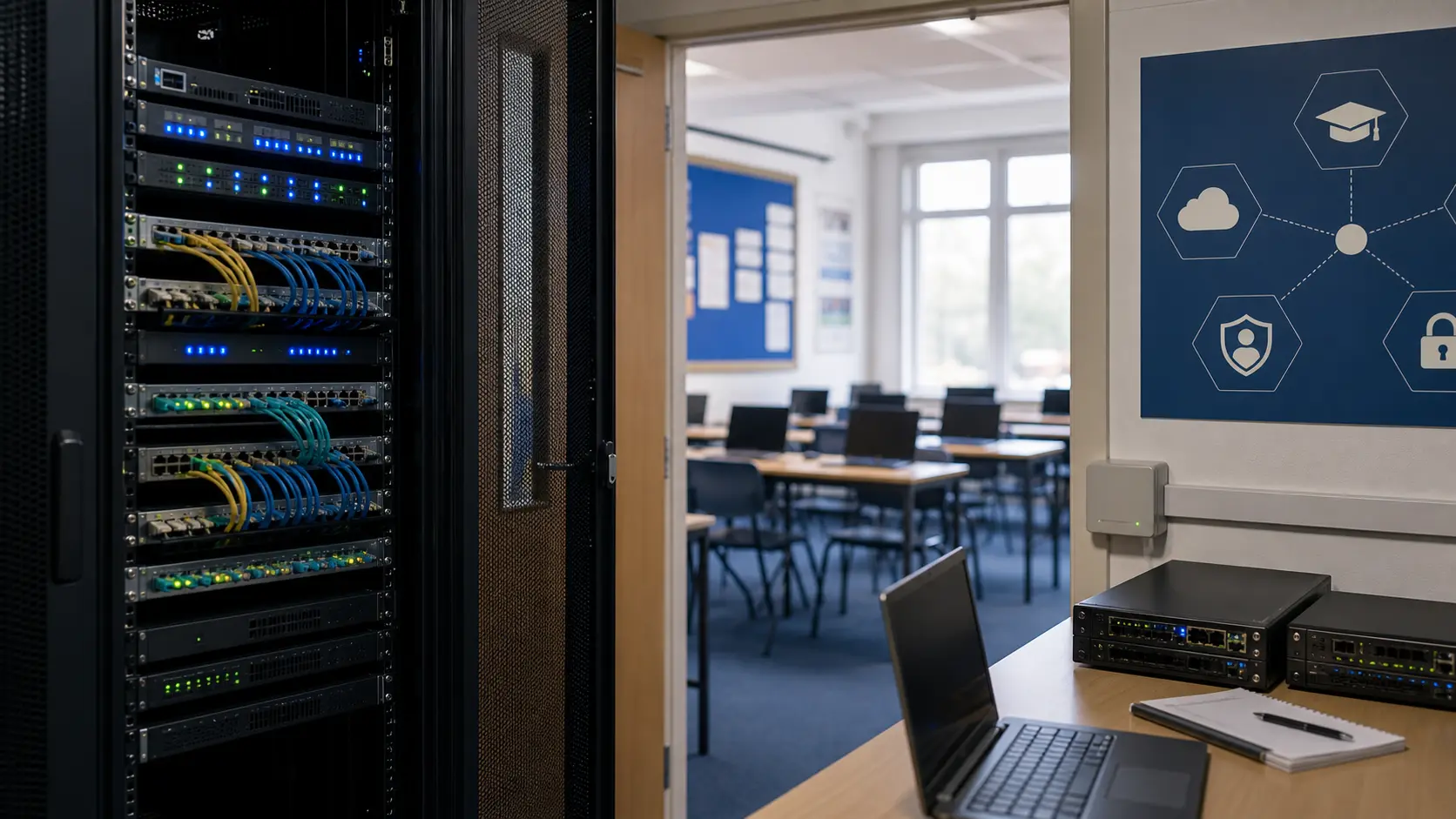
The footprint is sector-specific rather than covering the consumer telecommunications market. RM's public documents describe education technology, school connectivity, managed internet, filtering/safeguarding, and support services. This makes the company relevant because schools can depend on the same provider for access, policy controls, and support workflows.
The information gain is identifying a non-obvious infrastructure dependency. RM Education may not look like a conventional telecom operator, but public and routing evidence shows why it belongs in education network coverage.
Company Identity and Footprint
The canonical registration for this article isRM Education Ltd. The public display name used in the article isRM Education, and the regional framing isEurope & Middle East / Regional ISP. This framing is not cosmetic. It tells readers whether the company should be viewed as a national access operator, a regional ISP, a cloud platform, a wholesale backbone network, a data‑centre‑adjacent provider, or a mixed‑infrastructure business.
RM Education Ltd is the company entity. RMIFL and Internet for Learning are better treated as network or service labels, not as the legal name. The directory row mixed a routing-style label with the company name; the corrected profile keeps RM Education as the legal subject and uses RMIFL/AS5503 as evidence.
A clear identity layer is necessary because infrastructure directories often contain routing labels, brand names, historic names, or group names alongside legal names. If those labels are published without explanation, the reader cannot know whether BTW is tracking a company, a network resource, a product brand, or a parent group. This article therefore uses the company as the entity and keeps ASNs, prefixes, route entities, and registry labels in the evidence layer.
Operational Role
The footprint is sector-specific rather than covering the consumer telecommunications market. RM's public documents describe education technology, school connectivity, managed internet, filtering/safeguarding, and support services. This makes the company relevant because schools can depend on the same provider for access, policy controls, and support workflows.
The operational role is best understood through the public services that create a dependency. In this case, public data indicates that RM Education is tracked for UK education-sector internet, safeguarding/filtering, managed IT services, and AS5503/RMIFL network evidence. This does not mean every service is equally important, nor that all customers buy the full stack. It means the company has a visible infrastructure surface that can affect continuity, route choice, supply risk, or local market resilience.
That is also why the article avoids a generic treatment of corporate history. BTW readers need to know what the company can influence. For RM Education, the relevant influence lies in the relationship among the service footprint, network evidence, and customer dependency. The profile is written to make that relationship readable without turning dynamic routing data into permanent assertions.
Network Evidence and Resources
AS5503 is the routing anchor. Companies House evidence supports the legal identity, while RM service pages support the school connectivity and managed technology role. The article does not assert a current school count, live traffic levels, or private education contracts.
The strongest public network marker in this profile isAS5503. This marker is useful because it links the company file to visible routing or interconnection evidence. It is also limited. An ASN can show that a network‑oriented signal exists, but it does not by itself prove customer scale, traffic share, private contracts, financial exposure, or operational quality. Those claims require separate public evidence and must be re‑verified whenever exact current values matter.
The article therefore treats network resources as evidence, not as entities. This distinction corrects a common directory problem: a routing label can look like a company name, and a company name can be embedded in an AS‑description, but neither should automatically create a separate entity. The company entity remains RM Education Ltd; AS5503 and any associated route or peering records remain supporting evidence.
Dependency Surface
The dependency surface is education continuity. If a provider handles internet access, filtering, safeguarding, and managed IT support, a disruption or product change can affect classroom access, child‑safety workflows, and administration at the same time. That sector‑specific exposure is the reason BTW tracks the company.
For market readers, dependency is the useful lens. A provider can be important because it controls access networks, because it hosts workloads, because it carries wholesale traffic, because it supplies interconnection, because it sells managed services, or because it sits in front of applications as a security or distribution layer. The specific dependency for RM Education is not a universal telecom cliché; it comes from the public operational role described above.
This dependency can be direct or upstream. Some users may buy the company's services directly. Others may be exposed through a carrier, a cloud route, a school network, an enterprise managed‑services bundle, a hosting platform, a cable system, or a wholesale path. The article does not need a private customer list to be useful. It needs a defensible explanation of where public evidence shows that a dependency could form.
Evidence Notes
- http://www.rm.com— public company or service evidence for RM Education.
- https://www.rm.com/— public company or service evidence for RM Education.
- https://find-and-update.company-information.service.gov.uk/company/01148594— legal, licence, or operator‑registry context.
- https://www.rm.com/about/privacy— public company or service evidence for RM Education.
- https://www.rm.com/technology/connectivity— public company or service evidence for RM Education.
- https://www.rm.com/technology/blog/2025/june/isp-30th-anniversary— public company or service evidence for RM Education.
These sources are used to support the public identity, service footprint, network evidence, and dependency assessment. They are not used to infer non‑public customer lists, current traffic volumes, or confidential contracts. Where a source is a company page, it is treated as evidence of public positioning and service offering. Where a source is a routing, registry, or filing document, it is treated as evidence of infrastructure role or company context, with the usual caution that technical datasets can change.
Monitoring Points
- AS5503/RMIFL routing and peering evidence
- School connectivity and filtering product updates
- Companies House or ownership changes
- Continuity signals and procurement activity in the education sector
- Public documents clarifying the use of Internet for Learning and RMIFL
These monitoring points are deliberately concrete. They are the signals most likely to alter the profile: routing posture, licence status, service footprint, interconnection depth, data centre or cloud region expansion, group ownership, public filings, and major continuity incidents. A future update should change the article only when public evidence changes one of these signals.
Editorial Assessment
The reason BTW should track RM Education is not that the company appears in a directory. It is that public evidence links the company to infrastructure functions that can matter for resilience, competition, customer dependency, or route diversity. The profile is therefore an intelligence baseline: it tells editors and readers what the company is, which public evidence supports the classification, where the dependency lies, and what should be monitored next.
The assessment is intentionally limited. It does not claim that RM Education is the largest operator in its market unless a public source says so. It does not turn AS5503 into a separate entity. It does not freeze live BGP observations as permanent facts. It does not claim exposure of private customers. It identifies an enterprise‑level infrastructure surface and explains why that surface merits continued attention.
- RM's public pages support education technology and connectivity services.
- Companies House supports the legal identity.
- RM's connectivity and ISP‑anniversary documents support the sector‑network context.
- The AS5503 evidence anchors the routing side.
Source Limitations
This profile uses public company, filing, regulatory, routing, and interconnection sources retrieved on 27 June 2026. It must be refreshed before publication in a fast‑moving news context, before citing exact live traffic or peer figures, and before making any claim concerning ownership, customer contracts, or infrastructure capacity that is not directly supported by the public sources. Unsupported claims must remain outside the public article.
Member Briefing
Deeper Profile Context
Sign in with the right membership level to unlock the full briefing and source notes.
Only for Strategic Circle
Strategic Circle
Open to all readers. Unlock profile briefings after joining and signing in.
Join Strategic CircleOnly for Leadership Alliance
Leadership Alliance
For qualified IP-asset owners and management; sign in to unlock alliance briefings.
Join Leadership Alliance