
Summary
- 2degrees and One NZ propose putting their radio access network assets into a jointly owned operator while keeping spectrum, core networks, backhaul and retail and wholesale businesses separate.
- That boundary may preserve meaningful rivalry, but it does not settle who controls the site-level investment, maintenance, access and service decisions that determine what customers and wholesale buyers experience.
The proposal has an appealing diagram: two mobile operators keep their brands, spectrum, core networks and customer offers; a jointly owned company takes responsibility for the radio equipment between the handset and the core. If that middle layer is merely an expensive collection of interchangeable antennas, sharing it could reduce duplicate investment without erasing competition. But the radio access network is not just a line on an organisation chart. It is where coverage, capacity, upgrade timing, repair and service quality become operating choices.
That distinction is why RANCo should be assessed as more than a cost-saving story. Its commercial promise depends on whether 2degrees and One NZ can remain independent where the shared network touches the services they sell. Keeping spectrum and core networks outside the joint venture is relevant evidence. It is not, by itself, proof that the service companies will retain independent control over every input that shapes network performance.
A boundary drawn in assets, not yet in decisions
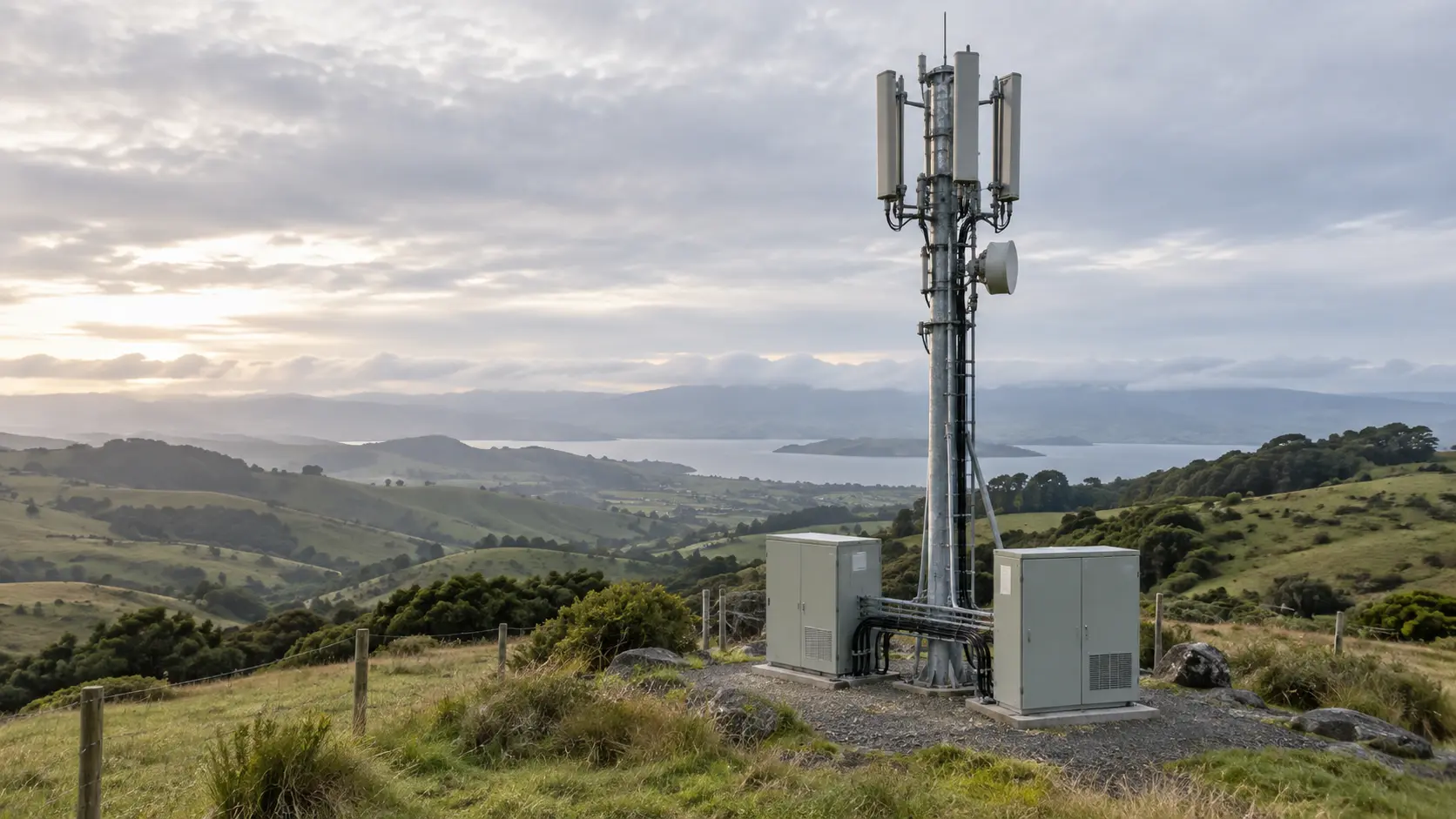
On 1 October, New Zealand’s Commerce Commission said it had received an application for a proposed joint venture to own and operate the radio access network assets currently owned by 2degrees and One NZ. The Commission describes those assets as equipment installed at cell sites: antennas, cables, remote radio equipment, power equipment and base-station equipment. Its case register identifies the application as open under section 66 of the Commerce Act.
The parties’ public description places those physical assets in a jointly owned business and says the two operators will continue to control spectrum-management rights, core networks, fibre backhaul, satellite capabilities and the products, customer systems and commercial offers that distinguish their services. One NZ says the shared entity would provide network services back to the two operators through separate wholesale arrangements. Both companies describe more efficient deployment, wider coverage, added capacity, resilience and faster adoption of new technologies as expected benefits.
Those are meaningful design claims, not operating results. The public announcements do not show the final wholesale contracts, the asset contribution schedule or the rules for deciding which sites receive capacity, when equipment is replaced, how faults are prioritized, or how the two service companies challenge a network decision. Nor do they disclose the decision rights that would apply if the joint venture’s owners disagree. Absence from a public announcement does not mean those protections do not exist. It means they cannot yet be used as proof that the separation works in practice.
The question is not whether two competitors can share infrastructure. They can. The question is whether the particular shared layer is sufficiently bounded—and governed with sufficiently enforceable access and performance rights—that each operator can still make a distinct offer without depending on a rival’s preferences.
The radio layer is part of the product
The parties say RAN equipment is a non-differentiating input and that the operators will continue to compete on spectrum, core networks, products, price and service. That is a reasonable hypothesis to test, not a conclusion that follows from the asset labels. A radio network’s configuration, site density, capacity allocation, coverage footprint, equipment generation and recovery time can affect what a customer experiences even when spectrum and the core remain with the service provider.
This does not mean every difference in coverage or speed is caused by RANCo, or that shared assets necessarily weaken competition. Operators may retain independent radio settings and customer-facing network features; a common owner may make investment more efficient or improve resilience. But the competitive importance of the shared layer has to be measured against real operating choices, not assumed away because the consumer does not see an antenna on a bill.
Wholesale customers make the boundary more demanding. A mobile virtual network operator buys a service, not a corporate diagram. It needs to know which service company is accountable for access, capacity, service levels, escalation and remedies when a problem crosses the boundary between radio assets and the operator’s core. If the network owner controls a material input but the retailer promises the experience, contract design determines whether responsibility and control line up.
The same issue applies to suppliers. Combining two purchasers can create scale and reduce duplicated procurement. It can also replace two negotiating positions with one buyer for equipment, installation, maintenance and related services. Lower input prices may be efficient. Whether they narrow supplier investment, innovation or service options is an empirical question, not an automatic consequence. The Commission’s early-stage inquiry includes both the downstream question of service competition and the upstream question of how the joint venture’s purchasing position may affect suppliers.
Test the counterfactual, not the press-release comparison
The Commission’s process compares the likely state of competition if the proposal proceeds with the likely state if it does not. The applicants say the alternative is that each company continues to own and operate its existing RAN assets. That is a starting point, not a complete counterfactual. The relevant comparison also asks which investments, upgrades, site sharing or commercial arrangements each party would realistically pursue without this joint venture.
The evidence should distinguish three propositions that are often compressed into one. First, sharing could avoid duplicated capital or operating cost. Second, that saving could be passed through as better coverage, capacity or resilience. Third, service-level competition could remain intact because the operators preserve control over the dimensions that matter to customers. Evidence for the first does not prove the second, and neither proves the third.
That separation matters for the claimed public benefits. “More efficient” is not a measured amount; “better coverage” needs a geography and a baseline; “more capacity” needs a time, place and traffic measure; and “greater resilience” needs a failure scenario and restoration comparison. Faster access to new technology is a schedule claim that can be checked against deployment milestones. Until those measures are disclosed, the benefits remain forecasts from the applicants.
The Commission’s 1 October statement is explicitly preliminary and based primarily on material provided by the parties. It invites submissions by 15 October and lists 23 November as the scheduled decision date, subject to extension. The regulator has not found that RANCo will lessen competition, nor that the promised separation eliminates that risk. The open case is the test, not its answer.
What a credible separation would look like
A useful public record would map the boundary in decisions as well as assets. It would explain who approves site additions and upgrades, how each service company can request capacity, how competing requests are ranked, what information is shared between the joint venture and its owners, and how an operator can challenge a decision. It would show whether wholesale access terms are transparent and enforceable, including for customers that rely on a service company’s network.
Performance evidence should be equally concrete. Coverage and capacity should be reported against comparable pre-transfer baselines. Outage records should distinguish radio faults from core-network or backhaul faults without shifting blame between entities. Repair and upgrade times should be compared across both operators and relevant locations. Investment records should identify which projects are new, accelerated or merely moved into the joint venture’s accounts. Supplier data should reveal whether procurement savings coexist with a viable range of equipment and support options.
None of these measures needs to disclose sensitive site security information or permit coordination on retail pricing. The point is to give the regulator, customers and wholesale buyers enough evidence to test the line the parties have drawn: shared physical assets, independent commercial judgment. If the separation is real, disciplined reporting should make that visible. If the results are mixed, measurement should show where the common network helps and where it constrains.
The proposed model could improve the economics of building and maintaining mobile coverage in a country where geography makes duplicate infrastructure costly. It could also preserve rivalry if access, operating decisions and customer-facing control are genuinely separated. But an ownership chart cannot establish either outcome on its own.
For now, RANCo is a proposal whose benefits are forecast and whose key service contracts remain outside the public record reviewed here. The right question is not whether the operators promise to compete. It is whether the decisions that determine coverage, capacity, quality and access remain independently contestable after the radio assets move. That is where the competition promise will have to prove itself.
Sources
- New Zealand Commerce Commission case register: RANCo / 2degrees / One NZ
- Commerce Commission: clearance sought for the proposed RANCo joint venture, 1 October 2026
- Commerce Commission Statement of Preliminary Issues, 1 October 2026
- 2degrees: Improving Aotearoa’s mobile networks, 27 August 2026
- One NZ: proposed mobile network infrastructure sharing platform, 27 August 2026
Sources
- New Zealand Commerce Commission case register: RANCo / 2degrees / One NZ
- Commerce Commission, clearance sought, 1 October 2026
- Commerce Commission, Statement of Preliminary Issues, 1 October 2026
- RANCo joint-venture clearance application, 25 September 2026
- 2degrees, “Improving Aotearoa’s mobile networks,” 27 August 2026
- One NZ, proposed mobile infrastructure-sharing platform, 27 August 2026
- Bill Bennett, Scoop, 2 October 2026
Member Briefing
Deeper Profile Context
Sign in with the right membership level to unlock the full briefing and source notes.
Only for Strategic Circle
Strategic Circle
Open to all readers. Unlock profile briefings after joining and signing in.
Join Strategic CircleOnly for Leadership Alliance
Leadership Alliance
For qualified IP-asset owners and management; sign in to unlock alliance briefings.
Join Leadership Alliance