
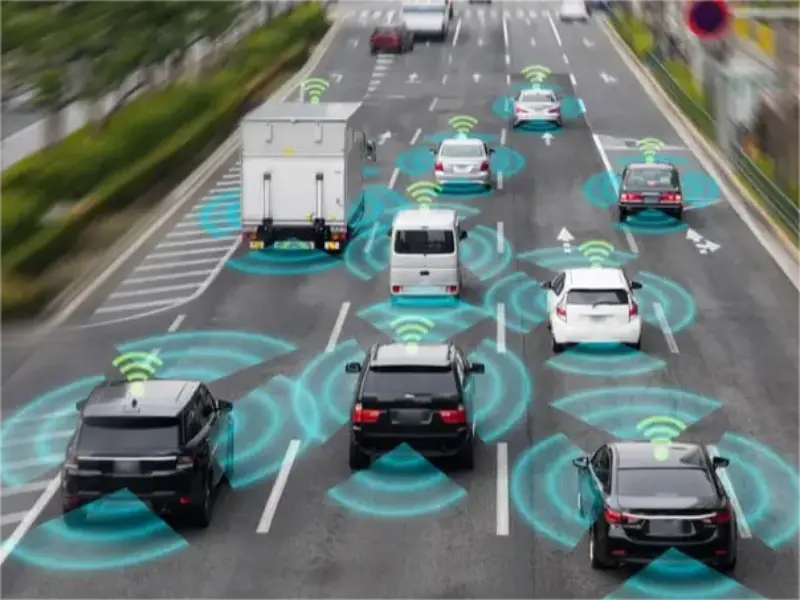
- Autonomous vehicles are a kind of intelligent cars to allow computers to operate the motor vehicle automatically and safely without any active human action.
- Autonomous vehicles rely on numerous sensors for navigation. In most autonomous vehicles, the combination of cameras, LiDAR, and RADAR form the primary set of sensors that provide the functionalities of imaging, detection, ranging, tracking, and sensing of the drive location for a seamless ride.
- There are two types of RADAR used in autonomous vehicles, Impulse RADAR and FMCW RADAR.
Automobile companies are focusing on numerous sensors for navigation. Cameras, LiDAR, and RADAR function together to form the primary set of sensors that provide the functionalities of imaging, detection, ranging, tracking, and sensing of the drive location for a seamless ride.
RADAR technology plays a critical role in AVs by providing reliable and accurate environmental perception, long-range detection, redundancy, adaptive cruise control, and collision avoidance capabilities.
The thriving autonomous vehicles industry
Autonomous vehicles (Avs), also known as autonomous cars (AC), driverless cars, computer-driven cars, wheeled mobile robots or robotaxi, are a kind of intelligent car that relies on artificial intelligence, visual computing, RADAR, monitoring devices and global positioning systems to work together to allow computers to operate the motor vehicle automatically and safely without any active human action.
AVs are a kind of intelligent car that realises driverless driving through a computer system, partially or entirely replacing the human driver in navigating a vehicle from an origin to a destination while avoiding road hazards and responding to traffic conditions. Avs will have a far-reaching impact on transportation, urban planning, and environmental protection.
Also read: Why is 5G needed for autonomous vehicles?
Advanced driver assistance systems (ADAS) have been experimented with since at least the 1920s. The first ADAS system was the cruise control system, invented by Ralph Teetor in 1948. The first semi-autonomous vehicle was developed in 1977 by the Mechanical Engineering Laboratory in Tsukuba, Japan. Google Self-driving Cars received the first U.S. self-driving vehicle license in May 2012.
The market of autonomous vehicles is evolving rapidly, driven by technological progress, regulatory developments, industry partnerships, and efforts to enhance consumer trust and acceptance. Continued innovation, collaboration, and regulatory clarity will shape the future growth and adoption of autonomous driving technology.
As of now, the market share of AVs is still relatively small compared to traditional vehicles, but several companies are at the forefront of developing AVs and shaping the future of transportation. The AV market is dynamic, with new players and innovations continually shaping its landscape.
Waymo is widely regarded as a leader in AV technology. Formerly a project under Google, Waymo focuses on developing fully autonomous driving systems using a combination of sensors, AI algorithms, and extensive real-world testing. They have launched commercial autonomous ride-hailing services and are working on expanding their AV capabilities across various vehicle platforms.
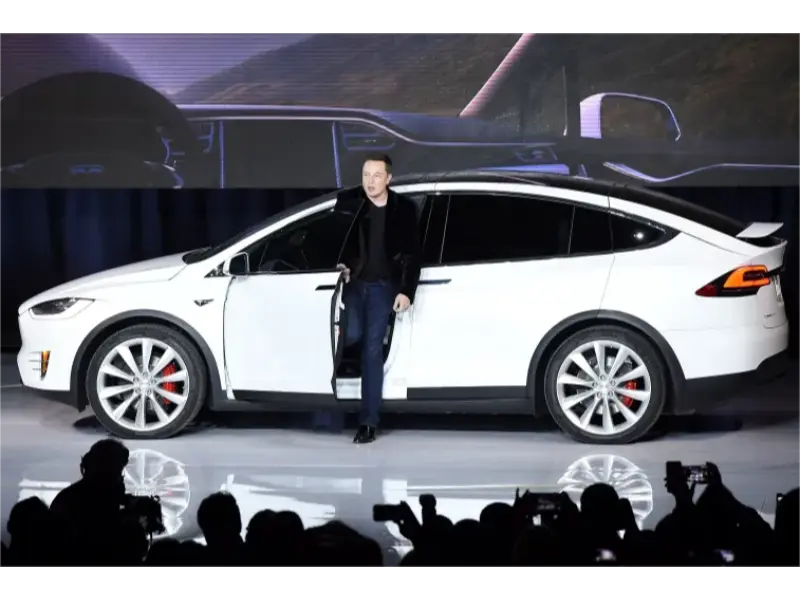
Tesla also invests heavily in autonomous driving technology. Their Autopilot system offers advanced driver-assistance features and is continuously evolving towards full self-driving capabilities. Tesla collects extensive data from its fleet of vehicles to improve AI algorithms and enhance safety and autonomy.
Cruise, acquired by General Motors (GM), is a major player in the AV industry. They focus on developing fully autonomous vehicles for ridesharing and delivery services. Cruise has received significant investments and partnerships, positioning itself as a key contender in the AV market.
While not a traditional automotive company, NVIDIA is a key player in providing AI hardware and software solutions for AVs. Their platforms, like NVIDIA DRIVE, power autonomous driving systems for various manufacturers and developers. NVIDIA’s technology is integral to enhancing perception, decision-making, and computing capabilities in autonomous vehicles.
The use of RADAR technology in AVs
The industry has witnessed the shift from human-driven vehicles to autonomous or self-driven vehicles. Automobile companies are focusing on research and development in sensor technologies, as autonomous vehicles rely on numerous sensors for navigation.
With the help of sensors, autonomous vehicles ensure no human interaction is needed while driving. A wide range of sensors are used in autonomous vehicles to build reliable vision. The sensors help the self-driving vehicle to detect hurdles or blockages in the driving environment and to move without causing fatalities.
Different sensors function together to form an accurate detection system in autonomous vehicles. In most autonomous vehicles, the combination of cameras, LiDAR (light detection and ranging), and RADAR (radio detection and ranging) form the primary set of sensors that provide the functionalities of imaging, detection, ranging, tracking, and sensing of the drive location for a seamless ride.
These sensor functionalities overlap, which helps in detecting the three-dimensional shape, distance, and speed of nearby entities.
The principle of operation for LiDAR and RADAR are the same. LiDAR uses laser beams (light waves) to determine the distance between two entities. Instead of the light waves used in LIDAR, RADAR relies on radio waves. The time taken by the radio waves to return from the obstacles to the device is used for calculating the distance, angle, and velocity of the obstacle in the surroundings of the autonomous vehicle.
Also read: How do autonomous vehicles work?
RADAR in autonomous vehicles operates at the frequencies of 24, 74, 77, and 79 GHz, corresponding to short-range radars (SRR), medium-range radars (MRR), and long-range radars (LRR), respectively. They each have slightly different functions:
SRR technology enables blind-spot monitoring, lane-keeping assistance, and parking assistance in autonomous vehicles.
MRR sensors are used when obstacle detection is in the range of 100-150 meters with a beam angle varying between 30° to 160°. SRR technology enables blind-spot monitoring, lane-keeping assistance, and parking assistance in autonomous vehicles.
MRR sensors are used when obstacle detection is in the range of 100-150 meters with a beam angle varying between 30° to 160°. The automatic distance control and brake assistance are supported by LRR radar sensors.
RADAR technology in autonomous vehicles operates with millimetre waves and offers millimetre precision. The utilisation of millimetre waves in autonomous vehicular RADAR ensures high resolution in obstacle detection and centimetre accuracy in position and movement determination. Compared to other sensor technologies in autonomous vehicles, RADAR works reliably under low visibility conditions such as cloudy weather, snow, rain, and fog.
Types of RADAR used in autonomous vehicles
There are two types of RADAR used in autonomous vehicles, Impulse RADAR and FMCW RADAR.
In impulse RADAR, one pulse is emitted from the device and the frequency of the signal remains constant throughout the operation. In FMCW RADAR, pulses are emitted continually. Pulses are modulated over the entire operation and the frequency varies over the transmission time.
FMCW RADAR is dominant in autonomous vehicles due to its high resolution in range and depth perception. Extensive research studies by automobile manufacturers will continue to develop advanced variants of impulse and FMCW RADAR. Cadence software offers simulation tools to develop end-to-end RADAR systems not only for autonomous vehicles but also for aerospace, defence, and commercial applications.