Summary
- RFC 9712 replaces a community-consensus gate for exploratory meeting locations with an IASA decision after community consultation, while sending narrow “Why We Meet” viability concerns to the IESG.
- It turns “close proximity” into a reviewable boundary—a safe walk of no more than ten minutes early and late—and replaces a fixed one-third hotel block with enough rooms for expected demand.
- Overflow hotels become optional, exposing where availability risk and cost sit instead of pretending that every preference is free.
- The durable control is a decision receipt: who excluded a city, which evidence and forecast were current, what concern triggered escalation, who accepted the contract risk, and what the meeting later showed.
The city that never reached the evidence stage
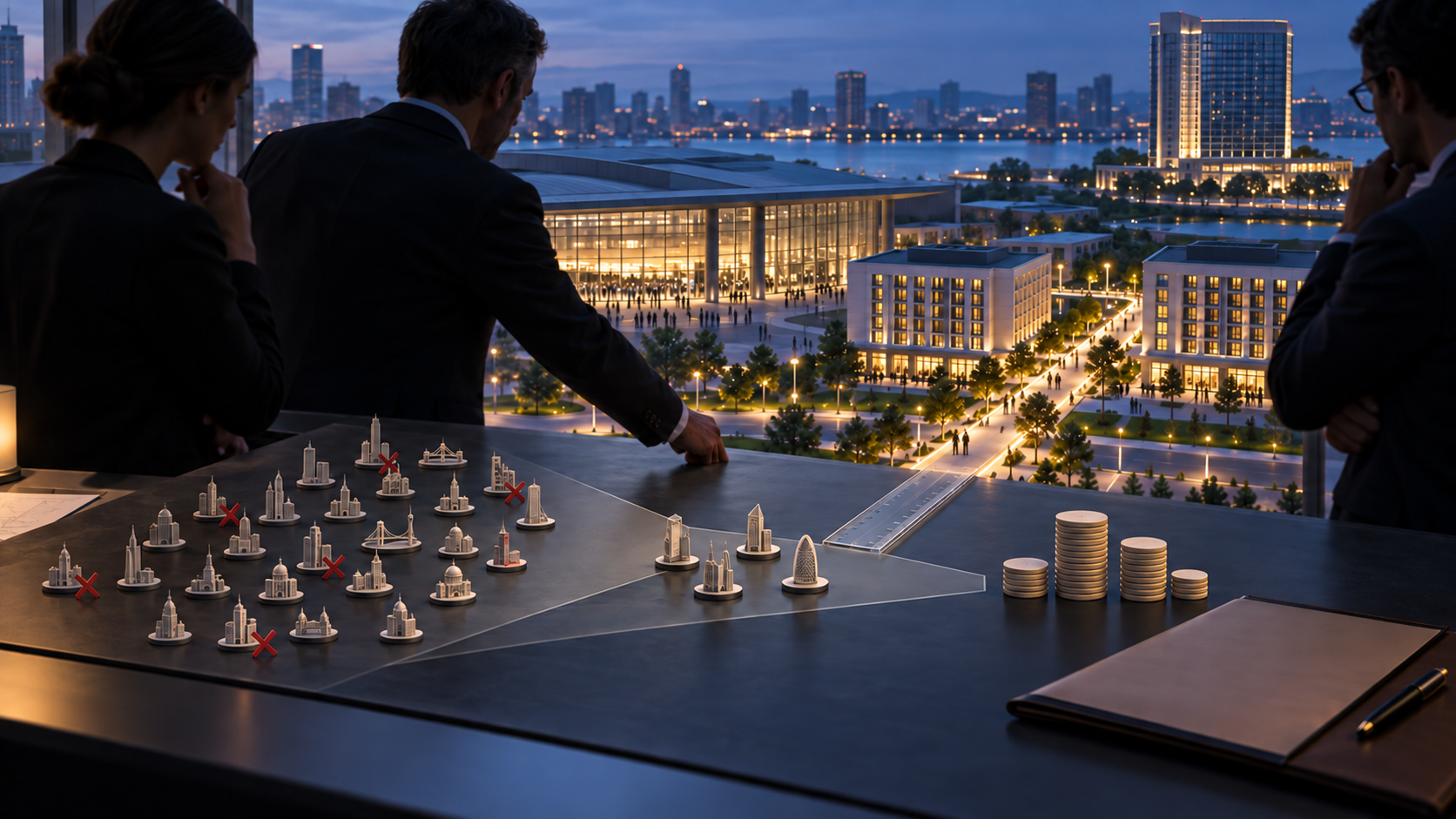
Suppose a venue team starts with twenty cities. Twelve vanish because they lack a single hotel large enough to host sleeping rooms and meeting space under one roof. Nobody has yet measured the walk from a convention centre to nearby hotels, tested the route at 07:00 or 22:00, modelled room demand, or compared the total cost borne by IASA and participants. “One roof” was described as a preference. In the candidate funnel, it operated as a prohibition.
That is the institutional problem behind several changes in RFC 9712. A preference can be sensible: one roof concentrates the community, simplifies negotiation and networking, and may bundle meeting space with a large room commitment. But if the preference has no named owner or exception boundary, it can remove choices before facts exist. The absence of a rejection record then makes the exclusion look like geography rather than governance.
The decision moved; consultation did not disappear
Under the earlier RFC 8719 process, a participant could nominate an exploratory city, the community would discuss it, and the IETF Chair would determine whether consensus existed to proceed. RFC 9712 concluded that this was the wrong control. Consensus is a high bar designed for decisions of a different character; attendance at previous exploratory meetings also showed that consensus to experiment was not the same thing as operational viability.
The replacement is more precise. IASA may schedule an exploratory meeting through the ordinary venue process after assessing the city and consulting the community. If a concern suggests the location cannot support the core purposes described in “Why We Meet,” IASA defers that viability question to the IESG. Community input remains evidence. IASA owns the venue decision. The IESG owns a narrow safeguard, not general venue selection. The LLC Board still approves the recommendation before contracts turn it into a financial commitment.
This division matters because “consulted,” “decided” and “protected” are different claims. Consultation without a decision owner invites an unrecorded veto. Administrative authority without consultation hides local knowledge. An unlimited escalation route lets the safeguard swallow the rule. RFC 9712 gives each verb a different custodian.
Ten minutes is a boundary, not a verdict
Some readers had treated “close proximity” as proof that only a one-roof site could comply. RFC 9712 states a measurable alternative: the meeting space and primary hotel can be separated by a safe walk of no more than ten minutes during early morning and late evening.
The number narrows argument, but it does not perform the audit. A map-radius calculation does not show the actual pedestrian route. A daytime visit does not establish late-evening lighting. An able-bodied walking time does not settle accessibility, crossings, gradients, weather exposure or personal safety. A defensible assessment therefore records the route, time bands, method, assumptions, exceptions and date. Ten minutes is the point at which evidence can be contested; it is not evidence by itself.
One third looked objective and measured the wrong quantity
RFC 8718 had sought a room block of at least one-third of projected attendance. That ratio was easy to repeat, but projected attendance is not identical to hotel demand. Local participants commute. Others use apartments, loyalty properties or cheaper hotels. Remote participation changes travel decisions. A fixed percentage can therefore generate both shortages and expensive unused commitments.
After COVID-19, RFC 9712 notes, hotels were more likely to seek advance payment or stronger guarantees, discounts were weaker, alternative lodging competed with room blocks, and IASA had assumed risk by reserving too many rooms. The new rule asks for enough rooms to meet expected demand.
That language is intentionally adaptable and operationally incomplete. “Expected” needs an owner, a data vintage and a range. Before signature, the receipt should show the attendance scenario, room-night distribution, alternative-lodging assumption, deposits, attrition clauses and sensitivity to remote participation. Afterward, pickup data should test the forecast. Otherwise a flexible standard becomes discretion without memory.
Optional overflow makes the risk visible
Overflow hotels sound like additional resilience. Historically, RFC 9712 says, they were underused, financially risky and rarely contracted. Making them optional allows IASA to judge whether a second property will genuinely improve access or merely create another guarantee.
The option does not remove risk; it reallocates it. Without an overflow contract, participants may bear price and availability risk. With one, IASA may carry minimum-block or cancellation exposure. A one-roof venue can shift part of venue cost into participant room rates, while a convention-centre model may place a more visible venue charge on IASA. “Cheaper” has no meaning until the ledger states whose cost is counted.
IETF 125 shows the safeguard in use
The public IETF 125 decision provides a useful implementation receipt. The IESG limited its question to whether the meeting remained viable under “Why We Meet,” acknowledged substantial uncertainty and expected much lower on-site participation. The reported consultation figures included expected in-person attendance of 51% among all respondents, 41% among working-group chairs and 57% among active authors. Using IETF 113 as a comparator, the IESG decided that the minimum viability threshold was met.
Those percentages do not prove eventual attendance, broad enthusiasm or compliance with every venue criterion. They show something narrower and more useful: the safeguard had an owner, a scoped question, disclosed uncertainty, evidence and a decision. That is what prevents consultation from masquerading as either plebiscite or decoration.
Sources
- RFC 9712: IETF Meeting Venue Requirements Review
- RFC Editor record for RFC 9712
- RFC 8718: IETF Plenary Meeting Venue Selection Process
- RFC 8719: High-Level Guidance for the Meeting Policy
- RFC 8711: Structure of the IETF Administrative Support Activity
- IETF meeting planning
- IETF 125 decision and survey summary
Member Briefing
Deeper Profile Context
Sign in with the right membership level to unlock the full briefing and source notes.
Only for Strategic Circle
Strategic Circle
Open to all readers. Unlock profile briefings after joining and signing in.
Join Strategic CircleOnly for Leadership Alliance
Leadership Alliance
For qualified IP-asset owners and management; sign in to unlock alliance briefings.
Join Leadership Alliance