
Summary
- Oracle's multicloud database business grew 1,529% year over year in Q1 FY2026, 817% in consumption terms in Q2, 531% in Q3 and 404% in Q4, but no quarter discloses the absolute dollar base behind any of those percentages. [https://www.oracle.com/news/announcement/q1fy26-earnings-release-2025-09-09/] [https://www.fool.com/earnings/call-transcripts/2025/12/10/oracle-orcl-q2-2026-earnings-call-transcript/] [https://investor.oracle.com/investor-news/news-details/2026/Oracle-Announces-Fiscal-Year-2026-Third-Quarter-Financial-Results/] [https://investor.oracle.com/investor-news/news-details/2026/Oracle-Announces-Record-Q4-and-FY-2026-Results-Driven-by-Cloud-Infrastructure--Cloud-Applications/default.aspx]
- The most externally checkable dimension of the programme is the region count: 45 live multicloud regions across AWS, Azure and Google Cloud as of December 2025, and per-partner counts of 33 Microsoft regions, 14 Google regions and a planned 22 AWS regions by the end of Q4 FY2026. [https://www.fool.com/earnings/call-transcripts/2025/12/10/oracle-orcl-q2-2026-earnings-call-transcript/] [https://blogs.oracle.com/ceo/from-the-q3-earnings-call]
- The product mechanism is now complete across all three hyperscalers: Oracle Database@AWS reached general availability on July 8, 2025; Database@Google Cloud expanded regional availability in January 2025 and added AI database services in October 2025; Database@Azure gained a dedicated Autonomous AI Database option; and AWS Interconnect Multicloud with OCI reached general availability in July 2026. [https://www.oracle.com/news/announcement/oracle-database-at-aws-now-generally-available-2025-07-08/] [https://www.oracle.com/news/announcement/oracle-and-google-cloud-expand-regional-availability-and-add-powerful-new-capabilities-to-oracle-database-at-google-cloud-2025-01-30/] [https://www.oracle.com/news/announcement/ai-world-oracle-database-at-google-cloud-adds-new-oracle-ai-database-services-2025-10-14/] [https://techcommunity.microsoft.com/blog/oracleonazureblog/new-oracle-autonomous-ai-database---dedicated-option-on-oracle-ai-databaseazure/4504929] [https://aws.amazon.com/about-aws/whats-new/2026/07/aws-announces-AWS-interconnect-multicloud-OCI-GA/]
- The decelerating percentage series is arithmetically consistent with a business moving from a negligible base toward materiality, but it cannot be converted into dollars from public disclosures, and Oracle's own naming of the Q4 metric is inconsistent between its press release and its earnings call. [https://investor.oracle.com/investor-news/news-details/2026/Oracle-Announces-Record-Q4-and-FY-2026-Results-Driven-by-Cloud-Infrastructure--Cloud-Applications/default.aspx]
- FY2026 closed with total revenue of $67.4 billion (+17%), Cloud Infrastructure revenue of $18.1 billion (+77%) and remaining performance obligations of $638 billion (+363%), the last figure being the part of the story outsiders can least verify. [https://investor.oracle.com/investor-news/news-details/2026/Oracle-Announces-Record-Q4-and-FY-2026-Results-Driven-by-Cloud-Infrastructure--Cloud-Applications/default.aspx]
The one part of Oracle's cloud story you can count
Oracle's fiscal 2026, which ended on May 31, 2026, was defined in public discussion by a single number: $638 billion of remaining performance obligations, up 363% year over year. That figure, disclosed in the company's fourth-quarter results, represents contracted future revenue that has not yet been recognised — and almost none of it can be attributed to named customers, named capacity or named geographies from public filings. [https://investor.oracle.com/investor-news/news-details/2026/Oracle-Announces-Record-Q4-and-FY-2026-Results-Driven-by-Cloud-Infrastructure--Cloud-Applications/default.aspx]
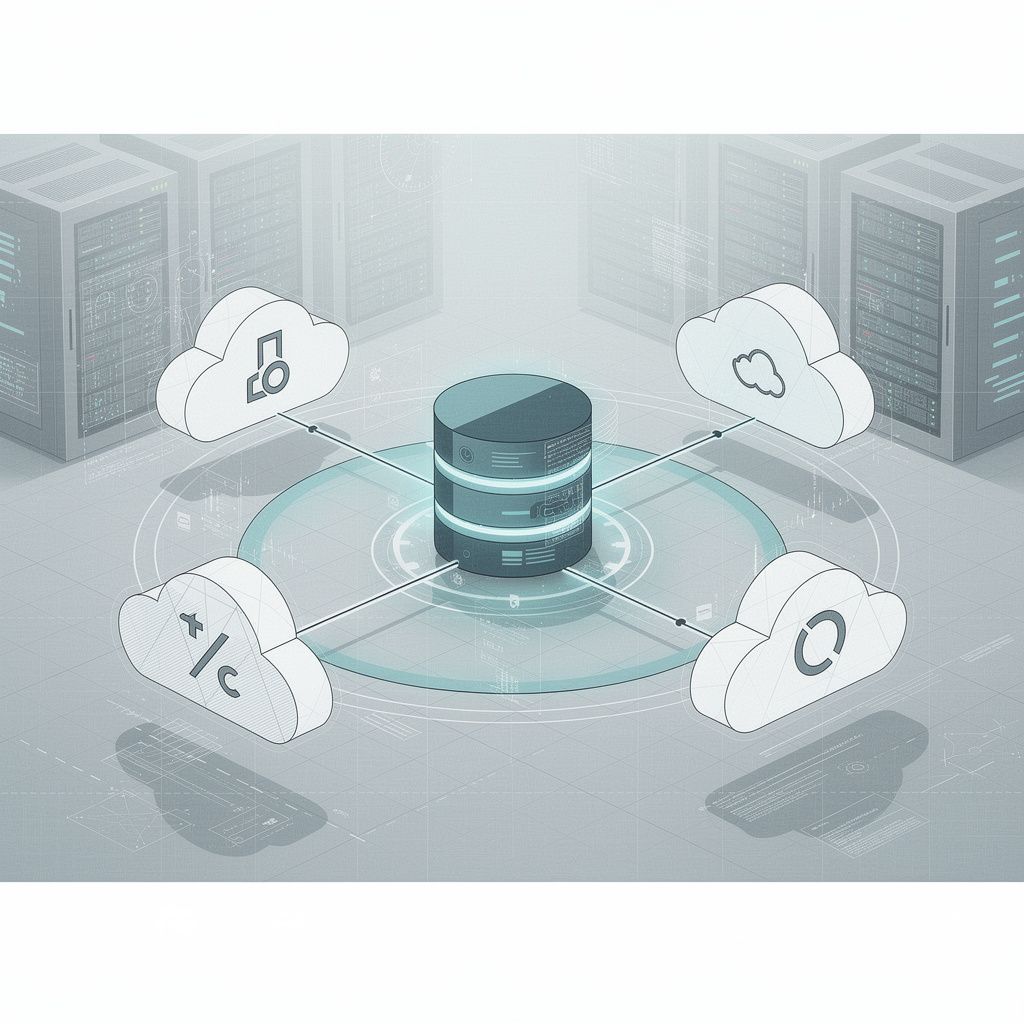
There is, however, a second Oracle cloud story running in parallel, and it behaves differently. Since 2023 Oracle has been building out Database@AWS, Oracle Database@Azure and Oracle Database@Google Cloud: physical Oracle Exadata and Autonomous Database infrastructure installed inside the datacenters of its three largest competitors, operated by Oracle but purchased through the hyperscaler's own billing, support and procurement channels.
Unlike the AI backlog, this programme produces artefacts an outsider can enumerate: launch dates, regional availability documents, interconnect products and a quarterly growth percentage that Oracle volunteers without being asked.
This report treats that second story as a ledger and audits it. The finding is not that the multicloud business is small or failing — every available indicator points the other way — but that the two ledgers serve different evidentiary functions, and conflating them is how the unverifiable part of Oracle's narrative borrows credibility from the verifiable part.
The growth series: four quarters, four percentages, zero dollars
The headline series Oracle disclosed across fiscal 2026 is striking precisely because of its trajectory:
- Q1 FY2026 (quarter ended August 2025): "MultiCloud database revenue from Amazon, Google and Microsoft grew at the incredible rate of 1,529% in Q1," in the words of Oracle Chairman and CTO Larry Ellison in the company's earnings release. [https://www.oracle.com/news/announcement/q1fy26-earnings-release-2025-09-09/]
- Q2 FY2026 (ended November 2025): multi-cloud database consumption up 817% year over year, per the earnings call transcript; the press release reports cloud database services revenue up 30% and Autonomous Database revenue up 43% in the same quarter. [https://www.fool.com/earnings/call-transcripts/2025/12/10/oracle-orcl-q2-2026-earnings-call-transcript/] [https://www.oracle.com/news/announcement/q2fy26-earnings-release-2025-12-10/]
- Q3 FY2026 (ended February 2026): Multicloud Database revenue up 531% in USD, per the third-quarter results release. [https://investor.oracle.com/investor-news/news-details/2026/Oracle-Announces-Fiscal-Year-2026-Third-Quarter-Financial-Results/]
- Q4 FY2026 (ended May 2026): "The Oracle Multicloud AI Database" grew 404% in Q4 — described in the release as Oracle's fastest-growing business ever. [https://investor.oracle.com/investor-news/news-details/2026/Oracle-Announces-Record-Q4-and-FY-2026-Results-Driven-by-Cloud-Infrastructure--Cloud-Applications/default.aspx]
A percentage series that declines from 1,529% to 404% across four quarters is not evidence of weakening demand; it is what any rapidly growing business looks like when its base expands. If Q1 revenue on the multicloud line was, hypothetically, $100 million, then 1,529% growth implies roughly $1.6 billion; if it was $10 million, the implied figure is $162 million. Oracle has not disclosed which — or any other — base. No quarterly release in fiscal 2026 states multicloud database revenue in absolute dollars, and the ratio of percentage to dollar has never been published. [https://www.oracle.com/news/announcement/q1fy26-earnings-release-2025-09-09/] [https://www.oracle.com/news/announcement/q2fy26-earnings-release-2025-12-10/] [https://investor.oracle.com/investor-news/news-details/2026/Oracle-Announces-Fiscal-Year-2026-Third-Quarter-Financial-Results/] [https://investor.oracle.com/investor-news/news-details/2026/Oracle-Announces-Record-Q4-and-FY-2026-Results-Driven-by-Cloud-Infrastructure--Cloud-Applications/default.aspx]
There is also a definitional wobble worth recording precisely. The Q4 FY2026 release names the 404% metric "The Oracle Multicloud AI Database"; the Q4 earnings call, as transcribed by third parties, reportedly describes the same figure as "multi-cloud revenue." Whether these are the same measure is not established by public documents, and Oracle's releases do not include a reconciliation of the multicloud line against the broader Cloud Infrastructure segment. [https://investor.oracle.com/investor-news/news-details/2026/Oracle-Announces-Record-Q4-and-FY-2026-Results-Driven-by-Cloud-Infrastructure--Cloud-Applications/default.aspx]
Two further limitations follow. First, a growth percentage on an undisclosed base is compatible with almost any absolute outcome; it constrains the narrative far less than a dollar figure would. Second, "consumption" — the word used in the Q2 call for the 817% metric — is not defined in the transcript excerpt, and consumption growth and revenue growth can diverge materially when pricing, commitment structures or recognition timing change. [https://www.fool.com/earnings/call-transcripts/2025/12/10/oracle-orcl-q2-2026-earnings-call-transcript/]
The region ledger: the countable dimension
If percentages are the soft part of the ledger, regions are the hard part. Oracle's multicloud buildout is physically countable, and the company has been disclosing counts that move quarter to quarter:
- Q2 FY2026: 11 new multicloud regions added in the quarter, bringing the total to 45 live regions across AWS, Azure and Google Cloud, with 27 more planned. The same call placed OCI at 147 live customer-facing regions with 64 more planned. [https://www.fool.com/earnings/call-transcripts/2025/12/10/oracle-orcl-q2-2026-earnings-call-transcript/]
- Q3 FY2026: per-partner counts — 33 regions live with Microsoft and 14 with Google; AWS grew from 2 live regions at the start of the quarter to 8 at its end, with a plan to exit Q4 at 22. Oracle framed this as having "achieved global region coverage in all partner clouds." [https://blogs.oracle.com/ceo/from-the-q3-earnings-call]
The two sets of numbers do not simply add up to each other: 45 total live regions in December 2025 versus 33 + 14 + 8 = 55 in March 2026 reflects both genuine growth and a change in counting method — Oracle's own communications use "regions" and "sites" loosely, and a multicloud "region" inside a hyperscaler is not the same unit as an OCI region. This is exactly the kind of methodological drift that a countable ledger is supposed to prevent, and readers should treat both figures as self-reported operational snapshots rather than audited inventories. [https://www.fool.com/earnings/call-transcripts/2025/12/10/oracle-orcl-q2-2026-earnings-call-transcript/] [https://blogs.oracle.com/ceo/from-the-q3-earnings-call]
What the region counts do establish is direction and pace. The AWS buildout is the newest and steepest: from 2 live regions in November 2025 to a planned 22 by May 2026 — a roughly tenfold expansion of the physical multicloud footprint on Oracle's smallest partner within two quarters. The Microsoft relationship, by contrast, is mature at 33 live regions, and Google at 14 has grown steadily since the January 2025 expansion of regional availability for Database@Google Cloud. [https://blogs.oracle.com/ceo/from-the-q3-earnings-call] [https://www.oracle.com/news/announcement/oracle-and-google-cloud-expand-regional-availability-and-add-powerful-new-capabilities-to-oracle-database-at-google-cloud-2025-01-30/]
Oracle's own documentation allows partial independent verification of the region dimension. The company publishes separate region availability pages for Database@Azure and Database@Google Cloud, which enumerate the hyperscaler regions where the service can be deployed. These pages are vendor-authored, but they are structured, dated and specific in a way that press releases are not. [https://docs.oracle.com/iaas/Content/database-at-azure/oaa_regions.htm] [https://docs.oracle.com/en-us/iaas/Content/database-at-gcp/get-started-regions.htm]
The mechanism: what Database@X actually is
The technical architecture explains why the hyperscalers are cooperating. Oracle Database@X is not an interconnect product; it is Oracle-managed Exadata hardware and Autonomous Database software running physically inside the partner's datacenters, bought through the partner's marketplace and covered by the partner's enterprise agreements. A customer with a large Microsoft Azure commit can spend it on Oracle Database@Azure; the same applies on AWS and Google Cloud.
This is why the product exists at all: it converts hyperscaler cloud commitments — which customers were already locked into — into Oracle database revenue, and converts Oracle's database installed base into hyperscaler-adjacent consumption without a migration project.
The build-out of this mechanism across fiscal 2025 and 2026 proceeded in dated, verifiable steps:
- January 30, 2025: Oracle and Google Cloud announced expanded regional availability and new capabilities for Oracle Database@Google Cloud. [https://www.oracle.com/news/announcement/oracle-and-google-cloud-expand-regional-availability-and-add-powerful-new-capabilities-to-oracle-database-at-google-cloud-2025-01-30/]
- July 8, 2025: Oracle Database@AWS became generally available. [https://www.oracle.com/news/announcement/oracle-database-at-aws-now-generally-available-2025-07-08/]
- October 14, 2025: at Oracle AI World, the company announced new Oracle AI Database services on Database@Google Cloud, and separately launched Multicloud Universal Credits — a single pool of Oracle credits spendable across Oracle Cloud Infrastructure and the multicloud environments. [https://www.oracle.com/news/announcement/ai-world-oracle-database-at-google-cloud-adds-new-oracle-ai-database-services-2025-10-14/] [https://www.oracle.com/news/announcement/ai-world-oracle-introduces-multicloud-universal-credits-2025-10-14/]
- April 16, 2026: Oracle and AWS announced a collaboration to expand multicloud networking between OCI and AWS. [https://www.oracle.com/news/announcement/oracle-and-aws-collaborate-to-expand-multicloud-networking-2026-04-16/]
- July 2026: AWS announced the general availability of AWS Interconnect Multicloud for OCI, the networking product that lets workloads on the two clouds exchange traffic at private, predictable rates. [https://aws.amazon.com/about-aws/whats-new/2026/07/aws-announces-AWS-interconnect-multicloud-OCI-GA/]
On the Azure side, Microsoft's own channels document the deepening: the Azure blog describes new features, regions and programs for Oracle Database@Azure aimed at "unlock data and AI innovation," and Microsoft's technical community blog carries the announcement of a dedicated option for Oracle Autonomous AI Database on the platform. [https://azure.microsoft.com/en-us/blog/oracle-databaseazure-offers-new-features-regions-and-programs-to-unlock-data-and-ai-innovation/] [https://techcommunity.microsoft.com/blog/oracleonazureblog/new-oracle-autonomous-ai-database---dedicated-option-on-oracle-ai-databaseazure/4504929]
Google's positioning is the most explicit about the strategic logic. Its partner blog frames Oracle Database@Google Cloud as "the foundation for the agentic enterprise," arguing that customers want their transactional systems of record to sit alongside AI services without data movement — which is precisely the constraint the in-datacenter placement solves. [https://cloud.google.com/blog/topics/partners/the-foundation-for-the-agentic-enterprise-built-with-oracle-database-at-google-cloud]
The completion of the interconnect layer in mid-2026 matters more than any single region launch. Database@X monetises the database; the interconnect products monetise everything around the database by making it cheap and predictable to pair OCI-hosted workloads with hyperscaler-hosted ones. AWS Interconnect Multicloud reaching GA in July 2026 means the AWS side of that pairing is now a shipped product rather than a roadmap item. [https://aws.amazon.com/about-aws/whats-new/2026/07/aws-announces-AWS-interconnect-multicloud-OCI-GA/]
What the multicloud ledger verifies — and what it does not
The verifiable core of the story is narrow but real. As of the public record:
- The product exists and shipped, on all three hyperscalers, with dated GA milestones. [https://www.oracle.com/news/announcement/oracle-database-at-aws-now-generally-available-2025-07-08/] [https://www.oracle.com/news/announcement/oracle-and-google-cloud-expand-regional-availability-and-add-powerful-new-capabilities-to-oracle-database-at-google-cloud-2025-01-30/] [https://techcommunity.microsoft.com/blog/oracleonazureblog/new-oracle-autonomous-ai-database---dedicated-option-on-oracle-ai-databaseazure/4504929]
- The physical footprint is expanding rapidly, with self-reported region counts that are specific, dated and partly corroborated by structured vendor documentation. [https://www.fool.com/earnings/call-transcripts/2025/12/10/oracle-orcl-q2-2026-earnings-call-transcript/] [https://blogs.oracle.com/ceo/from-the-q3-earnings-call]
- The commercial motion is growing fast enough that its percentage growth rate is decelerating from a very high base — the arithmetic signature of a line item moving from noise toward materiality. [https://www.oracle.com/news/announcement/q1fy26-earnings-release-2025-09-09/] [https://investor.oracle.com/investor-news/news-details/2026/Oracle-Announces-Record-Q4-and-FY-2026-Results-Driven-by-Cloud-Infrastructure--Cloud-Applications/default.aspx]
- The hyperscalers themselves are publicising the partnership on their own channels, which would be inexplicable if it were commercially empty. [https://cloud.google.com/blog/topics/partners/the-foundation-for-the-agentic-enterprise-built-with-oracle-database-at-google-cloud] [https://azure.microsoft.com/en-us/blog/oracle-databaseazure-offers-new-features-regions-and-programs-to-unlock-data-and-ai-innovation/] [https://aws.amazon.com/about-aws/whats-new/2026/07/aws-announces-AWS-interconnect-multicloud-OCI-GA/]
What the ledger does not verify:
- The absolute size of the multicloud business in dollars, in any quarter. [https://investor.oracle.com/investor-news/news-details/2026/Oracle-Announces-Record-Q4-and-FY-2026-Results-Driven-by-Cloud-Infrastructure--Cloud-Applications/default.aspx]
- Whether the Q4 "Multicloud AI Database" metric and the call's "multi-cloud revenue" are the same measure. [https://investor.oracle.com/investor-news/news-details/2026/Oracle-Announces-Record-Q4-and-FY-2026-Results-Driven-by-Cloud-Infrastructure--Cloud-Applications/default.aspx]
- The revenue per region, which would be the natural efficiency measure for the buildout: 45 live regions generating what, exactly? No public figure answers this.
- The relationship between multicloud growth and the much larger AI infrastructure narrative. Oracle's Q3 disclosure that AI infrastructure revenue grew 243% year over year, at a 32% gross margin, sits in a separate measurement frame from the multicloud percentages, and no public document connects them. [https://blogs.oracle.com/ceo/from-the-q3-earnings-call]
The credibility substrate
This is where the two ledgers meet. Oracle's AI-era pitch to investors and customers is that it can deliver capacity at a scale and speed nobody else can — 850 megawatts of datacenter capacity delivered in a single quarter, per the company's Q1 FY2027 disclosures, and a $638 billion backlog that presumes years of buildout. [https://investor.oracle.com/investor-news/news-details/2026/Oracle-Announces-Record-Q4-and-FY-2026-Results-Driven-by-Cloud-Infrastructure--Cloud-Applications/default.aspx]
The multicloud programme performs a different rhetorical function: it is the part of the Oracle cloud story where promises become countable objects on short cycles. A region opens, a product reaches GA, an interconnect ships — each is a small, dated, falsifiable claim. Every one of those claims that verifies makes the next unverifiable claim — that a multi-hundred-billion-dollar backlog will convert into delivered, energised capacity — slightly easier to believe. The mechanism is not logical proof; it is reputation transfer from a measurable domain to an unmeasurable one.
That transfer is legitimate only if the measurable domain is measured honestly. The evidence here is mixed. Oracle publishes the percentages and the region counts, dates its product milestones precisely, and lets third parties — AWS, Microsoft, Google — corroborate the partnership's existence from their own channels. Against that, it declines to publish dollar figures for the fastest-growing line in its portfolio, changes the metric's name between its release and its call, and shifts between incompatible counting methods for regions across two quarters. None of these are evidence of misstatement.
All of them are reasons the multicloud ledger cannot be read as an audit of the AI-capacity story.
FY2026 in full
The context in which this multicloud ledger sits, from Oracle's own Q4 FY2026 release: full-year total revenue of $67.4 billion, up 17% in USD; cloud revenue (IaaS and SaaS combined) of $34.0 billion, up 39%; Cloud Infrastructure (IaaS) revenue of $18.1 billion, up 77%; and remaining performance obligations of $638 billion, up 363% year over year and up $85 billion sequentially. Q4 alone delivered $19.2 billion of total revenue (+21%) with IaaS at $5.8 billion (+93%). [https://investor.oracle.com/investor-news/news-details/2026/Oracle-Announces-Record-Q4-and-FY-2026-Results-Driven-by-Cloud-Infrastructure--Cloud-Applications/default.aspx]
Against that frame, even a generous reading of the multicloud percentages implies a business that is still small relative to Oracle's total cloud revenue — growing off a base that remains, by every public indication, in the hundreds of millions to low single-digit billions rather than the tens of billions. That is not a weakness of the strategy; it is evidence that the strategy is early, and that the region buildout is an investment in future consumption rather than a current-revenue engine.
The honest characterisation is: real, fast-growing, physically verifiable, and not yet large enough to carry the weight the AI narrative places on Oracle's overall credibility.
Oracle's guidance evolution during the year reinforces the framing. In Q1 FY2026 the company forecast OCI revenue growing 77% to $18 billion for the fiscal year, alongside a plan to deliver another 37 datacenters to its three hyperscaler partners for a total of 71 — a commitment tied directly to the multicloud footprint rather than to Oracle's standalone regions. [https://www.oracle.com/news/announcement/q1fy26-earnings-release-2025-09-09/] Analyst commentary on the Q1 print noted the miss on headline revenue even as OCI's forward trajectory dominated the discussion. [https://www.constellationr.com/index%2ephp/insights/news/oracle-q1-misses-sees-oci-revenue-surging-over-next-4-years]
Member Briefing
Deeper Profile Context
Sign in with the right membership level to unlock the full briefing and source notes.
Only for Strategic Circle
Strategic Circle
Open to all readers. Unlock profile briefings after joining and signing in.
Join Strategic CircleOnly for Leadership Alliance
Leadership Alliance
For qualified IP-asset owners and management; sign in to unlock alliance briefings.
Join Leadership Alliance