
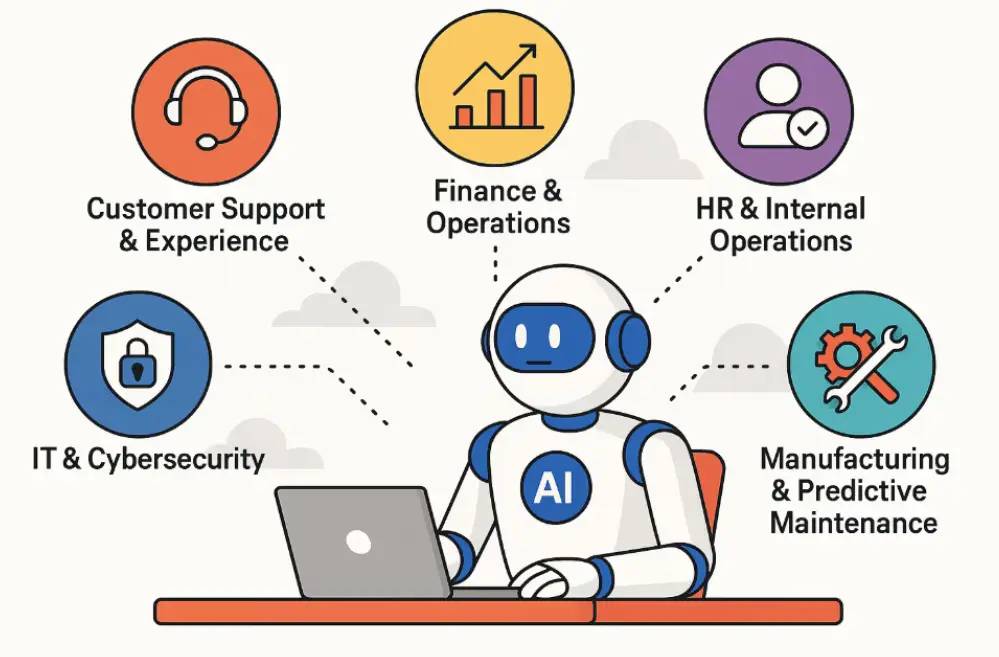
Oracle is advancing an AI-driven strategy for autonomous enterprise operations, integrating AI capabilities into its cloud software platforms. This strategic move reflects broader industry trends and aims to reduce manual intervention in business processes across finance, supply chain, and human resources.
- Oracle announced 22 Fusion Agentic Applications on 24 March 2026 for finance, human resources, supply chain and customer-experience workflows.
- The products are designed to coordinate teams of agents inside Fusion’s data, policies, permissions and approval structures, with people retaining control over important decisions and exceptions.
- Availability is documented, but the launch coverage provides no named production customer, independently measured return or proof of a fully autonomous enterprise.
A product release, not an autonomous enterprise
Oracle used its AI World event in London on 24 March 2026 to introduce 22 Fusion Agentic Applications. The applications span finance, human resources, supply chain and customer experience. Examples include workspaces for workforce scheduling, product design and supplier sourcing, cross-selling, and cash collection.
The important change is architectural. Rather than presenting a single assistant that answers a prompt, Oracle describes coordinated teams of agents that share context and move a business process toward a defined outcome. Because they sit within Fusion Cloud Applications, they can use transactional data, policies, role-based permissions and approval hierarchies already held in the suite.
Reuters reported that the system is intended to gather and enter data and make recommendations while people concentrate on negotiation and risk tolerance. Oracle executive Steve Miranda drew a clear boundary: important decisions remain with humans, while administrative execution such as entering invoices and purchase orders is the work Oracle expects AI to replace.
What Oracle actually shipped
Oracle’s announcement described the 22 applications as available, while independent reports placed the release in early April as part of Fusion Cloud Applications 26B. By July, Oracle’s product documentation listed the agentic workspaces and their functions. That supports a release claim, but availability in a catalogue is not the same as use in a live customer process.
The applications offer different operating modes. A human-in-the-loop mode can require approval for every proposed action. A human-in-the-lead mode allows agents to make some decisions while reserving material judgments for people. Oracle says customers may increase autonomy as confidence grows. That last step is a roadmap and adoption choice, not evidence that enterprises are already running end to end without staff.
CIO’s reporting says the applications were expected in the April 26B release and highlights practical limits. Analysts expected supervised autonomy to dominate in the near term, with people handling exceptions and decisions involving financial or reputational risk. They also warned that process engineering, security, evaluation, governance and long-term maintenance remain customer responsibilities.
Customer adoption is the missing proof point
The March launch material did not name a customer running one of the 22 applications in production, state how many organizations had activated them, or publish a controlled before-and-after result. Predictions that Oracle’s installed base will adopt the tools are forecasts, not adoption evidence. The same applies to reported time savings from unspecified early testing: without a named organization, workload, baseline and error rate, they cannot establish production value.
This distinction matters because the phrase “autonomous enterprise” describes Oracle’s destination. The released capabilities are narrower: packaged workflows, agent coordination, approval modes, audit trails and a builder inside AI Agent Studio. Evidence of real adoption would require a named live deployment, the level of autonomy enabled, human override and exception rates, reliability over time and a measured operational result.
Control, integration and liability
Oracle controls the application design, orchestration framework and commercial model. Customers control permissions, approval thresholds, process configuration and whether agents may execute actions. The agents depend on accurate Fusion records and on third-party data being connected and synchronized correctly.
The Register reported Gartner’s warning that connecting external repositories and legacy systems still requires substantial technical work and is not itself autonomous. The same report points to an unresolved accountability question: monitoring and audit logs can show what an agent did, but they do not decide who is liable when an automated decision causes loss.
Consumption-based pricing and Oracle’s own ROI dashboard add another measurement issue. A vendor dashboard can help an operator track usage, but it does not replace independent validation of savings, accuracy or business impact. Integration costs, model errors and exception-handling labour must be counted alongside time saved.
Why it matters
Fusion Agentic Applications move Oracle’s enterprise-AI proposition from isolated assistants toward coordinated execution inside systems of record. That is a meaningful product step because finance, payroll, sourcing and collections carry permissions, approvals and consequences that a general chatbot does not manage.
It is not yet evidence of an enterprise operating autonomously. The credible near-term model is supervised automation: agents progress routine work, people set the boundaries and intervene on exceptions. Oracle’s larger claim will be testable only when customers publish production scale, failure handling, independent outcomes and the decisions they are willing to delegate.
What to watch
Track named production customers, activation counts, autonomy settings, action and override logs, exception rates, pricing and consumption, independent ROI, and incidents involving incorrect or unauthorized actions. Those measures will show whether the 22 applications become durable operating tools or remain a well-integrated version of enterprise automation.
Member Briefing
Deeper Profile Context
Sign in with the right membership level to unlock the full briefing and source notes.
Only for Strategic Circle
Strategic Circle
Open to all readers. Unlock profile briefings after joining and signing in.
Join Strategic CircleOnly for Leadership Alliance
Leadership Alliance
For qualified IP-asset owners and management; sign in to unlock alliance briefings.
Join Leadership AllianceSnapshot
Category
InstitutionRegion
GlobalSignal Focus
GovernanceContent Type
ProfilePrimary Domain
SecurityTopic
GovernanceImpact
HighConfidence
Limited confidence (80%)Confidence score guide
Several public sources