
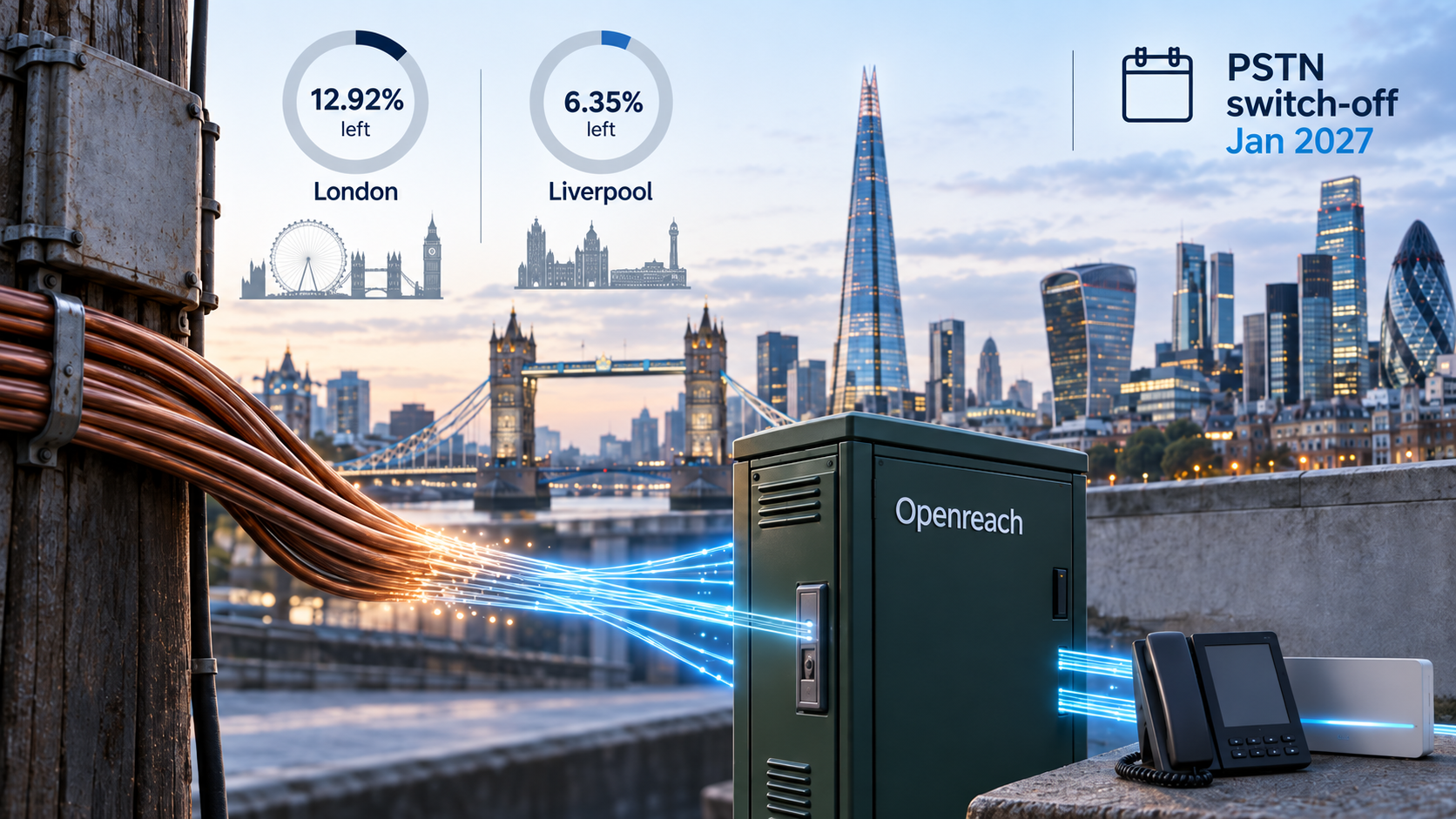
- London has 235,934 WLR lines left to migrate, or 12.92% of its 2020 base, the highest share among ten urban areas compared by Openreach
- Liverpool has 6.35% left, followed by Manchester at 7.35% and Sheffield at 7.55%, as providers work towards the 31 January 2027 PSTN deadline
The fact
Openreach has published city-level data showing how much of its Wholesale Line Rental base remains to be moved from the UK's legacy phone network. London has 235,934 lines left to convert, equal to 12.92% of its 2020 base. Glasgow follows at 10.60%, while Liverpool has the lowest remaining share at 6.35%. Manchester is at 7.35% and Sheffield at 7.55%.
Across the ten cities and surrounding areas, more than 90% of the legacy lines recorded in 2020 have moved to digital alternatives. Openreach estimates around 1.5 million copper-based lines remain nationally, including about 350,000 business premises, before the PSTN closes on 31 January 2027. The company has also raised WLR prices during 2026, with a final increase due on 1 October that will take basic legacy line rental to twice its 2025 level.
The assessment
The city figures show that the PSTN programme is moving from mass migration towards dealing with the remaining exceptions. Providers have already converted most ordinary lines, but some of those still connected support equipment such as payment terminals, lift diallers, alarms, intercoms and other systems that need to be identified and tested before their underlying service changes.
London's 12.92% figure does not by itself explain why its migration rate is lower. It does show that providers still have both the largest absolute pool and the highest remaining share among the ten urban areas in Openreach's comparison. The work is therefore increasingly about finding individual dependencies rather than moving large groups of conventional phone users.
For BTW readers, the final phase of the PSTN programme depends on whether providers can identify what still uses each legacy line and move those services without interruption. City-level migration figures now provide a more useful measure of where that work remains concentrated.
What to watch
Watch London's remaining WLR total after the October price increase, alongside national business-line migrations before 31 January. Also track how many customers require temporary emergency voice arrangements after the deadline. Falling line counts accompanied by successful migration of alarms, payment systems and other connected equipment would show that providers are clearing the harder residual cases rather than simply reducing ordinary voice lines.
Member Briefing
Deeper Profile Context
Sign in with the right membership level to unlock the full briefing and source notes.
Only for Strategic Circle
Strategic Circle
Open to all readers. Unlock profile briefings after joining and signing in.
Join Strategic CircleOnly for Leadership Alliance
Leadership Alliance
For qualified IP-asset owners and management; sign in to unlock alliance briefings.
Join Leadership Alliance