
Summary
- NTT WEST's 14 September announcement schedules applications from 18 September and service from 9 October in specified parts of Okazaki, not a completed citywide rollout.
- The commercial offer spans access, internet-provider and television agreements. Some wholesale-based retail offers can carry the services, but eligibility and contract responsibilities are not uniform.
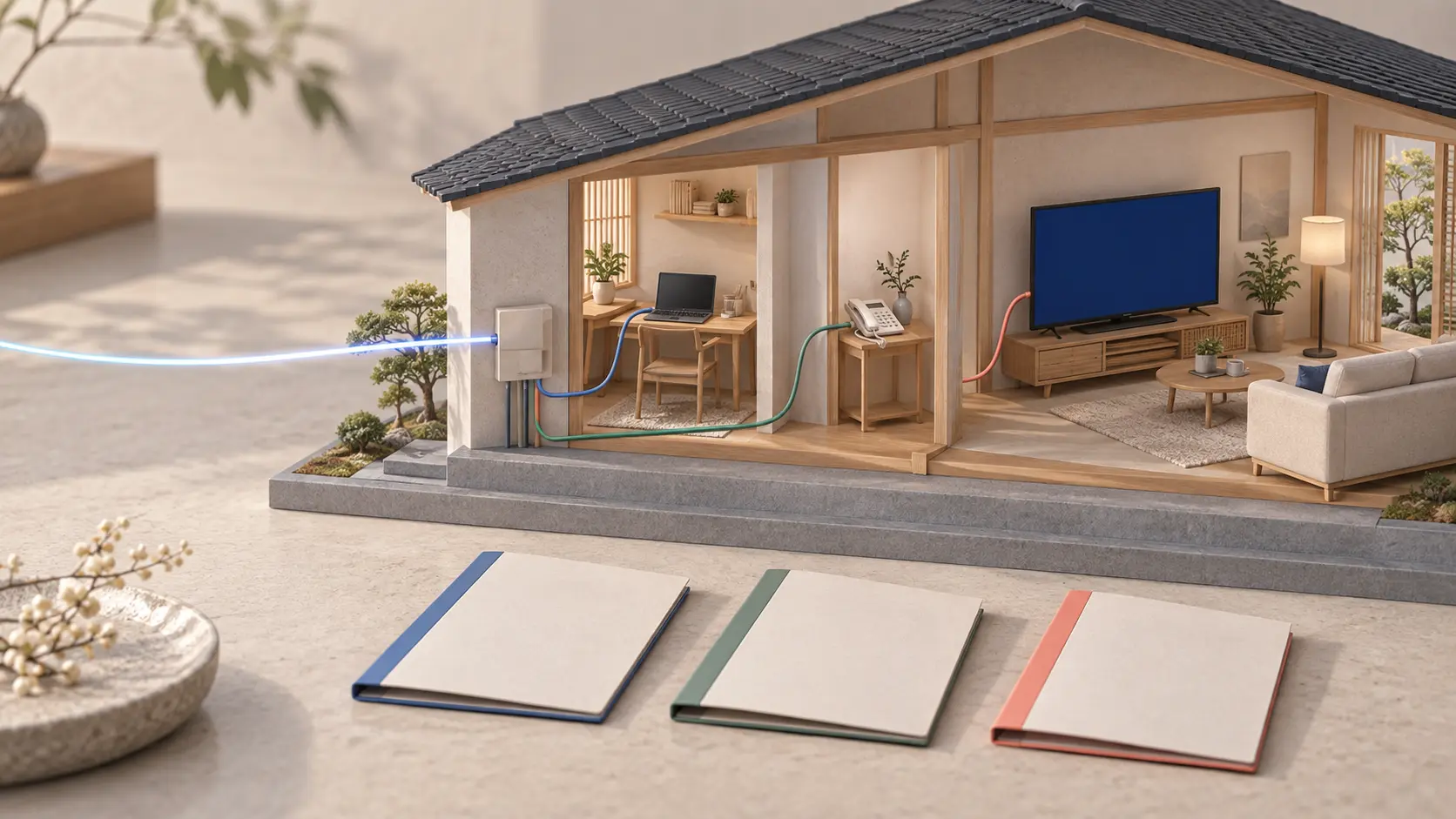
A fibre connection can carry several services without making them a single purchase. That is the useful market reading of NTT WEST's 14 September announcement for parts of Okazaki, in Japan's Aichi prefecture. The planned expansion combines fibre access, IP telephony and television-related offerings; its footnotes describe a more divided retail relationship than a coverage map suggests.
Two dates, then an address check
Applications are scheduled to open on 18 September, with service planned from 9 October. Neither milestone has occurred as of this article's 15 September reporting date. The operator identifies only parts of the city and warns that some premises inside the service area may still be unavailable.
The directly supplied fibre-access services also require a compatible internet-provider contract and separate usage charges for internet use. Access availability is therefore not proof that a household has bought a complete internet service. The announcement establishes a proposed market extension, not a subscriber count or an independently tested improvement in speed.
Television adds another commercial boundary
The household television offer requires both NTT WEST's telecommunications transmission service and SKY Perfect JSAT's broadcasting/viewing service. The official television conditions spell out that split, alongside the need for eligible access services and appropriate reception equipment.
Paid BS/CS channels bring additional provider agreements, charges and equipment requirements. The announcement says SKY Perfect JSAT bills the specified optional television-service basic and selected-channel fees. A shared physical connection does not merge the companies' contractual roles. Nor do the reviewed sources establish an all-in bill or a saving for a particular household.
Apartment eligibility needs equal care. Restrictions apply to the ordinary household service, including apartment-type access, while a separate building-wide contract plan has its own owner-level access, transmission and viewing agreements and charges. Neither “all apartments excluded” nor “all apartments automatically included” is a faithful account of those arrangements.
Retail choice on the same access network
The release also says some optical-collaboration offers can support the television services. Under NTT WEST's explanation of that model, other providers lease its access lines and combine them with their own services. The retail access contract is then with the collaboration provider; internet-provider service may be included, depending on the offer.
This creates room for different retail packages without requiring every seller to build a parallel last mile. It does not establish how many such offers will be available at a particular Okazaki address, or whether competition will lower its bill. Those are outcomes to investigate after the announced access opportunity becomes usable.
The distinction is practical: a customer can see the same underlying fibre technology while buying from a different counterparty, under a different set of inclusions. Network coverage and retail comparability are related, but they are not interchangeable.
Member Briefing
Deeper Profile Context
Sign in with the right membership level to unlock the full briefing and source notes.
Only for Strategic Circle
Strategic Circle
Open to all readers. Unlock profile briefings after joining and signing in.
Join Strategic CircleOnly for Leadership Alliance
Leadership Alliance
For qualified IP-asset owners and management; sign in to unlock alliance briefings.
Join Leadership Alliance