
Summary
- Nuuly averaged about 484,000 active subscribers in Urban Outfitters' fiscal second quarter, up 30.4%, while Subscription segment revenue rose 28.6% to US$178.6 million. A rough same-quarter receipt proxy fell about 1.4%, but it is not company-reported ARPU and one quarter does not establish a trend.
- Adjusted Subscription operating margin still reached 10.1%. The harder test comes next: automation, an unspecified offer intended to lift ARPU, and an eventual fulfilment network for roughly 1.2 million subscribers have to improve receipts and utilisation without weakening demand.
The quarter produced three different clocks
Nuuly's subscriber count, revenue and physical network no longer move on the same timetable.
Urban Outfitters reported US$178.605 million of Subscription segment revenue for the three months ended 31 July 2026, up 28.6% from US$138.932 million. Average active subscribers increased 30.4%. Management's conference-call notes put the quarterly average at approximately 484,000 and said the active base crossed 500,000 in early June before the usual summer easing.
The small gap between those growth rates is more informative than either headline alone. Dividing reported segment revenue by the rounded average count produces a quarterly revenue-per-average-active-subscriber proxy of about US$369. Repeating the exercise for the prior year—inferring roughly 371,000 average subscribers from the current count and the reported growth rate—produces about US$374. On those rounded inputs, the proxy declined approximately 1.4%.
That calculation is an analytical receipt, not an Urban Outfitters metric. The company did not report realised ARPU. Its Subscription segment is primarily the monthly Nuuly women's apparel rental service, but subscribers can also purchase rental pieces they already hold or order merchandise through the site or app for delivery with the next rental shipment. Revenue per average subscriber therefore mixes the core fee with purchase behaviour, timing and rounding. It is not price, recurring revenue, churn, lifetime value or contribution profit.
The direction is also not yet a trend. In the first fiscal quarter, Subscription revenue rose 34.5% while average active subscribers increased 33.3%. Across the first half, the respective increases were 31.4% and 31.8%. The latest quarter creates a question about monetisation mix; it does not answer it.
Margin improved while the receipt proxy softened
The opposing margin signal is why a subscriber-only reading would be inadequate. Adjusted Subscription gross profit was about US$52.5 million, or 29.4% of revenue, against US$39.7 million and 28.5% a year earlier. Adjusted Subscription operating income rose to about US$18 million, or 10.1%, from US$12.5 million and 9.0%. Management described this as Nuuly's first double-digit operating-margin quarter.
Those adjusted figures matter. Reported Subscription gross profit included a US$1 million benefit from refunds of tariffs previously paid under the International Emergency Economic Powers Act. The much larger companywide refund does not belong to Nuuly. Removing the segment benefit leaves a cleaner view: the business converted more of each revenue dollar into adjusted gross and operating profit even though the simple receipt proxy edged lower.
That combination can occur without contradiction. Rental inventory may circulate more efficiently; fulfilment, laundry, damage and marketing costs may absorb better; merchandise purchases can alter revenue mix; or seasonal subscriber behaviour can move the average denominator. Urban Outfitters does not disclose the unit data needed to choose among those explanations. It reports segment sales, gross profit and operating income, while principal Subscription assets are rental product and property and equipment. It does not publish churn, retention, cohort revenue, add-on purchases, segment cash flow or cost per turn.
Management also cautioned that the second quarter is seasonally Nuuly's strongest margin period. Its fiscal-year outlook calls for more than US$700 million of Nuuly revenue and a high-single-digit operating margin, with high-single-digit margins expected in the back half. The 10.1% quarter is therefore a useful operating receipt, not a new permanent floor.
Capacity is arriving before a disclosed monetisation design
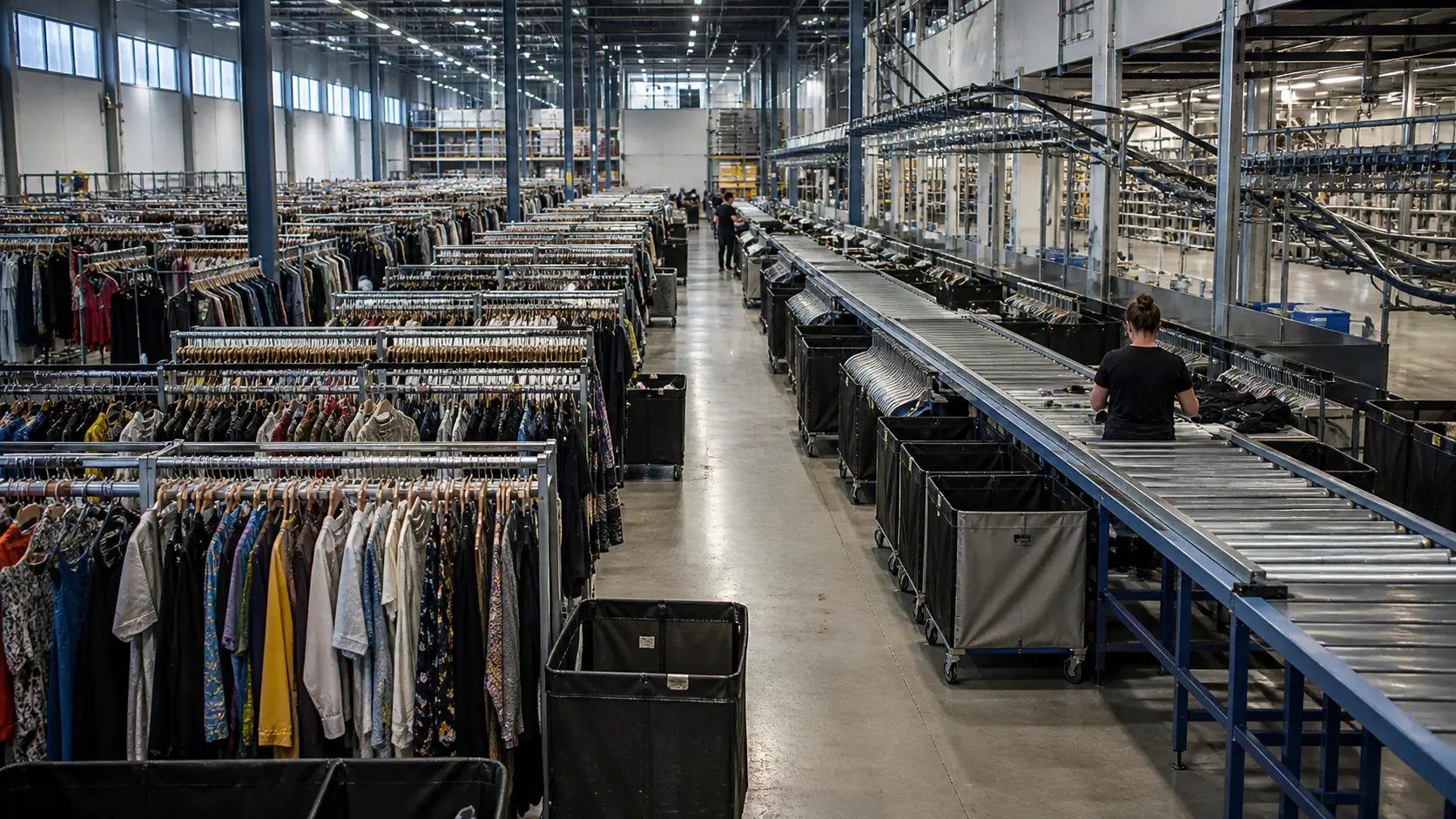
The denominator is about to become physical. Urban Outfitters is expanding its Kansas City-area Nuuly facility from roughly 600,000 to 1 million square feet and says it can support as many as 600,000 subscribers. Garment-storage automation was due to begin in the current month, sortation in the fiscal fourth quarter and picking around the middle of the next calendar year.
A second step is planned outside Philadelphia for late calendar 2028. Management described an initial 300,000-square-foot East Coast building expandable to 1 million square feet, taking regional capacity from about 200,000 to 600,000 subscribers. Together, management puts eventual network capacity near 1.2 million subscribers.
That is roughly 2.4 times the early-June subscriber peak, using 500,000 as a conservative reference. It is not a forecast that 1.2 million people will subscribe. Capacity is permission to serve demand, not evidence that demand exists. The economic value depends on the pace at which inventory, labour, transportation and automation are loaded across the larger fixed-cost base.
Urban Outfitters has the balance-sheet resources to build. It ended July with US$598.756 million of cash and US$117.371 million of marketable securities, and paid US$268.056 million for property and equipment in the first half. The company plans about US$475 million of fiscal-year capital expenditure, roughly half for logistics. But that logistics envelope spans both Retail and Subscription; assigning half the plan, or any exact dollar amount, to Nuuly would invent a segment disclosure.
The first-quarter filing offers one concrete connection: property-and-equipment cash spending rose to US$193.244 million, primarily for distribution-network investment that included purchasing the previously leased Raymore, Missouri Nuuly fulfilment centre. The spend establishes commitment. It still does not reveal Nuuly's incremental capital return.
The promised ARPU lever remains unnamed
Management says it will extend the programme in the first half of the next calendar year with the specific intention of increasing ARPU. It has not disclosed what the extension is, what it will cost, who can use it, what take-up it assumes or whether it changes fulfilment intensity.
That missing design is central. A higher-priced tier, more items, faster delivery, add-on purchasing or another service could all lift revenue per subscriber, but each would place a different burden on rental inventory, garment turns, warehouse automation and transport. A lever that lifts receipts while consuming disproportionately more handling capacity may not improve returns. A lever that is operationally light may still test retention if subscribers perceive weaker value.
Assortment adds another moving part. Management said Nuuly approached 33,000 choices, about 35% more than a year earlier, across Urban Outfitters' own brands, third parties and vintage product. It also pointed to personalisation, fit guidance and delivery improvements. Those features can plausibly support conversion or retention, but the disclosure supplies no cohort receipt. They remain management's operating explanation until churn, repeat behaviour or realised ARPU makes the outcome observable.
Sources
- Urban Outfitters fiscal-2027 Q2 earnings release filed with the SEC
- Urban Outfitters Form 8-K filed 26 August 2026
- Urban Outfitters fiscal-2027 Q1 Form 10-Q
- Urban Outfitters fiscal-2026 Form 10-K
- Urban Outfitters fiscal-2027 Q2 results and commentary
- Urban Outfitters fiscal-2027 Q2 conference-call notes
Member Briefing
Deeper Profile Context
Sign in with the right membership level to unlock the full briefing and source notes.
Only for Strategic Circle
Strategic Circle
Open to all readers. Unlock profile briefings after joining and signing in.
Join Strategic CircleOnly for Leadership Alliance
Leadership Alliance
For qualified IP-asset owners and management; sign in to unlock alliance briefings.
Join Leadership Alliance