Summary
- The Commission's per-event Event Notification Report prints the event time and the notification time as separate header fields, so an outsider can subtract them: two hours eleven minutes against a four-hour tier, three hours fifty-one minutes against an eight-hour tier.
- The same header carries no discovery field, though discovery is where the 60-day written report starts and where one eight-hour category is defined; and on one 2026 report the two printed endpoints carry zone labels the page never defines, so the interval is 23 minutes on one reading and minus 37 minutes on the other.
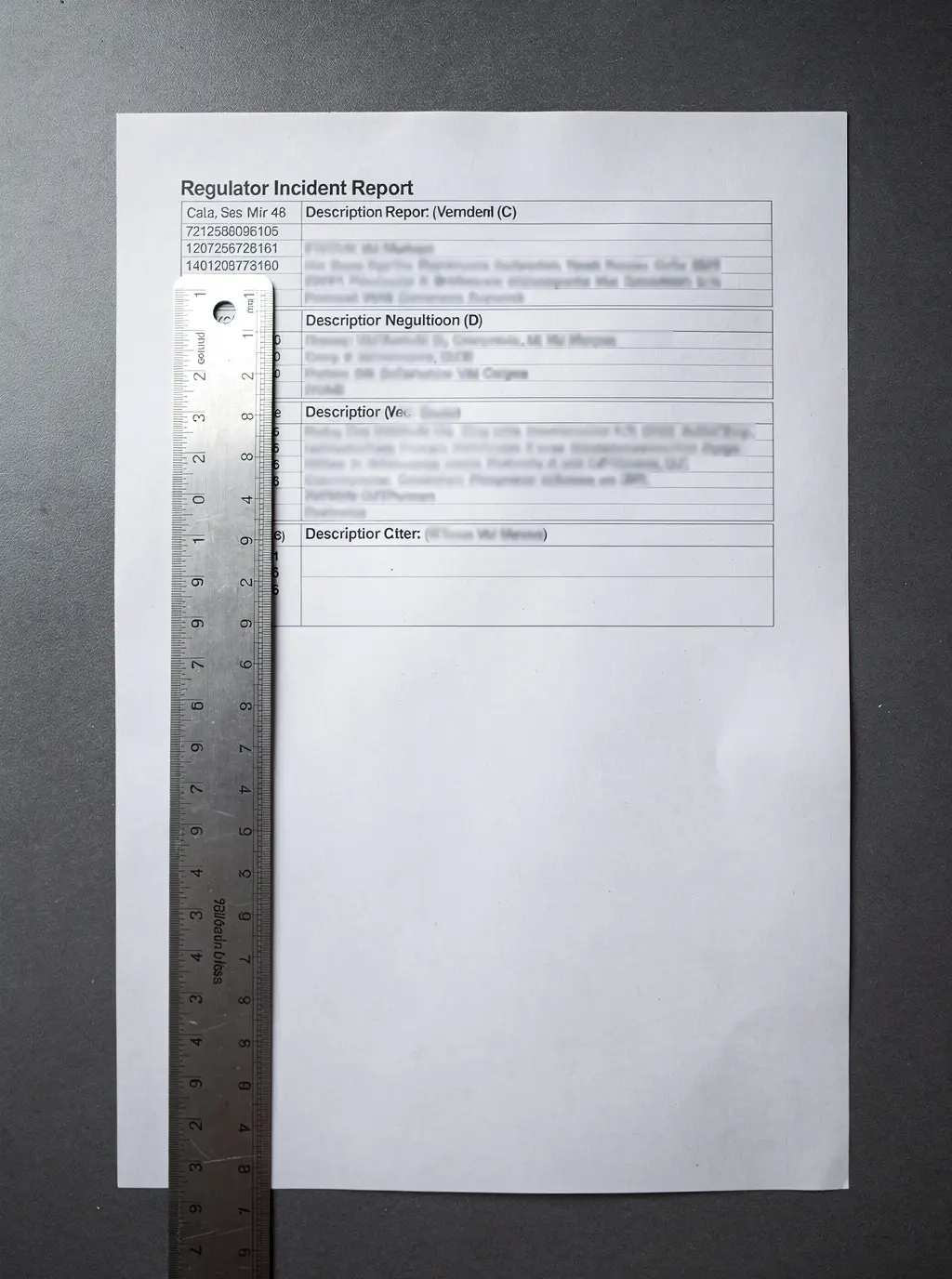
Two timestamps sit a few lines apart in the Commission's own report on Event 58177. Event Time: 03:03 [EST]. Notification Time: 05:14 [ET]. Same date, 26 February 2026. Subtract, and the licensee took two hours eleven minutes to tell the regulator that a reactor at Hatch Unit 1 had tripped while critical, against a four-hour outer bound. The report names the section in its own header — 50.72(b)(2)(iv)(B) - RPS Actuation - Critical — and the licensee's narrative repeats it: this event is being reported as a four-hour, non-emergency notification per 10 CFR 50.72(b)(2)(iv)(B) (Event Notification Report, 27 February 2026).
I have spent five briefings looking for that subtraction. The FCC's 47 CFR Part 4 prints a product threshold and presumes the outage filing confidential. The Federal Reserve's interagency rule runs a 36-hour clock from the bank's own determination. CIRCIA prints two clocks and left the manner-and-form rule pending. The Cyber Resilience Act's Article 14 prints four intervals for the manufacturer and none for the buyer. Form DOE-417 prints four filing intervals and an annual table of events with no arrival column at all. In each of those, an outsider could read the deadline and could not time it.
Here both ends of the clock are on the page.
The rule behind the pair is worth reading in its own words, because the hour count is the least interesting thing in it. 10 CFR 50.72(b) carries three non-emergency tiers — one hour, four hours, eight hours — and every one of them is anchored to the same moment: as soon as practical and in all cases within one, four or eight hours of the occurrence (10 CFR 50.72; the Commission's own reproduction agrees word for word (part050-0072)). The Emergency Class limb is anchored somewhere else entirely — notification not later than one hour after the time the licensee declares one of the Emergency Classes. And the written report sits under a different section with a different anchor: a Licensee Event Report within 60 days after the discovery of the event (10 CFR 50.73).
Four starting points, three kinds. The occurrence, three times. The licensee's own declaration, once. Discovery, twice — the 60-day written report, and inside the eight-hour tier a category defined by an event that, at the time of discovery, could have prevented the fulfilment of the safety function. Two of those anchors are acts of the licensee. Neither of them is timestamped in the header block that carries the other two.
Then the second file, and the pattern holds. Event 58242, Beaver Valley Unit 2, filed as an eight-hour non-emergency notification under 50.72(b)(3)(ii)(A) - Degraded Condition: Event Time 09:20 [EDT], Notification Time 13:11 [ET], three hours fifty-one minutes inside an eight-hour bound (16 April 2026).
Then the third file, and the arithmetic stops cooperating. Event 58129, Comanche Peak, an Unusual Event reported under 50.72(a)(1)(i): Event Time 18:23 [CST], Notification Time 18:46 [ET] (27 January 2026). Read the brackets as two labels for one local clock and the licensee notified in 23 minutes. Read them as two named offsets — Central Standard Time against Eastern Time — and the notification precedes the event it reports by 37 minutes. The page does not define [ET]. Both readings sit on the same line of the same document, and the sign of the subtraction depends on which one a reader supplies.
That is the finding in miniature. The strongest receipt I have found in six notification regimes is a receipt with one undefined label and one missing field.
The missing field matters more. The three 2026 headers I read for this piece print a notification date and time, an event date and time, and a last update date. None prints a discovery date or time. Yet discovery is where the 60-day written report starts, and where one eight-hour category begins. The clock a stranger can time is the occurrence-anchored one; the obligations that run from what a licensee knew, and when, run off the page.
Discovery is not absent from the programme altogether. It appears wherever the licensee volunteers it, inside the narrative: Incident date: March 4, 2025. Discovery date: March 14, 2025 (14 March 2025). A date inside a paragraph is not a field, and a field is what a stranger can query across a thousand reports.
The bound on that claim belongs beside it. The programme publishes yearly indexes from 1999 through 2026 and also offers a monthly raw data text file and an Excel data dictionary (Event Notification Reports); the metadata record names both files and describes the monthly one as pipe-delimited (data.gov record). I could not open either file for this piece, so the statement stops where the material does: on the headers of the reports I read, plus one 2011 pipe-delimited record reproduced by a third party, which shows notification and event dates and times, a zone field, class and section, and no discovery column (csvkit documentation). That record is not a Commission publication and cannot establish today's schema. The data dictionary is the document that would settle it, and it stays unread.
The addressee matters here too. A notification under 50.72 goes to a staffed operations centre rather than to a filing window, and the published reports are headed U.S. Nuclear Regulatory Commission Operations Center; the written-report alternative under 50.73(a)(1) is a telephone call to the NRC Operations Center. What arrives at 05:14 is a call turned into a paragraph, not a document drafted for review. That is why the notification can exist within four hours of a trip, and why it reads the way it does.
What would change the reading is small and cheap. A discovery date and time in the header, printed beside the event and notification fields, would let an outsider time the 60-day written report and the discovery-anchored eight-hour category the same way this piece times Hatch. One defined bracketed label — or both endpoints printed in the same offset — would stop the subtraction flipping sign on a page the agency publishes as its record of what happened.
None of this is an accusation, and the records do not support one. Two hours eleven minutes is inside four. Three hours fifty-one is inside eight. Twenty-three minutes is inside one. This is about what a published record can be made to prove: more than any of the five instruments I compared it against, and less than the rule it reports on.
Prior coverage, stated rather than assumed: two searches on 19 November 2026 — for the Commission and for the instrument's own name — returned no BTW rows, so the delta claimed here is the instrument and its published residue rather than any licensee's history. The adjacent coverage this piece measures itself against is the five notification regimes named above.
Member Briefing
Read the full trend briefing
Members read the full briefing with the source notes behind every finding.
Strategic Circle
A daily briefing in your language, built from changes we have verified.
Join for USD 20/monthCancel anytime.
Members also get the full research library, a daily briefing on the networks they follow and the private forum.