
Summary
- What it says: Natural Wireless is best read as a New York-area fixed-wireless operator whose hardest asset is not a speed claim but permission: roof access, building pathways, line of sight, landlord trust, backhaul diversity and technicians who can turn a high place into working service befor
- Main topic: Regional ISP economics; Peering and transit; Public-sector continuity
- Context: market / company research report / North America; United States; New York metropolitan area
The install begins above the rent roll
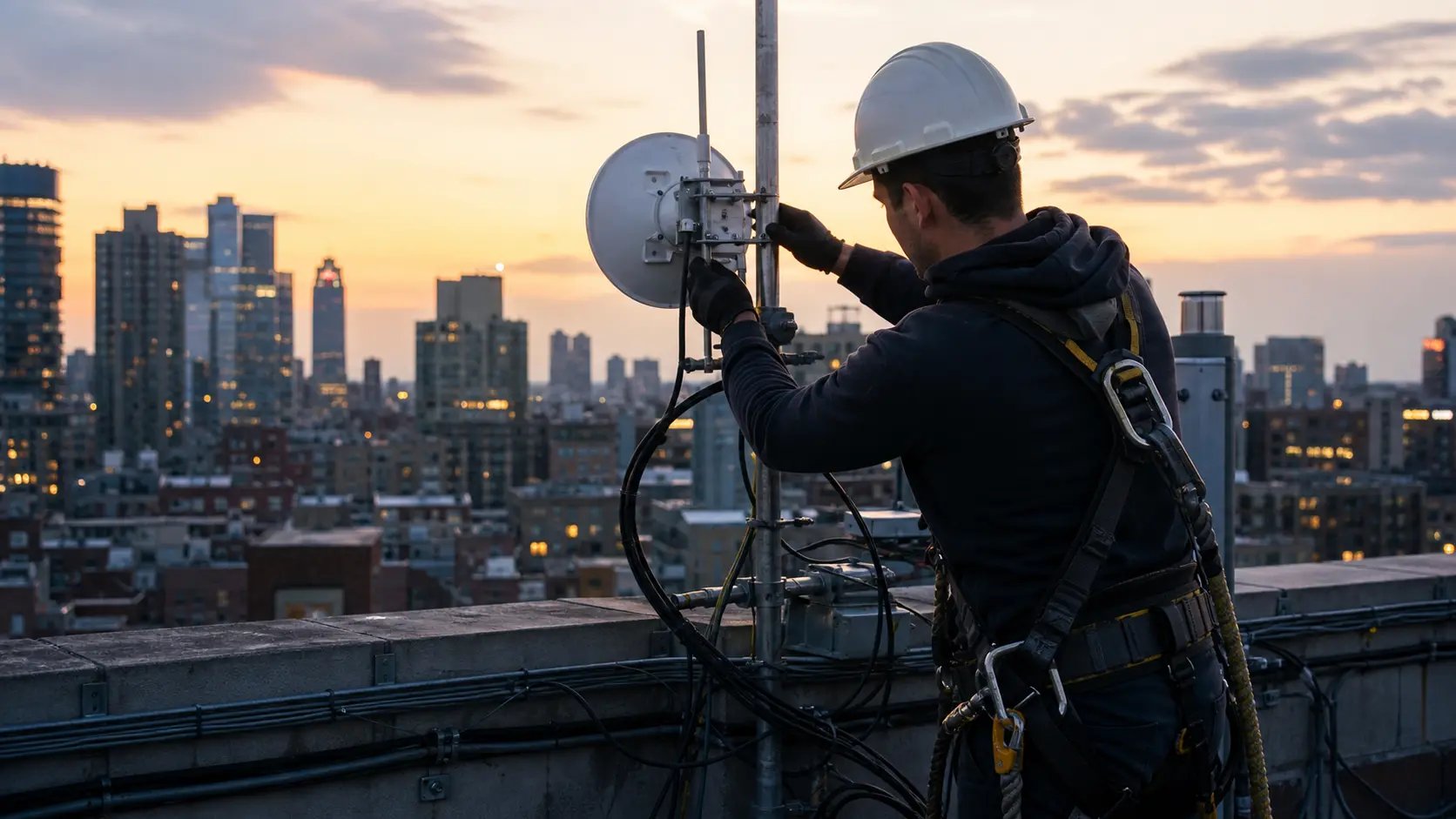
A Natural Wireless sale begins in a place that most broadband plans treat as an afterthought: the roof. A technician needs safe access, power, mounting room, a line of sight, permission from the owner or manager, and enough confidence that the customer below will treat the wireless path as serious infrastructure rather than as a temporary workaround. The visible equipment may be a modest antenna, a weatherproof enclosure and a cable route down through the building, but the scarce asset is institutional consent. In dense New York buildings, that consent is a form of rent.
Whoever can secure height, pathway, backhaul and a resident or commercial buyer has created something that is harder to replicate than another advertising claim about speed.
Natural Wireless presents itself as a dedicated internet provider for businesses, residents and short-term venues, saying that it owns, manages and operates its infrastructure and that its history began in 2003 with hotel internet service before expanding into residential internet, commercial dedicated broadband and event Wi-Fi (https://naturalwireless.com/). The company now sells the language of "Fixed Wireless Fiber" to businesses, emphasizing automatic failover, no underground wires, installation within five days and speeds up to 20Gbps (https://business.naturalwireless.com/). Its residential page offers building-wide access, symmetrical speeds up to 1/1Gbps, no annual contract, no sign-up or cancellation fees, and the promise that a resident can connect to the property's Wi-Fi signal without managing a router or waiting for an apartment service call (https://residential.naturalwireless.com/).
The best early clue to the economics is not the homepage. It is a 2024 New York Public Service Commission filing in a dispute over Spectrum's effort to enter a 958-apartment building at 29-55 Northern Boulevard in Long Island City. The landlord's response said the property already had Verizon, RCN and Natural Wireless, and that Natural Wireless was using available pathways for routing telecommunications cabling to each apartment; the filing argued that Spectrum was late because the building's available space and pathways had already been allocated (https://documents.dps.ny.gov/public/Common/ViewDoc.aspx?DocRefId=%7B701D5291-0000-C311-8F2C-CE050D26F63F%7D). That is a single adversarial filing, not a neutral engineering audit. Yet it exposes the real economy. A broadband provider in an apartment tower is buying its way into space measured not only in bits per second, but in sleeves, risers, closets, cabinets, conduits, roof rights, manager patience and the owner's fear of disruption.
That filing also explains why Natural Wireless is more interesting than a small marketing wrapper. A provider that can become one of the named options inside a 958-unit property has a building-level asset, even if its national brand awareness is low. The property may not deliver every apartment as a paying customer. It may not guarantee a long contract. But the building relationship creates a local market that a rival cannot enter merely by buying transit or lowering a price. It must obtain access, prove engineering feasibility, manage landlord risk and persuade residents or businesses that a wireless path is not second class.
The governing argument is therefore simple. Natural Wireless has a defensible role if it can keep turning urban height and building access into quick, physically diverse connectivity that building owners, businesses and residents value enough to pay for. Its risk is that the same asset is fragile: lose a landlord relationship, fail a high-rise support test, underinvest in backhaul, or let Verizon, Starry, Spectrum, Astound, T-Mobile or a building-wide fiber provider reset expectations, and the rooftop becomes only another piece of hardware.
Identity, network standing and the New Jersey base
The public identity record is reasonably clear. ARIN identifies Natural Wireless, LLC as organisation NWL-20, with a South Hackensack, New Jersey address at 60 Saddle River Ave - Unit B, a registration date of February 14, 2013 and an update date of November 25, 2024 (https://whois.arin.net/rest/org/NWL-20.json). The ARIN point-of-contact record lists a Natural Wireless network operations contact at the same South Hackensack address, a noc@naturalwireless.com email address and a +1-201-438-2865 office number (https://whois.arin.net/rest/poc/NOC13028-ARIN.json). The company website footer uses Natural Wireless, LLC, while its public contact and business pages continue to direct prospective buyers to the Natural Wireless domain and phone lines (https://naturalwireless.com/).
The routing record is broader than the old local-Wi-Fi story might imply. ARIN records AS18616, named NATURALWIRELESS, as assigned to Natural Wireless, LLC, with registration on May 7, 2013 (https://whois.arin.net/rest/asn/AS18616.json). ARIN also records AS26878, named TWRS-NYC, to Natural Wireless, LLC, with an original registration date of December 11, 2002 and a May 29, 2024 update (https://whois.arin.net/rest/asn/AS26878.json). A newer AS400648, also named NATURALWIRELESS, was registered to Natural Wireless, LLC on March 1, 2024 (https://whois.arin.net/rest/asn/AS400648.json). Those records do not show customer count or revenue. They do show control of internet numbering and routing assets, which matters when selling dedicated access to enterprises and buildings that care about route continuity, public addressing and operational accountability.
The associated network blocks reinforce that picture. ARIN's list of Natural Wireless organisation networks includes IPv4 ranges such as 52.119.64.0-52.119.95.255, 64.111.64.0-64.111.79.255, 68.233.176.0-68.233.191.255, 198.254.112.0-198.254.127.255 and multiple Towerstream-labeled ranges, plus an IPv6 allocation 2606:FA80::/32 (https://whois.arin.net/rest/org/NWL-20/nets.json). The presence of old TWRS names matters because Natural Wireless is not only growing organically. It appears to have absorbed at least some assets once tied to Towerstream, a fixed-wireless carrier whose own brand was built around rooftop service in dense markets.
PeeringDB gives the public interconnection surface for AS18616. It lists Natural Wireless as a regional Cable/DSL/ISP network with 100 IPv4 prefixes, zero IPv6 prefixes shown in that profile, traffic in the 20-50Gbps band, mostly inbound traffic, an open peering policy, two New York facilities and two exchange connections (https://www.peeringdb.com/api/net/8905). The two facilities are Digital Realty NYC at 60 Hudson Street and 375 Pearl / Intergate.Manhattan, both in New York; the exchange ports include a 30Gbps DE-CIX New York connection and a 10Gbps Digital Realty New York connection (https://www.peeringdb.com/api/net/8905). For a regional operator, that is neither tiny nor national-scale. It is a New York-centric interconnection footprint aligned with the company's city-building thesis.
This is also where the uncertainty begins. PeeringDB's profile shows no IPv6 prefixes and no IPv6 exchange addresses for AS18616, even though ARIN lists an IPv6 allocation to the organisation. That may reflect how the company updates public records rather than every internal capability. Still, to a technically demanding buyer it is a question. A business buying resilient internet wants to know not only that a route exists, but that the provider's routing, addressing, monitoring, abuse handling, maintenance windows, upstream diversity and IPv6 roadmap are current.
Natural Wireless has enough public network evidence to be taken seriously; it does not disclose enough to make external diligence easy.
The building, not the household, is the sales unit
Natural Wireless's residential proposition is unusually building-centered. The residential page says residents can access service anywhere on the property, including the apartment, gym, roof and community room, and that online subscription requires connecting to the Wi-Fi signal rather than managing a router or other equipment (https://residential.naturalwireless.com/). That is not the usual retail broadband sale in which a household chooses a modem, books a technician and becomes one isolated account. It is closer to a managed amenity model: the building obtains a property-wide access layer, and residents decide whether to join the managed service.
The company's 11 Hoyt announcement makes the model explicit. Tishman Speyer selected Natural Wireless as the building-wide internet and Wi-Fi service provider at 11 Hoyt, a 57-story Brooklyn condominium with more than 55,000 square feet of indoor and outdoor amenities. Natural Wireless described a pre-installed 1/1Gbps service, no installation appointment, no annual contract and resident connectivity in both apartments and amenity areas (https://naturalwireless.com/11-hoyt-now-powered-by-natural-wireless-building-wide-internet-service/). A quoted Tishman Speyer executive said the building-wide internet amenity helped set the building apart and improved residents' internet experience. That is precisely the landlord-side economic claim: broadband is not only a utility bill; it is a leasing and resident-satisfaction feature.
An older co-op and condo trade article adds operational color. Dror Schuchman of Natural Wireless described running vertical CAT5 or fiber and hiding Wi-Fi transmitters so wires and equipment are not visually disruptive; he said the installation is typically in hidden areas and that residents need not have wiring runs placed in each apartment because tenants connect wirelessly, with several radios extended to each floor in many cases (https://cooperatornews.com/article/wiring-your-co-op-or-condo). The article is old and should not be treated as a current engineering specification. It is still useful because it describes the strategic continuity: Natural Wireless's advantage has long been to reduce apartment-by-apartment friction inside buildings where owners care about aesthetics, resident disruption and managed common areas.
This changes the unit economics. If Natural Wireless wins only one apartment at a time, it must compete against every retail offer a resident can buy that month. If it wins a building-wide relationship, it can amortize roof work, backhaul, riser work, radios, access points, support visits and sales cost across a larger address pool. The 11 Hoyt example provides the logic but not the revenue. A 57-story luxury building with shared amenity areas can make always-on property Wi-Fi valuable to management even if some residents retain Verizon, Spectrum, Astound or another option in their individual units.
Natural Wireless can be both primary service for some households and a building infrastructure provider for the property.
The same model creates concentration risk. A building relationship may be valuable enough to justify tailored installation and support; it may also represent a large chunk of local revenue. If a property manager becomes unhappy, a board changes policy, a bulk agreement expires, a competitor subsidizes a retrofit, or residents organize around a quality complaint, revenue can move in clusters. That is the risk hidden inside the building-as-sales-unit model. It is efficient when adoption rises. It is abrupt when trust breaks.
The business product is path diversity sold as time
Natural Wireless's business pages sell a different version of the same urban scarcity. The company says its fixed-wireless approach is "100% diverse" because it avoids underground wires, offers automatic failover, can be installed within five days and reaches up to 20Gbps on business service pages (https://business.naturalwireless.com/). A Brooklyn business page says the company's roof-mounted infrastructure lets it install, test and put a business online within five business days, and that rates range from 5/5 Mbps to 1/1Gbps with guaranteed bandwidth, data transfer rates and performance (https://business.naturalwireless.com/fiber-internet-brooklyn-ny/). Another Queens page claims a 99.9 percent service-level agreement, five-day installation and a microwave network of rooftop antennas and relays rather than underground copper or fiber construction (https://business.naturalwireless.com/fiber-internet-queens-ny/).
These are company claims and should be weighted accordingly. Their economic meaning is nevertheless clear. Natural Wireless is selling time and physical diversity. A business that cannot wait months for a lateral build, road opening, landlord approval or incumbent circuit can sometimes buy a rooftop path quickly. A customer that already has a fiber circuit may buy Natural Wireless as a second path if both existing "redundant" wired circuits enter through the same basement or street route.
In a city where a manhole fire, water main break, street work or basement cable cut can damage several nominally separate services at once, diversity from the roof can be more valuable than another wire in the same duct.
The company's own one-page hotel case study is blunt about the failure it wants buyers to imagine. It says a Manhattan hotel with more than 500 guest rooms believed three redundant internet connections were enough until a manhole explosion caused a complete internet outage that disrupted room charges, reservations, guest internet and security cameras; Natural Wireless says it designed and deployed a dedicated dual-path fixed-wireless connection within hours and restored operations before the day ended (https://d3bql97l1ytoxn.cloudfront.net/app_resources/463288/documentation/1466480_1734342114829_en-US.pdf). This is a marketing case study rather than a third-party incident report, so it should not be used as audited proof of the unnamed hotel's outage. It is still a revealing sales artifact: the company is selling insurance against the concentrated physical risks of urban wireline access.
The temporary connectivity business follows from the same operating model. Natural Wireless says its events service can quickly and securely deploy internet to indoor or outdoor locations and support needs ranging from guest Wi-Fi to live streaming (https://events.naturalwireless.com/). The main site also highlights Little Island, New York's floating public park, where Natural Wireless says it was selected as an internet service provider and supplied dedicated internet with automatic failover, dual connection and low latency (https://naturalwireless.com/natural-wireless-connecting-new-york-s-first-floating-park/). Temporary venues are not the same economics as apartment buildings, but they use the same scarce inputs: fast site survey, radio path, backhaul, power, support, reputation and the ability to make a customer believe that wireless will work under public pressure.
For field operations, the hard work is physical. A rooftop circuit has to be surveyed, installed, powered, grounded, labelled, monitored and maintained. A building-wide residential service has to balance backhaul, access points, hallways, apartment layouts, elevator cores, concrete, interference, resident devices and support calls. A business failover link has to switch cleanly when the primary path fails, which means testing, routing, CPE configuration and escalation procedures before the emergency.
Natural Wireless's promise of five-day business activation is not magic; it is a claim that the company has enough roof inventory, field labor, inventory, engineering templates and local permission to compress the elapsed time between order and revenue.
Revenue is earned one building at a time
The revenue book implied by Natural Wireless's public record is a map of buildings rather than a map of census tracts. A conventional access provider talks about homes passed, franchise territory and monthly retail plans. Natural Wireless talks about named towers, property-wide internet, resident experience, owner agreements, temporary venues and business continuity. That distinction matters because the cost of reaching a building is lumpy. The first customer requires sales work, landlord consent, engineering review, rooftop access, internal cabling, radios, testing and support readiness.
The hundredth customer inside the same building can be much cheaper to add if the access layer is already working.
This is why the 11 Hoyt example is economically richer than a single plan advertisement. A 57-story tower with more than 55,000 square feet of amenities gives Natural Wireless several possible revenue surfaces: resident subscriptions, common-area connectivity, management satisfaction, amenity differentiation and future referrals to the same developer's portfolio (https://naturalwireless.com/11-hoyt-now-powered-by-natural-wireless-building-wide-internet-service/). The company does not disclose what 11 Hoyt pays or how many residents subscribe, so the article cannot compute ARPU. But the model is visible. If the building relationship is strong, Natural Wireless can earn recurring residential revenue without repeating the full acquisition cost for every lease turnover. If the relationship weakens, resident move-ins become a churn risk rather than an acquisition channel.
The unofficial price signals show the narrowness of the consumer spread. A 2021 AskNYC post described Natural Wireless in a Brooklyn building at roughly $40 per month for 250Mbps symmetrical service, no in-apartment hardware and no router management (https://www.reddit.com/r/AskNYC/comments/mk3os4/natural_wireless_for_residential_internet/). Starry now advertises plans starting at $30 per month with a debit discount and a three-year price lock (https://www.starry.com/). Verizon's 5G Home page sells no annual contract, no hidden fees, included router and multi-year price guarantees, with 5G Home download speeds up to 100Mbps, 5G Home Plus up to 150Mbps and 5G Home Ultimate up to 300Mbps in its plan explanation (https://www.verizon.com/home/internet/5g/). These are not identical products; Natural Wireless's building-wide service and symmetrical claims differ from cellular FWA. But a resident comparing monthly bills may not make that distinction unless quality or convenience is obvious.
The business side can carry better economics because the pain of downtime is more valuable than raw bandwidth. A $40 residential account can be lost to price or Wi-Fi frustration. A business that cannot run point-of-sale, cloud files, VoIP, reservations, security cameras or guest connectivity during an outage may pay for a second path even if it rarely uses the full capacity. Natural Wireless's hotel case study is effectively a lesson in avoided loss: the value of the wireless circuit appears when several wired paths fail together (https://d3bql97l1ytoxn.cloudfront.net/app_resources/463288/documentation/1466480_1734342114829_en-US.pdf). That is why the business pages emphasize failover, guaranteed bandwidth, dual connections and fast activation rather than only price (https://business.naturalwireless.com/ and https://business.naturalwireless.com/fiber-internet-brooklyn-ny/).
The cost side is less visible but just as important. Every rooftop path can require insurance certificates, building induction, safety protocol, RF exposure documentation, power work, landlord coordination, a clean cable route and a return visit when construction, weather, window-washing rigs or roof work disturb the installation. The New York City rooftop-code provisions on antenna markings, 24/7 contact signs and RF exposure compliance are a reminder that a roof is not a casual equipment shelf (https://codelibrary.amlegal.com/codes/newyorkcity/latest/NYCadmin/0-0-0-142765). Those obligations do not necessarily make the business unattractive. They help explain why incumbency matters. Once Natural Wireless has earned access and documented the site, a rival cannot instantly reproduce the same operating base.
Support labor is the margin hinge. Natural Wireless can make a building-wide service feel effortless when a resident connects smoothly in an apartment, gym, roof deck and lobby (https://residential.naturalwireless.com/). The same architecture can feel opaque when a resident does not understand where the Wi-Fi problem begins: device, room shape, access point, building backhaul, upstream route or interference. That is where a managed wireless model differs from a modem model. The provider owns more of the experience and therefore more of the blame. A high-touch support team can turn that into retention. A slow or inconclusive support process can turn a low-friction sign-up into an equally low-friction exit.
At scale, the economic test is density adjusted for trust. Natural Wireless does not need to be the largest broadband provider in New York to earn a useful niche. It needs enough high-value buildings, business circuits and event relationships to keep field crews productive, backhaul utilized and support expertise specialized. It also needs enough route and access diversity to make the "wireless fiber" claim feel different from cellular home internet and different from a second wire entering the same basement. The roof creates the opportunity. The monthly account book determines whether the opportunity compounds.
Law gives competitors rights; buildings still ration space
New York's legal environment does not allow a landlord simply to block cable entry at will. Public Service Law Section 228 says a landlord may not interfere with cable television facilities on a property, though the landlord can require reasonable conditions to protect safety, appearance, functioning and tenant convenience, require the cable company or tenant to bear the installation and removal cost, and require indemnity for damage (https://www.nysenate.gov/legislation/laws/PBS/228). The Department of Public Service's FAQ explains that an operator denied access can petition for an Order of Entry and that nominal compensation of $1 is generally authorized unless a property-value reduction is demonstrated (https://dps.ny.gov/cable-television-company-right-entry-provide-service-faqs).
Federal policy also pushes against building-level lockouts. The FCC's 2022 multiple-tenant-environment rules prohibit certain revenue-sharing arrangements that keep competitors out of buildings and require disclosure of exclusive marketing arrangements; the order says MTEs include apartments, condominiums, cooperatives, commercial premises and shopping malls, and that obstacles to competitive choice are a real problem for people who live and work in those environments (https://www.federalregister.gov/documents/2022/03/28/2022-05862/improving-competitive-broadband-access-to-multiple-tenant-environments). In theory, those rules should help challengers. In practice, they do not create infinite riser space, infinite roof space or infinite management attention.
The 29-55 Northern Boulevard filing shows the practical gap between legal access and engineering access. The landlord did not merely say it disliked Spectrum. It argued that the building had point-of-entry sleeves, main distribution frame constraints, IDF closet issues and already occupied pathways, and said Verizon, RCN and Natural Wireless were present in a way that made Spectrum's proposed installation infeasible for the 958-unit property (https://documents.dps.ny.gov/public/Common/ViewDoc.aspx?DocRefId=%7B701D5291-0000-C311-8F2C-CE050D26F63F%7D). Whether one agrees with the landlord's position or not, the filing captures the operational reality: a building can be legally open to competition while physically awkward enough that every additional provider becomes a negotiation over scarce space.
Rooftops are regulated spaces as well. New York City's fire code requires rooftop telecommunications installations, including cellular antennas, to comply with identification, contact-signage and radio-frequency exposure requirements; it calls for durable markings, 24-hour contact information near relevant equipment and compliance certification for rooftop access areas (https://codelibrary.amlegal.com/codes/newyorkcity/latest/NYCadmin/0-0-0-142765). These are not exotic obligations, but they turn each roof into a managed operating environment. A provider with experience navigating access, signage, safe maintenance, owner requirements and RF compliance has an advantage over a pure reseller.
Natural Wireless's business development hiring confirms that access rights are a commercial function, not just a legal fact. A current company career page for a New York City MDU / property-wide internet role says the job is to secure building-wide access agreements, target new construction and conversion projects, negotiate long-term license agreements, build relationships with developers and property managers, and coordinate with legal, deployment and engineering teams on feasibility (https://naturalwireless.applytojob.com/apply/AEWU4QwIgb/Business-Development-Manager-MDU-PropertyWide-Internet-NYC). That is the job description of a company whose moat is partly real estate sales. The buyer is not only the resident or the CIO. It is the owner, the construction manager, the property manager and the board.
Towerstream's assets show expansion by market purchase
The most important external market clue is the 2024 Towerstream transaction. A law firm announcement said it represented Towerstream I Inc. in the sale of three wireless markets of commercial wireless services to Natural Wireless, LLC; the sale included subscribers, tower leases, equipment and FCC licenses, and required releases and amendments with Melody Business Finance, LLC (https://hkesnerlaw.com/law-office-of-harvey-kesner-successfully-completed-the-sale-of-three-wireless-markets-of-commercial-wireless-services-to-natural-wireless-llc-on-behalf-of-towerstream-i-inc-of-newport-rhode-island/). The announcement does not name the markets or the price. It does identify the asset categories that matter in fixed wireless: subscribers, tower leases, equipment and licences.
That list is a concise valuation map. Subscribers produce cash flow if churn is low and service quality holds. Tower leases create height and coverage. Equipment creates installed replacement value but may require modernization. FCC licences can preserve spectrum rights or operational flexibility. Releases and lender amendments suggest there was a financing or creditor context around the seller's assets.
For Natural Wireless, the transaction points to a strategy beyond one-building-at-a-time organic growth: buy useful wireless footprints when the price is lower than the cost of recreating the roof rights, customer base and regulatory assets from scratch.
The ARIN records line up with that timing. AS19982, named TWRS-FL, is now registered to Natural Wireless, LLC, with a May 29, 2024 update (https://whois.arin.net/rest/asn/AS19982.json). AS26878, named TWRS-NYC, was also updated on May 29, 2024 and is registered to Natural Wireless, LLC (https://whois.arin.net/rest/asn/AS26878.json). ARIN's network list for the organisation includes several TWRS-labeled netblocks alongside Natural Wireless-labeled ranges (https://whois.arin.net/rest/org/NWL-20/nets.json). Public registry records are not the transaction documents, but they support the inference that Natural Wireless now controls internet number resources associated with the acquired Towerstream footprint.
This matters for buyers and lenders. A regional fixed-wireless operator can look fragile if it depends only on local sales and old equipment. It looks more interesting if it can consolidate distressed or non-core wireless markets, integrate subscribers, rationalize leases, bring routes into its own interconnection fabric and reuse its sales playbook across New York, New Jersey, Florida, Pennsylvania or other urban markets. But acquisitions also import technical debt. Old radios, lease escalators, unhappy customers, underused licensed assets and uneven local support can erase the benefit of a cheap purchase.
The one fact that would most change the judgement is the acquired-markets retention rate: if most Towerstream customers stayed and paid after integration, Natural Wireless has proven an expansion engine; if churn was heavy, the assets may be less valuable than the announcement suggests.
The substitution threat is no longer only cable
Natural Wireless competes against several kinds of substitute, each with a different pressure point. Traditional wired providers can bundle TV, mobile, fiber, cable, voice and promotions. Verizon's Fios and 5G Home products create a brand and price umbrella. Spectrum and Astound can be present through cable infrastructure and building pathways. Starry has long attacked the same MDU fixed-wireless market with a simple residential proposition, and its homepage now says Starry is joining Verizon, advertises plans starting at $30 per month with a debit discount, a three-year price lock, no long-term contracts and free Wi-Fi router (https://www.starry.com/). Verizon's 5G Home page says Starry is now a Verizon company and also markets Verizon 5G Home as a plug-and-play service with no annual contracts, no hidden fees or equipment charges, price locks and customer termination-fee credits (https://www.verizon.com/home/internet/5g/).
Verizon's Starry acquisition changes the market psychology. Verizon announced in October 2025 that Starry served MDUs in Boston, Denver, Los Angeles, New York and Washington, D.C., and that the acquisition would support a plan to double fixed-wireless subscribers to 8-9 million by 2028 and expand fixed-wireless availability to 90 million households (https://www.verizon.com/about/news/verizon-acquisition-starry). By July 2026, Verizon's own customer page says Starry is now part of Verizon (https://www.verizon.com/home/internet/5g/). For Natural Wireless, the threat is not simply that Starry exists. It is that a national carrier can combine an urban MDU wireless playbook with mobile bundling, fiber, advertising scale, customer credits and deep procurement.
The customer-loss mechanics differ by segment. A household leaves Natural Wireless if the building Wi-Fi feels unstable in video calls, if a wired alternative promises lower latency or a stronger in-unit router, if Starry or Verizon offers a lower price with an easier guarantee, or if the resident distrusts a managed property network. A business leaves if a national carrier can provide a better SLA, if a second fiber path becomes available, if internal IT prefers a familiar procurement vendor, or if a cloud migration reduces the need for a dedicated local failover circuit.
An event buyer leaves if a venue already has a preferred connectivity partner or if a production firm brings its own bonded cellular, satellite or carrier relationship.
Unofficial customer chatter is mixed but economically useful. A Reddit post in AskNYC from 2021 described Natural Wireless as available in a Brooklyn building at roughly $40 per month for 250Mbps symmetrical service and no in-apartment hardware, while the poster worried about scarce public information and the security implications of building-wide access (https://www.reddit.com/r/AskNYC/comments/mk3os4/natural_wireless_for_residential_internet/). A more recent Long Island City Reddit thread from early 2026 complained about weak connections during virtual calls in Jackson Park and discussed switching to Verizon, while another commenter said Natural Wireless had worked better in a smaller apartment layout (https://www.reddit.com/r/longislandcity/comments/1ql2ke1/natural_wireless_internet_in_jackson_park/). These are not representative surveys. They are signals of what the business must manage: customers may like price and convenience, but a few visible complaints can reshape a building's conversation.
Third-party directory signals should also be handled carefully. ChamberofCommerce lists Natural Wireless at 1412 Broadway in New York with a 4.4-star rating from 118 reviews and a phone number matching the company's retail presence (https://www.chamberofcommerce.com/business-directory/new-york/new-york/internet-service-provider/11915847-natural-wireless). The BBB page says Natural Wireless is not BBB accredited but gives an A+ rating and describes the company as a wireless internet service provider with 22 years in business (https://www.bbb.org/us/nj/east-rutherford/profile/internet-service/natural-wireless-0221-90007596). Ratings pages can be noisy and should not substitute for operating data. Their value is reputational: they suggest a real customer footprint, but not enough public depth to settle the quality question.
A failure scenario that changes the economics
Consider a high-rise where Natural Wireless is one of the installed providers, similar in scale to the 29-55 Northern Boulevard example. The company has a rooftop path, cabling through constrained pathways, access equipment on floors and a resident base that values quick sign-up. The property manager changes, a competitor offers a lower bulk rate, and residents begin reporting video-call instability.
Natural Wireless dispatches technicians, but the root cause is partly physical: one wing has weak in-unit coverage after renovations, a roof radio needs realignment after storm work, and the primary backhaul path is being stressed during peak hours. The customer issue is no longer one trouble ticket. It becomes a landlord-retention problem.
If the building relationship is lost, the economics change sharply. The company does not merely lose one household. It loses the address pool, the marketing right, the goodwill attached to common-area Wi-Fi, and the chance to amortize roof and riser costs across future residents. The equipment may remain recoverable, but the building's reputation has moved to a competitor. In a 958-unit property, even modest adoption can represent enough monthly revenue to justify dedicated support attention. Losing the relationship would therefore turn a capitalized local asset back into stranded field work.
The same failure can hit the business side. A hotel or media customer buys Natural Wireless for diversity. If automatic failover fails during the one outage it was meant to protect, the customer's willingness to pay for roof diversity collapses. A circuit sold as insurance is judged only when the insured event arrives. That is why Natural Wireless's 24/7 support article matters. The company says it offers round-the-clock technical support and continuous monitoring by remote management support teams because downtime can stop productivity, time and money for businesses (https://naturalwireless.com/natural-wireless-offers-24-7-technical-support/). Support labor is not a soft feature; it is part of the economic product.
What a buyer would pay for, and what it would demand
A buyer, lender or large customer would pay for Natural Wireless's building access inventory, recurring revenue, roof rights, leases, route diversity, ARIN resources, interconnection presence, business contracts, event relationships and acquired wireless markets. It would value evidence that the company can win long-term MDU agreements before construction is complete, as the MDU business development job description suggests (https://naturalwireless.applytojob.com/apply/AEWU4QwIgb/Business-Development-Manager-MDU-PropertyWide-Internet-NYC). It would pay more if Natural Wireless can show low churn in luxury residential buildings, high attach rates for building-wide service, profitable business failover circuits, and smooth integration of Towerstream subscribers and leases.
It would discount anything that depends on unsupported marketing language. "Up to 20Gbps" is a headline, not a margin. "Within five days" is a service promise, not proof of average install time. "No underground wires" is valuable only if the wireless path, backhaul, power and routing are genuinely separate from the customer's other failure points.
A serious lender would ask for building-by-building contracts, renewal dates, churn, ARPU, install cost, average truck rolls, support call rates, roof lease terms, backhaul contracts, SLA credits, outage history, spectrum licence schedules, equipment age, inventory of acquired Towerstream assets and customer concentration by property.
It would also demand technical diligence. PeeringDB shows 20-50Gbps traffic and two New York exchange connections, which is useful evidence of scale, but not enough to prove resilience under failure (https://www.peeringdb.com/api/net/8905). ARIN shows multiple ASNs and network blocks, which supports control, but not route quality, IPv6 deployment or security posture (https://whois.arin.net/rest/org/NWL-20/nets.json). The FCC and New York rules shape competitive access, but they do not guarantee that every building can physically accept another provider (https://www.federalregister.gov/documents/2022/03/28/2022-05862/improving-competitive-broadband-access-to-multiple-tenant-environments and https://dps.ny.gov/cable-television-company-right-entry-provide-service-faqs). The underwriting question is not whether Natural Wireless is real. It is how much of its revenue is attached to durable rights rather than replaceable preference.
Public evidence register
The company's own pages establish the service claims: business dedicated access, automatic failover, no underground wires, five-day installation, up to 20Gbps, residential building-wide access, no annual contract, online sign-up and 1/1Gbps residential capability (https://naturalwireless.com/, https://business.naturalwireless.com/, https://residential.naturalwireless.com/ and https://business.naturalwireless.com/fiber-internet-brooklyn-ny/).
The strongest building proof comes from Natural Wireless's named projects and the PSC dispute. 11 Hoyt supports the building-wide luxury-residential model, 1/1Gbps service and no-install appointment proposition (https://naturalwireless.com/11-hoyt-now-powered-by-natural-wireless-building-wide-internet-service/). One Vanderbilt supports commercial high-rise positioning and dual-path fixed-wireless language in a prestige tower (https://naturalwireless.com/natural-wireless-is-now-available-at-one-vanderbilt-avenue-new-york-ny-10017/). The 29-55 Northern Boulevard filing supports the claim that Natural Wireless can be present inside a large MDU where pathway scarcity affects later competitors (https://documents.dps.ny.gov/public/Common/ViewDoc.aspx?DocRefId=%7B701D5291-0000-C311-8F2C-CE050D26F63F%7D).
The network evidence comes from ARIN and PeeringDB. ARIN identifies Natural Wireless, LLC, its South Hackensack address, organisation handle NWL-20, public NOC contact, AS18616, AS26878, AS400648, AS19982 and associated IPv4 and IPv6 resources (https://whois.arin.net/rest/org/NWL-20.json, https://whois.arin.net/rest/poc/NOC13028-ARIN.json, https://whois.arin.net/rest/asn/AS18616.json, https://whois.arin.net/rest/asn/AS26878.json, https://whois.arin.net/rest/asn/AS400648.json, https://whois.arin.net/rest/asn/AS19982.json and https://whois.arin.net/rest/org/NWL-20/nets.json). PeeringDB supports the 20-50Gbps regional network profile, 100 IPv4 prefixes, zero IPv6 prefixes in that profile, 60 Hudson and 375 Pearl facilities, and DE-CIX New York / Digital Realty New York exchange connections (https://www.peeringdb.com/api/net/8905).
The market and policy evidence comes from New York law, New York DPS guidance, FCC MTE rules, NYC rooftop fire-code language, the Towerstream transaction notice, Starry and Verizon's current residential fixed-wireless positioning, and public customer-signal pages (https://www.nysenate.gov/legislation/laws/PBS/228, https://dps.ny.gov/cable-television-company-right-entry-provide-service-faqs, https://www.federalregister.gov/documents/2022/03/28/2022-05862/improving-competitive-broadband-access-to-multiple-tenant-environments, https://codelibrary.amlegal.com/codes/newyorkcity/latest/NYCadmin/0-0-0-142765, https://hkesnerlaw.com/law-office-of-harvey-kesner-successfully-completed-the-sale-of-three-wireless-markets-of-commercial-wireless-services-to-natural-wireless-llc-on-behalf-of-towerstream-i-inc-of-newport-rhode-island/, https://www.starry.com/, https://www.verizon.com/home/internet/5g/, https://www.reddit.com/r/AskNYC/comments/mk3os4/natural_wireless_for_residential_internet/ and https://www.reddit.com/r/longislandcity/comments/1ql2ke1/natural_wireless_internet_in_jackson_park/).
The judgement
Natural Wireless is not easiest to value as a simple WISP. Its public record points to a company that has learned how to monetize urban friction. It sells a roof path where trenches are slow, a managed building network where apartment-by-apartment wiring is disruptive, a business backup where basement diversity is suspect, and a temporary connection where venues cannot wait. ARIN, PeeringDB and the Towerstream-linked records show that there is real network substance behind the sales language. The building examples show that the model can land in high-value properties.
The job posts show that future growth depends on real estate relationships as much as packet routing.
The risks are equally specific. The business is exposed to landlord decisions, dense-building support quality, concentrated property relationships, wireless-path maintenance, backhaul proof, IPv6 and route transparency, acquired-asset integration, and national competitors that can subsidize MDU fixed wireless with mobile and fiber economics. Verizon's ownership of Starry raises the competitive bar. A resident who only wants cheap internet can leave for a $30 or $35 offer if quality is close enough. A business that only wants a familiar procurement process can choose a national carrier.
Natural Wireless must therefore keep proving that its roof is not a shortcut; it is a genuinely separate and professionally operated access path.
The one fact that would most change the judgement is building-level retention. If Natural Wireless can show that large properties renew after the first contract, that resident adoption rises after move-in, that support incidents fall rather than rise as occupancy matures, and that Towerstream-era customers remain profitable after integration, then the rooftop-rent model is stronger than it first appears. If churn is heavy or building relationships are mostly short-lived marketing wins, the company is more exposed to substitution than its interconnection record suggests.
For now, Natural Wireless deserves to be tracked as a real regional infrastructure operator rather than a directory placeholder. Its most valuable asset is not invisible spectrum romance or a generic fixed-wireless slogan. It is a practical New York operating craft: find the roof, win the owner, light the path, keep the building calm, and make the customer believe that the fastest way around the street is above it.