
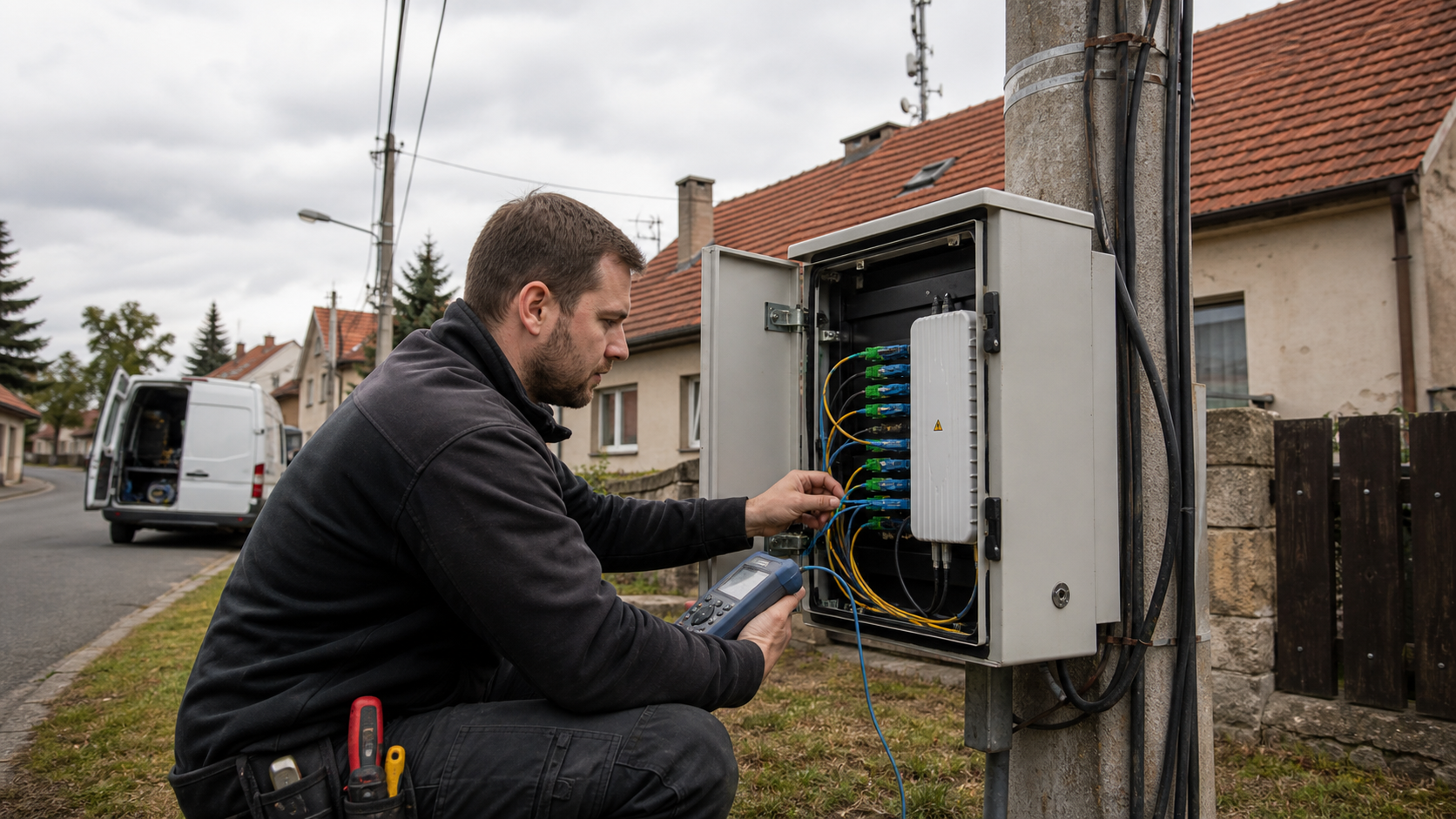
Summary
- What it says: Mraknet s.r.o. is interesting because it shows how a local Czech broadband operator can still earn a place between national telco bundles and do-it-yourself wireless substitutes: not by pretending to be a national carrier, but by making access, support, local construction and sma
- Main topic: Regional ISP economics; SME service continuity
- Context: market / company research report / Europe & Middle East
The first price is not the whole bargain
A household outside Prague does not buy broadband from an economic model. It buys a line that has to work when children are streaming, a parent is on a work call, a camera needs remote access, or a small office has payroll due. In Starý Plzenec, Rokycany and the surrounding part of the Plzen region, Mraknet s.r.o. tries to make that ordinary problem local. Its current consumer page sells wireless access at 369 CZK per month for 80/80 Mbit/s, 60 GHz wireless and fibre tiers from 100/100 to 300/300 Mbit/s at 369, 459 and 549 CZK per month, installation from zero, a router at 50 CZK per month, and the first two months free (https://mraknet.com/internet-na-doma/). The Czech regulator's comparison tool records the same basic bargain: Wi-Fi 80M at 369 CZK, fibre 100M at 369 CZK, fibre 200M at 459 CZK and fibre 300M at 549 CZK, all without a term commitment and without a data cap (https://srovnavac.ctu.gov.cz/operator/1602/grid?type=4).
That price is the article's starting point because it shows the difficult space in which a small access operator works. Mraknet is not selling a premium national brand. Nor is it obviously selling the cheapest possible connection in the Czech market. Vodafone's comparison-tool entries show 100 Mbit/s fixed internet promotional prices at 299 CZK and list prices around 399 CZK for some Start products (https://srovnavac.ctu.gov.cz/operator/141/grid?do=tableParameters-sortByColumnName&tableParameters-columnName=planUrl&tableParameters-sort=ASC&type=4). O2's comparison-tool entries show O2 Internet MAX 100 at a 599 CZK regular monthly price, with a 499 CZK displayed price and a six-month promotional price (https://srovnavac.ctu.gov.cz/operator/747/grid?type=4). T-Mobile's fixed and wireless 100 Mbit/s entries show 649 CZK regular pricing with 299 CZK promotional periods, device rental language and, in some variants, 24-month commitments (https://srovnavac.ctu.gov.cz/operator/758/grid?type=4&page=5&chargePeriod=month). A customer can therefore find a national bundle that is temporarily cheaper, a national brand that is more expensive, or a local operator that tries to remove the friction: call the nearby support line, ask for an address check, get a technician visit, buy or rent the router, and add TV, VoIP, cameras or IT support.
The governing question is whether that local convenience creates enough margin. Mraknet's own public story says the network began in 2004 as a neighbourhood network for a few homes and now connects more than 10,000 households and firms, while remaining close to customers in the region (https://mraknet.com/). The legal company, Mraknet s.r.o., is registered in Czechia under IČO 28055853, with ARES listing formation on 7 April 2009, active status, VAT registration, NACE category 61 for telecommunications, and a seat at Cachna 440, 33202 Stary Plzenec (https://ares.gov.cz/ekonomicke-subjekty-v-be/rest/ekonomicke-subjekty/28055853). The company's footer gives the same name, IČO and VAT identifier, places it in the commercial register at the Regional Court in Plzen, section C, insert 22951, and lists a 24/7 customer line plus contact offices in Stary Plzenec and Rokycany (https://mraknet.com/).
This makes Mraknet more than a search-result placeholder. It is a local access business with public tariffs, regulatory entries, RIPE resource records, a support footprint, recruitment signals and municipal contract traces. But it is also not a hidden national network. The public routing evidence is deliberately narrow: a RIPE LIR record, one visible IPv4 allocation, a small autonomous system, and route-policy links to upstream networks.
The economics are therefore the economics of a regional operator that must turn local proximity into lower churn, add-on revenue and municipal trust before national operators, infrastructure wholesalers, labour costs and capital needs compress the spread.
BTW's judgement is conditional but constructive. Mraknet looks like a genuine Czech regional ISP with a defensible local role. Its advantage is not scale in the national sense; it is the ability to combine last-mile access, local field work, support, wireless upgrades, fibre projects, TV, VoIP, security cameras and small-business IT into one relationship. Its risk is that this same bundle is labour-heavy, capital-hungry and exposed to upstream dependence. If the 10,000-customer claim corresponds to active, paying, low-churn access lines, Mraknet has a stronger recurring base than its public routing footprint alone suggests.
If much of that base remains price-sensitive wireless service with limited upgrade economics, the company has to keep running fast just to stand still.
Legal identity, local offices and the claim of regional scale
The legal record is straightforward enough to anchor the company. ARES identifies Mraknet s.r.o. as an active Czech limited liability company, IČO 28055853, formed on 7 April 2009, with the registered address Cachna 440, Stary Plzenec, and with economic classifications that include telecommunications and related service activities (https://ares.gov.cz/ekonomicke-subjekty-v-be/rest/ekonomicke-subjekty/28055853). The company's privacy document repeats the same legal identity, address, IČO and court registration, and states that Mraknet processes customer and user data in connection with services and electronic communications networks under Czech electronic communications law (https://mraknet.com/wp-content/uploads/2026/05/GDPR-ZZOU.pdf). The website footer lists the company, the same IČO and VAT number, contact offices at Zizkova 186 in Stary Plzenec and Plzenska 399 in Rokycany, and a 24/7 phone line (https://mraknet.com/).
The history claim reaches further back than the legal company's formation date. Mraknet's homepage says the story began in 2004 as a small neighbourhood network and that, 21 years later, it connects more than 10,000 households and firms and belongs among the largest providers in the region (https://mraknet.com/). The same theme appears on its public Facebook page, which says that after 20 years and with more than 10,000 users, Mraknet is one of the largest providers of internet and TV in the region (https://www.facebook.com/mraknet/). These are company claims, not audited subscriber filings. They are still economically relevant because they indicate what Mraknet is trying to sell: continuity, local familiarity and scale large enough to operate professionally, but not so large that the support relationship feels anonymous.
The service mix is broad for a regional access provider. The homepage advertises household internet, an e-shop for networking equipment, internet television, VoIP, cameras and security, and IT management and service (https://mraknet.com/). The business and apartment-association page sells the same access tiers to companies and homeowner associations, adds a business Wi-Fi proposition, and describes IT service for computer networks, servers and user devices, including remote and on-site support (https://mraknet.com/podnikatele-svj/). The municipalities page presents internet for towns and villages, public-administration connectivity, optical infrastructure construction, Smart City language, IT service and camera systems (https://mraknet.com/mesta-obce/). That range matters because the household line alone may not pay for the whole operating burden. The margin can come from being the trusted local technology contractor, not just from carrying bits.
Recruitment also supports the operating picture. Mraknet's career page lists open roles for a Wi-Fi network technician, an optical network technician, an IT/IS technician and an optical-network designer, and describes work on optical networks, internet-infrastructure construction and hardware/software administration (https://mraknet.com/kariera/). Recruitment pages are not proof of headcount, but they are useful labour signals. A company that needs Wi-Fi installers, fibre technicians, IT support and planners is not only reselling a national access line from a call centre. It is maintaining field infrastructure, customer premises equipment and business systems close to where customers live.
The same field character shows up in public contracts. The Czech Register of Contracts lists 21 records involving Mraknet's IČO, including a 2026 road-administration agreement for microduct and cable-chamber work valued at 66,034 CZK without VAT, a 2026 school internet-service contract with value undisclosed, a 2025 secondary-school optical-network order valued at 136,035 CZK including VAT, a 2025 State Veterinary Administration lease record valued at 162,080 CZK without VAT, a 2022 Plzen city IT administration contract for data links valued at 160,000 CZK without VAT, and road-administration agreements linked to optical cable works in Tymakov and Stary Plzenec (https://smlouvy.gov.cz/vyhledavani?party_idnum=28055853). The numbers are not transformative revenue. Their importance is different: they show that Mraknet appears in the local public infrastructure fabric, in places where ducts, masts, schools, municipal buildings and service continuity matter.
Municipal records add a similar signal. A 2021 Stary Plzenec council document approved a future easement agreement for a public communications network on city land, a cooperation agreement with Mraknet, and a loan arrangement involving HDPE microtubes or optical fibres (https://www.staryplzenec.cz/e_download.php?file=data%2Furedni_deska%2Fobsah4756_1.pdf&original=Usnesen%C3%AD+RM+20.pdf). That is not a subscriber count. It is better than a subscriber count for one part of the analysis, because it points to the physical and administrative work that makes a local ISP durable: permissions, ducts, fibres, chambers, public property and municipal coordination.
RIPE membership is a control signal, not a scale story
Mraknet appears in the RIPE NCC list of local internet registries offering services in Czech Republic, with the registry based in Czech Republic (https://www.ripe.net/membership/member-support/list-of-members/CZ/). The RIPE database organisation record identifies ORG-MS473-RIPE as Mraknet s.r.o., org-type LIR, country CZ, registration number 28055853, address in Stary Plzenec, phone number matching the company's public support line, and a created date in April 2017 (https://rest.db.ripe.net/search.json?query-string=Mraknet&source=ripe). The same RIPE record was last modified in May 2026, which is useful because stale registry entries are common in small-network research and this one has recent administrative movement (https://rest.db.ripe.net/search.json?query-string=Mraknet&source=ripe).
The routing record is small. RIPEstat identifies AS205982 as "ASmraknet Mraknet s.r.o." and says it was announced at the 3 July 2026 query time (https://stat.ripe.net/data/as-overview/data.json?resource=AS205982). RIPEstat's announced-prefixes endpoint shows one current announced prefix, 185.200.108.0/22, over the recent timeline ending 3 July 2026 (https://stat.ripe.net/data/announced-prefixes/data.json?resource=AS205982). The RIPE inetnum record for 185.200.108.0 - 185.200.111.255 lists netname CZ-MRAKNET2-20170421, country CZ, organisation ORG-MS473-RIPE, and allocated PA status (https://rest.db.ripe.net/ripe/inetnum/185.200.108.0%20-%20185.200.111.255.json). Hurricane Electric's BGP toolkit likewise shows AS205982 as Mraknet s.r.o., with one originated IPv4 prefix, no originated IPv6 prefix visible there, 1,024 IPv4 addresses originated, and one observed IPv4 peer at the time its page was viewed (https://bgp.he.net/AS205982).
That evidence should be read correctly. A /22 and one visible autonomous system do not make Mraknet a large carrier. They do make it more than a marketing wrapper. RIPE membership gives the company direct registry standing. The address block gives it a routable resource base. The AS record lets it announce its own prefix. The lack of visible IPv6 origination in the Hurricane Electric view is a caution flag, not a verdict; it suggests that, on public BGP evidence, the network is not presenting the kind of broad dual-stack footprint one might expect from a larger modern operator (https://bgp.he.net/AS205982). For a local access provider, that may not stop household sales today. For future municipal, business and security-camera use cases, public IPv6 readiness will become more visible.
The upstream picture is also narrow. The RIPE aut-num record for AS205982 lists import and export policy involving AS47232 and AS200678 (https://rest.db.ripe.net/ripe/aut-num/AS205982.json). RIPE identifies AS47232 as ISPAlliance and AS200678 as Arenis in the database records, while Hurricane Electric labels AS47232 as ISP Alliance a.s. and AS200678 as Komplet NET s.r.o. on its BGP pages (https://bgp.he.net/AS47232 and https://bgp.he.net/AS200678). Hurricane Electric's AS205982 page also showed Vodafone Czech Republic as the observed IPv4 peer (https://bgp.he.net/AS205982). Public BGP tools do not reveal every private circuit, resale arrangement, cache, wireless backhaul or physical path, so they should not be treated as a full network design. But they do show that the visible global routing surface is concentrated. If one upstream, backhaul route or exchange relationship becomes impaired, the company needs redundancy outside what a casual routing page can prove.
The economic meaning is simple. RIPE standing and address control help a regional ISP look responsible to business customers, public bodies and technically literate users. They reduce dependence on pure resale. They also bring responsibility: route hygiene, abuse handling, registry maintenance, security operations and support for customers who may need public addressing, camera access or business continuity. Mraknet's support knowledge base includes a public article for customers who need a public IP address for a camera system or remote access (https://mraknet.com/internet-33/). That is exactly where registry control becomes commercial rather than symbolic. A customer does not care about an AS number until the camera cannot be reached, the VPN fails, a game server needs ports, or a business application demands stable addressing.
The revenue logic is a dense local account book
Mraknet's public pricing allows a rough view of revenue logic, even without audited revenue in the public evidence used here. A 369 CZK monthly household plan, before VAT and discounts, is not a luxurious product. At 10,000 customers, a simple household-only thought experiment at 369 CZK per month would imply 3.69 million CZK of monthly billings, or 44.28 million CZK per year, before any adjustment for VAT, promotions, customers on cheaper or older plans, business services, unpaid bills, installation costs, add-ons, IPTV, VoIP, equipment rental or municipal work. This is not reported revenue; it is a scale-sensitivity exercise based on Mraknet's published 369 CZK entry price (https://mraknet.com/internet-na-doma/) and its own 10,000-households-and-firms claim (https://mraknet.com/).
The important lesson from that exercise is not the exact number. It is that the business depends on recurring local accounts. A wireless or fibre access line may start as a low monthly fee, but each account can carry router rental at 50 CZK, the "safe internet" security package at 29 CZK, internet television, VoIP, camera installation, mesh Wi-Fi, public IP needs, IT support or future fibre upgrades (https://mraknet.com/internet-na-doma/ and https://mraknet.com/podnikatele-svj/). The household is a platform for small add-ons; the local firm or apartment association is a platform for higher-touch service; the municipality is a platform for infrastructure credibility.
The entry price also creates a payback problem. Mraknet advertises installation from zero, two months free and technician contact quickly after a customer submits the form, with connection "tomorrow or at the latest within three working days" in the public sales flow (https://mraknet.com/internet-na-doma/). That is a strong customer promise. It is also a cash-flow claim against the company. A truck roll, roof visit, fibre drop, router, antenna, support call, provisioning time and possible follow-up visit have to be recovered from monthly service fees. If a customer leaves quickly, the company eats the acquisition cost. If the customer stays for years and buys add-ons, the local install becomes a durable annuity.
This is why the router and Wi-Fi language matters. Mraknet's current site is full of weak-signal, mesh, garden, office, guest Wi-Fi, 2.4 GHz versus 5 GHz, VPN slowness, packet loss and public-IP help articles (https://mraknet.com/podpora/). That is not decorative content. It reveals the actual support burden. Customers do not experience broadband as a line from a PoP to the internet; they experience it as coverage in a bedroom, a meeting room, a garden, a workshop or a camera on a construction site. Mraknet's e-shop and router rental propositions let it participate in the home and office Wi-Fi layer rather than leaving all of that value to retailers and installers (https://mraknet.com/e-shop/).
The 60 GHz wireless tier is especially revealing. Mraknet sells 60 GHz wireless at 100/100, 200/200 and 300/300 Mbit/s, with the same headline prices as equivalent fibre tiers (https://mraknet.com/internet-na-doma/). Wireless in the 60 GHz class can be a fast way to improve capacity where trenching fibre to every premise is slow or uneconomic. It can also be more sensitive to line-of-sight, installation quality and maintenance. The economics are therefore a substitution: lower civil-work cost and faster deployment in exchange for more careful radio planning and customer-premises work. For a regional provider, that can be rational. The question is whether the radio layer can keep pace with customer expectations as national fibre and cable offers advertise 500 Mbit/s, 1 Gbit/s or 2 Gbit/s packages (https://srovnavac.ctu.gov.cz/operator/141/grid?do=tableParameters-sortByColumnName&tableParameters-columnName=planUrl&tableParameters-sort=ASC&type=4).
The fibre side is more future-proof but more capital intensive. Mraknet's municipal page talks about building optical infrastructure for towns and villages and says it cooperates on projects with the Plzen Region, including with support from grant titles (https://mraknet.com/mesta-obce/). Public contracts show microduct, optical-network and easement-related work rather than only retail subscriptions (https://smlouvy.gov.cz/vyhledavani?party_idnum=28055853). This is how a local operator can create a stronger moat: it ties its retail business to rights of way, ducts, municipal relationships and local construction knowledge. It is also how a small operator can become financially stretched. Fibre routes require planning, permits, construction, documentation, maintenance and capital before the revenue arrives.
The customer value is proximity under pressure
Mraknet's public promise is essentially proximity. The homepage says support is available 24/7 and describes the company as a "family on the network" (https://mraknet.com/). The support page lists 47 support posts and downloadable contracts, terms, price lists and service documents (https://mraknet.com/podpora/). The business page promises stable connectivity, firm-wide Wi-Fi, IT administration and a combination of remote and personal support for small and medium firms (https://mraknet.com/podnikatele-svj/). The municipalities page promises internet, optical infrastructure, public-administration connectivity, cameras and IT support for towns and villages (https://mraknet.com/mesta-obce/). The carrier-grade claim is not "we have the largest backbone"; it is "we are nearby when something breaks."
External customer signals broadly support that this proximity matters, while reminding readers not to overread public ratings. Firmy.cz lists Mraknet's Stary Plzenec internet listing with a 4.2 rating and describes the company as offering unlimited internet via modern 5 GHz wireless technology, IT consulting and service (https://www.firmy.cz/detail/12711575-internet-mraknet-s-r-o-stary-plzenec.html). Rychlost.cz says Mraknet provides wireless access and lists coverage evidence in the districts of Pribram, Plzen-mesto, Plzen-jih, Plzen-sever and Rokycany (https://rychlost.cz/isp/mraknet-s-r-o/). Its verified review page shows recent high ratings, including 100 percent on 18 April 2026 and 96 percent on 29 October 2025, but also low scores such as 32 percent on 31 December 2025 and 56 percent on 13 April 2025; the site warns that such statistics are indicative and affected by hardware, software and other conditions (https://rychlost.cz/isp/mraknet-s-r-o/hodnoceni/).
This is the right way to treat unofficial market signal. A rating page does not prove network quality. It does show what customers judge: speed, price, technical support, contract handling and installation speed. Those are exactly the variables that determine whether a local ISP can charge enough to survive. A customer who is happy with national mobile bundles may not call Mraknet. A customer who wants someone to move active equipment, fix weak Wi-Fi, configure port forwarding, change router settings, support cameras, or coordinate with an apartment association may value local response more than a temporary 299 CZK national promotion.
The contract register shows that public bodies also buy proximity in pieces. The Plzen city IT administration contract for data interconnection, school internet-service and optical-network orders, road-administration microduct work and State Veterinary Administration lease records are small by national telecom standards (https://smlouvy.gov.cz/vyhledavani?party_idnum=28055853). For a regional ISP, they are useful proof of embeddedness. They bring work, references, rights of way and institutional familiarity. They also create expectations. Once a school, municipality, care home, road authority or veterinary site depends on a local provider, the provider cannot behave like a low-cost best-effort home-Wi-Fi shop.
The middle customer is where the margin can widen
The most important Mraknet customer may not be the cheapest household line or the largest public contract. It is the middle customer: a small firm, an apartment association, a school, a municipal office, a construction site, a shop, a care provider, a workshop or a local service business that needs connectivity plus someone responsible. Mraknet's public pages are pointed at exactly this middle. The business page does not sell only bandwidth. It sells stable firm connectivity, office and warehouse Wi-Fi, server and user-device administration, backup, security, optimization and a mixture of remote and on-site help (https://mraknet.com/podnikatele-svj/). The municipal page adds offices, technical operations, cameras, optical infrastructure and Smart City language (https://mraknet.com/mesta-obce/). The support page shows the operational reality behind those words: questions about VPN slowness, public IP addresses, port forwarding, active equipment, IPTV stability, router configuration, weak Wi-Fi and different Wi-Fi names for 2.4 GHz and 5 GHz (https://mraknet.com/podpora/).
This middle customer matters because pure residential broadband is a hard place to earn excess margin. A household may compare Mraknet's 369 CZK offer against a national promotion, take the cheapest path, and call only when something fails. A business or building manager may behave differently. If a local office has payment terminals, cloud accounting, remote desktops, cameras, shared printers, guest Wi-Fi and staff who blame the internet for every application delay, the access line becomes part of the operating system of the business. A local provider can then sell not only a bitstream but risk reduction. The public business page's language about reliable operation, higher load, offices, meeting rooms, warehouses and process support is therefore economically meaningful, even though it is written as marketing copy (https://mraknet.com/podnikatele-svj/).
The add-on structure is not trivial. Internet television can defend household retention, especially when a family wants one provider for broadband and TV rather than a separate national bundle (https://mraknet.com/televize/). VoIP can still matter for small offices, reception desks and organisations that need fixed-number continuity without an old copper line; Mraknet's VoIP price list shows calls from fixed to fixed numbers, fixed to mobile numbers, internal VoIP calls and other destination categories (https://mraknet.com/wp-content/uploads/2026/05/cenik_voip_2025.pdf). Cameras and security can matter for homes, shops, municipalities and construction sites; the household and municipal pages both offer camera and security propositions around remote access, property protection and service support (https://mraknet.com/internet-na-doma/ and https://mraknet.com/mesta-obce/). IT service can matter for firms and public bodies because the same local provider that sees the access line can also diagnose the router, switch, server, backup and endpoint environment (https://mraknet.com/podnikatele-svj/).
The practical economic point is that these services share trust and truck rolls. A technician already visiting a roof, basement, apartment cabinet or municipal building can inspect wiring, install Wi-Fi, replace a router, discuss cameras, check a fibre path or quote IT support. That does not mean every add-on is high margin. Hardware resale can be thin. Camera installation can be labour-heavy. VoIP revenue is small in an era of mobile calling. But the bundle can lower churn.
A customer using Mraknet for access, router rental, public IP, TV, cameras and local IT support has more reasons to stay than a customer buying only a discounted 100 Mbit/s line.
Apartment associations and multi-dwelling buildings are a particularly important test. Mraknet's business/SVJ page speaks directly to apartment buildings, shared wiring, common spaces and individual apartments (https://mraknet.com/podnikatele-svj/). A building can create a local monopoly-like pocket if the provider wins access to internal wiring and installs service cleanly. It can also become a support trap if residents blame the provider for every in-home Wi-Fi issue. The difference is installation quality, documentation and customer communication. National operators can serve apartments at scale, but local providers can sometimes move faster with a building committee, a property manager or a local electrician. That is one reason the public site stresses address-based availability, technician visits and tailored Wi-Fi solutions rather than only a national coverage map (https://mraknet.com/internet-na-doma/).
Municipal work has the same double edge. A town or village wants broadband, cameras, office connectivity and sometimes fibre planning. Mraknet's municipal page says optical infrastructure is a strategic investment for towns and villages and mentions cooperation with the Plzen Region and grant support (https://mraknet.com/mesta-obce/). Public contracts show small but concrete interactions with road administration, schools, Plzen city IT administration and other public bodies (https://smlouvy.gov.cz/vyhledavani?party_idnum=28055853). These jobs can help an ISP create routes, references and institutional legitimacy. They can also consume scarce engineering time. A 66,034 CZK microduct-related agreement or a 136,035 CZK school optical-network order is useful, but it does not carry the financial weight of a large enterprise connectivity contract. The operator still has to make hundreds or thousands of small monthly accounts work.
The middle customer also explains why public IP demand is not a footnote. Mraknet's support article about needing a public IP for cameras or remote access shows a common small-business and household edge case (https://mraknet.com/internet-33/). A provider with its own address resources can choose how to price, assign and support public addressing. But IPv4 addresses are scarce, and Mraknet's visible 185.200.108.0/22 block represents only 1,024 IPv4 addresses before routing and network-design constraints (https://rest.db.ripe.net/ripe/inetnum/185.200.108.0%20-%20185.200.111.255.json). If many customers want public IPv4 for cameras, servers or remote access, the company has to ration, charge, use carrier-grade NAT for ordinary users, encourage IPv6 where practical, or design more complex solutions. That is a technical detail with commercial consequences. The customer sees "my camera does not work from outside"; the ISP sees an address-management problem tied to scarce registry resources.
This is where Mraknet's small size can be both an advantage and a constraint. A nearby technician can explain the difference between a router problem, a Wi-Fi problem, a public-IP need and a remote-access configuration. That explanation can earn trust. But the same support conversation takes time, and time has to be paid for from a monthly bill that may start at 369 CZK. The middle customer can widen margin only if the provider charges appropriately for work that is not ordinary access. If every camera, VPN, router and server issue is treated as free broadband support, the bundle becomes a cost centre rather than a moat.
Why Czech market structure leaves room for Mraknet
Czech fixed broadband is unusually hospitable to local and wireless operators. CTU reported that in 2024 wireless access in free bands, often understood as Wi-Fi-based fixed access, remained the most widely used fixed-internet access method at 26.8 percent, while FTTH/B rose to 957,000 subscriptions, or 22.9 percent of the total (https://ctu.gov.cz/en/press-release-volume-transferred-data-higher-again-wi-fi-still-dominates-fixed-internet). The Czech Statistical Office reported almost 4.1 million fixed broadband active connections in 2023, of which about 1.58 million were wireless fixed access and about 2.50 million were wired fixed access (https://csu.gov.cz/digital-infrastructure). The same statistical page says fixed connections with advertised speeds of at least 100 Mbit/s increased from 800,000 in 2018 to 1.8 million in 2023 (https://csu.gov.cz/digital-infrastructure).
Those numbers explain Mraknet's positioning. A small Czech ISP is not automatically a historical leftover. Wireless fixed access remains structurally important. Fibre is growing, but unevenly and with heavy construction requirements. CTU also reported that fixed-internet users transferred an average of almost 366 GB per active fixed connection per month in 2024, and that fixed internet prices in Czechia are comparatively cheap internationally (https://ctu.gov.cz/en/press-release-volume-transferred-data-higher-again-wi-fi-still-dominates-fixed-internet). Cheap fixed internet and rising data use are hard for every operator. They are especially hard for local operators because customers expect more capacity without accepting the full cost of local construction.
The European policy context points in the same direction. The European Commission's digital-connectivity page for Czechia says the national VHCN plan focuses on backhaul and access networks, seeks at least 100 Mbit/s upgradeable to 1 Gbit/s for all households, and minimum symmetrical gigabit speeds for businesses, state administration, local self-government and socio-economic entities (https://digital-strategy.ec.europa.eu/en/policies/digital-connectivity-czech-republic). It also says the country already has backbone optical infrastructure to the level of district cities, so the missing investment often lies in absent backhaul connections and access-network parts (https://digital-strategy.ec.europa.eu/en/policies/digital-connectivity-czech-republic). That is Mraknet's world: district-city backbones and national brands may exist, but local access, ducts, apartment buildings, villages and support relationships still decide who actually serves the customer.
National operators remain formidable. CETIN describes itself as a wholesale provider of telecommunications infrastructure and electronic communication services, seeking access to broad infrastructure to deliver fast and reliable services at reasonable costs (https://www.cetin.cz/about-us/cetin-newtork). PPF, CETIN's owner, calls CETIN a leading wholesale infrastructure provider for fixed and mobile networks in Czechia (https://www.ppf.eu/en/our-companies/cetin-group). Vodafone, O2 and T-Mobile can bundle mobile service, television, promotional pricing, customer apps, nationwide marketing, device financing and broader support infrastructure. Mraknet cannot win by imitating all of that. It has to win the customer segments where national scale is too remote, too slow, too generic or too tied to a bundle the customer does not want.
The narrow price comparison shows this balance. Mraknet's 100/100 fibre at 369 CZK sits below O2's 100 Mbit/s MAX regular price shown by CTU and below T-Mobile's 100 Mbit/s regular xDSL or wireless prices in the CTU tool, but it is not always below Vodafone's promotional 100 Mbit/s entry price (https://srovnavac.ctu.gov.cz/operator/1602/grid?type=4, https://srovnavac.ctu.gov.cz/operator/747/grid?type=4, https://srovnavac.ctu.gov.cz/operator/758/grid?type=4&page=5&chargePeriod=month, and https://srovnavac.ctu.gov.cz/operator/141/grid?do=tableParameters-sortByColumnName&tableParameters-columnName=planUrl&tableParameters-sort=ASC&type=4). Mraknet's local answer has to be service density: symmetric upload where offered, quick technician engagement, practical Wi-Fi help, cameras, VoIP, IT service and a real office. If the buyer is only comparing a headline monthly price during a national promotion, Mraknet's margin is fragile.
Upstream, spectrum and support are the hidden cost stack
The public evidence suggests three major cost pressures. The first is upstream and backhaul dependency. A small autonomous system with one visible IPv4 prefix and concentrated route-policy records can be perfectly adequate for a regional ISP, but it is not self-sufficient. Transit, peering, backhaul, failover, route filtering, abuse handling and DDoS exposure all sit behind the retail tariff. Hurricane Electric's AS205982 page shows one IPv4 prefix and one observed IPv4 peer, while RIPE policy records list upstream relationships through AS47232 and AS200678 (https://bgp.he.net/AS205982 and https://rest.db.ripe.net/ripe/aut-num/AS205982.json). The risk is not that these relationships are bad. The risk is that a small operator's bargaining power is limited when backhaul costs, upstream policy, outage response or route quality matter.
The second cost is last-mile technology mix. Wireless lets a regional ISP reach customers quickly and economically. It also creates field work: sightlines, antennas, roof access, weather exposure, interference, customer-premises power, router quality and support calls. Mraknet's support catalogue itself shows the everyday burden: weak Wi-Fi, outages, packet loss, VPN slowness, set-top box problems, port forwarding, public IP needs and router changes (https://mraknet.com/podpora/). Fibre reduces some radio-layer problems and raises capacity, but it moves costs into ducts, permits, civil works, splicing, documentation and property access. Public road and municipal agreements involving microtubes, chambers, optical cables and easements show that Mraknet is exposed to this construction economy (https://smlouvy.gov.cz/vyhledavani?party_idnum=28055853 and https://www.staryplzenec.cz/e_download.php?file=data%2Furedni_deska%2Fobsah4756_1.pdf&original=Usnesen%C3%AD+RM+20.pdf).
The third cost is human support. Mraknet's website promises 24/7 support and fast technician engagement (https://mraknet.com/). The career page shows an active need for technical staff across Wi-Fi, fibre, IT/IS and design roles (https://mraknet.com/kariera/). This is a good sign for operating substance and a warning for margin. Labour is not a variable cost that disappears when traffic is light. If customers expect a local person to answer, diagnose, schedule, climb, splice, configure, replace, document and reassure, the company needs enough skilled people. Skilled technicians are expensive relative to a 369 CZK entry tariff.
Regulation and security add another layer. CTU's undertaking database explains that it records undertakings authorised to do business in electronic communications and their notified networks and services under Section 13 of the Electronic Communications Act (https://ctu.gov.cz/en/vyhledavaci-databaze/evidence-podnikatelu-v-elektronickych-komunikacich-podle-vseobecneho-opravneni-od-2022). Search results for Mraknet's IČO in CTU's electronic-communications records show the company tied to public fixed communications networks, internet services, leased circuits, optical lines and broadcasting-related service categories (https://ctu.gov.cz/vyhledavaci-databaze/evidence-podnikatelu-v-elektronickych-komunikacich-podle-vseobecneho-opravneni-od-2022?export=1&format=csv&ico=28055853&order=Po%C5%99adov%C3%A9+%C4%8D%C3%ADslo+osv%C4%9Bd%C4%8Den%C3%AD&sort=asc&use_pager=1). Mraknet's privacy policy describes processing of traffic and location data, IP addresses, billing information, customer communications and cooperation with lawful authorities where required (https://mraknet.com/wp-content/uploads/2026/05/GDPR-ZZOU.pdf). The larger the service bundle becomes, the more this compliance burden matters.
The one fact that would most change the view
The single fact that would most improve the judgement is a clean operating split: active broadband lines by technology, churn, average monthly revenue per customer, upstream/backhaul redundancy, fibre homes passed, and annual capital expenditure. Public evidence gives pieces of the picture: the company's 10,000-households-and-firms claim (https://mraknet.com/), RIPE resource evidence (https://rest.db.ripe.net/search.json?query-string=Mraknet&source=ripe), one announced IPv4 prefix (https://stat.ripe.net/data/announced-prefixes/data.json?resource=AS205982), current retail tariffs (https://mraknet.com/internet-na-doma/), public contracts (https://smlouvy.gov.cz/vyhledavani?party_idnum=28055853), and local support signals (https://mraknet.com/podpora/). It does not give the internal mix that determines profitability.
If most of the 10,000 accounts are active access subscribers with low churn, a growing fibre share, healthy ARPU from add-ons and real upstream redundancy, Mraknet is a stronger business than its small BGP footprint implies. It would be a local utility-like account base with room to sell higher-value services into firms, apartment associations and municipalities. If the customer count includes inactive, low-revenue, promotional, legacy or thin-TV relationships, or if a large share depends on wireless links that require frequent support, the margin is narrower.
The most negative change would be evidence that national fibre, cable or fixed-wireless promotions are capturing Mraknet's higher-value customers while leaving it with support-heavy, low-price accounts. The CTU tool already shows that national brands can put 100 Mbit/s or faster services into the same psychological price range during promotions (https://srovnavac.ctu.gov.cz/operator/141/grid?do=tableParameters-sortByColumnName&tableParameters-columnName=planUrl&tableParameters-sort=ASC&type=4). A local ISP can survive that if customers value response, local installation, symmetric uploads, camera and IT help, and municipal familiarity. It struggles if customers treat all internet as the same commodity.
The second negative change would be evidence of poor resilience. A visible routing footprint with no IPv6 origination on the Hurricane Electric page and concentrated upstream evidence is not fatal, but it creates a question (https://bgp.he.net/AS205982). The company can answer that question with redundant physical routes, strong monitoring, route hygiene, security controls and transparent incident handling. Public evidence does not yet show enough to close the issue.
The third negative change would be labour strain. The company is recruiting roles that are central to its value proposition: Wi-Fi technicians, optical technicians, IT/IS staff and fibre designers (https://mraknet.com/kariera/). If hiring lags demand, the local-service advantage can turn into a queue. In a regional ISP, support quality is not a soft brand metric. It is the product.
Public evidence used for this assessment
The identity evidence starts with ARES, which records Mraknet s.r.o., IČO 28055853, active status, formation on 7 April 2009, VAT registration, telecommunications classification and a Stary Plzenec address (https://ares.gov.cz/ekonomicke-subjekty-v-be/rest/ekonomicke-subjekty/28055853). The company's own website and privacy document confirm the public support line, contact offices, company registration details and electronic-communications privacy obligations (https://mraknet.com/ and https://mraknet.com/wp-content/uploads/2026/05/GDPR-ZZOU.pdf).
The service and pricing evidence comes from Mraknet's household, business and municipal pages, which list 369/459/549 CZK internet tiers, 80/80 to 300/300 Mbit/s offers, two free months, router rental at 50 CZK, household Wi-Fi help, business Wi-Fi, IT service, municipal optical infrastructure and camera/security propositions (https://mraknet.com/internet-na-doma/, https://mraknet.com/podnikatele-svj/ and https://mraknet.com/mesta-obce/). CTU's price comparison gives a regulatory mirror of Mraknet's listed broadband offers and comparison points against Vodafone, O2 and T-Mobile (https://srovnavac.ctu.gov.cz/operator/1602/grid?type=4, https://srovnavac.ctu.gov.cz/operator/141/grid?do=tableParameters-sortByColumnName&tableParameters-columnName=planUrl&tableParameters-sort=ASC&type=4, https://srovnavac.ctu.gov.cz/operator/747/grid?type=4 and https://srovnavac.ctu.gov.cz/operator/758/grid?type=4&page=5&chargePeriod=month).
The network-resource evidence comes from RIPE NCC's Czech member list (https://www.ripe.net/membership/member-support/list-of-members/CZ/), the RIPE organisation search for Mraknet (https://rest.db.ripe.net/search.json?query-string=Mraknet&source=ripe), RIPEstat's AS overview and announced-prefixes endpoints for AS205982 (https://stat.ripe.net/data/as-overview/data.json?resource=AS205982 and https://stat.ripe.net/data/announced-prefixes/data.json?resource=AS205982), the RIPE aut-num and inetnum records (https://rest.db.ripe.net/ripe/aut-num/AS205982.json and https://rest.db.ripe.net/ripe/inetnum/185.200.108.0%20-%20185.200.111.255.json), Hurricane Electric's AS page (https://bgp.he.net/AS205982), and IPinfo's AS summary (https://ipinfo.io/AS205982).
The public-sector and local-infrastructure evidence comes from the Czech Register of Contracts search for IČO 28055853 (https://smlouvy.gov.cz/vyhledavani?party_idnum=28055853) and a Stary Plzenec council document approving communications-network and optical-fibre-related arrangements involving Mraknet (https://www.staryplzenec.cz/e_download.php?file=data%2Furedni_deska%2Fobsah4756_1.pdf&original=Usnesen%C3%AD+RM+20.pdf).
The market and customer-signal evidence comes from Firmy.cz's Mraknet listing (https://www.firmy.cz/detail/12711575-internet-mraknet-s-r-o-stary-plzenec.html), Rychlost.cz's ISP page and verified-rating page (https://rychlost.cz/isp/mraknet-s-r-o/ and https://rychlost.cz/isp/mraknet-s-r-o/hodnoceni/), plus CTU and Czech Statistical Office market data showing the continuing importance of fixed wireless access, rising fibre share, growing data use and cheap fixed-internet pricing in Czechia (https://ctu.gov.cz/en/press-release-volume-transferred-data-higher-again-wi-fi-still-dominates-fixed-internet and https://csu.gov.cz/digital-infrastructure).
On present evidence, Mraknet is best understood as a local operating company whose economic value sits between the roof, the street and the helpdesk. The RIPE record proves a degree of network control. The tariff page proves a price point. The municipal and contract records prove local infrastructure contact. The support and recruitment pages prove a labour-intensive service model. The unanswered question is whether those pieces combine into a durable, cash-generating regional access base or a thin margin that has to keep absorbing more capacity, more support and more construction just to defend the same 369 CZK customer relationship.