
Summary
- A Manitou lease, rental placement or service-backed machine sale is best read as an uptime contract around one operating unit: a telehandler, access platform, forklift or compact loader that must be available when a construction yard or farm needs lift capacity. The price is disciplined by rental fleets, used-machine purchases, local dealer leases, Caterpillar, JCB and Genie alternatives, and the option to outsource lift work rather than carry machine ownership.
- The strongest public evidence supports a service-and-residual-value thesis, not a claim about the margin on any single machine. Manitou Group says it generated EUR2.564 billion of 2025 net sales, EUR420 million from Services & Solutions, works through more than 800 dealers, and runs spare-parts logistics and connected-machine services that directly address downtime and resale risk (https://www.manitou-group.com/wp-content/uploads/2026/03/20260311_PR_2025_RESULTS_with-financial-extract_EN.pdf, https://www.manitou-group.com/en/group/profile/, https://www.manitou.com/en-US/original-spare-parts, https://www.manitou.com/en-US/connected-machines).
- The decisive private metric would be renewal economics by machine cohort: realized uptime, days-to-repair, first-time fix rate, parts fill rate, utilization, monthly payment, warranty cost, end-of-term resale proceeds and customer renewal rate by dealer territory. The public record is consistent with Manitou selling lower total cost of ownership, but it does not prove customer-level savings without those operating measurements.
The machine decision starts with a day that cannot slip
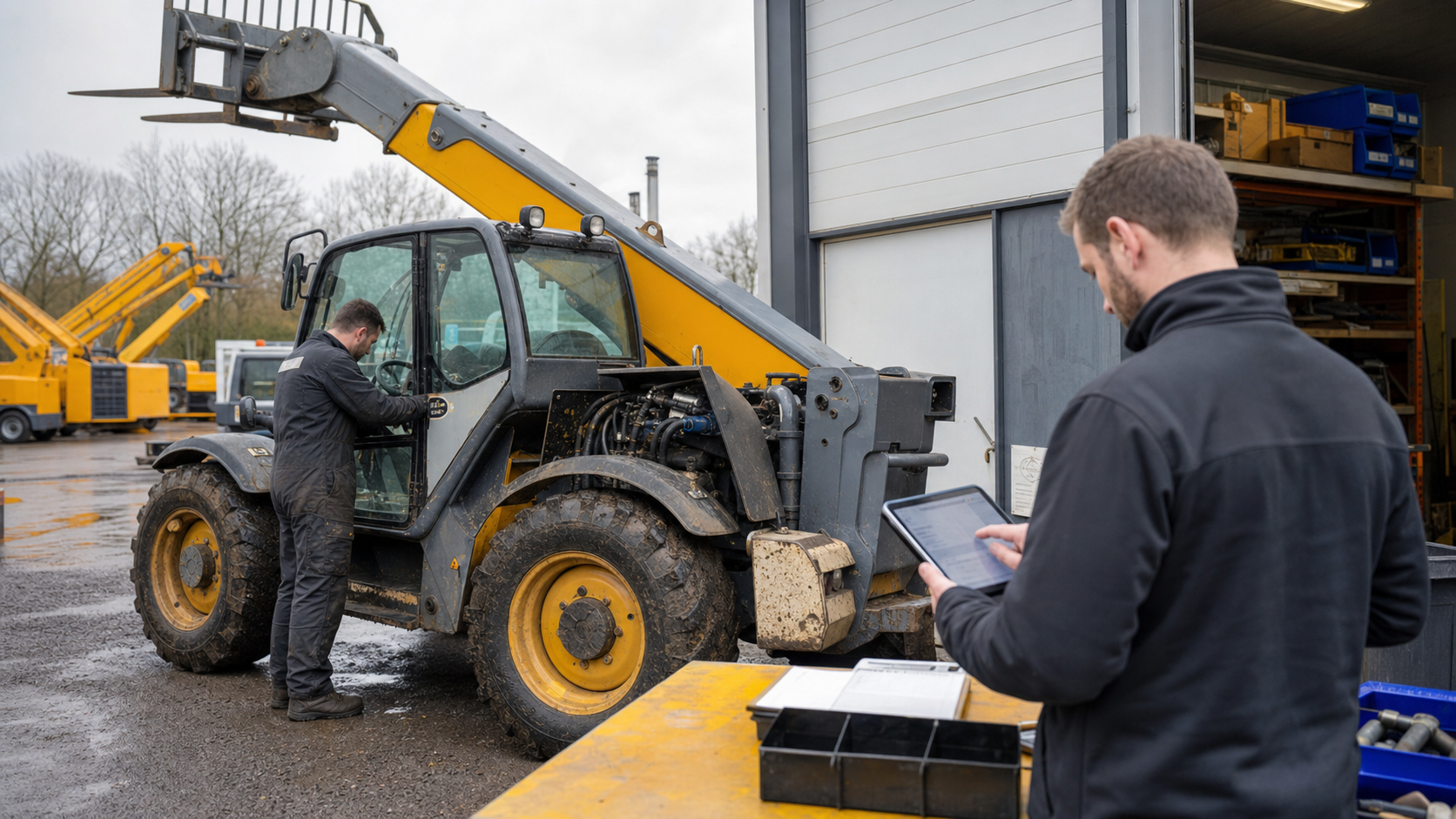
Picture a site manager outside Nantes on a Monday morning. Roof trusses are arriving, pallets need to move across uneven ground, and a concrete crew has reserved a narrow time window. The manager can rent a telehandler for the week, lease a Manitou through a local dealer, buy a used machine, ask a subcontractor to bring lifting capacity, or price a new Caterpillar, JCB, Genie, JLG or Magni alternative through another channel.
In agriculture, the same decision appears during harvest, silage handling or winter feed operations: the machine is only one line in the calculation, but a lost day can turn into labour waste, missed delivery, spoiled timing or a paid crew waiting beside an idle asset.
That is the operating unit in this note: an equipment lease, rental or service-backed machine sale around a Manitou handling or access machine. The useful question is not whether Manitou makes recognisable red machines. It is whether the contract converts uncertain ownership burdens into a predictable availability cost. Rental fleet supply disciplines the price because the buyer can call a rental yard instead of owning. JCB and Caterpillar discipline the product and dealer benchmark because both sell directly comparable telehandlers and support systems (https://www.jcb.com/en-US/products/machines/telescopic-handlers/, https://www.cat.com/en_US/products/new/equipment/telehandlers.html). United Rentals shows the substitute in its simplest form: a catalogue of telehandlers with different lift capacities, reach profiles and job-site uses that can be hired instead of bought (https://www.unitedrentals.com/marketplace/equipment/forklifts/telehandlers). A used Manitou, found through the manufacturer's own used-equipment channel or a wider marketplace, disciplines residual value because ownership has an exit price rather than a theoretical book value (https://used.manitou.com/en_GB/, https://www.machinerytrader.com/listings/for-sale/manitou/telehandlers-lifts/1038).
The burdens transferred by a good Manitou contract are concrete. A buyer can push financing arrangement, extended warranty, maintenance options, spare-parts access, diagnostic preparation and eventual resale into a dealer-backed package. Manitou's financing page explicitly frames the choice as buy, lease or rent, new or used, with the dealer arranging a package around machinery, accessories and services, including extended warranty (https://www.manitou.com/en-US/our-financing-services). Its extended-coverage page describes warranty options up to six years or 6,000 hours, certified technicians, original parts and transferability on resale (https://www.manitou.com/en-US/protect-your-business-manitou-extended-warranty). Its parts page says the parts structure includes logistics centers in France, Italy, the United States and India, distribution centers in South Africa, Brazil and Singapore, 24-to-72-hour shipment depending on region, and nearly 800 expert workshops (https://www.manitou.com/en-US/original-spare-parts). Its connected-machine page says fleet managers can monitor location, hours, fuel, maintenance status, alerts, access, fault codes and CAN data through EasyMANAGER (https://www.manitou.com/en-US/connected-machines).
Those public claims are strong enough to define the thesis. They are not strong enough to settle it. Manitou Group data proves scale, product breadth, dealer reliance and a meaningful Services & Solutions division. It does not prove that a 2026 lease on one MT telehandler in western France carries a lower true hourly cost than a rented JCB, a used Caterpillar, a local rental fleet machine or outsourced lifting. The private measurement that would settle the point is a cohort table: monthly payment plus maintenance plus fuel or energy plus transport plus downtime plus residual value, matched against utilization and repair intervals.
Until then, the right judgement is bounded: Manitou has the public ingredients of an uptime-priced machine contract, and the economics remain a test of local dealer execution.
The public company is a French manufacturer with a service annuity attached
MANITOU BF S.A. is not a loose brand name. French public company records identify MANITOU BF, active and listed, under SIREN 857 802 508, headquartered at 430 Rue de l'Aubiniere, 44150 Ancenis-Saint-Gereon, with activity described as manufacturing lifting and handling equipment and an ISIN of FR0000038606 (https://www.pappers.fr/entreprise/manitou-bf-857802508). Euronext lists MANITOU BF under FR0000038606 on its Paris market page (https://live.euronext.com/en/product/equities/FR0000038606-XPAR). The group profile describes Manitou Group as a developer, manufacturer and provider of equipment and services for handling, aerial work platforms and earthmoving, serving construction, agriculture and industrial markets through the Manitou and Gehl brands (https://www.manitou-group.com/en/group/profile/).
The group is therefore easiest to understand as a machine maker that tries to keep contact with the machine after delivery. Its profile states that the group had EUR2.6 billion of revenue in 2025, 6,100 employees, more than 800 dealers, 10 production sites and seven spare-parts logistics centers. It also says 2025 revenue was split 67 percent construction, 24 percent agriculture and 9 percent industries (https://www.manitou-group.com/en/group/profile/). That mix matters for the lease economics because construction and agriculture have different utilisation rhythms. Construction equipment may be hired for specific projects, while agricultural handling machines can be tied to seasonal peaks, feed logistics and animal-care continuity. A product that can serve both markets is valuable only if the local dealer can match financing, attachment choice and support to those different duty cycles.
The 2025 annual-results release sharpens the distinction between machine sales and service economics. Manitou reported EUR2.564 billion of 2025 net sales, down 3.4 percent from 2024, with recurring operating profit of EUR143 million, equal to 5.6 percent of sales, and net debt down to EUR212 million excluding IFRS 16 lease commitments (https://www.manitou-group.com/wp-content/uploads/2026/03/20260311_PR_2025_RESULTS_with-financial-extract_EN.pdf). The same document separates Product division sales of EUR2.144 billion from Services & Solutions sales of EUR420 million. Product gross margin fell to 16.2 percent of sales, while Services & Solutions gross margin was 25.0 percent. Services & Solutions revenue rose 2.8 percent over the year, helped by spare parts, attachments, service offerings and used equipment sales.
That is context, not proof of a profitable unit lease. The group does not publish a per-machine margin by contract type, dealer, use case or territory in the public material reviewed here. A Services & Solutions gross margin of 25.0 percent says that the after-sale perimeter is economically meaningful at group level. It does not say a particular dealer can source a hydraulic component fast enough to save a small contractor's week, or that a particular machine's residual value will cover a lease-rate assumption. The line between useful public evidence and overclaiming is important.
Manitou's group disclosures support the idea that parts, services and used equipment are integral to its economics. They do not prove the customer's avoided cost.
The Q1 2026 update adds one more clue. Manitou reported EUR648 million of first-quarter 2026 revenue, up 8.0 percent, EUR631 million of machine order intake, and an equipment order book of EUR1.210 billion. Management said momentum was driven by European markets, "particularly with rental companies", and noted Europe revenue growth of 12.5 percent, helped by telehandler volumes (https://www.manitou-group.com/wp-content/uploads/2026/04/260428_PR_Revenue_Q1_2026_EN.pdf). This is important because rental companies are professional buyers of utilization and residual value. They do not buy a machine because a brochure says it is versatile. They buy when they believe the acquisition cost, maintenance burden, uptime, residual value and customer demand will support rental yield.
Yet even this evidence has limits. Rental-company demand validates the category as a professional fleet asset; it does not automatically validate end-user leasing. Rental fleets can spread idle time across many customers, rotate machines geographically and employ in-house technicians. A small builder or farm cannot always do that. The same Manitou machine may therefore make sense as a rental-fleet unit while being too capital-heavy for a one-yard operator unless the lease and service package is carefully designed.
A rental yard keeps the lease honest
The most powerful competitor to a Manitou lease is not another brochure. It is the ability to rent the machine for the job and give it back. United Rentals lists telehandlers from small 6,000-pound units to high-capacity and rotating machines with reach, lift and terrain characteristics matched to job-site tasks (https://www.unitedrentals.com/marketplace/equipment/forklifts/telehandlers). That visible rental shelf turns a new-machine price into a practical question: how many days a year will this yard need the capacity, how many of those days are predictable, and how much is it worth to avoid the phone call to the rental counter?
If utilization is low or irregular, rental wins. It converts fixed cost into variable cost, removes resale timing, moves many maintenance and inspection burdens to the rental operator, and gives the site access to different capacities as each job changes. If utilization is high, leasing or ownership can win because daily rental rates include the rental firm's overhead, transport, maintenance, idle risk and profit. A buyer that can use one machine for many jobs, keep trained operators, schedule preventive maintenance and protect resale condition has a reason to internalize the machine. The Manitou lease sits between those extremes.
It tries to give the buyer enough ownership-like availability without leaving them alone with financing and repair uncertainty.
Manitou's own rental-company page makes that logic explicit from the supplier side. It addresses rental firms around utilization, durability, residual value, uptime, parts availability, technician training, financing and telematics (https://www.manitou.com/en-US/manitou-rental-companies). That page is marketing, but it is useful marketing because rental companies are the harshest audience for the thesis. A rental yard does not care about sentimental attachment to a manufacturer. It cares whether a machine can be hired often, repaired quickly, accepted by operators and resold at a defensible price. When Manitou tells rental firms that residual value and uptime are central, it reveals what the manufacturer thinks the economic buyer is really buying.
The lease price is also disciplined by used equipment. Manitou runs an official used-equipment site for Manitou and Gehl machines, with telehandlers and other machine types searchable by category, currency and country, and says its network of 800 certified dealers selects, checks and fixes used machinery (https://used.manitou.com/en_GB/). MachineryTrader's public listing page for Manitou telehandlers showed more than 1,200 listings and a displayed average price figure at the time it was reviewed, alongside specific machines with hours, model years, lift capacity and seller details (https://www.machinerytrader.com/listings/for-sale/manitou/telehandlers-lifts/1038). Those listings are not a valuation model. They are a market signal: used machines are visible, compared and financed, so a lease cannot assume the customer has no exit benchmark.
Residual value works in two directions. A strong used market lets a buyer believe that a well-maintained Manitou can leave the fleet without becoming scrap. It also lets a buyer ask why a new lease is needed at all. A three-year-old machine with acceptable hours can be a rational substitute if the buyer can accept repair risk, spare-parts uncertainty, emissions-compliance limits, older telematics and a less predictable warranty position. The official used channel helps Manitou by keeping some resale flow close to certified dealers. The open used market constrains it by making alternatives visible.
Competitor breadth completes the discipline. Caterpillar's telehandler page presents telehandlers for agriculture, construction and landscaping, with low operating cost and reliability claims (https://www.cat.com/en_US/products/new/equipment/telehandlers.html). JCB's telescopic-handler page claims a long history in the telehandler concept, extensive lineup, run-cost competitiveness and strong residual value (https://www.jcb.com/en-US/products/machines/telescopic-handlers/). Genie is a live alternative in material handling and aerial lift equipment (https://www.genielift.com/en/material-handling). The presence of those alternatives means Manitou's dealer network and service package are not optional extras. They are the economic defense against substitution.
Dealer repair is the real local product
A machine lease can look financial on paper and operational in the yard. The local dealer is the bridge. Manitou's financing page says the dealer acts as the single point of contact, arranging financing solutions and supporting the customer through the purchase or lease of new or used machines (https://www.manitou.com/en-US/our-financing-services). That claim matters because many SME buyers do not have a dedicated equipment-finance desk. They need a monthly payment, an attachment list, insurance and warranty choices, tax treatment, delivery scheduling and service contacts to be understandable as one decision.
But the dealer's more important role begins after delivery. An idle telehandler is not a passive inconvenience. If it blocks a lift, a farm feed movement, an industrial loading task or a safety-critical access job, its cost includes labour waiting time, replacement hire, transport, project delay, customer frustration and managerial distraction. A small contractor may not have a spare machine, and an agricultural operator may not have a second loader with the same reach or attachment interface. The dealer therefore sells continuity as much as mechanics.
Manitou's parts page ties this continuity claim to a logistics promise. It describes original parts, manufacturer quality, trained dealers, diagnostics, life-cycle support, parts availability, four main logistics centers, three distribution centers, 24-to-72-hour shipment depending on region, and a network of nearly 800 expert workshops (https://www.manitou.com/en-US/original-spare-parts). Those claims directly address the main operating risk in the lease thesis: a machine does not create value merely by being financed. It creates value when repair time is shorter than the customer's substitute path.
There is still a hard uncertainty. Public pages do not disclose territory-level fill rates, parts back-order duration, technician availability, service-truck response times or repeat failure rates. The phrase "nearly 800 expert workshops" is useful evidence of network intent, but it is not an SLA. Two buyers in the same country can have different outcomes if one is near a strong dealer with skilled technicians and the other is at the edge of a territory. For a machine with hydraulic, electronic, engine and safety systems, technician scarcity can be as binding as parts scarcity.
This is where local support labour becomes the economic bottleneck. Manitou can manufacture and ship machines, but uptime is produced by mechanics, diagnostic tools, parts coordinators, warranty administrators and transport providers. The public group model says the company has built a distributor network on every continent and uses local networks for sale and service (https://www.manitou-group.com/en/group/profile/). That model fits the SME service-continuity problem because small buyers need nearby help. It also creates dependency on dealer quality that group revenue does not reveal.
The buyer should therefore price dealer repair as an operating metric, not a brand belief. Before signing a lease or buying a service-backed machine, the buyer would want to know average response time in its territory, weekend support availability, common parts stocked locally, service-van coverage, remote diagnostic capability, loaner or replacement-machine policy, and whether the dealer can handle attachments and software as well as base hydraulics. A cheaper monthly lease can be expensive if the dealer cannot mobilize when the machine fails during peak work.
A higher monthly lease can be rational if it buys a faster repair path and a better end-of-term resale document trail.
Spare parts and residual value are the same argument viewed at different dates
Spare parts are often discussed as a maintenance line. In a leasing or ownership decision they are also a residual-value line. A used machine's price depends not only on model year and hours but on confidence that future buyers can repair it. Manitou's parts and used-equipment pages therefore support the same economic story from two dates in the asset life. During the term, parts availability reduces idle time. At exit, a known parts channel and certified dealer support make the machine easier to underwrite for resale or continued use (https://www.manitou.com/en-US/original-spare-parts, https://used.manitou.com/en_GB/).
The official parts page is especially relevant because it links original parts to performance, safety, compatibility, durability and preservation of resale value. It also mentions a REMAN range of remanufactured parts with warranty (https://www.manitou.com/en-US/original-spare-parts). Remanufacturing and certified used machinery are not just sustainability themes. They can be balance-sheet tools. If components can be rebuilt and machines can be checked, fixed and resold through a known network, the buyer may accept a lower residual-value haircut at lease inception.
There is a competitive catch. Used-market transparency can reduce the manufacturer's pricing power. If a buyer sees a large pool of used Manitou telehandlers, the buyer can negotiate a new lease against a used purchase. If the market shows high residual values, that can justify a lease with lower monthly payments. If listings reveal steep depreciation for certain models, the buyer may demand a shorter term, more warranty, or rental instead. Open listings are therefore a discipline on both sides.
The strongest version of Manitou's residual-value thesis is not that every machine holds value. It is that a machine with dealer maintenance, original parts, connected-hour records and a known used-equipment channel is easier to price than an unsupported machine. The evidence is suggestive. Manitou's extended coverage is transferable in case of resale (https://www.manitou.com/en-US/protect-your-business-manitou-extended-warranty). The used site says certified dealers select, check and fix used machinery (https://used.manitou.com/en_GB/). The connected-machine page says data includes hours, maintenance status, alerts, location and fault information (https://www.manitou.com/en-US/connected-machines). Together, those claims point toward a traceable machine life.
The missing proof is the realised auction or resale premium. A buyer would need to compare similar models by age, hours, geography, maintenance record, attachment configuration and dealer provenance. The public market shows that Manitou machines trade; it does not isolate the value added by connected data or dealer maintenance. That distinction matters because residual-value language can be circular. A brand is said to hold value because buyers believe it will hold value. The harder evidence is transaction data across cycles, especially after rental-fleet disposals.
Manitou's 2025 group results make the cycle risk visible. Product division revenue fell 4.6 percent, while the company cited a wait-and-see attitude from certain key accounts, particularly large rental companies, pressure on selling prices, lower volumes, customs duties in the U.S. market and foreign exchange effects (https://www.manitou-group.com/wp-content/uploads/2026/03/20260311_PR_2025_RESULTS_with-financial-extract_EN.pdf). If rental fleets slow orders or dispose of machines into the used market, residual values can move quickly. A lease that assumes strong resale in a tight market can look less attractive when rental fleets release inventory.
Telematics turn uptime into a measurable promise, with a data caveat
Manitou's connected-machine offer is central to the lease thesis because it changes how uptime is observed. A buyer cannot manage what it cannot see. Manitou says its connected service gives remote access through a web portal or mobile app, allowing users to check machine location, access control, fault diagnosis and maintenance status. It lists machine status, geolocation, access management, maintenance monitoring, fuel level, hours of use, scheduling, alerts, fault codes and CAN data, and says EasyMANAGER can be accessed by PC, tablet and mobile with API options for integration (https://www.manitou.com/en-US/connected-machines).
This matters for three reasons. First, hours of use let the customer compare lease cost with actual utilization. A telehandler that looks expensive per month may be cheap per productive hour if it works daily. A machine that works only in short bursts should be rented or shared. Second, maintenance alerts and fault codes can let technicians prepare before an on-site visit, reducing wasted trips and misdiagnosis. Third, location and access management reduce friction in larger yards or rental fleets, where knowing where the machine is can save real time.
Telematics also change the negotiation. If the lease includes maintenance, both sides may care about machine use, operator behaviour, overload events, idle time and service intervals. Data can reduce dispute risk if it is trusted. It can also increase tension if the customer feels monitored without enough control over data use. The economics are not purely mechanical. They are also contractual and digital.
The data-sovereignty point is bounded. Manitou's public data-protection page for the site identifies Manitou BF as data controller for the described website contact processing, says contact-form data may be sent to the dealer or subsidiary selected by the user, and says data may be transferred outside the European Union depending on that dealer or subsidiary choice (https://www.manitou.com/en-US/data-protection-policy). That page supports the basic fact that Manitou publishes a personal-data notice and recognises cross-border transfer possibilities for site contacts. It does not prove where machine telematics data is hosted, how API integrations are secured, how long machine data is retained, or what telemetry terms apply in every national market.
For a small buyer, the privacy question may feel secondary to uptime. For a larger contractor, municipality, defence-adjacent buyer, logistics operator or regulated agricultural processor, the question is part of procurement. Machine location and hours can reveal project timing, site activity, operational intensity and fleet patterns. That does not mean connected machines are a problem. It means the lease should specify data access, ownership, retention, integrations, support responsibilities and cross-border handling where relevant.
This topic intersects with local service labour. If remote diagnostics help the dealer arrive with the right part, data creates uptime. If data is fragmented, unavailable to the local technician, or limited by integration barriers, the promise weakens. The buyer's question should be practical: can my dealer see the right data, can it act on it, and can I export enough information to manage cost per hour? The public page supports the existence of a connected offer, but only contract terms and dealer practice settle the value.
Financing is a price for optionality as much as a cost of capital
Manitou Group Finance frames financing as dealer-led and flexible. The public page says the dealer can help choose between buying, leasing or renting, new or used, and can include machinery, accessories and services such as extended warranty. It presents lease logic as paying for usage, optional maintenance, reduced resale burden at the end of the rental period, and regular renewal of equipment for a more predictable budget (https://www.manitou.com/en-US/our-financing-services). This is not a neutral statement of accounting. It is a sales argument about optionality.
For the buyer, the choice has at least five layers. The first is capital preservation: a lease may keep cash available for labour, working capital, materials or land. The second is risk transfer: residual-value and repair uncertainty can be partly shifted into contract terms. The third is technology refresh: a contractor may want newer safety, emissions, battery, telematics or attachment capabilities without holding older equipment too long. The fourth is tax and accounting treatment, which depends on jurisdiction and specific contract structure.
The fifth is bargaining simplicity: one dealer conversation can include the machine, attachment, warranty, maintenance and finance package.
The trade-off is that optionality is not free. The monthly payment embeds the financier's return, expected residual value, maintenance assumptions, dealer economics, risk and administration. A buyer with high utilization, good in-house mechanics, strong cash position and long planning horizon may prefer ownership. A buyer with volatile demand, limited workshop capability or project-specific needs may prefer rental. The Manitou lease earns its place only when the embedded service and residual-value benefits outweigh the financing spread.
Group results again provide context without settling customer economics. Manitou reported 2025 working-capital requirement down 22.4 percent, inventories down from the prior year, net cash flow from operating activities of EUR301.8 million, and net debt down sharply (https://www.manitou-group.com/wp-content/uploads/2026/03/20260311_PR_2025_RESULTS_with-financial-extract_EN.pdf). A stronger balance sheet can support strategic flexibility, but it does not tell the customer what lease rate is fair. In Q1 2026, the company expected full-year revenue growth around 5 percent and recurring operating profit around 5 percent of revenue, while warning about customs duties, raw-material trends, exchange rates, macroeconomic uncertainty, geopolitical shifts and commodity-price instability (https://www.manitou-group.com/wp-content/uploads/2026/04/260428_PR_Revenue_Q1_2026_EN.pdf). Those risks can affect machine prices, parts costs, financing assumptions and residual values.
The buyer's calculation is therefore a sensitivity table. If interest rates rise, leasing may look more expensive. If used values fall, leasing with residual-value protection may look better. If parts inflation rises, a maintenance-backed contract may be attractive. If project demand weakens, rental wins. If labour is scarce, dealer-backed maintenance has more value. If the local dealer is weak, ownership and leasing both lose to rental substitution or another brand's service network.
The cleanest way to express the price is not monthly payment but cost per available hour. Available-hour cost includes lease payment, fuel or electricity, routine maintenance, insurance, transport, operator training, downtime, replacement hire, repair administration and residual value. Manitou's public materials address many inputs in that model. They do not publish the combined output. That is why the thesis should be tested per buyer and per dealer.
The cost base is industrial, local and exposed to cycle pressure
Manitou's economics are not just dealer economics. They begin with manufacturing, steel, hydraulics, engines, electronics, batteries, labour, logistics and working capital. The group profile says Manitou's industrial approach rests on mechanical welding expertise, supply-chain flexibility and installation and mounting capacity in France and internationally (https://www.manitou-group.com/en/group/profile/). The 2025 results show cost sensitivity in numbers: cost of goods and services sold was EUR2.112 billion against EUR2.564 billion of net sales, research and development costs were EUR48.5 million, and selling, marketing and services expenses were EUR174.0 million (https://www.manitou-group.com/wp-content/uploads/2026/03/20260311_PR_2025_RESULTS_with-financial-extract_EN.pdf).
The annual release says lower volumes and selling-price pressure hurt Product division margins, while raw-material reductions and industrial efficiency improvements were not enough to offset the pressure. It also says the division continued R&D investment to support fleet electrification and carbon-footprint reduction (https://www.manitou-group.com/wp-content/uploads/2026/03/20260311_PR_2025_RESULTS_with-financial-extract_EN.pdf). That matters to a buyer because manufacturer cost pressure can pass into list prices, lease assumptions, option pricing, parts prices or delivery schedules. It also matters because product renewal is not free; electrification, data services and regulatory compliance consume engineering capital before they create customer value.
The strategic plan described in the 2025 results adds ambition and uncertainty. Manitou's LIFT 2026-2030 roadmap targets revenue above EUR3.8 billion, recurring operating income above 7.5 percent of revenue, electric machines at 28 percent of units sold, and EUR600 million of capital expenditure over five years. It also prioritises telehandler leadership, aerial work platform growth, responsible innovation, circular economy, remanufacturing, retrofit solutions, customer experience, digitalisation and data use (https://www.manitou-group.com/wp-content/uploads/2026/03/20260311_PR_2025_RESULTS_with-financial-extract_EN.pdf). These goals fit the lease thesis because electrification and remanufacturing can change total cost of ownership. They also raise execution risk because the company must fund transformation while defending margins in a competitive market.
Supplier and upstream dependence should be read through that lens. Manitou does not publish enough in the reviewed public documents to map every supplier, but the Q1 2026 release notes a joint venture with Hangcha dedicated to lithium-ion battery production, and says full-year outlook is affected by customs duties, raw-material trends and exchange rates (https://www.manitou-group.com/wp-content/uploads/2026/04/260428_PR_Revenue_Q1_2026_EN.pdf). Battery supply, electronics, emissions systems and imported components can therefore influence machine pricing and availability. A customer may experience those macro risks as delivery delay, option scarcity, higher monthly payments or longer parts lead times.
The cost base also explains why Services & Solutions matter. A manufacturer exposed to cycle swings in new equipment can use parts, attachments, service, used equipment and financing relationships to smooth contact with customers. But the 2025 release shows Services & Solutions was not immune to price pressure; its gross-margin rate fell by one percentage point and profitability was EUR17 million, 3.9 percent of revenue (https://www.manitou-group.com/wp-content/uploads/2026/03/20260311_PR_2025_RESULTS_with-financial-extract_EN.pdf). Service is not pure margin. It requires inventory, technicians, systems, logistics and dealer coordination.
For the buyer, this means the manufacturer has an economic incentive to keep the machine inside its service perimeter. That can be good when it improves availability, resale and diagnostic quality. It can be costly if parts and service are priced above the value delivered. The rational buyer should welcome a strong service ecosystem but insist on transparent maintenance scope, labour rates, response commitments and end-of-term condition rules.
Customer dependence cuts both ways
Manitou's public revenue mix makes customer dependence visible. Construction represented 67 percent of 2025 revenue, agriculture 24 percent and industries 9 percent (https://www.manitou-group.com/en/group/profile/). The company therefore depends heavily on construction cycles, while agriculture provides a different but still cyclical demand base. Rental companies appear as an important professional customer group in the 2025 and Q1 2026 statements; 2025 order intake was more than double the prior year, driven particularly by major rental companies and Europe, while Q1 2026 momentum was also driven by rental companies in Europe (https://www.manitou-group.com/wp-content/uploads/2026/03/20260311_PR_2025_RESULTS_with-financial-extract_EN.pdf, https://www.manitou-group.com/wp-content/uploads/2026/04/260428_PR_Revenue_Q1_2026_EN.pdf).
For Manitou, rental-company demand is attractive because rental fleets buy in volume and understand asset economics. It can also be dangerous. Large rental companies can delay purchases, demand price concessions, dispose of used fleets that pressure residual values, and shift orders between brands. Manitou's 2025 release mentions a wait-and-see attitude from certain key accounts, notably large rental companies, and intensified pricing competition (https://www.manitou-group.com/wp-content/uploads/2026/03/20260311_PR_2025_RESULTS_with-financial-extract_EN.pdf). That sentence should temper any simple story about rental demand. Rental customers validate the product only while the rental economics work.
For end users, rental-company strength is both a substitute and a support. A large rental market lets a contractor avoid ownership. It also creates the resale and service infrastructure that makes ownership less risky. Many used machines begin life in rental fleets. Many dealer service processes are sharpened by fleet customers who demand fast turnaround. A small buyer can benefit from that ecosystem without having the same bargaining power.
The agricultural side has a different rhythm. Manitou's range includes agricultural telehandlers and attachments as part of a broad handling offer (https://www.manitou.com/en-US/market-construction, https://www.manitou.com/en-US/original-spare-parts). Farmers and agricultural contractors often price machines by peak-season reliability, multi-task use and attachment flexibility. A farm machine may not have the same rental substitute at the exact moment of need, especially in rural areas where dealer proximity varies. In that case, a lease with maintenance and dealer support can be valuable even if average annual hours are lower than a construction fleet would require.
Industrial and logistics users may care more about safety, indoor emissions, access control, scheduled maintenance and data integration. Manitou's connected-machine page says its system can handle machine data, access management, maintenance monitoring and API integration (https://www.manitou.com/en-US/connected-machines). That broadens the relevance of the lease thesis beyond rough-terrain construction. Still, the public evidence is not enough to rank Manitou's connected service against every competitor's fleet platform.
The customer-dependence conclusion is balanced. Manitou's public material supports a diversified use-case story across construction, agriculture and industry. Revenue concentration in construction and reliance on rental customers make the cycle risk real. The buyer should ask whether the local dealer's support model is built around large fleet accounts, small owners, agriculture, or a mix. The same manufacturer can feel different depending on the customer tier it serves best in a territory.
Competition is a service network contest, not just a lift chart contest
Telehandler and access-equipment competition can look technical: lift capacity, reach, turning radius, stabilisers, cab visibility, attachment compatibility, engine power, emissions class, electric options and safety features. Those inputs matter. Caterpillar, JCB and Genie all show credible competing ranges or adjacent categories online (https://www.cat.com/en_US/products/new/equipment/telehandlers.html, https://www.jcb.com/en-US/products/machines/telescopic-handlers/, https://www.genielift.com/en/material-handling). United Rentals shows that rental customers may see several brands as substitutable for a job if the capacity and reach fit (https://www.unitedrentals.com/marketplace/equipment/forklifts/telehandlers).
But the economic competition is broader. A buyer compares the total support package: finance, warranty, repair, parts, telematics, transport, attachment availability, training, operator familiarity and resale channel. This is where Manitou's network claim matters. The group says it works through more than 800 dealers and that services range from maintenance to financing (https://www.manitou-group.com/en/group/profile/). The parts page points to logistics centers and workshops; the financing page points to dealer-led packages; the connected-machine page points to remote diagnostics and data (https://www.manitou.com/en-US/original-spare-parts, https://www.manitou.com/en-US/our-financing-services, https://www.manitou.com/en-US/connected-machines).
JCB's public language is notable because it competes on the same axis. It describes its telehandler lineup as extensive, with competitive run costs, build quality, versatility and residual values (https://www.jcb.com/en-US/products/machines/telescopic-handlers/). Caterpillar's page points to reliability, durability and low operating costs (https://www.cat.com/en_US/products/new/equipment/telehandlers.html). In other words, Manitou is not alone in claiming the economics. Any serious buyer should assume all major rivals understand uptime and residual value. The question is who proves it locally.
The buyer's practical comparison should include the cost of switching. If a yard already owns Manitou attachments, has operators trained on Manitou controls, uses EasyMANAGER data, has a dealer relationship and holds original parts, a Manitou renewal can be cheaper than a rival machine even when the rival's monthly payment is lower. If the buyer is starting fresh, the switching cost is lower and competitor pricing has more force. If a rental fleet in the area already stocks several brands, the buyer may be less exposed to one manufacturer's ecosystem.
There is also a technology-switching question. Electrification, battery supply, charging infrastructure and telematics integration can lock in decisions for longer than a traditional diesel machine did. Manitou's LIFT plan targets 28 percent electric machines in total units sold by 2030, and Q1 2026 references new electric construction and agricultural telehandlers and the Hangcha battery joint venture (https://www.manitou-group.com/wp-content/uploads/2026/03/20260311_PR_2025_RESULTS_with-financial-extract_EN.pdf, https://www.manitou-group.com/wp-content/uploads/2026/04/260428_PR_Revenue_Q1_2026_EN.pdf). If electric machines become more important in urban construction or indoor work, financing and residual-value assumptions will need to account for battery health, charging access and second-life value.
The right competitive judgement is therefore not brand ranking. It is a testable service-network question. Manitou appears well positioned where its dealer can bundle finance, maintenance, parts, connected data and used-machine exit. It is exposed where a rental fleet, JCB dealer, Caterpillar dealer, Genie channel or local used-market option can offer the same availability at lower all-in cost.
Regulation, geopolitics and operating risk sit inside the monthly payment
A machine lease hides macro risk in a local invoice. Customs duties, steel prices, foreign exchange, emissions rules, safety regulation, data rules and interest rates all find their way into monthly payments, parts prices or service availability. Manitou's Q1 2026 release is unusually explicit on this point: its outlook was affected by higher customs duties, unfavourable raw-material trends and exchange-rate fluctuations, and remained subject to macroeconomic uncertainty, geopolitical shifts and unstable commodity prices (https://www.manitou-group.com/wp-content/uploads/2026/04/260428_PR_Revenue_Q1_2026_EN.pdf). The 2025 annual results also cited U.S. customs duties, foreign exchange and selling-price pressure (https://www.manitou-group.com/wp-content/uploads/2026/03/20260311_PR_2025_RESULTS_with-financial-extract_EN.pdf).
For a French or European buyer, those risks may appear indirect, but Manitou is a global manufacturer with North American and LAPAM exposure. A tariff shock in one region can change production allocation, order timing or parts economics elsewhere. Currency moves can change imported component costs. Commodity moves can affect steel and hydraulic inputs. A sudden fall in construction activity can push manufacturers and dealers into price competition; a sudden rise can lengthen delivery lead times and raise rental prices.
Regulation adds another layer. Manitou sells machines used in safety-sensitive environments: lifting loads, moving people on platforms, working on rough terrain and operating around other workers. Public materials reviewed here show extended warranty, original parts, certified technicians, training links, connected diagnostics and data policies, but they do not provide a contract-by-contract regulatory map (https://www.manitou.com/en-US/protect-your-business-manitou-extended-warranty, https://www.manitou.com/en-US/original-spare-parts, https://www.manitou.com/en-US/data-protection-policy). Compliance responsibility can be shared or shifted depending on lease, rental or ownership terms. The buyer must know who handles inspections, operator training, software updates, accident documentation and end-of-term condition disputes.
Geopolitics also touches electrification. Battery supply chains, lithium-ion production, customs rules and sustainability procurement can influence electric-machine availability and pricing. Manitou's battery joint venture reference in Q1 2026 is therefore more than product news (https://www.manitou-group.com/wp-content/uploads/2026/04/260428_PR_Revenue_Q1_2026_EN.pdf). It is a sign that the group is trying to control more of the electrification input stack. The public record does not yet prove that this lowers customer cost or improves battery support at the local dealer level.
Data regulation is narrower but increasingly relevant. Connected machines can create useful operational evidence. They can also create records of location, hours, operator access and usage patterns. Manitou's website data-protection policy is not enough to judge machine telemetry governance across all products and countries, but it reminds buyers to treat data terms as part of the service contract (https://www.manitou.com/en-US/data-protection-policy). A machine that reduces downtime through remote diagnostics but creates unacceptable data exposure may not be the right fit for every buyer.
The operating risk conclusion is simple: a monthly lease is not a guarantee against the world. It is a mechanism for allocating risks. Some risks can be transferred to the dealer or financier. Some stay with the customer. Some remain with the manufacturer. The better the contract identifies those risks, the more likely the buyer is paying for genuine continuity rather than a smoother invoice.
What would change the judgement
The public evidence supports a cautious positive view of Manitou's machine-contract economics. The company has scale, a long French manufacturing base, a large dealer network, a meaningful service division, visible parts logistics, financing options, extended coverage, used-equipment channels and connected-machine tools. It also has recent evidence of rental-company demand in Europe and telehandler momentum in Q1 2026 (https://www.manitou-group.com/en/group/profile/, https://www.manitou-group.com/wp-content/uploads/2026/03/20260311_PR_2025_RESULTS_with-financial-extract_EN.pdf, https://www.manitou-group.com/wp-content/uploads/2026/04/260428_PR_Revenue_Q1_2026_EN.pdf).
The judgement would strengthen if Manitou disclosed or independently demonstrated territory-level uptime results, parts fill rates, remote-diagnosis effectiveness, repair response times, residual-value outcomes by model, and renewal rates for lease customers. It would also strengthen if customers could compare total available-hour cost against rental and used-machine alternatives across construction and agriculture. The public pages say the right things. Operating data would show whether they work.
The judgement would weaken if rental-fleet orders slowed sharply, if used Manitou values fell relative to JCB or Caterpillar equivalents, if parts lead times lengthened, if dealers lost technicians, if connected-service adoption stayed shallow, or if financing costs forced lease payments above local rental economics. The 2025 result already shows pressure on selling prices, product margins and rental-company timing; those are not theoretical risks (https://www.manitou-group.com/wp-content/uploads/2026/03/20260311_PR_2025_RESULTS_with-financial-extract_EN.pdf).
The most important uncertainty is local execution. Manitou can publish a global network. The buyer hires a nearby support reality. A lease in a strong dealer territory can be a rational hedge against idle equipment, resale uncertainty and repair chaos. The same lease in a weak dealer territory can become a financed machine with slower help than a rental yard would provide. That is why the buyer should ask for evidence before committing: recent comparable service tickets, parts availability for the chosen model, expected response time, warranty exclusions, connected-data access, end-of-term condition rules and realistic resale assumptions.
The conclusion is therefore a commercial hypothesis test. Manitou's public record supports the view that its lease, rental and service-backed sale proposition is designed to price uptime, dealer repair, spare-parts availability, financing convenience, residual value and fleet data into one machine decision. The record suggests that rental companies and European telehandler demand validate at least part of the proposition. It is consistent with a manufacturer trying to turn a cyclical equipment sale into a longer service relationship.
It remains unproven without customer-level data showing that a Manitou contract actually lowers cost per available hour against renting, used purchase, rival machines or outsourced lift work in the buyer's own yard.