
Summary
- NBI says the main National Broadband Plan build in County Louth is complete: about 9,000 premises are in the intervention area and more than 3,500 are connected.
- A completed route, an address ready to order, a retail choice, an installed line and sustained use are separate outcomes. NBI operates wholesale; providers sell to customers.
- Public evidence does not show Louth revenue, churn, margins, provider-level connections or how the €33m is allocated by premise.
From construction milestone to market funnel
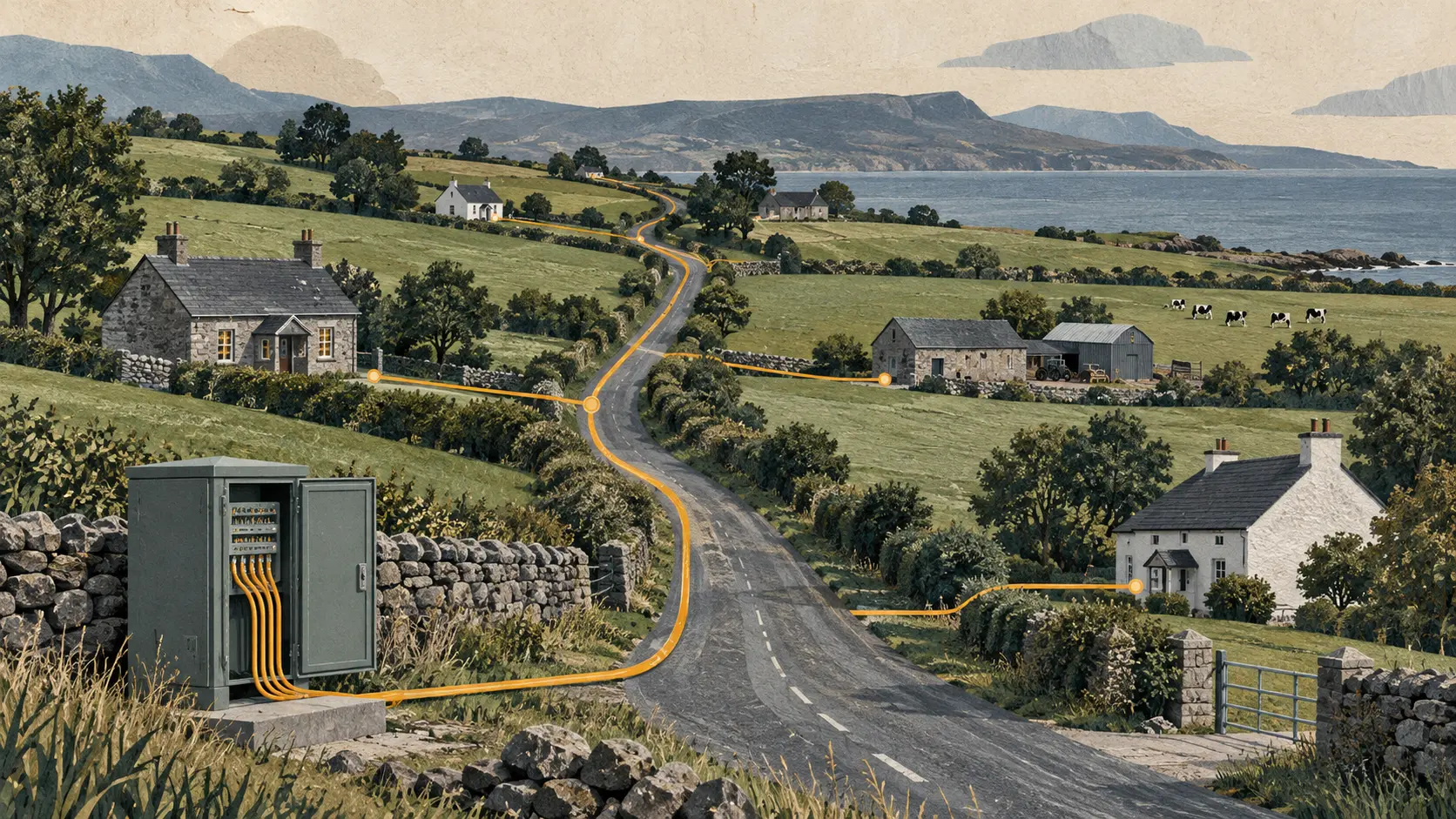
A fibre network can pass a house and still leave the household with a decision to make. A provider may need to list the address, quote a price and arrange an installation; a resident may compare that offer with an existing connection, wait for a landlord or business decision, or decline. Main-build completion is therefore an important supply milestone, but an incomplete measure of adoption.
National Broadband Ireland (NBI), the Irish department responsible for communications and Louth County Council announced on 12 October that the National Broadband Plan’s main infrastructure build in County Louth was complete. NBI says roughly 9,000 premises lie in the State Intervention Area, where the network delivers minimum speeds of 500 Mbps. More than 3,500 premises are connected. The €33m figure is the Government investment cited for the county.
Those figures describe a material change in access. They do not establish that every premise can order today, that each connected customer uses the service regularly, or that the investment has earned a commercial return. “In the intervention area”, “ready to order”, “connected” and “active over time” are different stages. Coverage announcements often compress them into a single story; market analysis should keep them apart.
Dividing more than 3,500 by about 9,000 suggests roughly four in ten premises are connected. It is only an indicator: both inputs are rounded, and the release gives no dated address-level denominator or county connection history. It is not a precise take-up rate and should not rank Louth against another area.
Wholesale access needs a retail route
NBI is a wholesale network operator. Customers buy retail broadband from service providers, not directly from NBI. The chain depends on providers making an offer available, processing orders, installing lines, supporting customers and competing on price, speed and reliability. Households and businesses then decide whether switching is worthwhile.
A shared network can widen choice because several retail brands may use one rural infrastructure. It also divides accountability. An address that cannot be ordered may reflect network readiness, provider systems, product availability or installation capacity. A fault may be reported to a retailer while its cause lies elsewhere. Louth’s published figures do not say which providers are active locally, how many connections each has, or how quickly orders become working lines.
An independent interim evaluation summarised by the Department in November 2024 found that retail providers in the Intervention Area increased from 30 in 2021 to 59 in 2023, with retail prices consistent with commercial areas. These programme-wide findings use data through 31 December 2023; they are not a current Louth provider list or price comparison.
The same evaluation put average cost of passing and connecting a premise at €2,156 in intervention areas, versus €597–€1,053 in commercial areas. This is a historical programme average, not NBI’s Louth cost or a subscriber’s bill. Separate subsidy measures—€2,632 per premise passed and €994 per premise connected—use different denominators. They should not be added or substituted for the combined cost figure.
Scale is not maturity
NBI says the national network is intended to enable access for 566,000 premises, up from 537,000 originally identified at contract signing. Almost 532,000 can connect and order; more than 193,000 connections have been recorded. In some longer-live areas, NBI reports take-up above 60%.
The rounded national figures imply a rough ratio near 36%; Louth’s is around 39%. These are not like-for-like performance measures: the national network combines areas of different ages, while the local number covers one county intervention footprint. Older-area take-up above 60% shows adoption can rise over time, not what Louth will achieve. The release offers no common cohort definition or time series for direct comparison.
The increase from 537,000 to 566,000 also changes the coverage denominator. It does not, by itself, show whether total spending rose or fell, what it cost to reach added premises, or whether unit economics improved.
What the milestone cannot answer
Useful next-stage data would follow the customer journey: premises passed, addresses technically ready to order, retail offers, orders placed, installations completed, active lines and service quality over time. Each stage answers a different question. A connection count is stronger evidence than a construction map, but without retention, fault resolution and use it cannot show whether connectivity has become dependable infrastructure in daily life.
The public sources reviewed disclose no Louth-specific revenue, average revenue per user, churn, wholesale margin, provider-level connections, activation time or allocation of the €33m by premise. They do not support an inference about NBI profitability, household usage or county payback. That limit does not discount the build; it defines what completion proves.
The Department says public intervention targets places where broadband would not be financially viable without support. The Louth market test is whether multiple providers turn shared infrastructure into reliable offers, whether residents and firms can activate them without undue friction, and whether service quality supports continued use. Completion opens the test; it does not answer it.
Sources
Member Briefing
Deeper Profile Context
Sign in with the right membership level to unlock the full briefing and source notes.
Only for Strategic Circle
Strategic Circle
Open to all readers. Unlock profile briefings after joining and signing in.
Join Strategic CircleOnly for Leadership Alliance
Leadership Alliance
For qualified IP-asset owners and management; sign in to unlock alliance briefings.
Join Leadership Alliance