
Summary
- Lightera says submarine optical fiber is normally purchased roughly a year before cable deployment, creating an important but incomplete demand signal for capacity scheduled to mature by 2029.
- The Brøndby and Norcross expansion is intended to nearly triple manufacturing capacity and support existing commitments and future programmes, but Lightera has not disclosed customers, contracted volume, utilisation or investment economics.
- Multicore fiber adds a second option: Lightera expects initial submarine deployments in 2029–2030, but that timetable is not evidence of submarine qualification, supplier selection, an installed system or revenue.
The one-year signal arrives before the factory proof
The most useful number in Lightera’s 21 September 2026 announcement may not be the promised capacity increase. It is the statement that optical fiber is typically purchased about one year before submarine-cable deployment. That lead time gives a fiber supplier some visibility before a cable reaches the sea, but it also exposes the gap investors and infrastructure buyers need to watch.
Lightera is committing manufacturing resources now for an expanded base that it says will be in place by 2029; evidence that the additional capacity has been absorbed should therefore emerge through qualifications, orders and production schedules before or around the deployment window it is intended to serve.
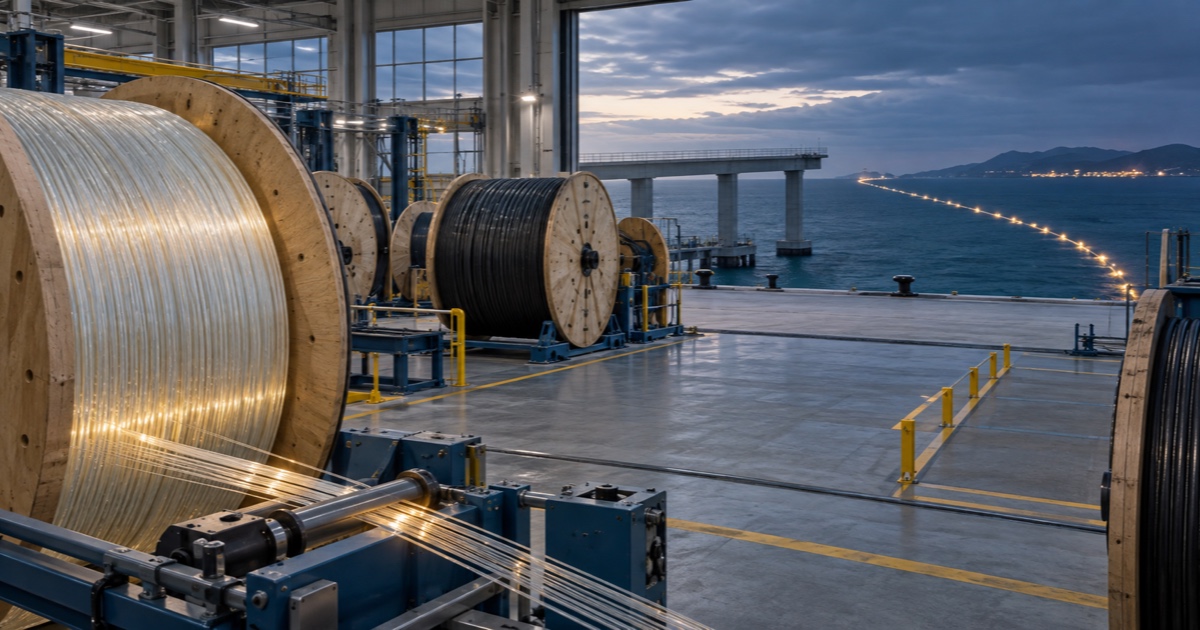
Lightera says the investment covers Brøndby, Denmark, and Norcross, Georgia, its identified submarine optical-fiber manufacturing centres, and will nearly triple manufacturing capacity by 2029. The company says the expansion supports existing customer commitments and future submarine cable programmes. It also attributes the market opportunity to AI infrastructure, hyperscale data centres, cloud computing and broader network expansion. Those statements establish management’s demand thesis; they do not disclose the size, duration or contractual quality of the demand available to Lightera.
That distinction matters because the announcement provides no starting production baseline. “Nearly triple” cannot be converted into fiber-kilometres, annual output or incremental saleable volume without knowing the denominator. Lightera also gives no capital amount, commissioning sequence, factory-by-factory phase schedule, customer names, programme names, backlog, minimum-purchase commitments, take-or-pay protection, prices, margins, utilisation assumptions or return thresholds. Capacity is therefore visible as a strategic option, not yet as an auditable cash-flow bridge.
A strong cable market is not the same as Lightera orders
Independent market evidence does support the proposition that submarine construction remains active. TeleGeography estimated that the value of new submarine cables planned to enter service between 2026 and 2029 exceeded $16 billion, while explicitly warning that not every planned system will be built. Its longer-range model projects about $5 billion of annual new-cable investment on average from 2026 through 2035 and more than one million kilometres of new cable over that period.
Those figures are useful context, but they cannot be mapped directly onto Lightera. A cable system’s capital cost includes far more than optical fiber: wet plant, repeaters, branching units, cable manufacture, vessels, survey, installation, terminal equipment and other engineering. A planned cable can also move, shrink or disappear. The relevant question is therefore not whether global submarine investment exists; it is what portion of that activity reaches Lightera as qualified, contracted fiber volume on economically acceptable terms.
The buying structure sharpens that issue. The submarine system market relies on a relatively small group of established turnkey suppliers and increasingly large content-provider buyers. Reuters has described the industry around major suppliers including SubCom, Alcatel Submarine Networks, NEC and HMN Technologies. A fiber producer may have early conversations with cable manufacturers and hyperscalers, yet those relationships do not remove the customers’ influence over specifications, qualification, scheduling and price.
Capacity economics depend on utilisation, yield and timing
The investment can create value if Lightera fills the new lines with qualified saleable output at prices that cover both variable production costs and the enlarged fixed-cost base. If demand arrives later than capacity, depreciation, labour and factory overhead are spread over fewer units. If the build arrives too late, Lightera risks being unable to serve customers when orders are released. The economic decision is therefore an asymmetry: spare capacity can be expensive, but a constrained supplier can lose a programme that may run for years.
Submarine applications also leave little room for treating qualification as a formality. NTT’s 2026 description of a multicore submarine cable system notes requirements that include operation at depths of up to 8,000 metres, reliability over more than 25 years and compatibility with installation infrastructure. Those are NTT’s system requirements, not Lightera specifications, but they illustrate why optical performance, splicing, cabling behaviour, reliability and interface compatibility must be demonstrated before a new fiber design becomes routine procurement.
That process affects working capital. Fiber may be produced well before marine installation, and the cable manufacturer itself must turn fiber into a completed wet plant before a cable ship deploys it. If production is scheduled against firm orders, working-capital exposure is more contained. If material is produced ahead of uncertain programmes, inventory and timing risk move back toward the supplier. Lightera has not disclosed enough contract detail to determine where that risk sits.
Conventional fiber can pay for the factory before MCF does
The expansion is not solely an MCF bet. Lightera’s ocean-fiber materials describe an established portfolio of submarine fibers and its involvement with space-division-multiplexed systems. That matters because conventional single-core and higher-fiber-count SDM designs can absorb manufacturing capacity independently of whether multicore fiber becomes commercially important on Lightera’s projected timetable.
MCF nevertheless changes the option value of the build. Instead of one optical core per fiber, multicore designs place several cores inside a common cladding, adding a spatial dimension for transmission. The technology is advancing beyond laboratory concepts. NTT said in March 2026 that it had developed a four-core MCF submarine cable system, including joint and terminal components, aimed at commercial deployment. Earlier work by NEC and NTT demonstrated 7,280-kilometre transmission using a coupled 12-core fiber. Both are relevant technical signals, but neither establishes that Lightera has qualified its own submarine MCF with a customer.
Lightera’s own evidence requires the same boundary. On 22 September, one day after the investment announcement, it reported that its four-core MCF was participating in multi-vendor interoperability demonstrations over 500 metres and 50 kilometres at ECOC 2026. That is evidence of ecosystem development. It is not evidence of a transoceanic cable qualification, a named submarine programme or a revenue-producing deployment.
The company’s 2029–2030 expectation for initial submarine MCF deployments should therefore be read as a technology-commercialisation window. A deployment expectation is not equivalent to passing a cable manufacturer’s qualification, winning a particular supply slot, surviving system integration, reaching ready-for-service or producing revenue.
The evidence bridge remains unfinished
Lightera’s announcement proves that management is willing to add submarine-fiber manufacturing capacity in Brøndby and Norcross and that it expects much more output capability by 2029. Its ocean-fiber history and current MCF work establish technical heritage. TeleGeography’s data show that the broader submarine construction market has a substantial pipeline, while NTT and NEC show that multicore submarine architectures are progressing technically.
What the public record does not yet connect is those three layers: market pipeline, Lightera capacity and Lightera economics. The missing evidence is specific. Qualification milestones need to identify usable products and customers. Customer or programme commitments need enough contractual detail to distinguish forecasts from protected volume. Production milestones need to show that added capacity is actually commissioned and saleable. Utilisation needs to show that fixed assets are being absorbed. Pricing, margin and cash-conversion evidence then has to show that volume creates returns rather than simply throughput.
Until those pieces appear, nearly tripling capacity is best understood as a supplier option on future submarine demand. The demand case is credible enough to justify attention. It is not yet sufficiently disclosed to prove the return.
Sources
- https://lightera.com/n/lightera-announces-major-capital-investment-to-expand-submarine-optical-fiber-manufacturing/
- https://lightera.com/ocean-fiber/
- https://resources.telegeography.com/building-tomorrows-internet-an-update-on-new-cable-investment
- https://resources.telegeography.com/forecasting-the-next-10-years-of-submarine-cable-investment-and-kilometers
- https://group.ntt/en/newsrelease/2026/03/13/260313a.html
- https://group.ntt/en/newsrelease/2024/03/21/240321a.html
- https://lightera.com/n/lightera-multicore-fiber-and-cabling-featured-in-oif-interoperability-demonstration-at-ecoc-2026/
- https://www.reuters.com/business/media-telecom/inside-us-push-steer-vietnams-subsea-cable-plans-away-china-2024-09-17/
Member Briefing
Deeper Profile Context
Sign in with the right membership level to unlock the full briefing and source notes.
Only for Strategic Circle
Strategic Circle
Open to all readers. Unlock profile briefings after joining and signing in.
Join Strategic CircleOnly for Leadership Alliance
Leadership Alliance
For qualified IP-asset owners and management; sign in to unlock alliance briefings.
Join Leadership Alliance