
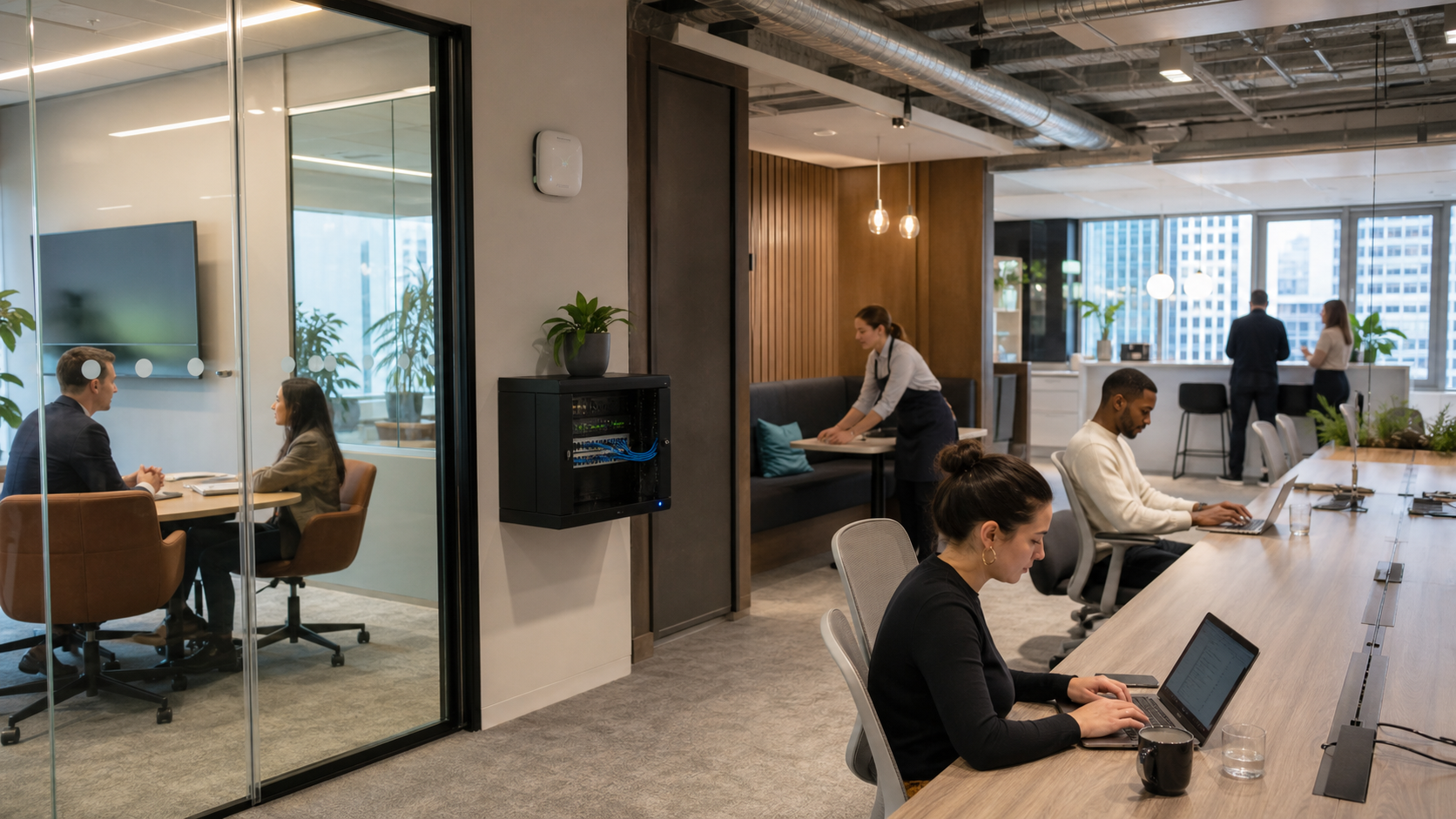
Summary
- Landmark Space Limited is best understood as a flexible-office and serviced-workspace operator rather than as a telecom provider: RIPE NCC membership points to number-resource governance and enterprise connectivity context, while the public product is office capacity sold as private suites, coworking, day offices, meeting rooms and virtual-office services.
- The economic case turns on utilisation. If member revenue per desk, room and address stays high enough, flexible terms can monetise premium locations; if hybrid work weakens attendance or customers trade down, the company still carries rent exposure, fit-out wear, on-site labour, business rates, cleaning, security and technology support.
The spread starts with fixed space and flexible payment
The first economic fact is the mismatch between the company's commitments and the customer's option. A landlord, fit-out contractor, security provider, cleaning supplier, software vendor and broadband supplier are paid on schedules that do not move neatly with a member's decision to come in two days this week and none next week. The member, by contrast, is buying optionality. A private-office customer wants a furnished floor without taking a conventional lease. A coworking member wants access without the responsibility of an office manager. A day-office buyer wants a professional setting for one day.
A virtual-office user wants a business address and mail handling without occupying much space at all. The operator is left to turn that patchwork of use into a stable margin.
That spread is visible in Landmark Space's own public offer. The current Elementa site, which describes Elementa as formerly Landmark Space, presents private offices that can be tailored to a team, coworking memberships, meeting rooms, virtual offices and day offices. A private-office page advertises customised layouts, branded details, integrated technology and fast internet. A coworking page offers monthly membership tiers, including London pricing from GBP 40 a month for limited casual use, GBP 250 a month for eight visits, and GBP 350 a month for unlimited London and UK access, before VAT.
A day-office page sells one-day private office use with no contract and fast Wi-Fi. Meeting rooms are sold by the hour or day, with credit packages offering discounts for regular users. Virtual offices are a separate low-occupancy revenue line, with iconic-address memberships shown from GBP 108 a month and add-ons for registered-address and call services.
The attraction to the customer is simple: avoid long property decisions. The risk to the operator is just as simple: it must commit ahead of demand, then resell smaller pieces of the same cost base. When a premium private-office location quotes GBP 995 per person per month at 1 Great St Helen's, or GBP 600 per person per month at 1 Giltspur Street, that price is not pure margin. It is a bundled payment for location, furniture, service labour, shared amenities, heating, lighting, security, cleaning, meeting-room access, broadband, reception, fit-out recovery and the option not to sign a conventional lease.
The company wins only if the desk is sold often enough, to customers who value those bundled services enough to pay more than the underlying property and service cost.
That is why the core measure is not brand awareness or network-resource status. It is utilisation multiplied by yield. A building can look full in photographs and still disappoint economically if members choose smaller suites, use fewer meeting rooms, churn quickly, require heavy discounts, or treat virtual-office and occasional-use products as substitutes for full private offices. Conversely, a building with a smaller footprint can be highly valuable if it keeps high-paying teams in well-used private suites while meeting rooms and day offices monetise intermittent demand.
The operating question is therefore not whether flexible work is popular in the abstract. It is whether Landmark Space can keep the paid use of each fitted-out floor close enough to its committed cost.
The company boundary is workspace, not telecom resale
The identity evidence matters because a number-resource clue can tempt readers to overstate the business. The RIPE NCC public member page names Landmark Space Limited and lists an address at 1 Royal Exchange, London, plus service-area countries including Germany, France, the United Kingdom, Ireland, the Netherlands and the United States. RIPE's own site explains that it distributes internet number resources to members and provides tools to manage allocations and assignments. That supports a narrow conclusion: Landmark Space has appeared in RIPE membership and number-resource governance context.
It does not prove that the company sells IP transit, broadband, cloud hosting or registry services.
The public commercial boundary is instead flexible workspace. The company's current site redirects from the old Landmark domain to Elementa Workspace and its structured data identifies the legal name as Elementa Workspace Limited with Landmark Space and Landmark Space Limited as alternate names. Companies House now lists company number 05374141 as Elementa Workspace Limited, active, incorporated on 23 February 2005, with previous names including Landmark Space Limited from 25 January 2018 to 30 June 2026 and I2 Office Limited before that.
The site describes Elementa as formerly Landmark Space and says it serves more than 11,000 members across UK locations. The source trail therefore points to a flexible-office operator with a rebranded public face, not a telecom carrier.
The distinction affects the economics. If Landmark Space were a connectivity seller, the key questions would be network reach, routes, wholesale transit cost, peering, spectrum, churn by access product and traffic growth. For this company, the question is different. Connectivity is a required ingredient inside the workspace bundle. It helps a finance team run video calls, a founder meet investors, a lawyer hold a confidential client session and a consultant access cloud tools. It also creates operational risk: outages can ruin the day for many members at once.
But it is unlikely to be the main reason a customer pays a premium for a City or Mayfair office. Location, privacy, service, appearance and ease of scaling are more direct value drivers.
That boundary should make the reader more demanding, not less. A flexible-workspace operator can look technology-enabled because it sells Wi-Fi, online booking, access control, CCTV, data handling and cloud-supported operations. Those are table stakes for professional offices. The question is whether the company can charge a premium because its technology is materially better than alternatives, or whether technology simply prevents disqualification. On the visible evidence, Landmark Space's connectivity and data commitments are important to trust but are not a standalone moat.
The public claim is fast, reliable internet and on-site technical support; the economic moat must come from reliable service at useful locations with disciplined space use.
Revenue is a stack, not a single desk price
Landmark Space's revenue model is a stack of products with different volatility. Private offices are likely the anchor because they reserve meaningful square footage for teams and can support per-person monthly pricing. At 1 Great St Helen's, the public page describes private offices across multiple floors with up to 96 workstations and a quoted starting point of GBP 995 per person per month. At 1 Giltspur Street, the site describes private offices across six floors with about 4,000 square feet on each floor and a starting point of GBP 600 per person per month.
Those numbers are useful because they show the customer promise: a ready workplace, not merely a desk.
Coworking is a different instrument. It broadens the customer base and fills demand below the private-suite threshold, but it also creates more variable usage. A casual member paying GBP 40 a month for one visit is not the same as a team taking a suite. An unlimited member paying GBP 350 a month can be attractive if usage is moderate and the member later upgrades, but less attractive if peak-hour demand consumes the best seats, phone booths and hospitality time without generating additional paid room use. The company tries to manage this by offering packages, credits, home-location access and limits on guests.
Its fair-usage guidance says unlimited coworking members can bring up to two guests for up to two hours, while day-office bookings must include all people attending because pricing is charged per person.
Meeting rooms can lift yield if they are booked at strong hourly rates and do not cannibalise private-office demand. The 110 Bishopsgate page shows named meeting rooms with capacities from six to 18 and hourly prices from GBP 81 to GBP 220. The 1 Giltspur Street page shows rooms from four to 12 capacity, with hourly prices from GBP 63 to GBP 131. The wider booking page shows a range of meeting-room rates across the portfolio, including higher-capacity rooms priced much more steeply.
These rooms are the economic bridge between occasional and committed use: a virtual-office customer may book a room for client meetings; a coworking member may reserve a room for a pitch; a private-office tenant may use meeting space for peaks instead of taking more permanent square footage.
Virtual offices are the most asset-light visible product, but they are not free. Mail handling, identity checks, registered-address add-ons, call forwarding, call answering, compliance and front-desk coordination all create labour and administrative burden. The product is economically attractive if address revenue rides on existing locations and team capacity. It becomes less attractive if compliance work rises, if mail volume is heavy, or if virtual-address customers need frequent support without converting to physical occupancy.
In a high-rent location, the best outcome is a balanced stack: private offices cover the floor, meeting rooms monetise peaks, coworking introduces future private-office customers, day offices sell intermittent demand, and virtual offices create address revenue without displacing higher-yield uses.
Occupancy decides whether flexibility is premium or leakage
Flexible workspace is often sold as an answer to uncertainty, but the operator absorbs some of the uncertainty it removes from the customer. A corporate team using flexible offices does not need to predict headcount five years out. It can add desks, reduce space, book a room, or use another location. That value is real. The problem is that the operator must still configure floors before demand is known. Too many small rooms can leave money on the table when larger teams are ready to pay. Too many large suites can sit underused when customers want smaller commitments.
Too much coworking area can feel lively but dilute revenue if members do not upgrade. Too little shared space can make the private-office product feel ordinary.
The company's public pages show it understands this tension. The private-office language emphasises adding desks, short-term project space and multiple-location access without traditional lease constraints. The 1 Giltspur Street page stresses the ability to scale up or down. The homepage says customers can add desks, book meeting rooms or adapt space as needs evolve. Those are not just service claims; they are operating levers. If the company can reconfigure space quickly and price that agility, it can earn for solving the customer's uncertainty. If it gives too much flexibility away, the same feature becomes margin leakage.
The external market makes utilisation more complex. Central London office demand for high-quality space has strengthened, and reporting citing Knight Frank, Savills and CBRE points to tight supply, rising prime rents and demand from finance, technology and professional-services tenants. At the same time, hybrid work remains durable. ONS-based reporting says more than a quarter of British workers had hybrid arrangements in early 2025, with higher-paid professional roles more likely to benefit.
Academic work on half-empty offices after flexible-work arrangements found low daily presence in studied software offices and persistent reasons for employees to avoid returning every day. That means the same customer can be more willing to pay for excellent space and less willing to occupy it five days a week.
For Landmark Space, that creates a narrow path. The company can benefit when employers want better offices to persuade people in, but it is exposed when those employers reduce total desk count. A premium flexible office can become the compromise: fewer permanent desks than the old lease, better experience on collaboration days, and no long commitment. But the operator must avoid being paid only for the reduced footprint while still providing the expensive features that make the office attractive. In practice, the utilisation test is whether customers pay for reliability and quality, not just for an escape from conventional leases.
Desk yield must cover rent, rates, fit-out and downtime
A desk in a serviced office carries costs that are easy to miss because the customer sees one monthly price. The operator pays for the premises or a management arrangement with the landlord, then layers on furniture, partitions, meeting-room equipment, acoustic treatment, kitchen facilities, signage, reception, security, cleaning, maintenance, broadband, insurance, compliance and sales cost. Some of those costs are upfront and fixed. Some are tied to usage. Some rise with inflation or regulation. The member's payment must cover all of them, plus downtime between customers and any discounted launch periods.
London property costs put pressure on that arithmetic. The Financial Times reported that prime City rents reached an average of GBP 130.80 per square foot in the first quarter of 2026, while prime West End rents were GBP 165 per square foot, citing Savills. Another report said the City risked running out of prime office space within three years because of limited construction and strong demand. Those figures do not map one-for-one onto Landmark Space's leases or landlord arrangements; the company may have older agreements, different buildings or managed-space economics.
But the direction is clear: high-quality London space is expensive, and good locations are not becoming easier to secure.
Business rates add another layer. Reporting on the serviced-office sector says more than 60 UK flexible-workspace operators warned the Chancellor that Valuation Office Agency changes could reclassify serviced offices in ways that increase tax burdens and remove small-business relief from users. The article reported backdated bills up to GBP 400,000 for some operators. That is an industry-wide pressure point rather than a company-specific charge, but it matters because fixed property taxes do not adjust to desk occupancy.
A location that looks profitable at normal rates can be less attractive if rates treatment changes after the fit-out is already sunk.
This is why the headline per-person price is only a starting point. A GBP 600 monthly private-office desk looks valuable only if the floor is sufficiently full, the term is long enough, the space does not require heavy custom work for each customer, and meeting-room or address revenue adds incremental profit. A GBP 995 desk in a premium City building may be justified if it serves clients who need proximity, image and service. But that same desk becomes vulnerable if a customer can secure a conventional lease, use a competitor, or meet in a hired room twice a month instead of paying for a permanent office.
Fit-out capital depreciates faster when work patterns shift
Fit-out is the silent capital risk in flexible workspace. The customer buys a ready-to-use environment, but someone had to pay for the environment before the customer arrived. Partitions, flooring, furniture, access systems, meeting-room screens, phone booths, kitchens, lighting, acoustic materials and network equipment all age. They also carry taste risk: what felt premium before the pandemic may feel dated after customers expect more collaboration rooms, better air quality, quieter booths, more informal seating and stronger video-call support. In a conventional lease, the tenant often takes more of that fit-out decision.
In a flexible office, the operator uses fit-out as the product.
Landmark Space's public language leans heavily into design. Private offices can include layouts, colour schemes, branded details, furniture and integrated technology. Locations advertise natural light, quiet settings, breakout areas, lounges, bike storage, showers, outdoor space and support teams. The sustainability report adds that the business is measuring emissions, reviewing materials and considering circularity in workspaces. These are economically relevant details, not decoration. Good design can raise willingness to pay and help employers persuade staff to attend.
Bad or stale design can push members toward home, competitors or traditional offices.
The utilisation test is therefore also a refurbishment test. A fitted-out floor must earn back its investment before customer preferences change or before the building needs another refresh. If customer contracts are short and fit-out is bespoke, the payback period is fragile. A customer may want branded walls and a special layout, then leave before those choices have been fully recovered. The company can charge setup fees or require term commitments, but the visible value proposition is flexibility. Push too hard on long lock-ins and the product begins to resemble the conventional leases it seeks to replace.
The better economic model is modular: standard enough to reuse quickly, polished enough to feel premium, and flexible enough to reconfigure without heavy new spending. Elementa's language about shaping offices around a team is attractive, but the margin depends on how often that shaping can be reused. A wall moved once for a high-paying customer may be rational. A full redesign for every churn event would be dangerous. This is the underappreciated difference between revenue growth and value creation in flexible workspace. More locations and more enquiries help only if the fit-out capital earns through repeated paid use.
Hospitality labour is part of the product
The public offer repeatedly mentions people-powered service. Site teams welcome guests, solve technology issues, handle mail, help set up rooms, keep kitchens stocked, enforce fair use, manage access and respond when equipment fails. The fair-usage guidance makes that labour visible: guests must be checked in, meeting-room names should be provided, catering requires coordination, technical support is available, phone booths and shared areas need rules, and day offices must be booked by attendee count. A flexible office is not just square footage. It is a service operation inside a property wrapper.
That has two consequences. First, labour can lift retention. A member paying a premium for a private office wants problems removed. If reception is responsive, rooms are ready, guests are handled professionally and Wi-Fi problems are fixed quickly, the customer may see the product as cheaper than hiring its own office support. The company says its independently measured Net Promoter Score is plus 63 and points to strong client retention; those are exactly the measures one would expect if service is central to the product.
Second, labour can compress margin. A receptionist, building manager, cleaner, technician or customer-success worker is not used only when a desk is full. The front desk must exist even on a quiet Monday. Cleaning and security remain necessary even when hybrid patterns lower attendance. Mail and registered-address products create small transactions that still require care. Meeting-room support can be intensive for a short booking. If customer usage becomes more intermittent, the labour per paid hour can rise even while the building looks busy at peaks.
The company has to price not only space but friction removal. A customer can rent a cheaper office and manage suppliers itself. It can use a hotel lobby, home office or ad hoc meeting room. It can ask staff to commute fewer days. Landmark Space's service staff must make the alternative feel costly in time, embarrassment, reliability or employee experience. That is a demanding standard because the customer sees flexibility as a way to reduce waste. The operator must prove that its labour is not waste but insurance against interruptions.
Connectivity is an admission ticket, not the moat
The article's telecom-economic angle sits here. A flexible workspace serving professional customers must support cloud software, video calls, secure access, guest Wi-Fi, meeting-room screens, online booking, access control, CCTV and data handling. The company's pages advertise high-speed connectivity, fast reliable internet, plug-and-play AV and technology support. Its privacy policy says it processes IP address, browser data, network traffic data, payment details, CCTV data and building-access information, and it mentions IT support, cloud software and telecommunications equipment among third-party service categories.
That is a meaningful operating surface.
RIPE membership reinforces the idea that internet number resources and network governance matter somewhere in the company's operating history. But the economic claim must remain narrow. A RIPE member record is not the same thing as a retail connectivity product. The company's customers are not being sold routes or transit in the public pages reviewed. They are being sold work environments where connectivity failure would damage the office experience. Connectivity therefore protects price rather than independently creating it.
This distinction is crucial for valuation. A workspace provider with excellent connectivity can reduce churn, support enterprise customers and host more demanding meeting-room use. It may attract teams in finance, law, consulting, media, software or professional services that cannot tolerate flaky calls. It may also differentiate from low-cost coworking rooms where Wi-Fi is an afterthought. But the customer still chooses a location, a fit-out, a service standard and a commitment level. If a rival can match reliable internet at a better location or lower price, Landmark Space's number-resource evidence does not by itself defend yield.
Connectivity also brings cost and liability. Guest networks must be segregated. CCTV and access-control data must be handled lawfully. Building teams need escalation routes when service fails. Meeting rooms need working AV at the start of the booking, not after a technician arrives. A single outage can affect many customers at once and turn an otherwise premium day into a refund demand. The company can use connectivity to avoid losing customers; it is harder to show that connectivity alone lets it charge a lasting premium. In that sense, network competence is the admission ticket to the flexible-office market.
Suppliers and landlords decide how much risk is really variable
The phrase "flexible workspace" can obscure who actually carries the long risk. Some operators lease space conventionally and resell it; some run management agreements where landlords share more upside and downside; some mix both approaches. The public material reviewed for Landmark Space does not give a full breakdown of lease versus management-contract exposure. That uncertainty matters. If the company is locked into long, upward-only property commitments, a downturn in member demand hurts quickly.
If landlords carry more of the property risk through management deals, the operator's capital burden is lighter but its economics depend on fees, incentives and the landlord relationship.
The competitor evidence points to why this distinction matters. IWG, the largest listed flexible-workspace operator, has emphasised capital-light expansion and management agreements in public commentary because fixed leases are dangerous when demand turns. The memory of WeWork's collapse still shapes the sector: rapid location growth and long commitments can look like scale until utilisation weakens. Smaller premium operators may avoid that extreme, but they face the same logic in miniature. A beautiful location is only valuable if the property commitment and member term structure are matched sensibly.
Suppliers also set the floor under operating cost. Connectivity providers, cloud booking tools, payment processors, cleaning firms, security contractors, furniture suppliers, maintenance crews, coffee and refreshments providers, caterers and compliance advisers are all part of the delivered product. The sustainability report says the business reviewed ESG impacts, supply-chain due diligence, operational resource use and greenhouse-gas emissions, and that it procures renewable power across its portfolio.
Those commitments can support customer expectations, especially for companies with their own sustainability reporting, but they also require governance, measurement and supplier coordination.
The most attractive position would be a portfolio where landlords want a flexible-office partner, the operator contributes brand and service expertise, fit-out is shared or recoverable, and customers pay enough for managed flexibility. The weaker position would be a portfolio where the operator has taken too much fixed property risk and must discount during soft periods. Without private contract detail, the correct stance is conditional: the operating model can be valuable, but only if the company has not promised customers more flexibility than it has negotiated upstream.
Customers have credible substitutes
Landmark Space is not selling a need that customers must satisfy in one way. A company that needs occasional collaboration can book a hotel meeting room, use a member club, borrow a client's office, meet at a conventional coworking competitor, or bring staff to its own leased office on set days. A founder can work from home and rent a room before investor meetings. A professional-services team can keep a smaller headquarters and use flexible space only for overflow. A company that has grown large enough may take its own lease and control branding, security and culture directly.
Remote and hybrid work strengthen those substitutes. Research on flexible work arrangements finds that many employees continue to prefer some home working, and ONS-based reporting shows hybrid work is common among professional and managerial workers, the same broad customer base that can buy premium flexible offices. That does not mean offices are obsolete. It means every office day must justify itself. Landmark Space's product has to make attendance productive enough that employers want to pay for it.
There is a positive version of the same story. Hybrid work can increase demand for flexible offices if customers want fewer permanent desks but better collaboration space. A company may abandon a tired lease and buy a smaller premium flexible suite. A distributed team may use day offices around transport hubs. A consultant may use a virtual address and book meeting rooms for client sessions. In that scenario, Landmark Space benefits from uncertainty because it sells a managed answer to uncertainty.
The negative version is that customers learn to buy only the minimum. A team that once needed 30 desks may buy 12, then book rooms only for key meetings. A virtual-office customer may never upgrade. A coworking member may treat the space as a cheap backup. A private-office customer may ask for more flexibility at renewal because competing providers are hungry. The company has to convert optional users into higher-yield users without making the product feel restrictive. That is a sales and service challenge, but also an economic challenge: optionality is valuable to the buyer precisely because it can be exercised against the seller.
Competition rewards location and service before brand
The UK flexible-workspace market is crowded. International Workplace Group operates through brands such as Regus and Spaces. Workspace Group serves small and medium-sized businesses across London and the South East. The Office Group and Fora occupy the premium end of London flexible offices. Runway East has expanded with a start-up and scale-up positioning in London and regional cities. Landlords themselves have developed flexible brands or partnership models.
Against that field, Landmark Space's advantage must be specific: quality locations, trusted service, existing customer relationships, practical meeting-room supply and reliable operations.
The location map is credible. Elementa lists London offices in the City, Farringdon, Mayfair, Marylebone and Fitzrovia, Holborn, Greenwich, King's Cross, Victoria and Soho, plus regional locations in Birmingham, Bristol, Manchester, Milton Keynes and Reading. The public pages show proximity to transport nodes such as Liverpool Street, Farringdon, Bank and Oxford Circus. These locations matter because the customer is often buying convenience for scarce in-person days. If staff are going to commute, employers need the destination to feel worthwhile and easy.
But location is not exclusive. Competitors also operate near transport, finance, law and technology clusters. Large landlords can offer fresh buildings with gyms, terraces, high sustainability ratings and direct landlord balance sheets. Smaller operators can undercut on price or specialise by community. Hotels and member clubs can win occasional meeting demand. The brand therefore helps only if it reduces perceived risk: customers believe rooms will be ready, bills clear, service responsive, and offices professional.
That is why the rebrand from Landmark Space to Elementa Workspace is economically meaningful. A rebrand can modernise a mature serviced-office perception and support a more experience-led premium. It can also create short-term identity risk if customers, brokers and searchers still know the company as Landmark. The Companies House name change on 30 June 2026 and the site redirection show an active transition. The value of that transition will be measured by lead quality and retention, not by the new name itself. A fresh brand that improves pricing and occupancy creates value. A fresh brand that merely renames the same cost base does not.
Regulation and data risk are part of the trust product
Flexible offices collect more information than a simple landlord might. They manage building access, CCTV, Wi-Fi, payment records, mail handling, guest names, director and shareholder identity checks for virtual offices, and sometimes call services. Elementa's privacy policy explicitly describes processing personal data for security clearance into buildings, communications, payments, CCTV, background checks and service delivery. Its virtual-office page says it asks for proof of identity, proof of residential address, company trading address and mail-forwarding address, and can support registered-office use as an add-on.
That creates a trust product. A member using a premium City address needs mail handled correctly. A company using a meeting room for confidential discussions needs guests managed and the room prepared. A customer relying on registered-address services needs identity and anti-money-laundering processes to work. A professional-services firm needs network and access data handled with care. These details are not glamorous, but they support premium pricing because they reduce risk for the customer.
They also create downside. A data breach, mail-handling failure, unauthorised building access or repeated AV failure could hurt the brand beyond one booking. Regulatory expectations around data protection, anti-money-laundering checks, building safety, employment and business rates can add cost. The sustainability report also puts ESG governance into the public record, including materiality assessment, emissions work, circularity, DE&I and risk management. Once such commitments are public, customers can ask for evidence and progress.
The company should welcome that scrutiny if it strengthens the product. Many enterprise customers increasingly need workplace suppliers that can provide data, safety, accessibility, sustainability and governance comfort. The risk is that compliance consumes overhead without creating price power. The commercial test is whether stronger governance helps close and retain better customers, especially those that will pay for private offices and recurring meeting-room use rather than occasional low-yield access.
The judgment turns on disciplined utilisation
Landmark Space's current evidence supports a cautious but constructive view. The company has a real operating business in flexible offices, a visible UK location portfolio, multiple revenue products, premium central London exposure, public claims of strong member retention and customer satisfaction, and enough technology and data infrastructure to support enterprise-grade workspace. The London office market is not dead; high-quality space is tight, and many employers still want attractive offices to bring teams together. That gives the company a demand backdrop.
The downside is equally clear. The product sells flexibility to customers while carrying fixed or semi-fixed cost. Hybrid work means attendance is more selective. Business rates and property costs can rise even when occupancy does not. Fit-out capital has to be recovered before styles and needs change. Labour is essential but expensive. Competitors can match many features. Connectivity is necessary but not a moat by itself. The company can grow revenue and still destroy value if it adds space faster than stable demand or discounts too heavily to keep locations looking full.
The conclusion is that Landmark Space faces a utilisation test, not a technology test. RIPE membership and network-resource context are relevant because a flexible-office operator must provide reliable connectivity and manage digital trust. They do not change the economic centre of gravity. The centre is the spread between a long property-and-service commitment and a customer's flexible payment. If Elementa can keep private-office occupancy high, use meeting rooms and day offices to monetise peaks, convert coworking and virtual-office users into higher-yield relationships, and negotiate upstream risk carefully, the model can work.
If not, flexibility becomes a promise made to customers and a burden kept by the operator.
The facts that would change the judgment are concrete. Stronger confidence would come from disclosed occupancy by location, average desk yield, customer retention by product, private-office renewal rates, meeting-room utilisation, fit-out payback periods, the share of management-contract versus lease exposure, network uptime, and evidence that rebranding has improved lead conversion rather than merely changed the sign on the door.
Weaker confidence would come from rising vacancy, heavy discounts, frequent fit-out write-offs, backdated rates bills, customer complaints about service or connectivity, or expansion into locations where the company lacks clear demand. Until those facts are visible, the right stance is disciplined scepticism: the business is credible, but the margin is earned desk by desk, room by room, and renewal by renewal.