
Summary
- Komatsu Ltd. is a Tokyo-headquartered manufacturer of construction, mining, utility, forestry and industrial machinery. Its public company profile, as of April 1, 2026, reports FY2025 net sales of JPY4,132.8 billion, operating income of JPY567.3 billion, 67,279 consolidated employees, 60 manufacturing locations for construction and mining or utility equipment, 55 sales locations and a sales-and-service distributor base covering 152 countries: https://www.komatsu.jp/en/aboutus/profile and https://www.komatsu.jp/en/aboutus/locations.
- The paid unit is not the machine alone. It is machine availability across a long equipment life: new equipment, financing, dealer labour, field service, spare parts, remanufactured components, telematics, repair planning, resale and mining or construction productivity support. The cheaper substitute is a Caterpillar, Hitachi, Volvo or local dealer account, a used machine, rental, delayed replacement, in-house maintenance, or a mine or contractor stretching old equipment for another cycle.
- Public evidence is strongest for group identity, financial scale, segment mix, geographic spread, aftermarket strategy, parts and service offerings, dealer-location structure, Komtrax operating data and the
.komatsupublic namespace record. It is weaker for dealer-level margins, parts fill rates, field-service response times, model-by-model reliability, customer retention and realized total cost of ownership. - The commercial judgment turns on whether Komatsu can keep machines productive after sale while defending price against new-equipment cycles, tariff and procurement costs, commodity-driven mining demand, construction capex pauses, rival dealer networks and the active used-equipment market.
The Uptime Account
Start with a machine that is not moving. A hydraulic excavator is waiting on a pump. A mining truck is parked during a shift change because a sensor fault has not been cleared. A forestry harvester needs a hose, a filter, a diagnostic visit or a remanufactured component. A contractor can rent a replacement, cannibalize another machine, call a local mechanic, search for used parts, change the schedule, or accept lower production for a day. The value of Komatsu appears at the point where those choices become more expensive than paying for the manufacturer's machine, dealer support, parts availability and data-backed maintenance plan.
That is why Komatsu should not be read only as a new-equipment manufacturer. The BTW directory record for the company is at https://btw.media/en/directory/komatsu-ltd, and the directory evidence includes the public .komatsu internet-resource record. That record matters because it confirms a named public accountability surface, but it is not the economic center of the company. The more important question is how Komatsu converts product quality and machinery data into uptime, aftermarket revenue and customer retention across construction, mining, utility and industrial markets.
By the third paragraph, the paid unit can be priced clearly. The customer buys productive machine hours over the life of a capital asset. The cheaper substitute is another brand's dealer network, a used machine, a rental fleet, an independent repair shop, a local parts seller, a delayed purchase, or continued operation of old equipment at higher maintenance risk. The main cost driver is the heavy fixed base behind the promise: engineering, factories, key components, steel and electronics procurement, dealer and field-service labour, regional warehouses, remanufacturing, finance balance sheets, software, warranty exposure and product liability. The strongest evidence classes are official financial reporting, Komatsu's own service and parts pages, its location and distributor disclosures, its monthly demand and Komtrax data page, and IANA's .komatsu delegation. The missing proof categories are dealer-level economics, machine-level reliability and customer retention.
Komatsu's company profile states the basic identity: Komatsu Ltd., established on May 13, 1921, with head office in Minato-ku, Tokyo, and main business in manufacturing and selling construction, mining, utility, forestry and industrial machinery: https://www.komatsu.jp/en/aboutus/profile. The same page gives FY2025 financial highlights of JPY4,132.8 billion in net sales and JPY567.3 billion in operating income. That is a large public manufacturer, not a narrow registry business. Its latest FY2025 presentation, dated April 28, 2026, reports net sales up 0.7 percent from FY2024, operating income down 13.7 percent, operating margin down to 13.7 percent, and net income attributable to Komatsu down 14.4 percent: https://www.komatsu.jp/en/-/media/home/ir/library/results/2025/en_fy254qpresentation.pdf.
The same FY2025 materials reveal the pressure behind the uptime account. Construction, mining and utility equipment sales rose only 0.2 percent to JPY3,806.0 billion, while segment profit fell 18.0 percent to JPY491.1 billion. Komatsu says improved selling prices were outweighed in profit by lower sales volume, product mix, fixed costs and higher production costs tied partly to tariffs. The message is not that demand disappeared. It is that new-equipment sales alone do not protect margin when volume, cost and mix move against the manufacturer.
This is where after-sale value matters. Komatsu Report 2025 describes a value-chain model that follows the machine from new sale through rental, finance, parts and services, key components, Komtrax data and used-equipment resale: https://www.komatsu.jp/en/-/media/home/ir/library/annual/2025/en/kr25e_value_01.pdf. The report says Komatsu provides spare parts, periodic maintenance, repairs, overhauls and remote monitoring, and that its in-house key components and Komtrax operating data help optimize equipment life-cycle cost. It also says aftermarket sales account for about half of construction, mining and utility equipment sales, with mining aftermarket share at about two-thirds because mining machines run long hours.
That last point is the heart of the business model. A mine does not buy a haul truck as a sculpture of capital spending. It buys tonnage moved through a difficult site over ten to fifteen years. Komatsu Report 2025 states that mining equipment operates in harsh conditions for extended hours and that customers choose equipment based on quality, durability and services that support stable utilization. The manufacturer that can prove high availability can charge for more than metal. It can charge for fewer interruptions in a mine plan.
Business Model And Revenue Logic
Komatsu's revenue logic has three layers. The first is original equipment: excavators, bulldozers, wheel loaders, dump trucks, underground mining equipment, forestry machines, industrial presses, sheet-metal machinery, machine tools and semiconductor-related equipment. The second is the value-chain business: parts, service, maintenance, remanufacturing, finance, rental, attachments, monitoring and used equipment. The third is solutions: Smart Construction, mine-management and analytics platforms, autonomous haulage, remote operation, machine guidance and production-optimization support.
The FY2025 segment mix shows why the first layer still dominates reported revenue. Komatsu's latest presentation reports construction, mining and utility equipment sales of JPY3,806.0 billion, retail finance sales of JPY126.1 billion and industrial machinery and others sales of JPY238.8 billion: https://www.komatsu.jp/en/-/media/home/ir/library/results/2025/en_fy254qpresentation.pdf. Construction and mining remain the large engine. But the profit mechanism is more subtle: new machines are cyclical, while parts and service recur as long as the installed base keeps working.
Komatsu Report 2025 says its construction and mining sales in FY2024 were almost evenly split between mining equipment and construction equipment, at JPY1,916.2 billion and JPY1,871.2 billion respectively: https://www.komatsu.jp/en/-/media/home/ir/library/annual/2025/en/kr25e_value_01.pdf. In FY2025, the presentation shows mining sales to outside customers down 0.6 percent to JPY1,904.4 billion, while construction sales rose 1.1 percent to JPY1,891.7 billion. The spread matters because construction demand follows housing, public infrastructure and private capex, while mining demand is tied to commodity prices, stripping ratios, replacement cycles, mine expansions and the productivity economics of large sites.
Pricing power comes from the customer's alternative. If a contractor buys a mid-size excavator, the invoice is compared with rival brands, financing, dealer convenience, fuel use, resale value, warranty, operator familiarity and availability of parts. If a mine buys large trucks or shovels, the invoice is compared with fleet compatibility, payload, tire and component life, autonomous-haulage readiness, service labour on site, parts inventory, rebuild planning and the cost of downtime. A machine with a higher initial price can be cheaper if it loses fewer productive hours.
A cheaper machine can be expensive if the customer cannot obtain parts or field support when work is under pressure.
Komatsu's retail finance arm supports this logic by turning a machine purchase into a balance-sheet decision. The FY2025 presentation says retail finance assets rose by JPY238.3 billion from the prior fiscal year-end because of higher new contracts and yen depreciation, while new contracts increased JPY75.8 billion mainly because of higher finance penetration in North America and Europe. Financing does not make a weak machine good, but it reduces purchase friction and gives Komatsu another way to keep the customer inside the brand account.
The industrial machinery segment has a different revenue shape. Komatsu Report 2025 says the segment includes presses and sheet-metal machinery for automotive customers, excimer laser light sources and temperature-control equipment for semiconductor manufacturing, and machine tools and automation lines: https://www.komatsu.jp/en/-/media/home/ir/library/annual/2025/en/kr25e_value_01.pdf. The FY2025 presentation says industrial machinery and others sales rose 6.8 percent and segment profit rose 38.5 percent, helped by large automotive presses and higher-margin excimer-laser maintenance. That segment is smaller, but it shows a similar mechanism: service and maintenance can be margin-relevant after the original machine sale.
The article's central judgment is therefore conditional. Komatsu is attractive when the customer is paying for availability, not just for a purchase order. It is less attractive when the buyer has slack time, a strong independent service base, multiple used-machine options, or no confidence that Komatsu's local support is better than competitors. Scale helps Komatsu, but scale is not enough. Heavy equipment customers experience the brand locally: at the dealer counter, on a jobsite, in a technician's diagnostic visit, in a parts warehouse, in a finance renewal and in a machine's resale value.
Parts, Service And Local Support Labour
Komatsu's own U.S. parts page makes the after-sale claim explicit. It says parts are intended to maintain function, extend life and minimize downtime, and that customers can order Komatsu Genuine and Reman parts through My Komatsu with dealer pickup or direct delivery: https://www.komatsu.com/en-us/products/parts. The same page describes My Komatsu as a digital hub for telematics data, parts manuals, service manuals, software and parts ordering. That is direct evidence for the Local support labour topic because the promise depends on dealer pickup, service manuals, parts ordering and machine data, not on generic manufacturing scale.
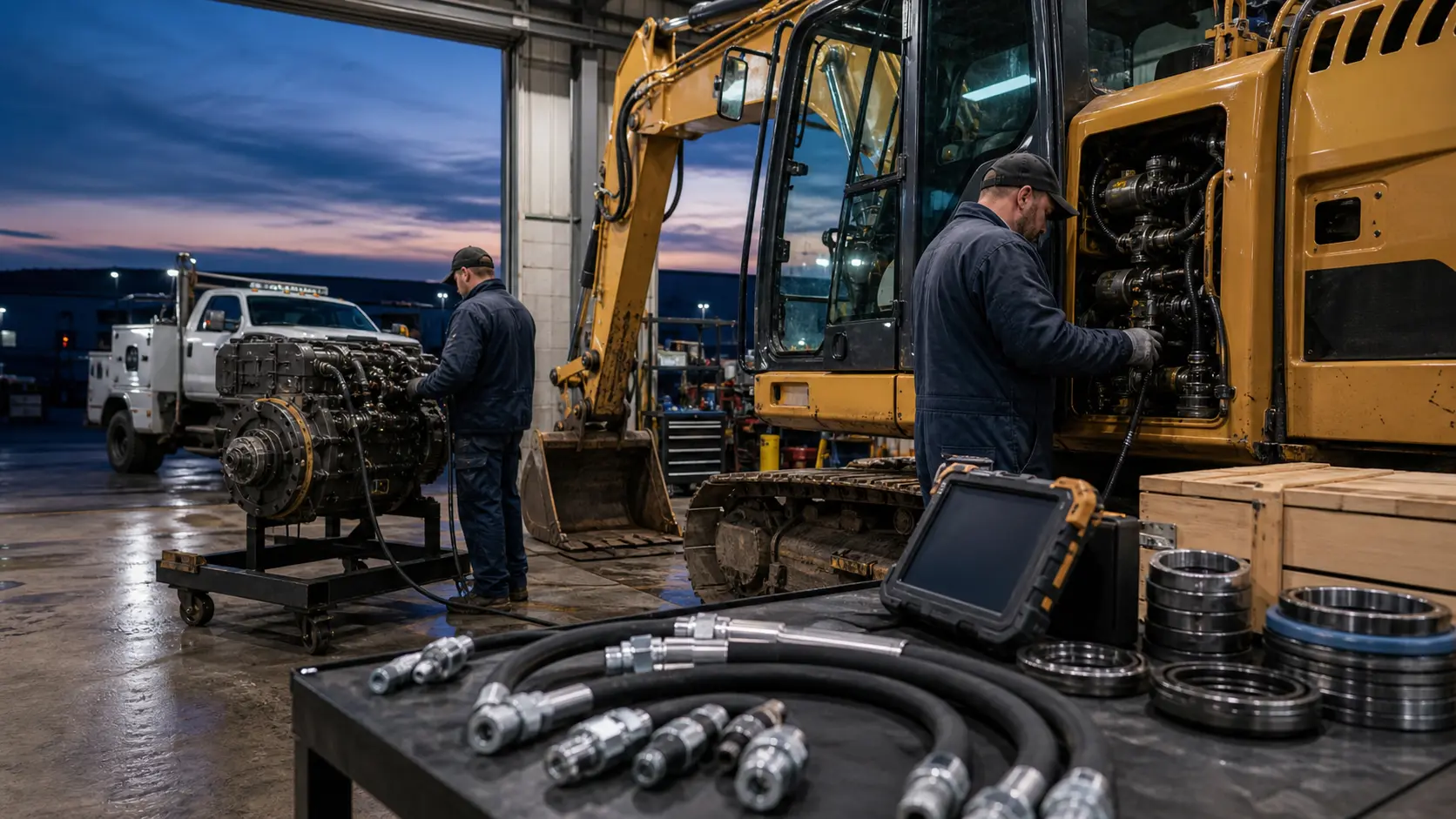
The service page is even more specific. Komatsu lists audit and save programs, chrome plating, component exchange, equipment monitoring and analysis, financing, Joy equipment services, NTC equipment services, maintenance and repair, remanufactured components, training and warranty programs: https://www.komatsu.com/en-us/services-and-support. It says component exchange supports planned and unplanned outages and mentions same-day or next-day delivery of remanufactured assemblies, regional warehousing and uptime. Those statements are commercial promises, not audited field metrics, but they directly support the idea that Komatsu prices machine availability after sale.
Remanufacturing is a central margin and retention tool. Komatsu's remanufactured components page says customers can choose used components remanufactured to original equipment specifications, with engines, transmissions, power modules, final drives, hydraulic cylinders, pumps, motors, electronics, fuel injection components, turbochargers, starters, alternators, air compressors and brakes among the categories: https://www.komatsu.com/en-us/products/parts/remanufactured-components. The economics are clear. A customer avoids buying a completely new component, Komatsu captures value from its design knowledge and salvage engineering, and the dealer or service network has another reason to remain the customer's first call.
Local labour matters because the machine fails locally. Komatsu's locator page lets users search countries, location types and equipment types, including distributor, field service, service partner, service, warehouse, distribution center, training center, branch, depot and dealer: https://www.komatsu.com/en-us/komatsu-locator. Komatsu's global locations page states that the group has sales and service distributors in 152 countries, plus manufacturing and sales locations: https://www.komatsu.jp/en/aboutus/locations. Those two pages are not customer-satisfaction evidence, but they show that Komatsu's operating model explicitly depends on a distributed support footprint.
The support footprint also creates cost. Field technicians, inventory, training centers, warranties, parts systems, emergency coverage and rebuilt components are not free. They are part of the price a customer pays when it chooses an original equipment account instead of the cheapest local alternative. A dealer can defend margin when it solves problems faster than the alternative. It destroys margin when support labour is consumed by misdiagnosis, repeated visits, warranty disputes or unavailable parts.
Komatsu's equipment monitoring claim reinforces this point. Its services page offers equipment monitoring and analysis to optimize performance with machine health data, and its parts page connects My Komatsu to telematics and service manuals. Komatsu Report 2025 says the company uses Komtrax to obtain machinery operating data and expand the value-chain business: https://www.komatsu.jp/en/-/media/home/ir/library/annual/2025/en/kr25e_value_01.pdf. The economics are not simply "data is valuable." Data is valuable if it improves timing: order the part before the failure, plan the shutdown, recommend the rebuild, compare idle hours, reduce fuel waste and avoid a surprise stoppage.
The used-equipment channel also supports the life-cycle story. Komatsu America's used-equipment site says certified used machines maintained in Komatsu CARE are less than six years old and have less than 6,000 operating hours, and that certified machines pass a 100-plus point final inspection: https://www.komatsuused.com/. This is a market signal and a company-authored sales surface, not proof of resale premiums across all markets. Still, it shows how Komatsu tries to turn service history into used-equipment liquidity.
Telematics And Resource Evidence
Komatsu's public data surface is unusually important for a heavy-equipment manufacturer. Its investor relations page for monthly demand, orders and Komtrax data says Komtrax data reports monthly average machine-use hours by region from the remote monitoring system for construction equipment: https://www.komatsu.jp/en/ir/library/demand-orders. This is not a customer-level performance audit. It is a signal that Komatsu can see usage patterns from an installed base and that investors are expected to treat machine-use hours as relevant market information.
Komatsu Report 2025 says Smart Construction had been applied at more than 40,000 sites globally as of March 31, 2025, and describes Smart Construction as a digital solution that visualizes and optimizes construction sites: https://www.komatsu.jp/en/-/media/home/ir/library/annual/2025/en/kr25e_strategy_01.pdf. The report also highlights standard 3D machine guidance in the PC200i-12 hydraulic excavator and broader automation, remote operation and software-defined vehicle initiatives. These facts support a strategic reading: Komatsu is trying to attach software and site optimization to its machines before competitors reduce the sale to horsepower and bucket size.
The risk is that telematics and digital solutions can become feature language unless they change a customer's costs. For a contractor, useful data reduces idle time, fuel waste, grade rework, survey cost, operator dependence or service surprises. For a mine, useful data improves dispatch, shovel-truck matching, maintenance windows, safety and payload discipline. If the data is not integrated into local decisions, it becomes an unused subscription or a screen in an office. Public sources do not show site-level productivity gains across the whole installed base, so the article treats the digital strategy as plausible but not fully proven.
The public internet-resource record is narrower. IANA's delegation record for .KOMATSU names Komatsu Ltd. as sponsoring organisation, lists GMO Brand Security as administrative contact, GMO Registry as technical contact, shows the name servers, and records the registration date as March 6, 2015 with the record last updated on June 20, 2023: https://www.iana.org/domains/root/db/komatsu.html. IANA's WHOIS gateway similarly identifies the .KOMATSU domain, organisation, contacts, name servers, DS data, WHOIS server and active status: https://www.iana.org/whois?q=.komatsu.
That evidence grade is high for public namespace accountability and low for Komatsu's core economics. It confirms a controlled brand TLD and an outsourced technical operation through GMO Registry. It does not prove Komatsu sells internet infrastructure, operates telecom networks, runs an autonomous system, has high digital uptime, or earns revenue from registry activity. For this article, the resource record is a public accountability marker. The company remains an industrial machinery and service business.
The useful inference is about digital dependence, not digital revenue. A global heavy-equipment group with telematics, parts portals, remote monitoring, dealer locations, financing, used-equipment sites and supplier portals needs reliable digital systems. IANA's record shows one piece of public namespace infrastructure; Komatsu's service pages show why digital reach matters to customers. But network-resource evidence cannot carry the business conclusion. Machine uptime, parts supply, dealer labour and customer retention do that work.
Cost Base, Suppliers And Upstream Dependence
Komatsu's cost base is industrial before it is digital. Factories, castings, engines, hydraulic systems, electronics, steel, undercarriage, batteries, tires, machining, testing, warranties, engineering staff, dealers, warehouses and finance funding all sit behind the machine. The FY2025 presentation says construction, mining and utility equipment segment profit fell partly because of higher production costs, lower volume, product mix and fixed costs, despite improved selling prices: https://www.komatsu.jp/en/-/media/home/ir/library/results/2025/en_fy254qpresentation.pdf. That is the classic pressure on a manufacturer with high fixed and semi-fixed costs.
Komatsu reduces some upstream dependence by developing and producing key components in-house. Komatsu Report 2025 says this is an advantage because key components affect machine performance and because the company can combine that knowledge with Komtrax data: https://www.komatsu.jp/en/-/media/home/ir/library/annual/2025/en/kr25e_value_01.pdf. In-house components can protect product differentiation and remanufacturing margins. They can also increase capital intensity, inventory risk and exposure to production bottlenecks if demand turns down quickly.
Supplier coordination remains essential. Komatsu's supplier page says open collaborative supplier relationships are vital, emphasizes quality, competitive pricing and innovation, and describes trade and customs compliance, deviation requests, process-change requests, supplier portals and conflict minerals commitments: https://www.komatsu.com/en-us/suppliers. The page is not a bill of materials, but it shows the operating burden. A global heavy-equipment manufacturer cannot price uptime if suppliers miss delivery dates, substitute parts without control, fail quality requirements or trigger customs and trade delays.
The tariff point is immediate. Komatsu's FY2025 presentation says projection assumptions included tariffs on steel and aluminum products and a refund related to IEEPA tariffs: https://www.komatsu.jp/en/-/media/home/ir/library/results/2025/en_fy254qpresentation.pdf. The article does not need to settle the tariff accounting. It needs to show the business mechanism: tariffs and trade changes affect production cost, price realization, regional production choices and competitiveness against local rivals. A stronger yen or weaker yen also changes both translation and price comparisons. Komatsu's risk factors separately state that foreign exchange moves can affect overseas sales, material costs and comparative prices against foreign competitors: https://www.komatsu.jp/en/ir/risk-factors.
The supplier risk is larger in mining than in ordinary construction. Mine machines are bigger, run longer and require specialized components. Tire availability, engine rebuilds, electric-drive systems, control electronics, hydraulic components and site-specific service all matter. When a mining truck or shovel is down, the lost production can dwarf the cost of a part. That creates pricing power for trusted suppliers, but it also raises the customer's standard. A mine will not accept a weak service answer simply because the original machine was expensive.
Komatsu's acquisition and electrification direction adds another upstream question. Its company location list includes American Battery Solutions as a U.S. operation for development, manufacturing and sales of batteries for construction, mining equipment and commercial vehicles: https://www.komatsu.jp/en/aboutus/locations. Battery and electrification exposure may become a strategic advantage as mines and contractors decarbonize. It also adds technology, cell supply, thermal management, charging infrastructure and safety requirements that can raise execution risk.
Customers, Cycles And Competition
Komatsu's customers are exposed to capex cycles. Construction customers care about housing starts, public infrastructure, private capital spending, rates, rental-fleet replacement and local labour. Mining customers care about commodity prices, mineral grades, stripping ratios, mine plans, copper and nickel demand, coal decline, energy transition and site-level utilization. Komatsu's own risk factors identify economic and market conditions, commodity demand, currency moves, competitive conditions, order cancellations, receivable collection and inefficient inventory or production capacity as risks: https://www.komatsu.jp/en/ir/risk-factors.
The FY2025 regional numbers show mixed demand. In construction, sales rose in North America and Europe but fell in Asia and Japan. In mining, sales fell in North America and Asia but rose in Latin America, Africa and Oceania, with total mining sales nearly flat in real terms. That is not a simple global boom or bust. It is a portfolio of cycles. Komatsu's value is partly that it can serve several regions and end markets, but geographic spread also exposes it to more currencies, policies, logistics risks and local competitors.
Caterpillar is the obvious competitive benchmark. Caterpillar's Cat brand page describes a broad product portfolio from skid steers to mining excavators, technology products, rental, finance and services, and emphasizes dealer support as a core reason to buy: https://www.caterpillar.com/en/brands/cat.html. That is a direct challenge to Komatsu's uptime account. Customers are not comparing Komatsu with a machine only. They are comparing two service systems, two parts networks, two financing options, two data strategies and two resale ecosystems.
Other substitutes are more fragmented. Hitachi Construction Machinery competes in excavators and mining equipment, Volvo Construction Equipment in articulated haulers, excavators and wheel loaders, Deere in North American construction equipment, SANY, XCMG and other Chinese manufacturers in price-sensitive segments, and local dealers or independent repair shops in service and parts. For some customers, the alternative is not a rival new machine but used equipment. MachineryTrader's Komatsu excavator listings page showed 3,661 listings when reviewed, with asking prices, hours, serial numbers, locations and sellers visible for many units: https://www.machinerytrader.com/listings/for-sale/komatsu/excavators/1031. That is an informal market signal, not a full residual-value study, but it shows an active secondary market.
An active secondary market cuts both ways. It supports resale confidence and financing values when used Komatsu machines remain liquid. It also competes with new equipment when contractors can buy a recent used machine, finance it, and repair it locally. Komatsu's certified used site tries to answer that by connecting used machines with Komatsu CARE history, inspections and extended coverage: https://www.komatsuused.com/. The brand wants used equipment to remain inside the service account rather than become a pure price alternative.
Customers also depend on dealers. A brilliant factory design can lose a renewal if the local dealer cannot provide a part, a technician or a credible repair plan. Conversely, a strong dealer can keep an older machine loyal to the brand long after the first invoice. This is why Local support labour is not a soft topic. It is the labour that turns Komatsu's global scale into a customer's local outcome.
Regulation, Geopolitics And Operating Risk
Komatsu's public risk factors are broad because the company is broad. Laws and regulations, environmental rules, climate-related approaches, product and quality liability, alliances and acquisitions, procurement, production, information security, intellectual property, natural disasters, wars, terrorism, accidents, epidemics and supply-network disruption all appear in the risk list: https://www.komatsu.jp/en/ir/risk-factors. For an analyst, the important point is not the list itself. It is how these risks affect the uptime promise.
Product and quality liability risk is central. A construction machine can injure people. A mining truck failure can disrupt a high-value site. A digital guidance error can damage work quality. A battery or power-system defect can create safety and downtime exposure. Komatsu's quality and reliability identity is valuable only if failures stay controlled and if field fixes are timely. Public reporting does not disclose model-level warranty claims, field campaigns or customer retention after failures, so the article does not overstate reliability.
Geopolitics matters through demand and cost. Mining demand is tied to resource nationalism, permitting, copper and battery minerals, coal policy, sanctions, energy transition and infrastructure plans. Construction demand depends on public works, rate-sensitive private spending and local credit. Trade measures and tariff costs can reshape where equipment is built and where prices are competitive. Komatsu's global locations give it production and sales flexibility, but global reach also means more exposure to disruption: https://www.komatsu.jp/en/aboutus/locations.
Information-security risk is no longer peripheral. Komatsu's risk page says sophisticated cyber attacks may impose higher costs for information-security measures and that leakage or misuse of confidential business and technology information could affect results: https://www.komatsu.jp/en/ir/risk-factors. For a machinery company with Komtrax data, My Komatsu, dealer systems, supplier portals, finance accounts and remote support, cybersecurity has a direct customer-trust dimension. A machine does not have to be physically broken for a customer to lose confidence if the systems used to monitor, order, invoice or support it are compromised.
Environmental regulation can change product design and customer choices. Komatsu Report 2025 describes work on diverse power sources, hydrogen combustion for a concept large dump truck, trolley autonomous operation, electrified construction equipment and carbon-neutral jobsite goals: https://www.komatsu.jp/en/-/media/home/ir/library/annual/2025/en/kr25e_value_01.pdf. These are not guaranteed profit streams. They are strategic options in a market where mines, governments and contractors increasingly ask for lower emissions without lower productivity.
Evidence Grade And The Public Record
The evidence grade for Komatsu is stronger than for a small private supplier but still uneven. Identity evidence is high. The official company profile gives the legal name, head office, establishment date, CEO, business description, financial highlights, employee count and group structure. The latest FY2025 presentation gives current sales, operating income, segment movements and regional performance. Komatsu Report 2025 gives the strategic model behind those numbers. These sources are company-authored, but they are formal investor and corporate disclosures, not casual marketing pages.
Operating-surface evidence is medium to high. The parts, services, remanufacturing, locator, supplier and technology pages are specific enough to show the shape of Komatsu's offer. They name component exchange, equipment monitoring, maintenance and repair, training, warranty programs, remanufactured engines and transmissions, dealer pickup, direct delivery, field service categories, supplier deviation requests and Smart Construction. That is enough to justify a local support labour and uptime thesis. It is not enough to prove that every region delivers the same standard.
A dealer locator can show categories; it cannot show whether a technician arrives in four hours, whether a warehouse has the pump in stock, or whether the customer renews after the repair.
Financial evidence is high at group and segment level but medium at the paid-unit level. Komatsu discloses net sales, operating income, segment sales and profit, retail finance assets and construction versus mining sales. It also discloses that aftermarket sales are about half of construction, mining and utility equipment sales in the FY2024 integrated-report discussion, with a much higher share for mining. That is excellent evidence that after-sale economics matter.
But the investor materials do not separate the margin of new equipment from parts, service, reman, dealer labour, software, finance, used equipment and attachments with enough precision to price each paid unit.
Market-signal evidence is useful but limited. KomatsuUsed.com shows that Komatsu America tries to keep certified used machines inside the brand's maintenance, warranty and inspection frame. MachineryTrader's thousands of Komatsu excavator listings show an active visible resale market. Those signals help answer whether the installed base has liquidity and aftermarket relevance. They do not show realized prices, net dealer margins, buyer satisfaction or whether the used equipment is competing with or supporting new Komatsu sales. A marketplace listing can reveal supply and asking-price ranges; it cannot prove value creation.
Technology evidence is also conditional. Komatsu publishes Komtrax data access for investors and says Smart Construction has reached more than 40,000 sites. That is stronger than a vague digital claim because it ties technology to machine-use data and jobsite adoption. The limit is that adoption does not automatically equal paid renewal, productivity improvement or customer lock-in. A site can use a digital tool without making it central to procurement. The important private facts would be active users, paid revenue, renewal rates, avoided rework, idle-hour reductions and service orders triggered by machine data.
Network-resource evidence receives the narrowest grade. IANA and WHOIS records are authoritative for the .komatsu namespace. They prove that Komatsu Ltd. is the sponsoring organisation and that the brand TLD has listed administrative and technical contacts. They do not prove the quality of Komatsu's customer portals, the security of dealer systems, or the economic value of telematics. They belong in the article because the directory record includes that public resource surface and because a modern parts and service account depends on digital reachability. They should not be allowed to displace the industrial facts.
This grading also protects against a common mistake in company research: overfitting the available public clue. If the first public clue is a namespace record, the easy error is to make the company sound like an internet-infrastructure provider. If the first clue is a product page, the easy error is to repeat the product catalogue. If the first clue is a financial table, the easy error is to stop at sales and operating income. Komatsu's economics require all three layers but in the right order.
The company is an industrial machinery group whose earnings quality depends on equipment life-cycle value; digital and resource records are supporting evidence; market listings and competitor pages are context.
The resulting judgment is measured. Komatsu has enough official evidence to support a serious uptime thesis, enough current financial disclosure to show cost and cycle pressure, and enough parts, service and dealer evidence to justify local support labour as a real topic. The public record does not yet prove that the company earns superior returns from those services in every geography. That uncertainty is not a defect in the article. It is the point a buyer, investor or credit analyst should price.
What Would Change The Judgment
The public evidence supports a strong but conditional view. Komatsu has the scale, product range, service ambition, data systems, parts pages, remanufacturing assets, distributor footprint and financial reporting of a serious uptime business. Its FY2025 results also show margin pressure, cost sensitivity and new-equipment cyclicality. The investment or credit judgment should therefore focus less on whether Komatsu is a real manufacturer and more on whether the service and solutions layer can make earnings less dependent on the next new-machine cycle.
The first facts that would change the judgment are field-service metrics. Dealer response times, first-time fix rates, parts fill rates, emergency component exchange availability, remote diagnostic success, warranty claims and repeat failures would show whether the after-sale promise is delivered. Public pages say the services exist. They do not prove outcomes across regions.
The second facts are retention and economics by customer type. Mining customers that renew trucks, shovels, autonomous systems, rebuilds and parts contracts over multiple cycles would validate the long-life account. Construction customers that return to the brand after resale, used purchases or rental exposure would validate the dealer account. Segment sales and profit are helpful, but they do not show whether parts and service margins are rising because customers value uptime or because new equipment is temporarily weak.
The third facts are local dealer economics. A large distributor footprint can be an asset or a cost burden. The answer depends on utilization, labour retention, inventory turns, training, service territory density and customer satisfaction. Komatsu discloses enough to show that local support labour is central. It does not disclose enough to show where that labour earns attractive returns.
The fourth facts are competitive win-loss data. Komatsu's main rivals sell the same reliability story. If Komatsu wins on total cost of ownership, uptime, autonomous capability, parts availability or dealer support, the brand has pricing power. If it wins mainly through discounting, finance terms or isolated product features, the earnings quality is weaker. Used-equipment prices, marketplace listings and certified used programs are useful market signals, but they are not a substitute for customer-level win-loss evidence.
The fifth facts are digital adoption and paid usage. Smart Construction on more than 40,000 sites is meaningful evidence of reach, but the commercial question is how many customers pay, renew and improve productivity enough to defend the fee. Komtrax operating data is valuable if it changes maintenance and purchasing decisions. Data that is collected but not acted upon has little pricing value.
The final judgment is that Komatsu should be read as a machine-uptime and life-cycle economics business with a public resource-accountability footnote, not as a public internet-resource company. The .komatsu record confirms a branded namespace surface. The financial and operating evidence shows the real question: can Komatsu turn equipment quality, dealer labour, parts supply, remanufacturing and machine data into durable customer dependence after the machine leaves the factory? On the public record, the answer is plausible and strategically coherent. The missing proof is not identity. It is measured uptime, service retention, parts performance and margin by the after-sale account.