
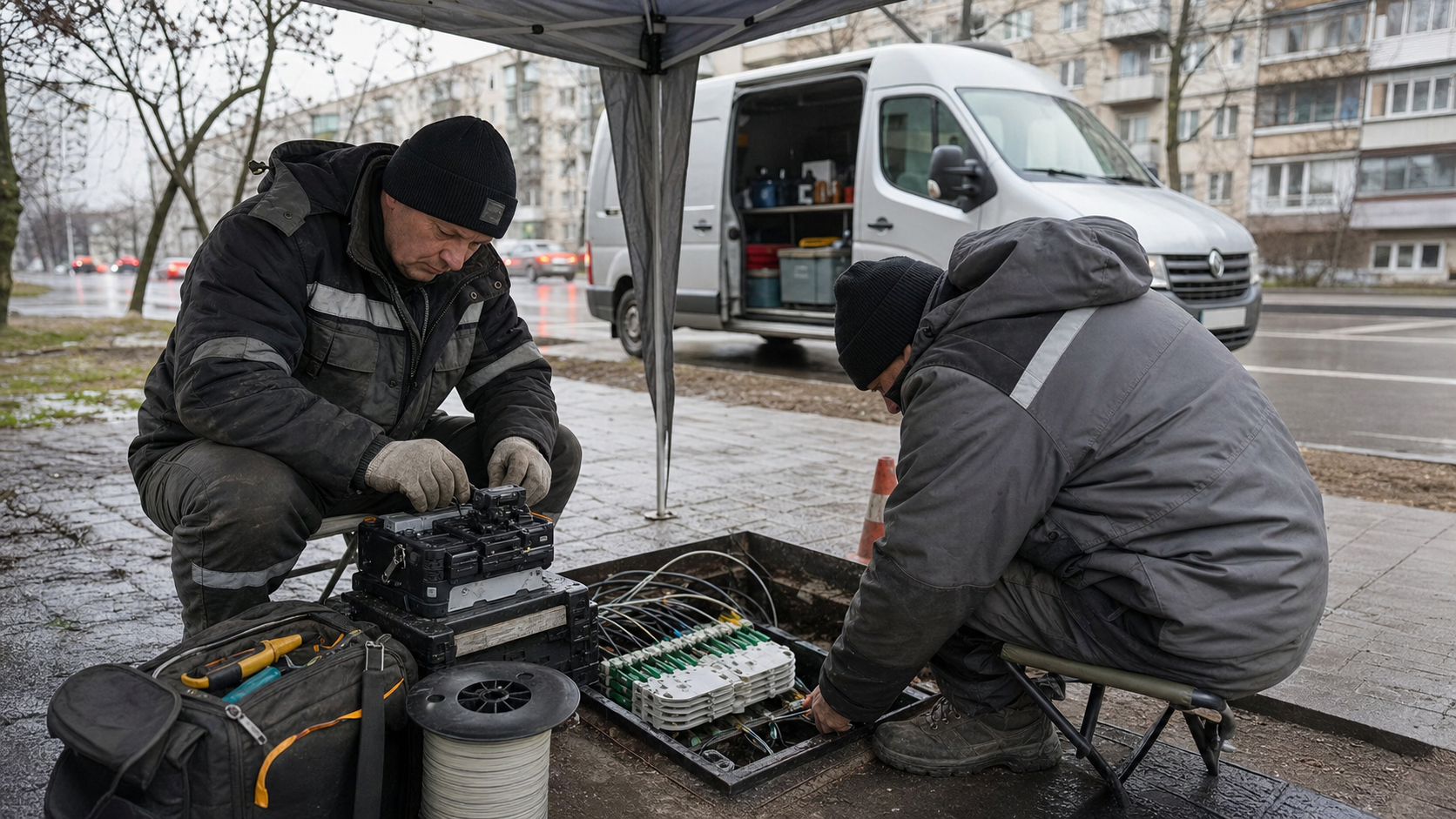
Summary
KhmelnitskInfocom LTD looks less like a pure consumer broadband reseller than like an old regional continuity platform that has had to keep reinventing its economics. The public record ties the company to EDRPOU 21336610, Heroiv Maidanu Street 40 in Khmelnytskyi, a registered limited liability company, a RIPE LIR organisation, AS8779, an InfoDom retail brand, a history of data networks for institutional users and a current retail tariff sheet that is extremely cheap by the standard of the repair burden it now carries.
The central judgment is that the company can be relevant if it prices and sells continuity, local support and provable route resilience. It is much less attractive if its economics remain framed mainly as low-cost megabits.
The evidence is useful but uneven. Routing data confirms real number resources: AS8779, five announced prefixes including three IPv4 aggregate blocks, a smaller IPv4 block and one IPv6 aggregate, plus RIPE import/export relationships and PeeringDB entries for DTEL-IX and KM-IX. Company pages advertise more than 1,200 city nodes, more than 10,000 subscribers, local technical support, GPON and Ethernet-era service layers, business tariffs and field-service fees. Ukrainian registry and data services identify the legal entity, director, registration date, activities, founder and a 2024 revenue figure.
The weakness is that none of this discloses active subscriber count, churn, power autonomy by node, repair time, route geography, capex backlog, debt, customer concentration or the share of revenue from public bodies. Those missing facts matter more than another speed-test claim.
The change-of-view facts are concrete. The upside case would improve if KhmelnitskInfocom disclosed node-level backup power, an active PON migration plan, real route-diversity maps, enterprise SLA revenue, low churn through blackout periods, and a tariff ladder that makes field labour self-funding.
The downside case would harden if the 10,000-subscriber marketing claim proves stale, if 2024 revenue cannot support the advertised footprint, if critical nodes depend on grid power without generator rotation, if public procurement revenue is fragmented and low-margin, or if national carriers and mobile backup absorb the customers most willing to pay for continuity.
The outage is the unit of analysis
Start with a single apartment, office or school link going down in Khmelnytskyi. The subscriber does not experience an autonomous system, a RIPE object or a tariff schedule. The subscriber experiences an application that will not load, a point-of-sale terminal that cannot settle, a child trying to study, a public office unable to move documents, or a small shop watching power and connectivity fail in the same morning. That is where KhmelnitskInfocom's economic question sits. Can the company charge enough for continuity and reachable support to fund route repair, backup power, upstream diversity and network renewal during disruption?
The answer is not obvious from the surface. On price, InfoDom's published retail offer is deliberately accessible. The tariff page lists a 100 Mbps residential plan at UAH 150 per month, GPON 100 at UAH 200, GPON 1000 at UAH 300, and business plans from UAH 300 for 50 Mbps to UAH 800 for 1 Gbps, subject to technical availability. Connection prices also tell a story: GPON connection and registration are listed at UAH 500 where feasible, while another residential connection category is promoted at UAH 1, with caveats for difficult work. A static IP is listed at UAH 350 per year.
A technician visit, router setup or peripheral setup can start at UAH 150.
Those numbers are not shameful. They are also not enough, on their own, to make a wartime fixed network resilient. A UAH 150 or UAH 300 monthly fee can buy a customer an internet access product. It cannot indefinitely absorb batteries, diesel, pole work, splicing, optics, routing engineering, tax, customer service, spare routers, vehicle time, exchange-port fees and the opportunity cost of keeping qualified technicians from leaving for better-paid IT or infrastructure work. The tariff sheet therefore has to be read as a floor, not as the economic thesis.
If the company is still selling mainly cheap bandwidth, it is underpricing the hard part of the business. If it is using cheap entry plans to defend density while upselling support, business continuity and local accountability, the model becomes more plausible.
The public-offer terms make that distinction sharper. Service begins after payment for the first settlement period, and the customer accepts the contract by paying, continuing to use the service or joining through the account process. The provider publishes quality information and conditions on its website. The provider can change tariff plans with notice through the site, and the service relationship depends on continued presence in the electronic-communications provider register. This is a prepaid, standard-form mass service with a local office and support layer attached. It is not, from the documents alone, a bespoke continuity contract.
The commercial question is whether KhmelnitskInfocom can persuade enough users that local continuity is worth a premium before outage economics force it to subsidise resilience from thin access fees.
Identity, control and the boundary of the business
The legal identity is unusually well anchored for a local ISP. Ukrainian company data sources identify TOV "KhmelnitskInfocom" under EDRPOU 21336610, registered in December 1997, with Heroiv Maidanu Street 40 in Khmelnytskyi as its address. Opendatabot identifies Yurii Boyarchuk as director and representative and lists the founder as the joint Ukrainian-German enterprise Infocom. YouControl also identifies the entity as registered, gives the same EDRPOU code, the same main wired-telecommunications activity and a charter-capital figure of UAH 41,855.
RIPE's organisation object for ORG-KL33-RIPE identifies KhmelnitskInfocom LTD as a Ukrainian LIR with the same registration number and address, and its aut-num object identifies AS8779, INFOCOM-KM.
That alignment matters. Many small providers are hard to separate from brands, resellers, neighbourhood network names or informal support businesses. Here the public record gives a cleaner boundary. There is the legal company. There is the InfoDom retail network and website. There is the legacy corporate-services site under the older company domain. There is a RIPE LIR organisation and an autonomous system. There is a current consumer-facing tariff and support apparatus. There is a procurement trail under the same EDRPOU code. That does not prove profitability or resilience, but it reduces basic identity risk.
The control boundary is still more complex than a one-line ownership field. The company describes itself historically as part of the Infocom structure and as a regional operator of a national multiservice data network, UkrPak. Its corporate history emphasises long ties to banks, public offices, schools and regional institutions. Its current InfoDom site presents a retail ISP and TV bundle for households and businesses. The economic entity therefore spans three layers: a local access network in Khmelnytskyi, a corporate and institutional services heritage, and a routing presence that must buy, peer or exchange traffic beyond the city.
The weakness is that the public record does not disclose internal ownership economics, debt, intercompany arrangements with Infocom, wholesale contracts, depreciation, actual node inventory, active subscriber count, or whether the "more than 1,200 nodes" claim is a maintained access footprint, a marketing-era count, or a mixture of cabinets, switches and serving locations. Control is identifiable; economic control is not fully visible. For a resilience judgment, that distinction is important.
A company can control a network in law and still be constrained by upstream terms, facility access, poles, building permissions, power supply and equipment import cycles.
What the infrastructure evidence actually proves
The strongest hard evidence is routing. AS8779 is not a decorative ASN. RIPE and RIPEstat data identify INFOCOM-KM as KhmelnitskInfocom LTD and show five announced prefixes: 46.252.208.0/20, 78.152.160.0/19, 94.230.192.0/20, 185.15.4.0/23 and 2a00:6740::/32. RIPE route objects identify those blocks as originated by AS8779. BGP.tools reports the same core set of prefixes and describes the network as a long-running BGP network with upstreams and peers.
PeeringDB lists the organisation as KhmelnitskInfocom LLC, website ic.km.ua, AS8779, AS-IC as its IRR set, Cable/DSL/ISP as network type, regional geographic scope, mostly inbound traffic, 10-20 Gbps traffic level and operational public peering at DTEL-IX and KM-IX old, each shown with 10G capacity.
The RIPE aut-num object is even more revealing because it names relationships rather than only prefixes. Its IPv4 import/export policy references AS3326, AS6939, AS28681, AS28773, AS29663, AS31210, AS49461, AS56423 and AS59613. The remarks identify communities for KM-IX, UA-IX, Datagroup, downstreams, DTEL-IX and GTU. That is evidence of a routing posture designed around more than a single commodity upstream. It is not proof that every customer route is physically diverse or that every upstream remains available in a local power event.
But it does support the conclusion that KhmelnitskInfocom has a genuine routing surface and some exchange diversity.
The company history also fits the routing evidence. The old corporate site says KhmelnitskInfocom built data-transfer services in Khmelnytskyi Oblast, supported UkrPak, worked on corporate networks and regional data links, adopted Frame Relay, MPLS, Radio Ethernet, Wi-Max, city fibre and 10-gigabit transport-core upgrades over earlier phases. The current InfoDom site says the network has more than 1,200 nodes across the city, more than 10,000 subscribers, 100 Mbps and 1 Gbps high-speed internet, and local technical support. The consumer internet page repeats the 1,200-node message and lists the current service plans.
There are two cautions. First, a routing table is not a field-service map. It proves a public internet control plane, not backup batteries in stairwells, power autonomy at aggregation nodes or spare cable on hand after a strike or storm. Second, legacy claims age. A company can have been a pioneer in X.25, Frame Relay, MPLS or Wi-Max and still face a present-day replacement cycle. The relevant question is not whether KhmelnitskInfocom once built sophisticated networks. It is whether the cash flow from today's customers supports the modern version of that network under Ukraine's power and security conditions.
Pricing says the company is defending density
The tariff sheet reads like a density strategy. Residential access is priced low enough to discourage switching on price alone. GPON tiers are simple: 100 Mbps for UAH 200 and 1 Gbps for UAH 300. A non-GPON residential category lists 100 Mbps for UAH 150. Business plans are also inexpensive: UAH 300 for Office Economy at 50 Mbps, UAH 400 for Office Profi at 100 Mbps, UAH 500 for Office 500 and UAH 800 for Office 1000 where technically available. Television is outsourced or partnered through Trinity packages listed at UAH 109 and UAH 159 per month.
The homepage advertises promotional balance credits and notes that some office package prices change from 1 January 2026.
The first implication is that churn defence matters. If a household can pay UAH 150-300 per month, the provider is not extracting monopoly rents. It is trying to keep neighbourhood density, spread fixed costs over many drops and maintain enough traffic scale to justify upstream and exchange participation. Density is a real asset for a local operator. Every additional customer on an already-built street can help absorb node, fibre and support costs. Every lost building weakens the economics of sending technicians, holding spares and maintaining local cabinets.
The second implication is that the company's economics are sensitive to free work. A single truck roll can consume the gross monthly revenue from a cheap plan. If a technician spends an hour travelling, diagnosing a customer-side cable problem and reterminating a connector, a UAH 150 starting fee may cover only a fraction of the fully loaded cost. If the visit is absorbed for goodwill during a local outage, the cost shifts into the access margin. That is sometimes the right customer-retention decision, but it cannot become the default funding model for resilience.
The third implication is that business users are under-monetised if they are buying only speed. A small office that needs payment terminals, cloud accounting, video calls, procurement portals or public-service access is buying continuity. A 50 Mbps or 100 Mbps line may be technically enough; the valuable thing is reachable support, predictable restoration and a backup option. KhmelnitskInfocom's current business tariff ladder prices higher than residential, but the public page does not show SLA tiers, backup-power options, dual-path access, priority repair or managed router packages. Those may exist privately.
If they do not, the company is leaving the only durable premium on the table.
The revenue arithmetic is both encouraging and uncomfortable
Opendatabot reports that KhmelnitskInfocom received UAH 13.9415 million of revenue in 2024. The InfoDom site advertises more than 10,000 city subscribers. Put those figures next to the published tariff sheet and the arithmetic becomes useful, not because it produces a precise valuation, but because it exposes the stress points.
If 10,000 active subscribers each paid only the UAH 150 residential plan every month, annual gross billings would be UAH 18 million before considering VAT treatment, promotional credits, inactive accounts, bad debt, bundled services, business tariffs and other revenue. If the average were UAH 200, the simple annual number would be UAH 24 million. If the active base were smaller, if the subscriber count includes historical, suspended or low-usage accounts, if many customers receive promotions, or if reported revenue is net of VAT and other accounting effects, the gap narrows. The public data does not allow a clean reconciliation.
The uncomfortable reading is that the advertised subscriber count may not represent current full-paying monthly lines. The more generous reading is that the 2024 revenue figure is still plausible after VAT, promotions, account mix and partial-year use, and that KhmelnitskInfocom is running a lean local network rather than an overbuilt luxury platform. Both readings can be true in part. The point is that the margin for resilience is not obvious.
A company of this size cannot casually absorb a large backup-power programme, major fibre rebuild, duplicated route path and enterprise-grade support operation without either raising ARPU, charging for higher-assurance products, securing institutional contracts, or getting some form of subsidy or procurement-backed continuity revenue.
The procurement data helps, but only cautiously. Clarity Project identifies the company as a participant in hundreds of public procurements, with many wins and signed contracts. That suggests local public-sector relevance and a long tail of institutional demand. But the reported aggregate value is not so large that it transforms the business into a high-margin government contractor. It also does not prove current concentration, contract renewal quality, gross margin, collection speed or service obligations.
Public contracts can stabilise a provider if they pay for continuity; they can drain a provider if they impose low prices, slow payment and high service expectations.
Backup power is the hidden tariff
Ukraine's telecom market is now also an energy-resilience market. World Bank, UN, industry and policy sources all describe a country where energy infrastructure damage, rolling outages and emergency connectivity needs have become part of normal planning. Ukrainian connectivity has proved remarkably adaptive, but adaptation is not free. Batteries degrade. Generators need fuel and maintenance. Network sites need safe installation, ventilation and theft protection. Technicians spend time on power systems rather than only on fibre and IP.
A local access network with many active nodes can become an energy logistics business during blackout periods.
That is why the technology mix matters. GPON is not just a speed upgrade; it can reduce the number of powered field electronics compared with older active Ethernet designs. Fewer powered intermediate nodes can mean fewer batteries, fewer generator stops and fewer failure points. But GPON still requires power at the optical line terminal and at the customer premises. Business continuity still needs routers, ONUs and local Wi-Fi backed up on the user side. For a household, a passive last mile can fail economically if the customer has no battery for the router.
For an office, the difference between "the ISP is up" and "the business is connected" may require a managed power and router package, not just a fibre drop.
KhmelnitskInfocom's public pages show some of the ingredients: GPON tariffs, a local office, technical support numbers, network settings guides, PPPoE setup guidance, router configuration materials and technician-service fees. They do not disclose backup-power depth. They do not say which nodes can run four hours, eight hours or longer; how many generators are available; whether enterprise aggregation points have redundant power; whether field teams can refuel during curfew or attack alerts; or whether priority institutions have protected routes. This is the single largest unknown in the economic case.
The company should want that unknown to become a sellable product. "We have cheap gigabit" is vulnerable to every national brand and every temporary mobile workaround. "We can keep this street, clinic, school office or payment point connected for a documented period under outage conditions, and we can show the restoration protocol" is more defensible. The customer is not paying for watts; the customer is paying to avoid operational stoppage. The provider is not charging a resilience premium because it is greedy.
It is charging because the alternative is to make all customers silently depend on an unfunded backup-power promise.
Route diversity is necessary but not sufficient
The route record gives KhmelnitskInfocom more credibility than a small provider with one hidden upstream. AS8779 has its own prefixes, a visible RIPE organisation, an AS-SET, exchange presence and multiple named routing relationships. PeeringDB's DTEL-IX and KM-IX entries, plus the RIPE aut-num references to UA-IX, Datagroup and other networks, support a picture of regional routing competence. This matters because a local ISP without routing competence becomes a reseller of someone else's resilience. KhmelnitskInfocom appears to have more agency than that.
Still, routing diversity has layers. A BGP policy can reference multiple networks while the physical routes share ducts, buildings, power supply, metro handoff points or long-haul corridors. A 10G exchange port does not prove enough upstream capacity during a failure if traffic shifts suddenly. An import from a network does not prove that the commercial relationship is active at the desired capacity. A route object does not show the cost of transit or the time required to restore a damaged handoff.
The article's judgment therefore gives credit for public routing maturity, but not for physical resilience that the public record does not show.
The most valuable disclosure would be a non-sensitive resilience map: number of independent upstream paths, not exact cable routes; exchange participation and capacity bands; which critical aggregation points have backup power; whether the company can reroute around one upstream loss; and what service classes get priority restoration. Such a disclosure would make it easier to sell business-continuity packages and to win public-sector trust. It would also force management to confront the cost of promises. If the backup route is real, charge for it. If it is not real, do not imply that cheap access includes it.
The competitive alternative is not only another fibre ISP. It is a portfolio: a national carrier line, a mobile router on a different network, Starlink for critical offices, and a local provider retained as the line that actually gets a human technician on site. KhmelnitskInfocom's advantage cannot be that it is the biggest network in Ukraine. It has to be that it knows Khmelnytskyi, controls enough local infrastructure to act quickly, and has enough upstream diversity to make local repair worth doing.
Labour, spares and collections decide the margin
The economics of local support are harsh because the customer sees the event only at the moment of failure. Before the failure, support looks like overhead. After the failure, support is the product. KhmelnitskInfocom's public pages give many phone numbers: technical support, commercial department, accounting, duty personnel and mobile contacts. The settings pages provide router and operating-system instructions. The offer and connection pages direct customers to the office, phone consultations and online payment channels. This is an operator built around reachable local administration, not only an anonymous checkout flow.
That support layer can become a premium if it is measured and priced. If a customer can pay for priority restoration, managed router setup, a backed-up ONU/router kit, static IP, monitored business access or documented response time, field labour becomes a revenue line. If support remains bundled into a cheap undifferentiated tariff, the best customers get subsidised by the quiet ones and the provider has no clean way to fund standby staff or spares.
Spares are especially important in Ukraine. A provider serving thousands of premises needs optical modules, fibre, splitters, routers, batteries, connectors, poles or building hardware, tools and vehicles. Import delay, currency pressure and sudden damage can turn a cheap part into a service bottleneck. None of the public documents disclose inventory policy. That is normal for a private company, but it leaves a real uncertainty. A provider can have good engineers and still lose customers if it waits too long for replacement hardware.
Collections are the other hidden part of resilience. InfoDom offers many payment methods: online systems, banks, terminals, electronic systems, bank cards and named payment platforms such as iPay and EasyPay. Online payment pages for KhmelnitskInfocom confirm that third-party payment rails exist. That reduces collection friction and can restore blocked access quickly after payment. It also reinforces the prepaid model. In a disruption economy, prepaid collection protects cash flow but can irritate customers if service is unstable.
The company has to make the bargain explicit: reliable restoration costs money; timely payment keeps technicians and backup systems funded.
Public-sector continuity is the natural premium, but it must be current
KhmelnitskInfocom's history is full of public and quasi-public uses: early regional data networks, banks, employment services, tax administration, Ukrposhta, justice bodies, pension and emergency institutions, schools and regional offices. Those historical references should not be read as current contracts. They should be read as evidence of a capability pattern: the company has long understood that connectivity in Khmelnytskyi is not only entertainment or household broadband. It is administrative capacity.
The current public procurement trail supports that pattern in a more recent way. Clarity Project's tenderer page shows many procurement participations and wins under the company's EDRPOU code. That is a sign of local institutional visibility. But the average contract value implied by the aggregate figures appears modest. Public-sector continuity is valuable only if it is not reduced to a lowest-price access line. A school, local office, utility, medical site or administrative unit may need backup connectivity more than raw speed.
If the procurement specification rewards only low monthly price, it starves the very local repair capacity the public sector will need during outages.
This is where management judgment matters. KhmelnitskInfocom should separate three offers. The first is commodity household access, priced for density. The second is small-business access with managed hardware, static addressing, support and reasonable restoration expectations. The third is continuity service for institutions: documented backup power, dual-path or failover design where feasible, escalation contacts, planned maintenance notices and post-incident reporting. The third should not be sold at household prices. It is not the same product.
The risk is political and commercial. In a stressed economy, local public buyers may not want to pay more for resilience until after a failure. Larger carriers may bundle national coverage and brand trust. Satellite backup may look simpler for critical sites. KhmelnitskInfocom's answer has to be local evidence: restoration logs, support reachability, known street-level plant, route visibility and a price that is high enough to keep the promise.
Competition is broader than broadband
The obvious substitutes are national fixed providers and other local ISPs. The less obvious substitutes are mobile data, workplace Wi-Fi, satellite terminals, shared building networks and customer self-insurance. During ordinary times, a household compares speed and price. During outages, the customer compares failure modes. A fibre ISP that fails with the grid is not meaningfully different from a mobile hotspot that also fails with the grid. A local ISP that can stay up while mobile cells congest has a premium. A satellite terminal that bypasses local fibre has a premium, but it needs power, hardware and clear sky. No substitute is perfect.
That is why a local provider's best defence is not to pretend substitutes do not exist. It is to position itself as part of the resilience stack. A business may keep mobile backup and still prefer a local fibre provider for primary service. A public office may use Starlink for emergency backup and still need fixed connectivity for daily work, internal systems and predictable latency. A household may tolerate a mobile fallback for one night but not for remote work every week. KhmelnitskInfocom can win if it makes its local restoration capacity visible and economically funded.
On pure bandwidth, the company has little structural pricing power. A UAH 300 gigabit plan trains the market to see gigabit as cheap. National brands can market larger footprints. Mobile operators can bundle devices and data. The company's distinctive asset is not "fast"; it is "nearby and accountable." The public pages show exactly that language through local office details, support numbers and setup help. But accountability becomes a cost unless customers pay for it. The company must stop treating field support as a footnote and make it a product tier.
The 2026 office-plan price-change notice is therefore more important than it looks. It shows management is willing to adjust business pricing. The question is whether those increases are merely inflation catch-up or a deliberate move toward continuity pricing. Inflation catch-up preserves survival. Continuity pricing funds a better network.
Regulatory risk is real, but the bigger risk is underinvestment
Ukraine's electronic-communications framework matters for KhmelnitskInfocom because the public offer itself ties service to the provider register and to the updated rules for electronic communications and consumer protection. NCEC's registry dataset describes a formal provider register with service types, territory, activity dates and status. The Law on Electronic Communications and newer rules are part of the operating context. NCEC's 2025 reporting describes a sector that has grown and adapted under wartime pressures while moving through European-alignment steps.
For a company like KhmelnitskInfocom, regulation is mostly a discipline and a disclosure burden, not the main threat. The main threat is that rules and customer expectations rise faster than the tariff base. Consumer rules require clearer terms. Quality expectations require measurement. Public buyers may demand more assurance. Wartime conditions require backup power and faster restoration. Equipment costs, wages and energy costs do not wait for local ARPU to rise.
There is also geopolitical risk. Khmelnytskyi is not the front line in the same way as occupied or heavily contested areas, but Ukraine's energy and civil infrastructure have been targeted nationally. The city can be affected by power shortages, air alerts, logistics disruption and national economic stress. A local ISP may avoid direct physical destruction and still suffer from customer hardship, supply constraints and power instability. Resilience is not a switch the company can turn on after the fact. It has to be financed in advance.
The regulatory upside is that policy increasingly recognises connectivity as essential infrastructure. That can help if procurement specifications, local government planning and national resilience programmes pay for real continuity rather than demanding cheap service. It can hurt if obligations become unfunded mandates. KhmelnitskInfocom should therefore argue for a clear economic truth: local networks cannot be both ultra-cheap and deeply resilient unless someone else funds the difference.
Unofficial signals are useful only as signals
Unofficial market signals around InfoDom are consistent with a local, known provider rather than a shell. Payment platforms list KhmelnitskInfocom as a biller. Local directory pages describe internet, IPTV, data transfer, corporate networks, Wi-Fi and WiMAX services. Company pages link to Facebook and Instagram. Router setup guides and payment instructions imply day-to-day consumer operations. None of these signals should be confused with audited performance. They do not prove customer satisfaction, uptime or financial health.
The correct use of these signals is narrower. They show discoverability, retail presence and service routines. They also show that KhmelnitskInfocom is exposed to reputational churn. A local ISP's brand is made in apartment chats, office referrals, procurement conversations and payment habits. If support is responsive, that local gossip becomes a moat. If outages are handled badly, the same gossip accelerates switching. Public-facing payment convenience and support instructions reduce friction, but they do not rescue weak restoration.
The older company site is another unofficial-seeming but valuable signal. It is not modern marketing. It preserves a history of technical milestones, old service types and institutional networks. That record supports the idea that KhmelnitskInfocom has engineering depth. It also warns that the business carries legacy layers. Legacy can mean trusted relationships; it can also mean older plant, old operating practices and a need for renewal. The economic question is whether the company has turned its history into a current premium product.
Judgment
KhmelnitskInfocom's investable or strategic value is not in being a cheap local ISP. Cheap local ISP economics are fragile: low ARPU, high support intensity, rising power costs, equipment replacement, national-brand competition and customer impatience. Its value is in being a local continuity operator with real network resources, public-sector familiarity and an accountable support footprint in Khmelnytskyi. The evidence supports that possibility. It does not yet prove that the business is charging enough to sustain it.
My base judgment is cautiously constructive on operational relevance and cautious on economics. The company has the right raw materials: legal continuity, AS8779, RIPE LIR status, visible prefixes, exchange presence, local tariffs, support channels, a GPON offer, historical institutional capability and payment rails. It also has the classic regional-ISP trap: the product the market sees is cheap bandwidth, while the product the region needs is resilient service. Unless the second product is separately priced, the first product will consume the margin needed to fund it.
What would change that view upward is evidence that KhmelnitskInfocom already has a serious continuity tier: documented node backup power, active PON migration by neighbourhood, real upstream physical diversity, paid business SLA contracts, public-sector continuity awards, low outage churn and 2025-2026 revenue that shows ARPU rising without subscriber collapse.
What would change it downward is a reconciliation failure between subscriber claims and revenue, evidence of stale node counts, heavy dependence on one physical route, generator gaps at key aggregation points, unprofitable procurement wins, or customer migration to national and satellite alternatives after repeated outages.
The practical recommendation is blunt. Do not sell resilience as a moral obligation hidden inside a UAH 150 plan. Sell it as a service. Keep a cheap household tier for density. Build a transparent business tier for support and managed hardware. Build a continuity tier for institutions and critical small businesses. Publish enough non-sensitive reliability evidence to justify the premium. If KhmelnitskInfocom can make local repair capacity worth more than cheap bandwidth, it remains economically relevant. If it cannot, the network may still work, but the most valuable customers will increasingly buy their continuity elsewhere.
Sources
- https://infodom.km.ua/
- https://infodom.km.ua/info_internet/
- https://id.km.ua/info_rate/
- https://infodom.km.ua/info_connect/
- https://infodom.km.ua/info_tv/
- https://infodom.km.ua/wp-content/uploads/OFERTA_infodom_for_site_v5_01102025.pdf
- https://ic.km.ua/index_km.html
- https://ic.km.ua/about_index.html
- https://ic.km.ua/about_contact.html
- https://ic.km.ua/about_rekv.html
- https://ic.km.ua/services_index.html
- https://ic.km.ua/data_transfer_index.html
- https://ic.km.ua/infodom_index.html
- https://ic.km.ua/corporation_index.html
- https://ic.km.ua/radiolink_price.html
- https://ic.km.ua/service_index.html
- https://ic.km.ua/service_account_status.html
- https://infodom.km.ua/settings_network/
- https://infodom.km.ua/settings_internet/
- https://infodom.km.ua/settings_wifi/
- https://www.ipay.ua/ua/bills/oplata-hmel-nickinfokom-online
- https://easypay.ua/ua/catalog/internet/khmelnitskinfocom
- https://opendatabot.ua/c/21336610
- https://youcontrol.com.ua/catalog/company_details/21336610/
- https://clarity-project.info/tenderer/21336610
- https://prozorro.gov.ua/en/about
- https://nkek.gov.ua/spozhyvacham-posluh/reiestry-postachalnykiv
- https://nkek.gov.ua/hromadskosti/publichna-informatsiia/nabory-danykh-nkek-shcho-pidliahaiut-opryliudnenniu-u-formi-vidkrytykh-danykh/reiestr-postachalnykiv-elektronnykh-komunikatsiinykh-merezh-ta-posluh
- https://data.gov.ua/en/dataset/ad65395c-55c6-4ff6-abfa-14709b66d9ae
- https://zakon.rada.gov.ua/laws/show/1089-20
- https://zakon.rada.gov.ua/go/z0502-22
- https://zakon.rada.gov.ua/laws/show/761-2025-%D0%BF
- https://nkek.gov.ua/pro-nkek/zvity-nkek/rz2025
- https://en.interfax.com.ua/news/telecom/1156657.html
- https://rest.db.ripe.net/ripe/aut-num/AS8779.json
- https://rest.db.ripe.net/ripe/organisation/ORG-KL33-RIPE.json
- https://stat.ripe.net/data/as-overview/data.json?resource=AS8779
- https://stat.ripe.net/data/announced-prefixes/data.json?resource=AS8779
- https://stat.ripe.net/data/routing-status/data.json?resource=AS8779
- https://stat.ripe.net/data/visibility/data.json?resource=AS8779
- https://bgp.tools/as/8779
- https://www.peeringdb.com/asn/8779
- https://bgp.he.net/exchange/KM-IX
- https://bgp.he.net/irr/as-set/AS-IC
- https://ipinfo.io/AS8779
- https://ipinfo.io/AS28681
- https://www.worldbank.org/en/news/press-release/2026/02/23/updated-ukraine-recovery-and-reconstruction-needs-assessment-released
- https://openknowledge.worldbank.org/entities/publication/c52d910e-e4f9-4bcd-9257-6867bdd89dd4
- https://ukraine.un.org/en/310512-world-bank-united-nations-and-european-union-issues-rapid-damage-and-needs-assessment
- https://www.itu.int/en/ITU-D/Regional-Presence/Europe/Documents/Publications/2025/Final_Ukraine%20Digital%20Development%20Country%20Profile%20version%203.0.pdf
- https://ficom.fi/news/ukraines-digital-resilience/
- https://www.point-topic.com/post/broadband-in-ukraine-surviving-war
- https://ces.org.ua/en/connectivity-during-blackouts-liliia-malion/
- https://freedomhouse.org/country/ukraine/freedom-net/2024
- https://www.berec.europa.eu/en/news/latest-news/berec-signs-revised-working-arrangements-with-ukrainian-national-regulatory-authority
- https://humanitarianaction.info/plan/1271/document/ukraine-humanitarian-needs-and-response-plan-2025/article/33-emergency-telecommunications
Member Briefing
Deeper Profile Context
Sign in with the right membership level to unlock the full briefing and source notes.
Only for Strategic Circle
Strategic Circle
Open to all readers. Unlock profile briefings after joining and signing in.
Join Strategic CircleOnly for Leadership Alliance
Leadership Alliance
For qualified IP-asset owners and management; sign in to unlock alliance briefings.
Join Leadership Alliance